
SEOUL · BONGEUNSA
Bongeunsa: What the Shot of a Temple Roof Against Glass Towers Leaves Out
Elena Walks Up from Exit 1 of Bongeunsa Station, Through the Jinyeomun Gate and the Temple Grounds, to the One Hall That Survived the Fire of 1939
The first part of “Gangnam & Songpa.” A tiled temple roof with glass towers rising behind it is a frame Elena knows well. Elena, who reads scenes, walks up from Exit 1 of Bongeunsa Station to find out whether that smooth shot survives on the street — and what it quietly folds away.
How to get there
Calculated with a map app’s walking route (TMAP), to the map’s representative point for Bongeunsa. The temple’s website says the entrance is about 100 m up from Exit 1.
This is the first of four parts of “Gangnam & Songpa.” The issue starts at Bongeunsa and goes on to the Starfield Library across the road, an observation deck in Jamsil, and Olympic Park with Mongchontoseong, the old earthen fortress.
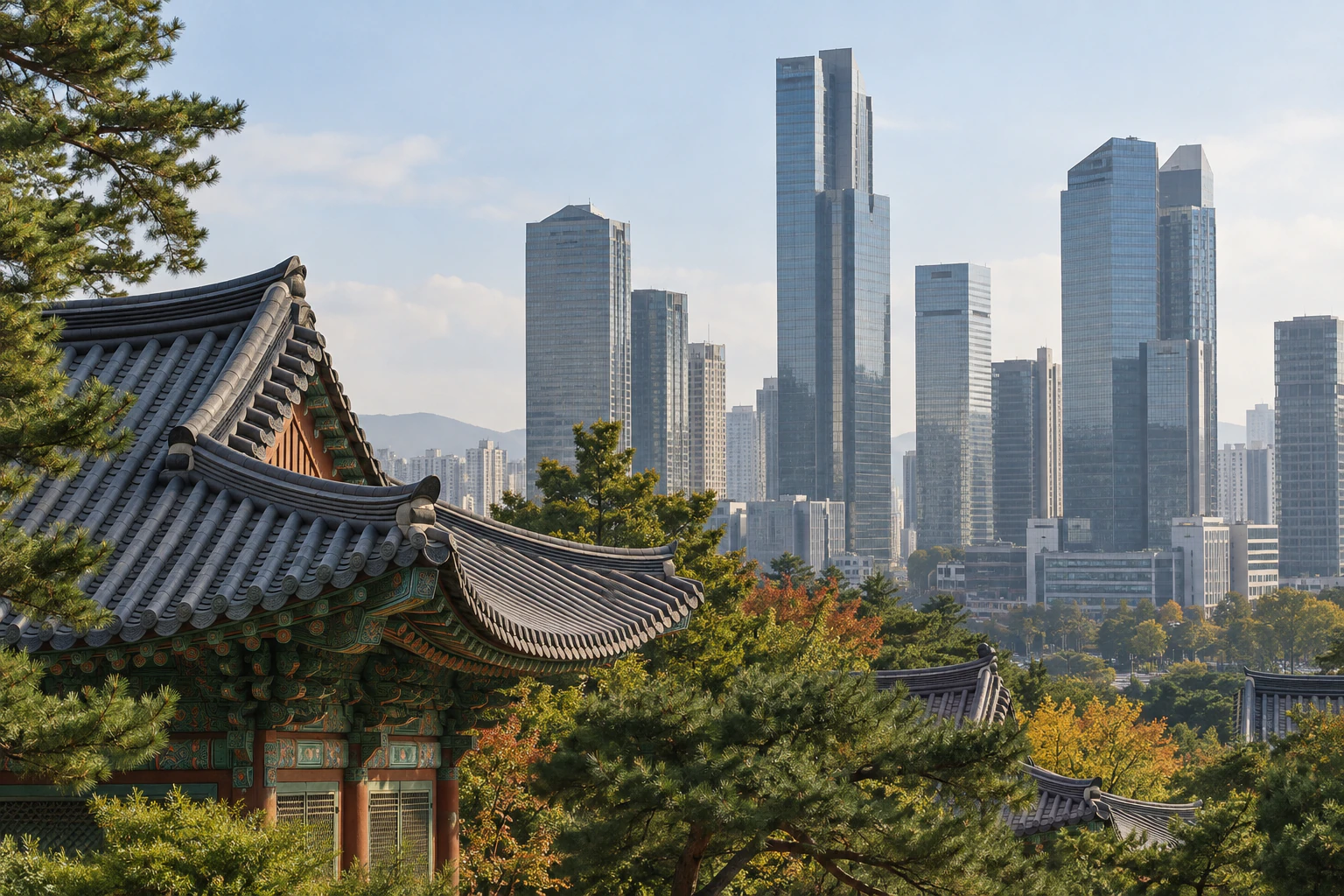
Elena reads scenes. She writes down first why a scene on screen feels seamless, then asks whether that seamlessness belongs to the screen or would survive on a real street. Bongeunsa suits the question well: the tiled roof in front, the glass towers behind, old and new in a single frame.
A weekday, two in the afternoon. On the first line of her notebook Elena writes: “What was between the roof and the towers?”
325 metres from Bongeunsa Exit 1
From Exit 1 of Bongeunsa Station (Line 9) to Bongeunsa, the map route is 325 m, about 4 minutes (TMAP pedestrian route calculation, to the temple’s representative point).
From Exit 1 of Bongeunsa Station on Line 9, a map app’s walking route puts the temple 325 metres and four minutes away — measured to the single point the map uses to represent Bongeunsa. The temple’s own website says that if you “come up about 100 m” from the same exit, you reach the entrance. The two figures simply measure to different places. The website also gives about 600 m from Exit 6 of Samseong Station (Line 2) and about 800 m from Exit 2 of Cheongdam Station (Line 7). Find on a map
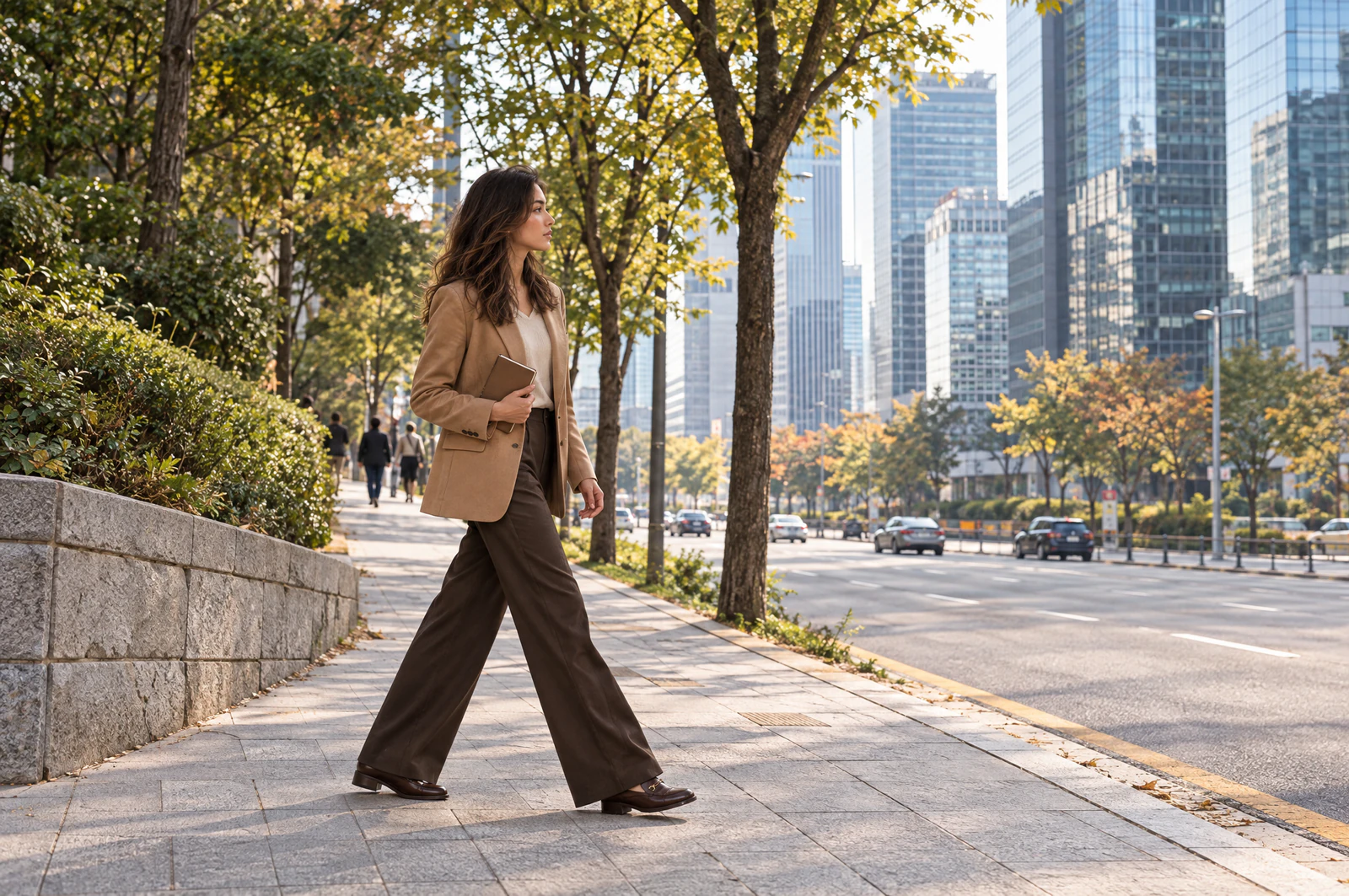
What Elena copies into her notebook first isn’t the distance but the verb: come up. The Bongeunsa she remembers from screens is usually a flat picture, roof and towers side by side at the same height. The directions, though, say you have to climb to get here. Perhaps the first thing the shot folds away, she writes, is this slope.
The address on the website is 531 Bongeunsa-ro, Gangnam-gu. The station is named after the temple, and so is the road that runs past its gate. In that single frame the temple is a small roof in front of the towers. On the map, the station and the street borrow its name. Elena notes the difference in small letters in the margin.
Not an Iljumun but the Jinyeomun
Bongeunsa website: the first gate of a temple is usually called the Iljumun, but Bongeunsa calls it the Jinyeomun.
The temple’s website introduces its first gate like this: the first gate you pass through at a Korean temple is usually called the Iljumun, but Bongeunsa calls it the Jinyeomun. Elena writes the name on the second line of her notebook. It’s a gate she has never once heard named on screen. Find on a map

At the gate she lists what the shot needs. For a tiled roof and glass towers to overlap in one frame, the distance between them has to be folded up: a long lens that pulls far things close, the wide road and its traffic pushed out of the frame, and the few minutes when the light is best. All three are conditions of the screen. On the street, you have to walk the distance the lens folded away, and the traffic that was outside the frame is right there beside you.
On a map, Bongeunsa faces a cluster of tall buildings across Bongeunsa-ro. Rather than hunt for the same framing, Elena decides to start counting what that shot leaves out.

794, 1498 — and 1562
Bongeunsa website chronology: in 1498 Queen Jeonghyeon rebuilt Gyeonseongsa as the memorial temple for the royal tomb of Seolleung and renamed it Bongeunsa.
A photograph doesn’t tell you how old a temple is. The chronology on the website breaks that age into several lines. It gives 794 as the year the monk Yeonhoe founded the temple, citing the Samguk yusa, then says there are no reliable historical records after that, and that until the early Joseon period the temple was known as Gyeonseongsa. Find on a map
In 1498, Queen Jeonghyeon rebuilt Gyeonseongsa as the memorial temple for the royal tomb of Seolleung and renamed it Bongeunsa. In 1562, when the tomb of Jeongneung was moved to the eastern slope beside Seolleung, the chronology says Bongeunsa was rebuilt on Sudosan hill. Its halls and living quarters became far larger than before, and, the entry adds, it became first among the temples of Gyeongsan (京山).
The website’s account of the Joseon period traces Bongeunsa’s rise to the head of the country’s temples to Queen Munjeong and the monk Bou in the reign of King Myeongjong. Bongeunsa became the head temple of the Seon (Zen) school, leading Korean Buddhism alongside Bongseonsa, head temple of the doctrinal school, and the Seon monastic examinations led by Bou were held here — so the fields in front of the temple came to be called Seunggwapyeong, the examination plain.
Elena writes: “This spot — from 1562.” The roof on screen is a single picture, but the ground it stands on has the date it was moved here. That two royal tombs, Seolleung and Jeongneung, are written into the temple’s chronology is something else the shot doesn’t show.
The fire of 1939, the roofs of 1941
Bongeunsa website (modern history): a fire in 1939 destroyed every building except the Panjeon, and the halls standing today were rebuilt in 1941 by Taeuk.
The website’s modern history adds one more line. In 1939 a fire burned down every building except the Panjeon, and the halls standing today were rebuilt in 1941 by Taeuk. Find on a map
Elena stops at that sentence for a long time. In the shot, the tiled roof in front of the towers plays the part of “the old”: glass is new, tile is old. But the website says the halls standing today, apart from the Panjeon, were rebuilt by Taeuk in 1941. Which hall a given roof on screen belongs to, and when that roof went up, is something this one sentence can’t settle. So Elena doesn’t pin a year on each roof. She only notes that behind the word “old” sit the fire of 1939 and the rebuilding of 1941.
The website lists the halls that make up the grounds today — the main Daeungjeon, Seonbuldang, Myeongbujeon, Yeongsanjeon, Bukgeukbojeon, the Panjeon, Chungnyeonggak, Unhadang, the Seon hall, Simgeomdang, Beobwangnu, Boudang and the Jinyeomun among them — together with a great Maitreya Buddha statue. Elena doesn’t try to memorise them all. She circles just one: the only building the fire spared, the Panjeon.

The hall the fire spared, and two characters
National Heritage Service: the Panjeon of Bongeunsa is a single-storey timber building with a gabled roof, built in 1856 and repaired in 1878 — the oldest building in the temple grounds. It is both a repository for scripture woodblocks and a hall for worship. The board under the central front eaves bears the two characters Panjeon (板殿) in relief, in the hand of Chusa Kim Jeong-hui (1786–1856). Category: city/provincial tangible heritage.
The National Heritage Service describes the Panjeon of Bongeunsa as a single-storey timber building with a gabled roof, first built in 1856 and repaired in 1878. It is the oldest building in the temple grounds, both a repository for woodblocks of the scriptures and a hall for worship. The temple’s chronology says that in the same year, 1856, woodblocks for the 81 volumes of the Avatamsaka (Hwaeom) Sutra and other texts were completed, and a new hall was built to keep them. Find on a map

In the photograph published by the National Heritage Service, the Panjeon sits on a stone platform, with red board walls on its side and green latticed doors across its front. It is a much quieter building than the glossy shot with the towers.
The board hung under the eaves at the centre of the front bears two carved characters: Panjeon (板殿). The National Heritage Service describes the calligraphy as a late work by Chusa Kim Jeong-hui (1786–1856) and says the board is inscribed “71 gwa byeongjung jak”. It adds that he is said to have died three days after writing it. The temple’s website says he wrote it a month before he died. The two accounts differ, and the National Heritage Service also notes that there are several theories about the year of his death. Elena doesn’t choose between them. She writes both lines side by side.
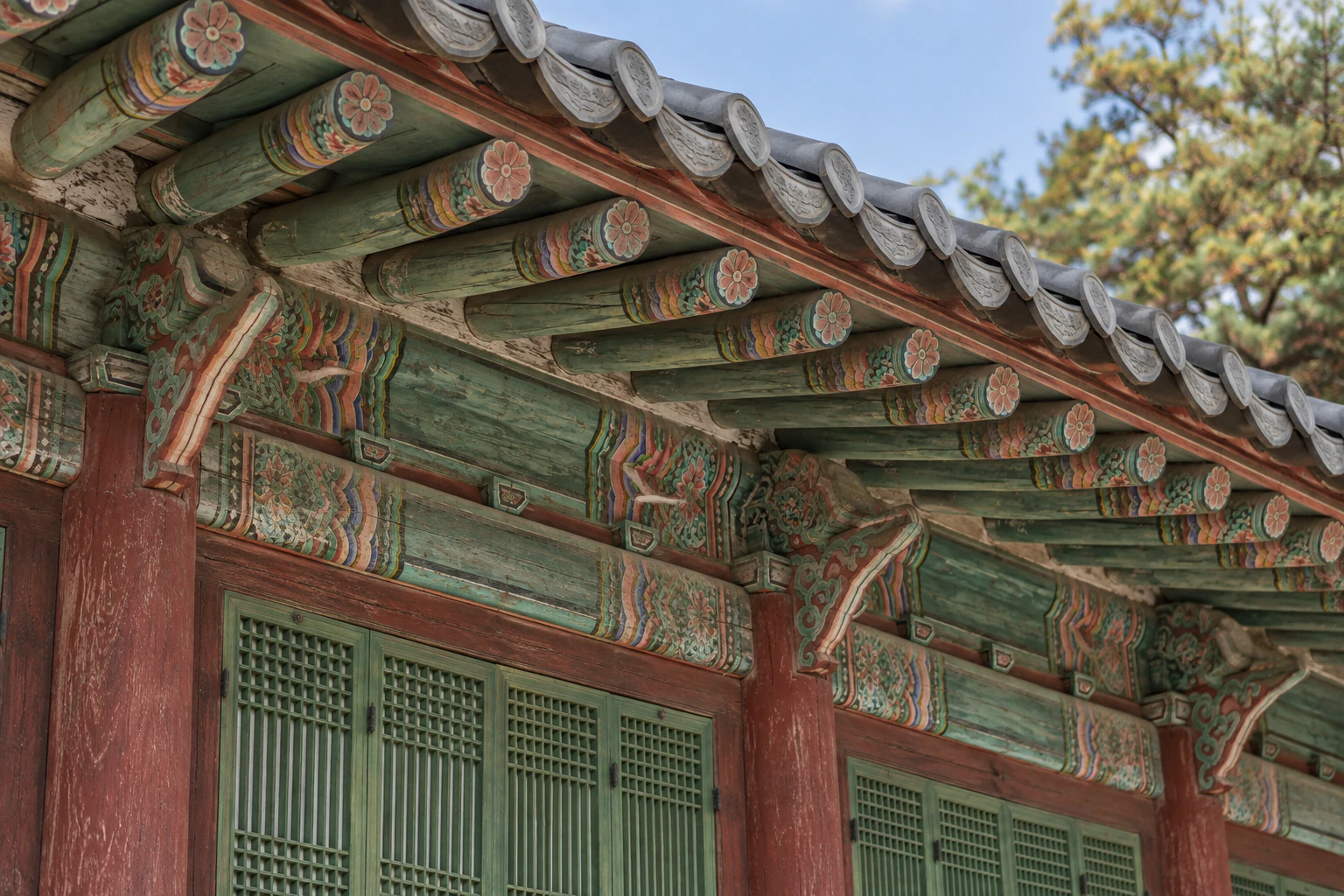
The website says Chusa turned to Buddhism in his last years and spent them here at Bongeunsa. In front of the Panjeon, Elena returns to the question she came with. The shot felt seamless because it stacked two eras in one frame. On the street, that stacking only half survives. What survives instead is something the shot never had room for: a timber building from 1856 and the two characters under its eaves.
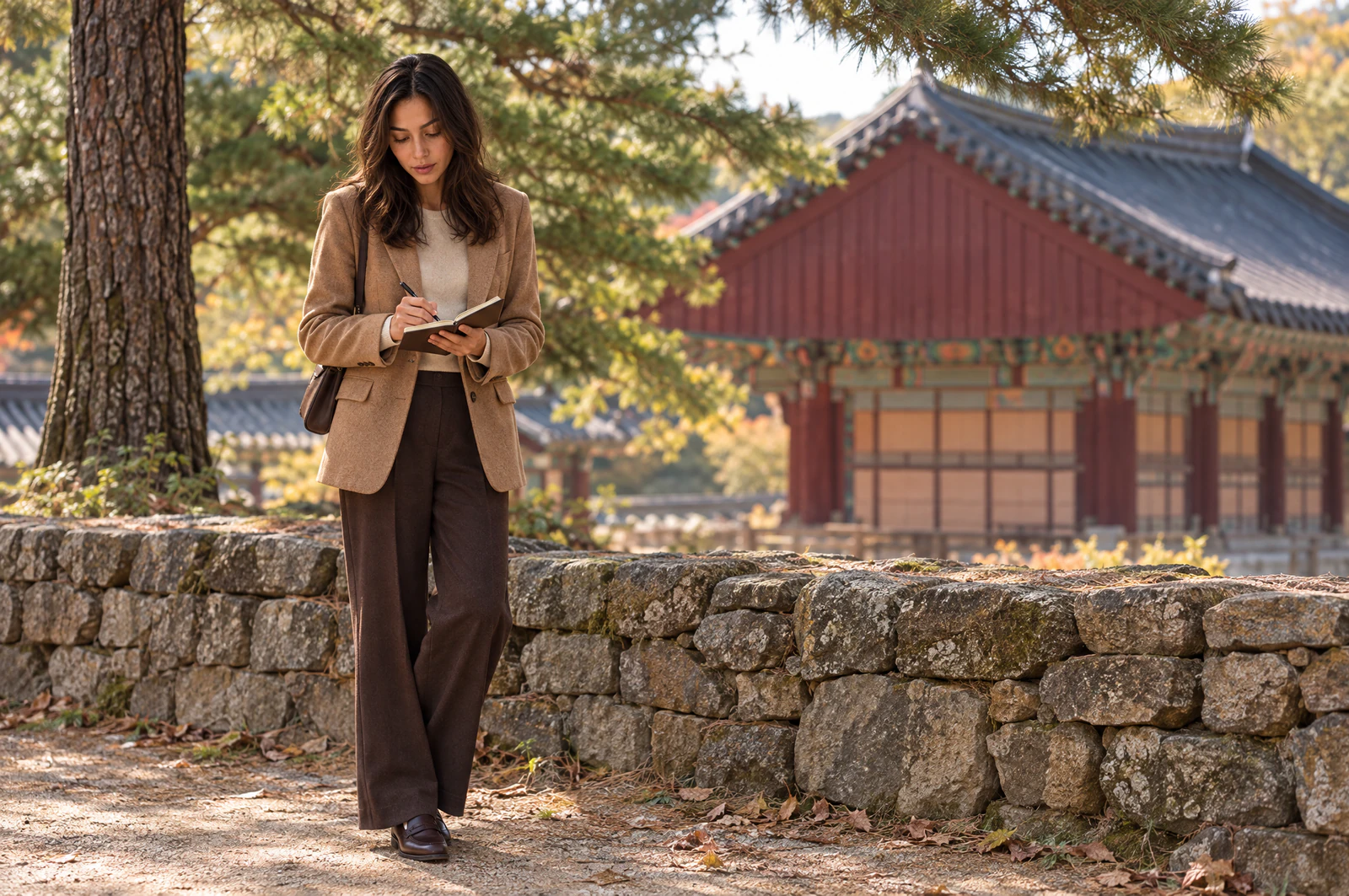
Elena heads back out towards the Jinyeomun. Three lines are left in her notebook: a temple you have to climb to, a site moved here in 1562, and a single building that escaped the fire of 1939. None of the three fits into the shot of tiled roof and glass towers.
That doesn’t make the shot wrong. The temple and the towers really are close, with one wide road between them. The screen has simply folded away the slope, the road and the history behind the roofs. In part two of “Gangnam & Songpa,” Maya crosses the road to the Starfield Library, beneath the buildings opposite.

(※ This article includes staged images created with AI.)
Try it on your own afternoon
An editorial suggestion: walk up from Exit 1 of Bongeunsa Station, pass through the Jinyeomun, wander the grounds with the chronology’s dates in mind, look at the Panjeon — the hall that survived the 1939 fire — from outside, and on the way out, try stacking the roofs and towers into one frame again.
A diagram of the order only · not to scale, orientation or the actual shape of the streets.
- From Bongeunsa Exit 1 to the temple — 325 m, about 4 minutes by a map app’s walking route (TMAP calculation). The temple’s website says the entrance is about 100 m up from the exit. Find on a map
- The Jinyeomun — Bongeunsa calls its first gate the Jinyeomun rather than the Iljumun (temple website). Find on a map
- The Panjeon — Built in 1856 and repaired in 1878, the oldest building in the grounds (National Heritage Service). Find on a map
- Looking back on the way out — On the pavement by the main road, watch the foot traffic before your photo. Find on a map
Getting there
TMAPChecked 2026.09.29
From Exit 1 of Bongeunsa Station (Line 9) to Bongeunsa, the map route is 325 m, about 4 minutes (TMAP pedestrian route calculation, to the temple’s representative point).
Bongeunsa website, directionsChecked 2026.09.29
the address is 531 Bongeunsa-ro (73 Samseong-dong), Gangnam-gu, Seoul, and the phone number is 02-3218-4800. The entrance is about 100 m up from Exit 1 of Bongeunsa Station. It is about 600 m from Exit 6 of Samseong Station and about 800 m from Exit 2 of Cheongdam Station.
Background11
Bongeunsa websiteChecked 2026.09.29
the first gate of a temple is usually called the Iljumun, but Bongeunsa calls it the Jinyeomun.
Bongeunsa website chronologyChecked 2026.09.29
founded in 794 by the monk Yeonhoe, citing the Samguk yusa. There are no reliable historical records after that, and it was known as Gyeonseongsa until the early Joseon period.
Bongeunsa website chronologyChecked 2026.09.29
in 1498 Queen Jeonghyeon rebuilt Gyeonseongsa as the memorial temple for the royal tomb of Seolleung and renamed it Bongeunsa.
Bongeunsa website chronologyChecked 2026.09.29
in 1562 the tomb of Jeongneung was moved to the eastern slope beside Seolleung and Bongeunsa was rebuilt on Sudosan. Its halls and quarters became far larger, first among the temples of Gyeongsan (京山).
Bongeunsa website (mid-Joseon)Checked 2026.09.29
Bongeunsa rose to head-temple status through Queen Munjeong and the monk Bou in King Myeongjong’s reign. It became head temple of the Seon school, leading Buddhism with Bongseonsa, head of the doctrinal school, and Seon monastic examinations led by Bou were held here, so the fields in front became Seunggwapyeong.
Bongeunsa website chronologyChecked 2026.09.29
in 1856 woodblocks for the 81 volumes of the Avatamsaka (Hwaeom) Sutra, one volume of the Byeolhaenggyeong and other texts were completed, and a new Hwaeom Panjeon was built to house them.
Bongeunsa websiteChecked 2026.09.29
Chusa Kim Jeong-hui (1786–1856) turned to Buddhism in his last years and spent them here at Bongeunsa. The board still hanging on the Panjeon was written a month before he died.
Bongeunsa website (modern history)Checked 2026.09.29
a fire in 1939 destroyed every building except the Panjeon, and the halls standing today were rebuilt in 1941 by Taeuk.
Bongeunsa website (modern history)Checked 2026.09.29
today halls including the Daeungjeon, Seonbuldang, Myeongbujeon, Yeongsanjeon, Bukgeukbojeon, Panjeon, Chungnyeonggak, Unhadang, the Seon hall, Simgeomdang, Beobwangnu, Boudang and Jinyeomun make up the grounds together with the Maitreya Buddha statue.
National Heritage ServiceChecked 2026.09.29
the Panjeon of Bongeunsa is a single-storey timber building with a gabled roof, built in 1856 and repaired in 1878 — the oldest building in the temple grounds. It is both a repository for scripture woodblocks and a hall for worship. The board under the central front eaves bears the two characters Panjeon (板殿) in relief, in the hand of Chusa Kim Jeong-hui (1786–1856). Category: city/provincial tangible heritage.
National Heritage ServiceChecked 2026.09.29
the Panjeon board is a late work by Chusa Kim Jeong-hui (1786–1856), inscribed “71 gwa byeongjung jak.” He is said to have died three days after writing it, though there are several theories about the year of his death.
- The address is 531 Bongeunsa-ro, Gangnam-gu, Seoul, and the phone number is 02-3218-4800 (Bongeunsa website, checked 29 September 2026).
- Out of respect for worshippers, please refrain from photographing inside a hall during a service or photographing people bowing or praying.
- Accounts of when the Panjeon board was written differ: the National Heritage Service passes on a tradition that Chusa died three days after writing it, while the temple’s website says a month before his death.
More from this area
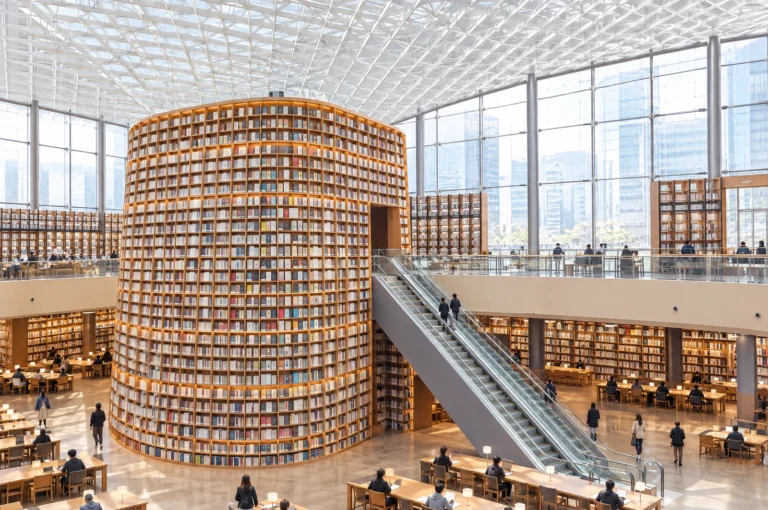
Starfield Library: Choosing the Tall-Shelf Scene Again, on Foot
Part two of “Gangnam & Songpa.” Starfield Library, in the middle of Starfield COEX Mall, fills 2,800 square metres over two floors with what its website calls a 13-metre-high wall of shelves, and it’s free for anyone to use. Maya saved this shelf on a screen long before she came. This time she goes on foot and chooses the scene again.
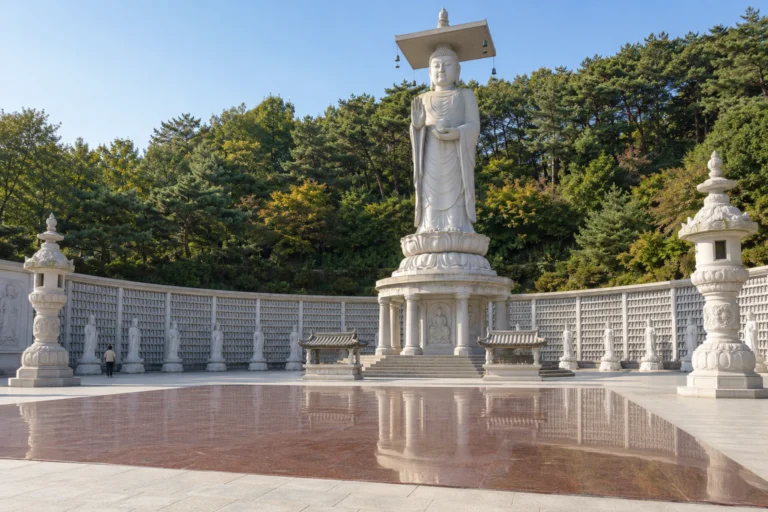
Bongeunsa’s Maitreya Plaza, the Morning After the Dawn Service
A new piece for “Gangnam and Songpa.” Bongeunsa’s website says its Maitreya Buddha was vowed in 1986 and completed in 1996 after ten years of work, and stands 23 m tall. Rina, who likes to go back to places, returns in the morning and walks on to the plaza deep in the grounds that she missed the first time.