
SEOUL · DONGDAEMUN
Heunginjimun and Its Half-Moon Wall
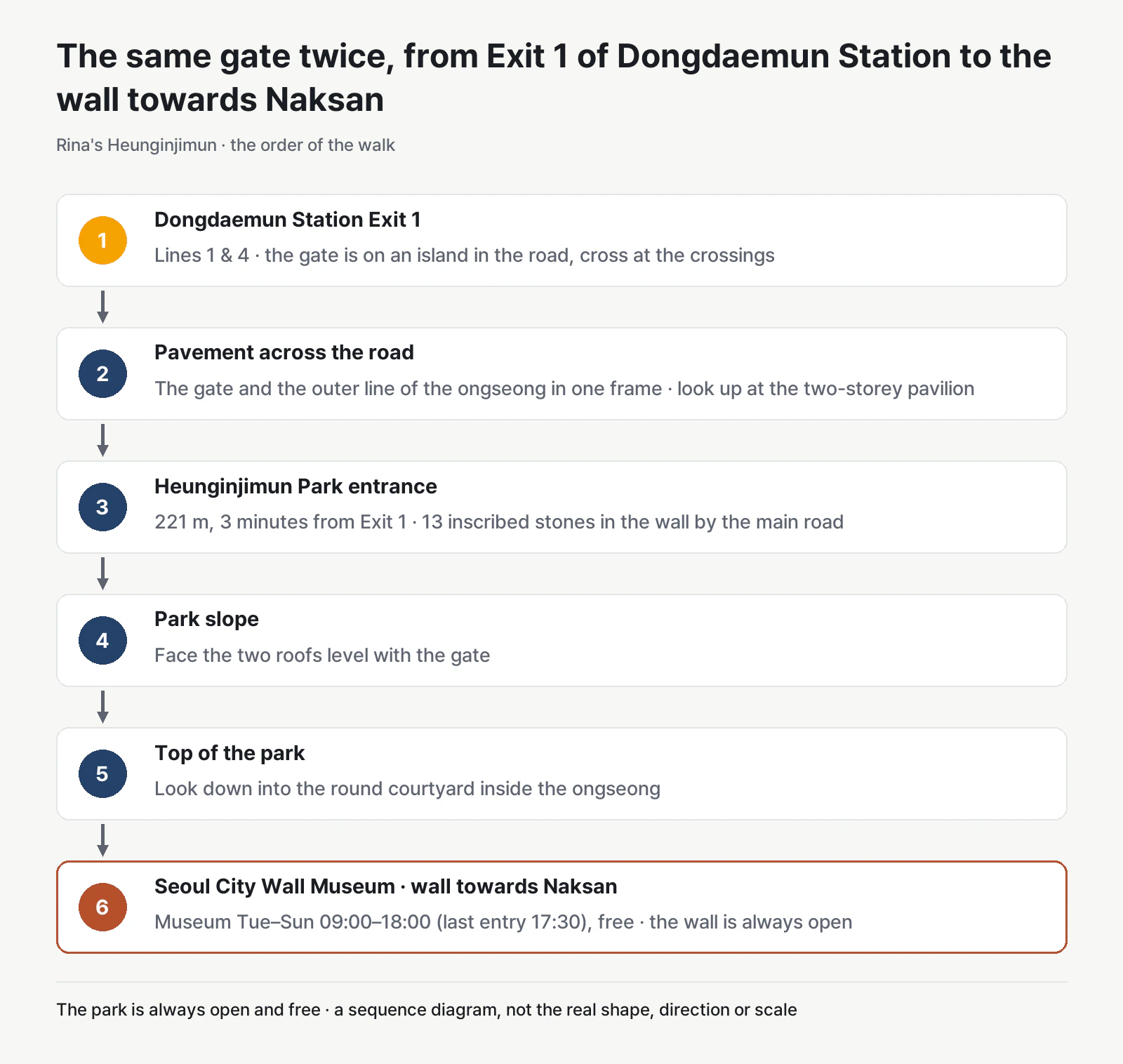
Heunginjimun is the east gate of Seoul’s old city wall, standing in the middle of a wide road right outside Exit 1 of Dongdaemun Station on Lines 1 and 4. Look at it once from the pavement across the road, then once more from the slope of Heunginjimun Park, 221 metres from Exit 1, and you can see the inside of the ongseong, the half-moon wall that only this gate of the city’s eight has. The park is always open and free, and the Seoul City Wall Museum in the park opens Tuesday to Sunday, 09:00–18:00, free.

How to get there
Come out of Exit 1 and you can see Heunginjimun in the middle of the road. The park is on the slope east of the gate.
Heunginjimun is the east gate of Seoul’s old city wall, the one most people in Seoul simply call Dongdaemun, the East Gate. It stands like an island in the middle of a wide road right outside Exit 1 of Dongdaemun Station on Lines 1 and 4, so almost anyone who has driven past has glimpsed it through a window at least once. But this gate only really shows itself if you look at it twice, on foot. From the pavement across the road you see the curved wall wrapped around the front of the gate like a half moon, and from the slope of Heunginjimun Park to the east you can look down into the round courtyard inside that wall.
Rina has been to Seoul many times and has passed Dongdaemun many times too. Through the window of an airport bus, through a taxi window, on the way to the Dongdaemun markets, the gate always appeared for a moment somewhere among the cars and then slid away behind her. The only photo she has of it is a blurry one, taken while the car waited at a red light. So on the first page of her notebook for this trip she wrote one line. “Dongdaemun — never properly seen.”
Today Rina gets out of the car and looks at the same gate twice, on foot. Once from the pavement across the road, with the gate and the curved wall in front of it in one frame, and once from the park slope above, looking down inside the wall. She plans to arrive at Dongdaemun Station around three on a weekday afternoon, see the gate twice, then walk slowly along the wall path above the park until the sun drops.
This piece follows Rina’s walk in order. From Exit 1 of Dongdaemun Station to the pavement across the road, the place where the wall was cut in 1907, the half-moon wall called the ongseong, the 1869 gate with its two roofs, the slope of Heunginjimun Park, the inside of the ongseong seen from above, and finally the Seoul City Wall Museum and the wall towards Naksan. If you only want to know where to stand, start with the summary just below. Whether you are dropping by between shopping at the Dongdaemun markets or setting out to follow the city wall, it is laid out so you can pick the parts you need.
The Cue
Heunginjimun stands in the middle of the road right outside **Exit 1 of Dongdaemun Station on Lines 1 and 4**. Look **once from the pavement across the road** and **once from the slope of Heunginjimun Park**, **221 m, 3 minutes** from Exit 1, and you can see both the outside and the inside of the **ongseong, the half-moon wall that only this gate of the eight has**. The park is **always open and free**, and the **Seoul City Wall Museum** in the park opens **Tuesday to Sunday, 09:00–18:00 (last entry 17:30), free**.
- **Where to look**: From the pavement across the road you get the gate and the outside of the ongseong in one frame. From the slope of Heunginjimun Park you look down into the round courtyard inside it.
- **Crossing**: The gate stands on an island in the middle of the road. Always use the pedestrian crossings.
- **Museum**: The Seoul City Wall Museum opens Tuesday to Sunday, 09:00–18:00 (last entry 17:30), free. It closes on Mondays and on 1 January, but opens when a Monday is a public holiday.
- **Walking on**: Behind the park, the restored wall runs on towards Naksan. The neighbourhoods along the wall path are places where people live, so pass through quietly.
Exit 1 of Dongdaemun Station, from across the road
Come out of Exit 1 of Dongdaemun Station on Lines 1 and 4 and the gate is right in front of you. It stands on an island in the middle of a wide road, though, so rather than heading straight for it, it is better to step back first and look from the pavement across the road. Before climbing up towards the park, Rina deliberately stops on the pavement and looks for the spot where the gate and the curved wall in front of it fit into one frame. The way the gate disappears for a moment behind passing cars and then reappears is, for the first time, exactly like the Dongdaemun she knew from car windows.
Open in Kakao Map — Heunginjimun Park
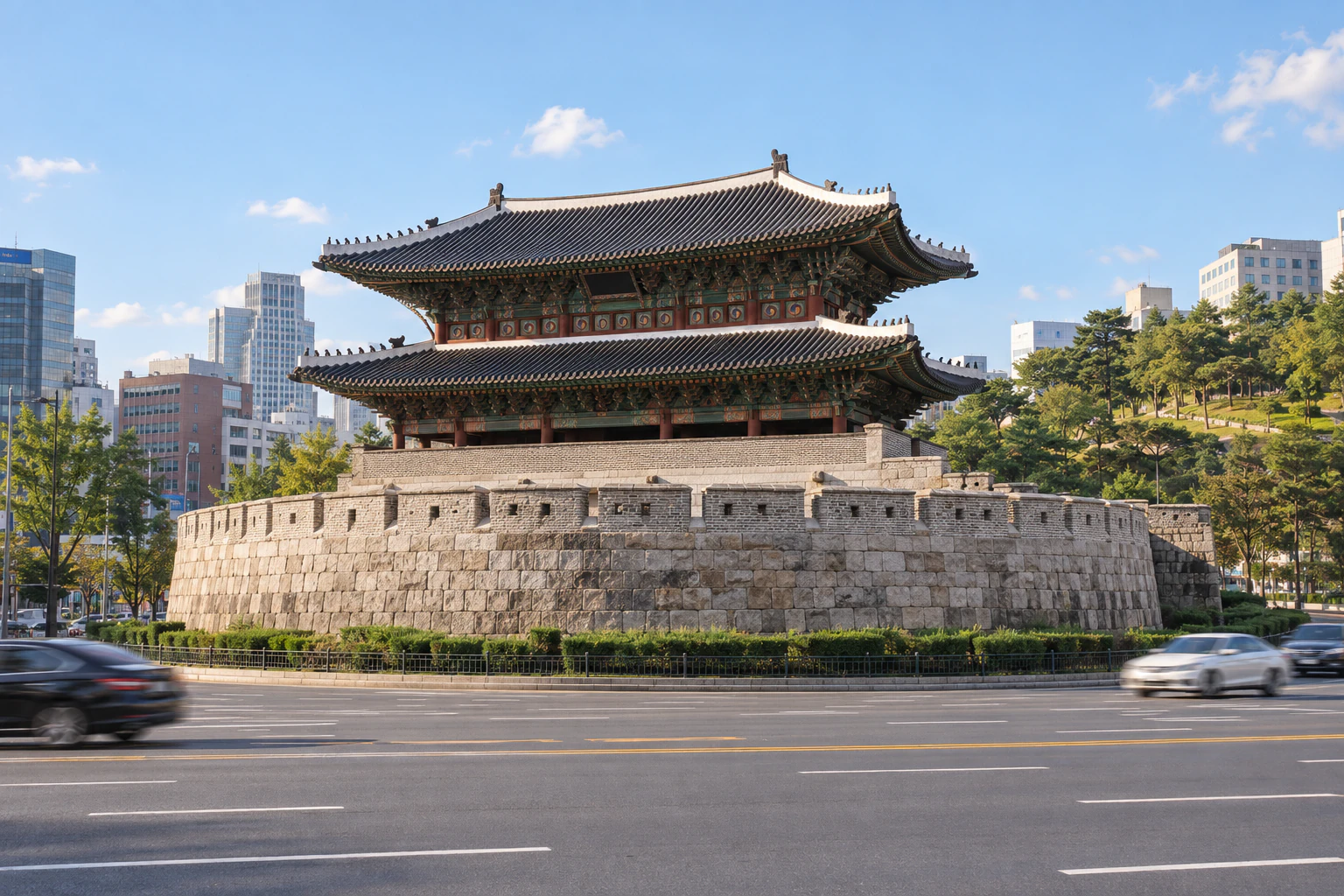
From across the road, what strikes her first is how low and broad the gate is. At the bottom is a base of large stacked stones with a rounded arched passage through the middle, and above it sit two storeys of wooden pavilion. From a car she only ever caught the roof, but standing still on foot she sees, one after another, how stone and wood make a single body. Rina writes in her notebook, from the bottom up, “stone, arch, two floors of wood”.
Every time the lights change, a wave of cars surges up in front of the gate and drains away again. Between them pass people queueing at the bus stop, people dragging big bundles towards the markets, and travellers holding up their phones to photograph the gate. Rina finds it strange that in the middle of all that noise, only the gate stays quietly where it is. To a gate that has held this spot for hundreds of years, the bustle of this junction is just one more passing scene.
While she looks from the pavement, Rina reads the gate’s name aloud once more. Heung-in-ji-mun, four characters. Of the eight gates of the city wall, this is the only one whose name has four characters, so if you write it next to the others, the name alone stands out. Rina writes Sungnyemun, Donuimun and Sukjeongmun in a row and draws a small star next to Heunginjimun alone.
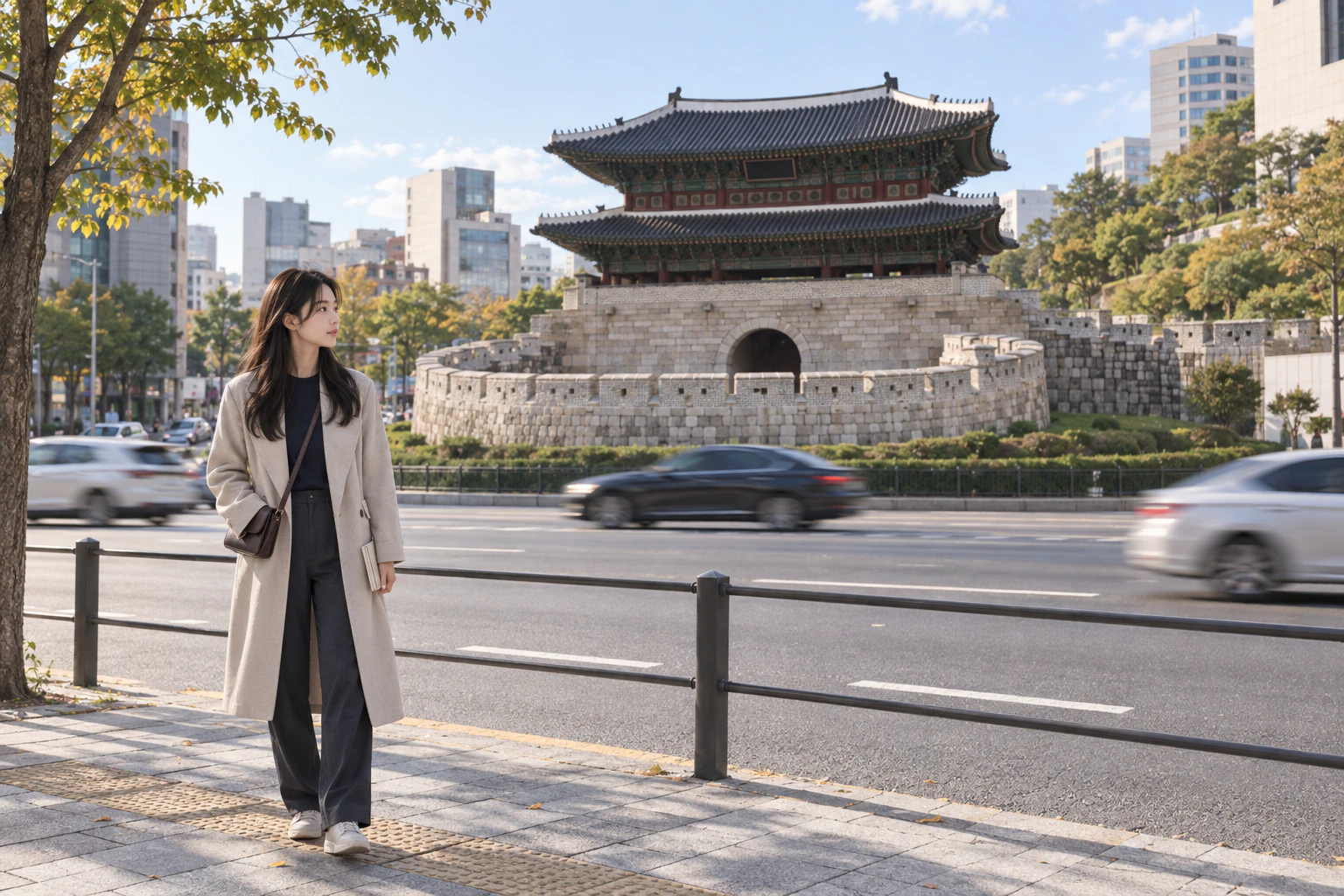
There are stories of the people who passed through this gate too. After the Manchu invasion of 1636, King Injo came back into the palace through Heunginjimun, and in 1882, during the Imo Incident, Queen Min left the city through Heunginjimun to escape the uprising. Rina briefly imagines the processions that went in and out of this gate over hundreds of years, much like the cars now passing in front of her. What passes this spot has changed, but the gate is still the city’s eastern way in, and Rina finds that quietly remarkable.
1907, where the wall was cut
If you look from across the road for a while, you notice something odd. A gate is meant to be part of a wall, but there is no wall running off on either side. In 1907 the walls on both sides of Heunginjimun were torn down, leaving the gate as it stands today. That is why, through car windows, the gate always seemed to stand alone among the traffic.
Rina draws a long line in her notebook, where the wall should have run out on both sides of the gate. Then she breaks the line right beside the gate and writes small above it. “1907, cut here.”
This gate is not the only one this happened to. The city wall began with an office set up to build it in 1395, the fourth year of King Taejo. It was first raised the following year, 1396, and in 1422, the fourth year of King Sejong, every stretch built of earth was rebuilt in stone. Then during the Japanese colonial period, gates and walls were pulled down on the pretext of city planning, and more was destroyed after liberation and during the Korean War. What Rina saw through car windows was a gate broken off from that long wall and left on its own.
The records of the first building show what a huge undertaking this wall was. It was raised in 1396 over two 49-day spells in the first and eighth lunar months, 98 days in all, by about 197,000 people gathered from across the country, and its full length along the ridges of Baegak (Bugaksan), Nakta (Naksan), Mongmyeok (Namsan) and Inwangsan came to about 18.6 kilometres. It averages around five to eight metres high, and it served as the city wall for 514 years, from 1396 to 1910. Rina writes down 18.6 and marks the spot where she stands today as a tiny dot on that long line.
Joining the broken wall back up began fairly late. Even after liberation, the wall kept being damaged as roads, houses and schools went up, and rebuilding started around Sukjeongmun in 1968 and spread to the whole line from 1974. So walking around Seoul today you often find stretches where old stones and newly laid stones run side by side. Rina guesses that the wall she will meet behind the park is a pieced-together wall like that, and decides to look for the places where the colour of the stone changes.
That is why seeing the city wall in Seoul now means going back and forth between the places where it is cut and the places where it survives. In some places the wall runs on along a mountain ridge, and in others, like here, only a gate is left in the middle of a road. Rina thinks that if she starts at this broken point today and walks on to where the wall picks up again behind the park, she can see the break and the join in a single walk.
The half-moon wall, the ongseong
From across the road you can see one more round stone wall in front of the gate. It wraps around the gate on the outside like a half moon. This wall is called an ongseong, a semicircular wall built to protect and reinforce the gate. It prevents anyone from rushing straight at the gate, while defenders on the wall could attack anyone who broke inside from several directions at once.

Heunginjimun is the only one of the city wall’s eight gates with an ongseong. The wall had four main gates, Heunginjimun to the east, Donuimun to the west, Sungnyemun to the south and Sukjeongmun to the north, with four smaller gates between them, and only the east gate received a curved wall like this. Rina remembers Sungnyemun, which she once saw on the way from Seoul Station. There was no round wall in front of that gate.
Only one gate of the eight, and why the east gate? The answer lies in the lie of the land. Seoul is high in the west and low in the east, so militarily the East Gate was the weakest point, which is why an ongseong was added to its outer side. To defend it, the gate on this lower ground was wrapped in an extra semicircular wall.
Look closely at the round wall and you see a lower wall running along its top, broken at regular intervals. This is a parapet, designed for taking cover and keeping watch outside from the top of the wall. From across the road, the parapet runs evenly along the top and makes the curve of the wall stand out more sharply. Rina lowers her eyes from the roof above the gate and follows the top line of the wall, realising the half moon is wider and more imposing than she expected.
Rina sits on a nearby bench and draws a half moon in her notebook, a line bulging outwards with the gate in the middle. All you can see from across the road is this outer line, so she cannot draw what the inside looks like yet. She closes the notebook with the inside left blank and decides to go up the park slope to fill it in.
Two roofs, a gate from 1869
Before heading for the park, Rina looks up above the gate once more. On top of the stone base sits a two-storey pavilion, five bays across the front and two bays deep. The roof is a hipped roof that looks like a trapezoid from the front, sloping on all four sides. Of the eight gates of the city wall, only Heunginjimun and Sungnyemun have two-storey gate towers, so even from a distance the doubled roofline gives this gate its face.
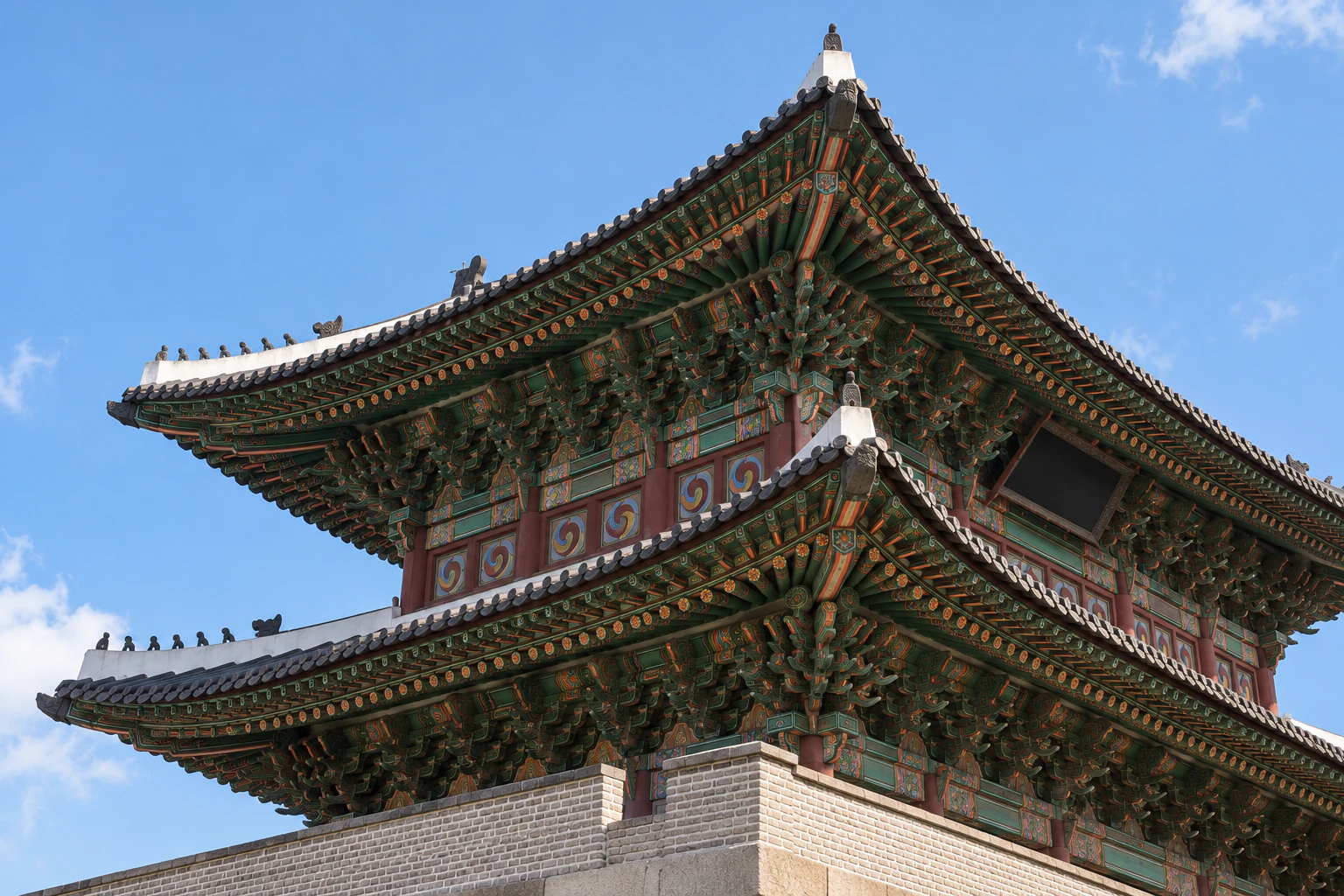
Look up under the eaves and the wooden members are packed tight. The brackets that hold up the eaves sit both on top of the columns and in the spaces between them, a style called dapo. Their slender profiles and intricate detailing showcase the character of late Joseon architecture. Brackets painted in green and red fill the space under the eaves, so looking up from below is like looking at a pattern woven in wood.

There is a reason for “late Joseon”. Heunginjimun was first put up in 1396, the fifth year of King Taejo, when the wall was built, and it was rebuilt in 1453, the first year of King Danjong, but the gate standing today was newly built in 1869, the sixth year of King Gojong. So the roof Rina is looking up at is not the roof from when the city wall was new, but one raised again more than 470 years later. Rina writes 1396 and 1869 side by side in her notebook and joins them with an arrow.
Through a car window she only knew it was an old gate, not that so many periods overlap inside it. The stone below holds the place from when the city wall was first built, and the wood above was rebuilt by late Joseon hands. The walls on either side of the gate were torn down at the start of the twentieth century. Rina notes that at least three periods overlap in a single gate.
To feel those three periods at once, it helps to look at the gate from several angles, as if walking around it. From the front, the arched passage and the two roofs look symmetrical, and from an angle you see the curve of the ongseong swinging out in front of the gate. Rina moves a few steps at a time along the pavement across the road and leaves several small sketches in her notebook of how the gate and the ongseong overlap differently from each spot.
The slope of Heunginjimun Park, level with the gate
Now Rina heads for the park to the east of the gate. East of the gate a slope rises towards Naksan, and that slope is Heunginjimun Park. From Exit 1 of Dongdaemun Station to the park the map route is 221 metres, a three-minute walk. The park was made in 2010 on the site of the old Ewha Womans University Dongdaemun Hospital, and it is always open with no admission charge.
The park covers a little over 11,000 square metres, and the higher up the slope you go, the more the view opens out, which makes it a good place to look around the whole Dongdaemun area. On one side of the hill is the Seoul City Wall Museum, and behind it the wall runs on towards Naksan. Standing at the park entrance, Rina sees that today’s walk is a single line that starts at the gate and climbs the hill along the wall.
Near the park entrance, in the wall that meets the main road, there is a cluster of stones with writing carved into them. They are stones engraved with things like the region that built the wall, the names of officials and stonemasons, and the date and section of the work, and thirteen of these inscribed stones are set in the wall here. This is the place with the most inscribed stones gathered together of all those found along the city wall, so it is worth slowly scanning the lower part of the wall before you climb into the park. Rina follows the carved characters one by one with her eyes, as if tracing them with a finger.
There is a reason the stones carry writing like this. When the wall was first built, the whole line was divided into 97 sections of 600 cheok each, every section was named in the order of the Thousand Character Classic, and each was handed to a county from the provinces. The stones are a record of which county built which section and who was responsible. Rina thinks of the carved characters as an old building log and, at the same time, as name tags for the people who built this wall.
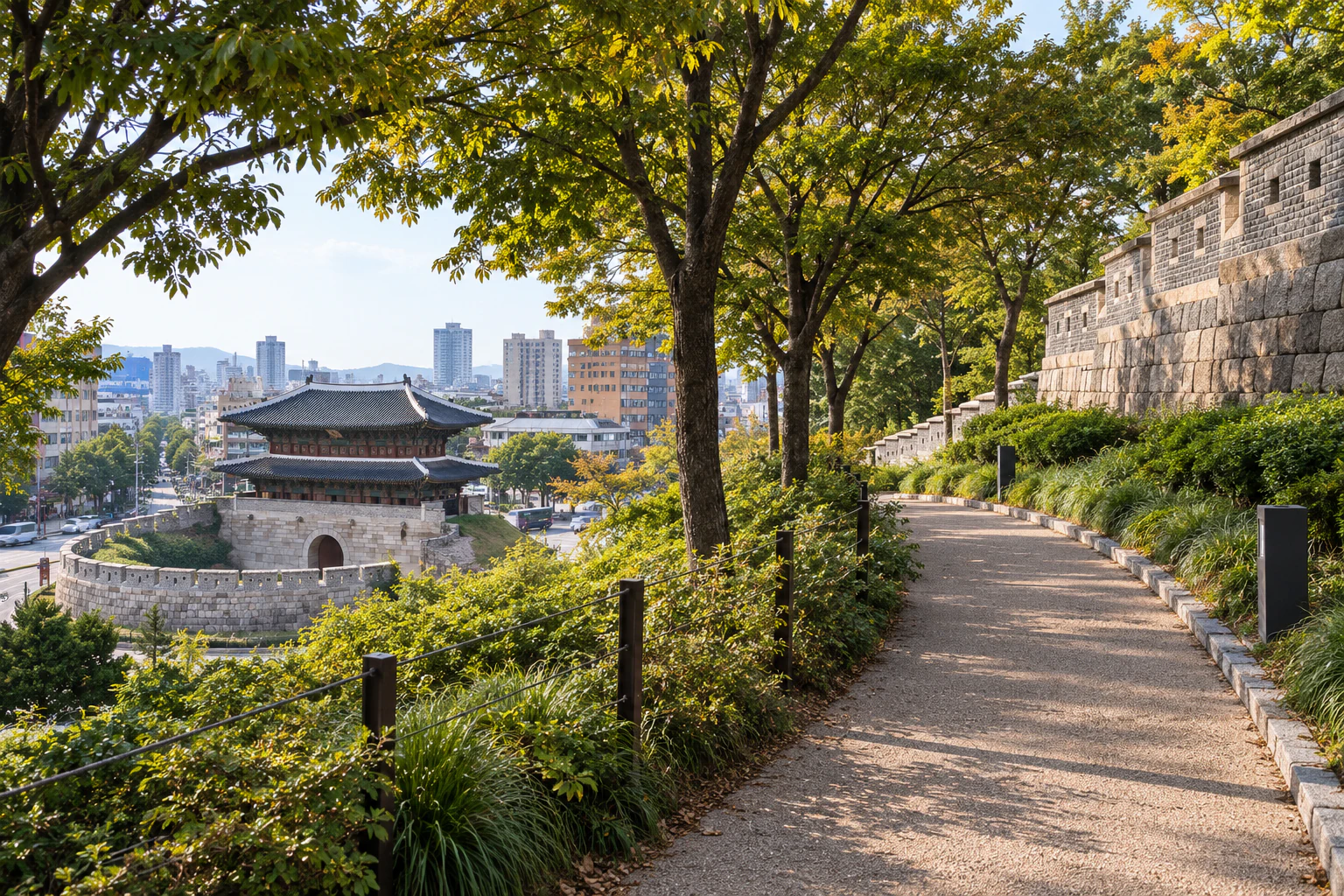
Climb a little way up the slope and your eye comes level with the gate. The roof of the two-storey pavilion that Rina looked up at from the pavement is now right in front of her at eye level. Sketching the underside of the eaves she looked up at earlier next to the roofline she now faces, Rina realises that the same roof becomes a completely different picture depending on the height you stand at.
The park slope is not hard to climb, and the height changes quickly before you get out of breath. Every step up makes the gate seem to sink a little lower, which is fun enough that Rina stops every few steps to look back. Each change in height shifts how the gate, the road and the buildings overlap, so it feels like splitting one place into several separate pictures.
From above, the inside of the ongseong
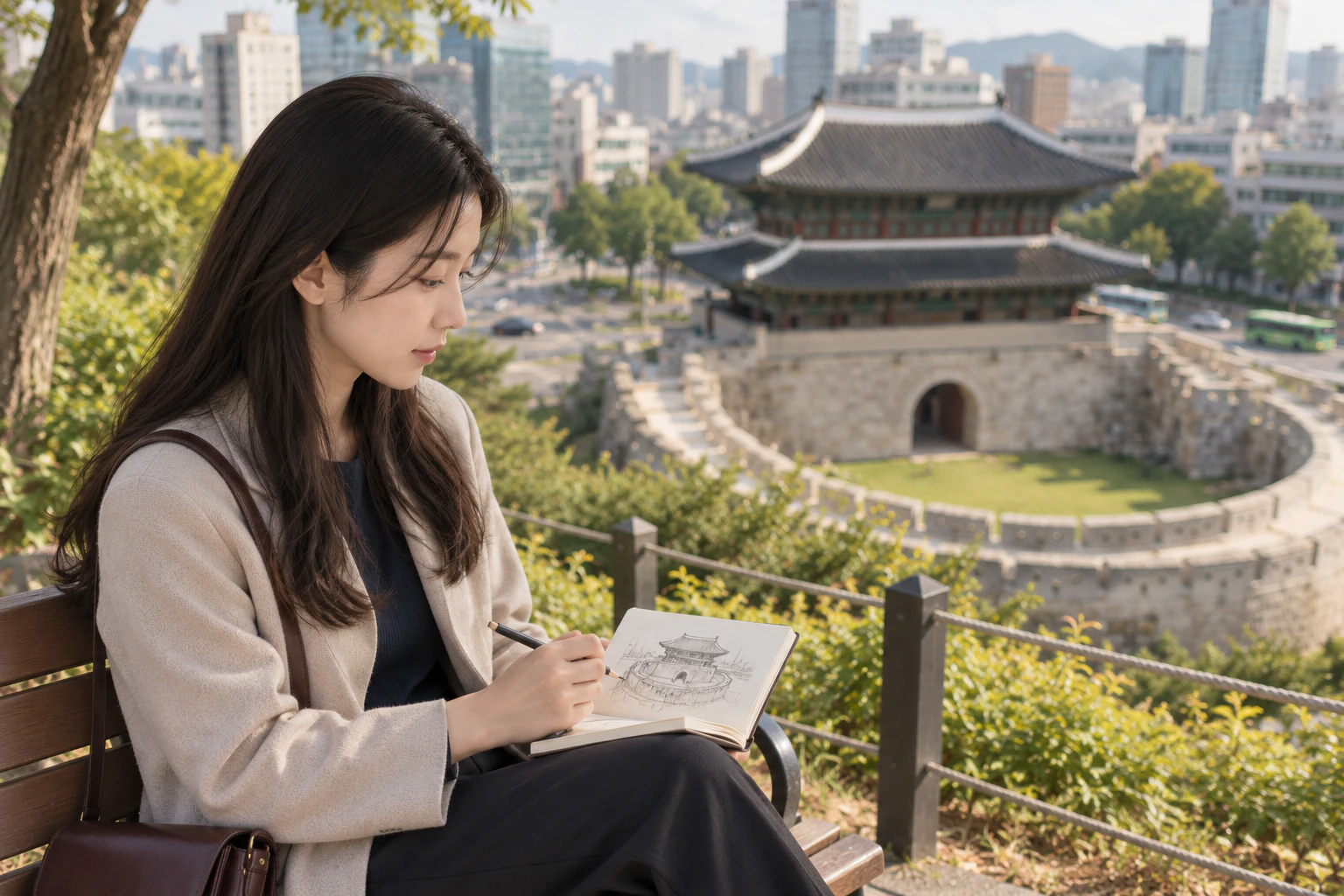
Climb a little further and now you are looking down on the gate. Because the park is high, the inside of the ongseong, which you cannot see from across the road, is in full view here. Inside the round stone wall is a round courtyard, and beyond it the arched passage of the gate stands open. If what you saw from across the road was the outer line of the wall, what you see here is what the wall wraps around.
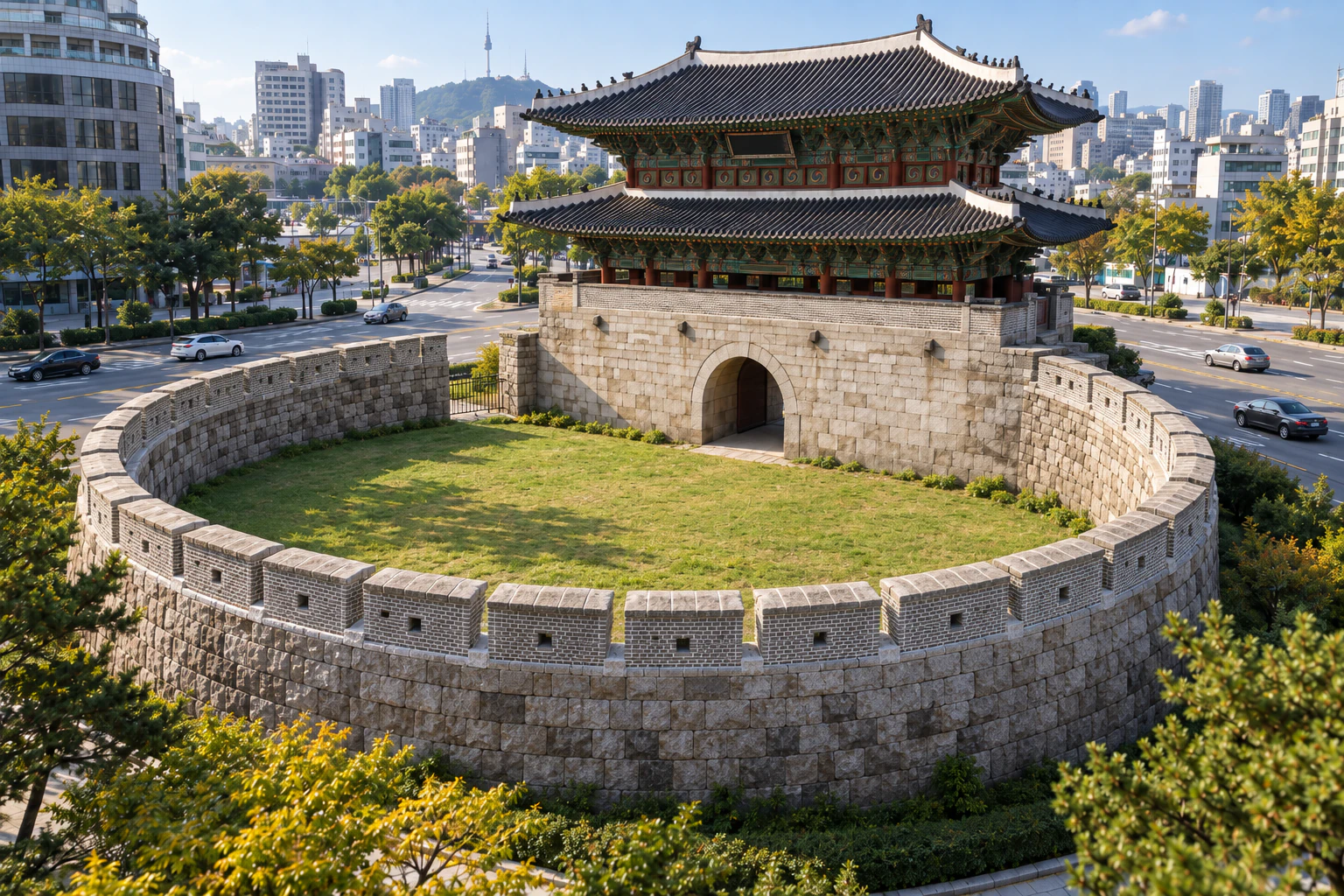
Rina opens her notebook again and corrects the half moon she drew earlier. From across the road she could draw only one line, the outside of the wall, but now she adds the inner line. The half moon becomes a wall with thickness, with a round courtyard inside it. The moment the blank space fills in, Rina feels she understands why she came to see the same gate twice today.
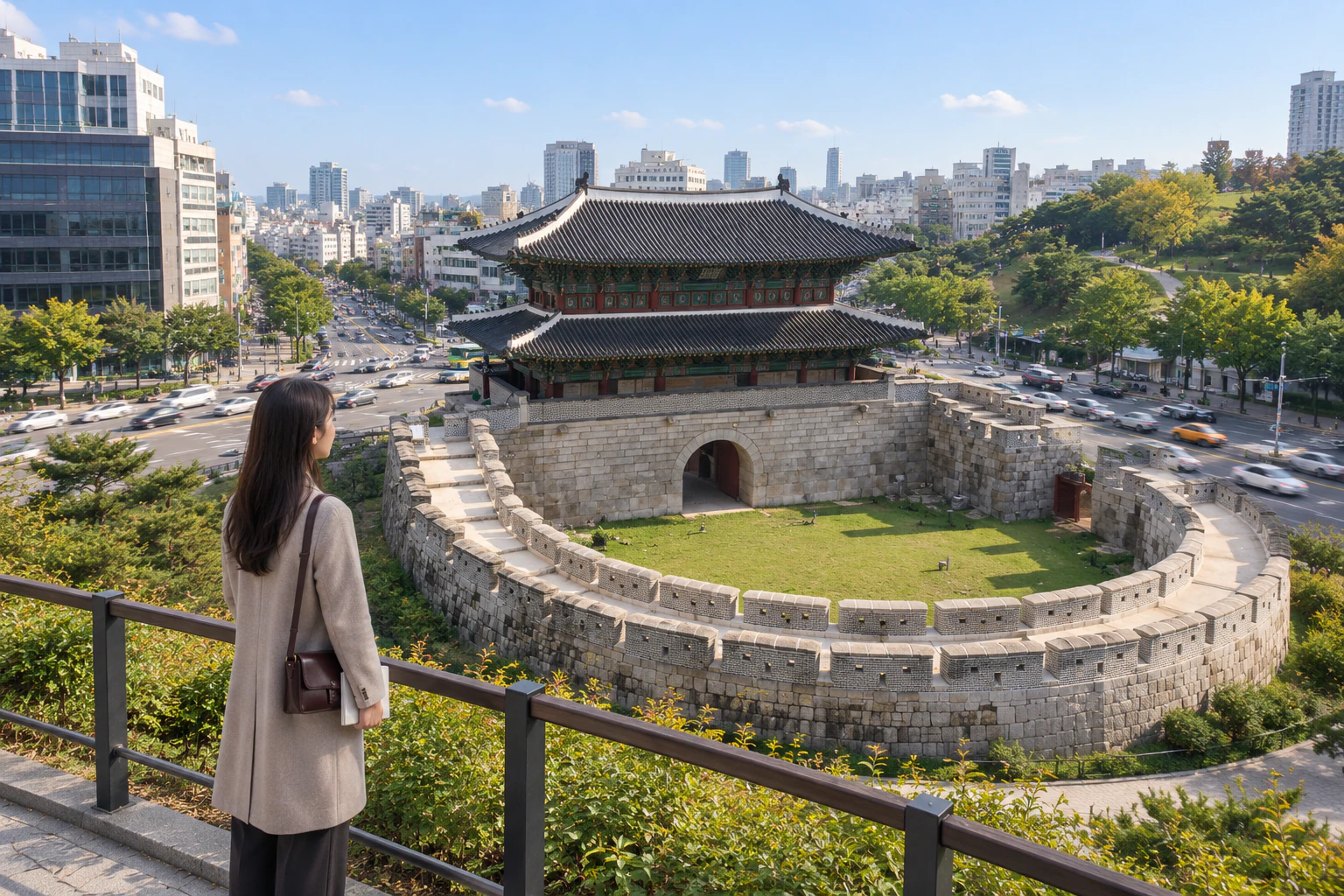
From above, it is also clearer why the ongseong was a wall for guarding the gate. To reach the gate you first have to step into the courtyard inside the round wall, and that courtyard is surrounded by a wall on every side. From the top of the wall the whole courtyard would have been in plain view, which is why the ongseong is called a facility rationally planned for attacking an enemy. Looking at the round courtyard from above, Rina thinks the half moon she saw from below was really a kind of small room set in front of the gate.
The roof looks different from above too. From below, the brackets and painted colours under the eaves caught her eye first, but from here it is the broad surface of the roof, covered in rows of tiles. The way the two roofs sit one above the other is clearer from this angle, and the slightly lifted lines of the roof corners make a single picture with the curve of the ongseong. Rina thinks she has now seen this gate from below, from the side and from above for the first time, and draws three small sketches side by side in her notebook.
Leaning on the railing, she can see the buildings towards the Dongdaemun markets beyond the gate, along with the cars moving along the road. Rina smiles, remembering herself passing this gate in one of those cars. Back then, the gate appeared among the cars for a moment and vanished, and now it looks the other way round, as if the cars appear around the gate for a moment and vanish.
The Seoul City Wall Museum and the wall towards Naksan
On one side of the park is the Seoul City Wall Museum. It occupies floors one to three of the Seoul Design Support Center, built after part of the old Dongdaemun hospital was pulled down, and it opens Tuesday to Sunday from 9am to 6pm (last entry 5.30pm), free. It closes on Mondays and on 1 January, but opens when a Monday is a public holiday. If you want to pull together everything you saw today at the gate and along the wall, it is a good place to stop before you leave the park.
If you come in the afternoon, it helps to think about the order. Museum entry ends at 5.30pm, so if you arrive late in the afternoon, it is easier to look at the gate from across the road first, head straight up into the park and visit the museum, then come out, look down into the ongseong and carry on along the wall path. The park and the wall are always open, so as long as you get into the museum in time, you can take the rest slowly until sunset. Rina, too, visits the museum first and then comes back to the railing to look down on the gate once more.
Behind the park, the restored wall runs on towards Naksan. Follow it uphill and the Naksan section of the city wall begins, and since the wall is open all day, you can walk it in the evening too. Jangsu Village and Ihwa Village, which the wall path passes through, are neighbourhoods where people live, though, so lower your voice and walk quietly past them. Rina decides to walk only as far as the place where she can see the wall join up again today, and to save the top of Naksan for another day.
A few steps up along the wall behind the park, the gate she looked up at from below grows smaller and smaller, and the city opens out beyond it. The wall breaks off at the road where the cars pass and starts again on this slope, running on up the hill. Next to the line she drew earlier, “1907, cut here”, Rina adds how the broken line picks up again behind the park. With the break and the join in one picture, the whole of today’s walk falls into place at a glance.
As the sun drops, Rina walks slowly up along the wall above the park. She has learned one thing today. Pass Dongdaemun in a car and it looks like a single gate, but look at it twice on foot and it shows two layers, the gate and its round wall. And of the eight gates, this is the only one with those two layers. Next to “never properly seen” on the first page of her notebook, Rina adds, small, “seen twice”.
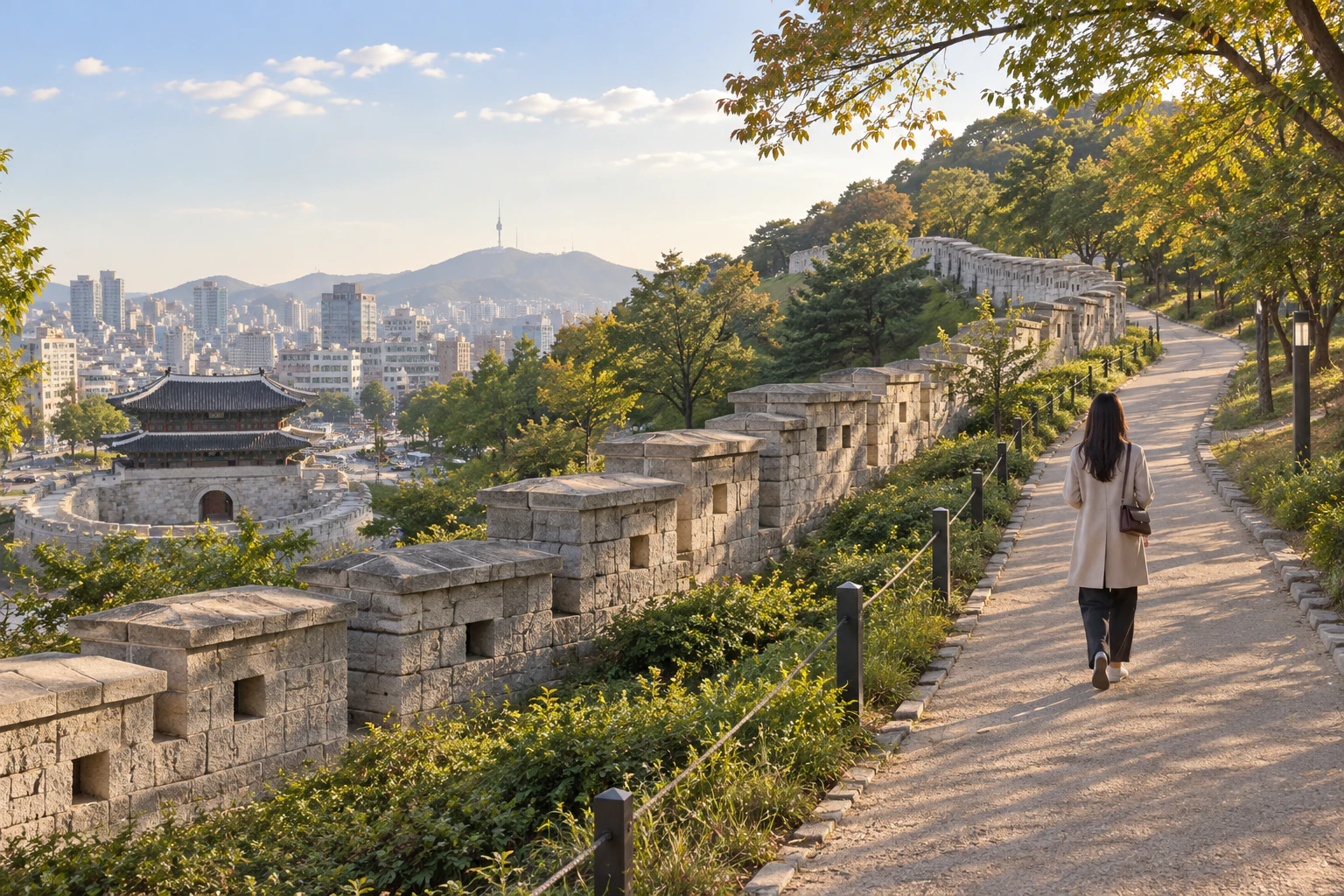
If you are near Dongdaemun, take half an hour between shopping or meeting friends and look at this gate twice. Come out of Exit 1, catch the gate and its round wall in one frame from the pavement across the road, then climb the slope of Heunginjimun Park three minutes away and look down into the round courtyard inside, and the Dongdaemun that once slid past your car window will show itself as the only two-layered gate of the eight.
(※ This article includes staged images created with AI.)
Common Mistakes
- Heading straight for the middle of the road — The gate stands on a traffic island. Always use the pedestrian crossings.
- Looking only from across the road — You can only see the round courtyard inside the ongseong by looking down from the slope of Heunginjimun Park.
- Going to the museum first on a Monday — The Seoul City Wall Museum closes on Mondays (it opens when a Monday is a public holiday). The park and the wall are always open.
- Talking loudly in the neighbourhoods along the wall — Jangsu Village and Ihwa Village are places where people live. Pass through quietly.
FAQ
How do I get to Heunginjimun?
Come out of Exit 1 of Dongdaemun Station on Lines 1 and 4 and it is right in front of you in the middle of the road. Heunginjimun Park is 221 m from Exit 1, a three-minute walk.
What is an ongseong?
A semicircular wall built outside a gate to protect and reinforce it. Of the eight gates of Seoul’s city wall, Heunginjimun is the only one with an ongseong.
Why does only Heunginjimun have an ongseong?
Seoul is high in the west and low in the east, so militarily the East Gate was the weakest point, and an outer curved wall was built to protect it.
Where can I see inside the ongseong?
Climb the slope of Heunginjimun Park to the east of the gate and look down, and you can see the round courtyard inside the ongseong.
When was today’s Heunginjimun built?
It was first put up in 1396, the fifth year of King Taejo, and rebuilt in 1453, the first year of King Danjong. The gate standing today was newly built in 1869, the sixth year of King Gojong.
When is the Seoul City Wall Museum open?
Tuesday to Sunday, 09:00–18:00 (last entry 17:30), free. It closes on Mondays and on 1 January, and opens when a Monday is a public holiday.
Is there an admission charge for Heunginjimun Park?
No. The park is always open and free.
Recap — 30 seconds before you go
- In the middle of the road outside **Exit 1 of Dongdaemun Station**, cross at the **pedestrian crossings**
- From the **pavement across the road**, the gate and the **outer line of the ongseong** in one frame
- From the slope of **Heunginjimun Park (221 m, 3 min)**, look down **inside the ongseong**
- The ongseong is **unique to Heunginjimun among the eight gates**, and today’s gate dates from **1869**
- **Seoul City Wall Museum** Tue–Sun 09:00–18:00, free, with **the wall towards Naksan** behind the park
Sources
- Korea Heritage Service — Heunginjimun, Seoul — First built 1396, rebuilt 1453, today’s gate built 1869 · two storeys, five bays by two, hipped roof, dapo brackets · semicircular ongseong · the only one of the eight gates with an ongseong checked 2026-10-20
- Seoul City Wall — Naksan section — Walls on both sides removed in 1907 · terrain high in the west and low in the east, and the ongseong · location of the Seoul City Wall Museum (Seoul Design Support Center) · Naksan section checked 2026-10-20
- Seoul City Wall — About the wall — 98 days in 1396, about 197,000 people · 97 sections of 600 cheok named after the Thousand Character Classic · about 18.6 km along the four inner mountains, 5–8 m high · 514 years · rebuilding from around Sukjeongmun in 1968, the whole line from 1974 checked 2026-10-20
- Seoul City Wall Museum — Visitor information — Tue–Sun 09:00–18:00 (last entry 17:30) · closed Mondays and 1 January (open on Monday public holidays) · free checked 2026-10-20
- Seoul Metropolitan Government news — Heunginjimun and Heunginjimun Park (citizen reporter) — Park made in 2010 on the old Dongdaemun hospital site, open all year round, free · view into the ongseong · 13 inscribed stones · King Injo’s return and Queen Min in 1882 · two-storey gate towers only at Heunginjimun and Sungnyemun · four-character name checked 2026-10-20
- Kakao Map — Heunginjimun Park — Destination and Exit 1 of Dongdaemun Station checked 2026-10-20
More from this area

Names at the foot of the wall: from Seoul’s inscribed stones to the City Wall Museum
The second part of “Jongno and Dongdaemun.” At the entrance to Heunginjimun Park, where the city wall meets the main road, some of the stones low in its outer face are carved with writing. The Seoul City Wall website calls them gakja seongseok — inscribed wall stones — and says more of them are gathered beside Dongdaemun Seonggwak Park than anywhere else on the wall. The early ones name a section and a county; from Sukjong’s reign on, they name a supervisor, a builder and a date. Maya looks at the stones, then walks up to the Seoul City Wall Museum on the hill to read about the people who defended the wall.

An Evening Walk Along the Naksan City Wall
Naksan Park is a hilltop park a 10- to 20-minute walk uphill from Exit 2 of Hyehwa Station on Line 4.