
SEOUL · DONGDAEMUN
Heunginjimun and Its Half-Moon Wall
Rina has passed Dongdaemun many times, always through a bus window.

How to get there
The 221 m / 3 min is a map-route calculation from Exit 1 of Dongdaemun Station to Heunginjimun Park.
In the last part of the previous issue, Noah walked Jongmyo. Follow Jongno east from there and you reach the east gate of the old city wall: Heunginjimun, better known as Dongdaemun.
Rina has been to Seoul many times, and she has passed Dongdaemun many times too — through the window of an airport bus, through the window of a taxi. Each time the gate flashed up somewhere among the traffic and slid away behind her. Only now does she write it down in her notebook: “Dongdaemun — never properly seen.”
Today she decides to look at it twice, on foot: once from the pavement across the road, and once from the park that looks down on it.
A gate standing alone in the road
Seoul City Wall website: in 1907 the walls on either side of Heunginjimun were torn down, leaving the gate as it stands today.
From Exit 1 of Dongdaemun Station (Lines 1 and 4) to Heunginjimun Park, the map route is 221 meters — three minutes. Before heading up to the park, Rina first stands on the pavement across the road. Find on map
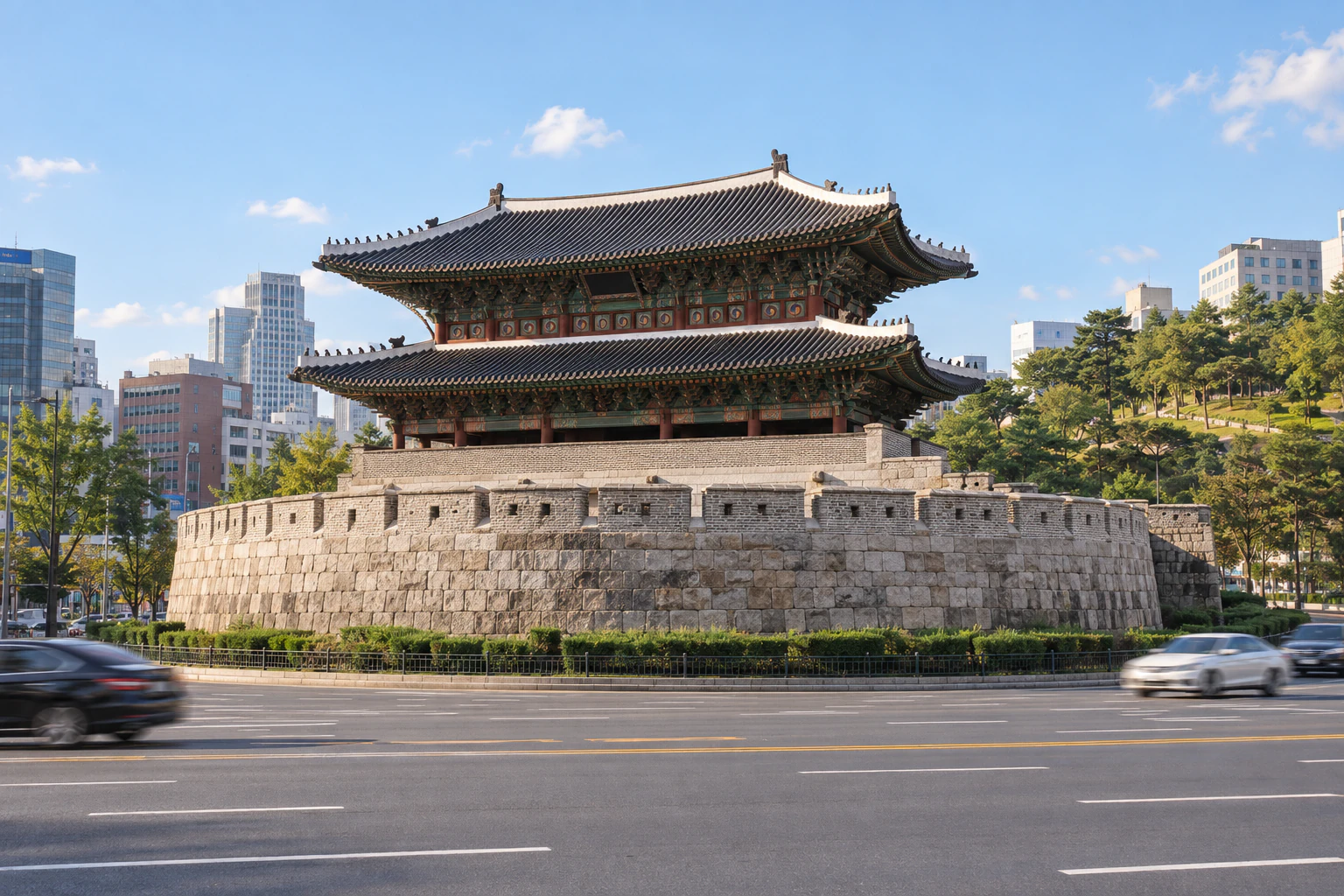
The gate sits like an island in the middle of a wide road. The walls that should run out from either side of it are gone. The Seoul City Wall website says the walls on either side of Heunginjimun were torn down in 1907, leaving the gate as it stands today. That is why, seen from a car window, the gate always seemed to be “somewhere in the traffic.”
Rina draws a line in her notebook — where the wall should have run out on both sides — and writes above it: “1907. Cut here.”
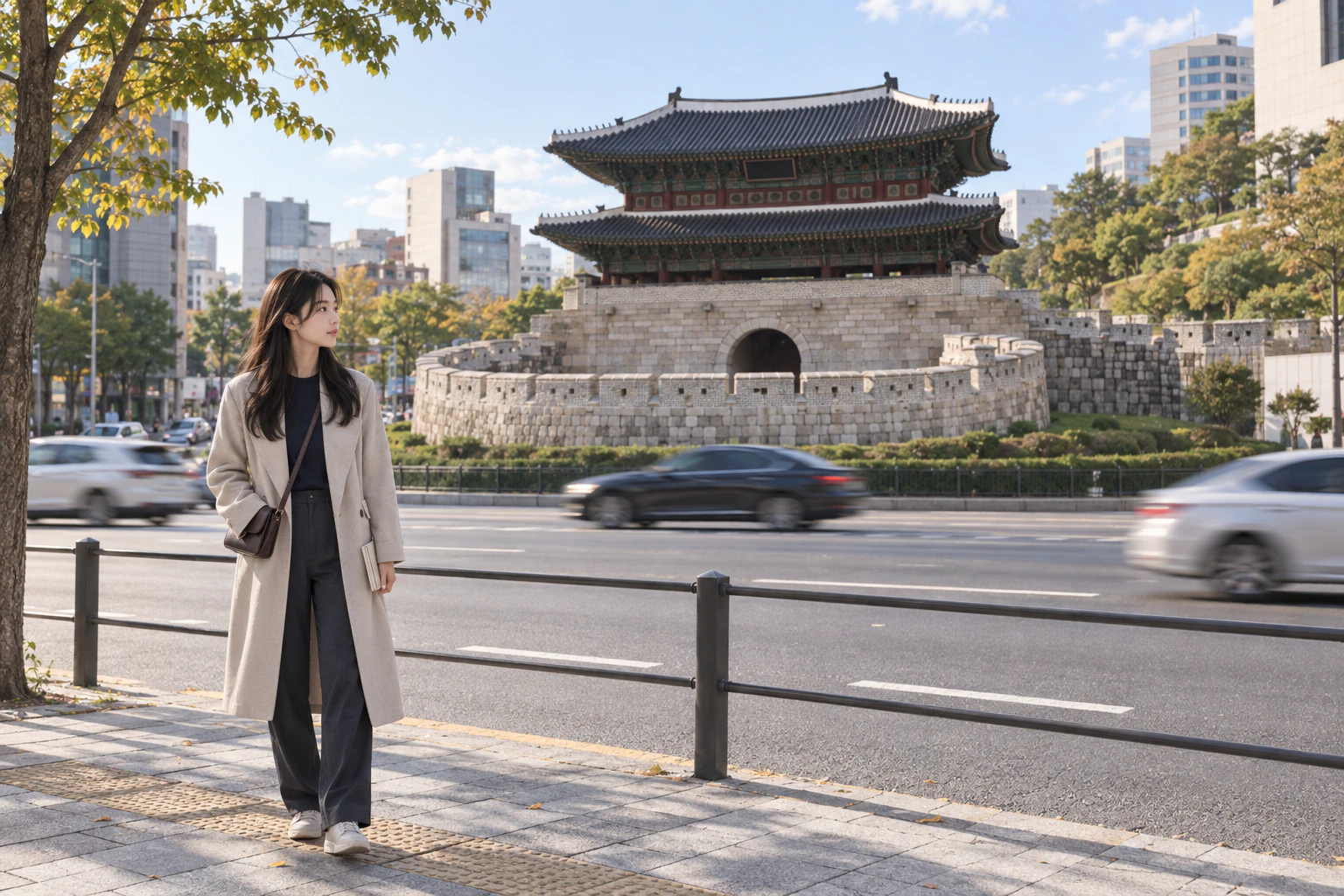
It wasn’t only this gate. The Korea Heritage Service says the wall was begun in 1395, and that in 1422 every stretch built of earth was rebuilt in stone. It adds that during the colonial period gates and walls were torn down in the name of city planning, and that more was lost after liberation and in the Korean War. What Rina had seen through the bus window was a gate left standing on its own, cut loose from that long wall.
The half-moon wall
According to the Korea Heritage Service, a semicircular enclosing wall (ongseong) was built on the outside of Heunginjimun to protect the gate. It is the only one of the city’s eight gates with an ongseong.
From across the road you can see a second, curved stone wall in front of the gate, wrapped around it from the outside like a half-moon. The Korea Heritage Service calls it an ongseong and explains that it was built in a semicircle to protect and defend the gate. And Heunginjimun is the only one of the city’s eight gates to have one. Find on map

Only one of the eight. Rina stops at that sentence. Why only the east gate? The Seoul City Wall website answers with the land itself: Seoul is high in the west and low in the east, so militarily Dongdaemun was the most vulnerable gate — which is why an extra ongseong was built outside it.
The Korea Heritage Service lists the four main gates of the wall: Heunginjimun to the east, Donuimun to the west, Sungnyemun to the south and Sukjeongmun to the north. Rina thinks of Sungnyemun. There was no curved wall like this in front of it. She draws a half-moon in her notebook.
Two roofs, a gate from 1869
According to the Korea Heritage Service, Heunginjimun is the east gate among the eight gates of the Seoul city wall, commonly called Dongdaemun. It was built in 1396 when the wall was raised, rebuilt in 1453, and the present gate dates from 1869. It is a two-storey building five bays wide and two bays deep under a hipped roof, with bracket clusters both on and between the columns — slender and heavily decorated, typical of the late Joseon period.
On top of the gate sits a two-storey pavilion. According to the Korea Heritage Service it is five bays wide and two bays deep, under a hipped roof that slopes down on all four sides. Find on map
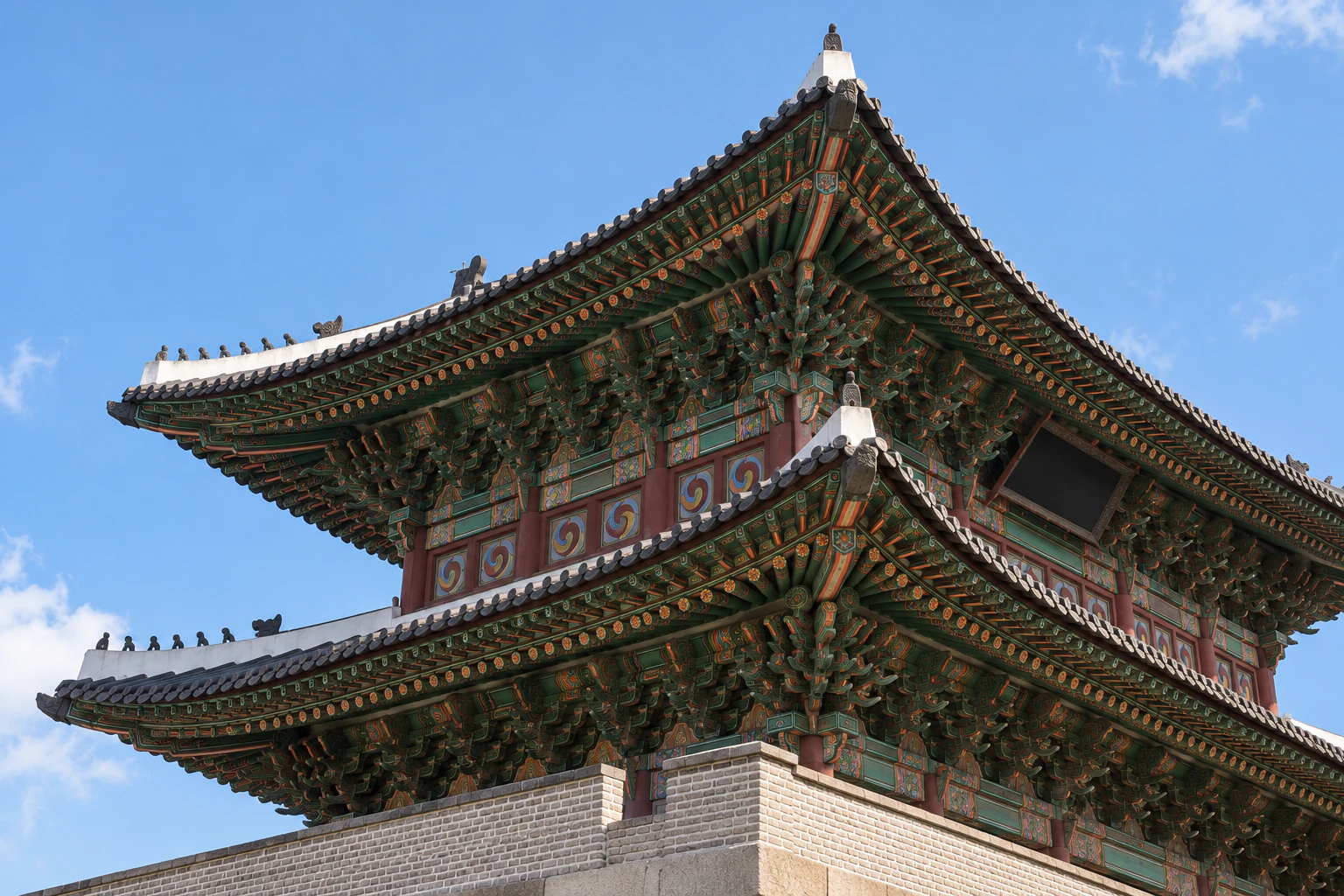
Look up under the eaves and the timber is dense: bracket clusters sit not only on top of the columns but between them too. The Korea Heritage Service describes them as slender and heavily decorated — typical of the late Joseon period.

“Late Joseon” is there for a reason. Heunginjimun was first built in 1396, when the city wall went up, and rebuilt in 1453 — but the gate that stands today dates from 1869. Rina writes 1396 and 1869 side by side and joins them with an arrow.
From above
A citizen reporter’s article on the Seoul Metropolitan Government’s “Seoul in My Hand” platform (15 February 2021): Heunginjimun Park was created in 2010 on the former site of Ewha Womans University’s Dongdaemun Hospital. Set on the slope rising east of the gate toward Naksan, it lets you see into the ongseong from above.
East of the gate, a slope rises toward Naksan: Heunginjimun Park. A 2021 citizen reporter’s article on the city’s “Seoul in My Hand” platform describes it as a park created in 2010 on the former site of Ewha Womans University’s Dongdaemun Hospital, open all year round and free. Find on map
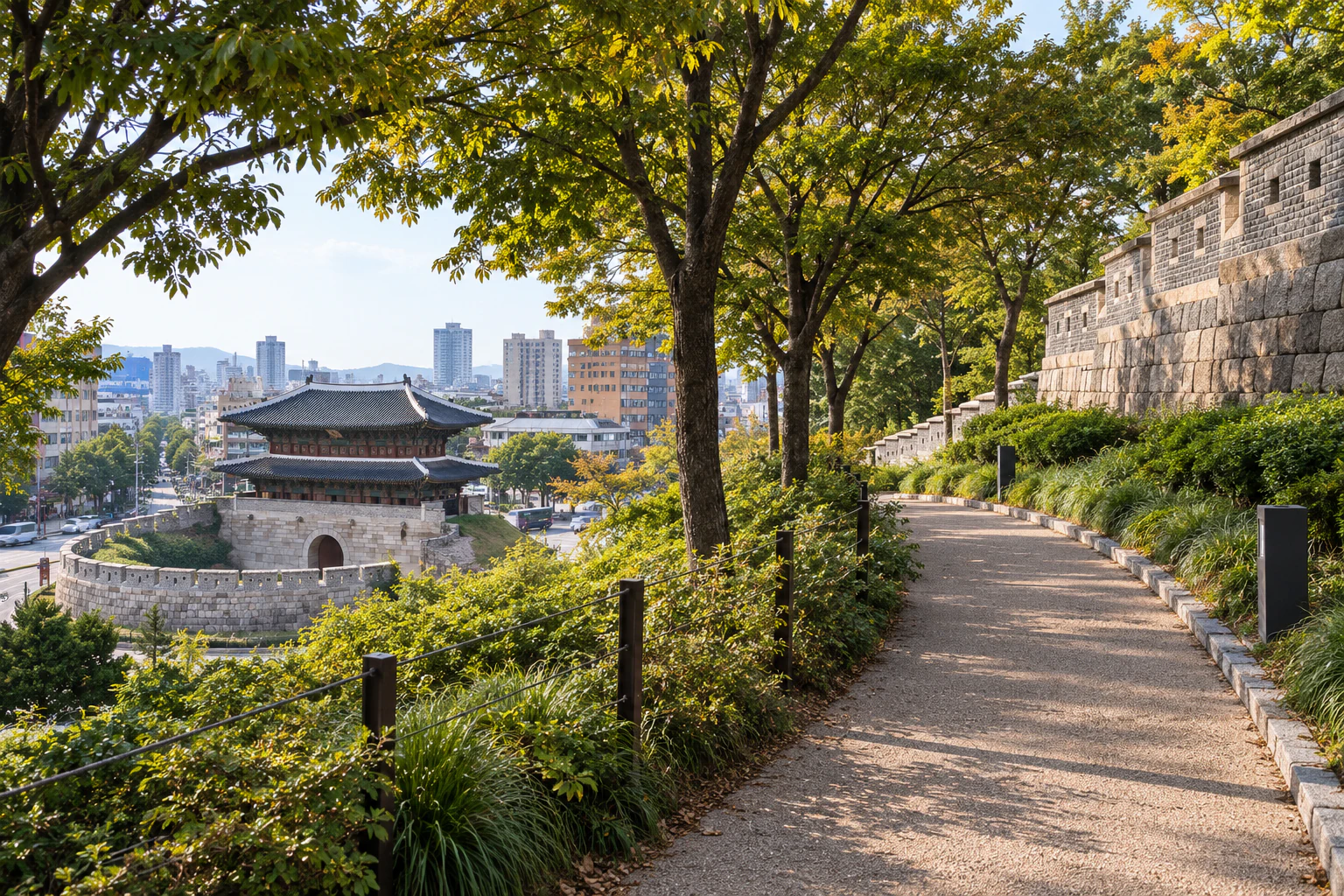
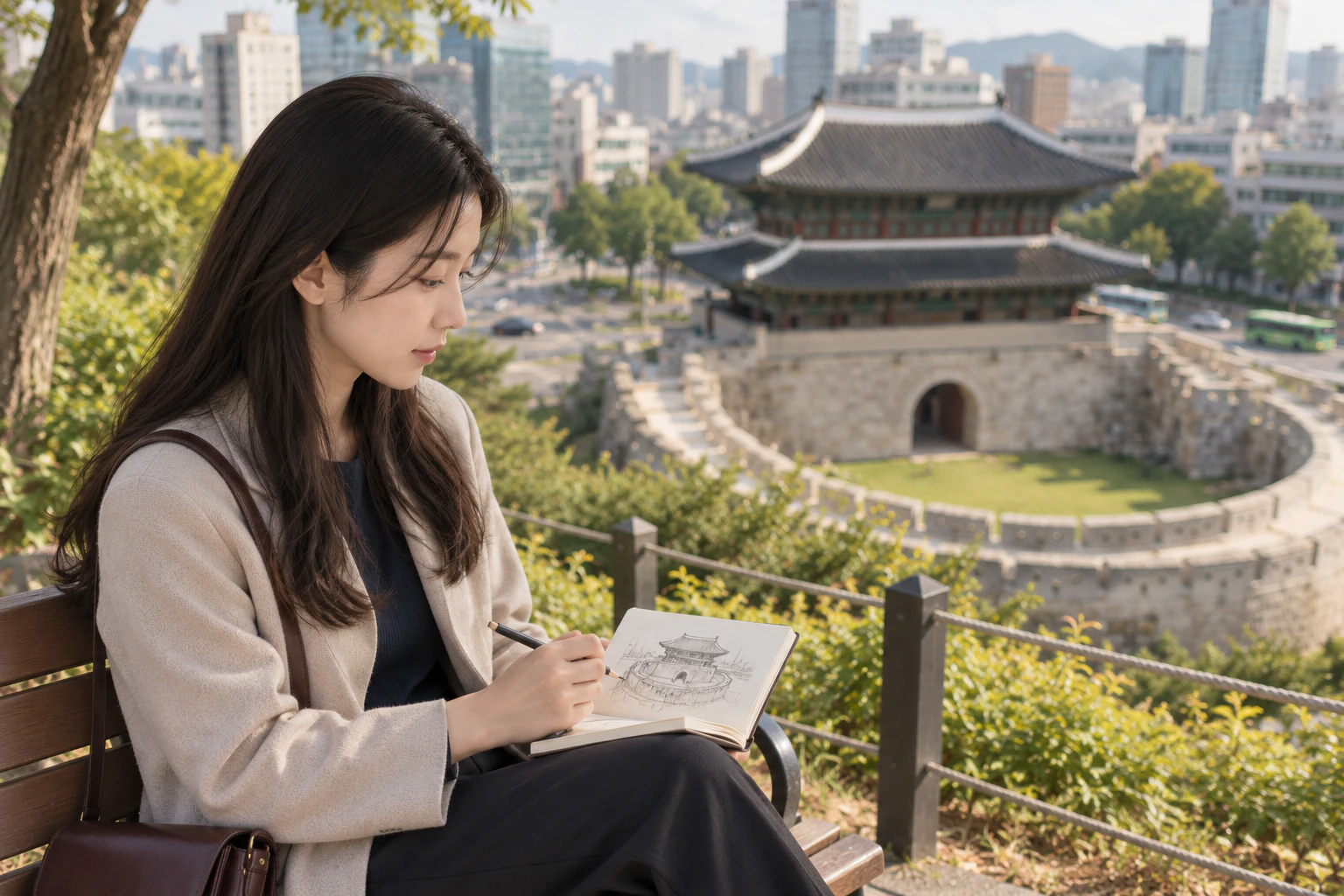
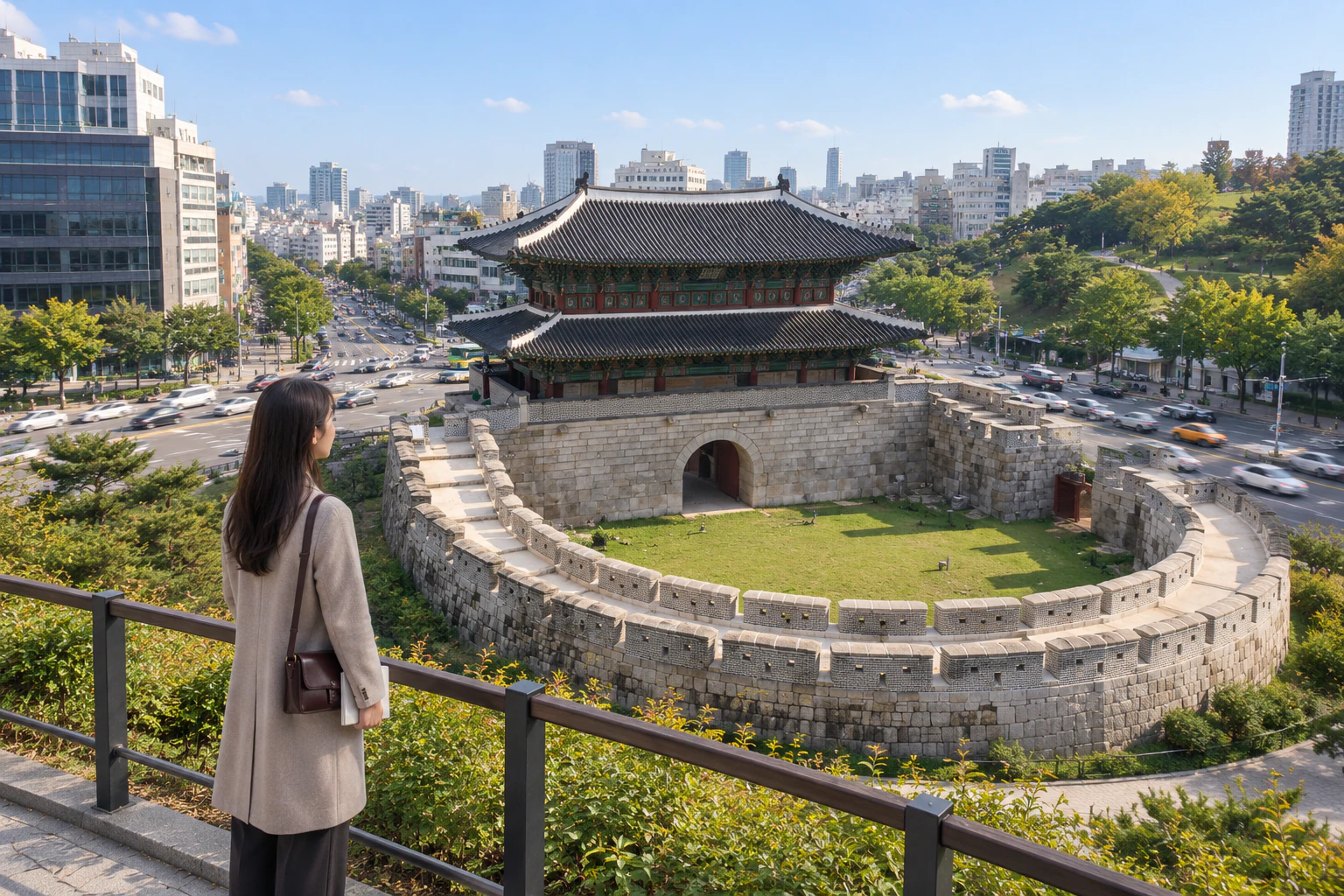
Climb a little and your eyes are level with the gate; climb a little more and you are looking down on it. The same article notes that from this height you can see into the ongseong. From across the road Rina saw only the outside of the curved wall. From here she can see the round lawn inside it.
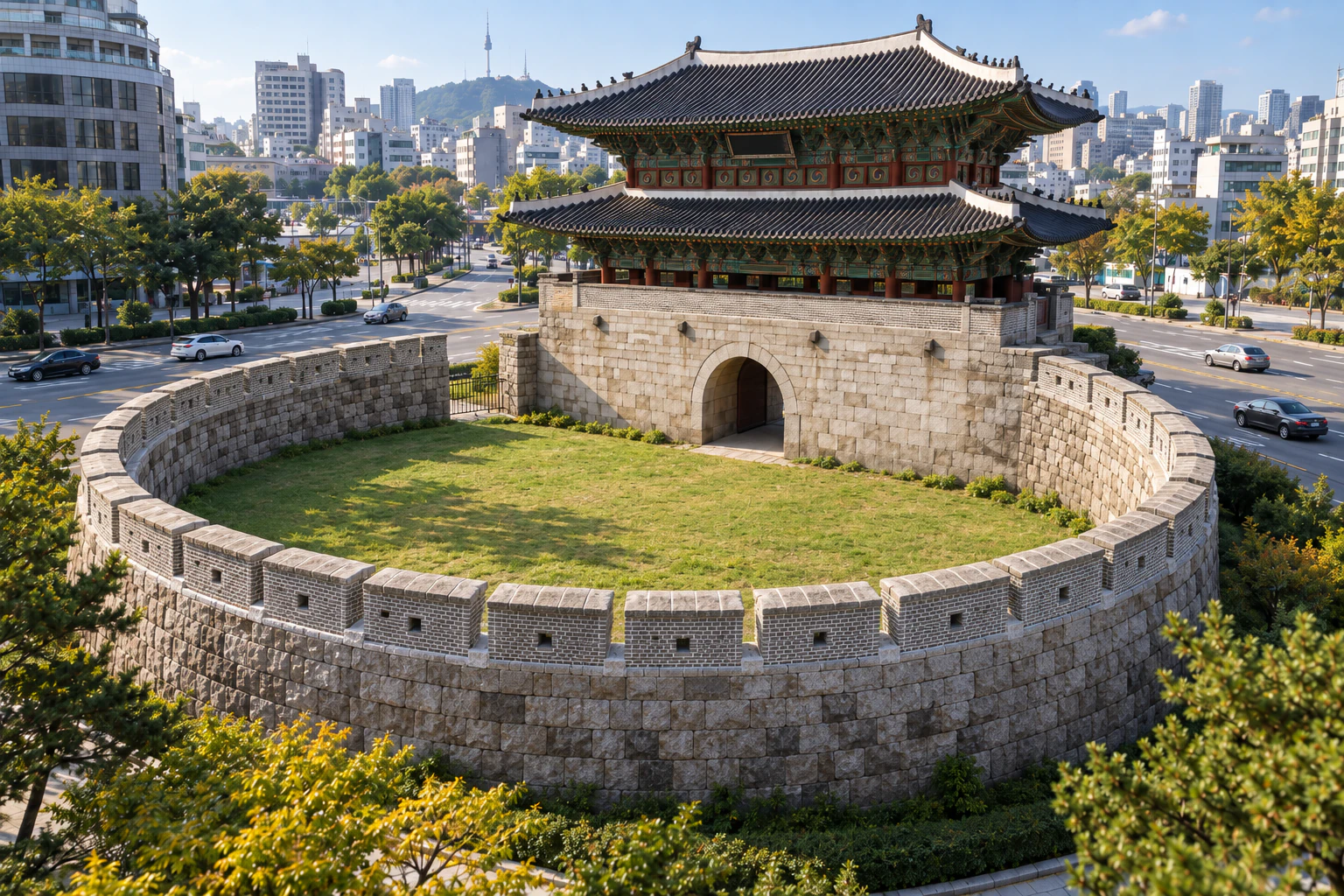
Rina corrects the half-moon in her notebook. What she drew across the road was only the outer line. Now she adds the inner one. Behind the park, a restored stretch of the city wall runs on toward Naksan.
At one side of the park is the Seoul City Wall Museum. The city’s wall website says it occupies floors one to three of the Seoul Design Support Center, built on part of the old Dongdaemun Hospital site, and the museum’s own website lists it as open Tuesday to Sunday, 9 a.m. to 6 p.m. (last entry 5:30), free of charge. Follow the wall uphill from the park and you are on the Naksan section — 3.2 kilometers from Hyehwamun to Gwanghuimun, about an hour and a half on foot, open 24 hours, according to the same website. Rina notes the numbers down for another day.
As the sun drops, Rina walks out along the wall toward the top of the park. She leaves with one thing. From a car window Dongdaemun looks like a single gate; seen twice on foot, it is two layers — a gate and a curved wall. Of the eight gates, this is the only one built that way.
Her note is short. Dongdaemun: once from across the road, once from the park above. The curved wall shows its inside only from above. The park, as of that 2021 article, is always open.
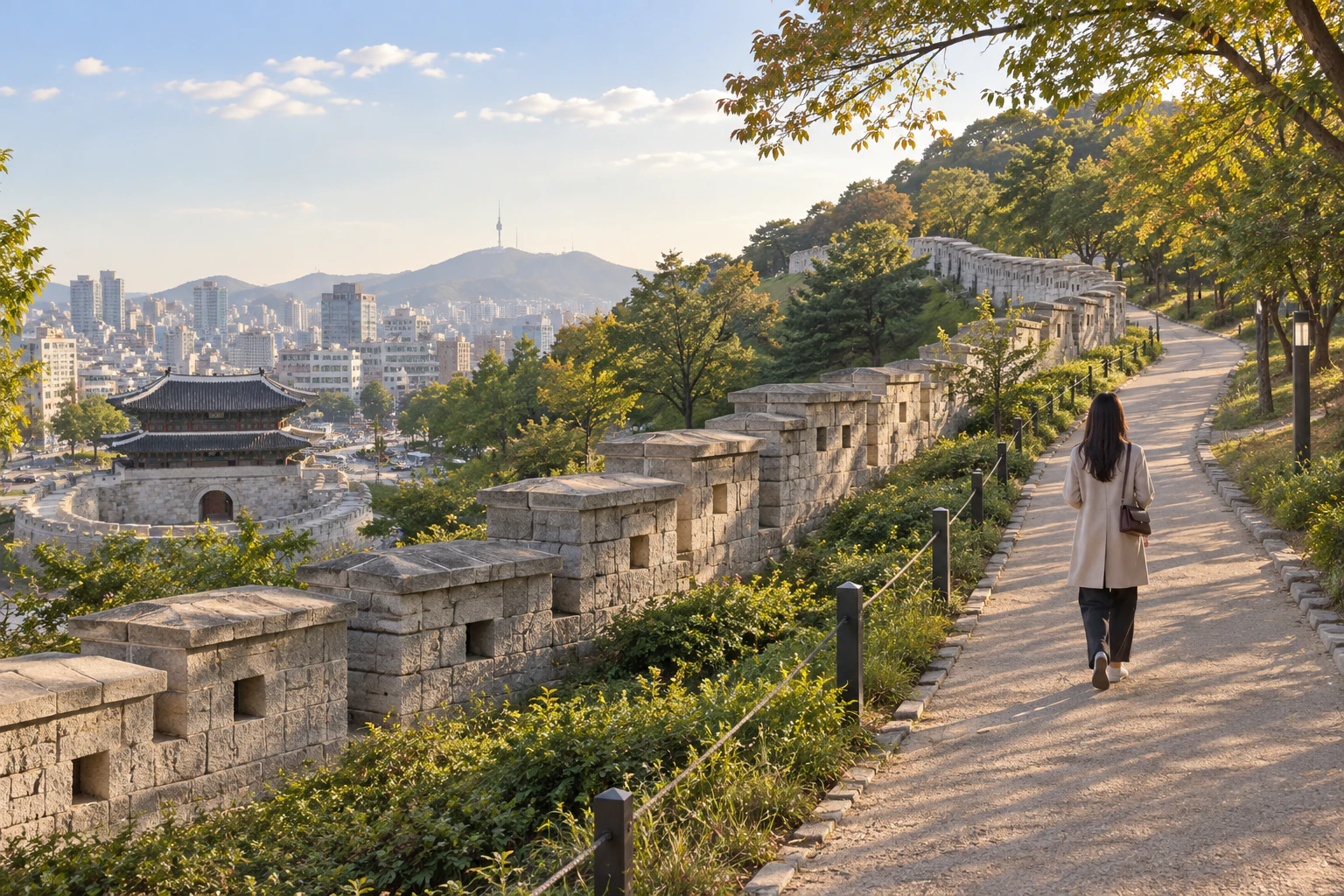
(※ This article includes staged images created with AI.)
Plan your visit
From Exit 1 of Dongdaemun Station, look at Heunginjimun first from the pavement across the road, then climb into Heunginjimun Park and look down into the ongseong. The 221 m / 3 min is a map-route calculation from Exit 1 to Heunginjimun Park. The gate stands in the middle of the road, so cross at the pedestrian crossings.
A concept diagram showing the order only · not to scale, direction or actual path shape.
- Pavement across the road — See the gate in the middle of the road and the curved ongseong in front of it in one view. Find on map
- Slope of Heunginjimun Park — At eye level with the gate: the two-storey pavilion and its hipped roof. Find on map
- Upper edge of the park — Look down into the round lawn inside the ongseong. Behind you, the restored city wall runs on toward Naksan. Find on map
Getting there
TMAPChecked 2026.09.24
From Exit 1 of Dongdaemun Station (Lines 1 and 4) to Heunginjimun Park, the map route is 221 m, about 3 minutes (TMAP pedestrian route calculation).
Checked 2026.09.24
Citizen reporter’s article on “Seoul in My Hand” (15 February 2021): Heunginjimun Park is open all year round with no admission fee.
Seoul City Wall websiteChecked 2026.09.24
the Naksan section is open 24 hours. When passing through Jangsu Village and Ihwa Village, walkers are asked to be considerate of residents.
Hours & fees
Seoul City Wall Museum websiteChecked 2026.09.24
open Tuesday–Sunday 09:00–18:00 (last entry 17:30), closed on 1 January and Mondays (open when a Monday is a public holiday). Admission is free.
Background9
Checked 2026.09.24
A citizen reporter’s article on the Seoul Metropolitan Government’s “Seoul in My Hand” platform (15 February 2021): Heunginjimun Park was created in 2010 on the former site of Ewha Womans University’s Dongdaemun Hospital. Set on the slope rising east of the gate toward Naksan, it lets you see into the ongseong from above.
Checked 2026.09.24
According to the Korea Heritage Service, Heunginjimun is the east gate among the eight gates of the Seoul city wall, commonly called Dongdaemun. It was built in 1396 when the wall was raised, rebuilt in 1453, and the present gate dates from 1869. It is a two-storey building five bays wide and two bays deep under a hipped roof, with bracket clusters both on and between the columns — slender and heavily decorated, typical of the late Joseon period.
Checked 2026.09.24
According to the Korea Heritage Service, a semicircular enclosing wall (ongseong) was built on the outside of Heunginjimun to protect the gate. It is the only one of the city’s eight gates with an ongseong.
Checked 2026.09.24
Seoul City Wall website (Seoul Metropolitan Government): because Seoul’s terrain is high in the west and low in the east, Dongdaemun was militarily the most vulnerable gate — which is why an extra ongseong was built outside it.
Seoul City Wall websiteChecked 2026.09.24
in 1907 the walls on either side of Heunginjimun were torn down, leaving the gate as it stands today.
Checked 2026.09.24
According to the Korea Heritage Service, the Seoul city wall had four main gates and four small gates. The main gates were Heunginjimun to the east, Donuimun to the west, Sungnyemun to the south and Sukjeongmun to the north. Only the east gate was given an ongseong to double its protection.
Checked 2026.09.24
According to the Korea Heritage Service, the city wall was begun in 1395 under a special construction office, and in 1422 every stretch built of earth was rebuilt in stone. During the Japanese colonial period gates and walls were torn down in the name of city planning, and more was destroyed after liberation and in the Korean War.
Seoul City Wall websiteChecked 2026.09.24
the Seoul City Wall Museum occupies floors 1–3 of the Seoul Design Support Center, built after part of Ewha Womans University’s Dongdaemun Hospital was demolished.
Seoul City Wall websiteChecked 2026.09.24
the Naksan section runs 3.2 km from Hyehwamun over Naksan and past Heunginjimun to Gwanghuimun, about 1 hour 30 minutes on foot.
- Heunginjimun Park is open all year round and free, according to a 2021 citizen reporter’s article on the city’s “Seoul in My Hand” platform (check current hours before you go). The Seoul City Wall Museum in the park is open Tuesday–Sunday 09:00–18:00 (last entry 17:30), closed on 1 January and Mondays (except public-holiday Mondays), free (museum website, checked 24 September 2026).
- This article’s route views the gate and its ongseong from the pavement across the road and from Heunginjimun Park.
- The gate stands on a traffic island. Use the pedestrian crossings.
More from this area

Names at the foot of the wall: from Seoul’s inscribed stones to the City Wall Museum
The second part of “Jongno and Dongdaemun.” At the entrance to Heunginjimun Park, where the city wall meets the main road, some of the stones low in its outer face are carved with writing. The Seoul City Wall website calls them gakja seongseok — inscribed wall stones — and says more of them are gathered beside Dongdaemun Seonggwak Park than anywhere else on the wall. The early ones name a section and a county; from Sukjong’s reign on, they name a supervisor, a builder and a date. Maya looks at the stones, then walks up to the Seoul City Wall Museum on the hill to read about the people who defended the wall.

An Evening Walk Along the Naksan City Wall
Follow the city wall uphill to Naksan for a view over Seoul at dusk.