
SEOUL · YONGSAN
The 3rd-floor Central Asian gallery, open until 9 pm: Noah’s map of the Dunhuang Buddhist sutras at the National Museum of Korea, drawn in the order things close
「천년의 봉인을 열다 — 돈황 불교 사경 소장품 특별공개」 (Opening a Thousand-Year Seal: Dunhuang Buddhist Sutras from the Collection), 23 October 2026 – 24 January 2027 · Central Asian gallery, World Culture Gallery, 3rd floor of the Permanent Exhibition Hall · 3 items, 8 pieces · open until 21:00 on Wednesdays and Saturdays (last entry 20:30) · the Museum Nadeulgil walkway from the Exit 2 side of Ichon Station
Noah’s time maps have always started at the moment a door opens. Today he is going to try the opposite, and write down the times when doors close, one by one. On the 3rd floor of a museum that stays open until 9 pm on Saturdays, sutras that lay sealed for nearly a thousand years are on display.
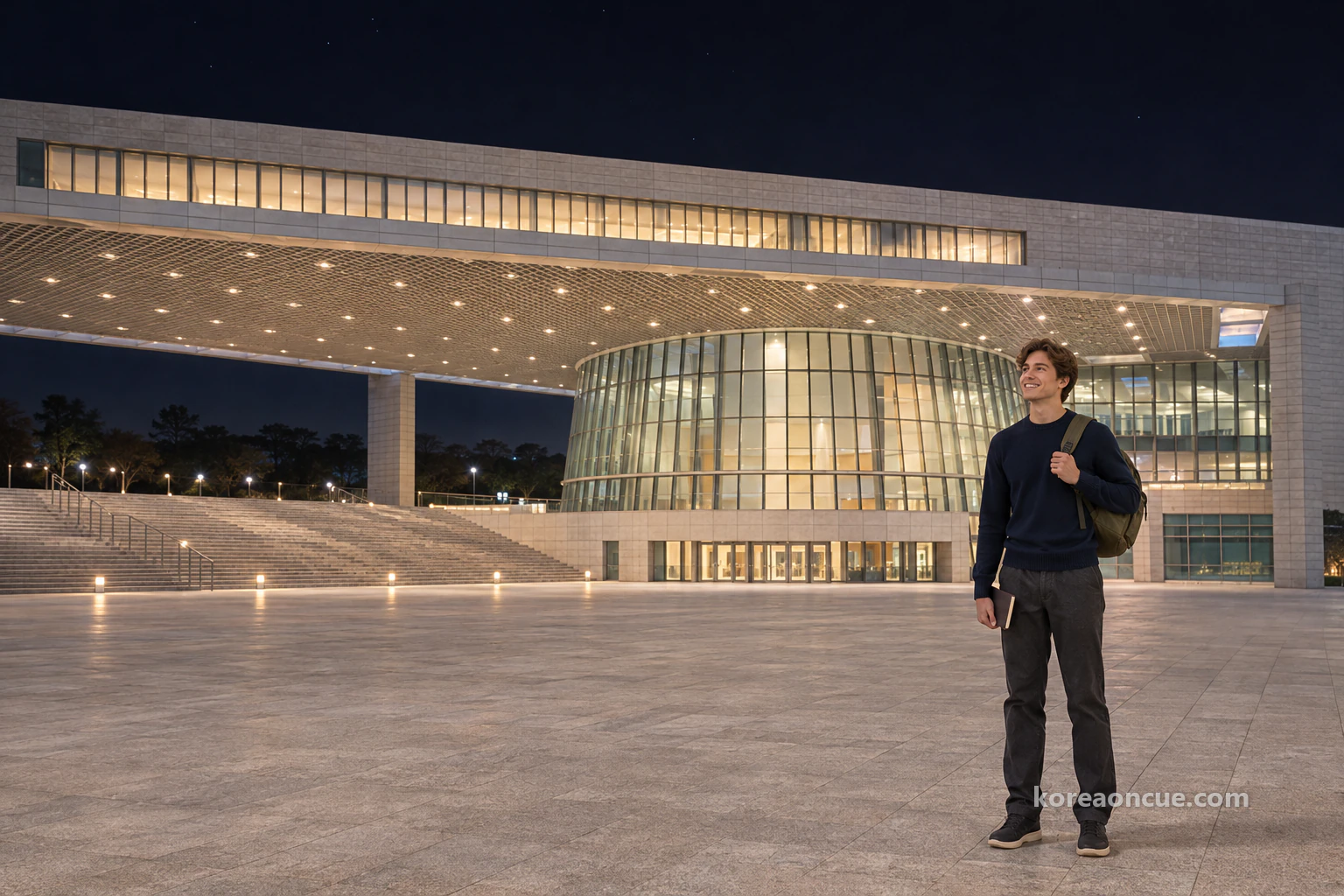
How to get there
A little after 5 pm on Saturday in the third week of November, Noah opens his notebook on the desk at his accommodation. Noah is twenty, from Canada, and he draws a map in his notebook of every place he walks for the first time. He adds times to those maps too, and calls them “time maps”. With the upright map he drew for the first time at the science centre two days ago, he already has five. But all five start at the time a door opens and end at the time Noah came out.
Today he wants to try it the other way round. On Saturdays the museum stays open until 9 pm, and the garden outside and the underground walkway to the station stay open even later. If he walks in the order that each door closes, he thinks he can catch on his map how a night folds itself away. On the right-hand edge of a blank page, Noah rules a single vertical line and writes “Closing order” at the top. On the left, as he did two days ago, he draws three boxes one above the other and leaves room for the building.

Today Noah is heading to the National Museum of Korea, at 137 Seobinggo-ro, Yongsan-gu. In the Central Asian gallery of the World Culture Gallery, on the 3rd floor of the Permanent Exhibition Hall, 「천년의 봉인을 열다 — 돈황 불교 사경 소장품 특별공개」 (Opening a Thousand-Year Seal: Dunhuang Buddhist Sutras from the Collection) is on. This piece follows Noah’s Saturday night in the order he walks it. From Ichon Station he takes the Museum Nadeulgil walkway, leaves his bag in the Great Hall and climbs the Path to History to the Central Asian gallery on the 3rd floor. After passing a ceramics display on the same floor and the Calligraphy and Painting Gallery on the 2nd, he heads back to the station in step with the times when the museum, the garden and the walkway close in turn.
The Cue — At a glance
The National Museum of Korea’s 「천년의 봉인을 열다 — 돈황 불교 사경 소장품 특별공개」 (Opening a Thousand-Year Seal: Dunhuang Buddhist Sutras from the Collection) runs from 23 October 2026 to 24 January 2027 in the Central Asian gallery (Room 307) of the World Culture Gallery, on the 3rd floor of the Permanent Exhibition Hall. It shows 3 items, 8 pieces, including the *Dazhidu lun* (Treatise on the Great Perfection of Wisdom), the *Great Prajñāpāramitā Sutra*, the *Śūraṅgama Sutra*, the *Sutra of the Buddha Names* and *Meditating Monk*, and puts four Dunhuang Buddhist sutras from the collection, among other items, on public display for the first time. The museum is open until 21:00 on Wednesdays and Saturdays (last entry 20:30), and until 17:30 on other days (last entry 17:00). On Wednesday 18 November, at 18:00 and 19:00, there is a curator talk on this exhibition. From the Exit 2 side of Ichon Station (Line 4 and the Gyeongui–Jungang Line), the “Museum Nadeulgil” walkway leads to the museum’s west gate.
- Subway: Ichon Station (Line 4 and the Gyeongui–Jungang Line), Exit 2 side → “Museum Nadeulgil” walkway → the museum’s west gate. There are lifts at Ichon Station Exit 1 and on the walkway on the Exit 2 side.
- Walkway hours: 07:00–23:00 (closed on museum closing days).
- Museum hours: Mon, Tue, Thu, Fri and Sun 09:30–17:30 (last entry 17:00) · Wed and Sat 09:30–21:00 (last entry 20:30). Staff start guiding visitors out 10 minutes before closing.
- Outdoor exhibition area (garden): 07:00–22:00.
- Closing days (2026): 1 January, Seollal (17 February) and Chuseok (25 September). Monday 7 December is a regular closing day for the Permanent Exhibition Hall, so this exhibition cannot be seen that day either.
- Exhibition: 23 October 2026 – 24 January 2027 · Central Asian gallery (Room 307), World Culture Gallery, 3rd floor of the Permanent Exhibition Hall · 3 items, 8 pieces.
- Bags and what you can bring: Belongings are checked at the security screening. Backpacks go in the 1st-floor lockers, and food is not allowed in.
- What to see: the Dunhuang Buddhist sutras, including the *Dazhidu lun*, and *Meditating Monk* · the curator talk on Wednesday 18 November · the themed display in the Buncheong Ware and White Porcelain Room on the same 3rd floor.
The nights it opens until 9 pm: closing at 21:00 on Wednesdays and Saturdays, last entry 20:30
The days you can stay late at the National Museum of Korea are Wednesday and Saturday. On those two days it opens at 9:30 am and closes at 9 pm. On Mondays, Tuesdays, Thursdays, Fridays and Sundays, it closes at 5:30 pm, and last entry is at 5. If you want to drop in after work or after dinner, pick a Wednesday or a Saturday. That is why Noah has chosen tonight, a Saturday, too: he wanted a day of walking another neighbourhood in daylight and coming to the museum in the evening.
Open in Kakao Map — Ichon Station
Before drawing the map, Noah fixes a small mistake. He had written “21:00” at the very top of the column on the right, but rereading the museum’s visitor information, he sees there is a separate last entry. On Wednesdays and Saturdays, last entry is at 8:30 pm. Entry ends 30 minutes before closing, and from 10 minutes before closing, staff start asking visitors to leave. Noah changes the top of the column to “20:30 last entry”, then writes “20:50” and “21:00” below it, in that order.
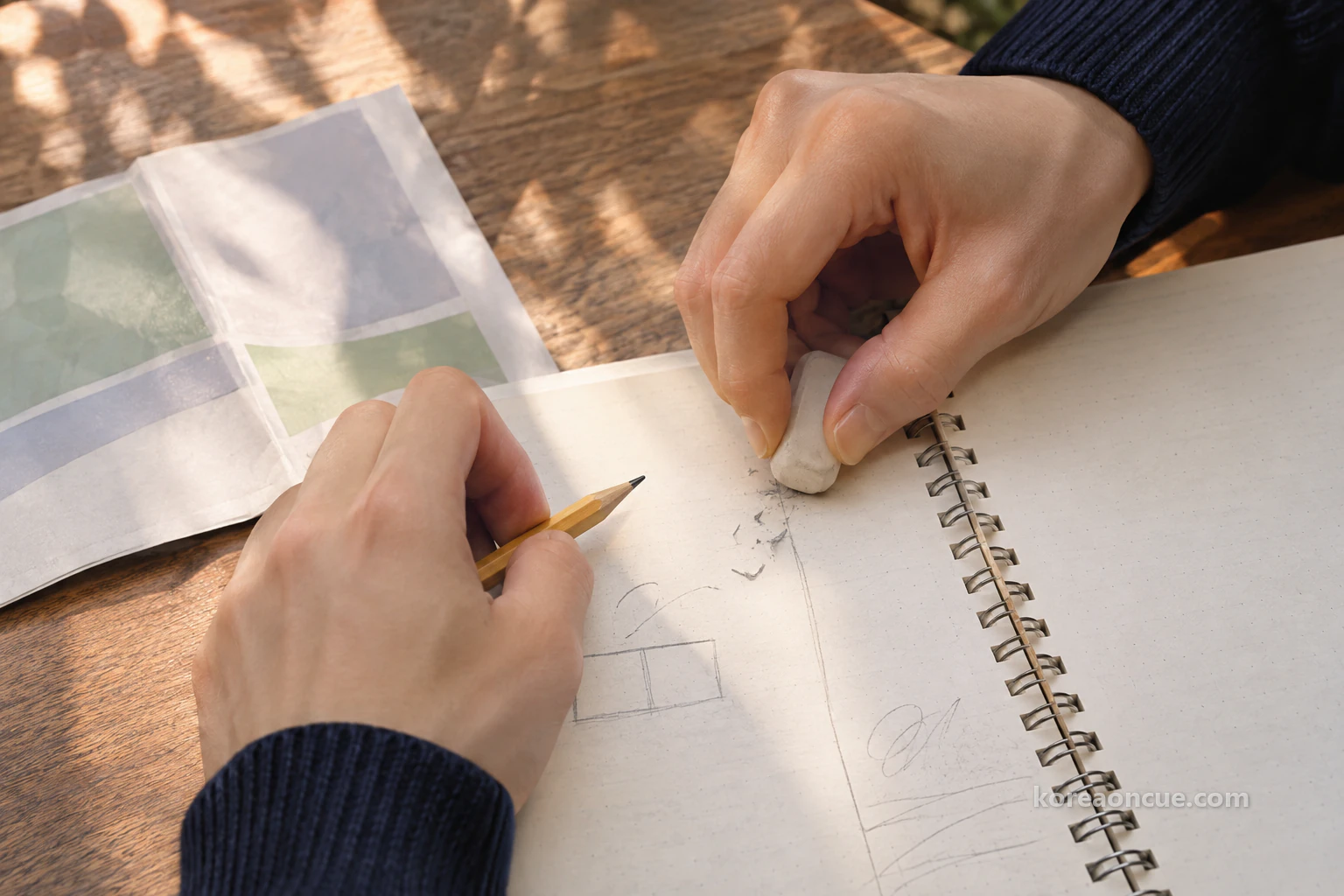
It helps to note the closing days as well. In 2026, the museum is closed on 1 January, on Seollal, 17 February, and on Chuseok, 25 September. It does open on Mondays, but the first Monday of March, June, September and December is a regular closing day for the Permanent Exhibition Hall. This December, that day is Monday the 7th, and since this exhibition is inside the Permanent Exhibition Hall, you cannot see it then. In a bottom corner of the column, Noah writes “12.7 Mon closed” in small letters.
When you go in the evening, it is easiest to count back from the closing times. You need to be inside the Great Hall before last entry at 8:30, and you have to allow time to leave your bag and climb to the 3rd floor. Noah decides to come in at about half past six, spend a little over an hour on the 3rd floor and leave about 20 minutes to come back down to the 1st floor. Because the exhibition is all in one room, that is enough to see another room on the same floor without hurrying. Count back from the closing times and settle the time you go in first.
The “Museum Nadeulgil” walkway from the Exit 2 side of Ichon Station: an underground path to the west gate, 07:00–23:00
By subway, get off at Ichon Station on Line 4 or the Gyeongui–Jungang Line. Head towards Exit 2 and you reach the “Museum Nadeulgil” walkway. This walkway leads to the museum’s west gate, so follow the name “Museum Nadeulgil” rather than the exit number and you won’t get lost. There are lifts at Ichon Station Exit 1 and on the walkway on the Exit 2 side, so look for those if you have heavy luggage.
The walkway is open from 7 am to 11 pm. On days when the museum is closed, the walkway does not open either. That means that even after the museum closes at 9 pm, you can still use this path to the station for another two hours. Seeing this figure, Noah decides where today’s map will end. When he writes “23:00 walkway” at the very bottom of the column on the right, the column is full from top to bottom.
The address to put into your phone map is “137 Seobinggo-ro”. The lot-number address is 168-6 Yongsan-dong 6-ga, and the postcode is 04383. The museum’s main phone number is 02-2077-9000, so you have a number to call if you get confused on the way. Noah writes the address in the bottom corner of the building boxes on the left of his map. If he gets lost in the dark, he wants this one line to come to mind before the map app does.
At 6:10 pm, Noah gets off at Ichon Station. At this time of year in November, it is already dark outside. Under the building boxes on the left of his map, Noah draws a small arrow and writes “18:10 Ichon” beside it. He decides not to time the journey here. What matters on today’s map is not when he arrives, but how much night is left between the closing times.
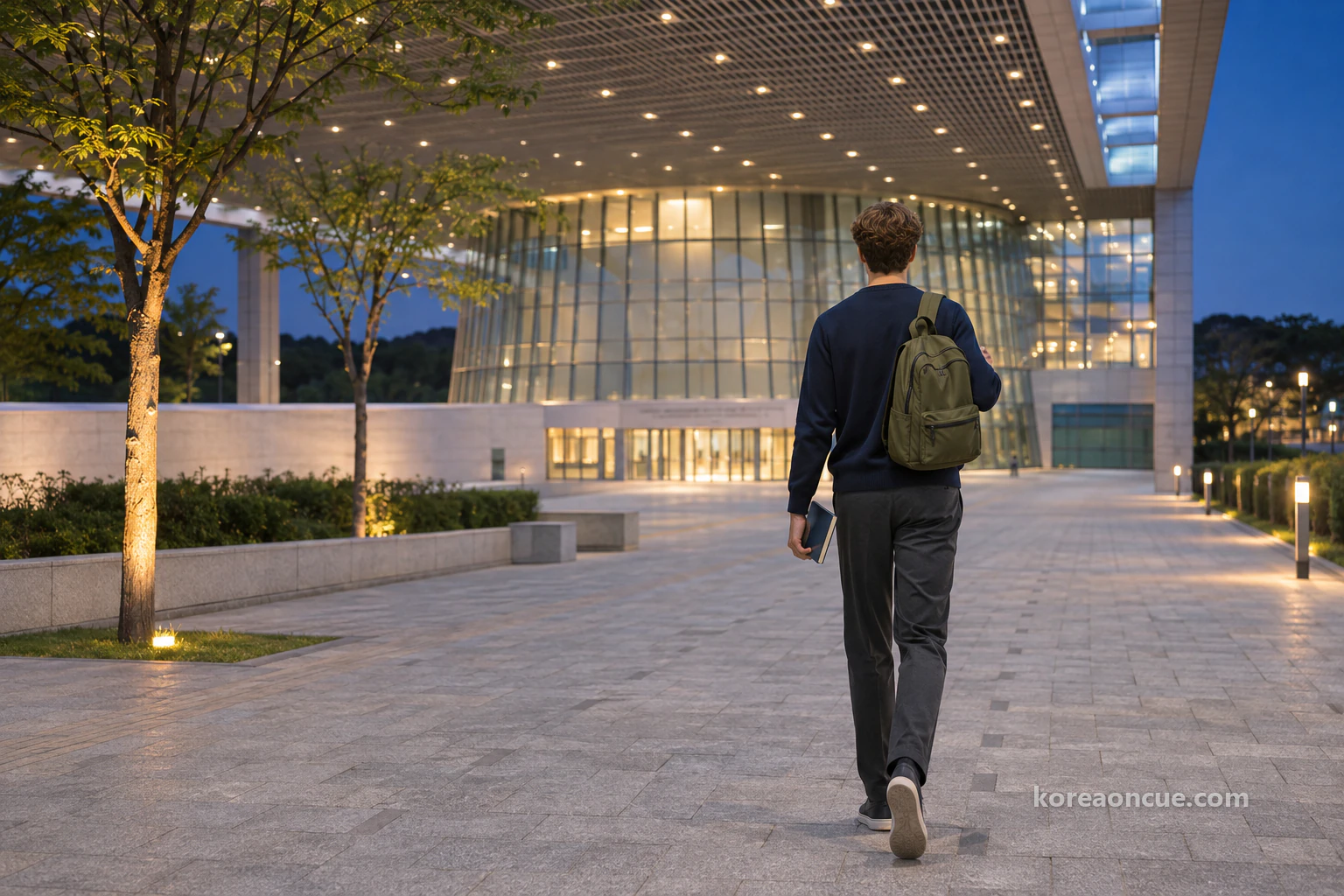
What to do first in the Great Hall: security screening, and backpacks in the 1st-floor lockers
The entrance to the Permanent Exhibition Hall is the “Great Hall” on the 1st floor of the east wing, where the information desk is too. Since 11 June 2024, belongings have been checked at the security screening. Backpacks and school bags have to go in the 1st-floor lockers. If you have come with a big bag, stop at the lockers before you go up to the galleries. Once your things are put away, your hands are free and the walk up through the building is much easier.
At about 6:25 pm, Noah stops for a moment in the Great Hall with his hand on his backpack strap. Inside the bag are two mandarins he brought from his accommodation. Food is not allowed in the museum. Noah frowns slightly, then remembers that the backpack has to go in a locker anyway, and smiles. He leaves the mandarins in the locker, bag and all, and takes only his notebook and pencil.
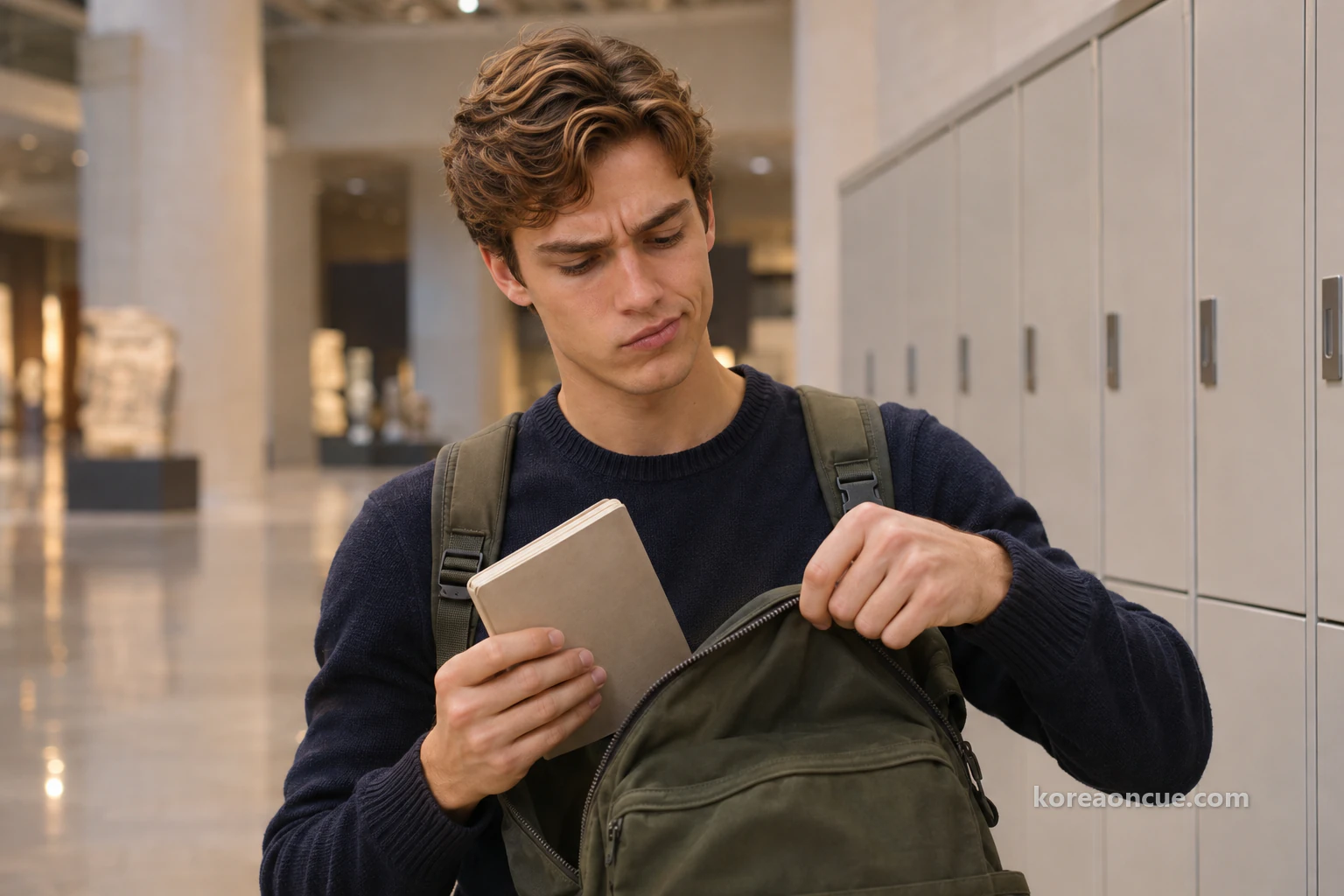
A few more things are worth knowing. Pets other than guide dogs are not allowed in, and you cannot enter wearing shoes with wheels. Photography with a flash, tripod, selfie stick or gimbal, and photography for commercial use, are banned throughout the museum. Noah prefers a pencil to a camera anyway, so tonight, too, he leaves his phone in his pocket and opens only his notebook.
Up to the 3rd floor by the Path to History: the route linking the 1st, 2nd and 3rd floors of the east wing
The Permanent Exhibition Hall spans the 1st, 2nd and 3rd floors of the east wing. The route that links floor to floor and room to room is the “Path to History”. Along it, you can move between the 1st, 2nd and 3rd floors and look round each gallery, whichever direction you are heading. On a first visit, it is easy to hesitate over where to go up, but following the Path to History makes getting lost much less likely. Noah, too, steps onto it from the Great Hall.
As he walks, Noah fills in the three boxes on the left of his map. In the bottom box he writes “1 Great Hall”, in the middle box “2” and in the top box “3 World Culture”. It is the same shape as the upright map he drew for the first time at the science centre two days ago. The difference is that a column of closing times now stands beside it on the right. Noah leaves plenty of room between the three boxes and the column, as space for joining them with lines later.
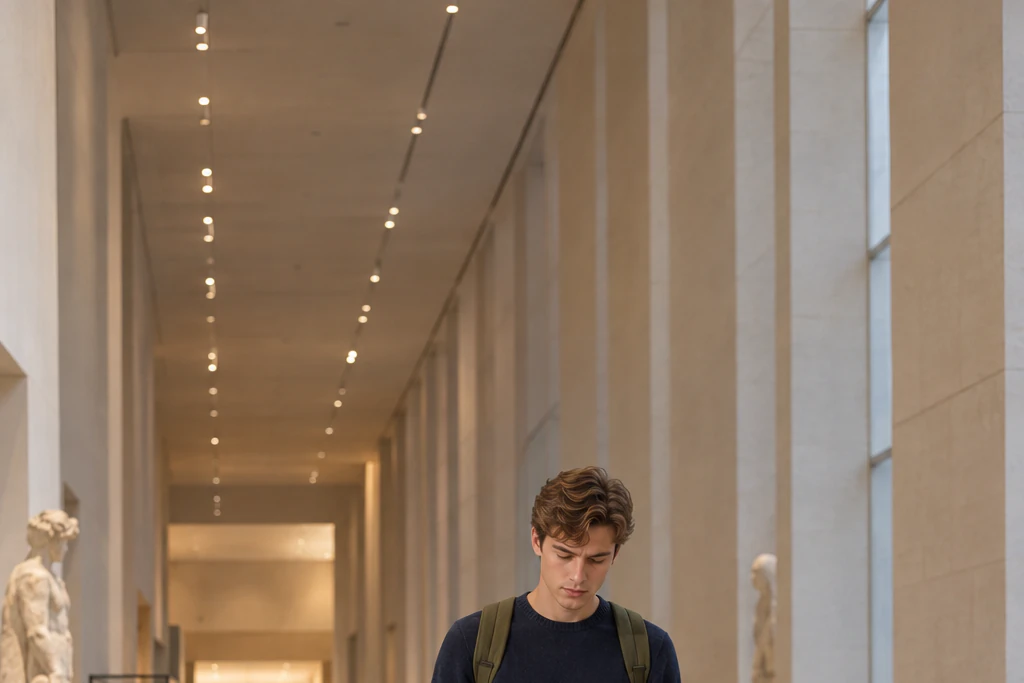
At 6:50, Noah reaches the 3rd floor. The 3rd floor has the World Culture Gallery, and the Sculpture and Crafts Gallery is on the same floor. Where Noah is going tonight is the Central Asian gallery, inside the World Culture Gallery. The 3rd floor on a Saturday night is quieter than he expected, so Noah slows down a little to soften his footsteps. In the top box he writes “18:50”, and next to it draws a small door to stand for the Central Asian gallery.
The Central Asian gallery (Room 307) in the 3rd-floor World Culture Gallery: 3 items, 8 pieces
The exhibition is in the Central Asian gallery of the World Culture Gallery, on the 3rd floor of the Permanent Exhibition Hall. The room number is 307. The full title is 「천년의 봉인을 열다 — 돈황 불교 사경 소장품 특별공개」, and it runs from 23 October 2026 to 24 January 2027. The museum classes it as a special exhibition. Come up from the Path to History to the 3rd floor and head for the World Culture Gallery.
At 7 pm, in front of Room 307, Noah reads the list of exhibits first: the *Dazhidu lun*, the *Great Prajñāpāramitā Sutra*, the *Śūraṅgama Sutra*, the *Sutra of the Buddha Names*, and *Meditating Monk*. At the end of the list are the words “3 items, 8 pieces”. Noah copies the two figures into his notebook side by side as “3 / 8”. With five names and two figures together on one line, he feels he has something to check off slowly, one by one, in front of the cases, and he is quietly pleased.
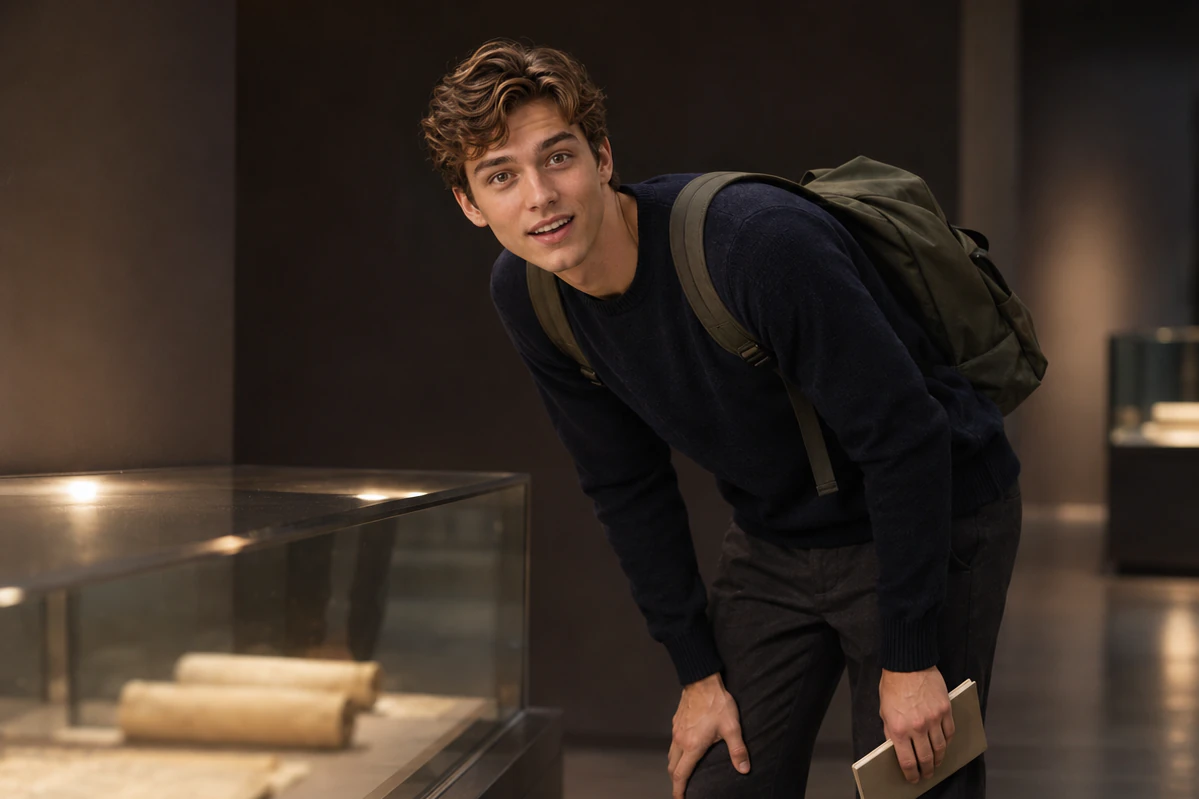
This exhibition presents the findings of a report the museum published in 2025, *Dunhuang Buddhist Sutras in the Collection of the National Museum of Korea*. It puts four Dunhuang Buddhist sutras from the collection, among other items, on public display for the first time. So the year after the report came out, you can see what it describes for yourself, in front of the cases. Noah draws two lines in pencil under the word “first”.
Noah decides not to copy the writing and the paper inside the cases onto his map. Instead, he notes only where he stood and how long he stayed. Looking is left to his eyes, and the pencil is kept for time and place. From 7 to 8 pm, lots of small dots appear inside the door he drew in the top box. The longer he stays in a spot, the darker the dot, and by 8 o’clock the door is almost full of dots.
What the “thousand-year seal” in the title means: Library Cave, Cave 17 of the Mogao Caves at Dunhuang, 1900
The meaning of the title starts with a place called Dunhuang. Dunhuang is an oasis city in Jiuquan, in China’s Gansu Province. Once the gateway to the Silk Road, it is where the Mogao Caves, a complex of cave temples, were made over a very long time. In one of them, Cave 17, the “Library Cave”, tens of thousands of cultural heritage items lay sealed for nearly a thousand years. The “seal” in the title comes from this cave.
Noah stands still for a long while in front of the words “gateway to the Silk Road”. A gateway is the door where a long road begins. Thinking of the people who passed through that door, Noah is reminded of his own maps, which start at subway exits. All six of his maps, after all, begin at a door of some kind. Trying not to let a laugh slip out, Noah draws a small door in the margin at the bottom of the page.
The Library Cave was discovered by chance in 1900. After that, “Dunhuang studies”, the research into its value, flourished. At this point Noah stops writing and rules a long horizontal line across the bottom of his notebook page. At the right-hand end he writes “1900”, then pushes the line left all the way to the edge of the page and writes “nearly a thousand years”. The night-time hours in the column on the right last a few hours, but this line lasts a thousand years.
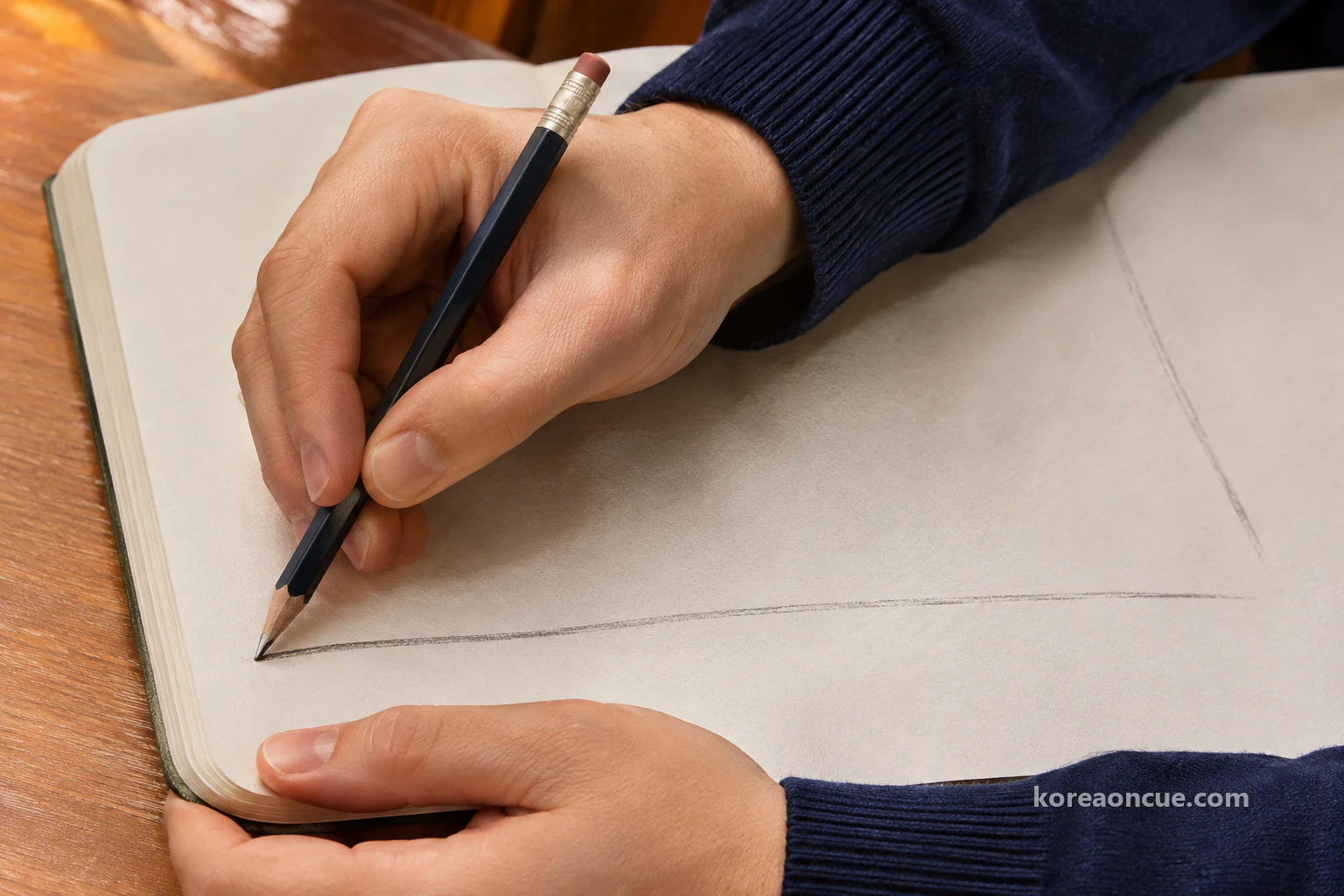
Looking from one line to the other, Noah gives a little laugh to himself. The time Noah has tonight is a little over two hours, until the museum closes. Yet the paper in front of him waited in a cave for far, far longer than that before coming out. Noah chooses to walk slowly. Even with only two hours, looking without hurrying seems like the one thing he can do in front of things that waited so long.
Four scrolls bought by the Yi Royal Family Museum: the 2025 report and the sutras shown for the first time
How these sutras came to the museum is also told briefly in the exhibition text. Four Dunhuang Buddhist sutras were bought by the Yi Royal Family Museum during the Japanese colonial period. In 2025, the National Museum of Korea published a report introducing these four. This exhibition presents the findings of that report. On the long line at the bottom of his map, Noah adds the name “Yi Royal Family Museum” in small letters.
What catches Noah’s eye on the list are the numbers after the names. After the four sutras comes “Deoksu 4555”, and after *Meditating Monk* comes “Bongwan 4037”. Noah copies the two numbers side by side next to the top box of his map. Five names grouped under two numbers look to him just like two stations on a map. For Noah, who loves numbers, it is the most enjoyable line of the night.

The exhibition text ends on a short wish. “We hope you will listen to the words of wisdom that have come, across a vast span of time, from the home of Buddhist sutras.” Noah reads along with the sentence silently, moving only his lips. He thinks the idea of listening suits a quiet gallery at night. The exhibition is run by the World Culture Department, and the enquiries number is 02-2077-9558.
Why copy out the *Dazhidu lun*? Four questions from the linked international symposium
There was a one-day event linked to this exhibition. On Friday 6 November 2026, an international academic symposium ran from 10:30 to 16:30. It was in the Small Auditorium of the National Museum of Korea’s Education Center, and a researcher from the Dunhuang Academy in China gave a special lecture. Entry was free on a first-come, first-served basis.
The symposium notice set out four questions. The first is “Why was the *Dazhidu lun*, a treatise rather than a sutra, copied out by hand?” The second is “How did the Dunhuang Buddhist sutras come all the way to the National Museum of Korea?” The third is “How was paper made in the Sui dynasty 1,400 years ago?”, and the fourth is “Who else in Korea holds Dunhuang Buddhist sutras, and how?”
The second question connects with the text Noah has just read. The exhibition text only goes as far as the Yi Royal Family Museum buying the four scrolls during the colonial period. What route they took from Dunhuang to Seoul before that is left as a question. Next to the second question mark, Noah draws an arrow and leaves its end as a dotted line. It is the mark he always uses when he doesn’t know a route all the way.
Noah carries the four questions onto his map as four question marks. Looking with a question in mind, rather than knowing the answer, keeps him in the gallery longer. In front of the cases, Noah stands for a long time by the first question mark. He can’t work out here exactly how a treatise differs from a sutra, but just wondering about the difference makes the paper look different to him. The symposium on these questions was held on Friday 6 November in the Small Auditorium of the Education Center.
Curator talks on Wednesday nights: Wednesday 18 November, 18:00 and 19:00, Central Asian gallery (Room 307)
On Wednesday nights there are curator talks. From 4 to 25 November 2026, the museum holds curator talks every Wednesday at 18:00–18:30 and 19:00–19:30. The programme runs during the Wednesday late opening, and admission is free. The session on this exhibition is session 898, on Wednesday 18 November. Its title is 「천년의 봉인을 풀다: 돈황불교사경」 (Unsealing a Thousand Years: Dunhuang Buddhist Sutras), it takes place in the Central Asian gallery (Room 307), and it is led by Lee Jae-ho of the World Culture Department.
Taking part is simple. There is no need to apply in advance, you can join on the spot, and there is no limit on numbers. For special exhibitions, though, you can only take part if you are inside the gallery at that time, and once you leave you cannot go back in. When a Wednesday is a public holiday, the programme does not run. So it is more relaxing to get into Room 307 a little before the start and look round the cases while you wait.
Next to the door in the top box of his map, Noah writes this schedule as “Wed 18:00 / 19:00 — Room 307”. That Wednesday was three days ago, so this box is a note for someone else. Noah underlines the condition “you must be inside the gallery”. On 18 November, it is easiest to plan your route so that you are inside Room 307 before 6 pm. Go up to the 3rd floor first for the 6 pm session, and see the other rooms afterwards.
The Buncheong Ware and White Porcelain Room on the same 3rd floor, and the Calligraphy and Painting Gallery on the 2nd: two rooms to stop at on the way down
Leaving the Central Asian gallery, Noah stops at one more room on the same 3rd floor. It is the Buncheong Ware and White Porcelain Room in the Sculpture and Crafts Gallery, on the 3rd floor of the Permanent Exhibition Hall. Here the themed display 「사계절 푸른 대나무, 도자기에 담다」 (Evergreen Bamboo, Captured in Ceramics) runs from 23 June 2026 to 31 January 2027. Its dates almost overlap with the Dunhuang sutra exhibition, so while you are on the 3rd floor, it is easy to see both at once. At the right-hand end of the top box, Noah writes “Bamboo — 3F”.
At 8:10, Noah finishes a lap of the room and checks the time. Last entry at 8:30 is getting close, but for anyone already inside, there is time left until the doors close at 9. Noah takes the Path to History down one floor. In the Calligraphy and Painting Gallery on the 2nd floor, 「추사 김정희와 그의 동반자」 (Chusa Kim Jeong-hui and His Companions) runs from 11 August to 22 November 2026. Today is the 21st, so for Noah it is the day before it ends.
At 8:35, in front of the Calligraphy and Painting Gallery, Noah writes “–11.22” in the middle box. Then he decides to look round that room only briefly. Tonight’s centre was the 3rd floor, and he wants to spend the time left walking in the order things close. If you go before 22 November, it is easiest to stop at the 2nd-floor Calligraphy and Painting Gallery on your way down from the 3rd floor. Noah joins the 2nd-floor box and the 3rd-floor box with one short diagonal line.
20:50 guidance out, 21:00 closing, 22:00 garden: heading outside in the order things close
From 8:50 pm, 10 minutes before closing, staff start asking visitors to leave. Noah times it so that by then he has taken the Path to History down to the Great Hall on the 1st floor. He takes his backpack out of the locker, sees the two mandarins are still there, and smiles to himself. A small tick goes in beside “20:50” in the column on the right. That is the end of his night inside the museum, but there are still three lines left in the column.
At 9 pm, the museum closes. But the night does not end there. The outdoor exhibition area outside the museum, in other words the garden, is open from 7 am to 10 pm. That means you can walk for another hour outside the closed building. Between “21:00” and “22:00” in the column, Noah draws three small trees to stand for the garden.
Noah walks slowly along the garden’s low lights. Deciding to eat the mandarins back at his accommodation, he looks down at the column on the right of today’s map. “20:30”, “20:50”, “21:00”, “22:00”, “23:00”. The further down it goes, the bigger the thing that closes. The gallery door, the museum door, the garden, and finally the path to the station.
To Ichon Station along the walkway, open until 11 pm: the sixth map sent to Hina
At 9:45, Noah leaves the garden and comes back to the walkway. The walkway is open until 11 pm, so even though he has come out before the garden closes at 10, there is no need to rush. Passing the west gate, Noah draws one more arrow under the building boxes on the left of his map, pointing the other way. Lying side by side with the arrow he drew on the way in, it shows at a glance that the way in and the way out are the same path. Beside it goes “21:45 walkway”.
As he walks, Noah photographs today’s map with his phone. At the very back of his notebook, the time map Hina gave him in Ttukseom on Halloween night is still tucked in. Since then, Noah has been sending Hina maps drawn the same way, and today’s is the sixth. Under the photo, Noah writes briefly: “Today I wrote down the times things close, not the times they open. The one at the bottom closes last.”
After sending it, Noah looks once more at the long line at the bottom of his notebook page. The night-time hours in the column on the right and the thousand-year line along the bottom sit together on the same page. It is the first time he has put two kinds of time on one map. The map he stood upright at the science centre has, tonight, grown sideways once more. Noah puts his phone in his pocket and goes through the ticket gates at Ichon Station before 10 pm.
If you go to see this exhibition, pick a Wednesday or Saturday evening. Get in before last entry at 8:30 pm, leave your bag in the Great Hall and take the Path to History straight up to the Central Asian gallery on the 3rd floor. If you see the Buncheong Ware and White Porcelain Room on the same floor before coming down, then even after the museum closes at 9, the garden is open until 10 and the walkway until 11. On Wednesday 18 November, get into Room 307 before 6 pm and wait for the curator talk. Monday 7 December is a closing day for the Permanent Exhibition Hall, so avoid it.
Common Mistakes
Taking last entry for closing time
on Wednesdays and Saturdays the museum closes at 21:00, but last entry is at 20:30. Staff start guiding visitors out 10 minutes before closing.
Going on another evening
the only days it opens until 9 pm are Wednesday and Saturday. On Mondays, Tuesdays, Thursdays, Fridays and Sundays it closes at 17:30.
Looking for it in the Special Exhibition Galleries because it is a special exhibition
this exhibition is in the Central Asian gallery (Room 307) of the World Culture Gallery, on the 3rd floor of the Permanent Exhibition Hall.
Heading into the galleries with a backpack on
backpacks and school bags have to go in the 1st-floor lockers. Food is not allowed in either.
Trying to join a curator talk halfway through
you can only take part if you are inside the gallery at that time, and once you leave you cannot go back in. The session on this exhibition is on Wednesday 18 November at 18:00 and 19:00.
Going on Monday 7 December
it is a regular closing day for the Permanent Exhibition Hall, so this exhibition cannot be seen either.
FAQ
How long is the exhibition on?
From 23 October 2026 to 24 January 2027.
Where is it?
In the Central Asian gallery (Room 307) of the World Culture Gallery, on the 3rd floor of the National Museum of Korea’s Permanent Exhibition Hall. From the Great Hall (1st floor of the east wing), take the Path to History up to the 3rd floor.
What is on show?
3 items, 8 pieces, including the *Dazhidu lun*, the *Great Prajñāpāramitā Sutra*, the *Śūraṅgama Sutra*, the *Sutra of the Buddha Names* and *Meditating Monk*. Four Dunhuang Buddhist sutras from the collection, among other items, are on public display for the first time.
Can I see it in the evening?
On Wednesdays and Saturdays the museum is open until 21:00, with last entry at 20:30.
Do I need to apply for the curator talk?
No. You can join on the spot, and there is no limit on numbers. The session on this exhibition is on Wednesday 18 November, 18:00–18:30 and 19:00–19:30.
When was the symposium?
Friday 6 November 2026, 10:30–16:30, in the Small Auditorium of the National Museum of Korea’s Education Center.
Which station should I use?
Ichon Station on Line 4 and the Gyeongui–Jungang Line. The “Museum Nadeulgil” walkway on the Exit 2 side leads to the museum’s west gate, and the walkway is open 07:00–23:00 (closed on museum closing days).
Who do I contact with questions?
The museum’s main number is 02-2077-9000, and for this exhibition, the World Culture Department on 02-2077-9558.
Recap — 30 seconds before you go
- Ichon Station, Exit 2 side → “Museum Nadeulgil” walkway (07:00–23:00) → the museum’s west gate → National Museum of Korea (137 Seobinggo-ro).
- Wed and Sat 09:30–21:00 (last entry 20:30) · other days until 17:30 · Permanent Exhibition Hall closed Monday 7 December.
- Central Asian gallery (Room 307), World Culture Gallery, 3rd floor of the Permanent Exhibition Hall · 23 October 2026 – 24 January 2027 · 3 items, 8 pieces.
- Security screening in the Great Hall · backpacks in the 1st-floor lockers · no food.
- Curator talk Wednesday 18 November, 18:00 and 19:00 (join on the spot) · garden open until 22:00.
Sources
- National Museum of Korea — exhibition page, “천년의 봉인을 열다-돈황 불교 사경 소장품 특별공개” (Opening a Thousand-Year Seal: Special Presentation of Dunhuang Buddhist Sutra Manuscripts)23 Oct 2026 – 24 Jan 2027 · Central Asia Gallery, World Culture Hall, 3rd floor of the Permanent Exhibition Hall · 『대지도론』, 『대반야경』, 『능엄경』, 『불명경』 (덕수4555) and <명상하는 승려> (본관4037) among 3 items, 8 pieces in allchecked 2026-11-03
- National Museum of Korea — visitor informationMon, Tue, Thu, Fri and Sun 9:30–17:30 (last entry 17:00), Wed and Sat 9:30–21:00 (last entry 20:30) · outdoor exhibition grounds (garden) 7:00–22:00 · backpacks go in the 1st-floor lockerschecked 2026-11-03
- National Museum of Korea — directions (subway)Lines 4 and Gyeongui-Jungang, Ichon Station Exit 2, towards the “박물관 나들길” (Museum Nadeul-gil) ⇔ the museum’s west gate · Nadeul-gil open 07:00–23:00 · 137 Seobinggo-ro, Yongsan-guchecked 2026-11-03
- National Museum of Korea notice — symposium linked to the Dunhuang sutra exhibition (30 Oct 2026)Friday 6 November 2026, 10:30–16:30 · Small Auditorium, Education Hall · free on a first-come basischecked 2026-11-03
- National Museum of Korea — “Conversations with Curators” in November (night opening)Wednesdays 4–25 November, 18:00–18:30 and 19:00–19:30 · the 18 Nov session covers the Dunhuang sutras · Central Asia Gallery (Room 307) · walk-in participationchecked 2026-11-03
- National Museum of Korea — exhibition spacesPermanent Exhibition Hall, East Building floors 1–3 · 으뜸홀 (Eutteum-hol), the information hall at the East Building entrance · the History Road links the gallerieschecked 2026-11-03
A Seoul story told with our AI characters. Place details are checked against public sources; the photos are AI-made illustrative images. How we use AI
More from this area

Haebangchon: choosing where to get off the village bus
On the day an overdue lunch was to be repaid in Haebangchon, Mali took charge of the route.
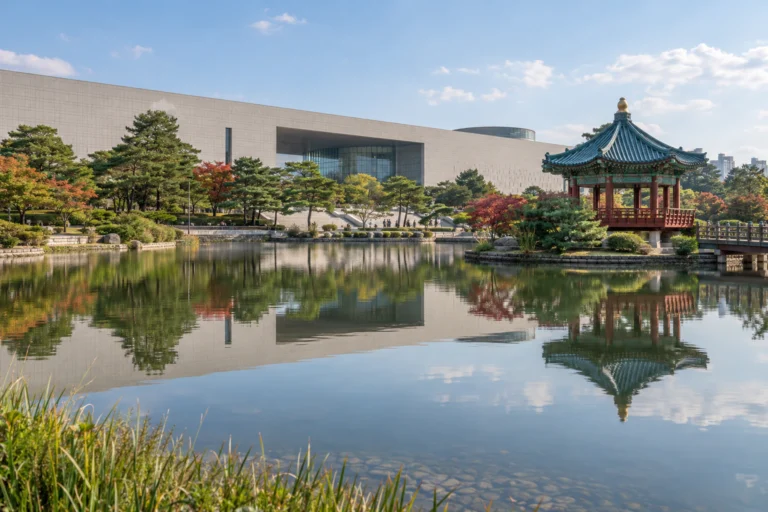
National Museum of Korea: the open yard and the pond
The first part of “Yongsan.” The National Museum of Korea opened in its new building in Yongsan on 28 October 2005. Its website gives a total floor area of 146,765.88 square metres, designed by Junglim Architecture. The permanent galleries are free, and on Wednesdays and Saturdays the museum stays open until 9 p.m. Lulu, choosing places to show a friend arriving from abroad next month, looks at the open yard in the middle of the building and the pond in front of it before any gallery.