
SEOUL · INSADONG
Inside the Gate at Jogyesa Temple
Step off the main road and through Jogyesa’s gate to find flower-lattice doors and an old lacebark pine.

How to get there
Exits are as given in the temple’s directions; distances and times are route-planner figures.
Leaving Tapgol Park, Noah wrote: “A temple with a courtyard. That is someone else’s afternoon.” That afternoon is now Rina’s. Jogyesa Temple — one block west of Insadong-gil, on Ujeongguk-ro.
It is Rina’s second time. On her first trip to Seoul she came out of Insadong past this temple, took one photograph in front of the main hall, and turned back. Rina had already seen many temples in Japan, so this one did not feel unfamiliar to her, and at the time it ended at “a temple, then.” That is exactly why she is back. A place you skip because it feels familiar is a place where the familiarity hides the differences. She has come to check those differences in detail.
Three things she knew before coming. That the temple began in 1910 under the name Gakhwangsa and, by way of Taegosa, came to be called Jogyesa (the temple’s own listing gives 1954). That the main hall is not a building that was built here, but one moved from Jeongeup in 1938. And that the grounds are open 24 hours. Each of the three sits a little apart from the grammar of the temples Rina has visited.
From Ujeongguk-ro to Iljumun — through the gate, straight into the courtyard
55 Ujeongguk-ro. From Exit 6 of Anguk Station (Line 3) it is 306 m, about 4 minutes; from Exit 2 of Jonggak Station (Line 1) 357 m, about 5 minutes (TMAP pedestrian routing, exit to Iljumun gate). The temple’s directions also list Exit 2 of Gwanghwamun Station (Line 5). Parking is limited and charged.
Out of Exit 6 of Anguk Station and south. As the temple’s directions say: about fifty metres, cross at the lights, a little further on the left, and the approach is on the right. By the route planner, 306 metres, four minutes. A short lane turning off the main road, and at the end of it stands Iljumun, the one-pillar gate. Find on map

The first thing Rina checks is the distance in front of the gate. At the temples she has visited, it is a long way from the gate to the hall — an approach path, trees on both sides, time spent walking in. Here, through the gate, the courtyard is right there. Main road — lane — gate — courtyard. Four short stretches, one after another. The temple describes itself as the only traditional temple in the middle of Jongno. That the distance between the main road and the courtyard is short shows from the gate onwards.
She looks up at Iljumun. A gate whose pillars stand in a single row. According to the temple, it is a recent addition, built along with the restoration of the main hall. Rina does not remember this gate from her first visit. Back then she only looked at the hall from the courtyard. The photo she took toward the hall that day did not include the gate.
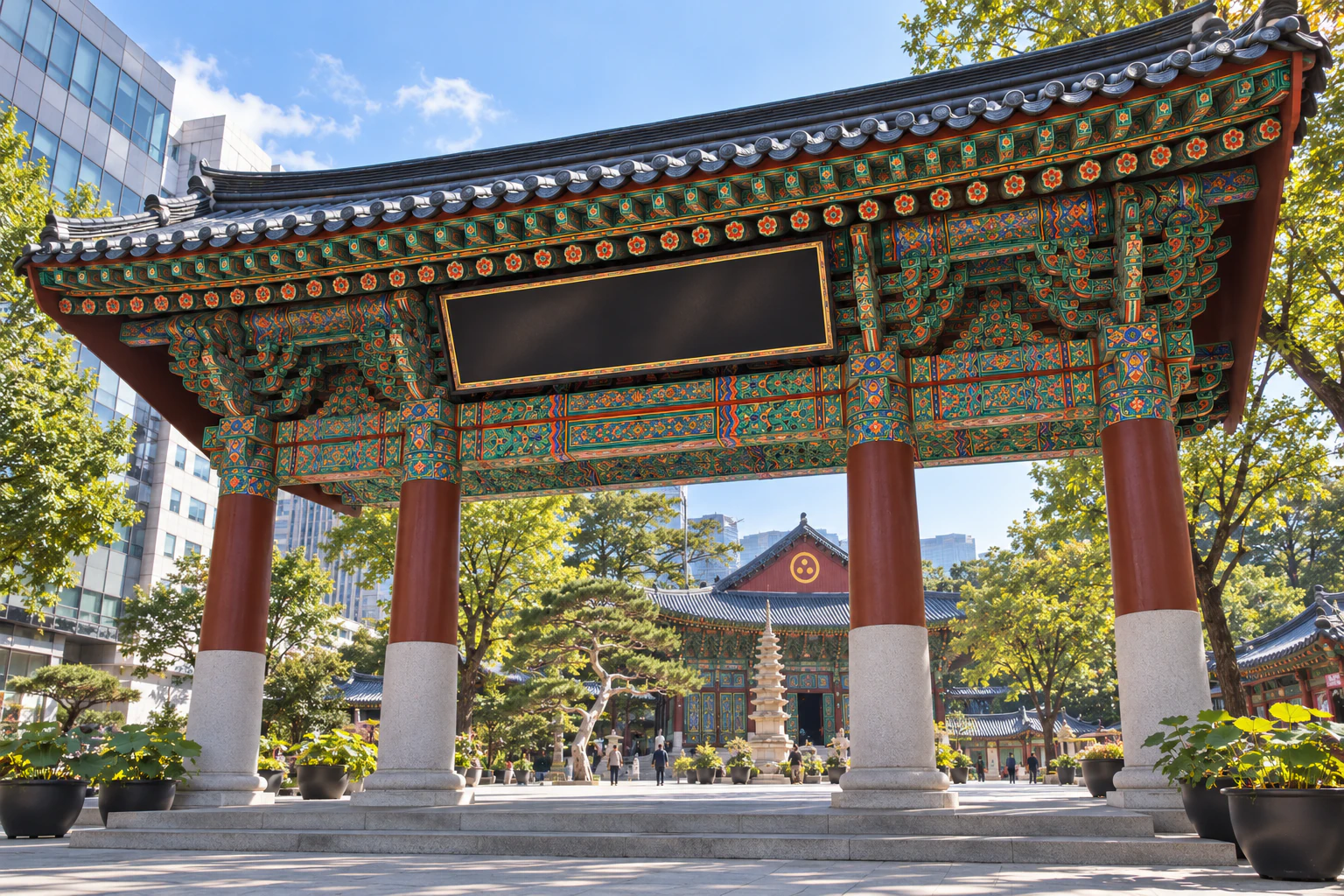
Through the gate. The courtyard opens.

In the courtyard — a hall that was moved
Jogyesa Temple is the head temple of the Jogye Order of Korean Buddhism. It was founded in 1910 as Gakhwangsa; work on the head temple at the present site began in 1937, and the main hall’s dedication ceremony was held on 25 October 1938. It later took the name Taegosa and then Jogyesa (the temple’s own listing gives 1954). The grounds are open 24 hours (temple listing).
Straight ahead across the courtyard is Daeungjeon, the main hall — a wide building under a high, steep roof, with a pagoda in front of it and two trees. On the temple’s site map the pagoda is the ten-storey octagonal reliquary pagoda and the trees are a pagoda tree and a lacebark pine. Rina folds the map and stands in the middle of the courtyard. This is probably about where she took the photograph the first time. Find on map

The difference between that photograph and what she sees now is that she knows the building’s history. According to the temple, Daeungjeon was moved here in 1938 from Jeongeup, where it had been a building called the Sibiljeon of the Bocheongyo religion, and rebuilt; the dedication ceremony was on 25 October 1938. The temple itself began as Gakhwangsa in 1910; work on the head temple at the present site began in 1937, and it later took the name Taegosa and then Jogyesa.
Rina reads that fact once more. “The hall was moved.” At the temples she has visited, a hall is built on its spot and grows old on its spot. This hall was built in another city as Bocheongyo’s Sibiljeon, then brought here — and now it is the centre of this courtyard. It is the kind of fact a repeat visitor likes: something you cannot possibly know the first time, and which makes the same building look different the second time.

The courtyard opens wide. The temple writes that the grounds fill with lanterns in spring, lotus in summer and chrysanthemums in autumn. What is in the courtyard on a given day is up to that day. Rina looks at the empty part of it. Seeing what a space is for is also a second-visit thing.
At the flower-lattice doors — every lattice a flower
The main hall, Daeungjeon, is a building moved here in 1938 from Jeongeup, where it had been the Sibiljeon of the Bocheongyo religion, and rebuilt (dedication ceremony 25 October 1938). It is seven bays across and four deep, with a hip-and-gable roof and multi-bracket eaves, and every door in every wall has a flower-pattern lattice (temple listing; Korea Heritage Service, Seoul Tangible Cultural Heritage).
She goes up to the hall. The Korea Heritage Service describes it as seven bays across and four deep, with a hip-and-gable roof and multi-bracket eaves, and notes that the doors in every wall are lattices decorated with flower shapes. This is the detail Rina came to check today. Find on map

Up close, the lattice is not a grid but flowers. Each panel is woven from petals, and that continues along all seven bays of the front. The hall doors Rina has seen elsewhere mostly have straight bars. Here the door is the decoration and the decoration is the door. Her expression changes a little. The doors must have been in her first photograph, but that time she photographed the building, not the doors.

Rina chooses to stop at the doors today. This piece does not cover the inside of the hall; her camera stops at the lattice too. The flower doors are enough from outside.
She looks up at the eaves. The bracket sets are dense, above the columns and between them — what the heritage listing calls the multi-bracket style. The dancheong colours gather under the eaves. To Rina, the colours feel different from the temple colours she is used to seeing in Japan. Where exactly the difference lies is hard to put into words, and since one more look at the detail might tell her, she looks once more.

At the lacebark pine — white bark, the living branches
The lacebark pine beside the main hall is a Natural Monument estimated to be about 500 years old, 13.6 m tall and 2.0 m around at chest height. Its bark peels in broad patches to show white, and only the branches reaching toward the main hall are alive (Korea Heritage Service).
Beside the hall stands the lacebark pine. It is a Natural Monument, and the Korea Heritage Service estimates its age at about 500 years: 13.6 metres tall, two metres around at chest height. What Rina looks at first is not the numbers but the bark. Where it has peeled in broad patches, it is white. That, the listing says, is where the name comes from. Find on map

The listing adds one more sentence: only the branches reaching toward the main hall are alive. Rina looks from one side of the tree to the other. That one side is hard against the path people use and the other against a building, leaving too little room to grow — that is also from the listing. She looks at the direction the living branches point. The main hall.
Rina looks at details like this for a long time. Which way a 500-year-old tree is alive right now. On her first visit this tree would have been in the edge of the photograph as a white trunk. She did not know its name. On the second, knowing its name, its age and the direction it lives in, she realises that the thing that has been in this courtyard longest is not the building but the tree. The hall arrived in 1938; the tree was here before that.
She turns toward the pagoda tree. The temple introduces the two together — the pagoda tree and the lacebark pine in front of the main hall, keeping their place for centuries. But if the temple’s wording holds, both trees were keeping this spot before the hall arrived in 1938.
Grounds open 24 hours — a quiet recommendation
Open at all times, every day (Korea Tourism Organization TourAPI, updated December 2025, checked 22 Sep 2026). The temple’s own listing also says the grounds are open 24 hours.
The grounds are open 24 hours. The temple says so, and the Korea Tourism Organization’s data says open at all times, every day. The temples Rina has visited mostly have closing hours. Here the grounds stay open around the clock. That a temple in the middle of the city keeps its grounds open 24 hours is, for Rina, the biggest of today’s differences. Find on map
So her recommendation is quiet and short: see the flower doors and the pine in daylight first. The grounds are open 24 hours. Rina leaves the courtyard at night for another visit.

Back out through Iljumun. The four short stretches on the way in are just as short on the way out. Courtyard — gate — lane — main road. At the end of the lane, Ujeongguk-ro comes back into view. Rina looks back once. Through the gate, the courtyard side.
The Insadong series ends here. Lulu and Maya on Insadong-gil and Ssamziegil, Maya at the Kyung-In Museum, Noah in Tapgol Park, Rina at Jogyesa. The five places sit within a walkable stretch around Insadong. Rina writes down quietly that you should not walk all five at once. One at a time, twice each.
A courtyard one gate off the main road, a hall moved from another city, doors woven from flowers, a 500-year-old pine with white bark, grounds open 24 hours. In a place Rina passed with one photograph the first time, there were five details. A place skipped for being familiar shows the most on the second visit.
A repeat visitor’s job is not to find new places but to go back to the ones passed over and check the details. Rina did that job today, and quietly recommends the same order to whoever comes next.

(※ This article includes staged images created with AI.)
Plan your visit
Allow 30 to 40 minutes to walk in from Anguk Station through Iljumun, see the courtyard, the flower doors and the pine, and come out. How long you stay in the courtyard is up to you, and walking times are route-planner figures.
A concept diagram showing the order · not to scale, not oriented, not the actual shape of the streets.
- Anguk Station → the lane off Ujeongguk-ro → Iljumun — From Exit 6 of Anguk Station (Line 3), about 306 m, 4 minutes. From Exit 2 of Jonggak Station (Line 1), about 357 m, 5 minutes. The temple’s directions also give Exit 2 of Gwanghwamun Station (Line 5). Find on map
- The courtyard — main hall, pagoda, pagoda tree — Through Iljumun and you are in the courtyard. The main hall is straight ahead, with the reliquary pagoda and the two trees in front of it. Find on map
- The flower-lattice doors of the main hall — All seven bays of the front have flower-shaped lattices. Look closely from outside; the inside of the hall is not covered in this piece. Find on map
- The lacebark pine → Iljumun — The pine beside the hall is about 500 years old — look at the white bark and the branches toward the hall. Out through Iljumun and you are on Ujeongguk-ro. Find on map
Getting there
TMAPChecked 2026.09.22
55 Ujeongguk-ro. From Exit 6 of Anguk Station (Line 3) it is 306 m, about 4 minutes; from Exit 2 of Jonggak Station (Line 1) 357 m, about 5 minutes (TMAP pedestrian routing, exit to Iljumun gate). The temple’s directions also list Exit 2 of Gwanghwamun Station (Line 5). Parking is limited and charged.
Hours & fees
TourAPIChecked 2026.09.22
Open at all times, every day (Korea Tourism Organization TourAPI, updated December 2025, checked 22 Sep 2026). The temple’s own listing also says the grounds are open 24 hours.
Background1
Checked 2026.09.22
Jogyesa Temple is the head temple of the Jogye Order of Korean Buddhism. It was founded in 1910 as Gakhwangsa; work on the head temple at the present site began in 1937, and the main hall’s dedication ceremony was held on 25 October 1938. It later took the name Taegosa and then Jogyesa (the temple’s own listing gives 1954). The grounds are open 24 hours (temple listing).
- Grounds open at all times, every day — Korea Tourism Organization TourAPI, updated December 2025, checked 22 September 2026. The temple’s own listing also says the grounds are open 24 hours. Enquiries: +82-2-768-8600.
- Parking is limited and charged (temple directions); public transport is recommended.

