SEOUL · SEOULLO 7017
Seoullo 7017, the Road Above the Tracks
In front of Seoul Station stood an overpass built for cars in 1970. In 2017 it became Seoullo 7017, a walkway for people.
How to get there
Seoul City gives 180 m from Exit 1 of Seoul Station; Visit Seoul gives a 3-minute walk from Exit 2.
In the last issue Rina looked at Heunginjimun, the east gate of Seoul’s old city wall. This issue walks around the south gate, Sungnyemun, one place at a time. The first place is not a gate but a road: the overpass in front of Seoul Station where cars once sped.
Noah reads streets and routes with his eyes. At Gwangtonggyo he read what lay above and below a bridge; at Jongmyo, a length that would not fit in one frame; at DDP, a building with no straight lines. Today he is reading speed. What do you see when you walk a road that was built to get cars past quickly?
A weekday, four in the afternoon. On the first line of his notebook Noah writes: “How many minutes was this road, originally?”
Seventeen metres up from Exit 1
Seoul Metropolitan Government: Seoullo 7017 is 180 m from Exit 1 of Seoul Station (Lines 1 and 4).
Seoul City says Seoullo 7017 is 180 metres from Exit 1 of Seoul Station on Lines 1 and 4; Visit Seoul puts it three minutes on foot from Exit 2. Either way, it is close. Noah comes out at Exit 1, crosses the station forecourt, climbs the steps and stands on the walkway. Find on map
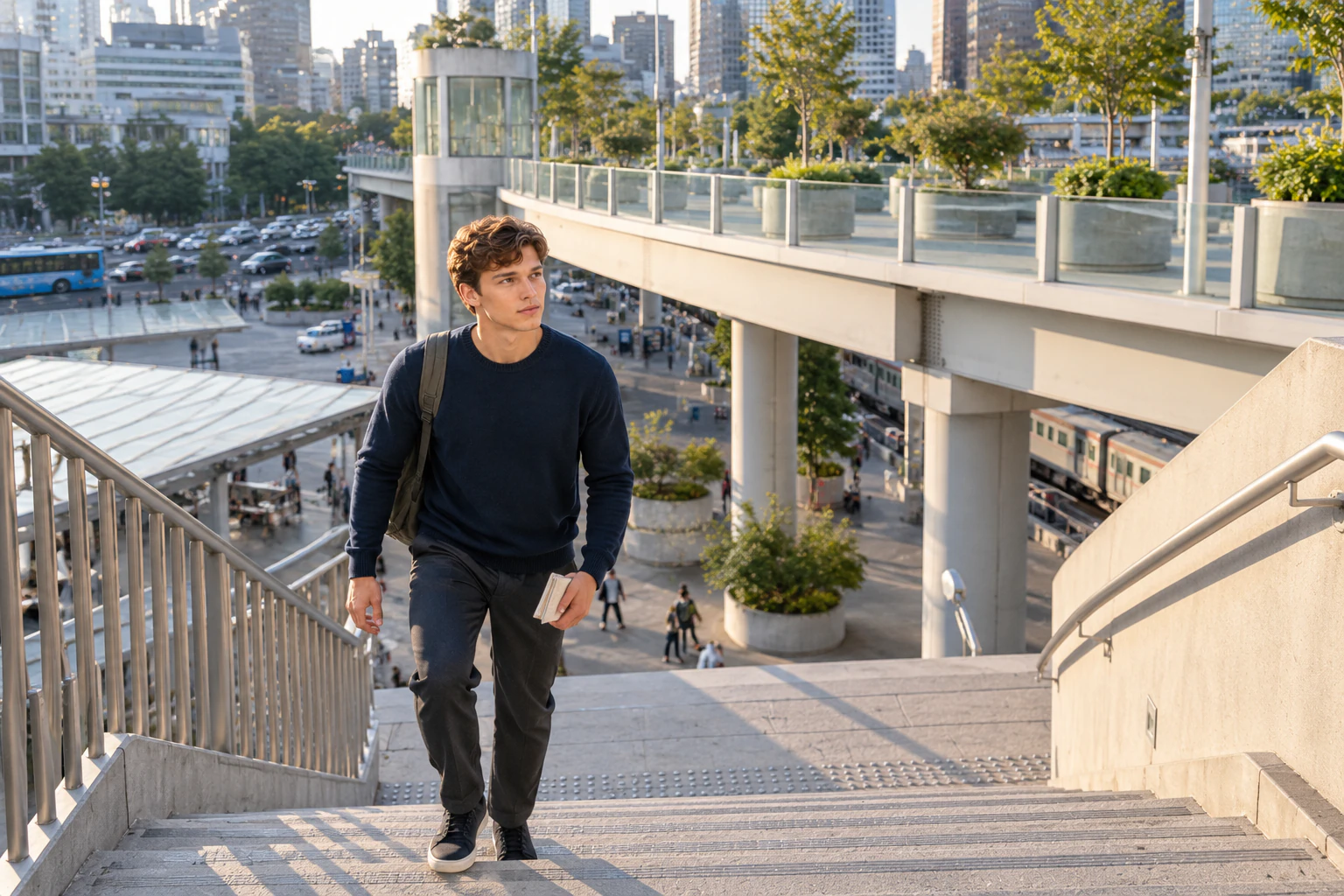
By Seoul City’s account, the name holds two numbers. 70 is 1970, the year the Seoul Station Overpass was built. 17 is 2017, the year Seoullo 7017 was made — and also its height of 17 metres, and the 17 pedestrian paths it connects to. Noah looks over the railing. Seventeen metres is higher than it sounds. The roofs of buses pass below.
According to Visit Seoul, Seoullo 7017 is open every day from midnight to midnight — it never closes. Noah notes that first. It looks like a park, but it is still a road.
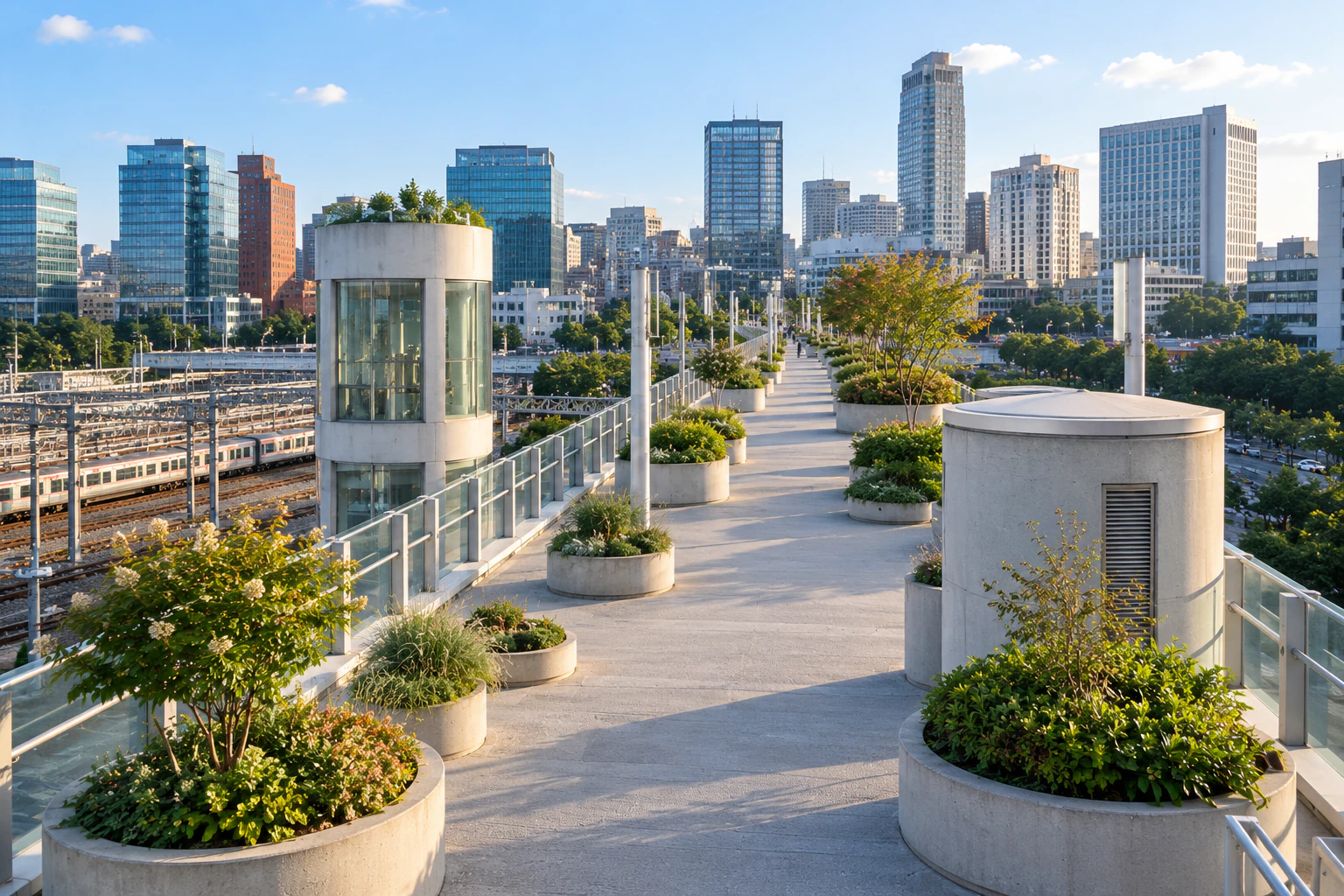
Up on the walkway, the old station building comes into view below. A citizen reporter notes that Culture Station Seoul 284, the old Seoul Station building, can be seen from Seoullo 7017. The building people once hurried through to catch trains is now something to look down on. In the corner of his notebook Noah sketches the new station, the old one and the overpass stacked in a single frame.
A line drawn for cars
Visit Seoul (Seoul Tourism Organization): the Seoul Station Overpass was built in 1970 in response to growing traffic congestion, and for decades it connected the eastern and western halves of the city.
Visit Seoul writes that the Seoul Station Overpass was built in 1970 in response to growing traffic congestion, and for decades it connected the eastern and western halves of the city. It was a line drawn in the air so that cars could clear the tangle in front of the station without stopping. Noah sees the line running straight ahead under his feet. Whoever drew it was thinking of moving cars, not people on foot. Find on map
The overpass aged. Visit Seoul explains that it was redeveloped into a pedestrian walkway as part of a Seoul-style urban regeneration project. According to a citizen reporter on Seoul City’s “Seoul in My Hand,” the overpass received a D safety grade in 2006; in 2014 it was decided to turn it into a pedestrian-only road; after an international design competition in 2015, work began in 2016, and it opened as Seoullo 7017 on May 20, 2017.
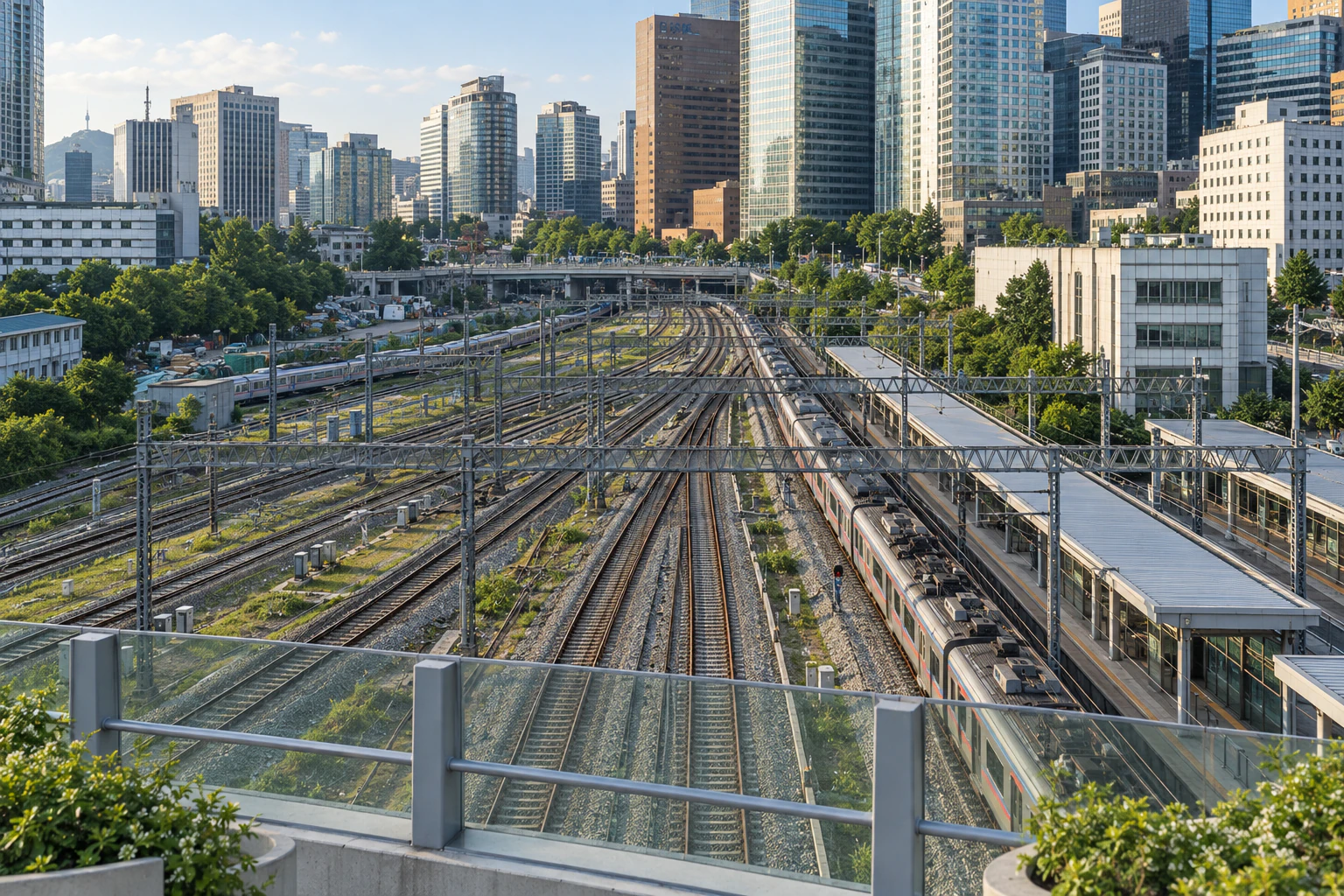
Noah leans on the railing and looks down. The tracks of Seoul Station run side by side in many strands, and the walkway crosses over them. By car this would have taken a moment. On foot, each line of track is its own thing.
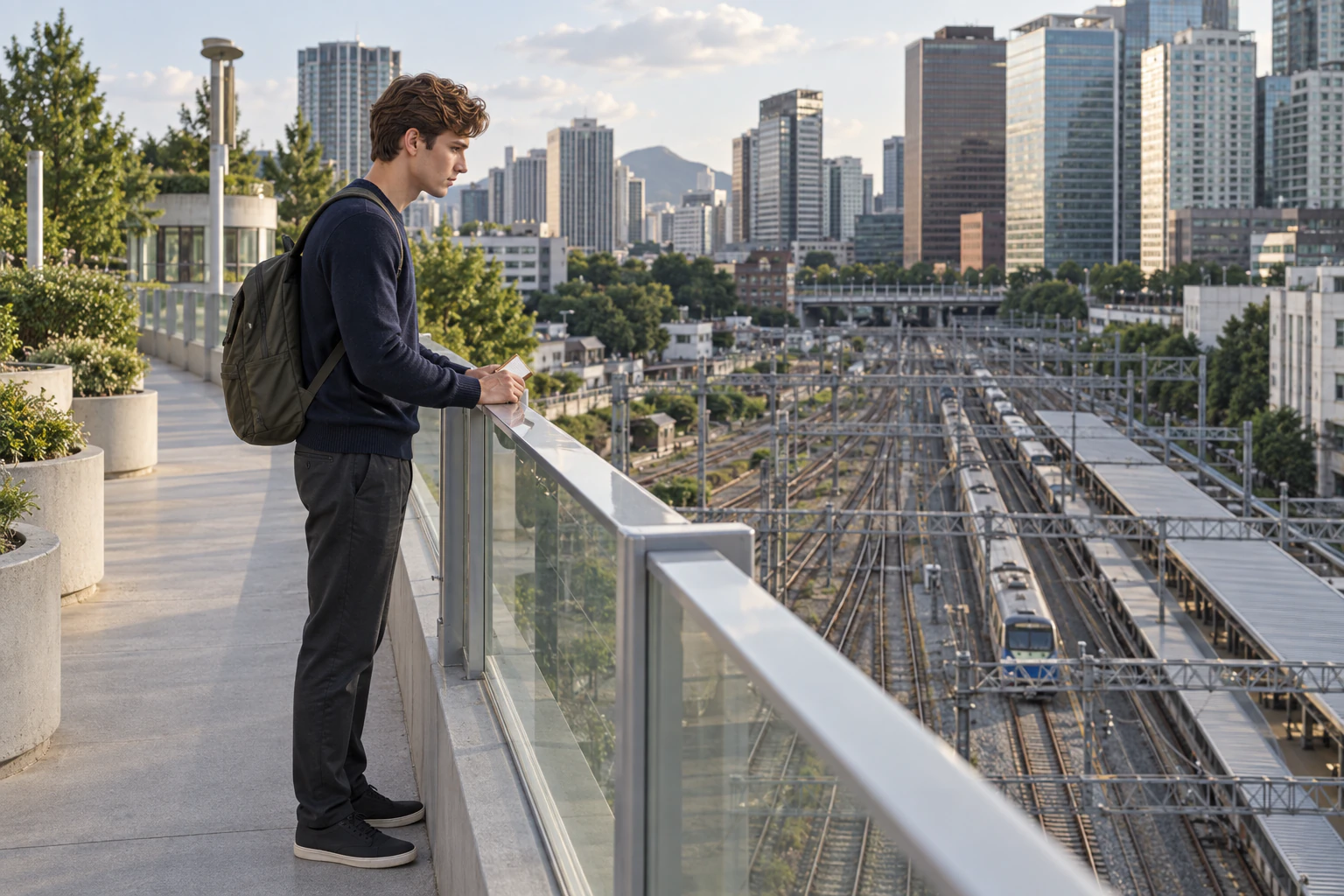
Between the round planters
Seoul City’s “Seoul in My Hand” (citizen reporter): Seoullo 7017 is planted with lotus, roses, birch and aquatic plants rarely seen in the city centre.
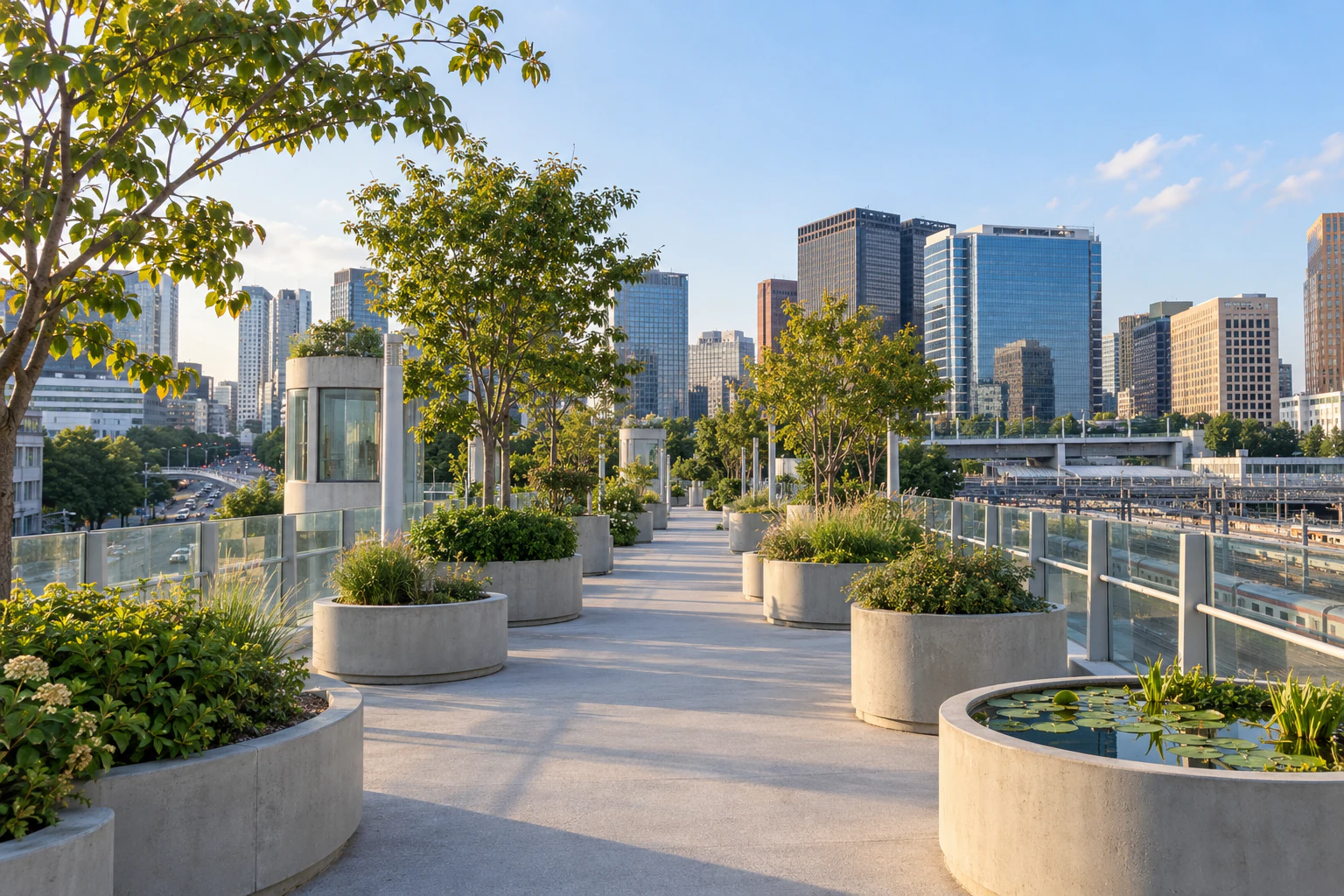
Where the lanes used to be, round planters stand in a row. Citizen reporters write that Seoullo is planted with lotus, roses, birch and aquatic plants rarely seen in the city centre, and that the round planters are its signature. They step aside to the edges rather than blocking the middle. Between them, Noah notices, everyone walks at a different speed. Find on map
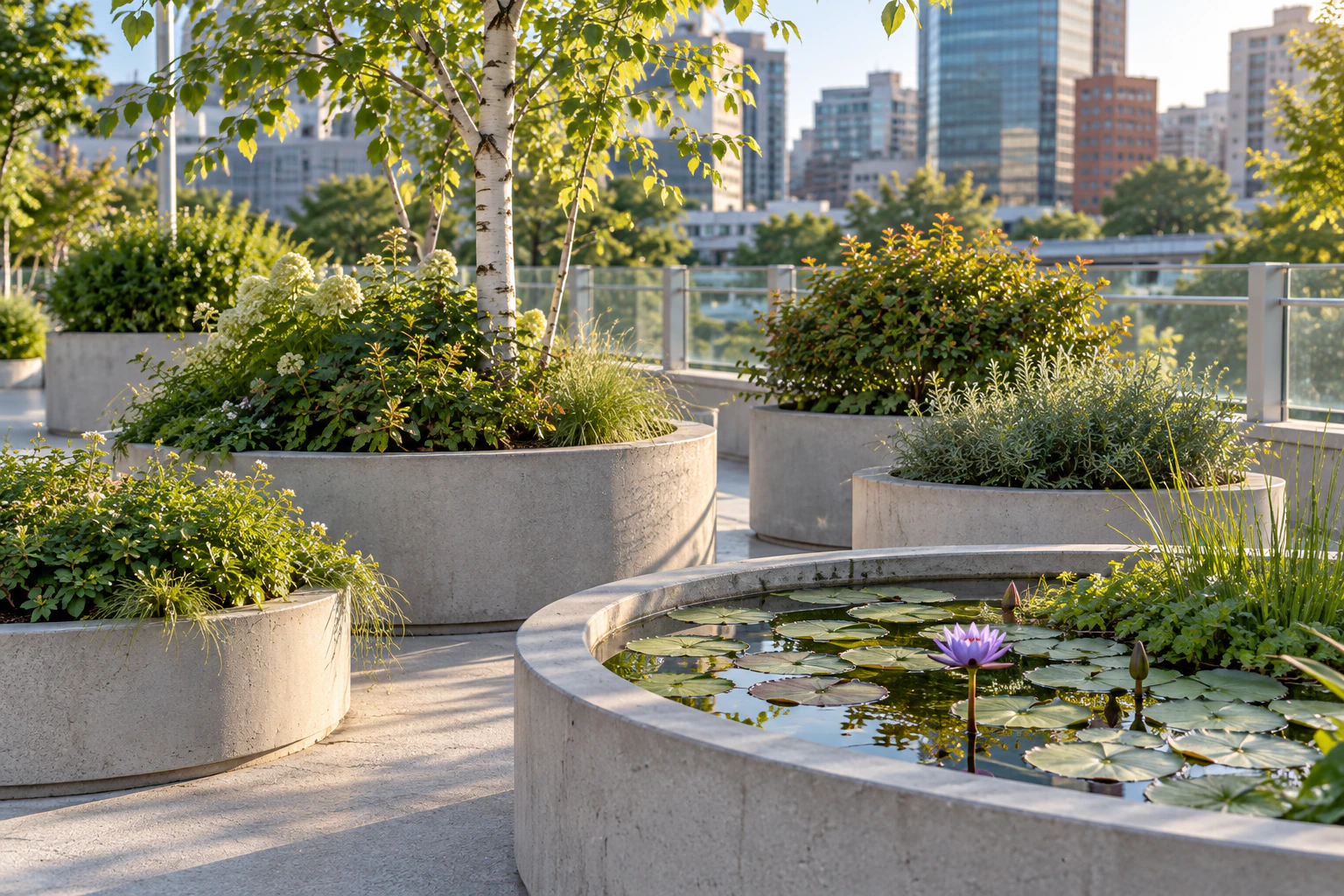
According to the reports, Seoullo 7017 connects by skywalk to four buildings including Seoul Station, with lifts along the way, and the Seoul Station rooftop garden was linked by skywalk on October 28, 2020. At the rose garden, the path is said to split three ways, toward Cheongpa-dong, Mallidong and Jungnim-dong.
When cars ran here, the overpass was a through route linking the eastern and western sides of the city. Today, pedestrian paths branch off from it into the surrounding area. Noah draws a single line in his notebook with three branches at the end. Then, instead of taking a branch, he walks toward Sungnyemun.
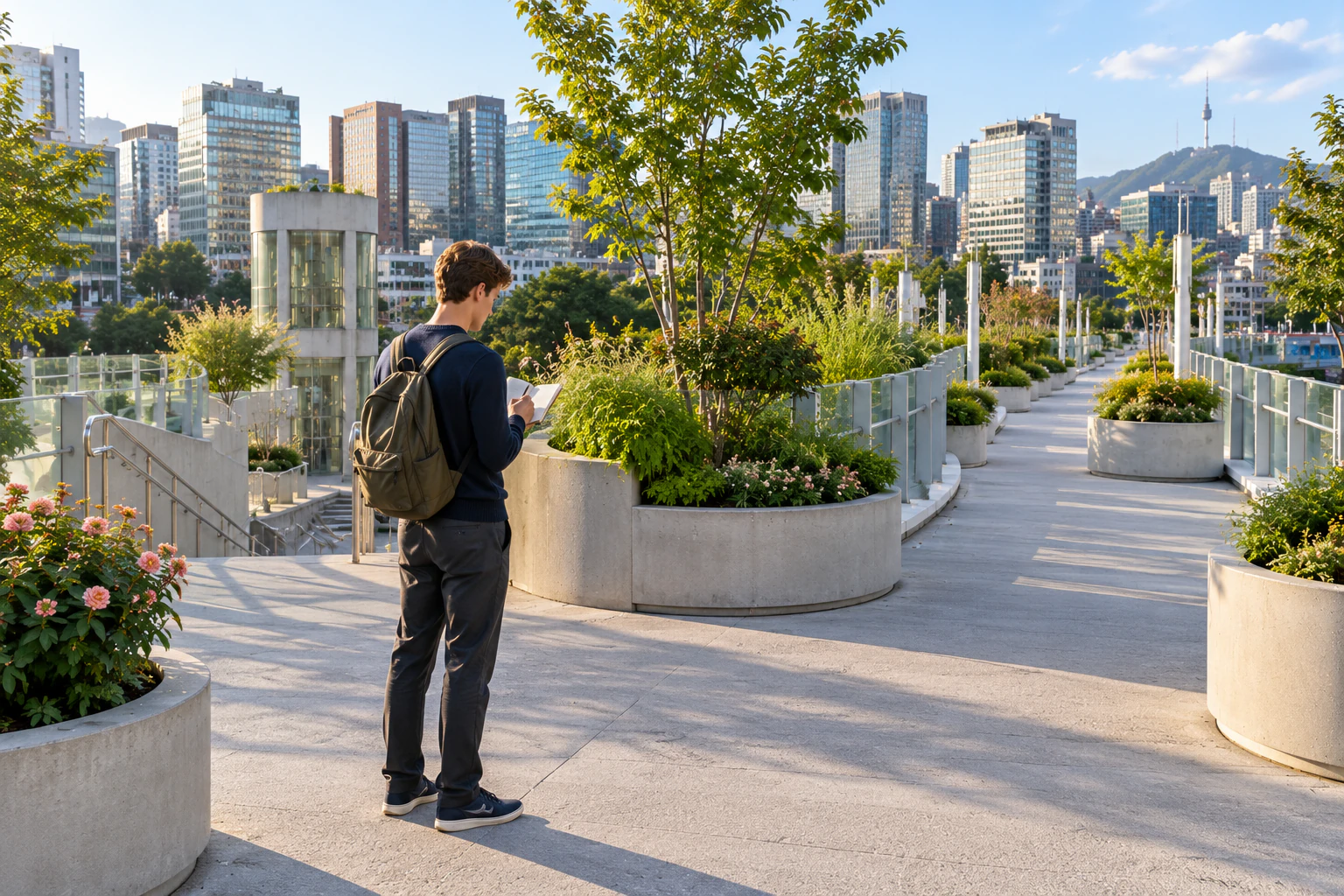
Where Sungnyemun comes into view
Seoul City’s “Seoul in My Hand” (citizen reporter): Seoullo 7017 sits next to Sungnyemun and the Sejong-daero pedestrian forest path, and Sungnyemun can be seen from the Seoullo observation deck.
A citizen reporter writes that Seoullo 7017 sits next to Sungnyemun and the Sejong-daero pedestrian forest path, and that Sungnyemun can be seen from the Seoullo observation deck. As Noah walks toward Hoehyeon, a wide road full of flowing traffic comes into view, with Sungnyemun in the middle of it. Find on map
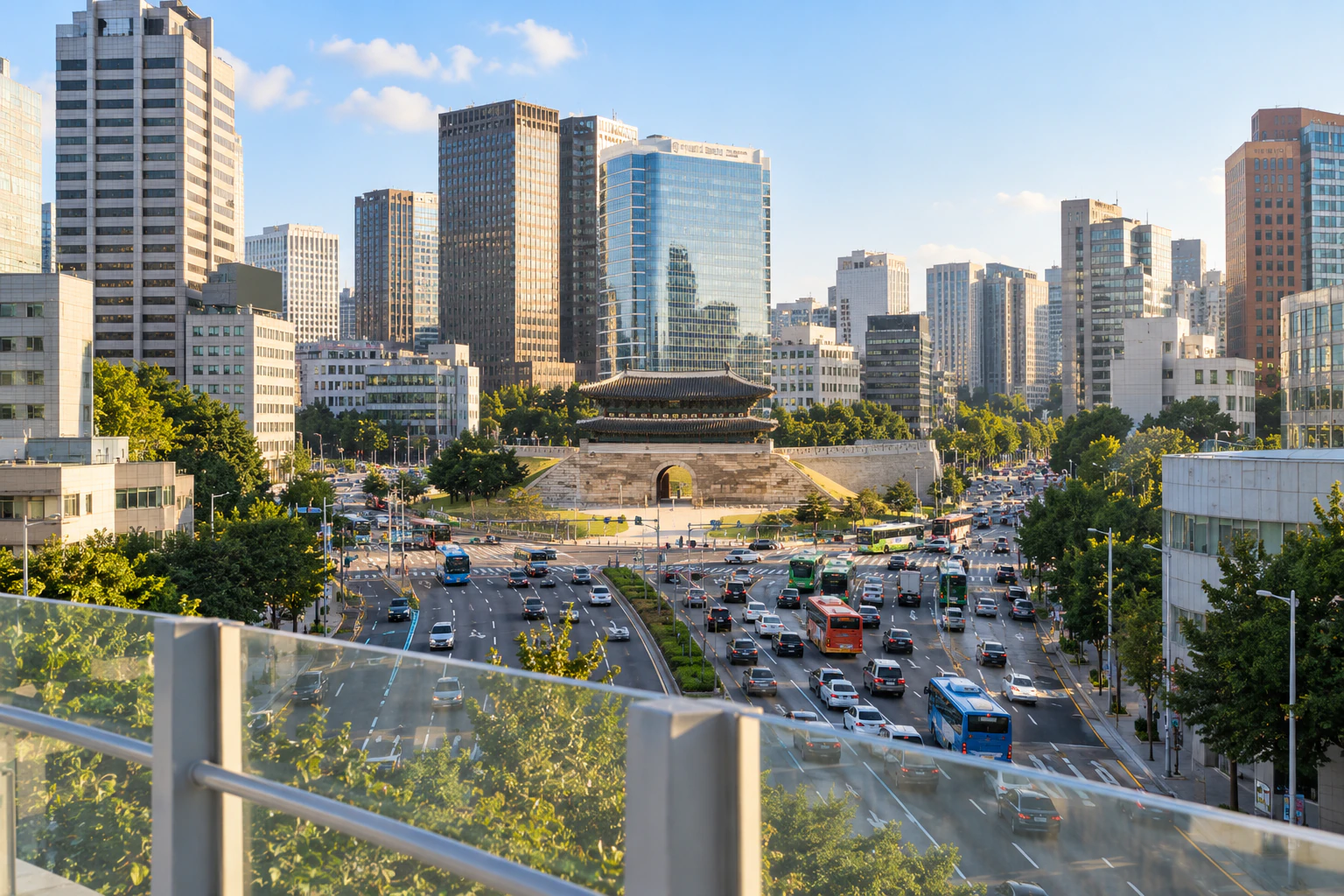
Here Noah notices one thing. The cars on this road would have let the gate slide past to one side. Someone on foot sees the gate first — from seventeen metres up, before getting there.
The gate is the next story’s place. Elena will stand in front of it. Today Noah doesn’t go down to it; he stops where it comes into view.
The idea that this road and the gate belong to one line isn’t only Noah’s. The guided walking course Visit Seoul describes, “Seoullo 7017: From Hanyang to Seoul,” starts at Exit 2 of Seoul Station on Line 1, passes Culture Station Seoul 284 and Seoullo 7017, and carries on to Sungnyemun, the Seoul City Wall and Baekbeom Square, taking about two and a half hours. What Noah walked today is the first part of it.
As the sun goes down, Noah stands on a landing of the stairs on the Hoehyeon side and opens his notebook. He never does answer the question on his first line, how many minutes this road used to be. Instead he keeps one observation: a line drawn straight for cars slows down when you walk it, and when it slows down you see the branches, the tracks and a gate in the distance.
His notes come to three lines. Come out at Exit 1 of Seoul Station and take the steps up. Open all day and night. To see Sungnyemun, walk toward Hoehyeon until the gate comes into view.
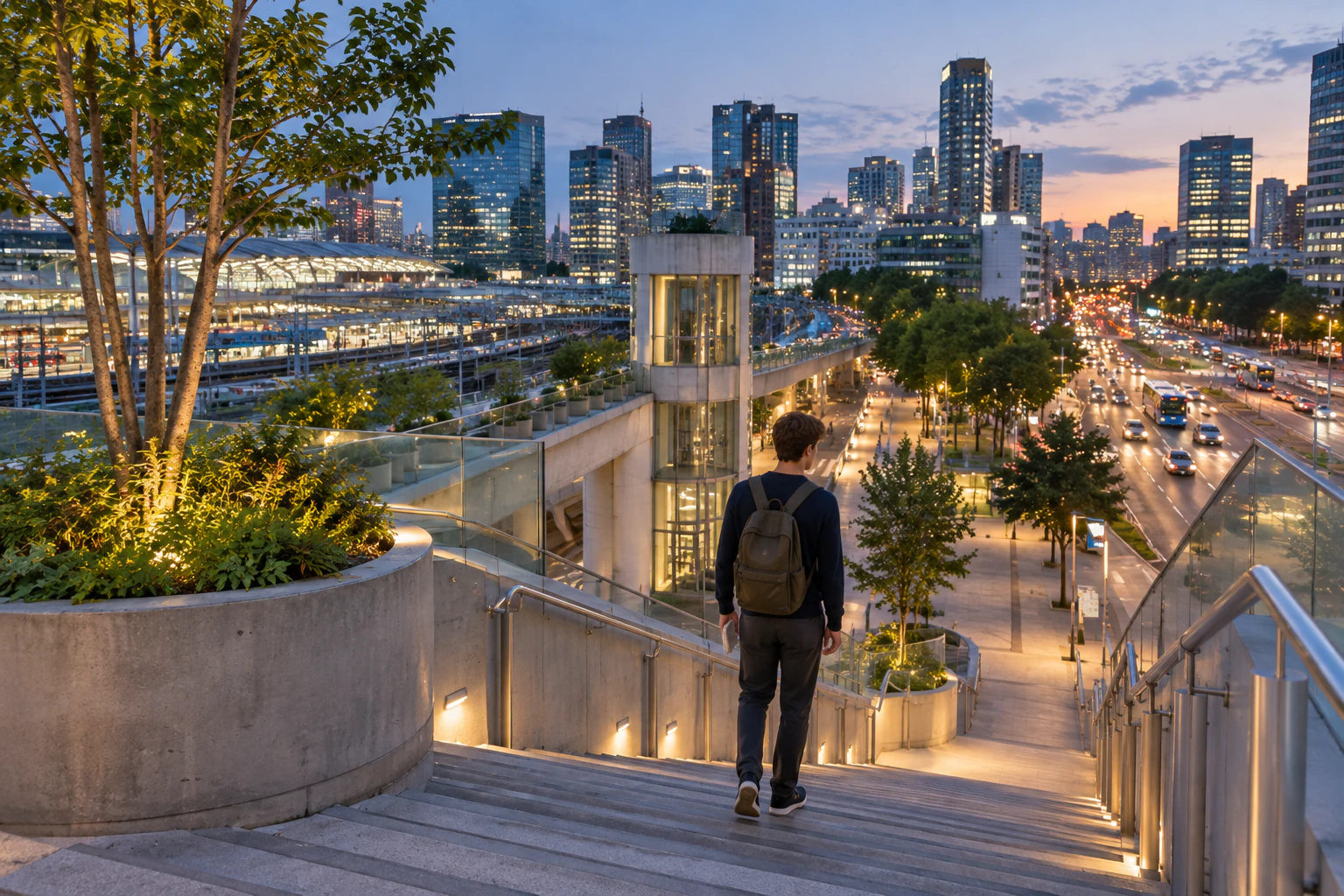
(※ This article includes staged images created with AI.)
Plan your visit
Come out at Exit 1 of Seoul Station and climb onto Seoullo 7017, cross above the railway, look at the fork at the rose garden, then walk toward Hoehyeon and stop where Sungnyemun comes into view. You can carry on to Sungnyemun in the next story.
A diagram of the order only — not to scale, and it does not show direction or the actual shape of the paths.
- From Exit 1 of Seoul Station onto Seoullo 7017 — 180 m from Exit 1, according to Seoul City. Up by steps or lift. Find on map
- The stretch above the railway — Seoul Station’s tracks spread out below the railing. Find on map
- The fork at the rose garden — Paths split toward Cheongpa-dong, Mallidong and Jungnim-dong. Find on map
- Toward Hoehyeon, where Sungnyemun comes into view — Leads on to Sungnyemun in the next story. Find on map
Getting there
Seoul Metropolitan GovernmentChecked 2026.09.25
Seoullo 7017 is 180 m from Exit 1 of Seoul Station (Lines 1 and 4).
Visit Seoul (Seoul Tourism Organization)Checked 2026.09.25
Seoullo 7017 is a 3-minute walk from Exit 2 of Seoul Station (Lines 1 and 4, Airport Railroad, Gyeongui–Jungang Line).
Hours & fees
Visit Seoul (Seoul Tourism Organization)Checked 2026.09.25
the Seoullo 7017 pedestrian walkway is open daily, 00:00–24:00.
Background11
Seoul Metropolitan GovernmentChecked 2026.09.25
in “Seoullo 7017,” 70 stands for 1970, the year the Seoul Station Overpass was built, and 17 for 2017, the year Seoullo 7017 was made, as well as its height of 17 m and its connection to 17 pedestrian paths.
Visit Seoul (Seoul Tourism Organization)Checked 2026.09.25
the Seoul Station Overpass was built in 1970 in response to growing traffic congestion, and for decades it connected the eastern and western halves of the city.
Visit Seoul (Seoul Tourism Organization)Checked 2026.09.25
as the Seoul Station overpass gradually deteriorated, it was decided to redevelop it into a pedestrian walkway as part of a Seoul-style urban regeneration project.
Checked 2026.09.25
Seoul City’s “Seoul in My Hand” (citizen reporter): the Seoul Station overpass received a D safety grade in 2006, and in 2014 it was decided to regenerate it as a pedestrian-only road. After an international design competition in 2015, work began in 2016, and it opened as Seoullo 7017 on May 20, 2017.
Checked 2026.09.25
Seoul City’s “Seoul in My Hand” (citizen reporter): Seoullo 7017 is planted with lotus, roses, birch and aquatic plants rarely seen in the city centre.
Checked 2026.09.25
Seoul City’s “Seoul in My Hand” (citizen reporter): the round planters are Seoullo’s signature.
Checked 2026.09.25
Seoul City’s “Seoul in My Hand” (citizen reporter): Seoullo 7017 connects by skywalk to four buildings including Seoul Station, with lifts along the way; the Seoul Station rooftop garden was linked by skywalk on October 28, 2020.
Checked 2026.09.25
Seoul City’s “Seoul in My Hand” (citizen reporter): at Seoullo 7017’s rose garden the path splits three ways, toward Cheongpa-dong, Mallidong and Jungnim-dong.
Checked 2026.09.25
Seoul City’s “Seoul in My Hand” (citizen reporter): Seoullo 7017 sits next to Sungnyemun and the Sejong-daero pedestrian forest path, and Sungnyemun can be seen from the Seoullo observation deck.
Checked 2026.09.25
Seoul City’s “Seoul in My Hand” (citizen reporter): Culture Station Seoul 284, the old Seoul Station building, can be seen from Seoullo 7017.
Visit Seoul (Seoul Tourism Organization)Checked 2026.09.25
the guided walking course “Seoullo 7017: From Hanyang to Seoul” starts at Exit 2 of Seoul Station on Line 1 and passes Culture Station Seoul 284, Seoullo 7017, Sungnyemun, the Seoul City Wall and Baekbeom Square, taking about 2.5 hours.
- The Seoullo 7017 pedestrian walkway is open daily, 00:00–24:00 (Visit Seoul, checked 25 September 2026).
- Seoul City gives 180 m from Exit 1; Visit Seoul gives a 3-minute walk from Exit 2.
- The old dedicated Seoullo 7017 web address now belongs to an unrelated site. Check Seoul City and Visit Seoul for official information.
- This is a pedestrian-only walkway. Don’t climb on the railings or lean out over them.