
SEOUL · SUNGNYEMUN
Sungnyemun Through Old Photographs
Old photographs show Sungnyemun with different walls on either side. Elena looks for what changed and what survived.

How to get there
A map-app walking-route calculation (TMAP). Visit Seoul gives 258 m from Exit 4; the Seoul City Wall website says a 10-minute walk.
In part one, Noah walked along Seoullo 7017 and stopped where Sungnyemun came into view. Today Elena stands in front of the gate itself.
Elena reads scenes. She writes down first why a scene in a drama feels seamless, then asks whether that seamlessness belongs to the screen or would survive on a real street. Sungnyemun suits that kind of eye. People have photographed the same gate for more than a hundred years, and those pictures are public.
A weekday, three in the afternoon. On the first line of her notebook Elena writes: “Same gate — but in every photo, the sides are different.”
A gate in the middle of a wide road
From Exit 4 of Seoul Station (Line 1) to Sungnyemun Plaza, the map route is 336 m, about 4 minutes (TMAP pedestrian route calculation).
She comes out at Exit 4 of Seoul Station and walks towards the gate. A map app’s walking route puts Sungnyemun Plaza 336 metres and four minutes away. Visit Seoul, the city’s official travel site, gives 258 metres from the same exit. However you measure it, it’s close. Find on map
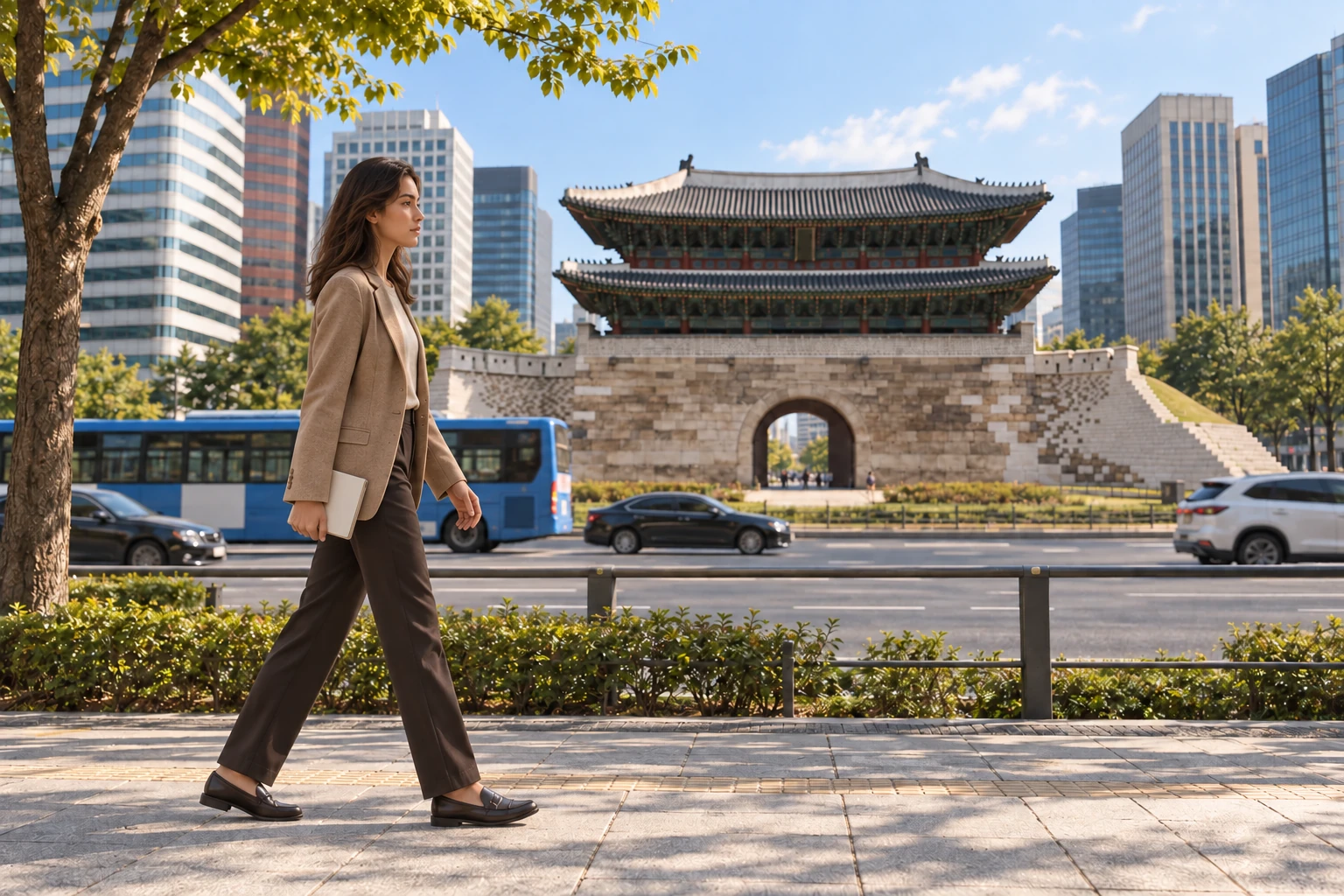
According to the Royal Palaces and Tombs Center of the National Heritage Service, Sungnyemun is open from 9 a.m. to 6 p.m. all year, with last entry at 5.55 p.m. It closes on Mondays — unless the Monday is a public or substitute holiday, in which case it opens, closing on the next non-holiday instead. Admission is free.
Elena pauses before stepping onto the plaza. Traffic splits and flows around both sides of the gate. It stands like an island in the middle of the road, and the lawn and stone paving around it make up Sungnyemun Plaza. On screen, this would be the shot where the background never stops moving and only the lead stays still.
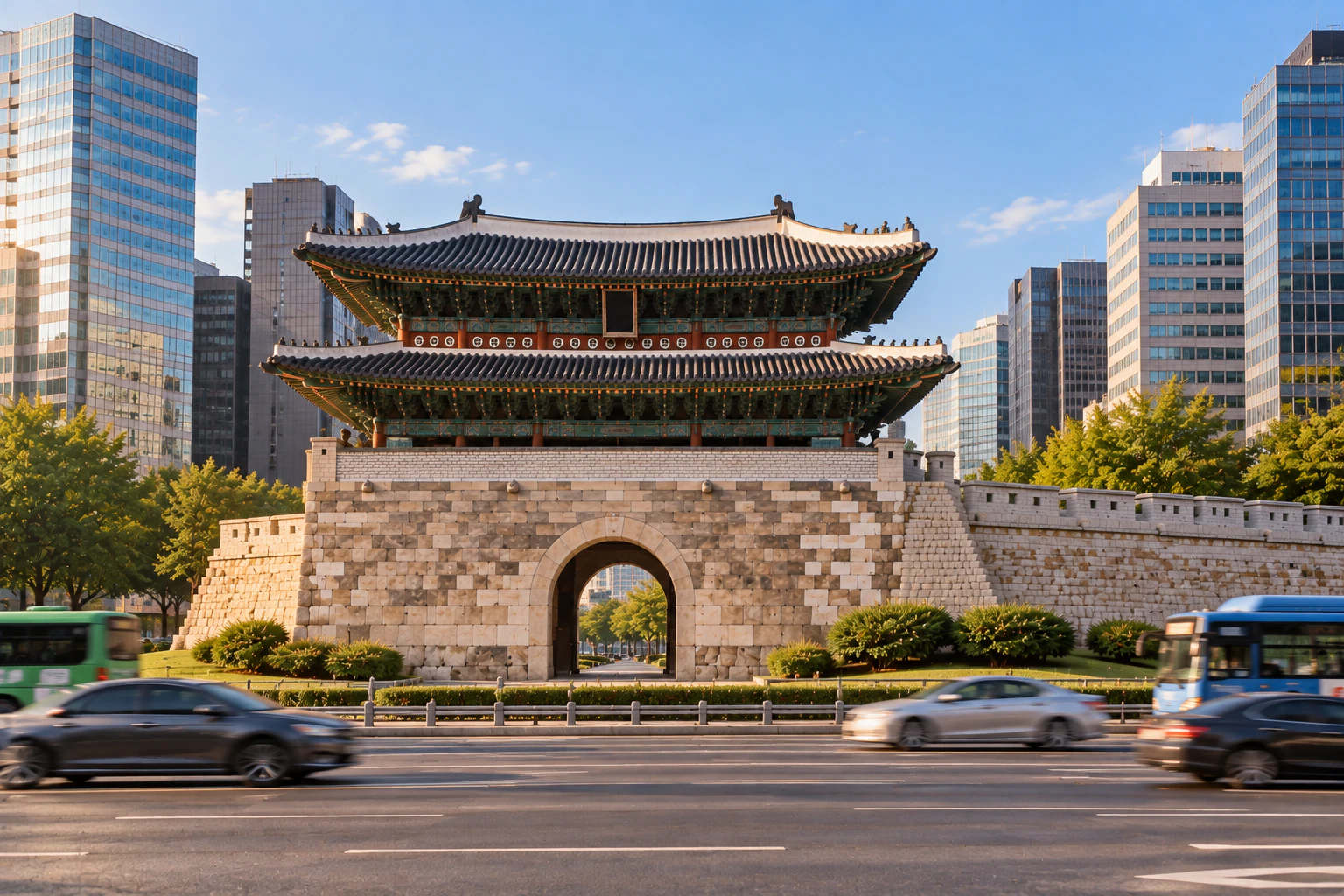
The south gate, 1398
National Heritage Service: Sungnyemun was the main gate of the Joseon-era Hanyang city wall and, standing to the south, was also called Namdaemun. Building began in 1396 and was completed in 1398; it was rebuilt in 1448. Dismantling and repair work in 1961–1963 revealed that major work had also been done in 1479.
The National Heritage Service describes Sungnyemun as the main gate of Hanyang, Joseon-era Seoul, and says that because it stood to the south it was also called Namdaemun, the Great South Gate. Work began in 1396 and finished in 1398; it was rebuilt in 1448. When it was taken apart for repairs in 1961–1963, it turned out that major work had also been done in 1479. Find on map
Its structure reads simply. A single rainbow-shaped arch, the hongye, passes through a tall base of stacked stone, and on top sits a two-storey pavilion five bays wide and two deep. From the front the roof is a trapezoid — a hipped roof. The Heritage Service notes that the bracket sets holding up the eaves sit between the columns as well as on them, in the dapo style, and that their gentle curves and sturdy joinery show features of the early Joseon period.
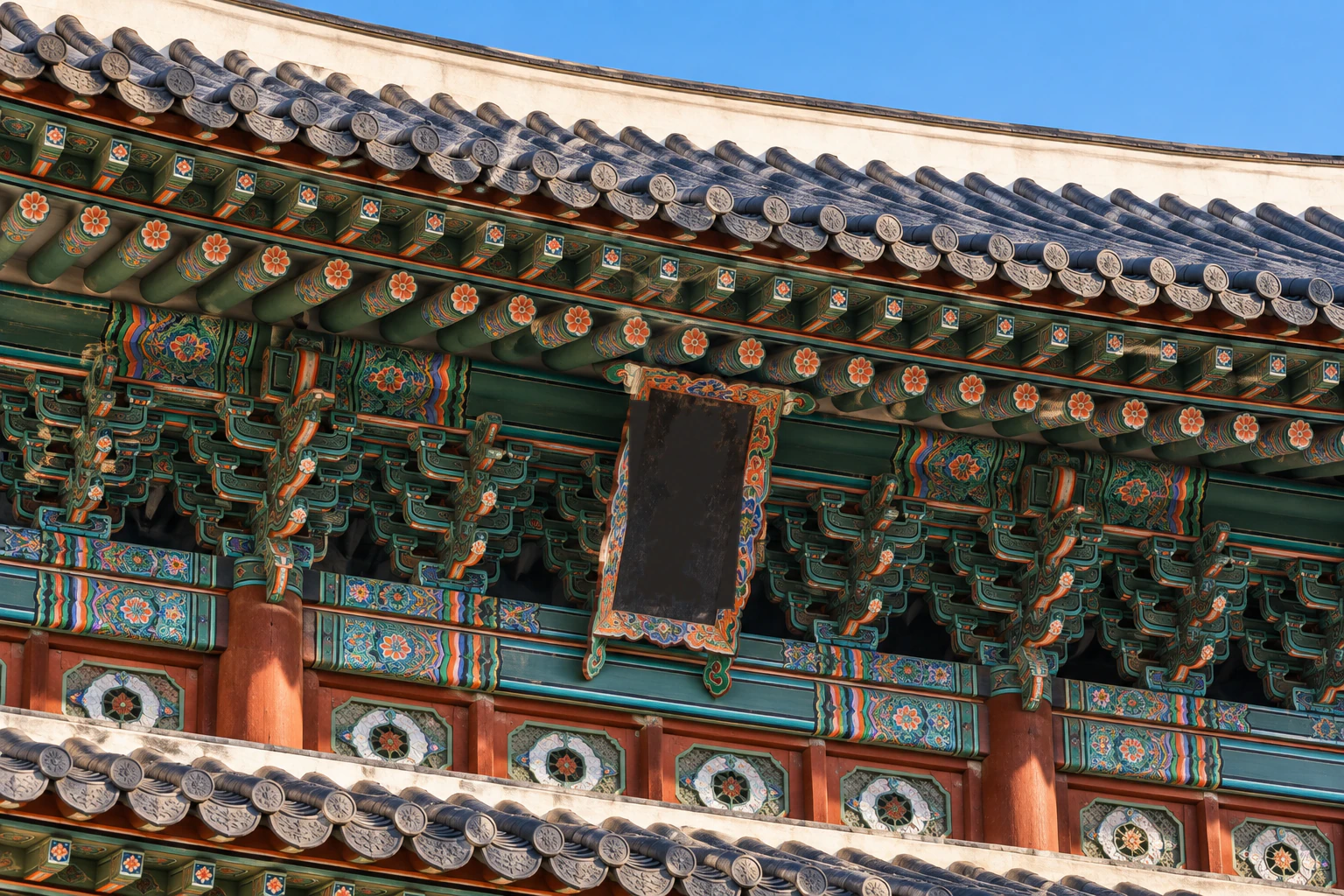
The name has a meaning too. According to the Royal Palaces and Tombs Center, the ye in Sungnye is propriety, one of the Confucian virtues alongside benevolence, righteousness and wisdom. In the Joseon era the gate was shut every night at injeong, around 10 p.m., and opened at paru, around 4 a.m., with a bell in the pavilion marking the time. Elena copies that into her notebook. This was a gate that opened and closed every day. Now, instead of a closing hour, it has visiting hours.
The sides that change from photo to photo
The National Heritage Service’s published photographs of Sungnyemun include “Sungnyemun and its city wall (1904),” “Namdaemun Market and Sungnyemun (1904),” “Sungnyemun with tram tracks (1905),” “the scene of the Sungnyemun fire (Feb 10, 2008)” and “the Sungnyemun restoration ceremony (May 4, 2013).”
Among the photographs of Sungnyemun published by the National Heritage Service are several old ones: “Sungnyemun and its city wall (1904),” “Namdaemun Market and Sungnyemun (1904)” and “Sungnyemun with tram tracks (1905).” Elena reads photographs as scenes. The middle is always the same: a stone base, one arch, two roofs. What changes is the edges of the frame. Find on map
The 1904 title still includes the city wall. The Royal Palaces and Tombs Center’s timeline says that in 1907 the wall was torn down, on the grounds of the Japanese crown prince’s visit to Korea. With its sides gone, the gate was left standing alone in the middle of the road. Most of the Sungnyemun Elena has ever seen belongs to the scene after that.
In the 2013 restoration, some of those sides came back. Writing in a column for Korea.kr, the government’s policy briefing site, a member of the restoration advisory panel said that walls which had not existed before the fire were rebuilt on both sides, and the stairs on both sides, which had lost their original form, were rebuilt as they had been after historical research. A Seoul citizen reporter noted that, facing the gate, 16 metres of wall went back up on the left and 53 metres on the right, towards Namsan.
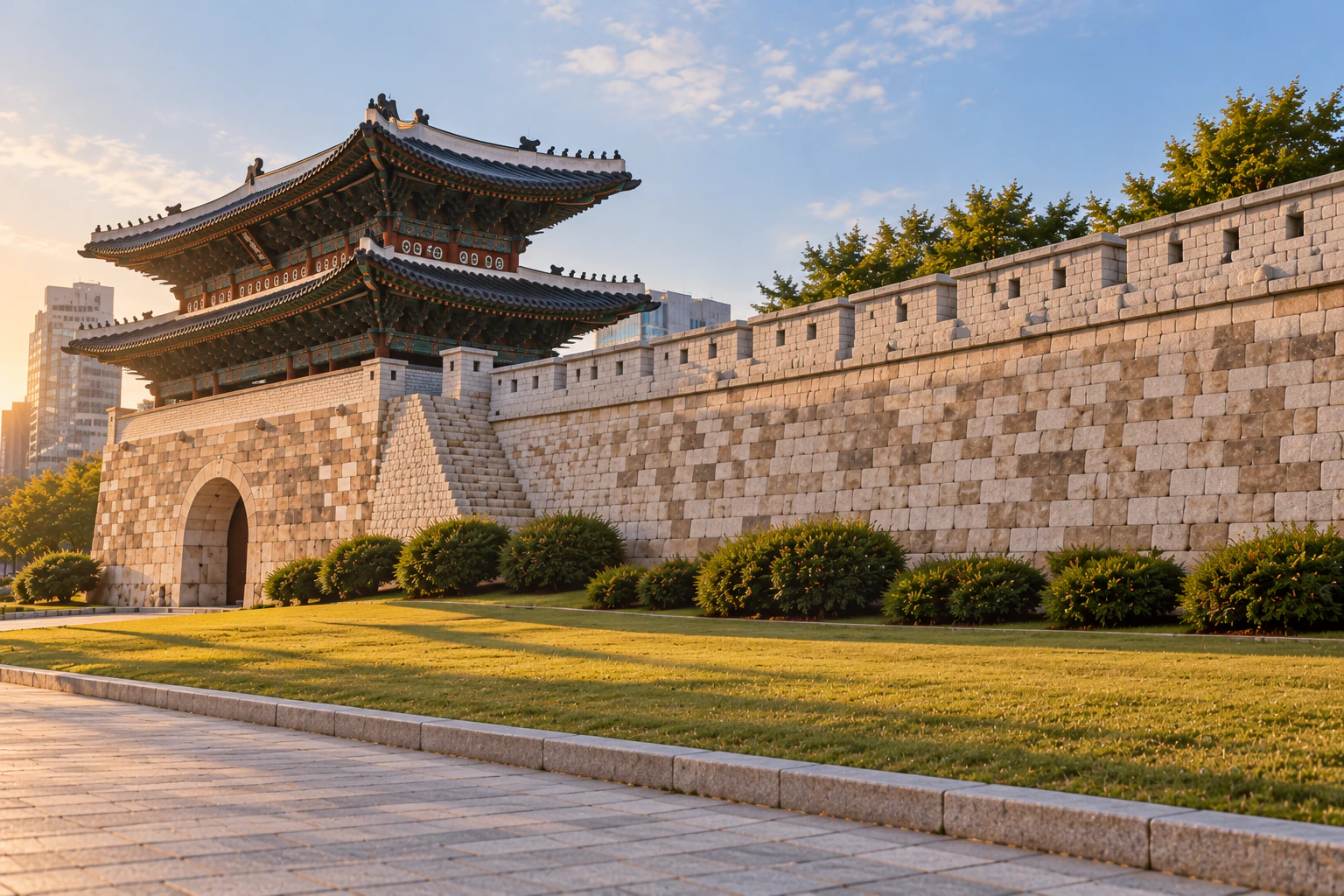
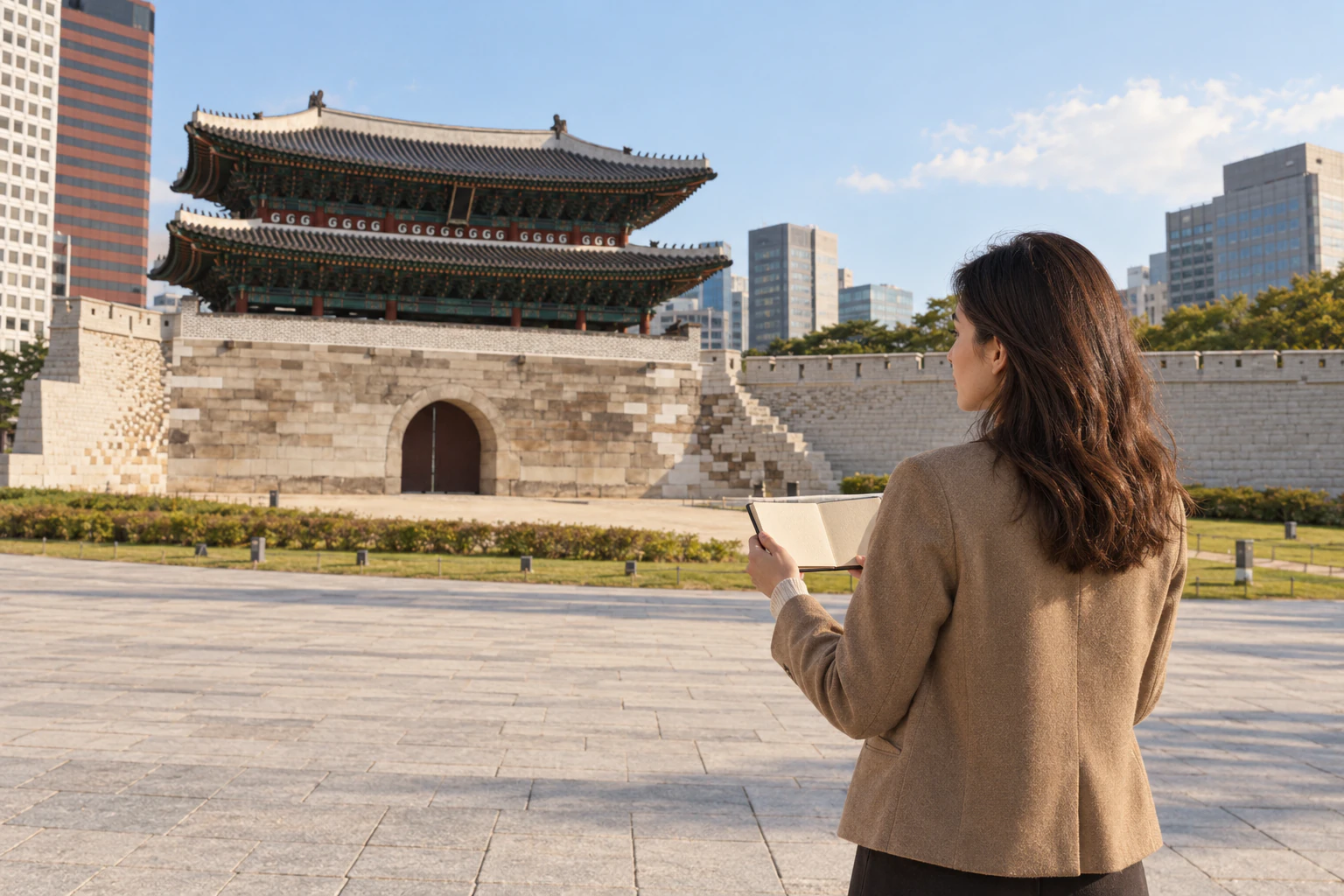
Elena holds her notebook sideways and uses its top edge as a guide line against the gate and the wall. With the new wall towards Namsan inside the frame, the view comes closer to the title of the 1904 photograph. Leave it out, and it becomes the familiar “gate standing alone in the road.” From the same spot, one frame is enough to split two eras.
The layer the fire left behind
National Heritage Service: fire broke out around 8:40 p.m. on February 10, 2008; at about 12:40 a.m. the next day the upper roof of the pavilion collapsed, the fire spread to the lower storey, and by about 1:55 a.m., five hours in, the building apart from the stone base had been damaged.
The National Heritage Service records the night of February 10, 2008, down to the time. The fire started at around 8.40 p.m. At about 12.40 a.m. the next day the upper roof of the pavilion collapsed. The fire spread to the lower storey, and by about 1.55 a.m., five hours in, the building apart from the stone base had been damaged. Find on map

The same Korea.kr column notes that the scene of the pavilion burning was broadcast nationwide on TV news. That is the sentence Elena stays with. For many people, Sungnyemun’s defining scene was a fire on a screen. Yet what the fire badly damaged was the wooden pavilion above. The stone base below remained.
According to the National Heritage Service, after five years and two months of restoration work Sungnyemun was completed on May 4, 2013, and reopened to the public. The column adds that materials were shaped and fitted by hand as far as possible, ironwork was made the Joseon way at a forge set up on site, and the painted decoration aimed to use natural pigments rather than chemical ones.
Elena looks up from in front of the stone base. The pavilion she sees is the one restored and reopened in 2013; the stone beneath it is the layer that remained after the fire. From a distance the gate is a single scene. Up close, it separates into layers from different times.
Under the arch, and a name board hung upright
Seoul City’s “Seoul in My Hand” (citizen reporter, 2020): the ceiling of the arched passage is painted with two dragons restored in an early-Joseon pattern, and a janggunmok, the heavy wooden bar once laid across the great doors, rests against the passage wall.
Step under the arch and the space overhead suddenly fills with colour. A 2020 article by a Seoul citizen reporter says the ceiling of the passage is painted with two dragons, restored in an early-Joseon pattern, and that a janggunmok — the thick, long wooden bar once laid across the great doors — rests along the passage wall. Find on map
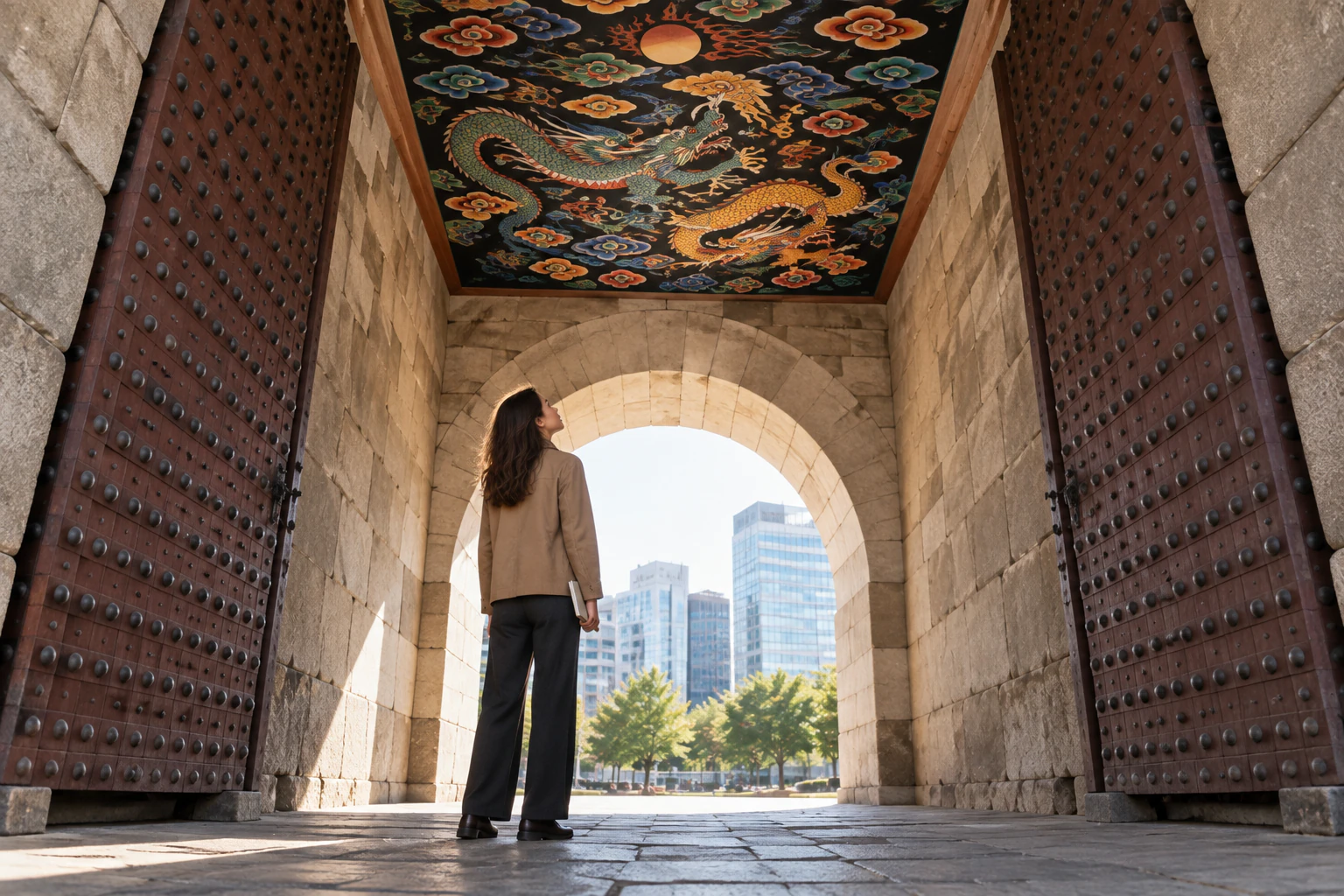
Back outside, Elena looks up at the pavilion. The name board hangs vertically rather than across. The same article passes on a feng-shui story: that it was hung upright to hold down the fire energy of Gwanaksan, a mountain to the south. The Royal Palaces and Tombs Center says the calligraphy is “said to be” by Grand Prince Yangnyeong.
Elena doesn’t write the two stories in the same box. Put together, a board hung upright to ward off fire and the fire that actually came make a tidy scene. But one is a story that has been passed down, and the other is a record kept down to the minute. In her notebook she copies “said to be” exactly as it is.
As five o’clock approaches, Elena opens her notebook at the edge of the plaza. What to keep is the middle: the stone base and the arch, a place that has stood here since 1398. What changed is the sides: the walls torn down in 1907, partly returned in 2013. And one thing to drop — remembering this gate only by the scene of the fire on screen.
Her notes come to three lines. Four minutes on foot from Exit 4 of Seoul Station. Closed on Mondays, with last entry at 5.55 p.m. To fit the wall and the gate into one frame, as in the old photographs, move to a point in the plaza where the Namsan-side wall and the gate can be seen together, then turn back. Just as the 1904 photograph was titled “Namdaemun Market and Sungnyemun,” the next story is the market outside this gate.
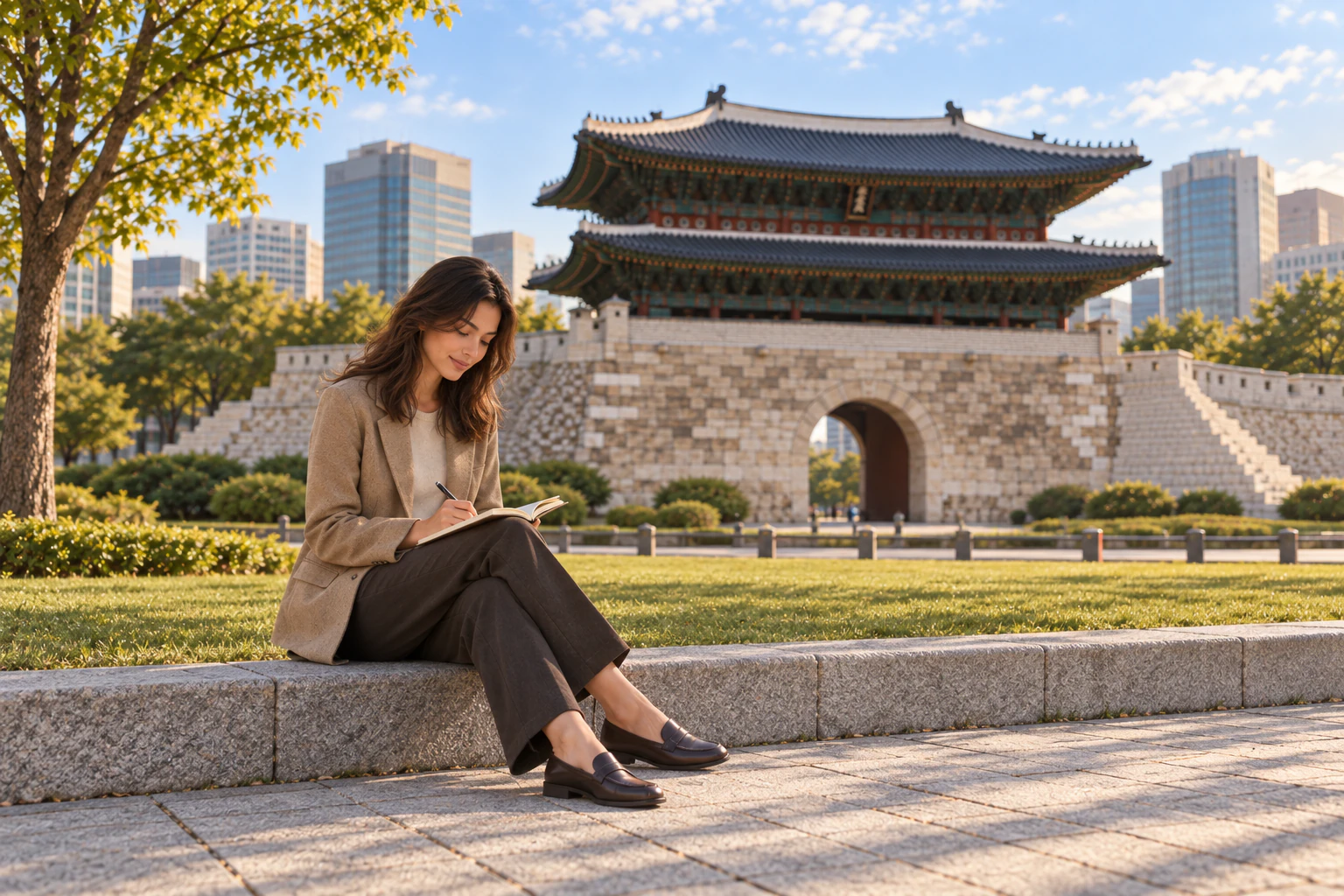
(※ This article includes staged images created with AI.)
Plan your visit
Walk over from Exit 4 of Seoul Station, look at Sungnyemun from the front, move to a point in the plaza where the Namsan-side wall and the gate can be seen together and turn back, then pass under the arch and look up at the ceiling and the name board. You can carry on to Namdaemun Market in the next story.
A diagram of the order only — not to scale, and it does not show direction or the actual shape of the paths.
- From Exit 4 of Seoul Station to Sungnyemun Plaza — 336 m, about 4 minutes by a map app’s walking route (TMAP calculation). Find on map
- In front of the gate — Take in the stone base, the arch and the two roofs at once. Find on map
- Where the Namsan-side wall and the gate are seen together — Turn back from inside the plaza and the wall and gate share one frame. Find on map
- Under the arch, and the name board — Look up at the dragon ceiling and the upright name board. Find on map
Getting there
TMAPChecked 2026.09.25
From Exit 4 of Seoul Station (Line 1) to Sungnyemun Plaza, the map route is 336 m, about 4 minutes (TMAP pedestrian route calculation).
Visit SeoulChecked 2026.09.25
Sungnyemun is 258 m from Exit 4 of Seoul Station (Lines 1 and 4, Gyeongui–Jungang Line, Airport Railroad).
Seoul City Wall websiteChecked 2026.09.25
Sungnyemun is a 10-minute walk from Exit 4 of Seoul Station (Lines 1 and 4).
Hours & fees
Checked 2026.09.25
National Heritage Service, Royal Palaces and Tombs Center: Sungnyemun is open 09:00–18:00 all year, last entry 17:55. It is closed on Mondays; when a Monday is a public or substitute holiday it opens, and closes on the next non-holiday instead.
Checked 2026.09.25
National Heritage Service, Royal Palaces and Tombs Center: admission to Sungnyemun is free.
Good to know
Checked 2026.09.25
The National Heritage Service’s published photographs of Sungnyemun include “Sungnyemun and its city wall (1904),” “Namdaemun Market and Sungnyemun (1904),” “Sungnyemun with tram tracks (1905),” “the scene of the Sungnyemun fire (Feb 10, 2008)” and “the Sungnyemun restoration ceremony (May 4, 2013).”
Background14
National Heritage ServiceChecked 2026.09.25
Sungnyemun was the main gate of the Joseon-era Hanyang city wall and, standing to the south, was also called Namdaemun. Building began in 1396 and was completed in 1398; it was rebuilt in 1448. Dismantling and repair work in 1961–1963 revealed that major work had also been done in 1479.
National Heritage ServiceChecked 2026.09.25
a rainbow-shaped arched gateway (hongye) sits in the middle of a tall stone base, topped by a two-storey pavilion five bays wide and two bays deep. The roof is hipped, and the bracket sets are placed between the columns as well as on them (the dapo style), showing features of the early Joseon period.
National Heritage ServiceChecked 2026.09.25
Sungnyemun is the oldest wooden building remaining in Seoul, and the oldest wooden structure among Seoul’s city walls whose date of construction is precisely known.
Checked 2026.09.25
National Heritage Service, Royal Palaces and Tombs Center: the name “Sungnye” takes ye (propriety) from the Confucian virtues of benevolence, righteousness, propriety and wisdom, and the name board is said to have been written by Grand Prince Yangnyeong, King Taejong’s eldest son.
Checked 2026.09.25
National Heritage Service, Royal Palaces and Tombs Center: in the Joseon era the gate was shut every night at injeong (around 10 p.m.) and opened the next morning at paru (around 4 a.m.), with a bell hung in the pavilion to mark the time.
Checked 2026.09.25
National Heritage Service, Royal Palaces and Tombs Center timeline: in 1907 the city wall at Sungnyemun was torn down, on the grounds of the Japanese crown prince’s visit to Korea.
Checked 2026.09.25
Column on Korea.kr, the government policy briefing (May 1, 2013, by a member of the Sungnyemun restoration advisory panel): the restoration rebuilt the walls on both sides, which had not existed before the fire, and the stairs on both sides, which had lost their original form, were rebuilt as they had been after historical research.
Checked 2026.09.25
Seoul City’s “Seoul in My Hand” (citizen reporter, 2020): facing the gate, 16 m of wall was rebuilt on the left and 53 m on the right, toward Namsan.
National Heritage ServiceChecked 2026.09.25
fire broke out around 8:40 p.m. on February 10, 2008; at about 12:40 a.m. the next day the upper roof of the pavilion collapsed, the fire spread to the lower storey, and by about 1:55 a.m., five hours in, the building apart from the stone base had been damaged.
Korea.kr column (May 1, 2013)Checked 2026.09.25
on February 10, 2008, the scene of Sungnyemun’s pavilion burning after an arson attack was broadcast nationwide on TV news.
National Heritage ServiceChecked 2026.09.25
after five years and two months of restoration work, Sungnyemun was completed on May 4, 2013, and is open to the public.
Korea.kr column (May 1, 2013)Checked 2026.09.25
the restoration shaped and fitted materials by hand as far as possible, made ironwork the Joseon way at a forge set up on site, and aimed to use natural rather than chemical pigments for the painted decoration.
Checked 2026.09.25
Seoul City’s “Seoul in My Hand” (citizen reporter, 2020): the ceiling of the arched passage is painted with two dragons restored in an early-Joseon pattern, and a janggunmok, the heavy wooden bar once laid across the great doors, rests against the passage wall.
Checked 2026.09.25
Seoul City’s “Seoul in My Hand” (citizen reporter, 2020): unusually, Sungnyemun’s name board hangs vertically, and according to a feng-shui story it was hung that way to hold down the fire energy of Gwanaksan mountain.
- Sungnyemun is open 09:00–18:00, last entry 17:55. It closes on Mondays (if a Monday is a public or substitute holiday it opens and closes on the next non-holiday), and admission is free (Royal Palaces and Tombs Center, National Heritage Service, checked September 25, 2026). Hours may change for operational reasons.
- Visit Seoul gives 258 m from Exit 4 of Seoul Station; the Seoul City Wall website says a 10-minute walk from Exit 4. The 336 m and 4 minutes in this story are a map-app walking-route calculation.
- Don’t climb or lean on the walls or the stone base. The plaza sits in the middle of the road — cross with the signals.
More from this area
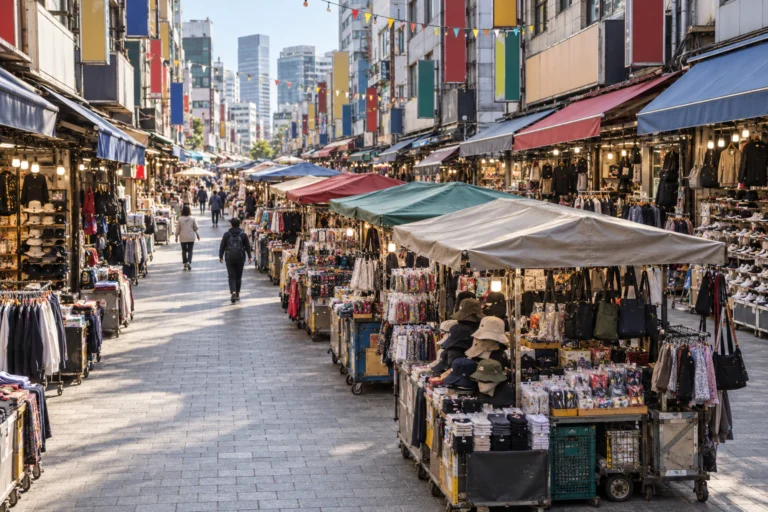
Namdaemun Market, where the day begins at night
Namdaemun Market has no single opening time for the whole market.

Bank of Korea Money Museum: walking into a 1912 bank for free
The fourth part of “Namdaemun & Myeongdong.” Eight minutes on foot from Namdaemun Market, the granite building on the main road is a former bank head office completed in 1912. The Bank of Korea Money Museum’s website says it was the first building in Korea to have a lift. Admission is free, and it opens Tuesday to Sunday. Lulu, who is choosing where to take a friend visiting from abroad, checks the English tour time before anything else.