
SEOUL · YUN DONG-JU LITERATURE MUSEUM
The Yun Dong-ju Literature Museum: Two Water Tanks Behind One Square of Sky
Elena Takes the Bus from Gyeongbokgung Station up to Jahamun Pass, Walks Through Rooms That Were Once Water Tanks, and Ends the Afternoon on Poet’s Hill
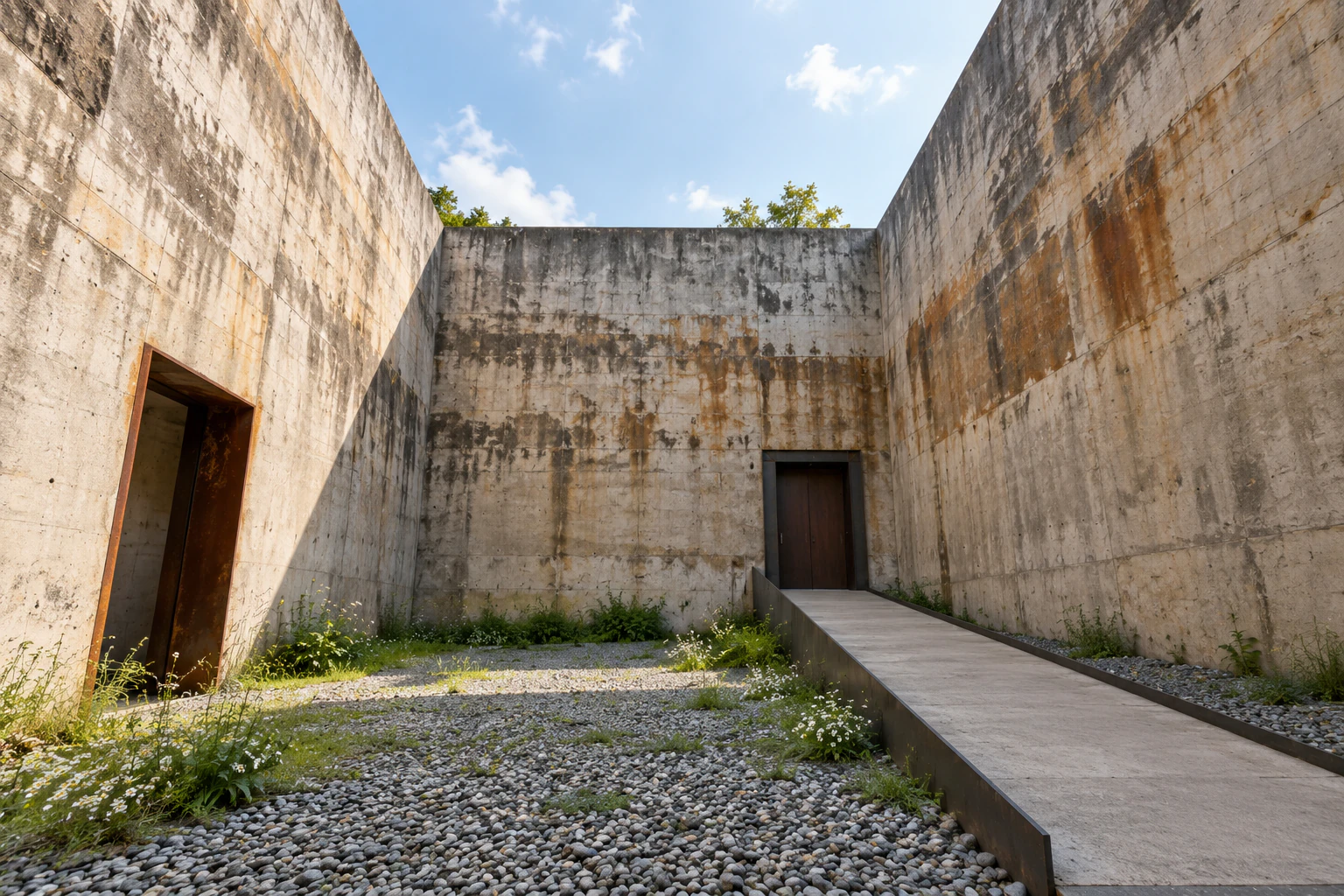
The last part of “Seochon.” Water-stained concrete walls with the sky cut into a square above them: that is the Yun Dong-ju Literature Museum Elena knows from screens. Elena, who reads scenes, heads up to Jahamun Pass to find out whether that smooth shot holds on the street — and why it always seems to be the same shot.
How to get there
Bus routes and the stop follow the museum’s official directions (Jongno Foundation for Arts and Culture); the walking distance and time from the stop are map-route (TMAP) estimates, measured from the further of the two stops.
This is the last of three parts of “Seochon.” Maya read the neighbourhood at Tongin Market, Noah at Suseongdong Valley, and now Elena climbs to the Yun Dong-ju Literature Museum, higher up the foot of Inwangsan.
Elena reads scenes. She writes down first why a scene on screen feels seamless, then asks whether that seamlessness belongs to the screen or would survive on a real street. Say “Yun Dong-ju Literature Museum” and one picture comes to her mind: four concrete walls streaked with water stains, and above them a square of sky.
A weekday, three in the afternoon — clear of the half-hour between 13:30 and 14:00 when the museum closes its rooms every day for cleaning. On the first line of her notebook Elena writes: “Apart from the room with the square sky, how many rooms were there?”
By bus from Gyeongbokgung, then 74 metres
Yun Dong-ju Literature Museum directions: from Exit 3 of Gyeongbokgung Station (Line 3), take local bus 1020, 7022 or 7212 to the “Jahamun Gogae, Yun Dong-ju Poet’s Hill” stop (01-106, 01-107); from Exit 2 of Gwanghwamun Station (Line 5), bus 1020 or 7212. Address: 119 Changuimun-ro, Jongno-gu, Seoul. Phone: 070-4531-4176.
The museum’s page on the Jongno Foundation for Arts and Culture website gives the way there by bus. From Exit 3 of Gyeongbokgung Station on Line 3, take the local bus 1020, 7022 or 7212 and get off at the “Jahamun Gogae, Yun Dong-ju Poet’s Hill” stop (01-106, 01-107). From Exit 2 of Gwanghwamun Station on Line 5, the 1020 and 7212 stop there too. By a map app’s walking route, the museum is 74 metres and a minute from the stop — and that is from the further of the two stops, one on each side of the road. Find on a map
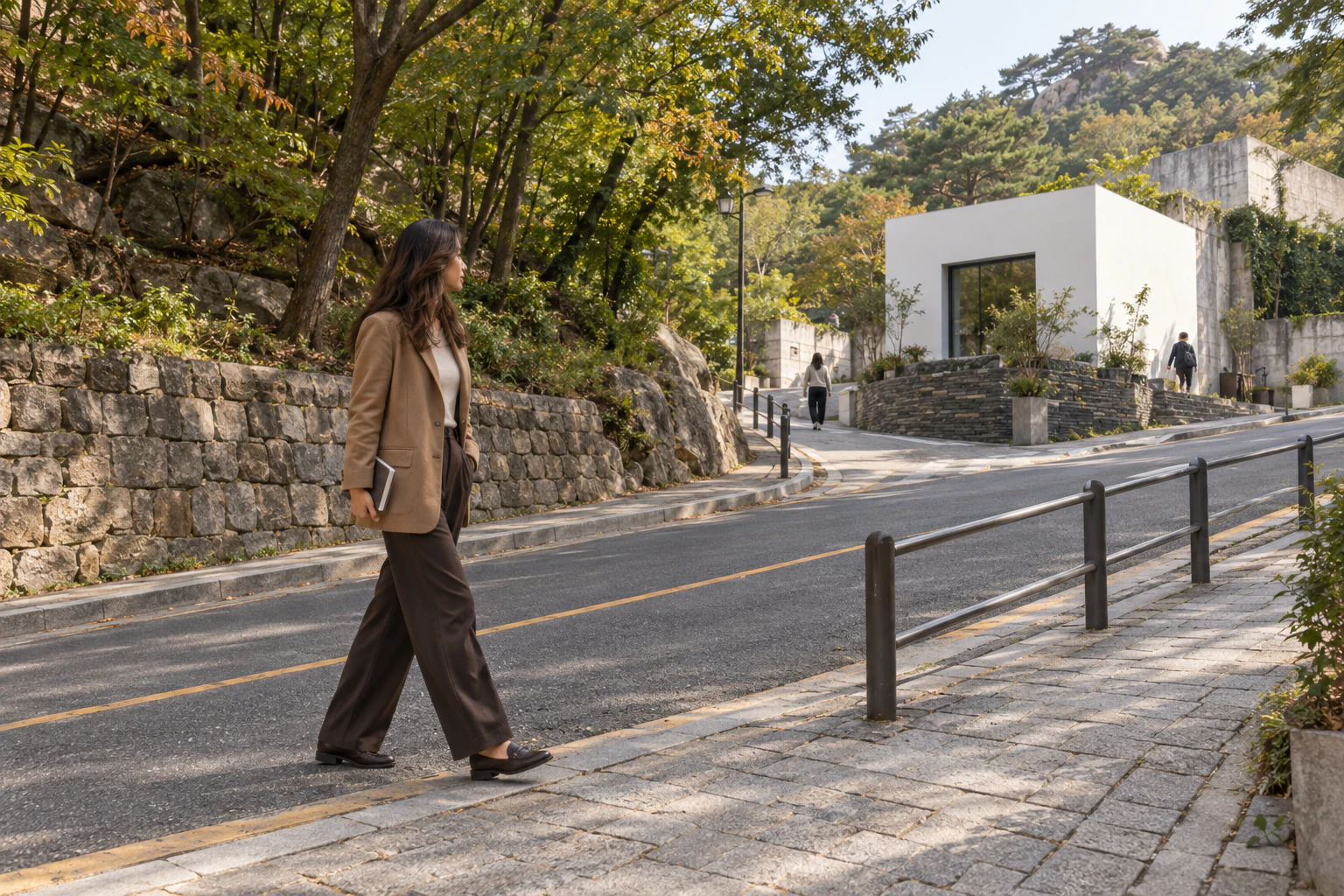
You can walk up, too. The same walking route puts the museum 2,198 metres and 28 minutes from Exit 3 of Gyeongbokgung Station. Elena copies the figures down and smiles. There is no climb in that shot of the square sky. On screen, the museum is always what you see once you have arrived.
In Seoul’s bus-stop data, the same stop is listed as “Jahamun Gogae · Yun Dong-ju Literature Museum.” The museum’s page names the stop after the hill; the city’s data names it after the museum. Elena writes the two names side by side. One stop, pointing at two places at once. The address on the museum’s page is 119 Changuimun-ro, Jongno-gu, Seoul.
A building that pushed the water on
The Yun Dong-ju Literature Museum opened in 2012, converted from the Cheongun water pressurising station and water tanks that had been abandoned at the foot of Inwangsan. A pressurising station puts pressure on slowing water so that it flows strongly again; the museum’s page calls the museum “a pressurising station for our souls.”
The museum doesn’t hide what the building used to be. Opened in 2012, its page says, the Yun Dong-ju Literature Museum was made from the Cheongun water pressurising station and water tanks that had been left abandoned at the foot of Inwangsan. It explains a pressurising station in a single line: a place that puts pressure on water that has slowed, so that it flows strongly again. Borrowing that idea, the page calls the museum “a pressurising station for our souls.” Find on a map
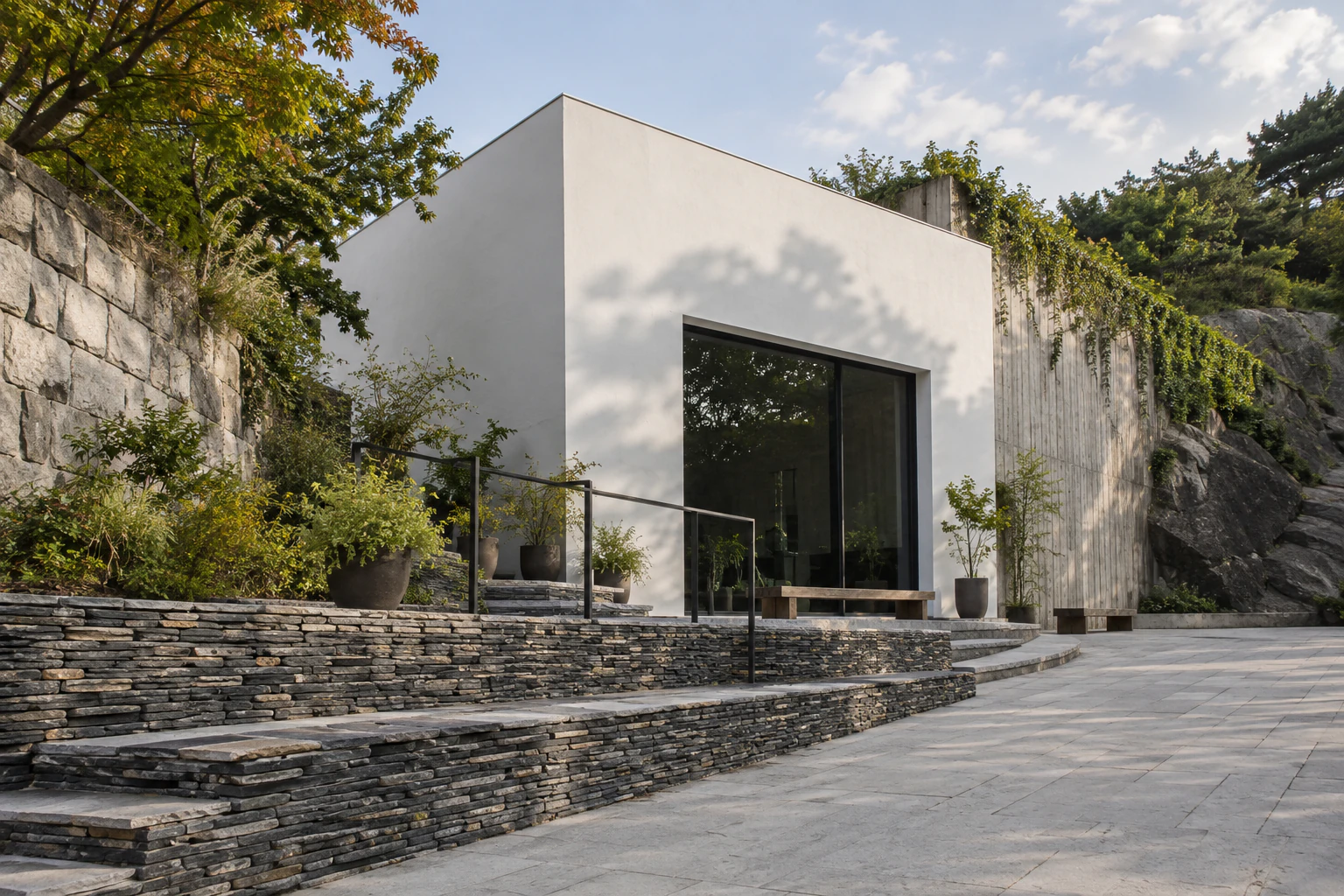
On the screens Elena remembers, the building is a neat white box. The Korea Tourism Organization’s published photographs show the same: a crisp-edged white building beside rough bedrock and a stone retaining wall, with low terraces of thinly stacked stone in front. White walls come out clean on screen. But that two tanks that once held water are joined to that white box is something no single front-on shot can tell you.
The page also says the building won the Korea Public Architecture Award in 2012 and the Seoul Architecture Award in 2014, and was designated a memorial facility in 2015 — adding that both the value of the space and its meaning are drawing attention. Elena writes the three lines one under another and underlines the last. The two awards are about the space. The designation is about the person the space remembers.
A white room for the notebook, not the camera
Gallery 1, “Siinchae” (the Poet’s House): a pure white space symbolising the poet’s untainted heart for poetry. Nine display stands hold photographs arranged in the order of his life, with facsimiles of his handwritten manuscripts.
The first room is Gallery 1, “Siinchae,” the Poet’s House. The museum describes it as a pure white space symbolising the poet’s untainted heart for poetry. On nine display stands, it says, photographs arranged in the order of his life sit alongside facsimiles of his handwritten manuscripts. Find on a map
The museum’s visitor notes contain one short line: photographs and video may be taken only in Gallery 2; photography is not allowed in Galleries 1 and 3. Reading it, Elena feels half of the day’s question answer itself. There was a reason the Yun Dong-ju Literature Museum on screen was always the same picture. Photography is allowed in only one room.
So in this room, Elena opens her notebook. The museum’s page passes on the account that while the poet was studying literature at Yonhi College, he lodged with his fellow writer Jeong Byeong-uk at the house of the novelist Kim Song (1909–1988) in Nusang-dong, Jongno-gu, and often climbed Inwangsan to shape his poems in the open air. It adds that “The Cross,” “The Wind Blows” and “Another Home” were written in this period.
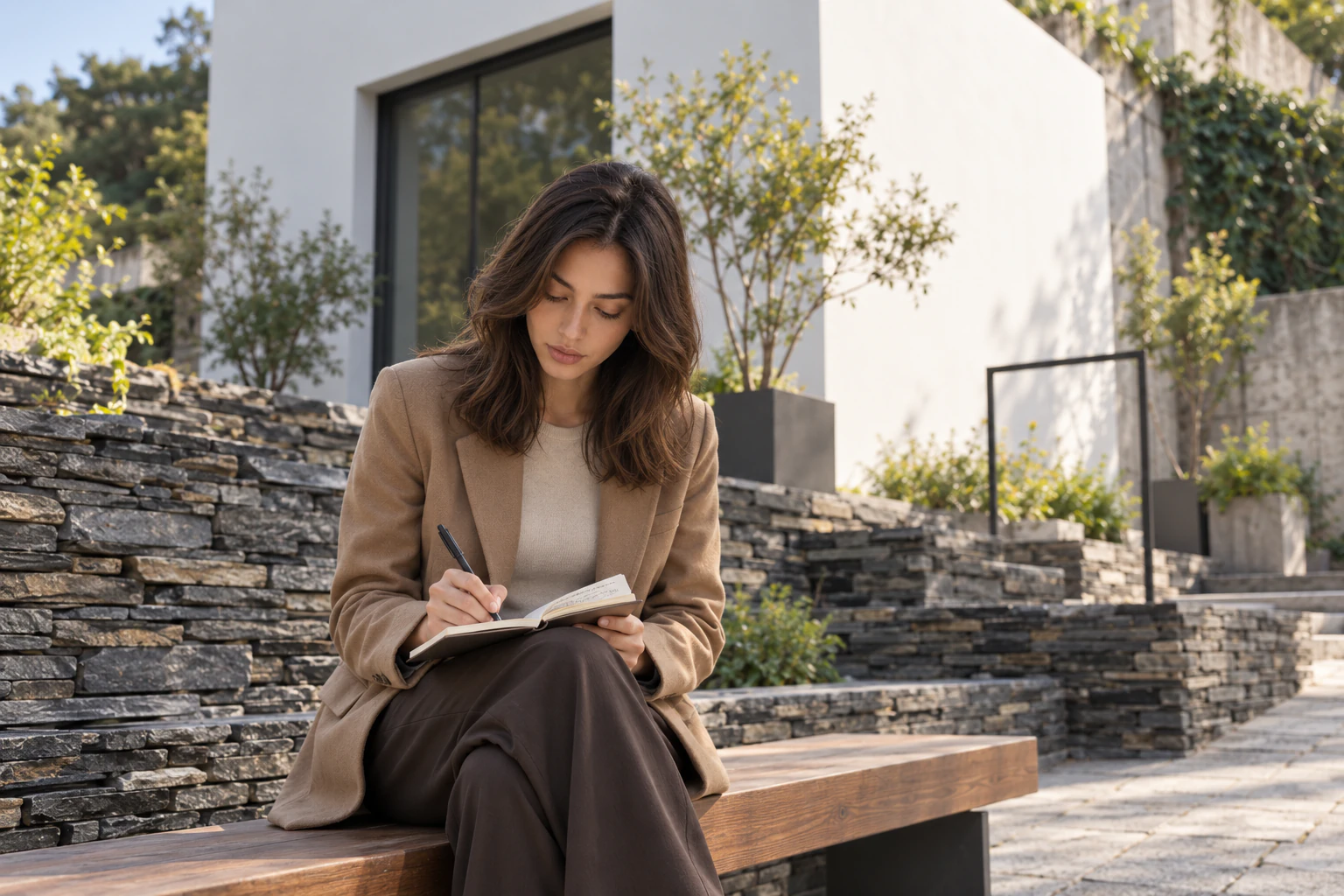
Elena doesn’t copy out any lines of verse. She writes down three titles and the name of a mountain, Inwangsan. By the museum’s own account, the building stands at the foot of that same mountain. The mountain the poet used to climb from Nusang-dong, she adds in the margin — and this time it’s Elena standing on its slope.
The room with the square sky, and the water on its walls
Gallery 2, the “Open Well”: inspired by the well in Yun Dong-ju’s poem “Self-Portrait,” the top of a disused water tank was opened to make a courtyard, named the Open Well. Traces of the water once stored in the tank remain on the walls, evoking the passing of time and the layering of memory.
Gallery 2, the “Open Well,” is the room in that picture. According to the museum, it took its cue from the well in Yun Dong-ju’s poem “Self-Portrait”: the top of a disused water tank was opened up to make a courtyard, which was named the Open Well. The traces of the water once stored in the tank remain on the walls, the page goes on, letting you feel the passing of time and the layering of memory. Find on a map
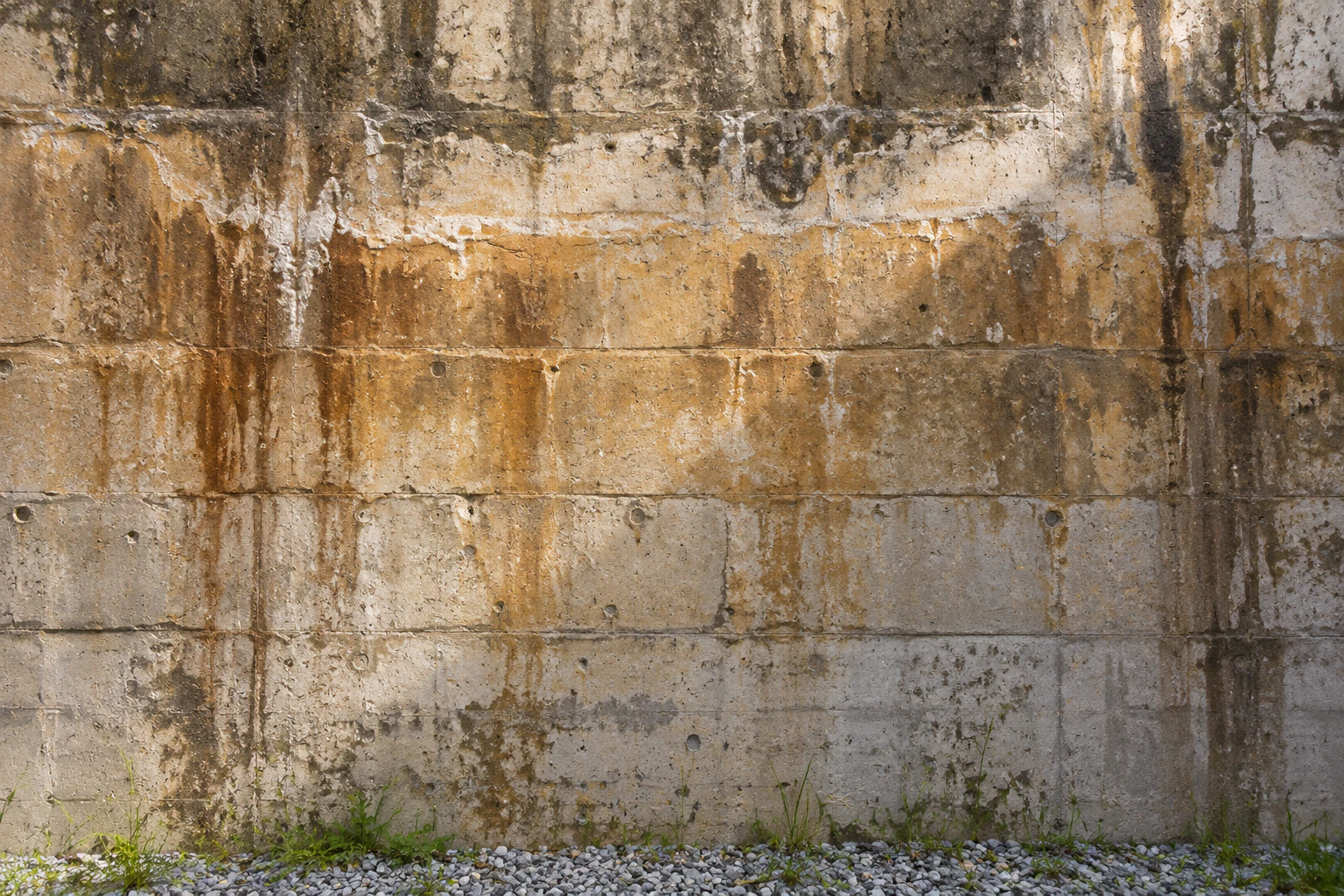
Elena lists what makes the shot so smooth. Tilt the camera slightly towards the sky and the four walls become a square frame. No one is inside the frame, and the stains on the walls catch the light like grain. So far, these are conditions chosen by whoever holds the camera. The fourth condition was set by the museum: this is the only room where photographs are allowed. The picture keeps looking the same not only because people’s eyes are alike.
So what is left on the street? On screen, the stains on the walls are texture, there for mood. Read through the museum’s own sentence, they are a record — marks left by the water that once filled these walls. In the Korea Tourism Organization’s photograph, a narrow sloping walkway runs beside a floor of gravel and grass, and there is a door in the left-hand wall and another at the far end. That’s the part a shot of the square sky usually crops out. To Elena, the two doors read like a sign that this room isn’t a destination but a passage between.
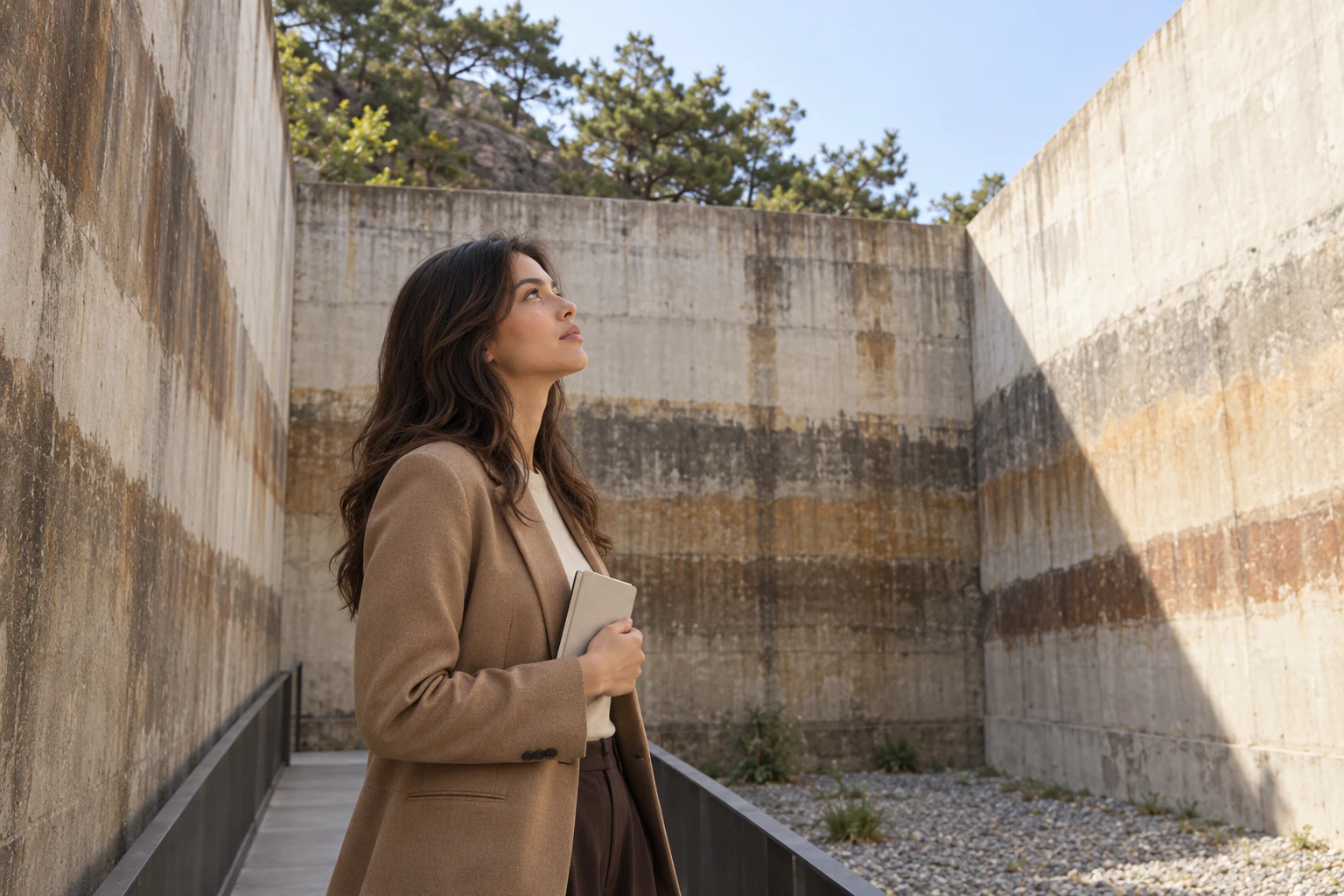
The Closed Well — a room you can’t take home as a picture
Gallery 3, the “Closed Well”: a second disused water tank preserved in its original form, designed as a space for silence and reflection, where a film about the poet’s life and poetry is shown. The last screening in Gallery 3 is at 17:15.
The next room is Gallery 3, the “Closed Well.” The museum says it was made from a second disused water tank, preserved in its original form. Unlike its neighbour, whose top was opened, this one was left closed. Designed as a space for silence and reflection, it shows a film about the poet’s life and poetry; the last screening of the day starts at 17:15, the museum notes. Find on a map
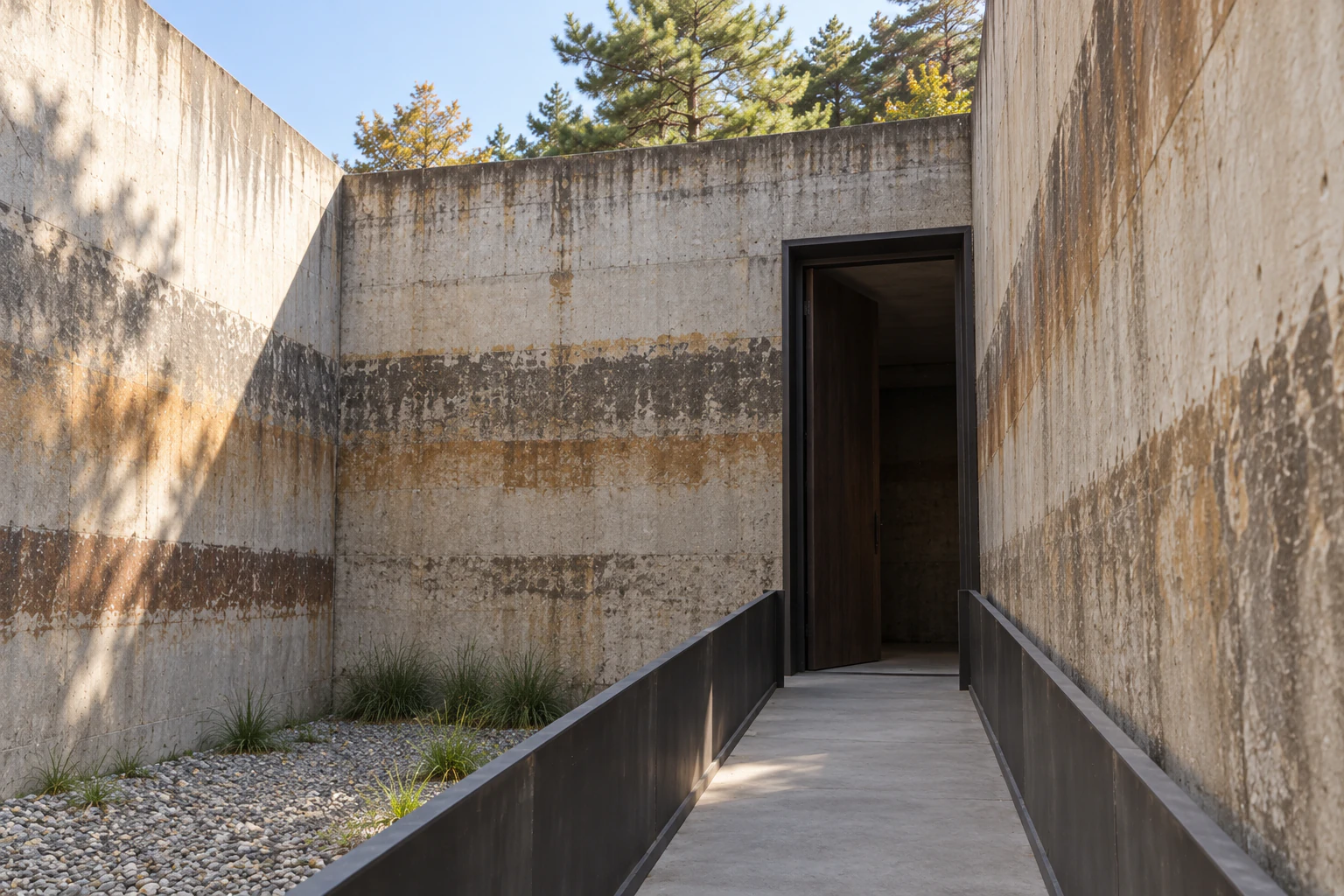
Photography isn’t allowed here either, so Elena can’t take this room away as a picture. Instead she writes the two wells side by side in her notebook: the open well and the closed well. Two water tanks, one opened to the sky, one left shut. Only the open one ever reaches the screen. The closed one stays only in that room, in the time you spend there.
Outside the museum, its page points to two more places. Climb the steps beside the building and there’s a small rest area called Byeoltteurak; behind the museum, a walking path called Poet’s Hill follows the bends of the hillside upwards. By a map app’s walking route, the point the map uses for Poet’s Hill is 257 metres and three minutes from the museum. An article on the Seoul city government’s news site, Seoul Mediahub, says there is a stone on the hill carved with the poem “Prologue.”
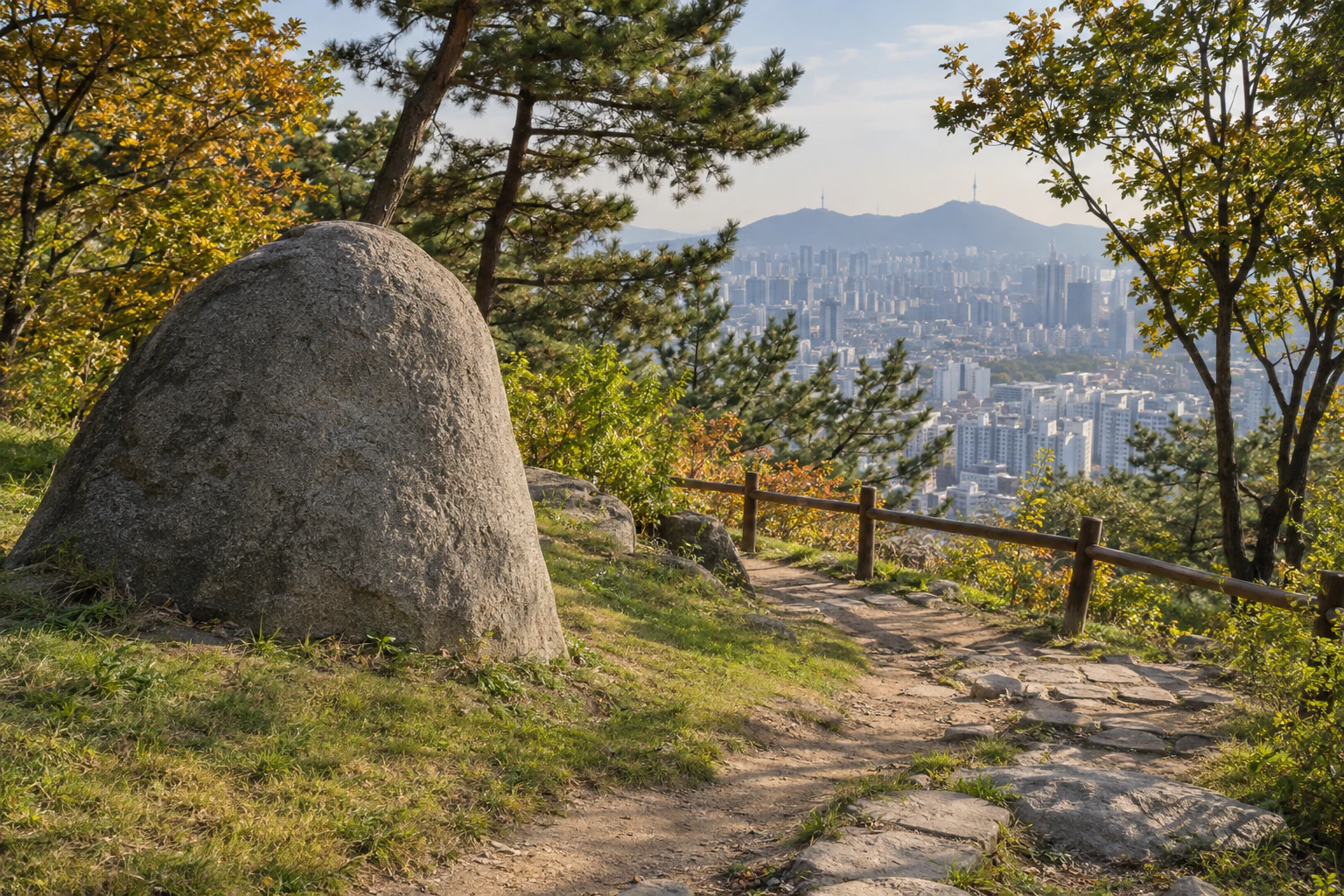
On the hill, Elena opens her notebook again. Three lines are left: a pass you climb by bus, a building that once pushed slowing water back on its way, and two rooms where photography isn’t allowed. None of the three fits into the picture of the square sky.
That doesn’t make the picture wrong. It is the one room where the museum allows photography. The other two simply stay off screen, as the rules say they should. The three parts of “Seochon” pass through a market and a valley and end here, on this hill. On the last line, Elena writes: “The rooms I couldn’t photograph stay with me longest.”

(※ This article includes staged images created with AI.)
Try it on your own afternoon
An editorial suggestion: take the bus from Exit 3 of Gyeongbokgung Station up to Jahamun Pass, open your notebook in Gallery 1, bring out your camera only in Gallery 2, where photography is allowed, watch the film in Gallery 3, then walk up to Poet’s Hill behind the museum.
A diagram of the order only · not to scale, orientation or the actual shape of the streets.
- From Gyeongbokgung Exit 3 to the Jahamun Gogae stop — Take local bus 1020, 7022 or 7212 and get off at the Jahamun Gogae stop (01-106, 01-107) (Jongno Foundation for Arts and Culture). From the further of the two stops to the museum: 74 m, about 1 minute by a map app’s walking route (TMAP calculation). Find on a map
- Gallery 1, “Siinchae” — A white room with photographs and facsimiles of handwritten manuscripts on nine display stands. No photography. Find on a map
- Gallery 2, the “Open Well” — A courtyard made by opening the top of a water tank. Photographs and video are allowed in this room only. Find on a map
- From Gallery 3, the “Closed Well,” to Poet’s Hill — Watch the film inside a water tank kept in its original form (last screening 17:15). From the museum to the map point for Poet’s Hill: 257 m, about 3 minutes (TMAP calculation). Find on a map
Getting there
Yun Dong-ju Literature Museum directionsChecked 2026.09.30
from Exit 3 of Gyeongbokgung Station (Line 3), take local bus 1020, 7022 or 7212 to the “Jahamun Gogae, Yun Dong-ju Poet’s Hill” stop (01-106, 01-107); from Exit 2 of Gwanghwamun Station (Line 5), bus 1020 or 7212. Address: 119 Changuimun-ro, Jongno-gu, Seoul. Phone: 070-4531-4176.
TMAPChecked 2026.09.30
From the Jahamun Gogae stop to the Yun Dong-ju Literature Museum, the map route is 35 m (under a minute) from stop 01-106 and 74 m, about 1 minute, from stop 01-107 (TMAP pedestrian route calculation). The story uses the further one: 74 m, about 1 minute.
Hours & fees
Gallery 2, the “Open Well”Checked 2026.09.30
inspired by the well in Yun Dong-ju’s poem “Self-Portrait,” the top of a disused water tank was opened to make a courtyard, named the Open Well. Traces of the water once stored in the tank remain on the walls, evoking the passing of time and the layering of memory.
Gallery 3, the “Closed Well”Checked 2026.09.30
a second disused water tank preserved in its original form, designed as a space for silence and reflection, where a film about the poet’s life and poetry is shown. The last screening in Gallery 3 is at 17:15.
Checked 2026.09.30
Open 10:00–18:00 (last entry 17:30); viewing restricted 13:30–14:00 daily for cleaning and disinfection. Closed Mondays, 1 January, and on the day of Seollal and Chuseok. Admission free.
Good to know
Checked 2026.09.30
Photographs and video may be taken in Gallery 2 only; photography is not allowed in Galleries 1 and 3.
Background10
TMAPChecked 2026.09.30
On foot from Exit 3 of Gyeongbokgung Station (Line 3) to the Yun Dong-ju Literature Museum, the map route is 2,198 m, about 28 minutes (TMAP pedestrian route calculation).
서울 열린데이터광장Checked 2026.09.30
In Seoul’s bus-stop data, stops 01-106 and 01-107 are named “Jahamun Gogae · Yun Dong-ju Literature Museum.”
Checked 2026.09.30
The Yun Dong-ju Literature Museum opened in 2012, converted from the Cheongun water pressurising station and water tanks that had been abandoned at the foot of Inwangsan. A pressurising station puts pressure on slowing water so that it flows strongly again; the museum’s page calls the museum “a pressurising station for our souls.”
Checked 2026.09.30
The museum won the Korea Public Architecture Award in 2012 and the Seoul Architecture Award in 2014, and was designated a memorial facility in 2015.
Checked 2026.09.30
While studying literature at Yonhi College, the poet Yun Dong-ju is said to have lodged with his fellow writer Jeong Byeong-uk at the Nusang-dong house of the novelist Kim Song (1909–1988) and often climbed Inwangsan to shape his poems. The museum says works including “The Cross,” “The Wind Blows” and “Another Home” were written in this period.
Gallery 1, “Siinchae” (the Poet’s House)Checked 2026.09.30
a pure white space symbolising the poet’s untainted heart for poetry. Nine display stands hold photographs arranged in the order of his life, with facsimiles of his handwritten manuscripts.
Checked 2026.09.30
Food and drink may not be brought in. There are no toilets inside the museum (visitors are directed to the public toilets in Cheongun Park, 100 m from the museum).
Checked 2026.09.30
Climb the steps beside the museum to reach Byeoltteurak, a small rest area and literary space; behind the museum, Poet’s Hill is a walking path that follows the bends of the hillside upwards, open to the wind.
TMAPChecked 2026.09.30
From the Yun Dong-ju Literature Museum to the map point for Poet’s Hill, the map route is 257 m, about 3 minutes (TMAP pedestrian route calculation).
Checked 2026.09.30
Seoul Mediahub (Seoul city government news site) article: a stone on Poet’s Hill is carved with Yun Dong-ju’s poem “Prologue.”
- Opening hours are 10:00–18:00 (last entry 17:30), with viewing restricted every day from 13:30 to 14:00 for cleaning and disinfection. Closed on Mondays, 1 January, and on the day of Seollal (Lunar New Year) and Chuseok. Admission is free (Yun Dong-ju Literature Museum page, Jongno Foundation for Arts and Culture, checked 30 September 2026).
- The address is 119 Changuimun-ro, Jongno-gu, Seoul, and the phone number is 070-4531-4176. There are no toilets inside the museum, and food and drink may not be brought in (museum page).
- Photographs and video are allowed in Gallery 2 only. As an editorial suggestion: keep other visitors out of your frame and don’t block the walkway for long.
- The stop name differs between sources: the museum’s page says “Jahamun Gogae, Yun Dong-ju Poet’s Hill,” while Seoul’s bus-stop data says “Jahamun Gogae · Yun Dong-ju Literature Museum.” These are different names used by the two sources, not names that distinguish the direction of bus travel.
More from this area
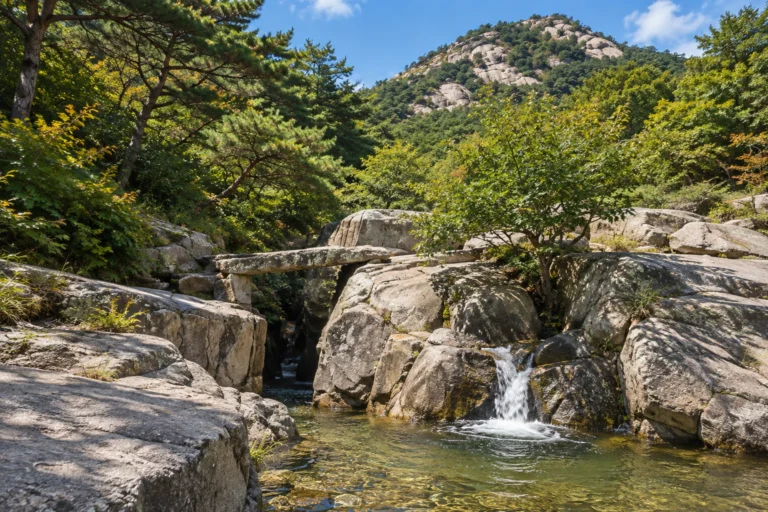
Suseongdong Valley: a stone bridge 711 metres’ walk uphill from the market lanes
Part two of “Seochon”.
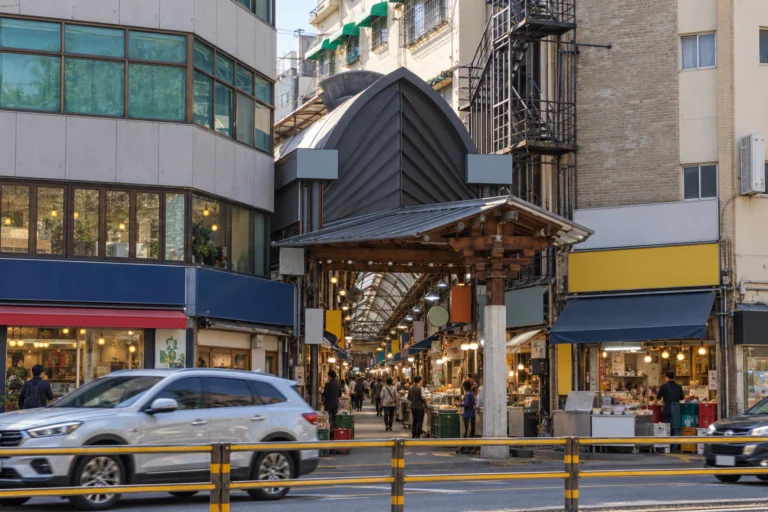
Tongin Market: Ten Coins and a Lunch Chosen Again, One Space at a Time
Part one of “Seochon.” Tongin Market, in the middle of Seochon to the west of Gyeongbokgung Palace, grew out of a public market founded in 1941 and now has some 70 shops. Since 2012 its lunchbox café has let visitors swap cash for old-style coins and fill a tray with small portions from around the market. Maya saved a picture of that finished tray on a screen long ago. This time she walks the aisle and fills the spaces herself.