
SEOUL · TONGIN MARKET
Tongin Market: Ten Coins and a Lunch Chosen Again, One Space at a Time
Maya Walks Up from Exit 2 of Gyeongbokgung Station into Seochon and Refills, Space by Space, the Coin Lunchbox She Once Saved from a Screen
Part one of “Seochon.” Tongin Market, in the middle of Seochon to the west of Gyeongbokgung Palace, grew out of a public market founded in 1941 and now has some 70 shops. Since 2012 its lunchbox café has let visitors swap cash for old-style coins and fill a tray with small portions from around the market. Maya saved a picture of that finished tray on a screen long ago. This time she walks the aisle and fills the spaces herself.
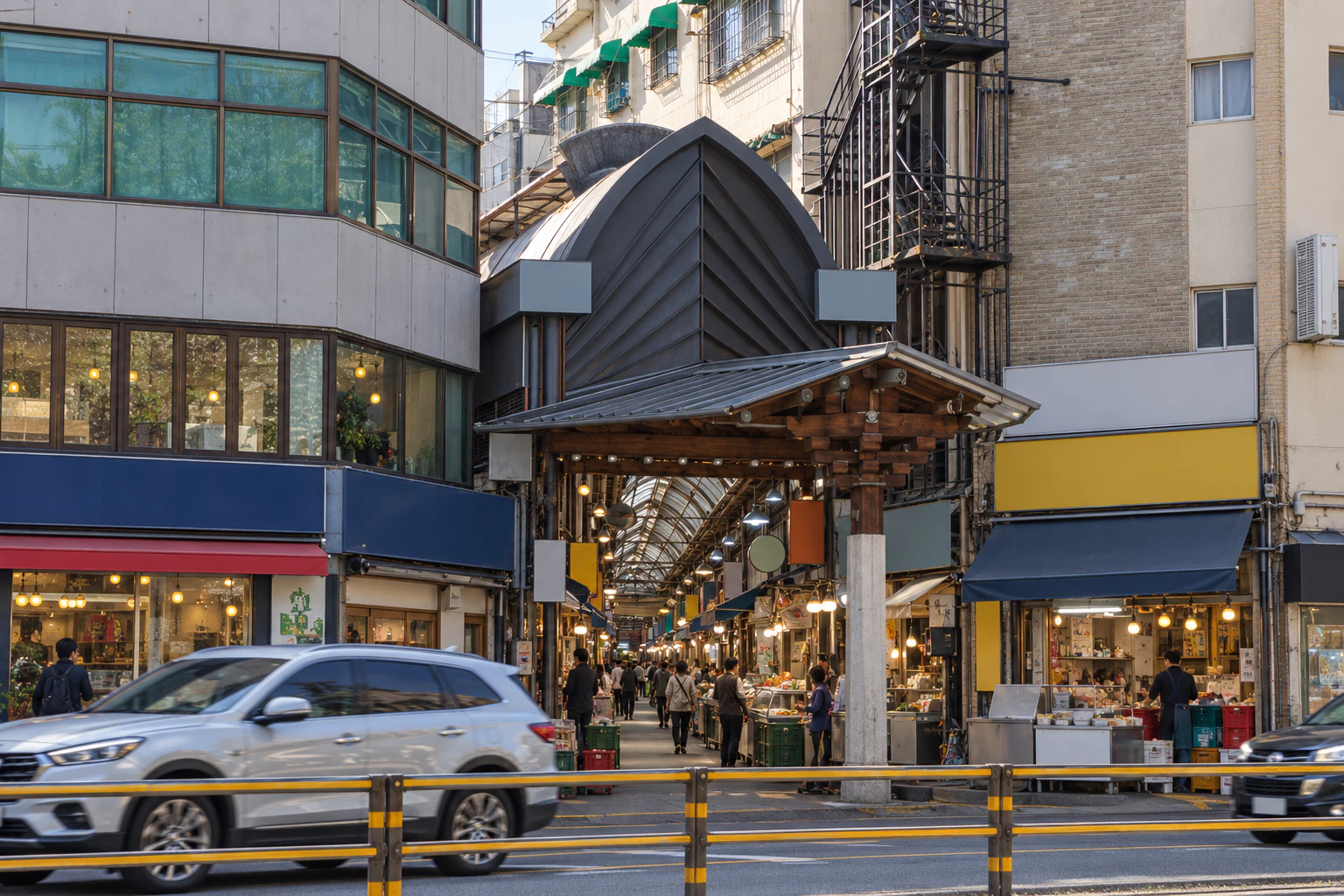
How to get there
Calculated with a map app’s walking route (TMAP) to the point marked as the market entrance. To the listed address (18 Jahamun-ro 15-gil) it is 598 m, about 8 min. Visit Seoul gives 515 m from Gyeongbokgung Station Exit 2.
This is the first of three stories from Seochon, the hanok neighbourhood west of Gyeongbokgung Palace, which we’re walking in three parts. Today Maya heads for Tongin Market, said to sit right at its centre.
Maya is someone who picked her Seoul on screen first. She keeps a list of scenes from dramas and videos, then goes to each place on foot and chooses again. For a long time her list has held one line: “A handful of old coins and a tray with little compartments.” Almost every scene she saved was the same shot — a tray seen from above, every compartment full, the meal already assembled.
Half past ten on a weekday morning, and neither a Monday nor a Tuesday. There’s a reason for that, which comes later. On the first line of her notebook Maya writes: “Not the finished tray. The filling of it.”
North from Exit 2 of Gyeongbokgung Station
Visit Seoul: Tongin Market is 515 m from Exit 2 of Gyeongbokgung Station on Subway Line 3. Address: 18 Jahamun-ro 15-gil, Jongno-gu, Seoul.
Visit Seoul, the city’s official tourism website, gives the way to Tongin Market as Exit 2 of Gyeongbokgung Station on Line 3, 515 metres away. The same article introduces the area west of the palace as Seochon, a neighbourhood of hanok houses, and says that Tongin Market sits at its centre. Find on a map
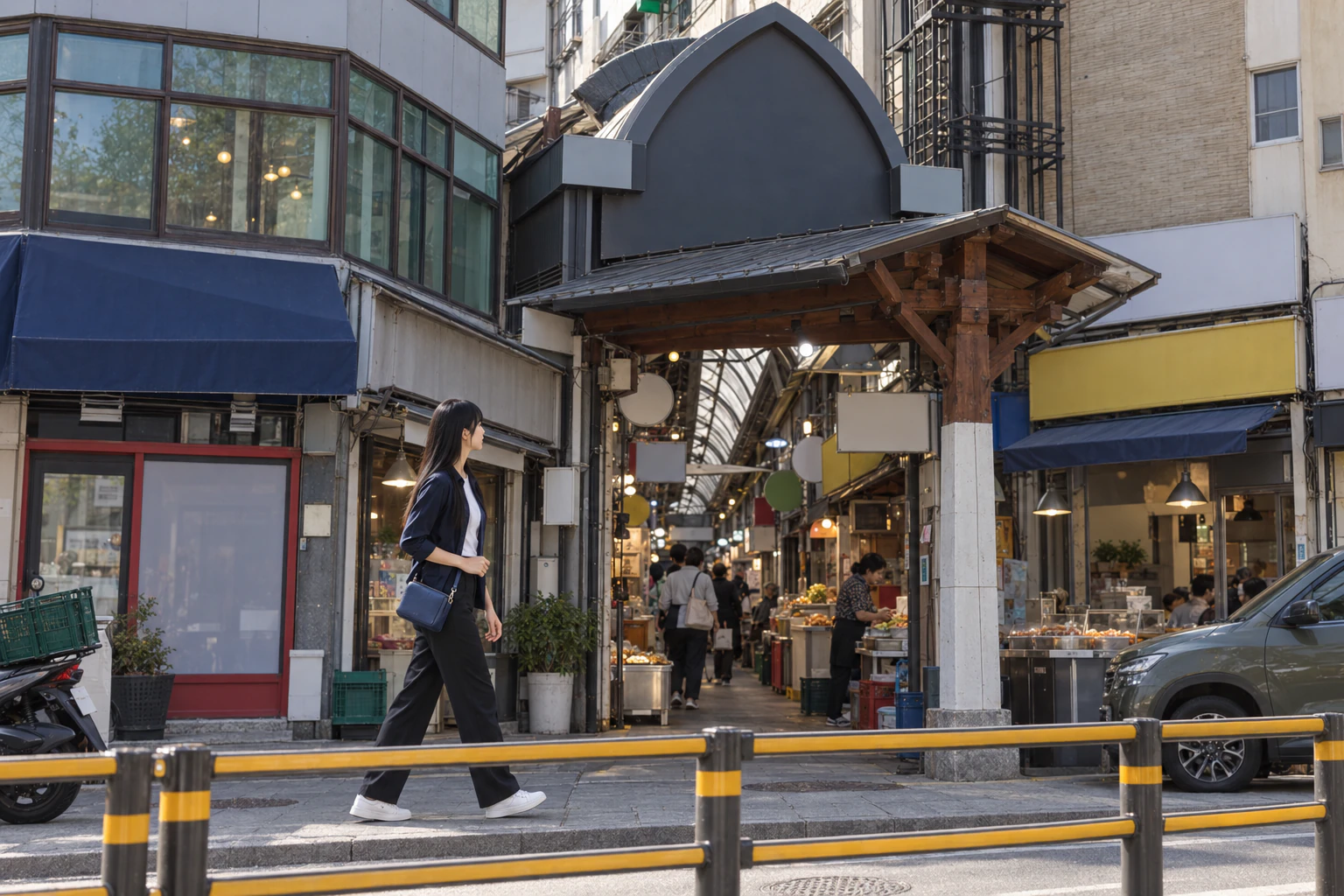
The directions box for this story uses a map app’s walking route (TMAP) from that same Exit 2. To the point marked as the market entrance it is 513 metres, about seven minutes on foot. Set the destination to the market’s listed address (18 Jahamun-ro 15-gil) instead and it stretches to 598 metres and eight minutes. Same market, different numbers — it depends on which door you stop at.
Maya comes out of the exit and follows the route north. This road wasn’t in any of her saved scenes. On screen, everything started on the tray. Walking here gives things an order instead: how far you go from the station before you start to feel hungry, which side the market gate first appears on. Maya notes the moment the gate comes into view in the corner of her notebook.
A hundred metres under the roof
Visit Seoul’s Tongin Market guide: about 100 m in from the market entrance is the customer service centre, and coins are sold at the lunchbox café on its first floor (second floor in Korean numbering). Ground floor: public toilets. First floor: lunchbox café, rest area and merchants’ association office.
Visit Seoul’s guide to Tongin Market says that about 100 metres in from the entrance you reach the customer service centre, and that the coins are sold upstairs in that building. It also sets out the floors: public toilets on the ground floor, and the lunchbox café and a rest area on the first floor — the second, by Korean counting. Find on a map

Published photographs show the entrance standing on the side of a main road. Step inside and a clear, round-arched roof runs the length of the aisle. Some pictures show fabric shades and strings of bulbs hung beneath it, and shops standing shoulder to shoulder on both sides.
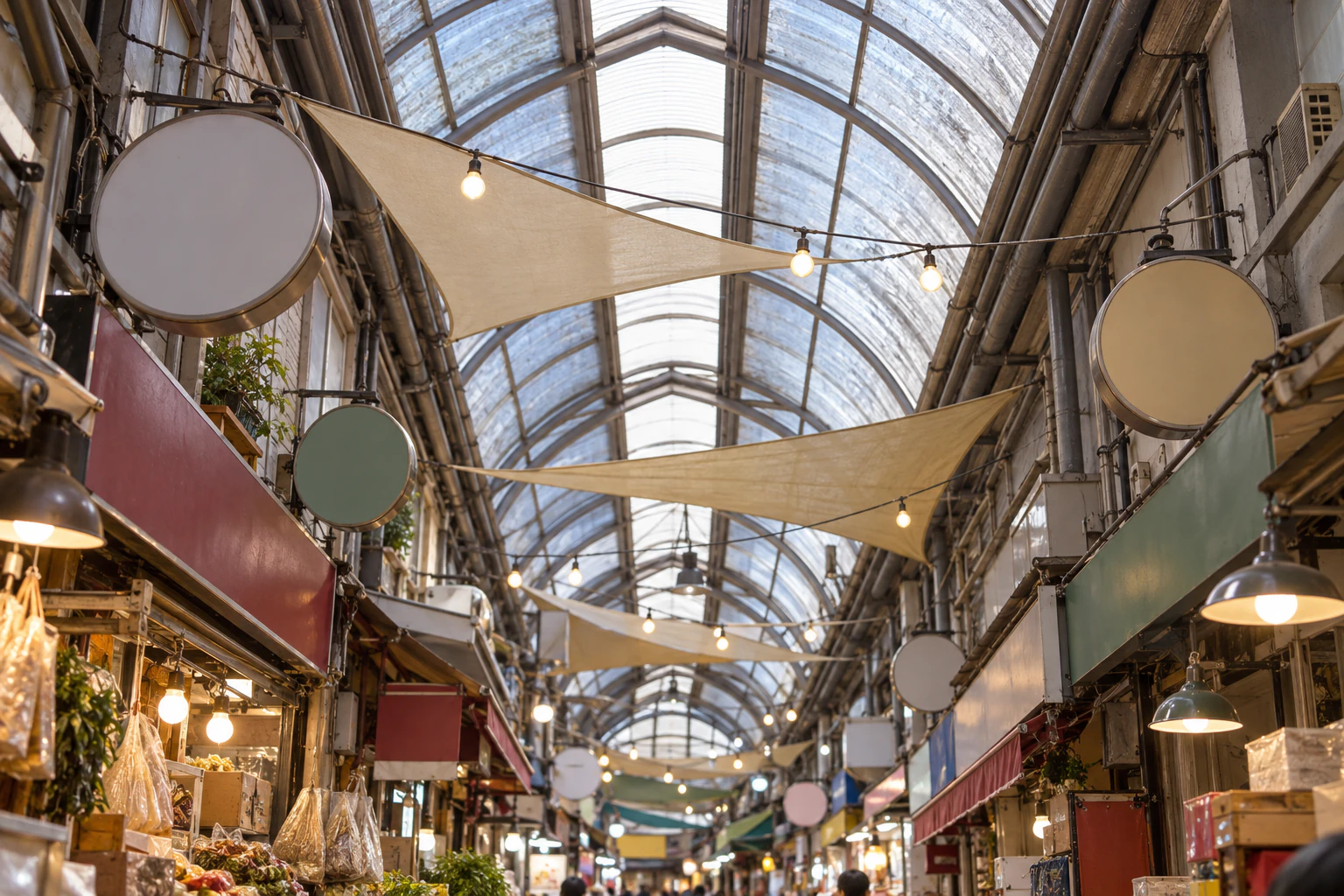
Maya walks those 100 metres slowly. Her saved scenes only ever showed the tray, never where the tray gets filled. Here, those compartments are scattered along both sides of the aisle. She has no coins yet, so she can’t choose anything. She does one lap with her eyes only and decides to pick on the second time round. In her notebook she writes her first correction: “The tray isn’t one place. It’s a 100-metre aisle.”
From a 1941 public market to some 70 shops
Korea Tourism Organization listing: Tongin Market grew out of a public market set up in June 1941, under Japanese colonial rule, for Japanese residents near Hyoja-dong. After the Korean War, as Seochon’s population rose sharply, stalls and shops gathered around the public market and it gradually took shape as a market.
The Korea Tourism Organization’s listing traces Tongin Market back to June 1941, when a public market was set up for Japanese residents near Hyoja-dong under colonial rule. After the Korean War, as Seochon’s population rose quickly, stalls and shops gathered around the public market, and bit by bit it took on the shape of a market. Find on a map
According to the same listing, it was registered as a recognised market in 2005 and then modernised, and in 2010 it was chosen as a “Seoul-style cultural market” under a scheme run by the city and Jongno-gu. It has some 70 shops. Food businesses such as restaurants and side-dish counters are the most common, followed by shops selling vegetables, fruit, fish and meat, with a few selling everyday goods like underwear, and some that do clothing alterations. Sources put the number of shops anywhere from about 70 to around 80, so here we follow the tourism organisation’s Korean-language listing.
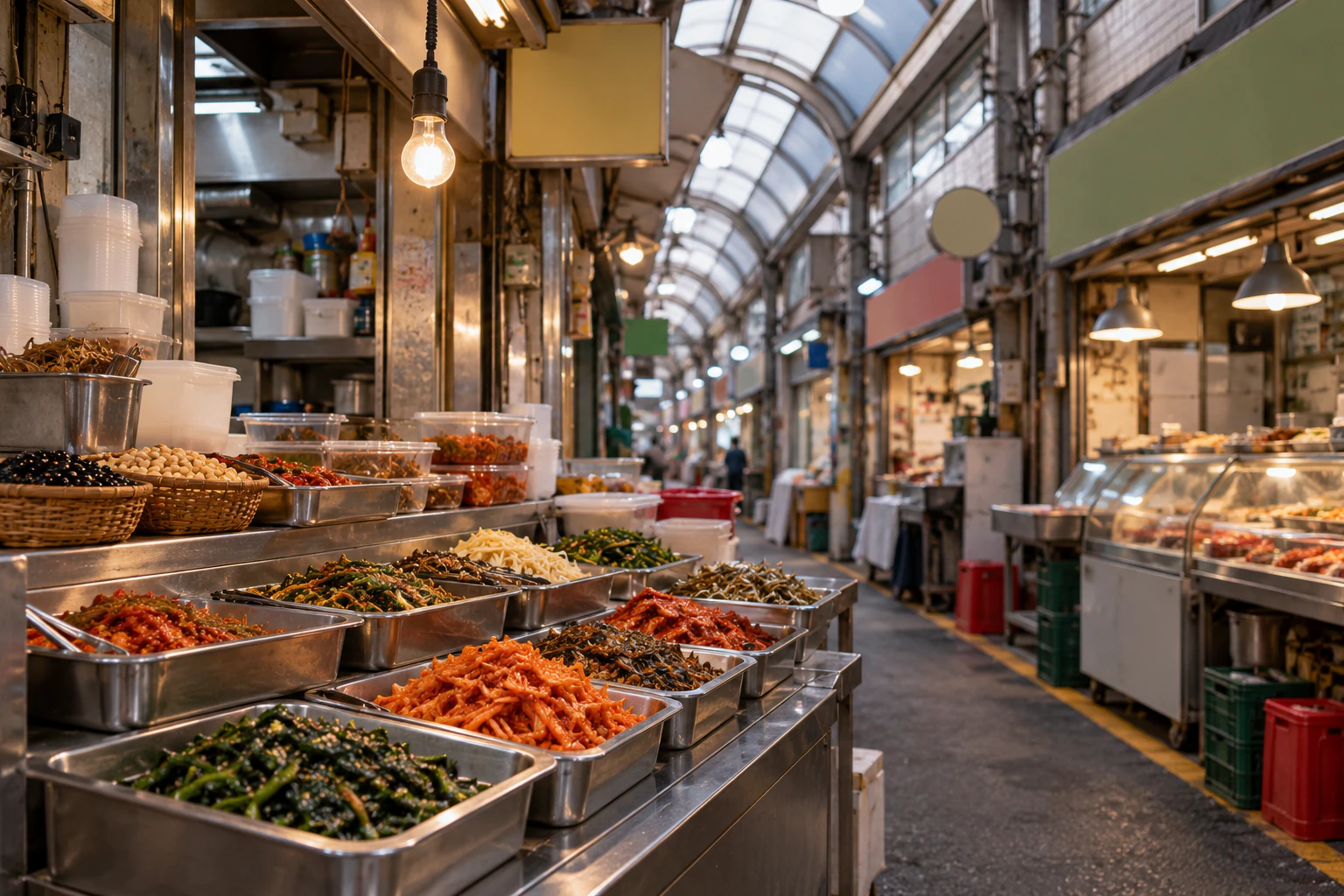
Maya’s list only had side dishes on it. Walk the aisle, though, and there are things wedged in between that would never go in a lunchbox: crates of vegetables, a shop selling fish, a spot where clothes get mended. This is the market that sat outside the edge of the tray photo. Maya works out that the market was here long before the lunchbox — not from the date, but from the way things are laid out.
Ten coins, turned into empty spaces
Visit Seoul: the lunchbox café is on the first floor (second floor in Korean numbering), near the centre of the market. You change money into yeopjeon, traditional-style coins, carry a tray round the market, and pick up small portions from the shops that take the coins, then go back up to the café to eat. Chopsticks and drinks are provided. Examples given: rice cakes stir-fried in oil (gireum tteokbokki), gujeolpan and rice steamed in a lotus leaf.
The tourism organisation’s listing says the market has run its lunchbox café, Tong, since January 2012. Visit Seoul explains how it works in a few lines. At the café, upstairs near the middle of the market, you change your money into yeopjeon — traditional-style coins. Then you carry a tray round the market, pick up a little of this and that at the shops that take the coins, and go back upstairs to eat. Chopsticks and drinks are provided, it says. Find on a map
Visit Seoul’s market guide puts one coin at 500 won and suggests about 5,000 won’s worth per person. That makes ten coins. A disposable lunchbox comes with them, it says, and the dishes it mentions as examples include rice cakes stir-fried in oil, gujeolpan and rice steamed in a lotus leaf. A citizen reporter writing for the Seoul city government’s news site mentions being given a “coin map” at the café. This story doesn’t rate one shop above another.
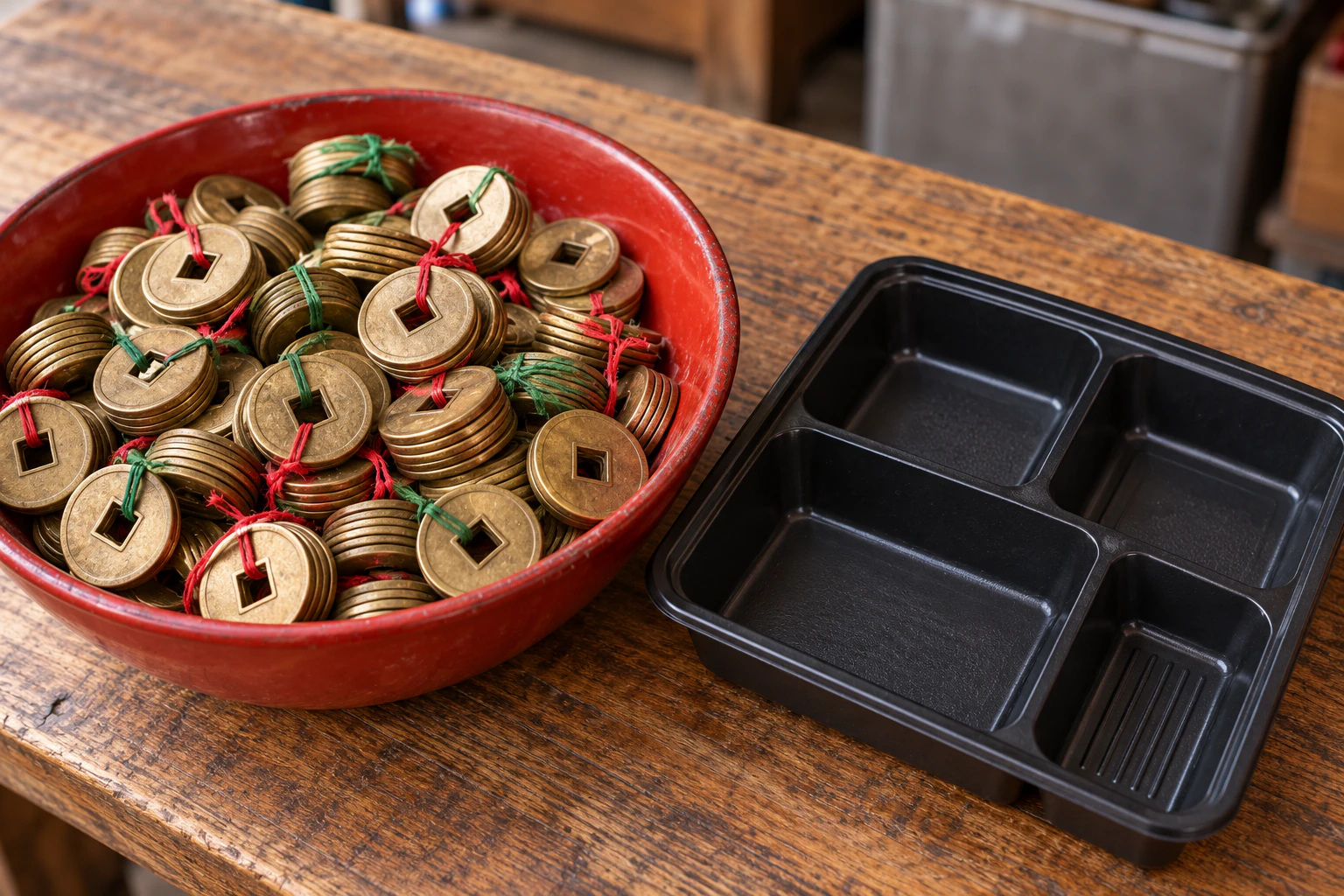
Maya lays the ten coins on her palm. On screen, the coins were props. In her hand, they’re a budget. How many for each space? Spend half at the very first counter? The tray she saved was a finished result. What Maya is holding now is a set of empty spaces and ten decisions.
On her second walk down the aisle, Maya fills the spaces one by one. She keeps the salty things apart from the soft ones and leaves one spot empty until the very end, to save the fun of deciding at the last counter. Second correction: “Better than a full tray — a tray with one space left.”

Opens at 11 — closes, depending on who you ask
Visit Seoul (updated September 2026): market 07:00–21:00; lunchbox café 11:00–15:00, closed on Tuesdays.
The most useful part of this story may well be the timing. Every source gives the market as 07:00 to 21:00, and every one adds that hours vary by shop. They also all agree that the lunchbox café opens at 11:00. Find on a map
Closing times and days off are another matter. Visit Seoul’s itinerary article, updated in September 2026, lists the café as 11:00–15:00 and closed on Tuesdays. A separate Tongin Market guide on the same site, dated 17 July 2026, says the café closes on Mondays and the whole market closes on the third Sunday of each month. The Korea Tourism Organization’s Japanese-language listing has the café closed on Tuesdays and the third Sunday, with coins sold until 15:00 on weekdays and 16:00 at weekends. And a citizen reporter’s piece on the city’s news site in 2025 gave opening until 16:00 on weekdays and 17:00 at weekends.
As an editorial choice, Maya avoids Monday and Tuesday and uses 11:00–15:00 on a weekday as the overlap in the published schedules. That is not a guarantee of operation. That’s why she arrived at half past ten. She adds one more line, as an editorial suggestion: “Before setting out, check the market’s official Instagram for the latest notice.” That’s the account both the tourism organisation and Visit Seoul list as the market’s website.
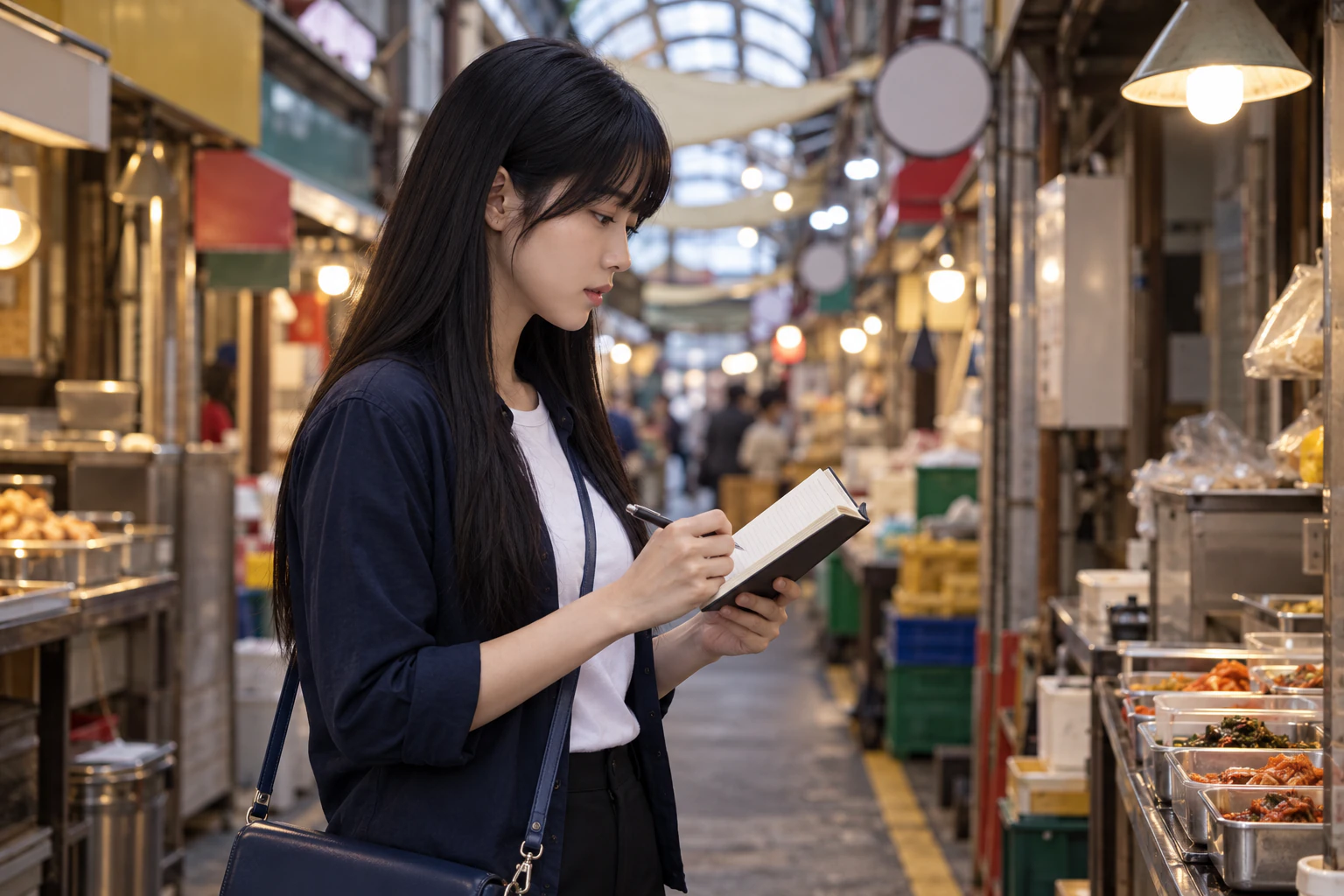
A little after noon, Maya carries her tray upstairs, then later comes back down into the aisle and walks towards the entrance. The scene she saved on screen was a single tray. What she has chosen again on foot comes to three things: the 500-odd metres from the station to the gate, the 100-metre aisle under the roof, and the order in which ten coins on her palm turned into empty spaces. The screen showed her the result. The market showed her the filling of it.
Maya doesn’t cross out that line on her list. She writes another one beside it: “Lunch isn’t a tray. It’s a lap.” In the next part, Noah heads to Suseongdong Valley, also in Seochon.
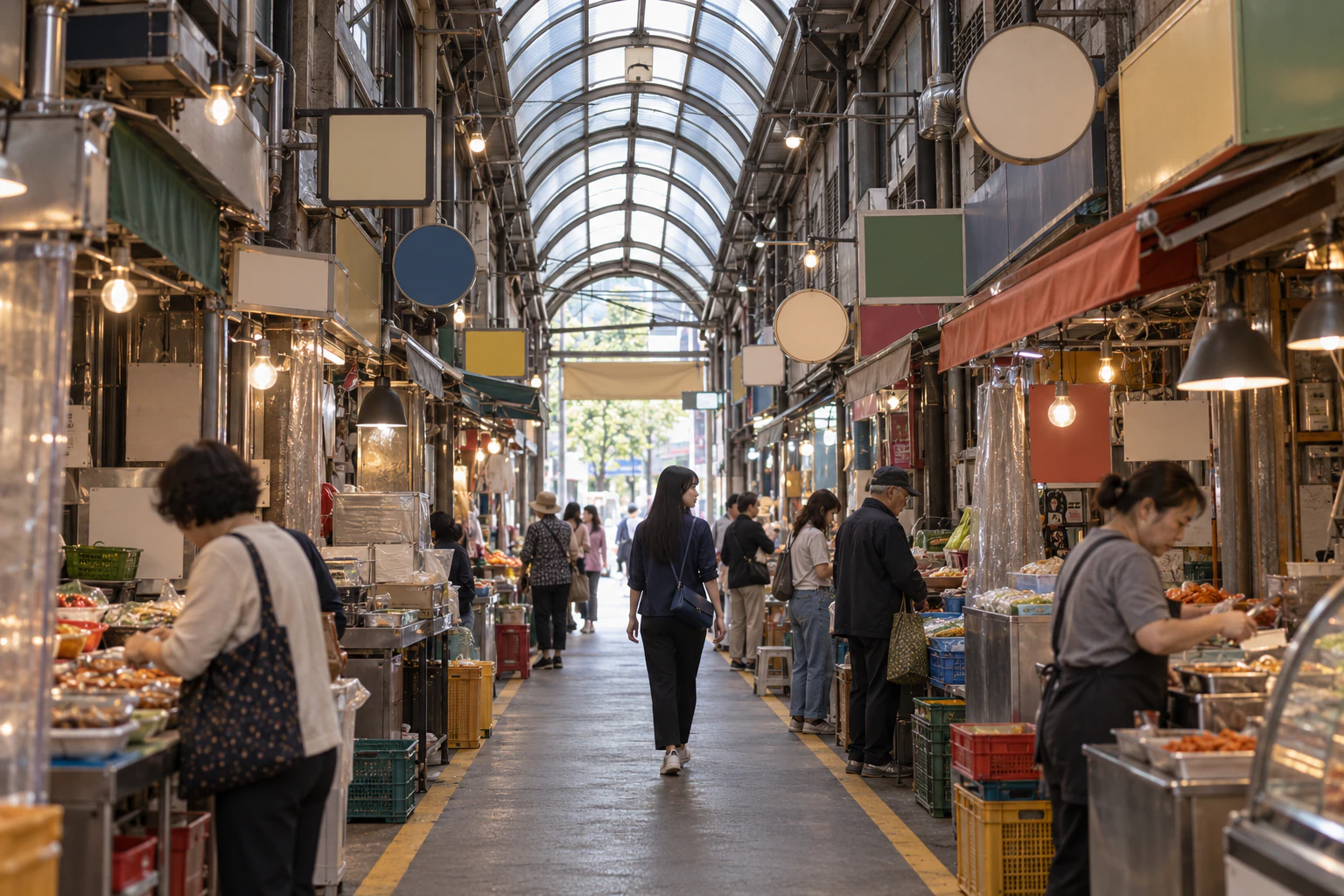
(※ This article includes staged images created with AI.)
Try it on your own lunch
An editorial suggestion: walk up from Exit 2 of Gyeongbokgung Station, walk the aisle once with your eyes from the entrance to the lunchbox café, change your money into coins, then fill your spaces on a second lap. We don’t review individual shops in the market.
A diagram of the order only · not to scale, orientation or the actual shape of the streets.
- Start from Gyeongbokgung Station Exit 2 — Visit Seoul gives the distance as 515 m. By a map app’s walking route (TMAP) it is 513 m, about 7 min, to the market entrance. Find on a map
- Walk the aisle once from the entrance — According to Visit Seoul, the customer service centre is about 100 m in from the entrance. Find on a map
- Change money into coins at the café upstairs — Visit Seoul puts one coin at 500 won and suggests about 5,000 won per person. Find on a map
- Fill up on a second lap, then eat upstairs — Pick up small portions at the shops that take the coins, then go back to the lunchbox café to eat. Find on a map
Getting there
Visit SeoulChecked 2026.09.30
Tongin Market is 515 m from Exit 2 of Gyeongbokgung Station on Subway Line 3. Address: 18 Jahamun-ro 15-gil, Jongno-gu, Seoul.
TMAPChecked 2026.09.30
From Exit 2 of Gyeongbokgung Station (Line 3) to the Tongin Market entrance, the map route is 513 m, about 7 minutes (TMAP pedestrian route calculation). To the market’s listed address point (18 Jahamun-ro 15-gil) it is 598 m, about 8 minutes.
Hours & fees
Visit Seoul (updated September 2026)Checked 2026.09.30
market 07:00–21:00; lunchbox café 11:00–15:00, closed on Tuesdays.
Checked 2026.09.30
Visit Seoul’s Tongin Market guide (as of 17 July 2026): open daily 07:00–21:00 (varies by shop). The whole market closes on the third Sunday of each month, and the lunchbox café closes on Mondays. Customer service centre: weekdays 11:00–15:00, Saturdays 11:00–16:00, closed on Mondays.
Korea Tourism Organization listingsChecked 2026.09.30
market shops 07:00–21:00 and the lunchbox café 11:00–15:00, with closing days that vary by shop (Korean edition). The Japanese and Chinese editions add that coins are sold until 15:00 on weekdays and 16:00 at weekends. The Japanese edition gives the café’s closing days as Tuesdays and the third Sunday, and the Chinese edition as the third Sunday of each month.
Checked 2026.09.30
A citizen reporter’s article on the Seoul Metropolitan Government’s news site (published 29 May 2025): lunchbox café Mon–Fri 11:00–16:00 (coins sold until 15:00), Sat–Sun 11:00–17:00 (coins until 16:00), closed on Tuesdays and the third Sunday of each month. A coin map is handed out at the café.
Good to know
TourAPIChecked 2026.09.30
Tongin Market’s website as listed by the Korea Tourism Organization and Visit Seoul: the Instagram account tongin_official (https://www.instagram.com/tongin_official/).
Background8
Visit SeoulChecked 2026.09.30
the area west of Gyeongbokgung Palace is Seochon, a small-scale neighbourhood of hanok houses, and Tongin Market sits at its centre.
Visit Seoul’s Tongin Market guideChecked 2026.09.30
about 100 m in from the market entrance is the customer service centre, and coins are sold at the lunchbox café on its first floor (second floor in Korean numbering). Ground floor: public toilets. First floor: lunchbox café, rest area and merchants’ association office.
Korea Tourism Organization listingChecked 2026.09.30
Tongin Market grew out of a public market set up in June 1941, under Japanese colonial rule, for Japanese residents near Hyoja-dong. After the Korean War, as Seochon’s population rose sharply, stalls and shops gathered around the public market and it gradually took shape as a market.
Korea Tourism Organization listingChecked 2026.09.30
in 2005 the market was registered as a recognised market under the special act on fostering traditional markets and then modernised its facilities. In 2010 it was selected as a “Seoul-style cultural market”, a scheme run by the Seoul Metropolitan Government and Jongno-gu.
Korea Tourism Organization listingChecked 2026.09.30
the market has some 70 shops. Food businesses such as restaurants and side-dish shops are the most numerous, followed by shops selling fresh produce such as vegetables, fruit, fish and meat, along with shops selling goods such as underwear and clothing-alteration shops.
Korea Tourism Organization listingChecked 2026.09.30
the market has run its lunchbox café, Tong, since January 2012.
Visit SeoulChecked 2026.09.30
the lunchbox café is on the first floor (second floor in Korean numbering), near the centre of the market. You change money into yeopjeon, traditional-style coins, carry a tray round the market, and pick up small portions from the shops that take the coins, then go back up to the café to eat. Chopsticks and drinks are provided. Examples given: rice cakes stir-fried in oil (gireum tteokbokki), gujeolpan and rice steamed in a lotus leaf.
Visit Seoul’s Tongin Market guideChecked 2026.09.30
each coin is worth 500 won, and about 5,000 won’s worth per person is enough. A disposable lunchbox comes with the coins.
- The market is open 07:00–21:00, with hours varying by shop. The lunchbox café opens at 11:00 (Visit Seoul · Korea Tourism Organization listings, checked 30 September 2026).
- The café’s closing time (15:00–17:00) and closing days (Tuesdays or Mondays, and the third Sunday of each month) differ between sources. Check the market’s official Instagram before you go.
- Some listings (the Korea Tourism Organization’s Japanese and Chinese editions) say coins are sold until 15:00 on weekdays and 16:00 at weekends. An early lunch is a safer bet than a late afternoon (editorial suggestion).
- Ask the shopkeeper’s permission before taking photos at the stall.
More from this area
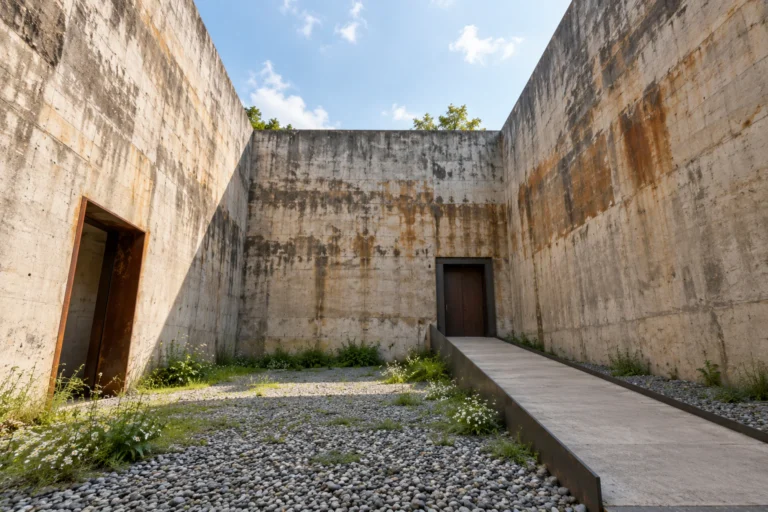
The Yun Dong-ju Literature Museum: Two Water Tanks Behind One Square of Sky
The last part of “Seochon.” Water-stained concrete walls with the sky cut into a square above them: that is the Yun Dong-ju Literature Museum Elena knows from screens. Elena, who reads scenes, heads up to Jahamun Pass to find out whether that smooth shot holds on the street — and why it always seems to be the same shot.
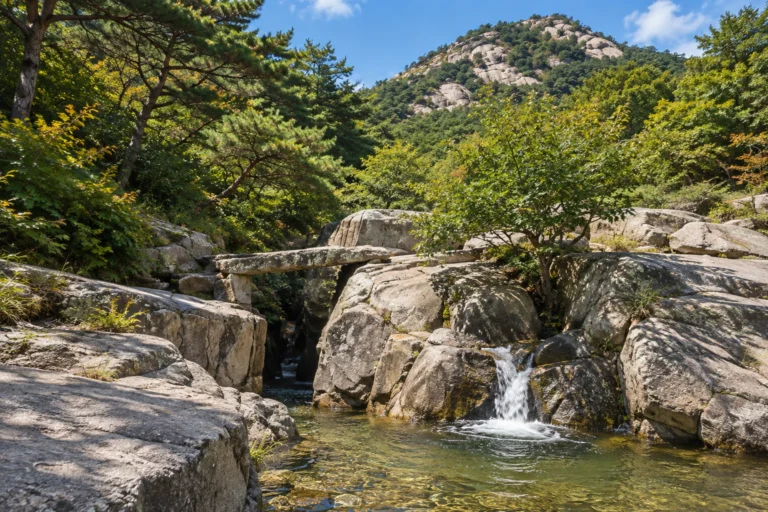
Suseongdong Valley: a stone bridge 711 metres’ walk uphill from the market lanes
Part two of “Seochon”.