SEOUL · NAMDAEMUN
Namdaemun Market: One Line of Food Alleys, Starting with Kalguksu
Lulu walks in from Hoehyeon Station Exit 5, looks in on the long counters of the kalguksu alley, passes the braised-hairtail alley and 1414 BORN Market, and spends the day until dusk picking out a “line” to hand to a friend
An added piece in the Namdaemun and Myeongdong issue. In the kalguksu alley, whatever you order, a small taste of another dish comes with it; the braised-hairtail alley took shape around 1988. When a friend coming to Seoul next month asks for “one meal at a market”, Lulu sets out to choose not one restaurant but a line of alleys.

How to get there
Pedestrian route calculated by a map app (TMAP), ending at the alley’s map point. The braised-hairtail alley is 228 m, about 3 minutes. The Namdaemun Market website gives a five-minute walk from Hoehyeon Station Exits 5, 6 and 7.
This is a new piece for the Namdaemun and Myeongdong issue. In part three, Maya noted how the goods change from alley to alley in Namdaemun Market and how every arcade keeps its own clock; at the food alleys she walked on without saying which place was better. In part four, Lulu walked out of the market to the Money Museum. Today Lulu goes back into the market. This time it is the food alleys.
Lulu is always choosing places to show someone. The friend who is coming to Seoul next month has sent a message: “I want to eat one meal at a market.” Instead of picking one restaurant, Lulu decides to string a few alleys together into a line. If one meal doesn’t suit, there is always the next alley.
Half past ten on a weekday morning. Camera around her neck, Lulu writes on the first line of her notebook: “Not one place. One line.”
46 metres from Hoehyeon Station, Exit 5
From Exit 5 of Hoehyeon Station (Line 4), the map route to Namdaemun Market’s kalguksu alley (42-1 Namdaemunsijang 4-gil) is 46 m, about a minute, and to the braised-hairtail alley (map point, 16-17 Namdaemunsijang-gil) 228 m, about 3 minutes (TMAP pedestrian route calculations; the end points are the map’s representative points).
By a map app’s walking route, the kalguksu alley is 46 m, about a minute, from Exit 5 of Hoehyeon Station on Line 4. The braised-hairtail alley is 228 m, about three minutes. Both end points are the single spot the map uses to stand for each alley. The market’s website says it is a five-minute walk from Exits 5, 6 and 7 of Hoehyeon Station. Find on a map
At the top of the exit stairs, the market reaches her ears first: the rattle of cart wheels, voices calling out goods, the smell of broth simmering somewhere. Lulu doesn’t lift her camera for a while; she just walks. What she wants to show her friend may be this smell more than any photo.

According to press reports, Seoul’s Jung-gu district announced this July that it had fitted the market’s seven entrance gates with matching sculptural structures and LED lighting, and relaid the worn asphalt walkways in stone. The same reports say it also put up signboards for themed alleys, such as the braised-hairtail alley, and overview maps at four main entrances. In the corner of her notebook Lulu writes: “For my friend: if lost, look for the alley signs first.”
The kalguksu alley and its long counters
Namdaemun Market website, themed alleys: the kalguksu alley appears on the left a short way past the market’s Gate 5. Stalls line both sides, with the middle left clear for people to pass. Each stall has a narrow cooking space and a long counter with stools in front. The food listed is kalguksu (knife-cut noodles), sujebi (hand-torn dough soup), janchi-guksu (thin noodles in broth), yeolmu naengmyeon (cold noodles with young radish kimchi), chalbap (sticky rice), boribap bibimbap (barley rice mixed with vegetables) and naengmyeon. The same text says that whatever you order, a small taste of another dish comes with it, and calls this the alley’s particular trait: order kalguksu and a taste of naengmyeon comes with it; order naengmyeon and a taste of kalguksu comes.
According to the website’s page on themed alleys, the kalguksu alley appears on the left a short way past the market’s Gate 5. That 5 is a market gate number, not the subway exit number. Stalls line both sides, the page says, with the middle left clear for people to pass. Each stall has a narrow cooking space and a long counter, with stools in front. Find on a map

A 2023 article on the Seoul city news site, “Seoul in My Hand”, explains that temporary doors against the wind and a roof make the alley look like a building of its own, but that it is really an open-air alley with noodle stalls along both sides and a roof laid over the top. The same article puts the alley’s history at sixty years or more, and says the menu settled around kalguksu and barley rice about forty years ago. Lulu copies the passage into her notebook and adds, in small letters, “2023 article”. Whether the roof and doors are the same today is something a three-year-old article can’t tell her.
The website lists kalguksu (knife-cut noodles), sujebi (hand-torn dough soup), janchi-guksu, yeolmu naengmyeon, chalbap (sticky rice), barley-rice bibimbap and naengmyeon. Then the page adds one more trait of the alley: whatever you order, a small taste of another dish comes with it. Order kalguksu and a little naengmyeon arrives; order naengmyeon and a little kalguksu.
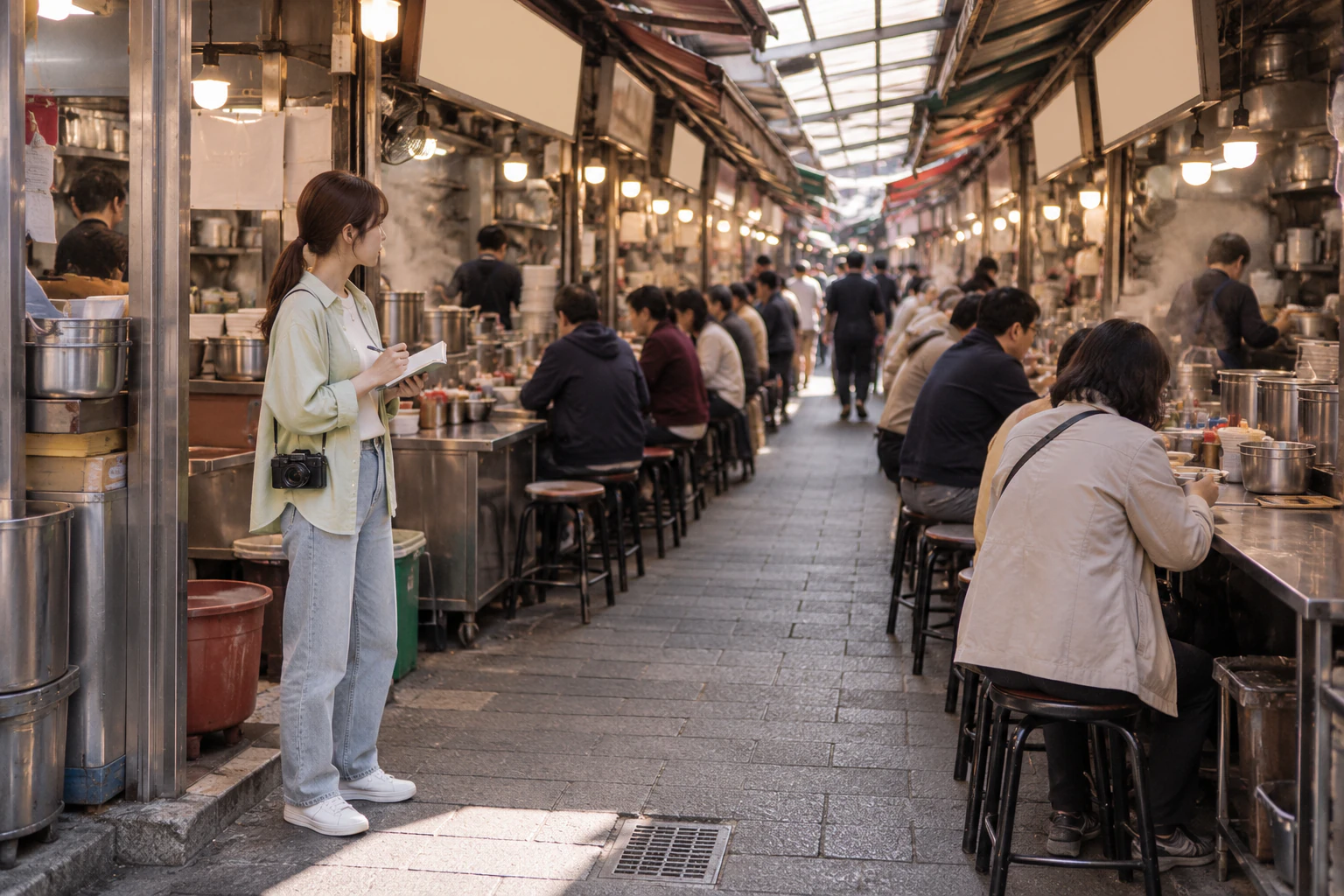
Lulu steps to one side of the alley entrance and looks in: a row of backs along the long counters, steam rising from the narrow kitchens. She doesn’t sit down today; this is a seat to take with her friend. Instead she copies the website’s line about the small taste into her notebook and adds a note for her friend: “If a little extra comes, enjoy it. If it doesn’t, don’t mind.” The website gives the alley’s hours as 06:00–21:00. That is for the alley as a whole, though, and individual stalls may differ.
Hairtail, since around 1988
Korea Tourism Organization’s travel information (last modified April 2025) says Namdaemun’s braised-hairtail alley took shape around 1988. Hairtail was cheap then; merchants braised it hot and spicy to their own taste, word spread, and the dish became famous. The area had been an ordinary row of eateries rather than a hairtail alley, it explains, and as the dish caught on, the shops around switched to it one by one. Each restaurant buys its hairtail from different waters (Yeosu, Jeju, Mokpo, Busan) and cooks it a little differently, so the taste varies a little from place to place. Opening hours and closing days, it says, differ by shop.
On the map, the braised-hairtail alley is 182 m, about two minutes, from the kalguksu alley. Korea Tourism Organization’s travel information says the alley took shape around 1988. Hairtail was cheap then, the account goes; merchants braised it hot and spicy to their own taste, word got around, and the dish became famous. Find on a map

The area, it says, had been an ordinary row of eateries rather than a hairtail alley, and as the dish caught on, the shops around switched to it one by one. The market’s website tells it in much the same way: the shops sold kalguksu, dumplings and so on before turning to fish, and although they also served braised mackerel and pollack, customers liked the hairtail best. Having just walked past the kalguksu alley, Lulu smiles at that line.
The website names radish, spring onion, garlic and chilli powder as the other ingredients, and says the hairtail comes from Busan, Yeosu, Mokpo or Jeju, each house with its own favourite source. The tourism organization likewise says that because the fish and the cooking vary a little, so does the taste from one restaurant to the next. Here too, Lulu doesn’t sit down. Instead she writes: “A place to come back to together.”
The hours depend on whose page you read. The website’s themed-alley page gives 03:00–21:00 for the hairtail alley; the tourism organization says hours and closing days differ by shop. Lulu copies the two lines side by side and does not merge them into one.
1414 BORN Market, joined to the hairtail alley
Namdaemun Market website, 1414 BORN Market: Bondong-geori, the street where the market first formed in the early Joseon period as country merchants passed through leading cattle and horses, was remade as “1414 BORN Market” under a themed-street project. Some sixty shops in six trades gather here — farm produce, snacks and side dishes, seafood and dried fish, daily goods, butchers and ordinary eateries — split between an A-block and a B-block lane, and it connects with the braised-hairtail alley. It opens Monday to Saturday, not Sunday, from early morning until 7 pm, and individual shops’ hours may vary a little.
The website introduces 1414 BORN Market as connected to the braised-hairtail alley. It explains that Bondong-geori, the street where the market first formed in the early Joseon period as country merchants passed through leading cattle and horses, took this new name under a themed-street project. Farm produce, snacks and side dishes, seafood and dried fish, daily goods, butchers, ordinary eateries: some sixty shops in six trades, split between an A-block and a B-block lane. Find on a map

The list of trades also includes several kinds of goods you buy and take away: farm produce, side dishes, seafood, dried fish and daily goods. Lulu wonders whether her friend’s lodging has a kitchen. If not, this can stay a lane for looking.
The website says 1414 BORN Market is open Monday to Saturday, not Sunday, from early morning until 7 pm, adding that individual shops may vary a little. Lulu writes “not Sunday” in her note, and underneath, “before 7”.

The food alley, and one hotteok
The Namdaemun Market website’s “Food > Main restaurants” page lists twelve places: two hotteok (filled griddle pancake) stands and three entries associated with dumplings, plus places for bindae-tteok (mung bean pancakes), jokbal (braised pig’s trotters), Pyongyang-style cold noodles, chicken soup and hangover soup, among others. One entry describes a vegetable hotteok filled with onion, garlic chives, carrot and glass noodles, fried in oil and brushed with soy sauce.
The website’s list of themed alleys also has a food alley, described as a street selling all kinds of dishes, from rice cakes, fried rice, bibimbap and barley rice to seolleongtang, with Korean, snack and Chinese-Korean food as its main fare. On its food page the website also lists twelve “main restaurants”: two hotteok stands and three entries associated with dumplings, plus places for mung bean pancakes, braised pig’s trotters, Pyongyang-style cold noodles, chicken soup and hangover soup, among others. This piece doesn’t copy the names. It is the market’s list, not Lulu’s. Find on a map
One entry on that list describes a vegetable hotteok filled with onion, garlic chives, carrot and glass noodles, fried in oil and brushed with soy sauce. Lulu circles that line. Kalguksu to sit down for, hairtail to come back for together, and one hotteok to eat while walking. The line for her friend now has three parts.
As the afternoon slips away, the light in the alleys drops. At some arcade entrances the shutters come down; elsewhere, steam is still rising. Lulu remembers Maya’s note that the market doesn’t close at a single hour. The food alleys are no different.

At dusk Lulu opens her notebook at the edge of the market. Under “Not one place. One line.” there are now three parts. Sit at the long counter in the kalguksu alley; come back to the hairtail alley together; eat the hotteok on the move. And 1414 BORN Market as a lane for looking.
The message to her friend is short: “Let’s come on a weekday, in the daytime. Sunday is the market’s regular day off, and only the outward-facing shops open if they choose to. Hours change from alley to alley, shop to shop.” Lulu presses send, listens to the market once more, and walks back towards Hoehyeon Station.
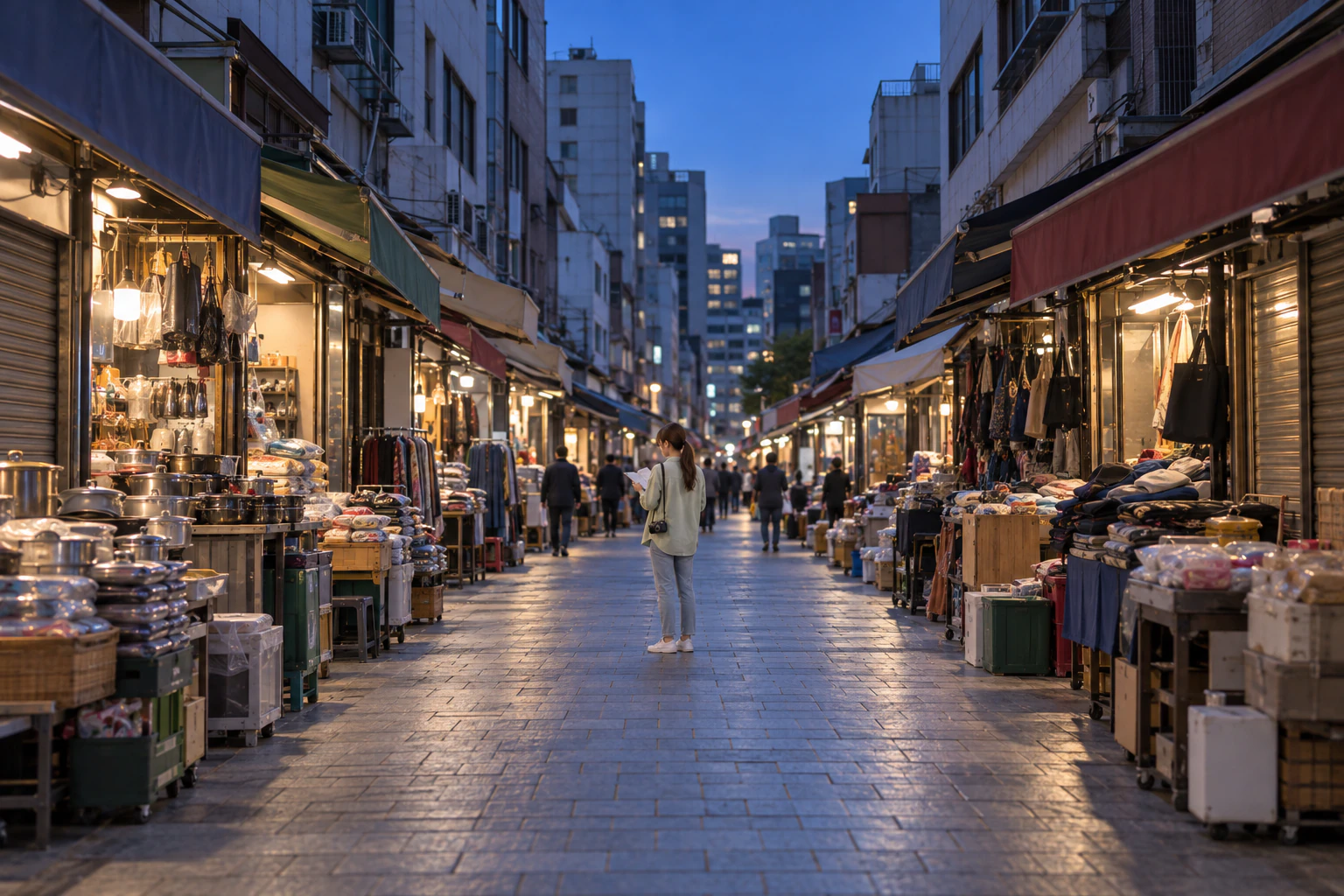
(※ This article includes staged images created with AI.)
Try it on your own meal
An editorial suggestion: enter the market from Hoehyeon Station Exit 5, eat in the kalguksu alley, pass the braised-hairtail alley and the 1414 BORN Market joined to it, and finish the line with the food alley and a hotteok from the market’s own list. Individual restaurants and shops are not featured.
A diagram of the order only · not to scale, orientation or the actual shape of the streets.
- Hoehyeon Station Exit 5 to the kalguksu alley — 46 m, about 1 min (TMAP calculation, ending at the alley’s map point). The market website gives a five-minute walk from Hoehyeon Station Exits 5, 6 and 7. Find on a map
- The kalguksu alley — 06:00–21:00 according to the market website. Diners sit at long counters here. Individual stalls’ hours may differ. Find on a map
- The braised-hairtail alley — 182 m, about 2 min from the kalguksu alley (TMAP calculation). The market website gives 03:00–21:00; Korea Tourism Organization says hours differ by shop. Find on a map
- 1414 BORN Market and the food alley — 1414 BORN Market: Monday to Saturday, early morning to 19:00, according to the market website (closed Sunday; may vary by shop). Find on a map
Getting there
TMAPChecked 2026.10.01
From Exit 5 of Hoehyeon Station (Line 4), the map route to Namdaemun Market’s kalguksu alley (42-1 Namdaemunsijang 4-gil) is 46 m, about a minute, and to the braised-hairtail alley (map point, 16-17 Namdaemunsijang-gil) 228 m, about 3 minutes (TMAP pedestrian route calculations; the end points are the map’s representative points).
Namdaemun Market websiteChecked 2026.09.28
a 5-minute walk from Exits 5, 6 and 7 of Hoehyeon Station (Line 4).
Hours & fees
Checked 2026.10.01
The Namdaemun Market website’s themed-alley pages give opening hours of 06:00–21:00 for the kalguksu alley and 03:00–21:00 for the braised-hairtail alley. Korea Tourism Organization’s travel information says that hours and closing days in the hairtail alley differ by shop.
Namdaemun Market Merchants’ AssociationChecked 2026.09.28
the market’s regular day off is Sunday; shops facing the street decide for themselves whether to open.
Namdaemun Market websiteChecked 2026.09.28
opening hours differ from building to building and shop to shop.
Background9
Namdaemun Market website, themed alleysChecked 2026.10.01
the kalguksu alley appears on the left a short way past the market’s Gate 5. Stalls line both sides, with the middle left clear for people to pass. Each stall has a narrow cooking space and a long counter with stools in front. The food listed is kalguksu (knife-cut noodles), sujebi (hand-torn dough soup), janchi-guksu (thin noodles in broth), yeolmu naengmyeon (cold noodles with young radish kimchi), chalbap (sticky rice), boribap bibimbap (barley rice mixed with vegetables) and naengmyeon. The same text says that whatever you order, a small taste of another dish comes with it, and calls this the alley’s particular trait: order kalguksu and a taste of naengmyeon comes with it; order naengmyeon and a taste of kalguksu comes.
Checked 2026.10.01
According to a 28 February 2023 article on the Seoul city news site (“Seoul in My Hand”), the kalguksu alley has temporary doors against the wind and a roof over it to keep the rain out, so it looks like a separate building; in fact it is an open-air alley with noodle stalls along both sides and a roof laid over the top. The same article puts the alley’s history at sixty years or more, and says the menu settled around kalguksu and barley rice about forty years ago.
TMAPChecked 2026.10.01
From the braised-hairtail alley to the kalguksu alley in Namdaemun Market, the map route is 182 m, about 2 minutes (TMAP pedestrian route calculation; both ends are the map’s representative points).
TourAPIChecked 2026.10.01
Korea Tourism Organization’s travel information (last modified April 2025) says Namdaemun’s braised-hairtail alley took shape around 1988. Hairtail was cheap then; merchants braised it hot and spicy to their own taste, word spread, and the dish became famous. The area had been an ordinary row of eateries rather than a hairtail alley, it explains, and as the dish caught on, the shops around switched to it one by one. Each restaurant buys its hairtail from different waters (Yeosu, Jeju, Mokpo, Busan) and cooks it a little differently, so the taste varies a little from place to place. Opening hours and closing days, it says, differ by shop.
Namdaemun Market website, themed alleysChecked 2026.10.01
the braised-hairtail alley did not start out with hairtail as its signature. The shops sold kalguksu, dumplings and the like, then switched their main dishes to fish. Alongside braised hairtail they served braised mackerel and braised pollack, but customers liked the hairtail best, the page says. The other ingredients are radish, spring onion, garlic and chilli powder; the hairtail comes from Busan, Yeosu, Mokpo or Jeju, and each house has its own favourite source. The main dishes listed are braised hairtail and braised mackerel.
Checked 2026.10.01
Namdaemun Market website, 1414 BORN Market: Bondong-geori, the street where the market first formed in the early Joseon period as country merchants passed through leading cattle and horses, was remade as “1414 BORN Market” under a themed-street project. Some sixty shops in six trades gather here — farm produce, snacks and side dishes, seafood and dried fish, daily goods, butchers and ordinary eateries — split between an A-block and a B-block lane, and it connects with the braised-hairtail alley. It opens Monday to Saturday, not Sunday, from early morning until 7 pm, and individual shops’ hours may vary a little.
Checked 2026.10.01
The Namdaemun Market website’s themed-alley page describes the food alley (21 Namdaemunsijang 4-gil) as a street selling all kinds of dishes, from rice cakes, fried rice, bibimbap and barley rice to seolleongtang (ox-bone soup), and lists its main fare as Korean, snack food and Chinese-Korean.
Checked 2026.10.01
The Namdaemun Market website’s “Food > Main restaurants” page lists twelve places: two hotteok (filled griddle pancake) stands and three entries associated with dumplings, plus places for bindae-tteok (mung bean pancakes), jokbal (braised pig’s trotters), Pyongyang-style cold noodles, chicken soup and hangover soup, among others. One entry describes a vegetable hotteok filled with onion, garlic chives, carrot and glass noodles, fried in oil and brushed with soy sauce.
Checked 2026.10.01
According to press reports, Seoul’s Jung-gu district announced on 7 July 2026 that it had finished the “Namdaemun Market Gamseong-garo (atmospheric street) project”, begun that March, in four months. It put matching sculptural structures and LED lighting on the market’s seven entrance gates, repaved worn asphalt walkways in stone, and installed signboards for themed alleys such as the stationery alley, the braised-hairtail alley, the women’s-clothing street and the glasses street, along with overview maps at four main entrances.
- The hours of 06:00–21:00 for the kalguksu alley and 03:00–21:00 for the braised-hairtail alley are alley-level times from the Namdaemun Market website’s themed-alley pages; Korea Tourism Organization says hours and closing days in the hairtail alley differ by shop (checked 1 October 2026). Neither page carries a publication date, so times may vary by shop and by day.
- According to the Namdaemun Market Merchants’ Association, every Sunday is a regular day off, with only outward-facing shops opening at their own discretion. Check the market’s notices for the Lunar New Year and Chuseok holidays.
- The “small taste” of another dish is what the market website’s kalguksu alley page says. Prices are not included; check the menu before you order.
- According to press reports, Jung-gu district said in July 2026 that it had finished installing gate structures, LED lighting, stone walkways, themed-alley signboards and overview maps in the market. In the narrow alleys, loaded carts and motorbikes come through, so don’t stop in the middle of the lane.