
SEOUL · DDP
DDP and the Water Gate Beneath the Plaza
A short walk south of Heunginjimun stands a building of silver curves.

How to get there
Exit 1 connects directly to DDP’s Oullim Square. Exit 2 is closer to the entrance of Dongdaemun History & Culture Park.
Rina looked at Heunginjimun twice, Maya found a name carved into the wall beside it, and Elena waited on top of Naksan for Seoul’s lights to come on. The Seoul City Wall website says the Naksan section runs past Heunginjimun and on to Gwanghuimun. Walk a little way south from Heunginjimun and you come to a building made of silver curves.
Noah reads streets and routes with his eyes. At Jongmyo he read a building too long to fit in a single frame by standing off to one side. On screen, DDP usually appears as one frame: a sweep of lit-up silver at night. Noah wants to know two things. Where does this building start, and where does it end? And before it was built, what was on this ground?
It is a Thursday, just past one in the afternoon. On the first line of his notebook, Noah writes: “Find one straight line.”
A building that starts two floors underground
DDP website (“Directions”): Exit 1 of Dongdaemun History & Culture Park Station (Lines 2, 4, 5) is close to Oullim Square, the DDP Market and the basement-2 entrances of the Design Lab and the Museum; Exit 2 is close to the Design Lab’s ground-floor entrance and the entrance to Dongdaemun History & Culture Park (Gallery Mun side).
He comes out at Exit 1 of Dongdaemun History & Culture Park Station, on Lines 2, 4 and 5. The DDP website says this exit is close to Oullim Square, the DDP Market, and the basement-level-2 entrances of the Design Lab and the Museum; for the park entrance, Exit 2 is closer. Before Noah has even reached the top of the stairs, he is already standing in the middle of the building. Find on map
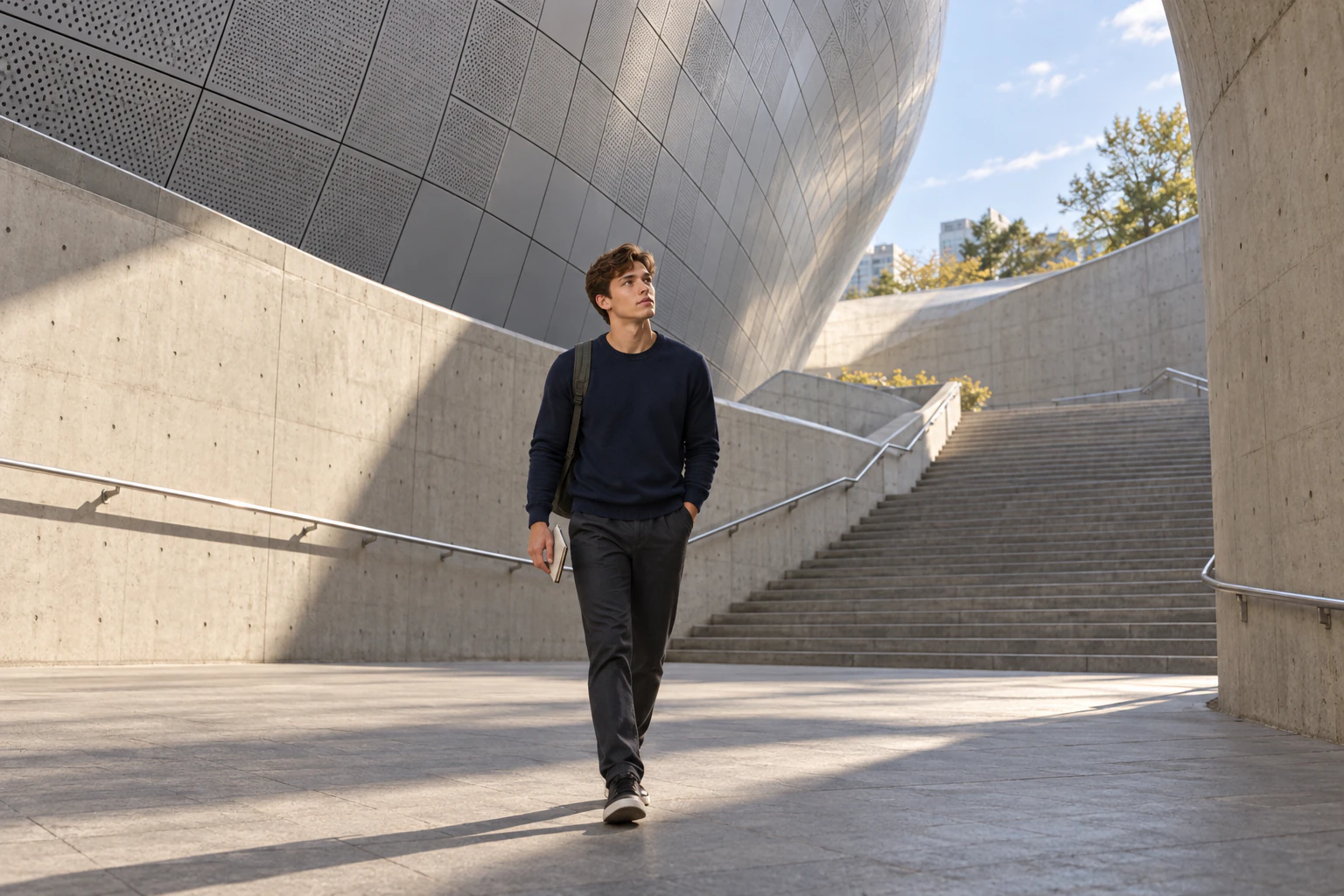
Oullim Square is a plaza two floors below street level. The website says it is open 24 hours. The building itself opens from 10:00 to 20:00 and closes on January 1 and on the day of Seollal and of Chuseok. Noah stands in the middle of the square and turns slowly all the way round. To Noah, the surfaces on every side keep curving, and the “straight line” in his notebook is not easy to spot.
The first thing that doesn’t fit is this. An ordinary building sits on the ground, and when you open the door you are on the ground floor. This one begins in a square below the ground. The walls around the square curve upward and simply become the body of the building, and Noah can’t find the line where wall ends and roof begins.
45,133 panels, no two alike
DDP website: most of the exterior is 45,133 aluminium panels, no two alike in size, curvature or dimensions. The site describes DDP as the world’s largest free-form (three-dimensional, irregular) building.
Noah takes the steps up to street level and starts walking along the outside of the building. From a distance the silver skin looks like one continuous surface; up close it is small plates fitted together. The DDP website says most of the exterior is 45,133 aluminium panels, and that no two share the same size, curvature or dimensions. It calls the building the world’s largest three-dimensional free-form structure. Find on map
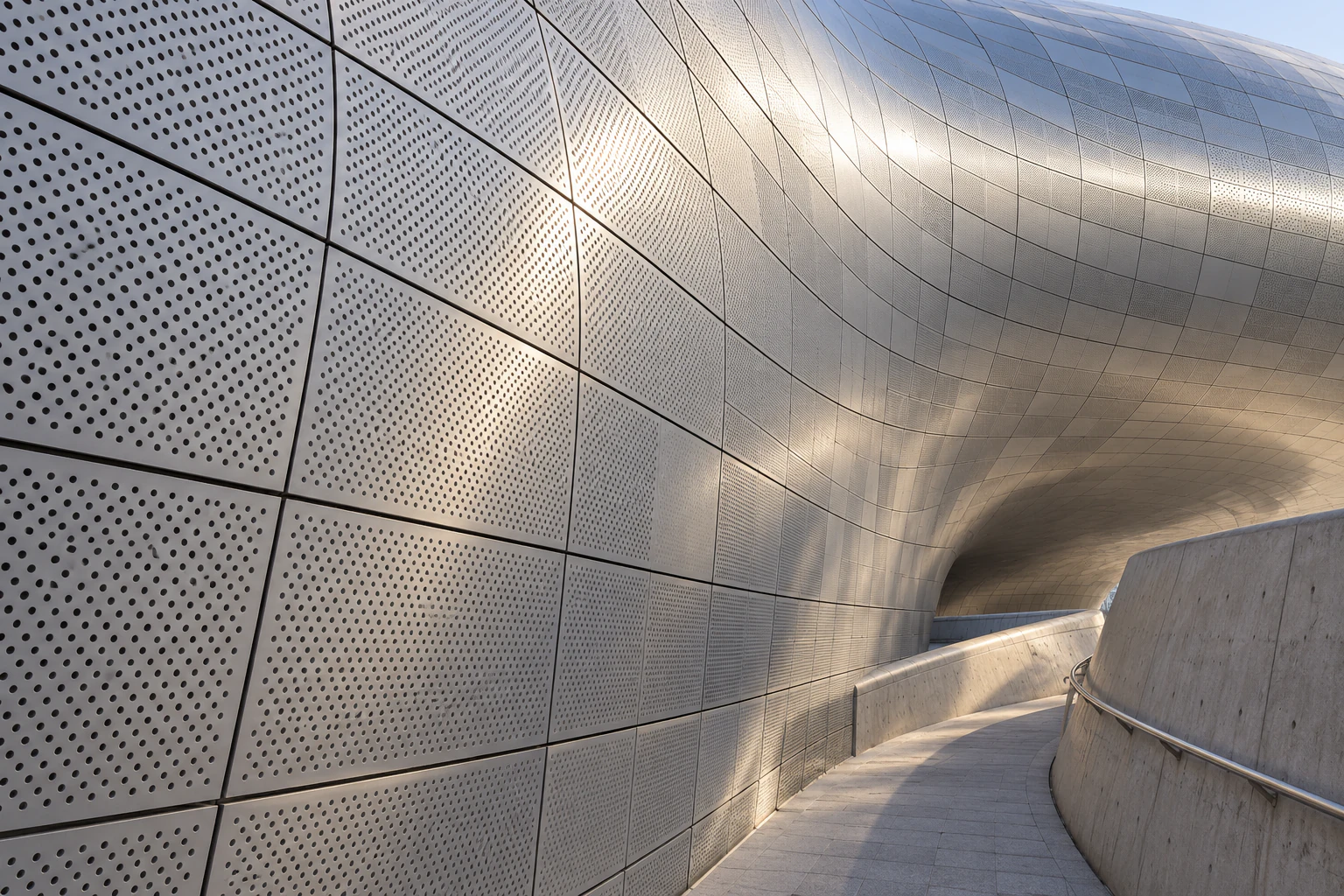
The architect was Zaha Hadid. The website introduces her as the first woman to receive the Pritzker Architecture Prize, in 2004, and explains that she was drawn to the way Dongdaemun never stops moving, from early dawn until late at night, and shaped the space out of curves and curved surfaces, slants and slopes. Noah decides to test that description on foot. Keeping his eyes on the wall, he walks the whole way round.
According to the building overview, the floor area is 86,574 square metres, with three levels below ground and four above, and the highest point is 29 metres. As he walks, Noah tries to find that 29 metres. He can’t pin it down. The wall rises and falls a little with every few steps, so there is no single moment when the top is obvious.

Inside, there are no columns in sight either. The website says mega-trusses of the kind used for bridges, together with space frames, made large column-free interiors possible, and in a hashtag it calls DDP a building with “not a single straight line or wall, inside or out.” Noah looks back at the first line in his notebook. Find one straight line. He has been all the way round, and he still hasn’t found one.

Eighty-two years of a stadium
Seoul City Wall Museum website (Dongdaemun Stadium Memorial Hall): Gyeongseong Stadium opened in October 1925 on the east side of the city wall. It was Korea’s first modern multi-sport stadium, built not to promote sport among Koreans but as part of Japanese colonial policy. It became Seoul Stadium in 1945 and Dongdaemun Stadium in 1985, stood on the same spot for 82 years, and was demolished in 2007.
In the building overview on the DDP website, the address comes with a note in brackets: the former site of Dongdaemun Stadium. According to the Seoul City Wall Museum website, Gyeongseong Stadium opened here, on the east side of the city wall, in October 1925. It was Korea’s first modern multi-sport stadium, but the museum is clear that it was built not for Koreans’ sport but as part of Japanese colonial policy. Find on map

With liberation in 1945 it became Seoul Stadium, and in 1985 Dongdaemun Stadium. Through two changes of name it stood on the same spot for 82 years, until it was demolished in 2007. The DDP website says construction began in April 2009, the building was finished in November 2013, and it opened on March 21, 2014. The park beside it opened earlier, in October 2009.
The park has a Dongdaemun Stadium Memorial Hall. The museum website says it shows things salvaged when the stadium was torn down, such as grandstand seats and floodlight lamps, along with a large-screen film. Noah stands with his back to the silver curves and tries to lay a running track and a grandstand over this wide ground in his head. The curves are new, open for a little over twelve years. For the 82 years before that, the ground beneath them was a stadium.
The wall and the water gate under the ground
Seoul City Wall Museum website (Dongdaemun History Museum): the former stadium site was where the Joseon-era Hullyeonwon (military training office) and Hadogam (a garrison) stood. Excavations in 2008–2009 found sections of the city wall, a chiseong (a jutting bastion), the Igansumun water gate and Joseon building sites — all thought to have been destroyed when a park and the stadium were built under Japanese rule.
Once the stadium was gone, the ground was dug up. The Seoul City Wall Museum website explains that this was where the Joseon-era Hullyeonwon, which selected and trained soldiers, and the Hadogam, where large numbers of troops were garrisoned, once stood. Excavations in 2008 and 2009 turned up parts of the city wall, a chiseong bastion, the Igansumun water gate and Joseon building sites — all thought to have been destroyed when a park and the stadium were built under Japanese rule. Find on map

Igansumun is a gate for water to leave by. The Seoul City Wall website says that, to carry water out of the walled city, two water gates, Ogansumun and Igansumun, were built near Heunginjimun. The museum site adds that they sat at the lowest ground along the watercourse and served both as drains letting streams out of the city and as defences against intruders. Here Noah finds the second thing that doesn’t fit. The building sweeps upward; the two water gates, by contrast, were built at the lowest ground along the watercourse.

The museum website says that when Hullyeonwon Park and Gyeongseong Stadium were built on the grounds of the Hullyeonwon and Hadogam, the traces of Igansumun vanished from the surface. According to the Korea Tourism Organization, the excavated finds are now preserved and displayed around the park. Noah stands in front of the stones of the water gate for a long while. He does not step into the remains. For all the years the stadium stood here, these stones lay buried under the ground.

The park’s Dongdaemun History Museum preserves and displays what the dig turned up. The website says excavation plans are engraved into the gallery floor, and that you can walk on a tiled path that was recovered and moved during the dig. Traces of ironworking came out of the old baseball field. The history museum and the stadium memorial hall open Tuesday to Sunday, 10:00 to 18:00, but close from 12:00 to 13:00 — which is why Noah came after one. Admission is free.
Noah sits down on a bench at the edge of the park and opens his notebook. He takes away one observation from today. On this ground, the newest thing floats above it in silver curves, and the oldest thing came up out of it. In between, for 82 years, it was a stadium. Three layers, inside one fence.
His notes end in three lines. The history museum closes 12 to 1, so come after one. Closed Mondays. Never found a straight line — found a water gate instead. “Jongno & Dongdaemun” has one part left.

(※ This article includes staged images created with AI.)
Plan your visit
Come out at Exit 1 of Dongdaemun History & Culture Park Station, start in Oullim Square, walk once around the outside of DDP, go down into the park to see the Igansumun water gate and the wall remains, then visit the Dongdaemun History Museum and the Dongdaemun Stadium Memorial Hall. The two halls close from 12:00 to 13:00 and on Mondays, so aim for a Tuesday-to-Sunday afternoon.
A diagram of the order only — not to scale, and it does not show direction or the actual shape of the paths.
- Oullim Square (Exit 1) — A plaza two floors below street level, open 24 hours. The DDP building is open 10:00–20:00. Find on map
- Once around the outside of DDP — Look closely at the silver skin and its panels. Spaces inside keep different hours depending on the programme. Find on map
- The Igansumun water gate and wall in Dongdaemun History & Culture Park — These are excavated remains. Don’t climb on or touch them; look from outside. Find on map
- Dongdaemun History Museum and Dongdaemun Stadium Memorial Hall — Tuesday–Sunday 10:00–18:00 (closed 12:00–13:00, last entry 17:30), free. Find on map
Getting there
DDP website (“Directions”)Checked 2026.09.25
Exit 1 of Dongdaemun History & Culture Park Station (Lines 2, 4, 5) is close to Oullim Square, the DDP Market and the basement-2 entrances of the Design Lab and the Museum; Exit 2 is close to the Design Lab’s ground-floor entrance and the entrance to Dongdaemun History & Culture Park (Gallery Mun side).
Hours & fees
DDP websiteChecked 2026.09.25
DDP is open 10:00–20:00, with some spaces running flexible hours depending on the programme. It closes on January 1 and on the day of Seollal and of Chuseok. Oullim Square, on basement level 2, is open 24 hours.
Checked 2026.09.25
Seoul City Wall Museum website (visitor information): the Dongdaemun History Museum and the Dongdaemun Stadium Memorial Hall open Tuesday to Sunday, 10:00–18:00, closing 12:00–13:00, with last entry at 17:30. They are closed on Mondays, January 1 and the day of Seollal and of Chuseok. Admission is free.
DDP websiteChecked 2026.09.25
construction began on April 28, 2009; Dongdaemun History & Culture Park opened on October 27, 2009; the building was completed on November 30, 2013, and opened on March 21, 2014.
Background12
DDP websiteChecked 2026.09.25
DDP was designed by Zaha Hadid. The site introduces her as the first woman to win the Pritzker Architecture Prize, in 2004, and lists the designers as Zaha Hadid Architects with Samoo Architects & Engineers. The site says she focused on the restless energy of Dongdaemun, changing from early dawn until late at night, and shaped the space in her own language of curves and curved surfaces, slants and slopes.
DDP websiteChecked 2026.09.25
most of the exterior is 45,133 aluminium panels, no two alike in size, curvature or dimensions. The site describes DDP as the world’s largest free-form (three-dimensional, irregular) building.
DDP website (building overview)Checked 2026.09.25
it stands on the former site of Dongdaemun Stadium, with a total floor area of 86,574 m², three floors below ground and four above, and a maximum height of 29 m.
DDP websiteChecked 2026.09.25
mega-trusses of the kind used in bridges, together with space frames, made large column-free spaces inside possible. In a hashtag the site also calls it a building with “not a single straight line or wall, inside or out.”
Checked 2026.09.25
Seoul City Wall Museum website (Dongdaemun Stadium Memorial Hall): Gyeongseong Stadium opened in October 1925 on the east side of the city wall. It was Korea’s first modern multi-sport stadium, built not to promote sport among Koreans but as part of Japanese colonial policy. It became Seoul Stadium in 1945 and Dongdaemun Stadium in 1985, stood on the same spot for 82 years, and was demolished in 2007.
Seoul City Wall Museum websiteChecked 2026.09.25
the Dongdaemun Stadium Memorial Hall shows items salvaged when the stadium was demolished, such as grandstand seats and floodlight lamps, along with a large-screen film.
Checked 2026.09.25
Seoul City Wall Museum website (Dongdaemun History Museum): the former stadium site was where the Joseon-era Hullyeonwon (military training office) and Hadogam (a garrison) stood. Excavations in 2008–2009 found sections of the city wall, a chiseong (a jutting bastion), the Igansumun water gate and Joseon building sites — all thought to have been destroyed when a park and the stadium were built under Japanese rule.
Seoul City Wall websiteChecked 2026.09.25
to carry water out of the walled city, two water gates, Ogansumun and Igansumun, were built near Heunginjimun. The Seoul City Wall Museum site explains that they sat at the lowest ground along the watercourse, and served both as drains letting streams out of the city and as defences against intruders.
Seoul City Wall Museum websiteChecked 2026.09.25
when Hullyeonwon Park and Gyeongseong Stadium were built on the grounds of the Hullyeonwon and Hadogam, the traces of the Igansumun water gate disappeared from the surface.
Seoul City Wall Museum websiteChecked 2026.09.25
the Dongdaemun History Museum preserves and displays finds from the excavations for DDP and the park. Excavation plans are engraved into the gallery floor, and visitors can walk on a tiled path recovered and moved during the dig. Iron-working finds from the old baseball field show large-scale ironwork at the Hadogam site.
Korea Tourism Organization dataChecked 2026.09.25
when Dongdaemun Stadium was cleared in 2008 to make the park, the dig turned up the Igansumun water gate and a chiseong bastion, 44 building remains including the Hadogam and Hullyeon-dogam sites, and about 1,000 major artefacts; the finds are preserved and displayed around the park. Dongdaemun History & Culture Park is always open.
Seoul City Wall websiteChecked 2026.09.24
the Naksan section runs 3.2 km from Hyehwamun over Naksan and past Heunginjimun to Gwanghuimun, about 1 hour 30 minutes on foot.
- DDP is open 10:00–20:00; some spaces keep different hours depending on the programme. It closes on January 1 and on the day of Seollal and of Chuseok (DDP website, checked September 25, 2026). Each exhibition has its own fees and hours, so check that day’s listings.
- The Dongdaemun History Museum and the Dongdaemun Stadium Memorial Hall close on Mondays, January 1 and the day of Seollal and of Chuseok.
- For the park entrance, Exit 2 is closer. Exit 1 connects directly to Oullim Square.
More from this area

Gwangjang Market: sitting in a row with strangers in the Food Alley
The last part of “Jongno & Dongdaemun.” After Heunginjimun, the city wall and DDP, this time it is a market. The Gwangjang Market website says Korean merchants founded the Gwangjang Company in 1905 to keep a market of their own. Today the busiest spot is the food market where three gates meet, and it stays open until 11 p.m. every day. But Visit Seoul lists the market as a whole until 6 p.m. and the vintage arcade upstairs until 7 p.m., both closed on Sundays, and hours at the hanbok and fabric shops vary from shop to shop. Lulu, who is bringing a friend visiting from abroad next week, realises that seeing only the Food Alley means missing half the market.

Gwangjang Market: the fabric and quilts beyond the Food Alley
A new piece for “Jongno & Dongdaemun.” Say Gwangjang Market and most people picture steam rising from the food stalls. Yet the shop-leasing notice on the market’s own website lists bedding and fabric on the first floor and hanbok, traditional cloth, fabric and bedding on the second, and Jongno-gu Office describes it as a market for textiles, cloth, hanbok and bedding. Elena, who reads places as scenes, goes looking for the fabric, hanbok and bedding shops beyond the Food Alley — and reads the colours of cloth folded on their shelves.