
SEOUL · GWANGJANG MARKET
Gwangjang Market: sitting in a row with strangers in the Food Alley
Lulu comes up from Exit 8 of Jongno 5-ga Station, walks through the food market where three gates meet and the vintage lanes upstairs, and plans a Saturday evening for a friend
The last part of “Jongno & Dongdaemun.” After Heunginjimun, the city wall and DDP, this time it is a market. In 1905 Korean merchants founded the Gwangjang Company to keep a market of their own. Today the busiest spot is the food market where three gates meet, and it stays open until 11 p.m. every day. But the general retail shops close at 6 p.m. and the vintage arcade upstairs at 7 p.m., both closed on Sundays, and hours at the hanbok and fabric shops vary from shop to shop. Lulu, who is bringing a friend visiting from abroad next week, realises that seeing only the Food Alley means missing half the market.
How to get there
The 62 m, 1 minute is the map-route calculation from Exit 8 of Jongno 5-ga Station to the East Gate of Gwangjang Market. Visit Seoul also gives “Exit 8, 62 m.”
This is the last part of “Jongno & Dongdaemun.” Rina looked at Heunginjimun twice, Maya found a name carved into the city wall, Elena waited on Naksan for Seoul’s lights to come on, and Noah saw the water gate that came up out of the ground beside DDP. All four looked at stone and buildings. What Lulu is going to see today is a place where people sit down and eat.
Next Saturday a friend is visiting from abroad, and Lulu plans to take them to Gwangjang Market. What the friend has seen in videos is a steaming griddle and people sitting shoulder to shoulder at narrow stalls. Is that one scene all there is? Lulu decides to go alone first and find out.
A weekday, three in the afternoon. Camera round her neck, Lulu writes on the first line of her notebook: “Besides the Food Alley, what else is there?”
Sixty-two metres from Exit 8
From Exit 8 of Jongno 5-ga Station (Line 1) to the East Gate of Gwangjang Market, the map route is 62 m, about 1 minute (TMAP pedestrian route calculation).
From Exit 8 of Jongno 5-ga Station on Line 1, the map route to the market’s East Gate is 62 metres, about a minute. Visit Seoul gives the same figure. Climb the exit stairs, look up, and the roof over the market entrance is already there. You could walk from Euljiro 4-ga Station on Lines 2 and 5 as well, but for her friend Lulu decides to write down just one thing: Exit 8. Find on map

She writes the hours first. According to Visit Seoul, the market opens Monday to Saturday, 9 a.m. to 6 p.m., and closes on Sundays. The Food Alley is open every day from 9 a.m. to 11 p.m., all year round. The vintage arcade on the second floor keeps 10 a.m. to 7 p.m. and also closes on Sundays. Copying the three lines into her notebook, Lulu stops. The Food Alley is the one that stays open into the night. The market-wide listing runs to 6 p.m. and the second-floor vintage arcade to 7 p.m.; other shops vary from shop to shop.
The market is big. A citizen reporter’s piece on Seoul City’s “Seoul in My Hand” site says that, as of 2024, Gwangjang Market had 5,628 shops. Inside the East Gate the covered passage splits into several directions. Lulu follows the way most people are walking.

Where three gates meet
Korea Tourism Organization data: the busiest part of Gwangjang Market is the food market that formed where the East Gate, North Gate 2 and South Gate 1 meet, drawing everyone from students to the middle-aged and the elderly.
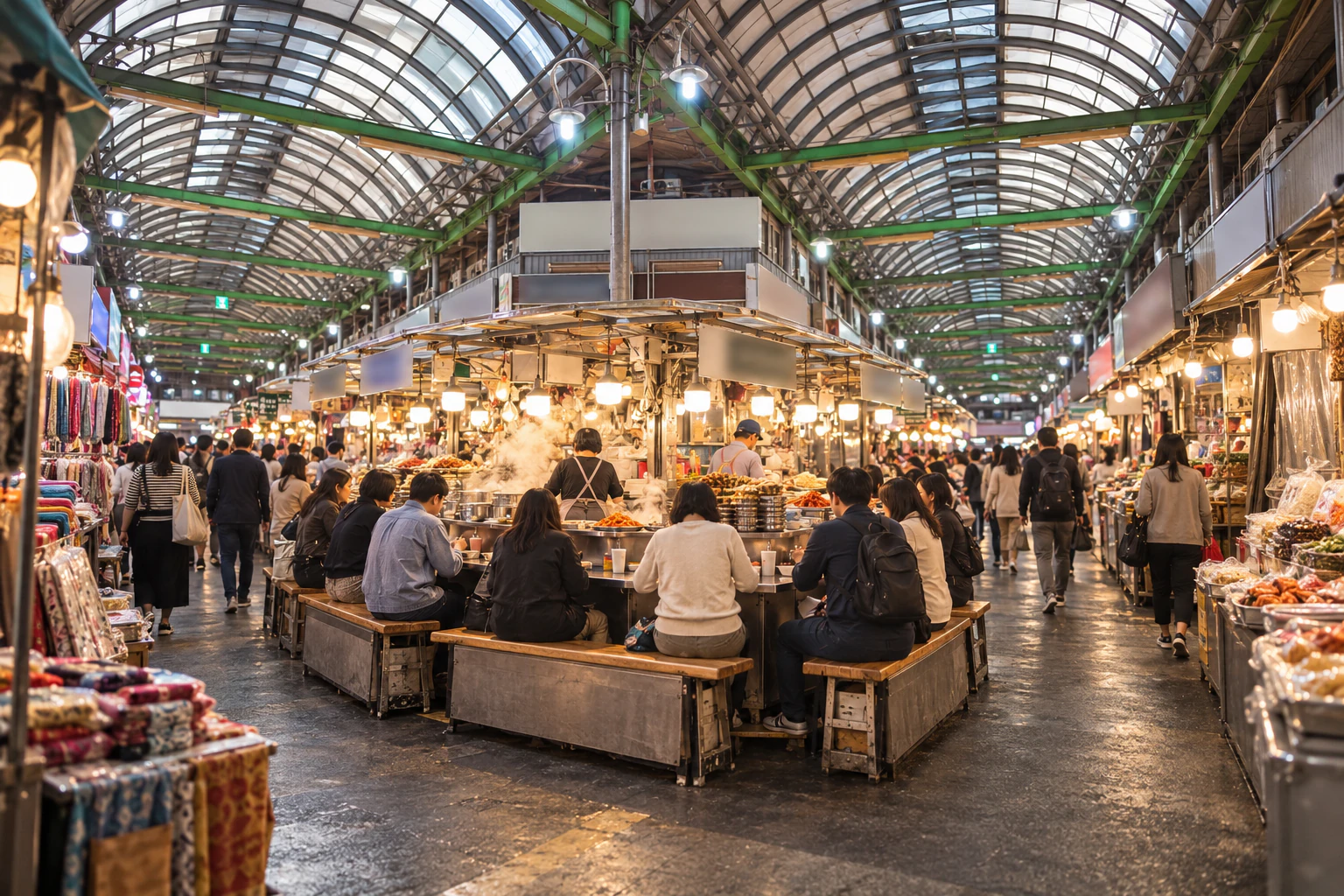
Korea Tourism Organization data says the busiest part of Gwangjang Market is the food market that grew up where the East Gate, North Gate 2 and South Gate 1 meet, a place for every age, from students to grandparents. The stream of people Lulu followed stops there too. The stalls gather where the lanes cross, under a roof. Find on map

The citizen reporter writes that past the yukhoe alley, where long queues fill a narrow passage, and the fish and side-dish shops, you reach the jeon alley at the heart of the market. The signature dish is bindaetteok, the mung bean pancake, and the story goes that it began with refugees from Hwanghae Province who came south during the Korean War and fried pancakes to sell. Every time a pancake flips on the griddle, the oil hisses.

Jongno-gu Office lists mung bean pancakes, gimbap and tteokbokki, sundae and head meat, yukhoe, meatballs, bibimbap and kalguksu among the food you can eat sitting together at the stalls. The bite-sized gimbap was long known as “mayak (drug) gimbap,” the reporter notes, until it was renamed “kkoma (little) gimbap” in response to public feeling that the word “drug” should not sound friendly to children.
A table that is really a row
Jongno-gu Office: mung bean pancakes, gimbap and tteokbokki, sundae and head meat, yukhoe, meatballs, assorted raw fish, bibimbap, spicy fish stew and kalguksu can be eaten sitting together at the stalls.
At the stall where Lulu sits, the seating is not a table but a row. The cooking happens in the middle, and customers sit side by side on long benches around it. Lulu finds a space between two strangers. The person on her left and the person on her right don’t know each other either, just like her. Nobody would feel odd sitting here alone, Lulu thinks. Her friend could sit alone too. Find on map

Before ordering, Lulu reads the menu board. At the end of 2023, Seoul City said it would introduce, with Jongno-gu, the merchants’ association and the food-stall association, a “portion labelling” rule that puts the quantity next to the price on menus. In May 2026 it announced intensive checks on hygiene and price display with Jongno-gu, with mystery shoppers, foreigners among them, watching for overcharging and unfair treatment of foreign visitors; in the same announcement, Jongno-gu said it would begin a real-name system for the market’s stalls from June.
Lulu adds a line for her friend: “Before ordering, check the price and the portion on the menu together.” Then she raises her camera. She photographs the griddle and the plates, not the faces of the people beside her or of the cooks. In a space this tight, she decides, the lens stops at the food.

The other half, beyond the Food Alley
Jongno-gu Office: the vintage shops on the market’s second floor pack narrow lanes with distinctive clothes.
Getting up from the stall, Lulu looks for the stairs. Jongno-gu Office says the vintage shops on the market’s second floor pack narrow lanes with distinctive clothes, and Visit Seoul suggests the hanbok stores and vintage shops upstairs for anyone interested in clothing. In the passage Lulu climbs to, clothes rails run along both walls right up to the ceiling. Find on map

The Gwangjang Market website says part of the market was destroyed in the Korean War and came back to life as refugees traded daily necessities and military goods, and that this was the beginning of Korea’s imported second-hand clothing market. The pancake story downstairs, too, is said to start with refugees. Lulu writes the two stories side by side in her notebook: one from the market’s own history, one handed down.
Out of the vintage lanes and a little further on are the hanbok and fabric lanes. The website describes rows of shops selling hanbok, pyebaek wedding gifts and burial garments for life’s rites, as well as children’s hanbok for first-birthday parties, norigae ornaments and rubber shoes. Bolts of fabric are packed tight on the shelves. Visit Seoul lists the market as a whole until 6 p.m. and the second-floor vintage arcade until 7 p.m., both closed on Sundays; hours at the hanbok and fabric shops vary from shop to shop.

According to the market’s history page, in 1905, when Japan’s currency reorganisation shook the footing of Korean merchants, they founded the Gwangjang Company that July. Unlike other markets run by Japanese owners, the Dongdaemun Market it operated kept going as a Korean market on Korean capital, on the site of the Baeogae market, one of the three great markets of late-Joseon Seoul, and from the 1960s it came to be called Gwangjang Market. The website says the name carries the meaning “to gather widely and keep.”
On her way out, Lulu answers the question on the first line of her notebook. Besides the Food Alley there are the vintage lanes upstairs and the hanbok and fabric lanes. The market-wide listing runs to 6 p.m. and the second-floor vintage arcade to 7 p.m.; hours at the hanbok and fabric shops vary from shop to shop. The scene her friend saw in videos was half the market.
Her note to her friend is three lines long. Come on Saturday afternoon and see the second-floor vintage lanes and the hanbok lanes first. The vintage arcade is closed on Sundays, and hours at the hanbok and fabric shops vary by shop. When it gets dark, head back to the food market where the three gates meet and sit in a row next to strangers. Before ordering, check the price and the portion together. “Jongno & Dongdaemun” ends here.
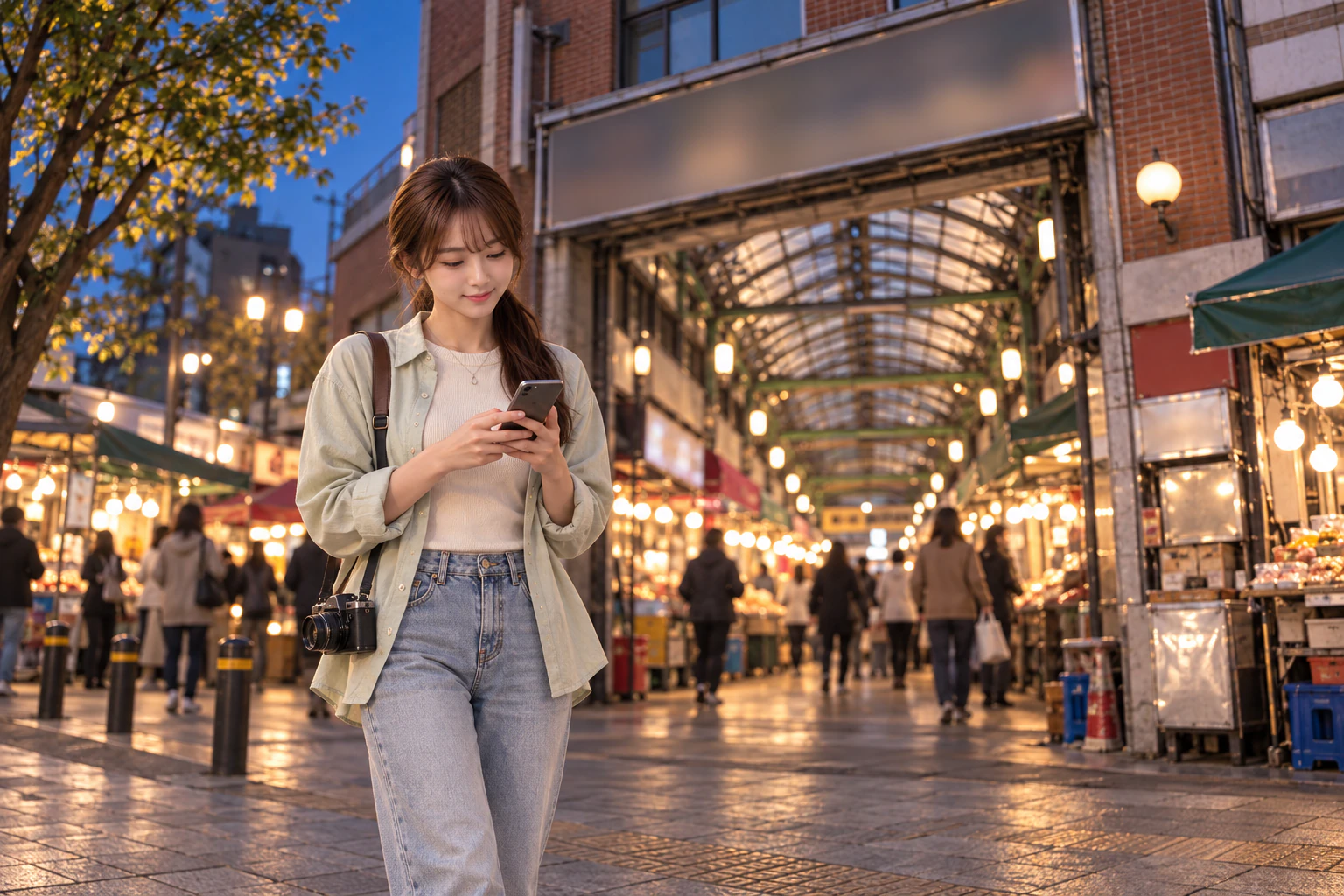
(※ This article includes staged images created with AI.)
Try it on your own afternoon
An editorial suggestion: come out at Exit 8 of Jongno 5-ga Station and go in through the East Gate; while it is light, see the vintage lanes on the second floor and the hanbok and fabric lanes, then sit down in the food market where the three gates meet as the sun goes down. Visit Seoul gives 6 p.m. for the market as a whole and 7 p.m. for the second-floor vintage arcade, both closed on Sundays, and hours at the hanbok and fabric shops vary by shop, so aim for a Monday-to-Saturday afternoon. The 62 m, 1 minute is the map-route calculation from Exit 8 to the East Gate.
A diagram of the order only — not to scale, and it does not show direction or the actual shape of the paths.
- East Gate (Exit 8, Jongno 5-ga Station) — 62 m from Exit 8. The market is open Monday–Saturday 09:00–18:00, closed Sundays. Find on map
- Vintage arcade, second floor — 10:00–19:00, closed Sundays. Narrow lanes packed with clothes. Find on map
- Hanbok and fabric lanes — Hanbok for life’s rites, pyebaek gifts, norigae and rubber shoes. Hours vary by shop. Find on map
- The food market where three gates meet — Daily 09:00–23:00. Sit side by side on the long benches round the stalls. Find on map
Getting there
TMAPChecked 2026.09.25
From Exit 8 of Jongno 5-ga Station (Line 1) to the East Gate of Gwangjang Market, the map route is 62 m, about 1 minute (TMAP pedestrian route calculation).
Visit Seoul (Seoul Tourism Organization)Checked 2026.09.25
Gwangjang Market is 62 m from Exit 8 of Jongno 5-ga Station on Line 1.
Hours & fees
Visit Seoul (Seoul Tourism Organization)Checked 2026.09.25
Gwangjang Market is open Monday to Saturday, 09:00–18:00, and closed on Sundays. The Food Alley is open daily 09:00–23:00, all year. The vintage clothing arcade is open 10:00–19:00 and closed on Sundays.
Background14
Korea Tourism Organization dataChecked 2026.09.25
the busiest part of Gwangjang Market is the food market that formed where the East Gate, North Gate 2 and South Gate 1 meet, drawing everyone from students to the middle-aged and the elderly.
Jongno-gu OfficeChecked 2026.09.25
mung bean pancakes, gimbap and tteokbokki, sundae and head meat, yukhoe, meatballs, assorted raw fish, bibimbap, spicy fish stew and kalguksu can be eaten sitting together at the stalls.
Checked 2026.09.25
Seoul City’s “Seoul in My Hand” (citizen reporter, February 2025): past the yukhoe alley, where long queues fill a narrow passage, and the fish and side-dish shops, you reach the jeon alley at the heart of the market. The market’s signature dish is the mung bean pancake, said to have started with refugees from Hwanghae Province who came south in the Korean War and sold fried pancakes.
Checked 2026.09.25
Seoul City’s “Seoul in My Hand” (citizen reporter, February 2025): the bite-sized gimbap was long called “mayak (drug) gimbap,” but its name was changed to “kkoma (little) gimbap” in response to public feeling that the word “drug” should not sound friendly to children and teenagers.
Checked 2026.09.25
Seoul City’s “Seoul in My Hand” (citizen reporter, February 2025): as of 2024, Gwangjang Market had 5,628 shops.
Checked 2026.09.25
Seoul City’s “Seoul in My Hand” (December 2023): the city announced, with Jongno-gu, the Gwangjang Traditional Market merchants’ association and the food-stall association, a “portion labelling” rule that puts the quantity next to the price on menus, to be introduced item by item from the first half of the following year after talks with merchants.
Seoul City press release (May 20, 2026)Checked 2026.09.25
with Jongno-gu, the city is running intensive hygiene, trading and safety inspections of Gwangjang Market in May–June before moving to regular checks. Mystery shoppers, foreigners among them, are watching for overcharging, pushy selling and unfair treatment of foreign visitors, and Jongno-gu said it would start a “real-name system” for the street stalls from June.
Jongno-gu OfficeChecked 2026.09.25
the vintage shops on the market’s second floor pack narrow lanes with distinctive clothes.
Visit Seoul (Seoul Tourism Organization)Checked 2026.09.25
for anyone interested in clothing, it recommends the hanbok stores and vintage clothing shops on the second floor.
Gwangjang Market websiteChecked 2026.09.25
part of the market was destroyed in the Korean War; it came back to life as refugees traded daily necessities and military goods, and this became the beginning of Korea’s imported second-hand clothing market.
Gwangjang Market websiteChecked 2026.09.25
shops selling hanbok, pyebaek wedding gifts and burial garments for life’s rites line the market, along with children’s hanbok for first-birthday parties, modernised hanbok, norigae ornaments and rubber shoes.
Gwangjang Market websiteChecked 2026.09.25
in 1905, when Japan’s currency reorganisation shook the footing of Korean merchants, they founded the Gwangjang Company that July. Unlike other markets run by Japanese owners, the Dongdaemun Market it operated kept going as a Korean market on Korean capital.
Gwangjang Market websiteChecked 2026.09.25
the Baeogae (Ihyeon) market around Jongno 4-ga and Yeji-dong was counted among the three great markets of late-Joseon Seoul. When it was licensed in 1905 it was named Dongdaemun Market; from the 1960s it came to be called Gwangjang Market.
Gwangjang Market websiteChecked 2026.09.25
the present name, Gwangjang (廣藏), carries the meaning “to gather widely and keep.”
- Gwangjang Market is open Monday–Saturday 09:00–18:00 (closed Sundays), the Food Alley daily 09:00–23:00 (all year), and the vintage arcade 10:00–19:00 (closed Sundays) (Visit Seoul, checked September 25, 2026). Individual shops may differ.
- Check the price and the portion on the menu before ordering. Seoul City announced portion labelling at the end of 2023, and intensive price-display and hygiene checks in May–June 2026; Jongno-gu said it would start a real-name system for stalls from June.
- The stalls are cramped. Don’t photograph the faces of other customers or the cooks, and don’t stop in the passage and block the queue.
More from this area

Gwangjang Market: the fabric and quilts beyond the Food Alley
A new piece for “Jongno & Dongdaemun.” Say Gwangjang Market and most people picture steam rising from the food stalls. Yet the shop-leasing notice on the market’s own website lists bedding and fabric on the first floor and hanbok, traditional cloth, fabric and bedding on the second, and Jongno-gu Office describes it as a market for textiles, cloth, hanbok and bedding. Elena, who reads places as scenes, goes looking for the fabric, hanbok and bedding shops beyond the Food Alley — and reads the colours of cloth folded on their shelves.
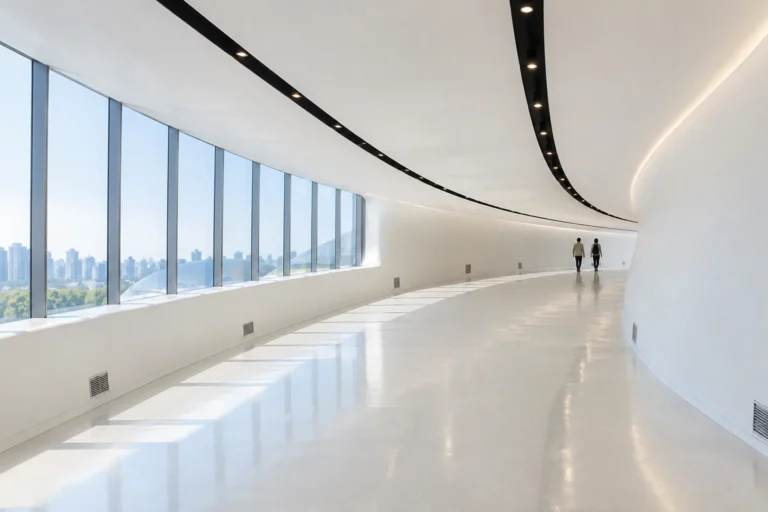
DDP: An Afternoon on a 533-Metre White Ramp
An added piece for “Jongno & Dongdaemun”.