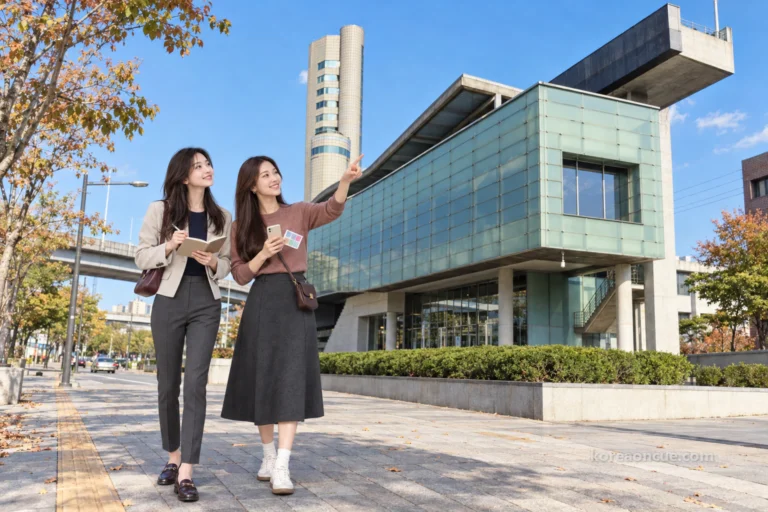
SEOUL · CHEONGNYANGNI
Hongneung Forest is open on weekdays too: Lulu’s gimbap and Maya’s tripod stayed on the breakfast table on the Saturday they went
Free and open on weekdays without booking since spring 2026, 10 a.m. on weekdays and 9 a.m. at weekends, seven minutes from Exit 3 of Korea University Station, and leave the picnic mat and the tripod at home
Lulu trusted an old post that called it a weekends-only forest, so she moved her Saturday shift and packed gimbap and a picnic mat. Maya bought a small tripod so the two of them could be in photos together. One notice Maya found two nights earlier rearranged their whole Saturday, starting at the breakfast table.

How to get there
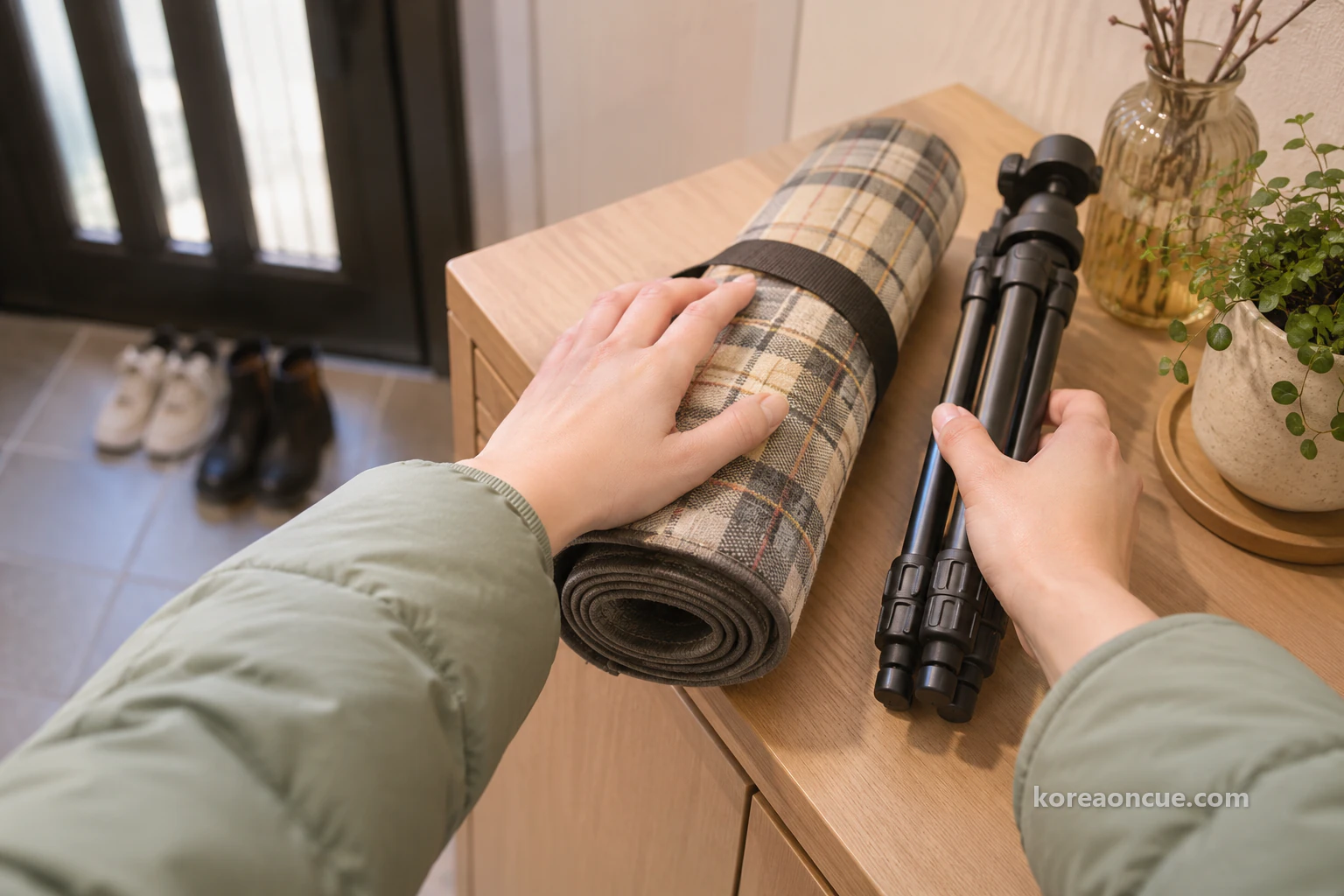
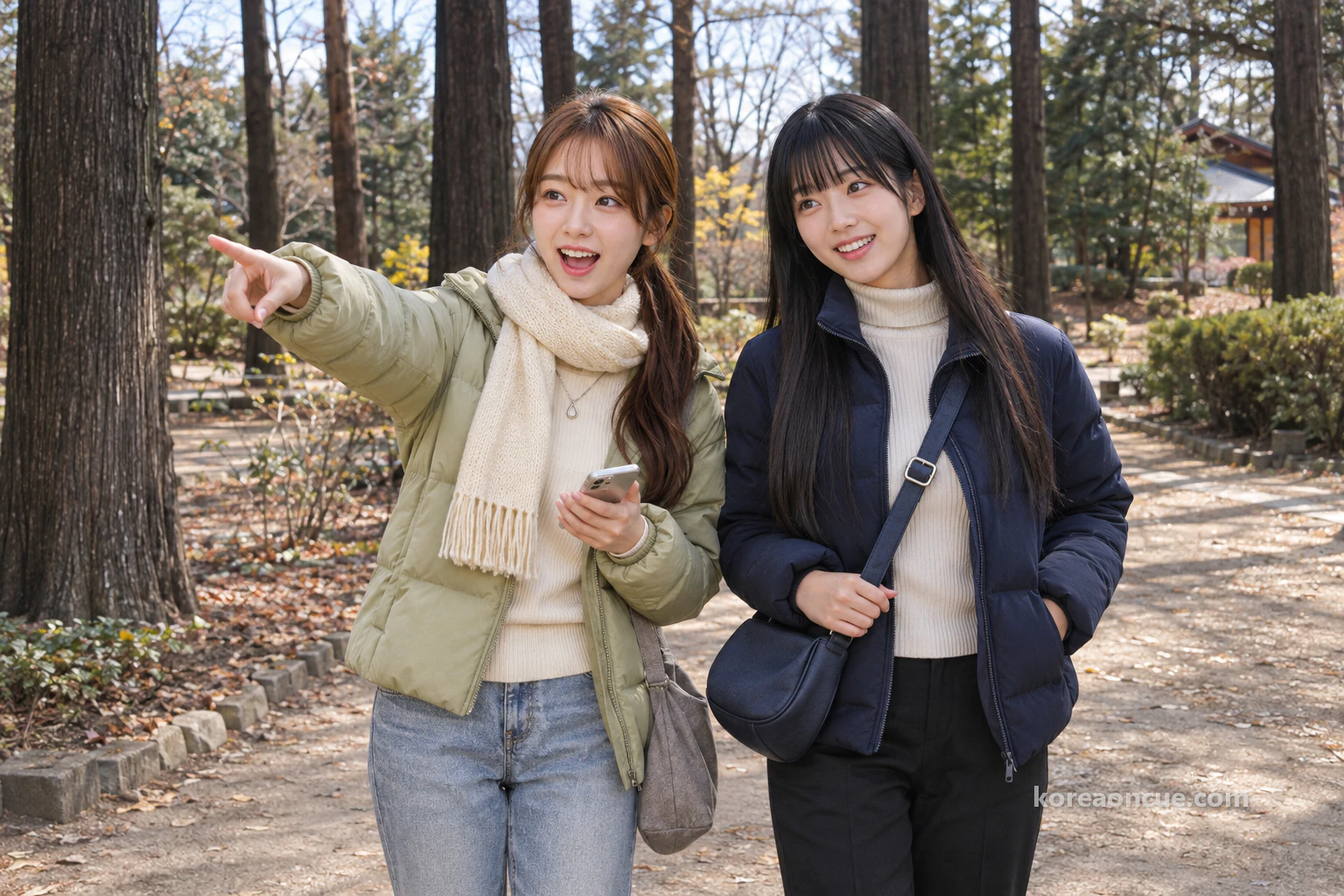
At half past seven on the morning of Saturday 28 November 2026, Lulu set two rolls of gimbap on the kitchen table. They were meant for lunch on a picnic mat in Hongneung Forest. Maya, who had stayed the night at Lulu’s, sat down opposite, took a palm-sized tripod out of her bag and placed it next to the gimbap. The two of them looked from one object to the other and burst out laughing at the same moment. “Let’s have the picnic here,” Lulu said, picking up her chopsticks.

Lulu and Maya were friends before Maya ever came to Seoul. Lulu is twenty, born and raised in the city, and she is the one who works out the order of the videos she sends to friends. Maya, twenty-one and from Singapore, always takes a step back and shoots wide, wherever she is. Ten days ago at Gyeongbokgung she stood inside one of her own photos for the first time, and since then she has bought a small tripod so the two of them can be in pictures together. It was the weekend the cold set in, and both of them had got their thick coats out.
Hongneung Forest, where they were going today, belongs to the National Institute of Forest Science and sits on Hoegi-ro in Dongdaemun-gu, on the spot where Korea’s first arboretum was laid out in 1922. This piece starts with why the gimbap and the tripod stayed on the table, then follows their day in order through whether the forest opens on weekdays, what time it opens, how to walk there from Korea University Station and what to leave at home. The Forest Science Museum inside the forest, this year’s last date for guided walks and the one trail recommended for winter come later, in the order the two of them walked.
The Cue — At a glance
Yes — since spring 2026 you can walk into Hongneung Forest on weekdays too, free and without booking. Weekdays open an hour later than weekends and the forest is closed on Mondays, so the only plan to avoid is turning up early on a weekday morning. Picnic gear and tripods cannot go in, so leave them at home and walk from Korea University Station, the closest stop.
- Where: Hongneung Forest, 57 Hoegi-ro, Dongdaemun-gu, Seoul.
- Station and exit: Korea University Station (Line 6) Exit 3, a 7-minute walk (0.5 km).
- Before you go in: Use a toilet first.
- Leave at home: Picnic mat, food, camera tripod, bicycle, pets.
- Enquiries: 02-961-2522.
Is Hongneung Forest open on weekdays? Yes, without booking, since late March 2026
Hongneung Forest now lets you in on weekdays without a booking. For a long time free walking was allowed only at weekends, and from late March 2026 it was extended to weekdays as well. Before that, the only way into the forest on a weekday was to book a guided forest walk, and those guided walks still run alongside, by booking. If you are not joining a guided walk and simply want to walk around, there is nothing to book and no entry fee. So there is no need to wait for the weekend, and as long as you avoid the closing days, a free half-day on a weekday can go straight to Hongneung Forest.
Open in Kakao Map — Korea University Station
Until two nights before, Lulu had no idea. Her plan had started with a single blog post written a few years earlier. Under a photo of gimbap laid out on a picnic mat were the words “a forest that only opens at weekends”, and Lulu believed them and moved her Saturday shift to another day. She had even settled the first caption of the video for her friends: “Hongneung Forest only opens at weekends.” The gimbap in the photo looked so good that she never scrolled down far enough to see when the post was written.
On Thursday night a message arrived from Maya, who had been looking up the times of the guided walks. “Lulu, it’s open on weekdays too. No booking.” The screenshot she sent with it was the National Institute of Forest Science’s report on the first week of wider opening this spring. Between 28 March and 5 April, nine days, 24,850 people came, and with the average for the last five years at about 86,000 a year, more than a quarter of a year’s visitors turned up in under ten days. Lulu went quiet for a long while, then sent a single line: “I moved my Saturday shift.”

It is easy to get confused, as Lulu did, because some of the information that comes up first in a search still carries the old rules. Sentences saying the forest opened only on Saturdays and Sundays from 1993, and that on weekdays you could only join a guided walk, both describe the rules from before the wider opening in late March 2026. Lulu took the screenshot Maya had sent and drew a line straight through the first caption she had planned. At least she had found out before sending her friends the wrong one, she told herself. As she deleted it she muttered, “So it wasn’t just me,” and Maya laughed and said she still should have checked the date.
What time does Hongneung Forest open? 10 a.m. on weekdays, 9 a.m. at weekends, last entry 4.30 p.m.
The hours differ between weekdays and weekends, and the weekend day is an hour longer. Closing time is the same, and entry stops 30 minutes before closing, so the last entry is the same whatever the day. Apart from Mondays, the forest also closes on 1 January and over the Seollal and Chuseok holidays. If you want an unhurried walk at the weekend, go in as soon as the gates open.
| Day | How to get in | Opening hours | Last entry |
|---|---|---|---|
| Tue–Fri | Free walking, no booking | 10:00–17:00 | 16:30 |
| Sat–Sun | Free walking, no booking | 09:00–17:00 | 16:30 |
| Mon | Closed | Closed | Closed |
Arrive on a weekday at the weekend time and you will spend an hour outside the gate, so on weekdays plan to arrive after opening. Last entry is the same on every opening day, so even when you set off late there is only one time to remember. The “enter at 9” in Lulu’s plan happened to be right because it was a Saturday, but had it gone into the caption as it was, a friend going on a weekday would have stood in the cold wind for a whole hour waiting for the gates. Lulu added “Sat–Sun only” in small letters next to it on the spot.
The Thursday-night messages went on for a long time after that. “So I could have gone on Friday.” “Yeah. But Saturday gives you an extra hour.” It was too late to swap the shift back, and it was also the weekend just before the guided walks ended for the year on 29 November, so they kept the date. Instead Lulu wrote two new caption lines: “10 a.m. weekdays, 9 a.m. weekends” and “in by 4.30”. Maya read them and sent back a smiling face, saying at last these were proper captions.

What you cannot take into Hongneung Forest: picnic mats, food, tripods and pets
Hongneung Forest is not a park you walk into carrying a picnic. Food, alcohol, picnic mats, camera tripods, bicycles, exercise equipment and flammable materials cannot be taken in, and pets cannot come in either. The whole forest is no-smoking and no-drinking, and picking or digging up plants is forbidden. Safety staff around the forest guide visitors to keep to the designated paths. Pack as if for a forest where you follow set paths and look at trees, and it is simple.
On Friday night it was Maya, again, who found that list first. Reading down the visitor rules, she stopped once at picnic mats and food, and again at camera tripods. The first two were Lulu’s, and the last was her own, bought the week before. The bag packed to copy one blog photo and the new thing bought so the two of them could be in pictures together were sitting side by side in the same line. “We’re both caught,” Maya wrote, and Lulu answered with nothing but a sighing face.
So Saturday morning’s picnic ended on the kitchen table. The two rolls of gimbap became breakfast, the picnic mat stayed on the shoe cabinet by the front door, and the tripod stayed on Lulu’s desk instead of in Maya’s bag. If you meant to have lunch at the forest, plan to eat outside it, before you go in or after you have finished walking and come out. Not looking for a place to eat inside makes for a more relaxed day. If you had in mind a walk with your dog or a spin on a bicycle, move that plan to another park, not Hongneung Forest.
How to get to Hongneung Forest from Exit 3 of Korea University Station: a 7-minute walk, closer than Cheongnyangni
The closest station to Hongneung Forest is not Cheongnyangni or Hoegi but Korea University Station on Line 6. You can walk from the two Line 1 stations as well, but the walk takes more than twice as long. Lulu was first going to head for the familiar Cheongnyangni Station, then changed to Line 6 when Maya showed her the distances. A born-and-bred Seoulite learning her way round the neighbourhood from a friend from Singapore — Lulu decided that scene was going in the video too.
| Station | Exit | On foot |
|---|---|---|
| Korea University Station (Line 6) | 3 | 7 min, 0.5 km |
| Cheongnyangni Station (Line 1) | 2 | 15 min, 1.2 km |
| Hoegi Station (Line 1) | 1 | 17 min, 1.4 km |
On walking distance alone, the Korea University Station side is 0.7 km shorter than Cheongnyangni. On a day with a cold wind that 0.7 km feels longer than it sounds, and Maya held up the numbers and laughed: “Here the short one wins.” By bus, take the 273 from Hoegi Station heading towards Kyung Hee University and get off at the Korea Institute for Defense Analyses stop (국방연구원 앞). There is no parking inside the forest, so walk or use public transport.
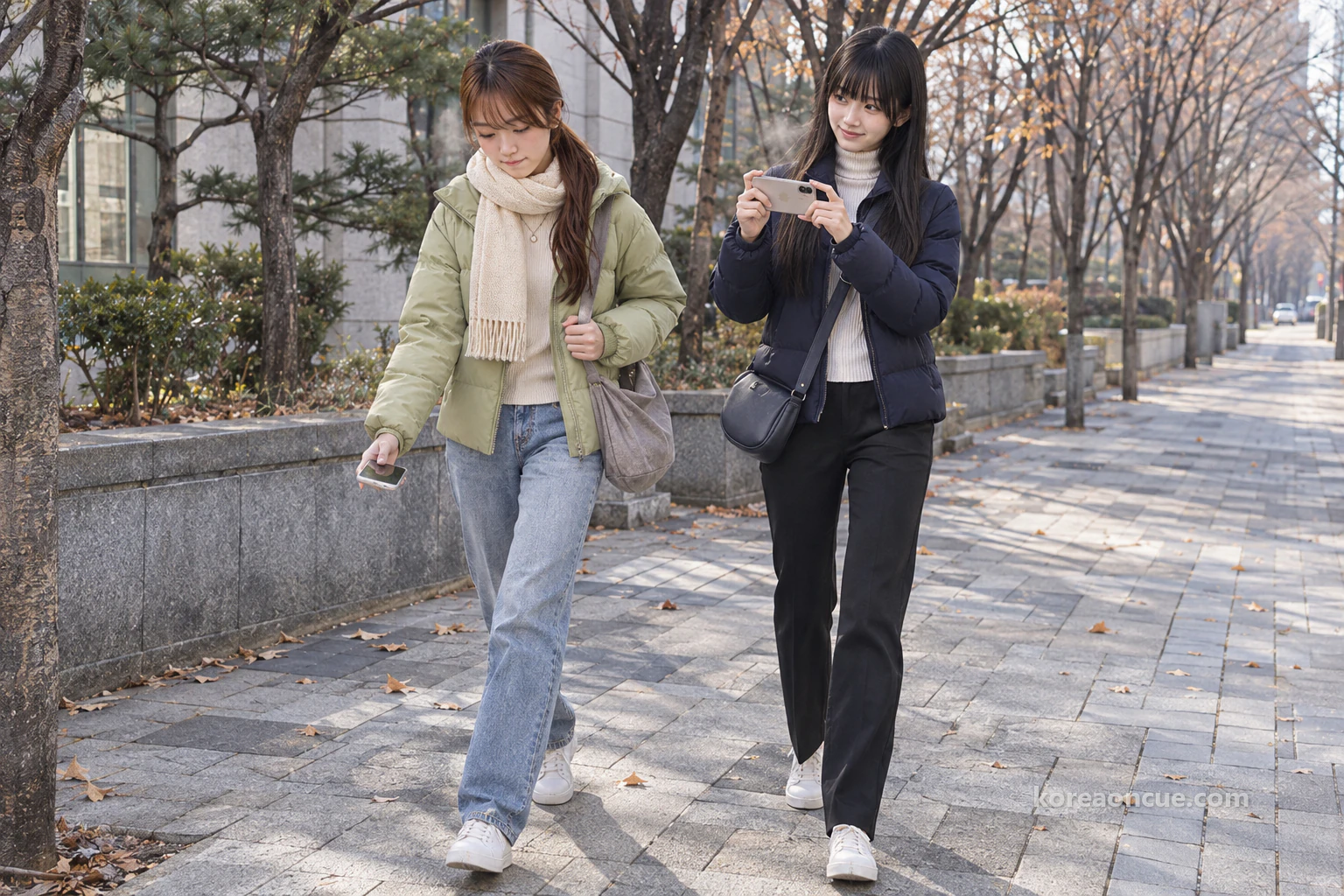
Coming out of Exit 3, Lulu did what she always does and held her phone low to film the pavement first. Starting somewhere new from the ground up is how her friends follow the way — that is Lulu’s order of things. Two steps behind, Maya took one wide shot of Lulu doing it. One filming the ground, the other filming the one filming the ground: a familiar sight for the two of them. Both turned up their collars against the cold wind, and Lulu’s bag, without the gimbap, was a good deal lighter than it had been that morning.
What to sort out before you go in: toilets and weather
Before you go into Hongneung Forest, use a toilet. Toilets are not easy to use inside the forest, and the official guidance specifically asks visitors to bear that in mind. Some trails take 30 minutes to walk, so dealing with it beforehand is far better than looking once you are in. Entry can be restricted because of the weather or conditions on site, so on a bad-weather day leave some slack in your plans. Children and older visitors are best accompanied.
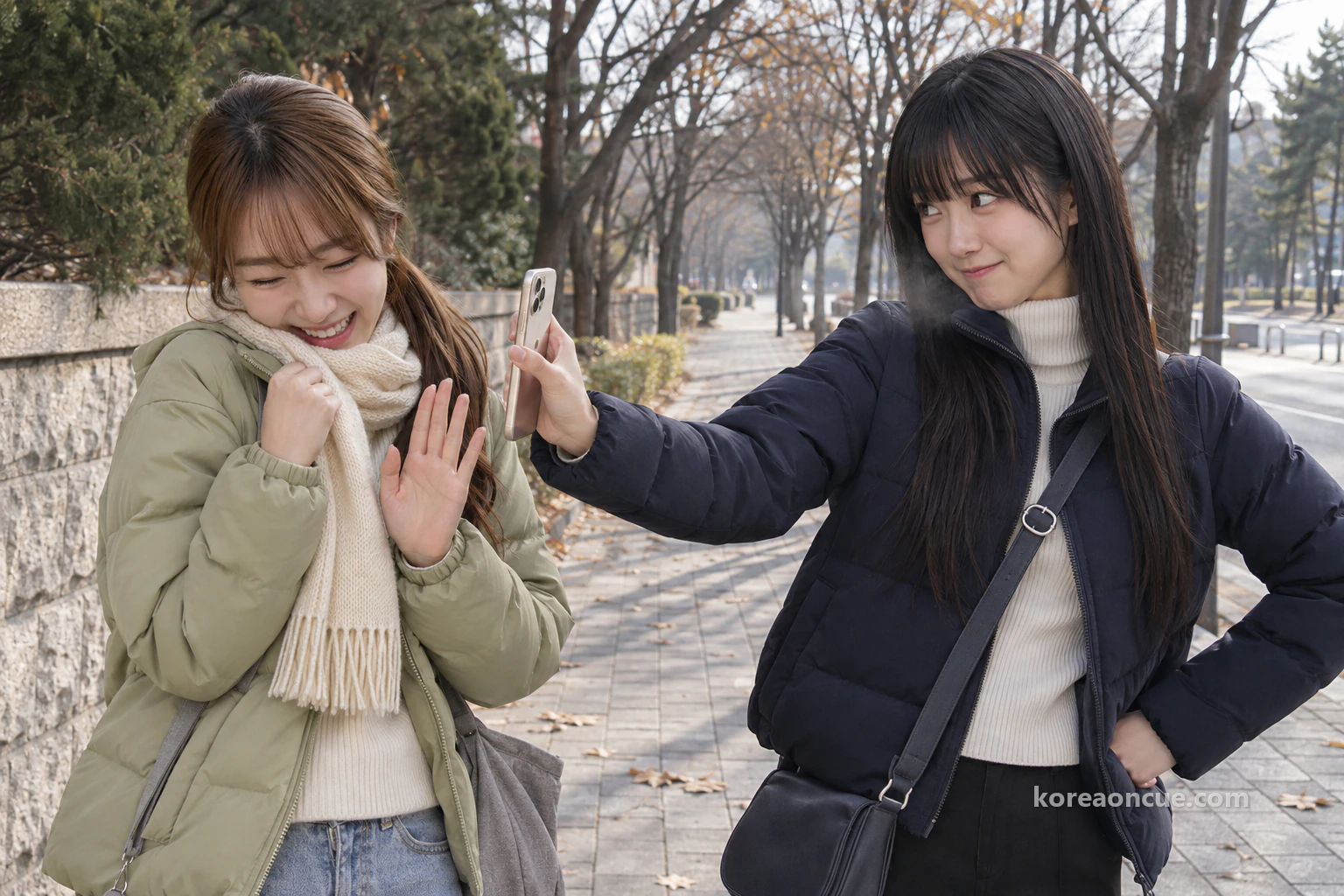
When Maya read that line out, Lulu tried to wave it off: “It’s a forest, what does it matter?” Instead of answering, Maya held her phone screen up in front of Lulu’s face once more. Having lost to old posts twice already that week, Lulu meekly nodded. They took care of things before going into the forest, each straightened her gloves once, and set off.
What kind of place Hongneung Forest is: Korea’s first arboretum, made in 1922
Hongneung Forest became Korea’s first arboretum when a forestry experiment station was set up here in 1922. It spreads over 41.8 ha on the south-western slope of Cheonjangsan (141 m), and 35.3 ha of that is forest. The forest is split into 13.4 ha of display gardens, where trees are planted together by group, and 21.9 ha of urban woodland. The name Hongneung comes from the site of Empress Myeongseong’s tomb, which was once here. Filming the first tree name tag she came across as the shot after the fallen leaves at her feet, Lulu decided the second scene of her video would say that this forest has been growing and studying trees for more than 100 years.
As they walked in, Maya stepped back out of habit. To get one wide shot she needed a spot where the whole forest fitted into the frame, and 41.8 ha is not a size that fits by stepping back a few paces. She moved three times or so, raising her phone this way and that, before giving up with a laugh. “Wide doesn’t work here. The forest’s too big.” At that, Lulu’s head shot up.

“That’s why it’s a place that doesn’t fit in one shot.” The places Lulu loves are always like that: paths that never fit into one frame from start to finish, so they have to be shown in order as you walk. With Maya giving up on wide shots, Lulu’s video actually got easier. She made the first scene the fallen leaves at her feet and decided to let the trail names choose the scenes from there on. Reading the five names one by one, she could see straight away what to film on which path.
The five trails in Hongneung Forest — where to start
Hongneung Forest has five named trails, and each differs in length, time and how hard it is to walk. Walk all five one after another and it takes 1 hour 45 minutes. On a first visit, decide first how many you will link up today, then pick the ones that suit the season. The season changes which paths you choose, even in the same forest.
| Trail | Length and time | Difficulty | Recommended seasons |
|---|---|---|---|
| Thousand-Year Forest Trail (천년의숲길) | about 650 m, about 15 min | Easy–moderate | Spring, autumn |
| Empress’s Trail (황후의길) | about 500 m, about 10 min | Moderate | Spring, autumn |
| Forest Journey Trail (숲속여행길) | about 700 m, about 20 min | Moderate–hard | Summer, autumn |
| Cheonjang Ridge Trail (천장마루길) | about 900 m, about 30 min | Moderate | Spring, summer, autumn |
| Wild Pear Tree Trail (문배나무길) | about 600 m, about 30 min | Easy–moderate | Spring, winter |
Reading down the five, the first one Lulu put her finger on was the Wild Pear Tree Trail. It is 600 m but takes 30 minutes, the same as the Cheonjang Ridge Trail, which is 300 m longer. Take it for a short path from its length alone and you will walk for longer than you expect, so look at distance and time together. The Forest Journey Trail, rated moderate–hard, is the toughest of the five, so choose to suit your legs.
Lulu put the trails in order the way she orders a video. She would start with the short, easy Thousand-Year Forest Trail to let her friends settle into the forest, and next would come the Empress’s Trail, whose name recalls where Hongneung comes from. She left the slot for the last scene empty. Endings are best decided while you walk — that was the rule of someone who has made a lot of videos.
Two people, no tripod: in Hongneung Forest, take turns
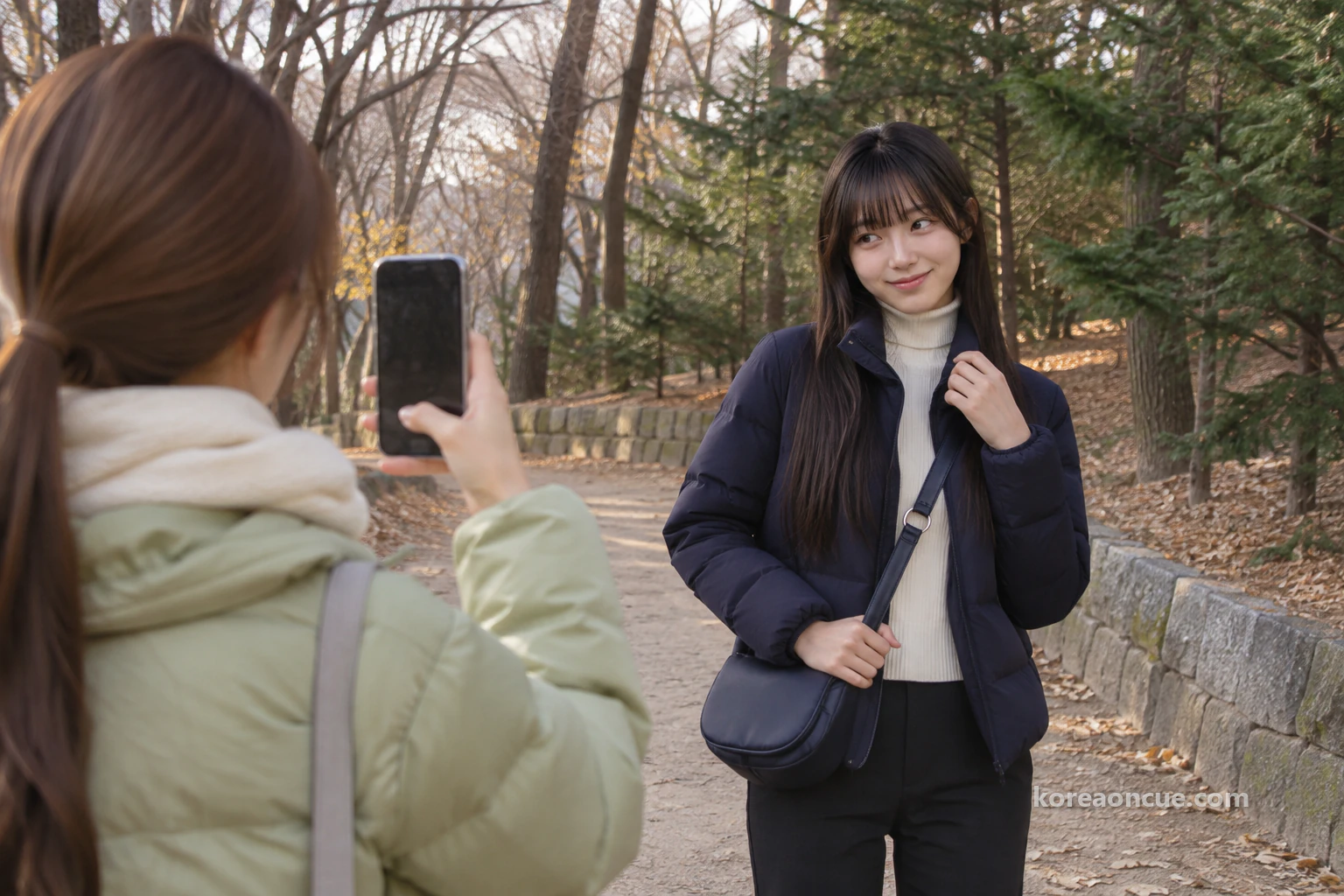
With the tripod left at home, any photo of the two of them together had to be done by hand. Maya tried first, stretching her arm out as far as it would go, but the screen filled with their two faces instead of the forest. “That’s just a selfie,” Lulu laughed, peering at the screen. For someone who shoots wide, an arm’s length of frame was far too narrow. Maya looked at her own face on the screen and laughed silently for a long time.
So they decided to take turns. When Lulu stepped back a few paces with the phone, Maya stood on the path, and then Maya stepped back and took Lulu in wide. Ten days earlier at Gyeongbokgung, the photo Lulu took had been the first time Maya stood inside her own picture, and today it was Maya’s turn to take some of Lulu as well. With a tripod, they would have been busy standing together and never taken each other’s photos at all.
If two of you want photos together, think about taking turns like this instead of bringing a tripod. If you are alone, choosing how many steps to take back is the same as choosing the composition. Even when stepping back, the two of them only moved within the designated path and kept their feet away from the plants and the research plots. Putting the day’s photos of each other side by side, Maya said to herself, “This beats a tripod.”
The bansong pine and the noble poplar: two trees to look up at in Hongneung Forest
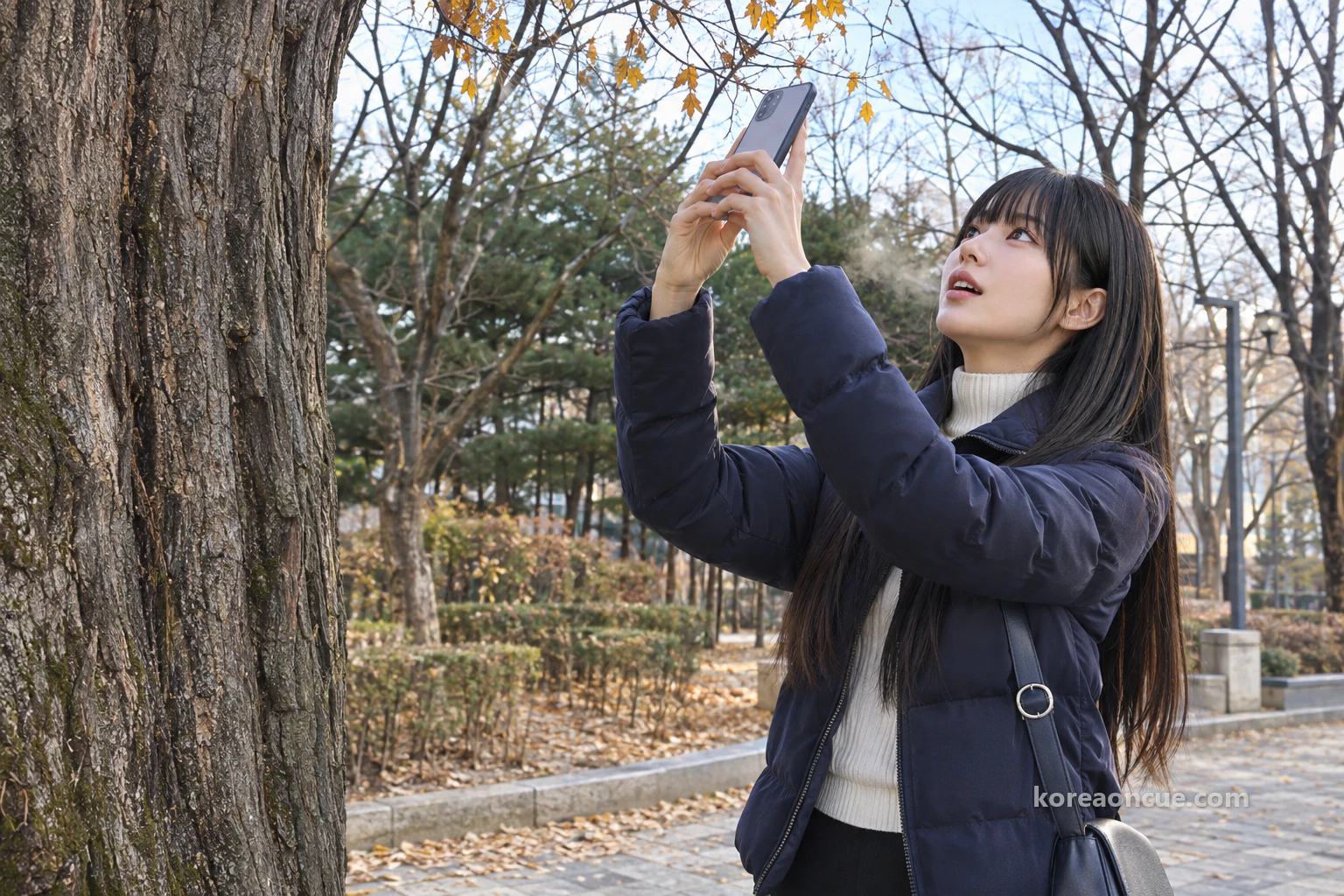
Hongneung Forest has plenty of well-known trees, and two of them are easy to remember by their numbers. One is a bansong, a multi-trunked pine, which at 133 years old is the oldest, and the other is a noble poplar confirmed as the tallest tree in Korea. The noble poplar is 38.97 m tall. When you come across the names of these two trees on your walk, stop for a moment and look up.
In front of the noble poplar, Maya gave up on a wide shot for the second time that day. Only with her head tipped right back could she see towards the top, and when she stepped back other trees got in the way, and when she stepped closer the top went out of the frame. She turned her phone upright, took the base, the trunk and the top in three shots and joined them one above the other. It was the same way she had lined up three photos to show Lulu on the night walk on Namsan. “This one doesn’t fit in one shot either,” Lulu said with a laugh, and took the three as one scene for her video.
The Forest Science Museum at Hongneung Forest: open Saturdays and Sundays, closing at 4 p.m. in winter
For individual visitors, the Forest Science Museum inside Hongneung Forest is open to walk into on Saturdays and Sundays, and admission is free. From November to February it opens 10:00–16:00, with a lunch break from 12:30 to 13:30. It is closed on Mondays and public holidays. The forest closes at 5 p.m. but the museum closes an hour earlier, so to see both, put the museum first and save the trails for when the sun is getting low.
The Forest Science Museum is a three-storey building that opened on 6 November 1999. It is also Korea’s first timber-framed building made with domestic structural glued-laminated timber, so you can see a large wooden building up close. It opens an hour after the forest, which makes it a good place for weekend visitors who came in at 9 to drop into and warm up during their walk.
They entered the forest at 9, walked two trails, and went into the museum around the time their fingertips started to sting with cold. Lulu read the room names aloud one by one, stopped at “Discovering the Story of the Forest” in Exhibition Room 1 and “Asking the Way in the Forest” in the screening room, and copied them into her notebook to use as scene titles. In front of Exhibition Room 3, “Memorial Hall for 100 Years of Forest Science Research”, Maya brought up the tree name tag Lulu had filmed earlier. Once they had thawed out, they left the museum before the lunch break and went back to the remaining trails, and decided to have lunch after they had finished walking and come out of the forest.
Guided forest walks at Hongneung Forest: until 29 November in 2026, booking closes at 5 p.m. two days before
Hongneung Forest’s guided walks run from 16 March to 29 November 2026. They take place three times a day, Tuesday to Sunday, and are booked in advance with set times and numbers. 29 November is a Sunday, so the Saturday the two of them went, the 28th, was the last Saturday of the year with guided walks. Unlike free walking, you need to secure a place ahead of time, so if you want to join one, line up the date and the deadline in the table below first.
| What | Details |
|---|---|
| Times | 10:30, 13:30, 15:30 |
| Meeting point | King Cherry Tree Rest Area |
| Booking opens | 10 a.m. on the 1st of each month, two months at a time |
| Booking closes | 5 p.m. two days before the day you want |
| Numbers | Up to 80 per session, on-site sign-up on the day if places remain |
The thing travellers most often miss is the booking deadline. Booking for a Saturday walk closes at 5 p.m. on Thursday, so by the time Maya was looking up walk times on Thursday night she was already a step too late. If you want to join one, fix the date before you come to Seoul and finish booking ahead of the deadline. Miss it and you can only hope for a leftover place. Opening the Thursday-night screenshot again, Maya sighed: “The deadline was a few hours before I even sent that message.”
They decided to walk without a guide today. Instead, Lulu wrote in her notebook: “guided walk, both of us, two days before”. With this year’s walks ending tomorrow, it was a promise not to miss 5 p.m. two days ahead the next time they ran. Maya read the line and copied the same words into her own notebook. After being a step too late on Thursday night, the two of them quietly agreed that next time each would check the date first.
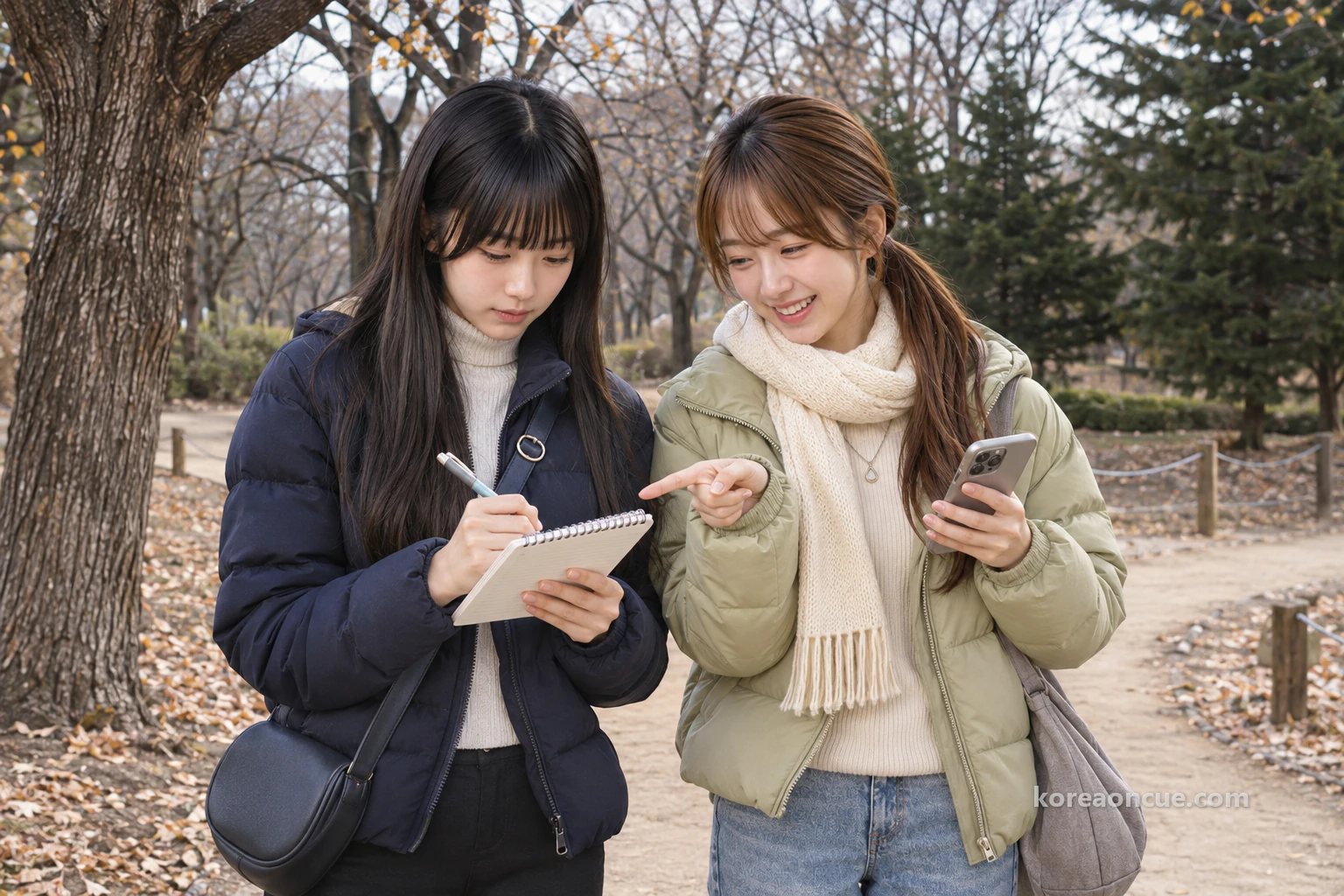
The trail with winter among its recommended seasons: the Wild Pear Tree Trail, 600 m
Of the five trails, the Wild Pear Tree Trail is the only one with winter among its recommended seasons. It was the end of November and there was no snow yet, but the two of them chose the path Lulu had first put her finger on as their last. It links the No. 1 Arboretum Display Garden, the conifer garden, with the No. 3, the broadleaf garden, so you can see conifers and broadleaf trees on a single path. It is short but takes its time, so they walked the end of the day without hurrying.
The two gardens hold plenty of trees, too. The conifer garden has 84 species in 16 families, and the broadleaf garden 195 species in 40 families. The last scene of Lulu’s video, the slot she had left empty, was filled on this path. As midday passed and the sun sank low and light came in between the conifers, Lulu lowered her phone and began filming the dirt path at her feet again. Having started the first scene at her feet, she wanted to close the last one there too.
“Let’s come back here when it snows,” Maya said, looking up at the green branches. Instead of answering, Lulu wrote one more line above “guided walk, both of us, two days before” in her notebook. It was “when it snows, Wild Pear Tree Trail”. She left the date out and kept it blank, and both of them hoped the snow would be the one to fill it in.
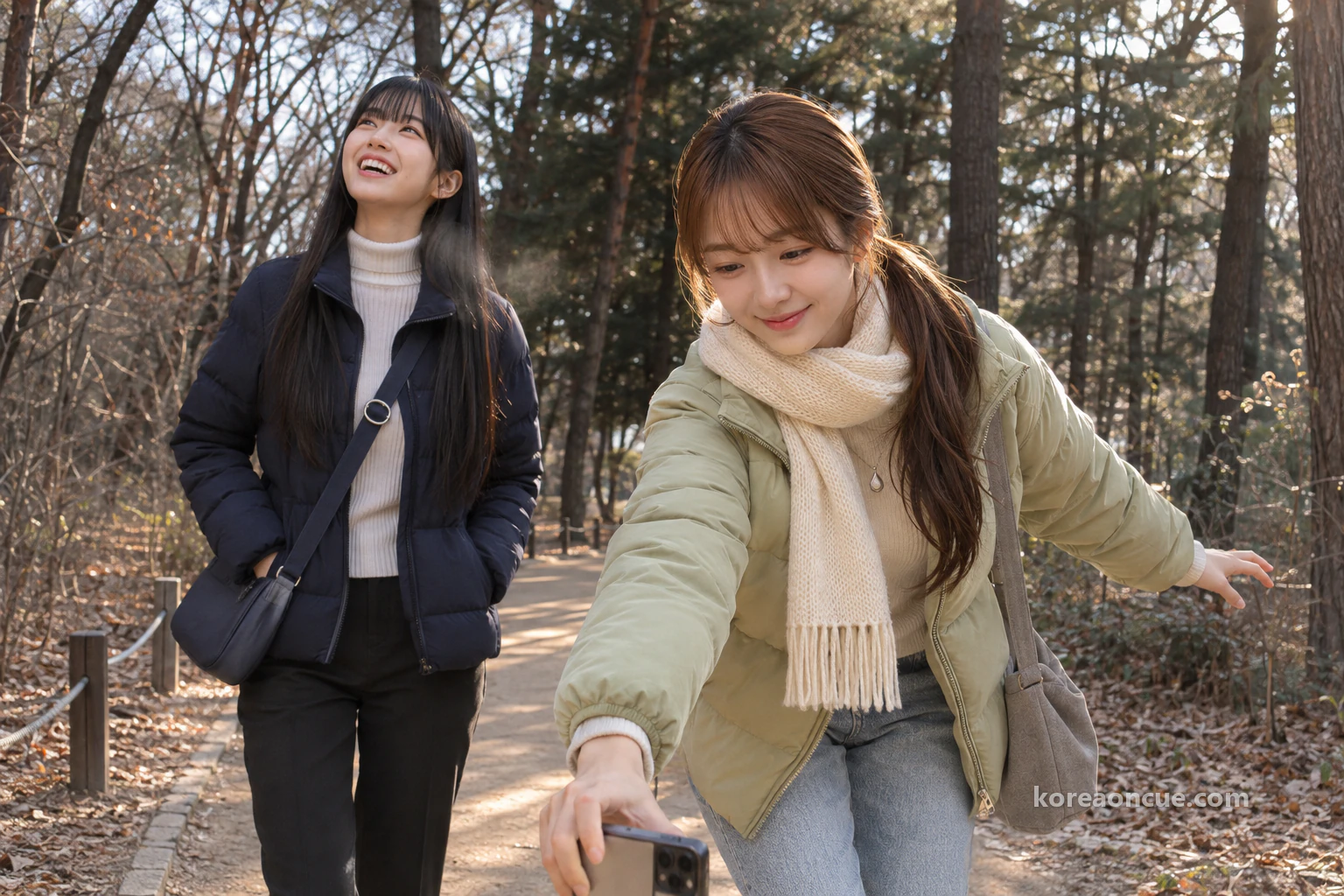
The three caption lines Lulu rewrote — Hongneung Forest’s day in short
After leaving the forest and having a late lunch with something warm and brothy, Lulu reworked the video captions from the top on the way back to Korea University Station. She deleted the opening “Hongneung Forest only opens at weekends” and put “Weekdays too, no booking, free” in its place. The second line was “10 a.m. weekdays, 9 a.m. weekends, in by 4.30”, and the third “Mat, gimbap and tripod stay at home”.
Scrolling through the day’s photos, Maya picked one and showed it to Lulu. It was Maya as Lulu had taken her on the trail and Lulu as Maya had taken her, placed side by side. The two were not standing in one frame together, but the photos showed two people a few paces apart, looking at each other. “Make this the third scene,” Maya said, and Lulu nodded straight away. Both of them knew it was a picture that would never have happened with a tripod.

Back home, the rolled-up picnic mat on the shoe cabinet and the tripod on the desk were waiting exactly where they had been left that morning. Maya put the tripod in her bag, laughing that next time she would use it somewhere it was allowed, and Lulu said that the day she spread the mat again, she would pick a park, not Hongneung Forest. Thanks to the tripod they could not take, they had spent the day in the forest taking each other’s photos. Lulu read the three rewritten caption lines one more time before she sent the video to her friends.
Common Mistakes
Planning for the weekend from an old post
Lulu trusted one blog post from a few years back and even moved her Saturday shift. It started because she was drawn to the gimbap photo and never scrolled down to see when the post was written.
Going at the weekend time on a weekday
The “enter at 9” in Lulu’s plan was only right because it was a Saturday. Had she sent that caption as it was, a friend going on a weekday would have waited an hour outside the gate.
Packing as if for a picnic
The gimbap and the mat never even reached the forest and ended at the breakfast table. They had been packed to copy a single blog photo.
Buying a tripod first so you can be in photos together
Maya’s new tripod stayed on Lulu’s desk. Instead, a photo they took in turns became the third scene of the video.
Looking up the guided walk too late
Maya, checking times on Thursday night, had already missed the booking deadline for the Saturday walk.
FAQ
Can a school group visit the Forest Science Museum?
Visits by school groups for learning are taken Tuesday to Friday.
How many people can join guided walks in a day?
80 per session, up to 240 a day.
Recap — 30 seconds before you go
- It is free and open without booking on weekdays too, but weekdays open an hour later than weekends, and it is closed on Mondays.
- Walk from Exit 3 of Korea University Station, and use a toilet before you go into the forest.
- Leave picnic gear and tripods at home, and if there are two of you, take turns photographing each other.
Sources
- Foresttrip — Hongneung Forest notice (Korean)Guided walks 16 March–29 November 2026, Tuesday–Sunday at 10:30, 13:30 and 15:30, meeting at the King Cherry Tree Rest Area · booking from 10:00 on the 1st of each month, two months at a time, closing at 17:00 two days before · 80 per session, 240 a day, on-site sign-up if places remain · no admission fee · no booking for free walkingchecked 2026-11-10
- Foresttrip — Hongneung Forest visitor rules (Korean)No food, alcohol, picnic mats, camera tripods, bicycles, exercise equipment or flammables, no pets · no smoking or drinking · no picking plants · no parking · take care, toilets are not easy to use · entry may be limited by weather and site conditions · children and older visitors with a companionchecked 2026-11-10
- National Institute of Forest Science — Directions to Hongneung Forest (Korean)57 Hoegi-ro, Dongdaemun-gu, Seoul · Korea University Station (Line 6) Exit 3, 7 min on foot, 0.5 km · Cheongnyangni Station (Line 1) Exit 2, 15 min, 1.2 km · Hoegi Station (Line 1) Exit 1, 17 min, 1.4 km · bus 273 from Hoegi Station towards Kyung Hee University, off at Korea Institute for Defense Analyses · 02-961-2522checked 2026-11-10
- National Institute of Forest Science — Hongneung Forest free walking FAQ (Korean)Open Tuesday–Sunday, closed Mondays (and 1 January, Seollal and Chuseok holidays) · weekdays 10:00–17:00, weekends 09:00–17:00 · no entry in the last 30 minuteschecked 2026-11-10
- National Institute of Forest Science — First week of weekday opening (Korean, April 2026)Free walking extended from weekends to weekdays, alongside booked guided walks · 24,850 visitors in the 9-day festival, against a five-year yearly average of about 86,000 · safety staff and designated paths, no food or pets, no damage to plants or research plotschecked 2026-11-10
- National Institute of Forest Science — Press release on weekday opening of the 100-year-old forest (Korean, December 2025)The oldest bansong pine at 133 years · the noble poplar, confirmed as Korea’s tallest tree at 38.97 mchecked 2026-11-10
- National Institute of Forest Science — Hongneung Forest trails and gardens (Korean)Length, time, difficulty and recommended seasons of the five trails · Arboretum Display Garden 1 (conifers) 84 species in 16 families, Garden 3 (broadleaf) 195 species in 40 families, linked by the Wild Pear Tree Trailchecked 2026-11-10
- National Institute of Forest Science — Forest Science Museum visitor guide (Korean)Opened 6 November 1999, three floors above ground · Korea’s first building framed in domestic structural glulam · individual visits Saturday–Sunday, closed Mondays and public holidays, free · November–February 10:00–16:00, lunch 12:30–13:30 · school groups Tuesday–Friday · Exhibition Room 1, the film room, Exhibition Room 3checked 2026-11-10
- National Institute of Forest Science — About the Hongneung experimental forest (Korean)Korea’s first arboretum, set up with the forestry experiment station in 1922 · 41.8 ha, 35.3 ha of forest (13.4 ha display gardens, 21.9 ha urban forest) · on the south-west slope of Cheonjangsan (141 m) · named after Empress Myeongseong’s former tomb sitechecked 2026-11-10
A Seoul story told with our AI characters. Place details are checked against public sources; the photos are AI-made illustrative images. How we use AI