
SEOUL · JEONGDONG
Seoul Museum of Art, Before You Enter
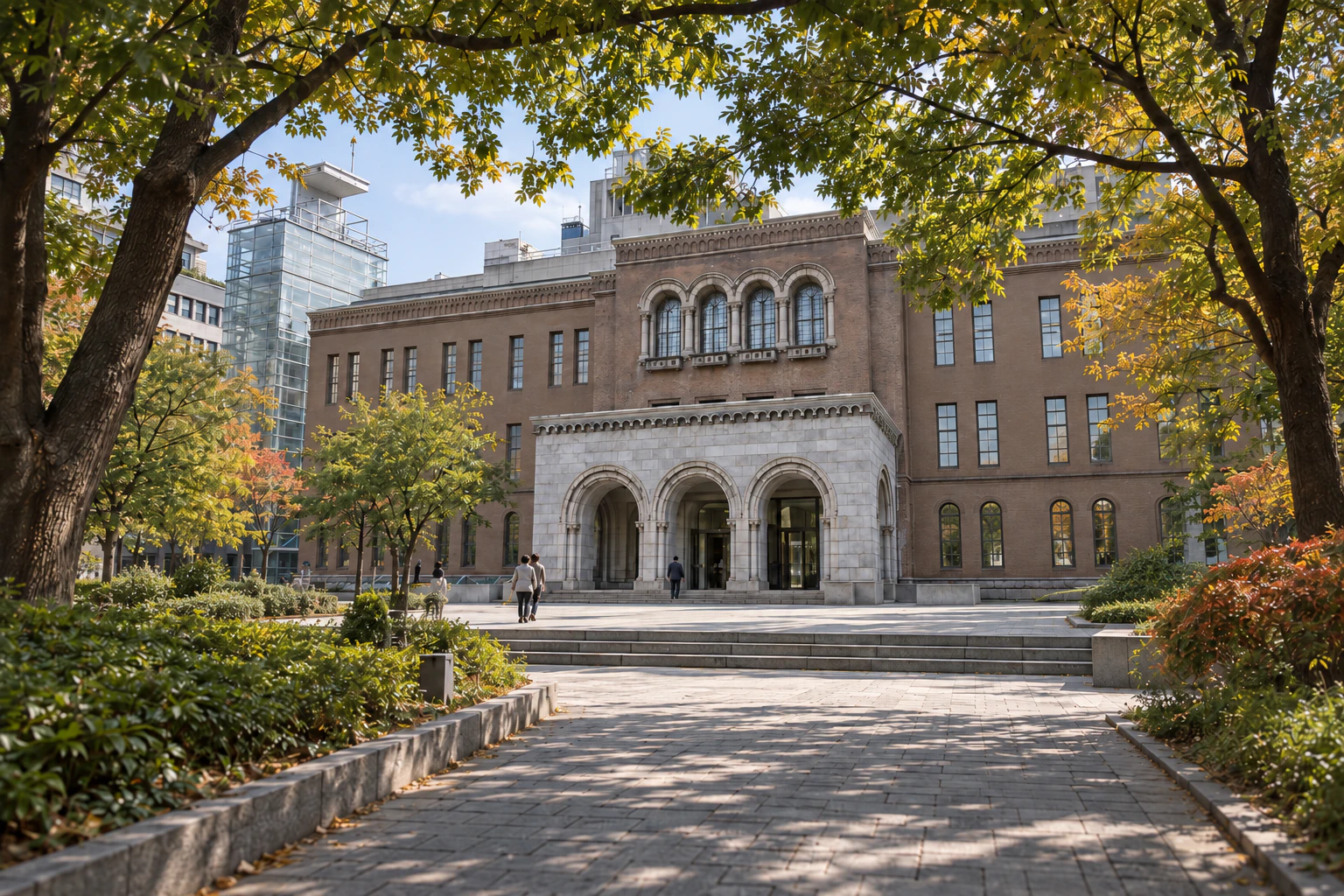
At the corner where the stone wall road ends, Elena does not stop; she carries on up the slope. A path with no wall, old trees, and above them the front of a building from 1928.
How to get there
Based on the museum’s official directions.
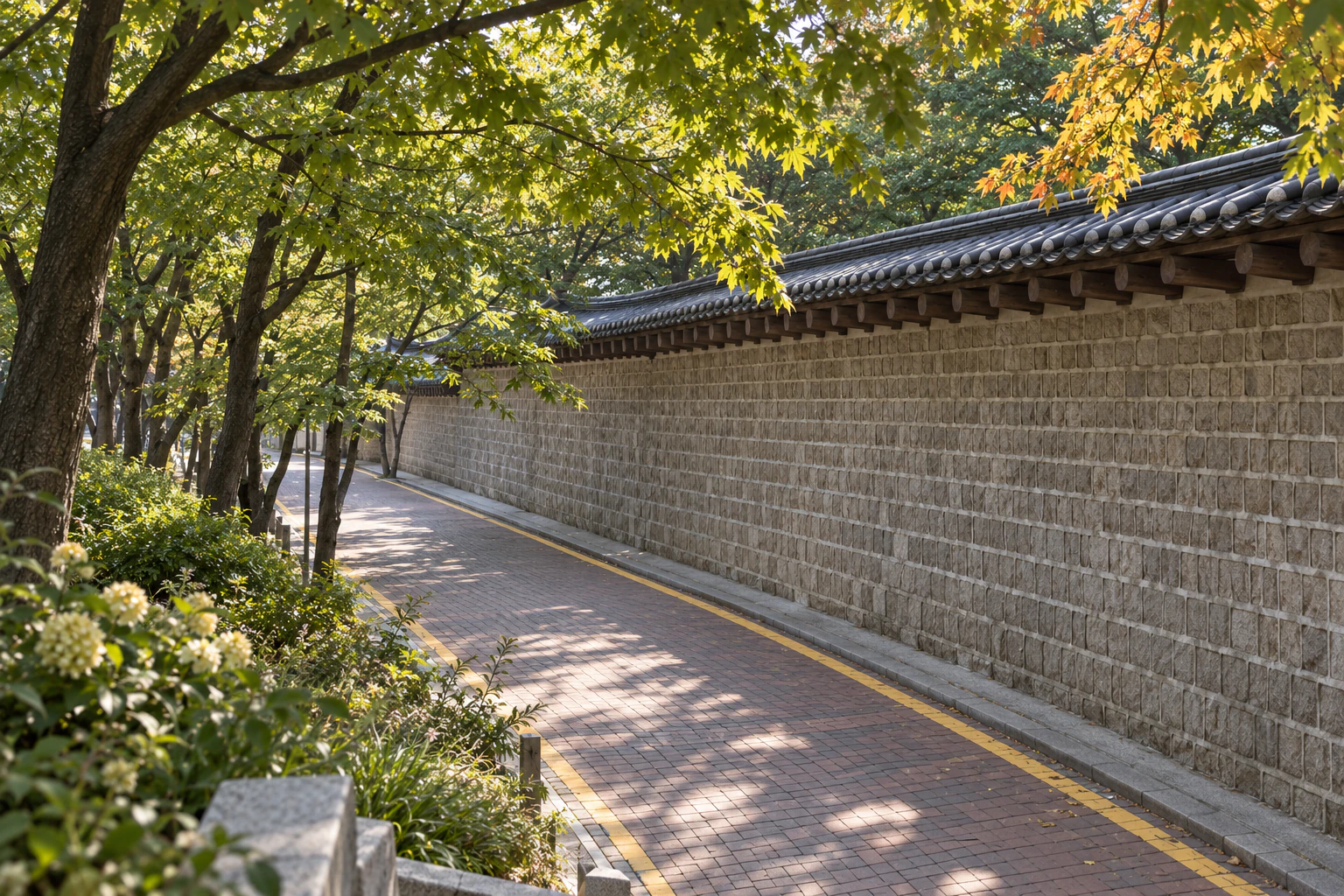
Last time, Elena walked Deoksugung Stone Wall Road from the front of Daehanmun to the corner by the art museum. That piece ended where the wall turns right; this one begins in the same spot. To the left of the corner, a sloping path opens with no wall around it, and that is today’s place: the Seoul Museum of Art, Seosomun Main Branch. This piece looks at that one building and nothing else.
The museum scenes Elena has seen on screen were mostly the same. A white wall, a single painting, two people in front of it, quiet footsteps. The museum was always ‘inside’. What the outside looked like, which path you came up — none of that was in the frame. So today she decides to spend longer in front of the door than beyond it.
There is one more thing. The museum’s own notes say the building went up in 1928 as a courthouse and served as the Supreme Court until 1995. She has seen courtroom scenes on screen too: a judge seated, two people facing each other, a camera looking down from somewhere high. That the building now serves as a place for looking at art has been on her mind since before she set off.
A slope with no wall — half the museum before the door
The approach climbs a sloping path off Deoksugung-gil; the museum was built without a boundary wall so that the garden of old trees and flowers, and the outdoor sculptures, can be enjoyed from outside (there is an outdoor exhibition area).
Turn left at the corner of the stone wall road and the path climbs. There is no wall. The museum’s notes say it was built without a boundary wall so that the garden and the sculptures could be enjoyed from outside, and standing here you see at once what that means. There is no line where the museum starts. The street simply becomes the garden. Find on the map

Old trees stand on both sides as the path rises. The trees on the stone wall road covered the street; these trees wrap the garden. Same afternoon, same neighbourhood, but the shade has a different shape. Elena notices it and smiles a little. One turn at the corner, and the mood changes this much.
There are sculptures in the garden. Elena walks past without reading the labels. The point of today is not to memorise the names of works but to see how a museum begins before its door. The pieces simply stand among the trees and flowers. The notes said the grounds have no wall so that people can see them from outside; standing in front of a sculpture, that makes sense a second time.
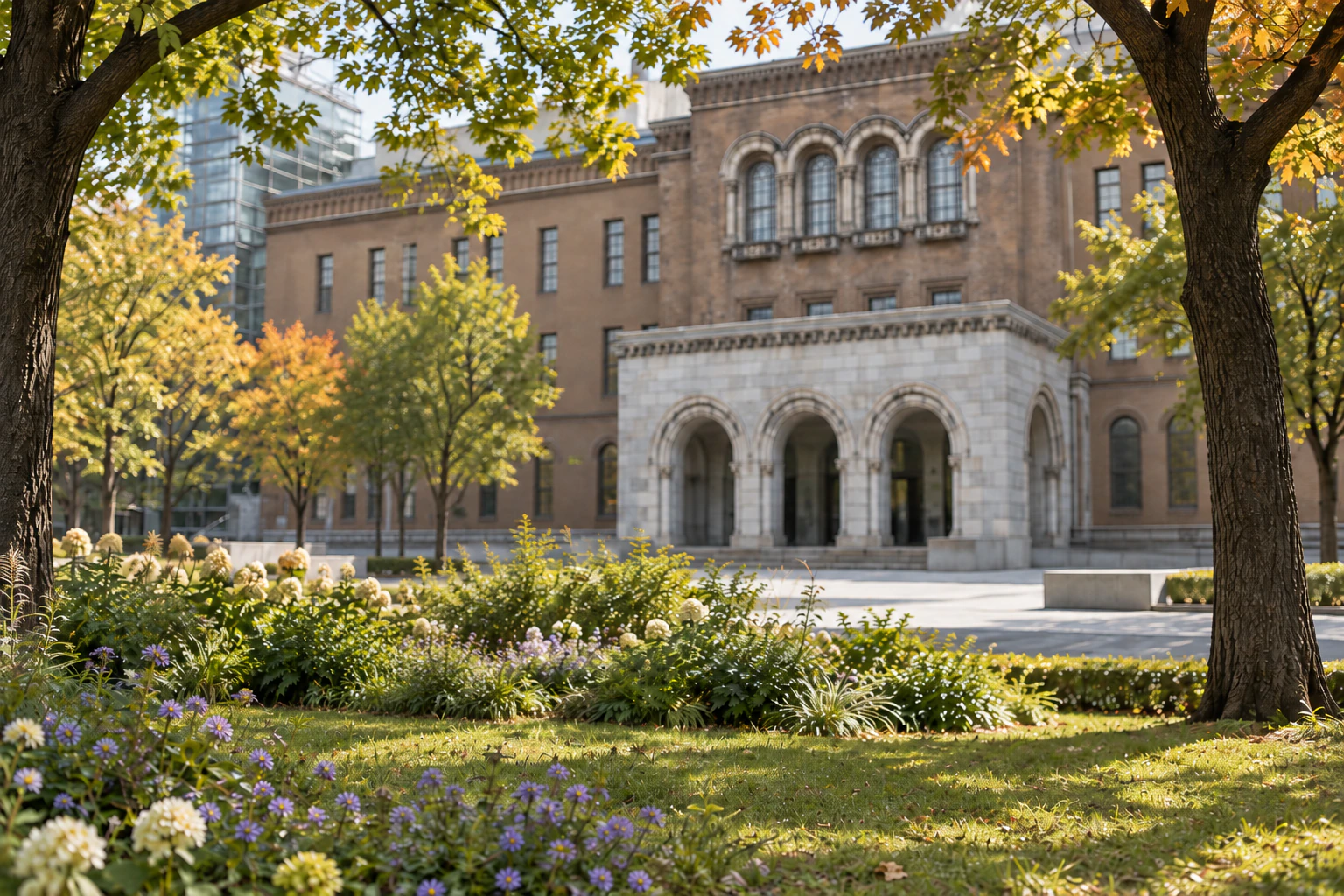
This part was never in the museum scenes on screen. The two people were always already inside. Which path they came up, how many trees stood outside — all of that was cut. Elena feels she is filling in the cut part with her own feet. This slope is the beginning of the scene.
Halfway up she turns to look back. The stone wall road she has just walked lies below. The corner where the wall turns right, the last spot of the previous piece, sits in one view. From higher up, the proportions of the same corner feel different. A small change in height gives the road a different impression.
Then she faces forward again. Between the trees the front of the building rises. Not all of it yet — only as much as the trees allow. Elena slows down. Better to have it revealed a little at a time than all at once.

The 1928 front — a wall that was once a court
The museum kept and renovated the Renaissance-style front of the old Supreme Court; that front was registered as a National Registered Cultural Heritage on 2 March 2006 under the name 'Former Supreme Court Building, Seoul' (no. 237). According to the Korea Heritage portal the front wall is 60 m wide and 15.1–16.1 m high, and the front entrance is 14.6 m wide and 5 m high.
At the top of the slope the trees step back and the whole front appears. The museum describes the building as the Renaissance-style front of the old Supreme Court joined to a modern building behind. The national heritage portal gives the front wall as 60 metres wide and a little over 15 metres high. Knowing the numbers does not make it feel bigger; it explains why it never fitted in one glance. Find on the map

Elena stands in front of the wall and looks left and right. Either side of the central entrance the two halves match. The courtroom scenes she saw on screen rarely showed the outside of the building — only the high ceilings and long corridors inside. This wall is the outside of those scenes. Elena briefly imagines the people who once passed through this front when the building was still a court.
Now that wall is the face of a museum. The notes say the court left in 1995 and the museum arrived in 2002. A building that handed down verdicts became a building for looking. Elena writes the sentence in her notebook. It may be the one that stays with her longest from today.
Behind the front, glass and a new building show. Old and new are joined, but nobody tried to force them to blend. The old front remains distinct from the newer rear, with a transparent link between them, as the notes describe. Elena likes that way of doing things: letting different things stay different.
She stands before the entrance. The notes give its width as a little over 14 metres. Set against the scale of a person, a width of just over 14 metres suddenly feels tangible. The museum doors on screen were always a single sheet of glass. This one is the mouth of a wall from 1928. At the threshold she looks up and catches that first-sight expression on her own face.

Beyond the door there is no gallery straight away. Between the old front and the lobby is a link space, and its ceiling is glass. The notes call it a bridge between the 1900s and the 2000s. Light falls from above. Elena pauses beneath it.

Past the lobby she climbs the stair. It was designed so that you see the sky as you climb, the notes say. As she climbs and looks up, the sky appears beyond the glass. The museum stairs on screen were always dim passages between white walls. This stair opens outward. Elena looks up three times on the way.
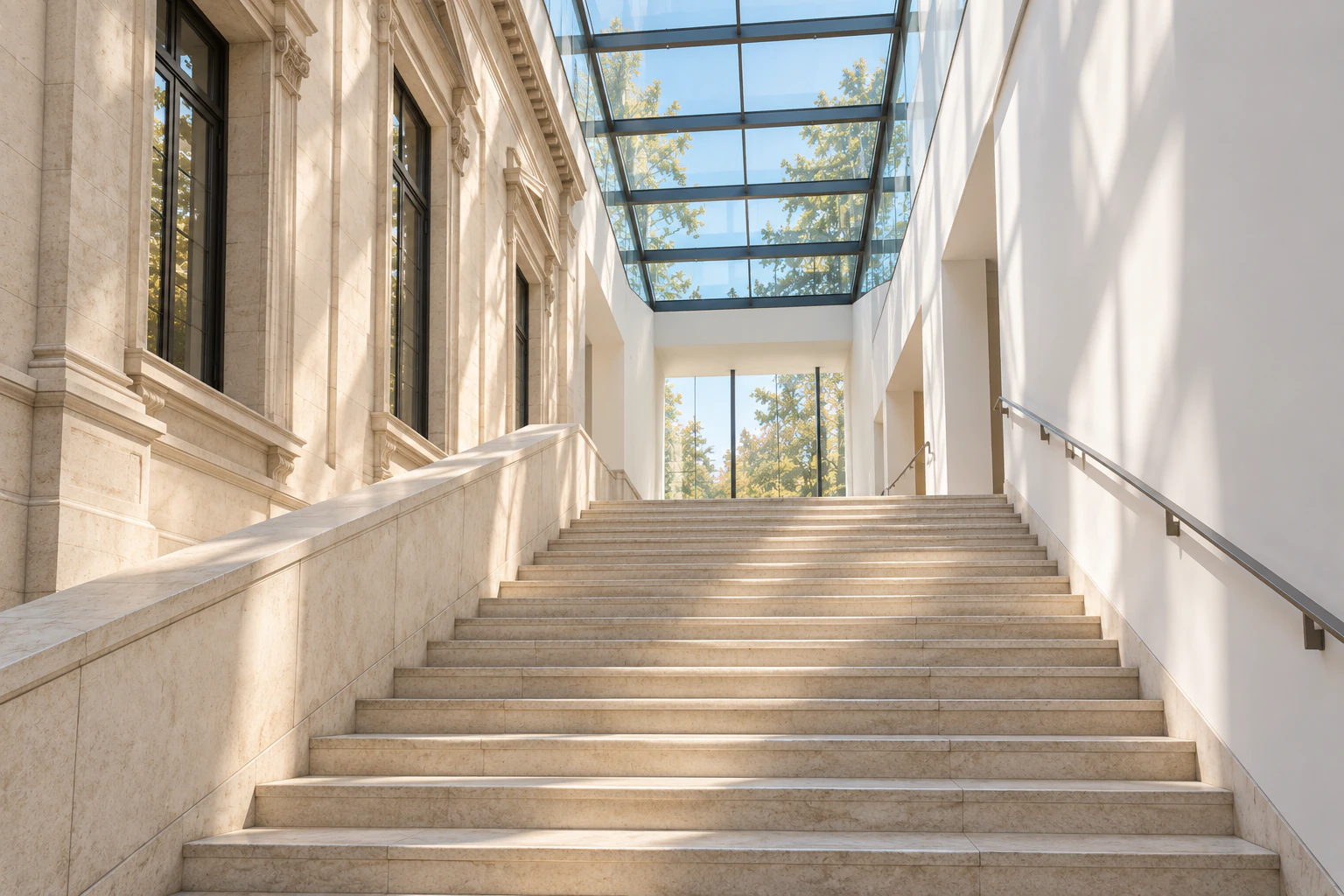
The stair from the second floor to the third is timber. Elena follows the changing materials with her eyes: old wall, glass, then wood. Each time the material changes, the building says something different. Elena writes down the order. This building shows you half of itself before the door and the other half on the stairs.

Under the skylight — and back outside
On the 2nd floor are the Chun Kyung-ja Collection gallery (a selection from the 93 works the artist donated, dating from the 1940s to the 1990s) and the Gana Art Collection gallery (a selection from 200 Korean realist works donated in 2001); the art library on the same floor is open Tue–Sat 10:00–18:00.
On the second floor are the permanent collection rooms. The notes say they show a selection from the 93 works donated by the painter Chun Kyung-ja, and a selection from 200 Korean realist works donated in 2001. In these rooms Elena watches the people looking at the paintings more than the paintings. This is the spot that most resembles the museum scenes on screen: a white wall, a painting, a person in front of it. Find on the map
The right-hand gallery on the second floor has an opening in the centre of its ceiling, designed to bring in natural light from the floor above.
The right-hand gallery on the third floor has a ceiling about six metres high and a pyramid-shaped skylight in the centre. The skylight is designed to bring natural light into the middle of the gallery.

The way down is the way up in reverse. The wooden stair, the stair with the sky, the glass-roofed link space, and then the old entrance. The materials come back in reverse order. Elena counts them backwards: timber, glass, old wall. Out of the door, and it is the garden again.
From the garden she looks up at the front once more. The wall looks different after coming out than it did going in, because she has now seen the glass ceiling and the sky behind it. A wall you look at knowing there is that kind of light behind it is not the same wall as one you look at not knowing. Elena writes that down as today’s second sentence.

From the front of the museum, the map says, it is about 300 metres along Jeongdong-gil to Chungdong First Methodist Church, roughly four minutes. She does not go that far today. Jeongdong-gil belongs to the next piece. Elena closes her notebook under a garden tree and walks down to where she can see the corner of the stone wall road. Today’s place ends here.
What Elena wants to pass on is an order. From the corner of the stone wall road, do not go straight to the door: climb the slope with no wall slowly, watch the front appear a little at a time between the trees and sculptures, turn round once halfway, and only then go through the door and stop under the glass ceiling. This museum shows you half of itself before the door, and it would be a shame to skip that half.

(※ This article includes staged images created with AI.)
Plan your visit
Allow 40 minutes to an hour: from the corner of the stone wall road up the museum path to the front, inside for the stairs and the permanent collection rooms, and back out to the garden. Walking times are map-route calculations; time spent in the galleries is not included.
A diagram of the order only · not to scale, not oriented, not the real shape of the streets.
- City Hall Station → museum — From exit 10 of City Hall Station (Line 2) it is 260 m, about 4 minutes, by the museum’s own directions. Or come as in the previous piece, along the stone wall road from Daehanmun: about 420 m, 5 minutes. Find on the map
- Path → front → inside — Climb the wall-less slope past the garden and sculptures to the front of the old Supreme Court. Through the entrance: the glass-roofed link space, the lobby, the stair with the sky, the permanent collection rooms on the 2nd floor, then the 3rd-floor galleries. Find on the map
- Museum → Jeongdong-gil — From the front of the museum along Jeongdong-gil to Chungdong First Methodist Church is about 300 m, 4 minutes — the next piece’s place. Find on the map
Getting there
Checked 2026.09.18
The Seosomun Main Branch is 260 m (about 4 minutes on foot) from City Hall Station exit 10 on Line 2, or 380 m (about 6 minutes) from exit 1 on Line 1, according to the museum's own directions.
Hours & fees
Checked 2026.09.18
Seoul Museum of Art (SeMA), Seosomun Main Branch, is open Tue–Thu 10:00–20:00, Fri 10:00–21:00, and Sat/Sun/public holidays 10:00–19:00 (Mar–Oct) or 10:00–18:00 (Nov–Feb); it is closed on Mondays and on 1 January (it opens if the Monday is a public holiday). Admission is free, special exhibitions are ticketed, and last entry is one hour before closing.
Background1
Checked 2026.09.18
There are lockers, wheelchair and pushchair loans (for children up to 36 months), a lift and folding museum chairs. The 1st floor has the playroom/nursing room (children up to 5, with a parent) and café; the art bookshop is on the 3rd floor.
- Admission is free; special exhibitions are ticketed. Last entry is one hour before closing, and the museum is closed on Mondays and on 1 January (it opens if the Monday is a public holiday). Fridays run until 21:00, so an evening visit is possible.
- Which galleries are open on the day, and what hangs in the permanent collection rooms, depends on the current exhibitions. Whether photography is allowed inside the galleries also varies by exhibition — follow the notices on site.
- There are lockers, wheelchair and pushchair loans and a lift; the 1st floor has the playroom/nursing room and café, and the art bookshop is on the 3rd floor (by the museum’s own notes). The approach is a sloping path, so check the lift and route on site if you use a wheelchair or pushchair.
- The car park is open Tue–Fri 09:00–22:00 and Mon/Sat/Sun/public holidays 09:00–21:00, at KRW 400 per 5 minutes on weekdays. This piece, though, was written for arriving on foot.

