SEOUL · LOTTE WORLD
Lotte World Folk Museum: An Afternoon Looking Down on a Palace Made Small
Maya goes underground from Jamsil Station Exit 4, takes a lift to the third floor, follows the numbers on the floor plan from prehistory to the Joseon miniature village, and looks down on a small palace with Geunjeongjeon inside it
To reach the Lotte World Folk Museum, walk underground from Exit 4 of Jamsil Station (Lines 2 and 8) and take the lift to the third floor, where the entrance is. It is open every day from 11:00 to 19:00, ticket sales and entry end at 18:30, and an adult ticket is 5,000 won. Maya picks just one thing in each gallery from prehistory to Goryeo, then finds Gyeongbokgung, a palace she has already walked through, from above in the Joseon Miniature Village.

How to get there
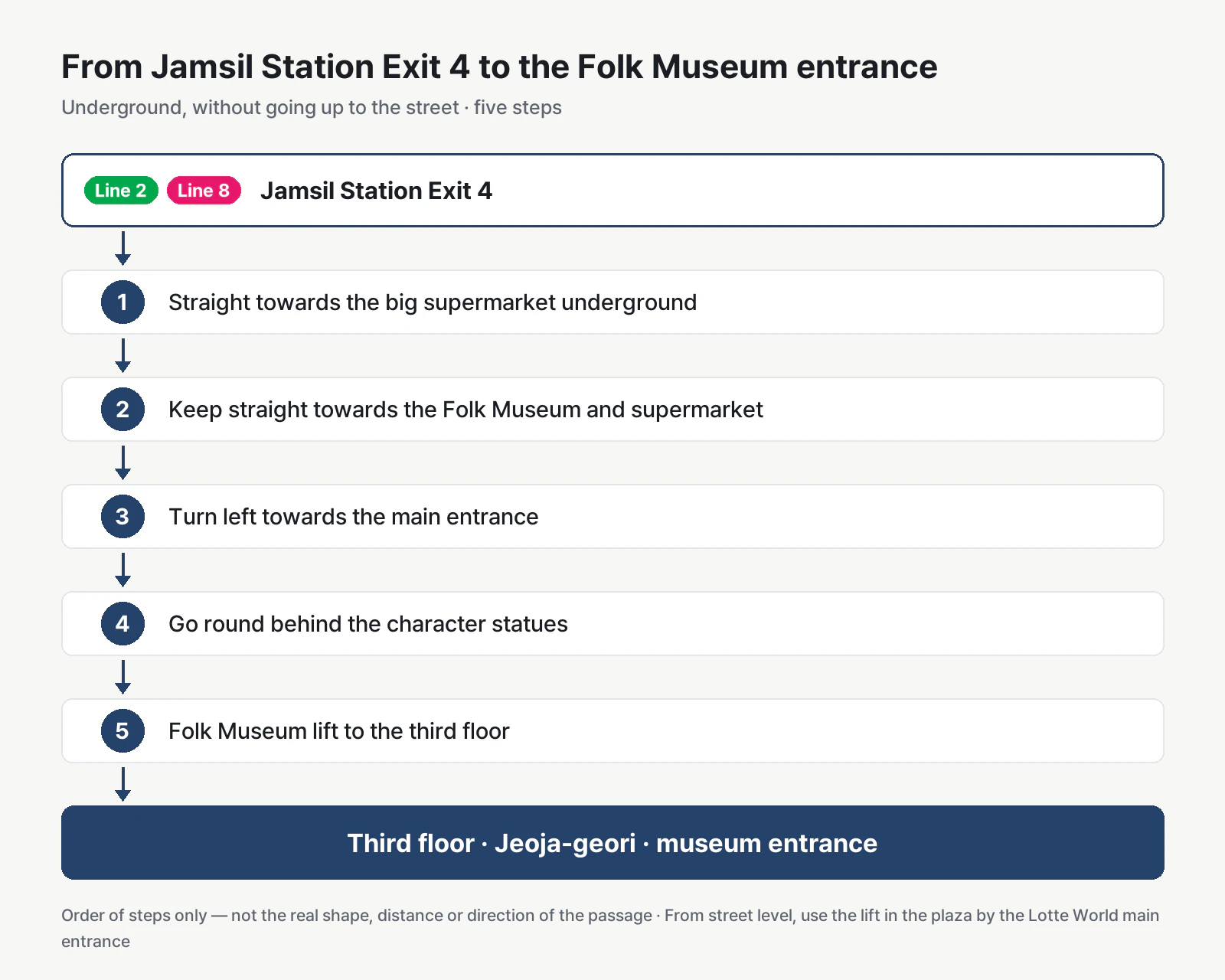
The Folk Museum website points to Exit 4 of Jamsil Station (Lines 2 and 8) and describes, in five steps, a route from the station through the underground level and up by lift to the museum entrance on the third floor. A map app’s walking route is calculated to a point at street level, so it is a different route from the underground-and-lift way the museum describes.
The Lotte World Folk Museum is the kind of place you reach without ever going up to the street: from Exit 4 of Jamsil Station you walk underground, take a lift to the third floor, and step out right at the entrance. It is open every day from 11 a.m. to 7 p.m., and you can buy a ticket and go in until 6.30 p.m. An adult ticket is 5,000 won, so you can visit the museum on its own without a theme-park ticket. Allow about an hour to see it all comfortably.
Maya, a 21-year-old creator from Singapore, walked through Gyeongbokgung first when she came to Seoul. Standing in the courtyard in front of Geunjeongjeon after passing Gwanghwamun, she had to tip her head right back to see the roof. The courtyards were wide, and the halls appeared one after another. She walked a great deal of the palace that day, but she never once saw the shape of the whole thing at a glance.
At the National Folk Museum of Korea she drew two columns in her notebook as she read the labels: “rebuilt” and “moved”. Today she adds a third beside them: “made small”. Having seen the palace on foot, she wants to look down on it all at once, so on a weekday afternoon she heads for Jamsil.
The Cue
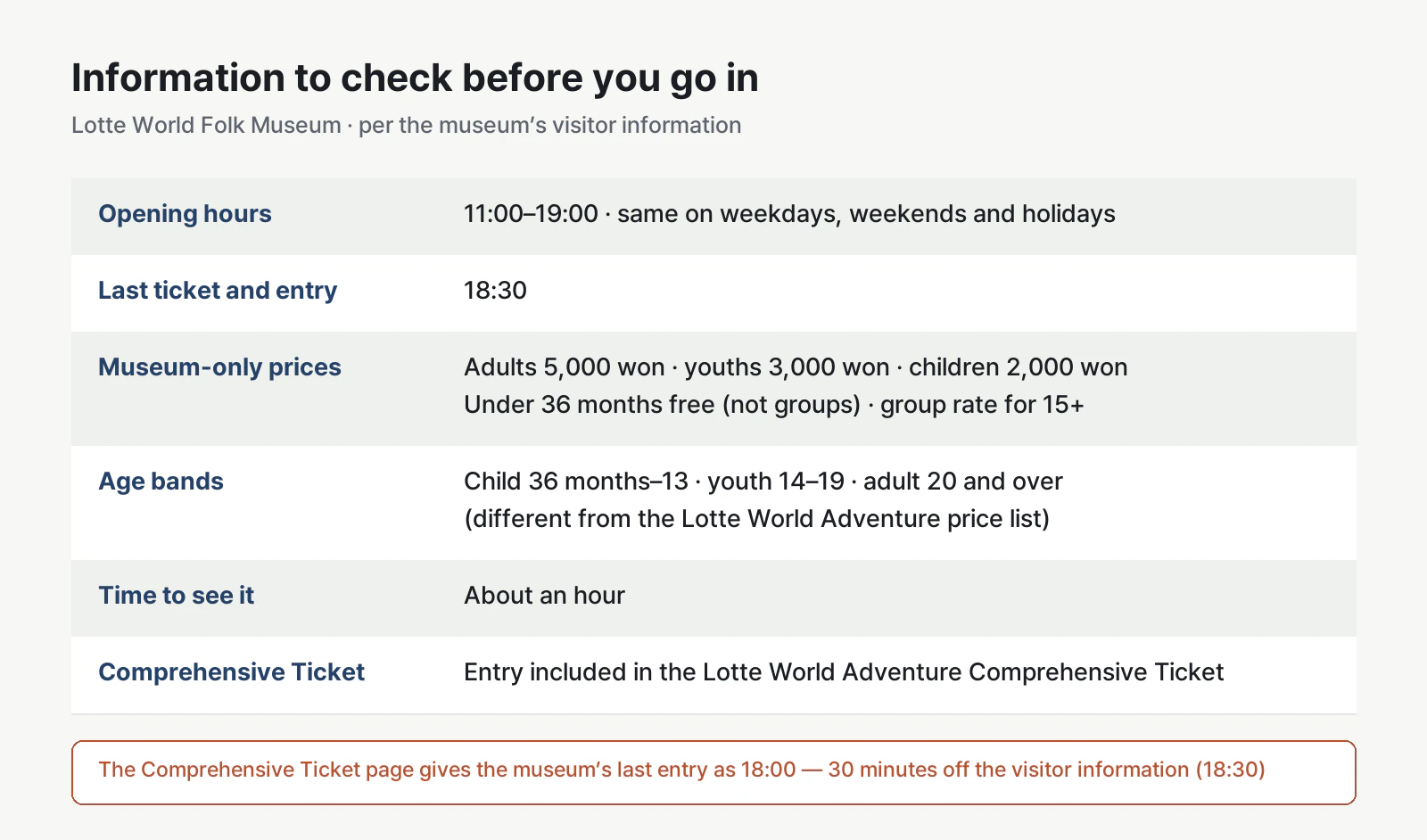
The Lotte World Folk Museum is reached from **Exit 4 of Jamsil Station (Lines 2 and 8)**: go underground and take the **lift to the third floor**. It is open **every day, 11:00–19:00**, with **ticket sales and entry ending at 18:30**, and costs **5,000 won for adults, 3,000 won for youths and 2,000 won for children**. Allow **about an hour** to go from prehistory to the Joseon Miniature Village. Photography is allowed, but tripods and flash are not.
- **The exit**: Head for Exit 4 at Jamsil Station, but don’t climb up to the street — follow the underground passage.
- **Last entry**: The museum is open until 19:00, but ticket sales and entry end at 18:30. If you want an hour inside, go in by about 17:30.
- **Age bands**: The museum’s own prices count children as 36 months to 13, youths as 14 to 19, and adults as 20 and over. These bands differ from the theme-park price list.
- **Photography**: You may take photos in the galleries. Leave tripods and flash behind, and don’t touch the exhibits.
- **Bags**: Food and drink can’t be taken in, and wheeled things such as bicycles and kick scooters can’t be brought in or left with staff.
From Jamsil Station Exit 4, underground and up to the third floor
The first trick at Jamsil Station is to walk towards Exit 4 without climbing the stairs to the street. The museum is on the third floor of the Lotte World shopping mall, so you follow the underground route and take the museum lift, which lets you out right in front of the entrance. Instead of a phone map, Maya copied the museum’s five-step walking directions into her notebook. A map app draws the route to a point at street level, while the museum’s directions run underground and up in the lift.
Open in Kakao Map — Lotte World Folk Museum
Step one is to walk straight from Exit 4 towards the big supermarket on the underground level. Step two is to keep going straight in the direction marked for the Folk Museum and the supermarket, and at step three you turn left towards the main entrance. At step four you go round behind the character statues, and at step five you find the lift for the Folk Museum. Take it to the third floor and you arrive at Jeoja-geori and the museum entrance.

Maya checked each step as she went. The wide passage was bright and busy, and one wrong turn looked as if it would leave her unsure where she had come from. So at every junction she looked at the verbs in her notebook again: straight on, keep going, turn, go round, go up. She was retracing on foot the steps she had seen on screen, counting it as the first thing she checked off today.
If you come by bus, plenty of routes pass Lotte World. Several stop nearby, from local buses such as 3217, 3313 and 3314 to buses 301, 341, 360 and 362, along with airport buses 6000 and 6006. Even after getting off a bus, though, the museum is still on the third floor of the mall, so you still go inside and look for the lift up. On a first visit, coming by subway and following the underground passage is the way you are least likely to get lost.
If you pick the wrong exit and end up at street level, don’t worry too much. The museum is on the third floor of the Lotte World mall, and taking the lift inside the plaza by the Lotte World main entrance up to the third floor also brings you to the entrance. Remembering this on the way home, Maya noted that next time she would try the street-level way in too. Follow the five underground steps on your first visit, and choose whichever way suits you after that.
Up on the third floor, Jeoja-geori comes first
When the lift doors opened, Maya stopped for a moment. She had expected the galleries straight away, but what appeared first was an indoor street of low shopfronts under tiled eaves. This is Jeoja-geori, a recreation of a Joseon-era market street. Under a dark ceiling, warm lamps glowed beneath the eaves, as if another age had been fitted inside the shopping mall.

Jeoja-geori is lined with restaurants serving traditional Korean food. Maya had already had lunch, so today she only walked through slowly. Even so, passing along it gave her an odd feeling. She hadn’t bought a ticket yet, and she was already standing inside a scene someone had rebuilt. The first line in her “rebuilt” column went down not at the museum entrance but on this street.
Food and drink can’t be taken into the museum, so if you are peckish, eat on Jeoja-geori first. Any drink you have needs finishing before the entrance too. Maya checked the water bottle in her bag, screwed the lid on tight and tucked it inside. Not carrying anything she wouldn’t take out in the galleries made the whole hour easier.
At the museum ticket desk Maya bought one adult ticket. Prices are 5,000 won for adults, 3,000 won for youths and 2,000 won for children, and children under 36 months go free. Visitors aged 65 and over pay the group adult rate when they show proof of age, and people with disabilities and national merit holders, plus one companion, pay the group rate. The museum counts children as 36 months to 13, youths as 14 to 19 and adults as 20 and over, which differs from the theme-park price list, so check your group’s ages against the museum’s own bands.
If you already have a Comprehensive Ticket for Lotte World Adventure, entry to the Folk Museum is included. Anyone stopping by on a theme-park day doesn’t need a separate ticket. The Comprehensive Ticket page and the museum’s own visitor information give different last-entry times, though, so if you plan to come in on that ticket, glance at the information table below before you set off.
If you come by car, keep your museum ticket. With a Folk Museum ticket for the same day you get up to two hours of parking at a reduced rate, after which the normal rate applies. You can settle the discounted amount directly at the parking kiosk. It makes no difference to someone like Maya arriving by subway, but on a family day out by car it is genuinely useful.
Following the numbers, one thing from each of three eras
The floor plan just inside the entrance gives each gallery a number. Number 1 is prehistory, 2 to 5 are Goguryeo, Baekje, Gaya and Silla, 6 is Goryeo, and 7 is the Joseon Miniature Village, while the Play Yard and the Pi Chun-deuk Memorial Hall appear by name only. Screens always showed her the most dramatic scene first, but today Maya decided to start from the smallest number. In return, she would choose just one thing in each era and look at it for a long time.
Following the numbers, you come across traditional hands-on spaces between the galleries. When time is short, Maya thought it better to save time for the miniature village first rather than stop at every hands-on corner. A full circuit takes about an hour, so saving a little time in each of the first three eras means you won’t have to rush in the last room. That was exactly why she chose just one thing per era.

In the prehistory gallery Maya chose a model of a Neolithic pit house. There were scenes of cave life from the Palaeolithic and of Bronze Age metalworking too, but the space where people actually lay down to sleep stayed with her longest. The house, dug into the ground in a circle with a roof on top, was smaller than she had imagined. She counted on her fingers how many people might have sat inside, then moved on to the next room.
In the Three Kingdoms gallery she stopped in front of the model of Seokguram on the Silla side. She passed a recreated Goguryeo tomb mural with its hunting scene, the Baekje rock-carved Buddha triad at Seosan and a Gaya mounted warrior, but what she chose was a model that brought a whole place indoors. Somewhere you normally have to climb a mountain to see sat at eye level. Bringing a faraway place close was another way of making something small, and Maya wrote that down here for the first time.
In the Goryeo gallery she was held by a model of the depositories at Haeinsa that house the Tripitaka Koreana. Alongside the making of the woodblocks, the structure of the building put up to keep them safe for centuries sat there in miniature. There was celadon-making and a model of Muryangsujeon as well, but Maya looked longest at how the windows and pillars fitted together. A living space, a faraway place, the structure of a building: across three rooms, what she chose kept changing in scale.
Between the cases and the models, the two columns again
As she walked the galleries, Maya kept thinking of the two columns from the National Folk Museum. This museum shows real artefacts alongside recreated models, so earthenware and stone tools in glass cases sit in the same room as tiny figures. Just by looking, it was hard to tell which things were old and which had been rebuilt. So before choosing a column, she kept her habit of reading the label first.

She decided to copy into her columns only what the labels said, and to leave the rest blank. At first it bothered her that she couldn’t fill them, but the blanks made her pay more attention to how things were being shown. In front of a case of artefacts she found herself stepping closer, while in front of a model she stepped back to take in the whole. In the corner of the page she called the difference “looking closer” and “stepping back”.
There are no guided tours at present, so you read the information panels in the galleries yourself. For Maya that was actually easier. Instead of walking at a guide’s pace, she could stay as long as she liked at any case that caught her eye. Some panels have small print and dim light, though, so rather than switching on her phone torch she chose to lean in a little closer.
The galleries were dim and quiet, so she turned her phone’s brightness down too. Photography is allowed, but flash and tripods are not, and touching the exhibits is not allowed. By standing a little to one side so her face didn’t reflect in the glass, she could see further in. Maya decided not to take many photos today, saving herself for the one picture she most wanted to keep at the end.
In the miniature village, Joseon all at once
As Maya stepped into gallery 7, the Joseon Miniature Village, the space suddenly opened out. In the three rooms before, she had picked one thing at a time, but here the whole village came into view at once. More than 2,000 figures at one-eighth scale show the four seasons of Joseon, its seasonal customs, rites of passage, and the lives of the royal court and ordinary people. Beyond a low glass edge, tiled and thatched houses gathered among low hills and fields stretched a long way.
The village also shows the changing seasons and the landscape. On one side fields were being flooded and rice planted, while on another, ripened grain was being brought in. Watching the same village change with the seasons, Maya realised that a passage of time no single photo could hold was set out here. That was why walking round the village suited it better than trying to keep it in one picture.

Maya first walked slowly all the way round, picking out scenes. Dano, rice planting, weaving and harvest sat with the turning of the seasons, and in one place a whole lifetime ran from a first-birthday party through a wedding and a sixtieth birthday to a funeral procession. A market scene and a village school had their places too, along with Joseon science such as the armillary sphere and the rain gauge. The figures were tiny, so she guessed each scene from how people were gathered rather than from their faces.
There is a coronation scene in the village too. The courtyard in front of Geunjeongjeon that Maya walked at Gyeongbokgung had been a wide, empty space full of passing visitors. Seeing a palace ceremony set up again with tiny figures gave her a rough sense of what that empty courtyard had once been for. She didn’t try to identify who each figure was; she simply took in the shape of the people gathered there.
Perhaps because she had picked one thing at a time before, the change of scale felt sharper here. Eyes that had looked at one pit house, one Seokguram and one set of depositories were now taking in a whole village. Maya started copying scene names into her “made small” column, then soon stopped. There wasn’t enough room. Instead, she headed deeper into the village to find the one place she had most wanted to see today.
Finding the Gyeongbokgung she walked, from above
Gyeongbokgung is here in the village too: a model that shrinks the real thing, starting with the main gate, Gwanghwamun, and including halls such as Geunjeongjeon, Sajeongjeon and Gyotaejeon. Maya stood at the glass edge and bowed her head. At Gyeongbokgung she had tipped her head back to see the roof of Geunjeongjeon, but today she was looking down on the same roof.

She traced the order she had walked that day across the model. Through Gwanghwamun, across the courtyard, a pause in front of Geunjeongjeon, then into the halls behind it. In the real palace each gate had revealed the next courtyard one at a time, but in the model she could see at a glance how the courtyards joined up. Keeping her fingertip in the air a little way off so it didn’t touch the glass, she slowly drew the route she had walked.
Screens only ever showed one spot at a time. Her photo in front of Geunjeongjeon had Geunjeongjeon in it, and whatever lay behind was outside the frame. In front of this model, though, everything from the main gate to the inner halls read as one structure. This is where Maya took the one picture she had saved herself for. The flash had been off from the start, and she stepped slightly aside so her own reflection stayed out of the glass.
Other visitors were at the model too. Maya waited for people to pass before stepping forward again. The Gyeongbokgung model is one of the places in the village where people linger, so it helps to treat a little waiting as part of the visit. On a weekday afternoon the wait was short, and in the meantime she flicked through the photos she had taken at the real palace. Taking your picture once people have moved aside also means fewer reflections of others in the glass.
In her notebook she wrote one short line: “A palace has to be made small to be seen at a glance.” The palace she walked, the palace on screen and the palace made small sat in one line for the first time. If you have walked Gyeongbokgung first, finding your own route on this model is a real pleasure. If you are planning to go, getting to know the palace’s layout from this model first is a good order too.
Past one person’s study, out into the Jamsil evening
On the way back from the village towards the entrance, Maya stopped briefly at the Play Yard, which she had only noted by name on the way in. It holds Joseon instruments and weapons such as the chongtong and singijeon, and traditional weddings are sometimes held there. After the big village, the objects set out one by one felt close again. Then, right beside the entrance, she found the last room.
As its name suggests, the Play Yard is an open space, a place where a gaze narrowed by the galleries relaxes for a moment. In front of the singijeon, Maya pictured a volley of arrows flying at once, then turned to the instruments beside it. It seemed odd at first to find weapons and instruments in one space, but both were things used where people gathered.
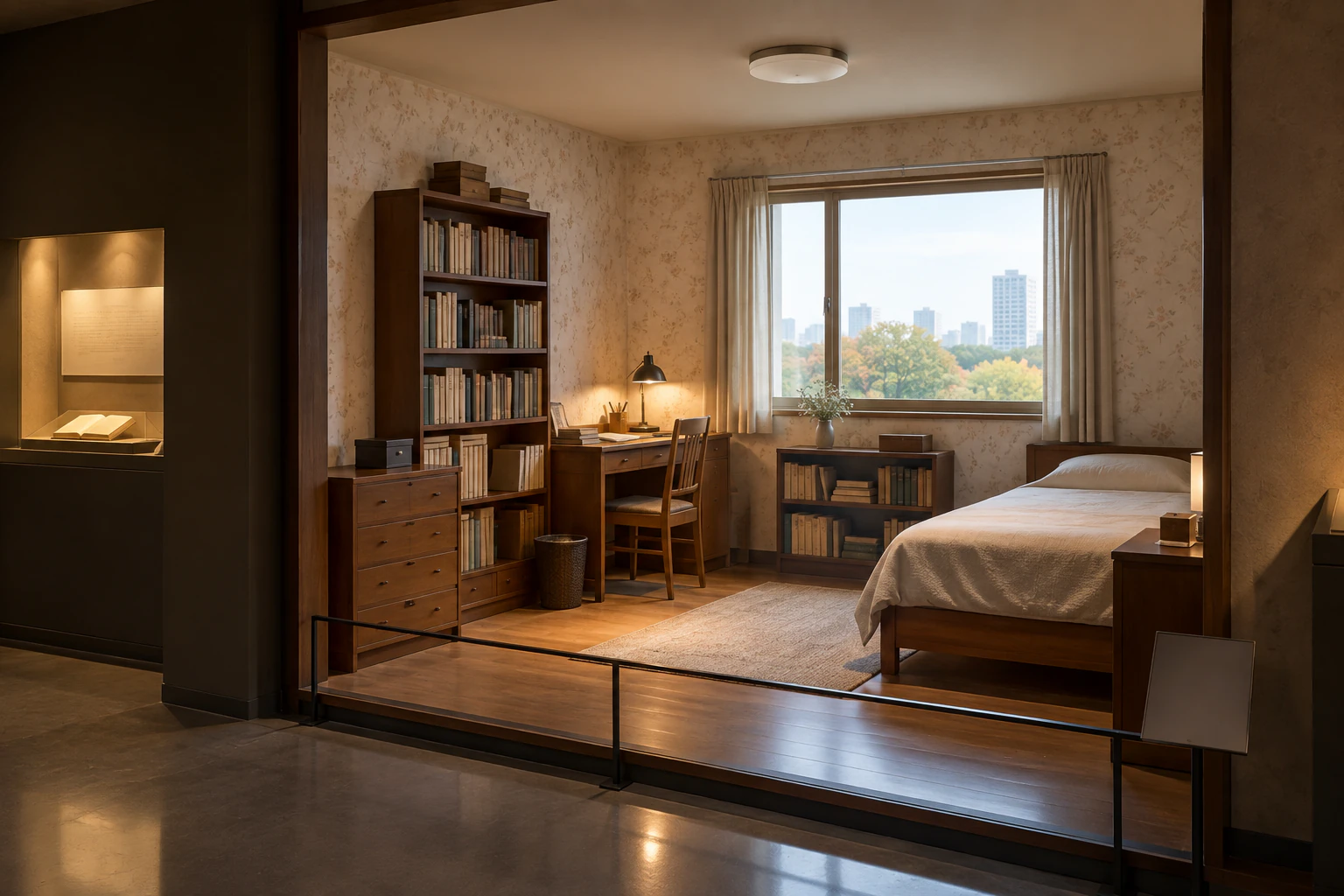
The Pi Chun-deuk Memorial Hall, on the third floor of the mall by the museum entrance, is an exhibition space about the life of the essayist Pi Chun-deuk, pen name Geuma (1910–2007). It is open every day from 11 a.m. to 7 p.m. and is free, with no separate ticket. Of its five sections, “Geuma’s Study” recreates the room in his Banpo-dong apartment, with the small bed, bookcase and desk he used. A gaze that had taken in all of Joseon had narrowed to one palace, and now to one person’s room.
Maya put this room in her “rebuilt” column, not “made small”. She liked that the columns split even inside one museum. Unlike the village, which had been shrunk, this room felt like the place one person had lived, brought here at its real size. She looked once more towards the bookcase, kept only the size of the room in her memory, and stepped out.
Besides the study, the Pi Chun-deuk Memorial Hall has four more sections. “Meeting Geuma” sets out his life in a timeline, and “Geuma’s Story” shows related objects and his best-known books. “Remembering Geuma” has a small screening room and a photo spot, and “Geuma’s Connections” tells of his family and the people close to him. Coming after the museum, it was a short stop, but being free, it is an easy last room to add.
As she came down in the lift and walked back through the underground passage, the five steps she had written down on the way in went by in the opposite order. Near Exit 4 she went up to street level for a breath of outside air and found evening light spreading over the wide road. She had spent little more than an hour in the museum, but for Maya it was an afternoon that gave her one more way of looking at Seoul.

Maya opened her notebook to the three columns again: “rebuilt”, “moved”, and today’s new “made small”. Today’s column had the most names in it, but the one she underlined was the Gyeongbokgung model. It was the place where she first saw a palace she had walked through, all at once.
If you are going to the Lotte World Folk Museum for the first time, try going underground from Jamsil Station Exit 4 and following the five steps up to the third floor in the lift. From prehistory to Goryeo, pick just one thing in each era and look at it slowly, and leave plenty of time for the Joseon Miniature Village. And if you have walked Gyeongbokgung already, don’t forget to look for that day’s route on the model. If you are already here with a theme-park ticket, it is an easy stop on the way, and even on its own the museum takes little more than an hour.
(※ This article includes staged images created with AI.)
Common Mistakes
- Going up to the street from Exit 4 — The museum is on the third floor of the shopping mall. Follow the underground passage from Exit 4 and take the Folk Museum lift up to the third floor.
- Arriving at 18:50 because it’s open until 19:00 — The museum closes at 19:00, but ticket sales and entry end at 18:30. For an hour inside, go in well before that.
- Using the theme park’s age bands for the museum — The museum’s own prices count children as 36 months to 13, youths as 14 to 19 and adults as 20 and over.
- Going in just before last entry and trying to see everything — A visit takes about an hour. Arriving at 18:30 leaves little time for the Joseon Miniature Village.
FAQ
Which exit at Jamsil Station?
Exit 4 on Lines 2 and 8. Don’t go up to the street: follow the underground passage, take the Folk Museum lift and get off at the third floor for the entrance.
Until what time can I go in?
The museum is open every day from 11:00 to 19:00, with ticket sales and entry ending at 18:30. Weekdays, weekends and public holidays are the same.
How much is the museum on its own?
5,000 won for adults, 3,000 won for youths and 2,000 won for children. Children under 36 months go free, and groups of 15 or more pay a reduced rate.
Is the Folk Museum included in the Lotte World Comprehensive Ticket?
Yes, the Lotte World Adventure Comprehensive Ticket includes entry to the Folk Museum. The Comprehensive Ticket page gives the museum’s last entry as 18:00, while the museum’s visitor information gives 18:30, so the two pages differ by 30 minutes.
How long does a visit take?
About an hour from prehistory to the Joseon Miniature Village. Allow a little more if you want to linger in the village.
Can I take photos?
Yes, in the galleries. Tripods and flash aren’t allowed, and please don’t touch the exhibits or run.
Do I need a ticket for the Pi Chun-deuk Memorial Hall?
No, the memorial hall by the museum entrance is free. It is open every day from 11 a.m. to 7 p.m.
Recap — 30 seconds before you go
- Go **Jamsil Station Exit 4 → underground passage → Folk Museum lift to the third floor**
- Open **11:00–19:00**, ticket sales and entry **end at 18:30** — go in early if you want an hour
- Prices **5,000 won adults · 3,000 won youths · 2,000 won children**, using the museum’s own age bands
- Pick **just one thing** in prehistory, the Three Kingdoms and Goryeo, and save time for **Gyeongbokgung in the Joseon Miniature Village**
- Photos are fine, but **no tripod or flash** — and the **Pi Chun-deuk Memorial Hall** by the entrance is **free**
Sources
- Lotte World Folk Museum — Visitor information — Hours 11:00–19:00 · last ticket and entry 18:30 · prices · age bands · gallery etiquette · items not allowed checked 2026-10-19
- Lotte World Folk Museum — Directions — Jamsil Station Exit 4 (Lines 2 and 8) · five-step walk · bus routes checked 2026-10-19
- Lotte World Folk Museum — Permanent exhibition — Prehistory, Three Kingdoms, Goryeo, Joseon Miniature Village, Play Yard, Pi Chun-deuk Memorial Hall checked 2026-10-19
- Lotte World Folk Museum — About the museum — Jeoja-geori · model village of 2,000+ one-eighth-scale figures checked 2026-10-19
- Lotte World Folk Museum — FAQ — Third floor of the shopping mall · about an hour to see · no guided tours at present checked 2026-10-19
- Lotte World Adventure — Ticket prices — Comprehensive Ticket includes the Folk Museum · museum last entry shown as 18:00 checked 2026-10-19