SEOUL · LOTTE WORLD
Lotte World Folk Museum: An Afternoon Looking Down on a Palace Made Small
Maya goes underground from Jamsil Station Exit 4, takes a lift to the third floor, follows the numbers on the floor plan from prehistory to the Joseon miniature village, and looks down on a small palace with Geunjeongjeon inside it
A new piece for “Gangnam & Songpa”. Lotte World Folk Museum is on the third floor of the Lotte World shopping mall in Jamsil. It divides Korean history from the Palaeolithic to the Joseon era into periods and shows it through real artefacts and reconstructed models, and its miniature village uses some 2,000 figures at one-eighth scale to portray the seasons, seasonal customs, rites of passage and the lives of the royal court and ordinary people in Joseon. Maya has stood in the courtyard of Geunjeongjeon. This time she looks down on a palace made small.

How to get there
The Folk Museum website points to Exit 4 of Jamsil Station (Lines 2 and 8) and describes, in five steps, a route from the station through the underground level and up by lift to the museum entrance on the third floor. A map app’s walking route is calculated to a point at street level, so it is a different route from the underground-and-lift way the museum describes.
This is a new piece for “Gangnam & Songpa”. In this issue’s Lotte World Adventure piece, Lulu planned a day with a friend, split between the glass roof and the island on the lake. Among the ticket details in that piece was one line for a pass that bundles the Adventure with the Folk Museum. Today we follow that line. No rides this time, only models: Lotte World Folk Museum.
Maya is someone who picks her Seoul on a screen first. In the Gwanghwamun series she stood among the rank stones in the courtyard of Geunjeongjeon, and in the front yard of the National Folk Museum she sorted the signs into two columns, “rebuilt” and “moved”. On screen the palace was always close up; on foot it turned out wider than she had expected. What she has never had is the whole palace at a single glance.
Two o’clock on a weekday afternoon. Next to the two columns in her notebook, Maya rules a third: “Made small.”
From Jamsil Station Exit 4, up by lift to the third floor
Lotte World Folk Museum website, directions (subway): Exit 4 of Jamsil Station on Line 2 and Exit 4 of Jamsil Station on Line 8. “Walking from Jamsil Station”: taking the lift up to the third floor connects directly to the museum entrance. (1) From Exit 4 go straight on underground towards the supermarket; (2) keep going straight towards the Folk Museum and the supermarket; (3) turn left towards the main entrance; (4) go round to the back; (5) take the lift that goes to the Folk Museum and get out on the third floor to arrive at Jeoja-geori (the Folk Museum).
The directions page on the Folk Museum website points to Exit 4 of Jamsil Station for both Line 2 and Line 8, and sets out the walk from the station in five steps. From Exit 4, head straight on underground towards the supermarket; keep going straight, turn towards the main entrance, go round to the back, take the lift that goes to the Folk Museum, and get out on the third floor at Jeoja-geori (the Folk Museum). The FAQ answers that the museum is on the third floor of the Lotte World shopping mall in Jamsil. Find on a map

A map app measures a route to a point at street level; the route on the website runs underground and up a lift. What Maya copies into her notebook is just the five verbs: straight on, keep going, turn, go round, go up.
Step out on the third floor and the first thing is Jeoja-geori. The website introduces it as a re-creation of a Joseon-era market street, where restaurants that keep traditional flavours alive offer a range of Korean traditional food. Maya has already had lunch, so today she only passes through. She takes one look back along the street that is said to recreate a market, then heads for the museum entrance.

The numbers on the floor plan, from 1 (Prehistory) to 7 (the Joseon Miniature Village)
Floor plan on the Lotte World Folk Museum visitor information page: a “museum entrance” marker and numbered pins 1 Prehistory, 2 Goguryeo, 3 Baekje, 4 Gaya, 5 Silla, 6 Goryeo, 7 Joseon Miniature Village; the Nori Madang and the Pi Chun-deuk Memorial Hall by name only, without numbers (plus an “exhibition hall” label). FAQ: a tour of the galleries takes about an hour; they consist of artefacts and models on themes from prehistory to the Joseon era, with a number of traditional hands-on spaces set up partway through. FAQ: the museum does not currently run guided exhibition tours.
The floor plan on the visitor information page marks the museum entrance and gives each gallery a number: 1 Prehistory, 2 Goguryeo, 3 Baekje, 4 Gaya, 5 Silla, 6 Goryeo, 7 the Joseon Miniature Village. The Nori Madang and the Pi Chun-deuk Memorial Hall appear by name only, without numbers. The FAQ says a tour of the galleries takes about an hour, with a number of traditional hands-on spaces set up partway through. Find on a map

A screen always showed her the most dramatic scene first. Today she makes her own order, starting with the smallest number on the floor plan. In her notebook she writes the numbers 1 to 7 down the page.
According to the permanent exhibition pages, the Prehistory gallery displays artefacts from the Palaeolithic, Neolithic and Bronze Ages and recreates everyday life in each period with models. The Three Kingdoms gallery shows the cultures of Goguryeo, Baekje and Silla, and of Gaya, through artefacts and models. The Goryeo section lists models recreating how the Tripitaka Koreana woodblocks and Goryeo celadon were made.
Maya bends a little in front of a display case. The museum introduces itself as showing real artefacts and reconstructed models together. So whether the thing in front of her is old or remade can’t be settled by looking alone. Maya reads the label first, then picks the column. It is a habit she picked up at the National Folk Museum.

A Joseon world made small: looking down on the palace
Lotte World Folk Museum introduction: “the miniature village uses some 2,000 figures reduced to one-eighth scale to portray realistically the four seasons, seasonal customs, rites of passage, and the lives of the royal court and ordinary people in the Joseon era.” Permanent exhibition, “Joseon Miniature Village”: a reduced-scale re-creation of daily life in Joseon, themed on scenes from a king’s enthronement to rites of passage, seasonal customs, folk beliefs and daily life. Gyeongbokgung — a model recreating the palace in reduced form true to the real thing, from Gwanghwamun, the main gate, to Geunjeongjeon, Sajeongjeon, Gyotaejeon and more. Also: the science of Joseon (armillary sphere, water clock, sundial, rain gauge and more), seasonal customs (Dano, rice planting, weaving, harvest), rites of passage (first-birthday feast, coming-of-age, wedding, sixtieth birthday, funeral procession, Seokjeonje rite), and others (a market scene, a Dragon King rite, a village schoolroom, a shaman’s house).
Number 7, the Joseon Miniature Village. The museum’s introduction says the village uses some 2,000 figures reduced to one-eighth scale to portray the four seasons, seasonal customs, rites of passage, and the lives of the royal court and ordinary people in the Joseon era. The permanent exhibition page describes it as a space themed on scenes from a king’s enthronement to rites of passage, seasonal customs, folk beliefs and daily life. Find on a map

One of the things this room’s description singles out is Gyeongbokgung. It is listed as a model that recreates, in reduced form and true to the real thing, the palace from Gwanghwamun, the main gate, to Geunjeongjeon, Sajeongjeon, Gyotaejeon and more. In the Gwanghwamun series Maya stood in the courtyard of Geunjeongjeon. Back then she had to tip her head right back to see the roof. Today she bows it.
A screen showed one spot at a time. If the website’s description is right, this model holds everything from the main gate to the inner halls. Maya stays still in front of it for a while. With a fingertip she traces once more the order in which she went through the gates and into the courtyard that day at the real palace, without touching anything, a little way off, in the air.

The miniature village description also lists the science of Joseon; seasonal customs such as Dano, rice planting, weaving and the harvest; rites of passage from a first-birthday feast to a sixtieth birthday and a funeral procession; a market scene; and a village schoolroom. Maya starts copying the names one by one into the “made small” column, then stops. The column isn’t big enough. Instead she writes a single line: “A palace has to shrink before you can take it in at a glance.”
A small study by the entrance
Lotte World Folk Museum permanent exhibition, “Pi Chun-deuk Memorial Hall”: an exhibition space on the life of Pi Chun-deuk, pen name Geuma (1910–2007). Hours 11 a.m. to 7 p.m. (open every day of the year); location: the entrance to Lotte World Folk Museum (third floor of the shopping mall); admission free. Sections: Meeting Geuma · Geuma’s Story · Geuma’s Study (recreating, just as it was, the Banpo-dong apartment where he lived, with the small bed, bookcase, desk and a favourite doll he cherished) · Remembering Geuma · Geuma’s Connections.
On her way back out towards the entrance, Maya goes into a room she had only noticed by name on the way in. According to the website, the Pi Chun-deuk Memorial Hall is an exhibition space at the entrance to Lotte World Folk Museum (third floor of the shopping mall) covering the life of the writer Pi Chun-deuk, pen name Geuma (1910–2007). Its hours are listed as 11 a.m. to 7 p.m., open every day of the year, and the visitor information says admission is free. Find on a map
Of the five parts listed in the description, the one where Maya lingers is “Geuma’s Study”. It is said to recreate the Banpo-dong apartment where he lived, just as it was, with the small bed, bookcase and desk he used. Unlike the tiny houses she looked down on in the miniature village, this is a room someone actually lived in, made again.
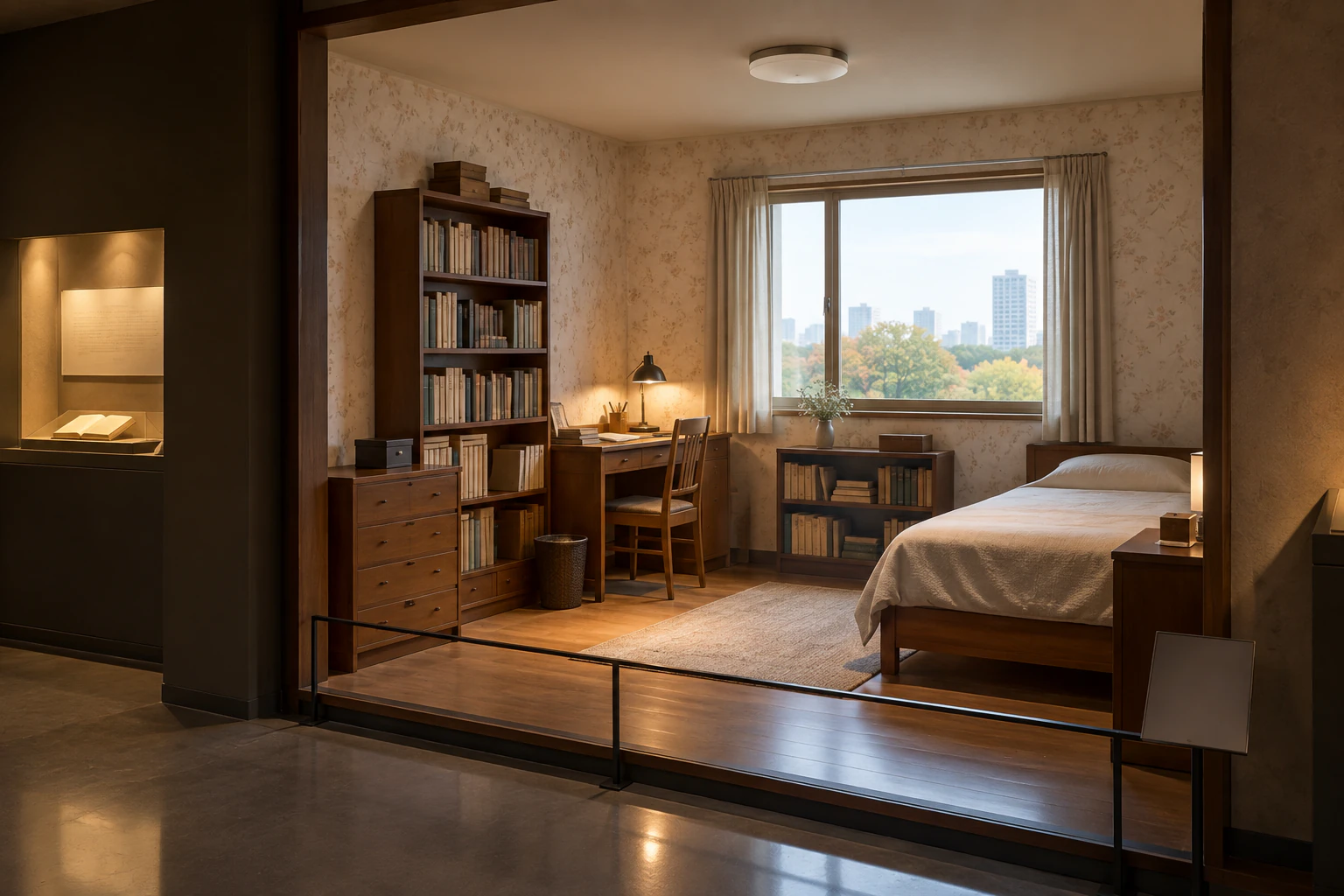
Maya puts this room in the “rebuilt” column rather than “made small”. Even inside one museum, the columns split. Before she closes the notebook she looks once more towards the bookcase. She doesn’t read the spines. She only keeps in mind how big the room is.
Two different last-entry times, and photos without flash
Lotte World Folk Museum visitor information: opening hours on weekdays 11:00–19:00 (entry and ticket sales close at 18:30) and on weekends/public holidays 11:00–19:00 (entry and ticket sales close at 18:30). Notice (23 September 2026), “Change to weekend and public-holiday opening hours in October and November”: previously 11:00–20:00 (last entry 19:00), changed to 11:00–19:00 (last entry 18:30).
The visitor information page gives opening hours of 11:00 to 19:00 on weekdays and on weekends and public holidays alike, with entry and ticket sales ending at 18:30. Find on a map
The same page’s visitor etiquette lists “photography allowed” alongside no tripods, no flash, no food or drink, do not touch, do not run, and keep quiet. For Maya, who picks Seoul on a screen, a line saying photos are fine is welcome. Today she took just one picture, of the palace in the miniature village. The flash was off from the start.
There is one more thing Maya checks before leaving. The Comprehensive Ticket on the Lotte World Adventure ticket page also includes the Folk Museum, and that page gives last entry to the museum as 18:00. That is 30 minutes earlier than the 18:30 on the visitor information page. Maya goes by the earlier one and aims to reach the museum entrance before 18:00.
Down in the lift and outside, the evening light has spread across a wide street. Maya looks again at the three columns in her notebook: “rebuilt” and “moved” from the National Folk Museum, and today’s “made small”. Today’s column holds several names, but the only one Maya has underlined is the Gyeongbokgung model. It was the first time she had taken in, at a single glance, a palace she had walked through.
Maya’s quiet recommendations are two. From Jamsil Station Exit 4, follow the website’s five steps underground and take the lift to the third floor. And if you have walked Gyeongbokgung first, come and see this small palace afterwards. If you’d rather spend a day on the rides side of Lotte World, this issue’s piece with Lulu splits the day between the glass roof and the island on the lake.

(※ This article includes staged images created with AI.)
Try it on your own afternoon
An editorial suggestion: from Jamsil Station Exit 4, follow the underground route given on the website and take the lift up to Jeoja-geori on the third floor, see the galleries in the order of the floor-plan numbers from Prehistory to the Joseon Miniature Village, and stop at the Pi Chun-deuk Memorial Hall by the entrance on your way out.
A diagram of the order only · not to scale, orientation or the actual shape of the streets.
- Underground from Jamsil Station Exit 4 — The website’s directions take you in five steps from Exit 4 of Jamsil Station (Lines 2 and 8) underground towards the supermarket, then up by the lift that goes to the Folk Museum to the third floor. Find on a map
- Jeoja-geori and the museum entrance, third floor — The website introduces Jeoja-geori as a re-creation of a Joseon-era market street. Find on a map
- From 1 (Prehistory) to 7 (the Joseon Miniature Village) — The floor plan on the visitor information page numbers the galleries. The FAQ says a tour takes about an hour. Find on a map
- The Pi Chun-deuk Memorial Hall by the entrance — According to the website, admission is free and it is open 11 a.m. to 7 p.m., every day of the year. Find on a map
Getting there
Checked 2026.10.02
Lotte World Folk Museum website, directions (subway): Exit 4 of Jamsil Station on Line 2 and Exit 4 of Jamsil Station on Line 8. “Walking from Jamsil Station”: taking the lift up to the third floor connects directly to the museum entrance. (1) From Exit 4 go straight on underground towards the supermarket; (2) keep going straight towards the Folk Museum and the supermarket; (3) turn left towards the main entrance; (4) go round to the back; (5) take the lift that goes to the Folk Museum and get out on the third floor to arrive at Jeoja-geori (the Folk Museum).
Checked 2026.09.30
Lotte World Adventure website, directions (subway): Jamsil Station Exit 4 on Line 2 and Exit 4 on Line 8.
Hours & fees
Checked 2026.10.02
Lotte World Folk Museum visitor information: opening hours on weekdays 11:00–19:00 (entry and ticket sales close at 18:30) and on weekends/public holidays 11:00–19:00 (entry and ticket sales close at 18:30). Notice (23 September 2026), “Change to weekend and public-holiday opening hours in October and November”: previously 11:00–20:00 (last entry 19:00), changed to 11:00–19:00 (last entry 18:30).
Checked 2026.10.02
Admission on the Lotte World Folk Museum visitor information page: adults 5,000 won individual (3,500 won for groups of 15 or more), youth 3,000 won, children 2,000 won (individual), free under 36 months (except in groups). Lotte World Adventure ticket page, “Comprehensive Ticket”: “Enjoy Lotte World Adventure and the Folk Museum in one go!” — Lotte World Adventure admission and rides (excluding paid facilities such as games) plus Folk Museum admission (last entry 18:00).
Good to know
Checked 2026.10.02
Lotte World Folk Museum visitor information, “Museum etiquette and precautions”: photography allowed · no tripods · no food or drink · please don’t run · no flash photography · please don’t touch · quiet viewing · no smoking in the galleries. Notes: photography is allowed in the galleries; food is not allowed in, for a pleasant viewing environment; items not allowed in include bicycles, kick scooters, inline skates, electric unicycles, wheeled shoes and children’s ride-on cars; bicycles, kick scooters and similar cannot be stored.
Background6
Checked 2026.10.02
Lotte World Folk Museum FAQ, “How do I get to the museum?”: it is on the third floor of the Lotte World shopping mall in Jamsil; take the lift in the plaza at the Lotte World main entrance up to the third floor.
Checked 2026.10.02
Floor plan on the Lotte World Folk Museum visitor information page: a “museum entrance” marker and numbered pins 1 Prehistory, 2 Goguryeo, 3 Baekje, 4 Gaya, 5 Silla, 6 Goryeo, 7 Joseon Miniature Village; the Nori Madang and the Pi Chun-deuk Memorial Hall by name only, without numbers (plus an “exhibition hall” label). FAQ: a tour of the galleries takes about an hour; they consist of artefacts and models on themes from prehistory to the Joseon era, with a number of traditional hands-on spaces set up partway through. FAQ: the museum does not currently run guided exhibition tours.
Checked 2026.10.02
Lotte World Folk Museum permanent exhibition: Prehistory gallery — artefacts of the Palaeolithic, Neolithic and Bronze Ages, with everyday life in each period recreated in models. Three Kingdoms gallery — the cultures of the three ancient kingdoms (Goguryeo, Baekje, Silla) and Gaya through artefacts and models. Goryeo — the making of the Tripitaka Koreana (models recreating the woodblock-making process and the Janggyeong Panjeon at Haeinsa), the making of Goryeo celadon (a celadon-making model and celadon on display), and more. Nori Madang — Joseon-era musical instruments and weapons on display, and a space where traditional wedding events are held.
Lotte World Folk Museum introductionChecked 2026.10.02
“the miniature village uses some 2,000 figures reduced to one-eighth scale to portray realistically the four seasons, seasonal customs, rites of passage, and the lives of the royal court and ordinary people in the Joseon era.” Permanent exhibition, “Joseon Miniature Village”: a reduced-scale re-creation of daily life in Joseon, themed on scenes from a king’s enthronement to rites of passage, seasonal customs, folk beliefs and daily life. Gyeongbokgung — a model recreating the palace in reduced form true to the real thing, from Gwanghwamun, the main gate, to Geunjeongjeon, Sajeongjeon, Gyotaejeon and more. Also: the science of Joseon (armillary sphere, water clock, sundial, rain gauge and more), seasonal customs (Dano, rice planting, weaving, harvest), rites of passage (first-birthday feast, coming-of-age, wedding, sixtieth birthday, funeral procession, Seokjeonje rite), and others (a market scene, a Dragon King rite, a village schoolroom, a shaman’s house).
Checked 2026.10.02
Lotte World Folk Museum permanent exhibition, “Pi Chun-deuk Memorial Hall”: an exhibition space on the life of Pi Chun-deuk, pen name Geuma (1910–2007). Hours 11 a.m. to 7 p.m. (open every day of the year); location: the entrance to Lotte World Folk Museum (third floor of the shopping mall); admission free. Sections: Meeting Geuma · Geuma’s Story · Geuma’s Study (recreating, just as it was, the Banpo-dong apartment where he lived, with the small bed, bookcase, desk and a favourite doll he cherished) · Remembering Geuma · Geuma’s Connections.
Lotte World Folk Museum introductionChecked 2026.10.02
“Jeoja-geori, recreating the scenery of a Joseon-era market” — through partnerships with restaurants that keep traditional Korean flavours alive, it offers a range of Korean traditional food. The directions page says that getting out of the lift on the third floor brings you to “Jeoja-geori (the Folk Museum)”.
- The visitor information page gives opening hours of 11:00–19:00 on weekdays and on weekends/public holidays, with entry and ticket sales ending at 18:30 (checked 2 October 2026). A notice dated 23 September 2026 announced that weekend and public-holiday hours in October and November change from 11:00–20:00 (last entry 19:00) to 11:00–19:00 (last entry 18:30).
- The museum has its own admission fee on the visitor information page (adults, individual: 5,000 won, checked 2 October 2026). The Comprehensive Ticket on the Lotte World Adventure ticket page also includes the Folk Museum, and that page gives last entry to the museum as 18:00.
- According to the visitor information page, photography is allowed in the galleries, but tripods, flash photography and bringing in food are not. Bicycles, kick scooters and similar items cannot be brought in and cannot be left in storage. The FAQ says the museum does not currently run guided exhibition tours.