SEOUL · JONGNO 3-GA
Jongno 3-ga’s Galmaegi Alley: An Evening at the Barbecue Tables Just Outside Exit 6
With an evening to herself on a Seoul work trip, Mali discovers that galmaegisal has nothing to do with seagulls, then finds a seat in the single row of tables outside the restaurants
The dictionary gives Mali a seabird. Just outside Exit 6, an alley of outdoor barbecue tables gives her something else to think about — and a new colour for the top of her notes.
How to get there
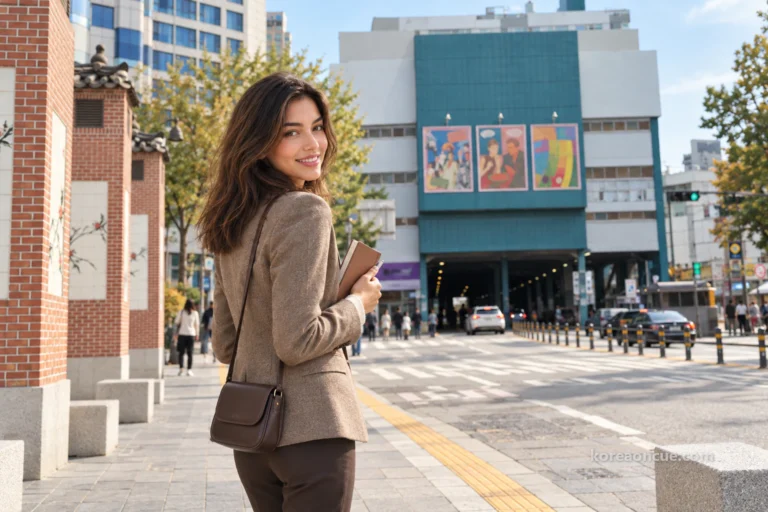
Mali works for a beauty magazine in Bangkok, and trips to Seoul come round about twice a month. She comes for meetings with Korean cosmetics companies, then puts one colour from the day at the top of her notes. This afternoon, it is the deep brick red on a table of new autumn products. When she leaves the meeting, the sun is beginning to drop and she has the whole evening to herself.

She decides where to spend it on the underground. A few days earlier, news that British travel publication Time Out had named Jongno 3-ga the world’s coolest neighbourhood this year appeared in her feed, but a line about casual barbecue restaurants opening in the lanes around Exit 6 caught her eye more than the ranking. Travellers exploring Seoul independently are finding local haunts through Instagram and TikTok, and roadside barbecue tables have become a popular way to experience a Korean after-work meal. Mali has seen the scene on her screen many times, though she has never sat at one of those tables.
Time Out’s reasons for choosing the neighbourhood follow much the same thread. Its clusters of hanok, traditional Korean houses, were developed in the 1920s as affordable homes, with modest shops and restaurants growing up around them and keeping the area’s unpretentious character. Younger generations now come for inexpensive food and relaxed outdoor evenings, while office workers gather in the lanes after work. Reading about it, Mali begins to see the smoking tables on her screen as part of an old neighbourhood’s evening, rather than a trend that appeared overnight.
On the train, she sends Rina a short message. They first met at Dongdaemun’s fabric market, exchanged Instagram accounts and have since left the occasional comment on each other’s photos. “I’m going to Jongno 3-ga this evening. On my own.” Before the train has passed two stops, Rina replies, “Lovely! Make sure to send photos.” It is only a short message, but someone waiting to hear how it goes makes the prospect of walking through an unfamiliar neighbourhood alone feel easier.
This is the story of that weekday evening, and a guide to a first visit to Galmaegi Alley, the barbecue lane immediately outside Exit 6 of Jongno 3-ga Station. Following Mali, we’ll look at what galmaegisal — pork diaphragm meat — actually is, when outdoor trading begins, why the tables stand in a single row and what to do before sitting down alone. There is also the question of when the alley gets busy. These are outdoor tables belonging to barbecue restaurants, a different evening from the tented food stalls in the same neighbourhood.
The Cue — At a glance
Galmaegi Alley is a lane of barbecue restaurants immediately outside Exit 6 of Jongno 3-ga Station. The name comes from galmaegisal, meat from a pig’s diaphragm, rather than galmaegi, the Korean word for a seagull. Jongno-gu has designated it a shared street, with outdoor trading hours from 6 p.m. to 4 a.m. the following morning and permanent shops limited to a single row of tables directly outside. Outdoor tables have been full around 8 p.m. even on a weekday, so arrive earlier and walk through the alley before sitting down if you want more choice.
- When: outdoor trading runs from 6 p.m. to 4 a.m. the following morning. Outdoor tables have been full even at 8 p.m. on a weekday.
- Which exit: the alley is immediately outside Exit 6 of Jongno 3-ga Station on Lines 1, 3 and 5.
- Galmaegisal: meat from a pig’s diaphragm. It has nothing to do with seagulls.
- Coming alone: ask before sitting down, making clear that there is one person.
- Seating: outdoor tables stand in one row directly outside each restaurant. Keep chairs out of the passage.
Just after six, outside Exit 6
Mali comes up through Exit 6 of Jongno 3-ga Station a little after six. The main road is busy with people heading home from work, and the smell of grilling meat reaches her as soon as she leaves the exit. A few steps ahead, red portable tables line the restaurant fronts, with thin trails of smoke rising above them. There is no need to open a map — this evening’s destination is right in front of her.

It helps to think of Jongno 3-ga’s outdoor evening seating in two broad groups. One is the tented street stall, commonly called a pojangmacha or pocha, while the other is a restaurant putting tables outside its own premises. Galmaegi Alley belongs to the second group. Where a pocha table might hold jeon, savoury pancakes, or tteokbokki, spicy rice cakes, these tables begin with a grill and tongs, with smoke rising into the lane.
Rather than sitting down straight away, Mali walks to the far end. On an unfamiliar street, she has a habit of making the outward walk just for looking, leaving any decisions until the way back. She opens her phone notes and creates her usual two sections, “To find out” and “Things I’ve seen”. Under the first she writes “Galmaegisal — what meat?”, and under the second, “Red chairs, red tables, smoke above them”.
The restaurant fronts are not all alike. Some retain old signs and worn doorframes, with the feel of places that have been here a long time, while others occupy converted hanok beneath tiled roofs. Outside both kinds, tables stand along the roadside and overseas travellers laugh as they decide where to sit. Mali thinks each restaurant seems to belong to a slightly different time, taking in the fronts without peering through the doors.
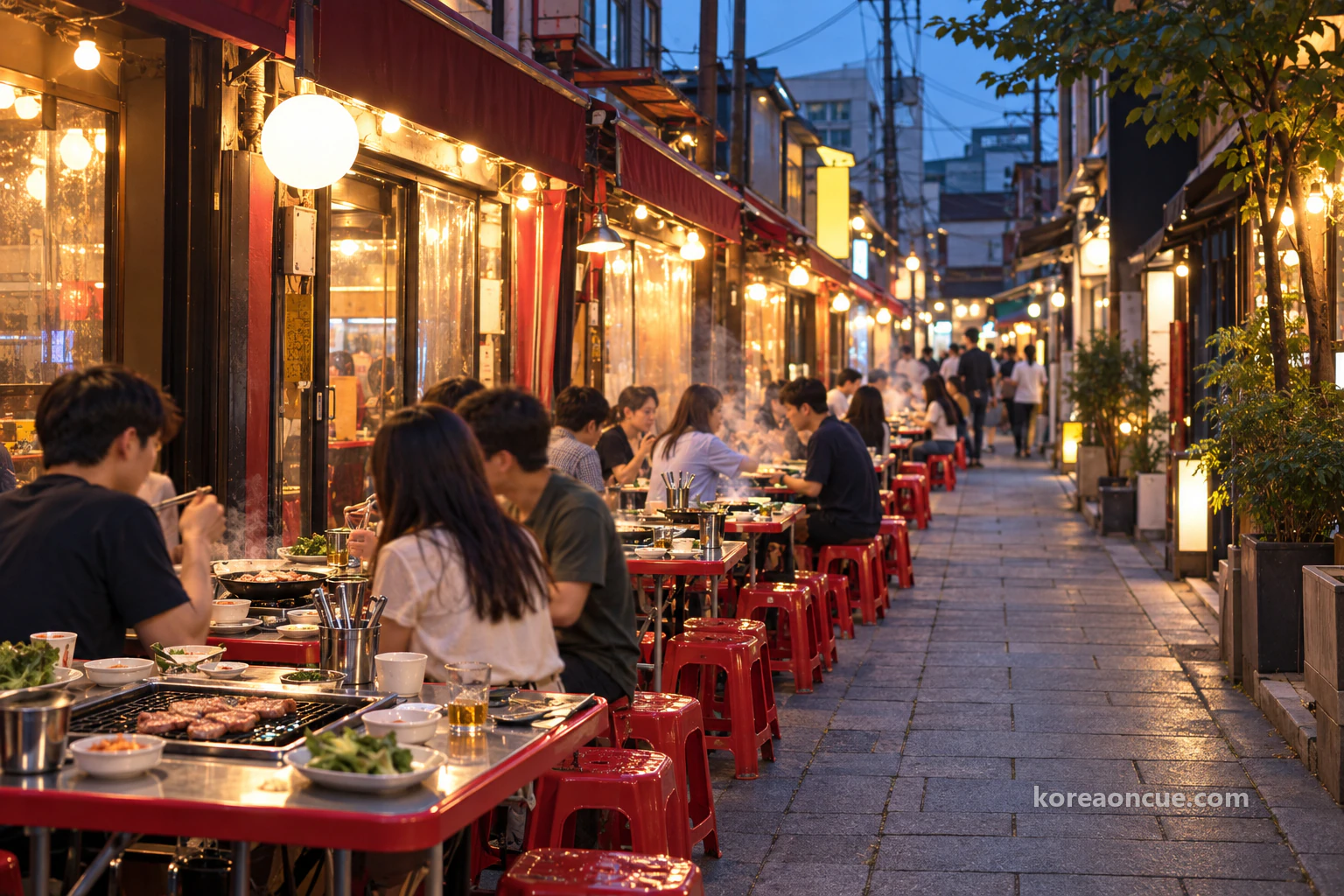
As she walks, her eye keeps returning to the colours. Most of the chairs and portable tables are red, forming a trail of red dots along the alley walls. At magazine shoots, Mali always notices how colours change under the lights, and she wonders how much deeper this red will look once the sun has gone and the restaurant lights are on. At the end of the alley, she adds a line under “Things I’ve seen”: “Lots of red. Will look deeper under the lights.”
No seagulls involved
Walking back, Mali decides to settle the first question in her notes. She types “galmaegi” into her phone dictionary and gets the white bird that flies over the sea. Looking at the screen, she laughs out loud. She knew the lanes around Exit 6 were full of barbecue restaurants, but surely nobody means barbecued seabirds. This time, she searches for the whole word, “galmaegisal”.
Mali is not the first person to make that connection. When galmaegisal first appeared in barbecue restaurants, people wondered why places serving pork and beef had started selling bird meat. It is actually meat from a pig’s diaphragm, called garomak in Korean. The diaphragm is a muscular sheet between the abdomen and chest that contracts and relaxes with each breath, helping the lungs work.
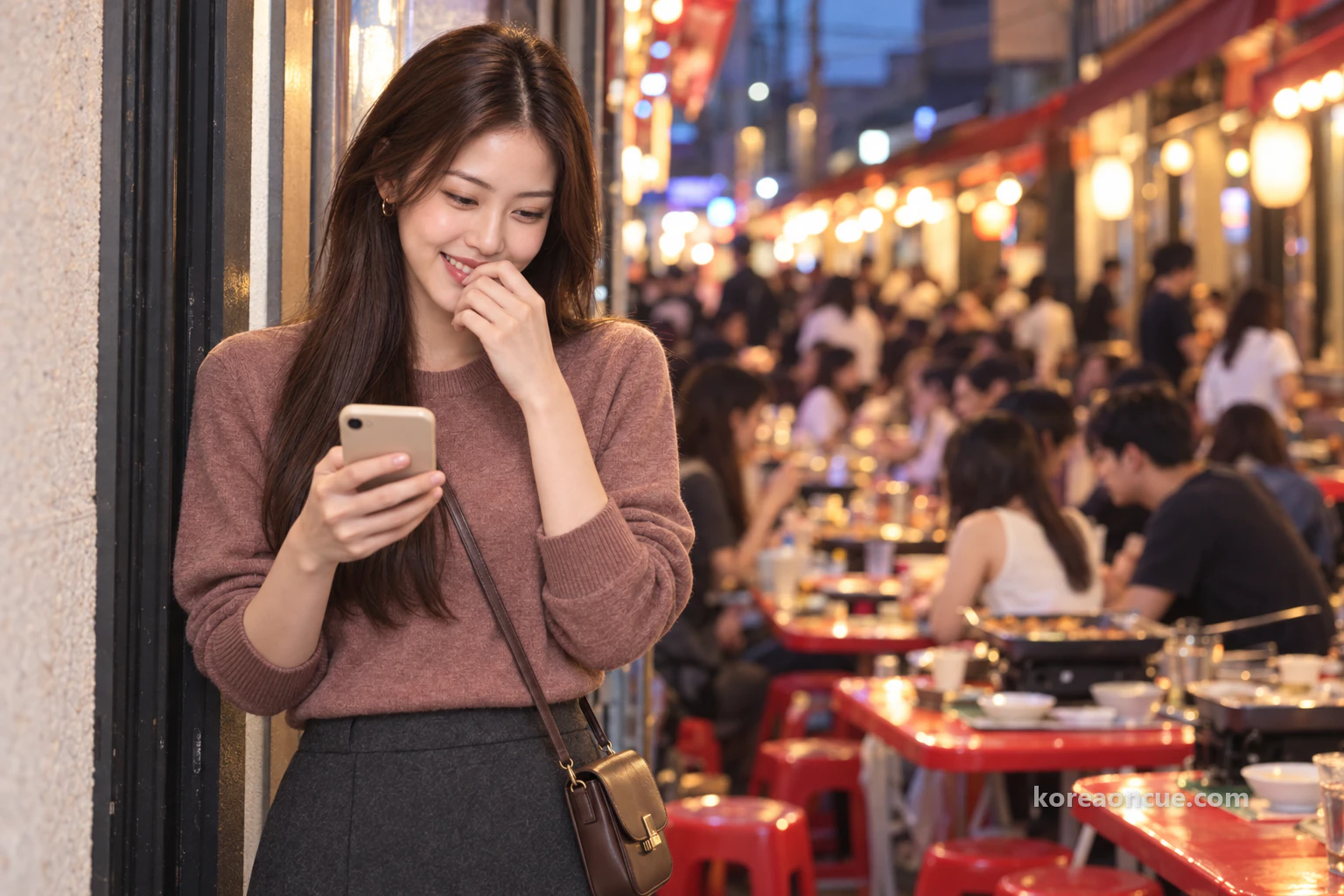
The meat attached to it is muscular and covered in a thin membrane, and was once considered a tough, less sought-after cut. Once people began removing the membrane before selling it, its mild flavour helped restaurants serving the cut on its own gain a following. One explanation of the name traces a change from “garomaksal” through “garomagisal” and “garomaegisal” to the similar-sounding “galmaegisal”. Nothing to do with the sea — the word simply ended up sounding like “seagull”.
As the trimmed meat became popular, restaurants specialising in it gathered together in some places, forming whole food alleys. Seongnam in Gyeonggi-do and Mapo in Seoul were among them, with the cut giving the streets their names. Mali likes that a meat name can become an alley name and adds “Alley name = meat name” to her notes. It is the sort of connection someone who sees cosmetics colours become product names every day would notice.
If searching for “galmaegi” brings up a seabird, as it does for Mali, try the full word instead. The cut comes from a pig’s diaphragm, so “pork diaphragm” makes a more useful English search. Beside “Galmaegisal — what meat?”, Mali writes “Pork, diaphragm”. Then she sends Rina a screenshot of the dictionary entry: “Here for seagull. Not the bird.”
One row outside each restaurant
On her second walk through the alley, Mali notices a curious order to the tables. Each restaurant has just one row outside, with no tables extending further into the passage. That leaves a route down the middle for people walking through and staff carrying grills and plates. At first she thinks it might be chance, but the arrangement holds all the way along, suggesting a boundary everyone is following.
There is one. Jongno-gu designated Galmaegi Alley a shared street in October 2025, limiting permanent shops to a single row of outdoor tables directly in front. As visitor numbers grew, items left in the street and outdoor trading beyond permitted areas narrowed the walking space, prompting repeated complaints. The row of tables and the passage beside it are an agreed arrangement that keeps the evening trade going while leaving room to walk.

In some places, that boundary is marked on the ground. On Donhwamun-ro 11-gil near Exit 6, yellow markings show permitted street-use areas, including spaces for single-row trading, and the traders’ safety team and district safety staff check them late into the night. Mali remembers the yellow line she stepped over near the exit without a thought, only now understanding that it marks a limit for the tables. Under “Things I’ve seen”, she writes “Yellow line = tables stay behind it”.
Customers can help keep that row in place too. Pulling a chair into the passage for more room, or standing beside a table while waiting for friends, takes up the space the restaurants are keeping clear. The middle of the alley is for people passing through and staff carrying grills and plates. Pull your chair towards the table, keep your bag on your lap or beneath the chair and wait out of the way at the end of the alley or beside a restaurant.
That thought changes how Mali chooses a seat. During her walk, she noticed a small table against the wall at the very end of a row. There, she thinks, she could sit alone without pulling a chair into the passage or getting in the way of anyone carrying plates. She had started by looking for somewhere inconspicuous, but now she is looking for somewhere that leaves the alley room to work.
Asking for a table for one
When it is time to choose, Mali hesitates. Everyone already seated seems to be in a pair or a group of four. Eating alone in Bangkok would not trouble her, but here she wonders whether one person can take a whole table, and whether sitting alone would make her more noticeable. She looks once more towards the end table, takes a breath and adds “Seat for one — end of alley, by the wall” under “To find out”.
Still, she does not turn back. She approaches someone tidying a grill beside the end table, holds up one index finger and asks, “One person?” Asking before pulling out a chair is the same approach she takes whenever she enters an unfamiliar shop. As she speaks, her other hand grips her bag strap.
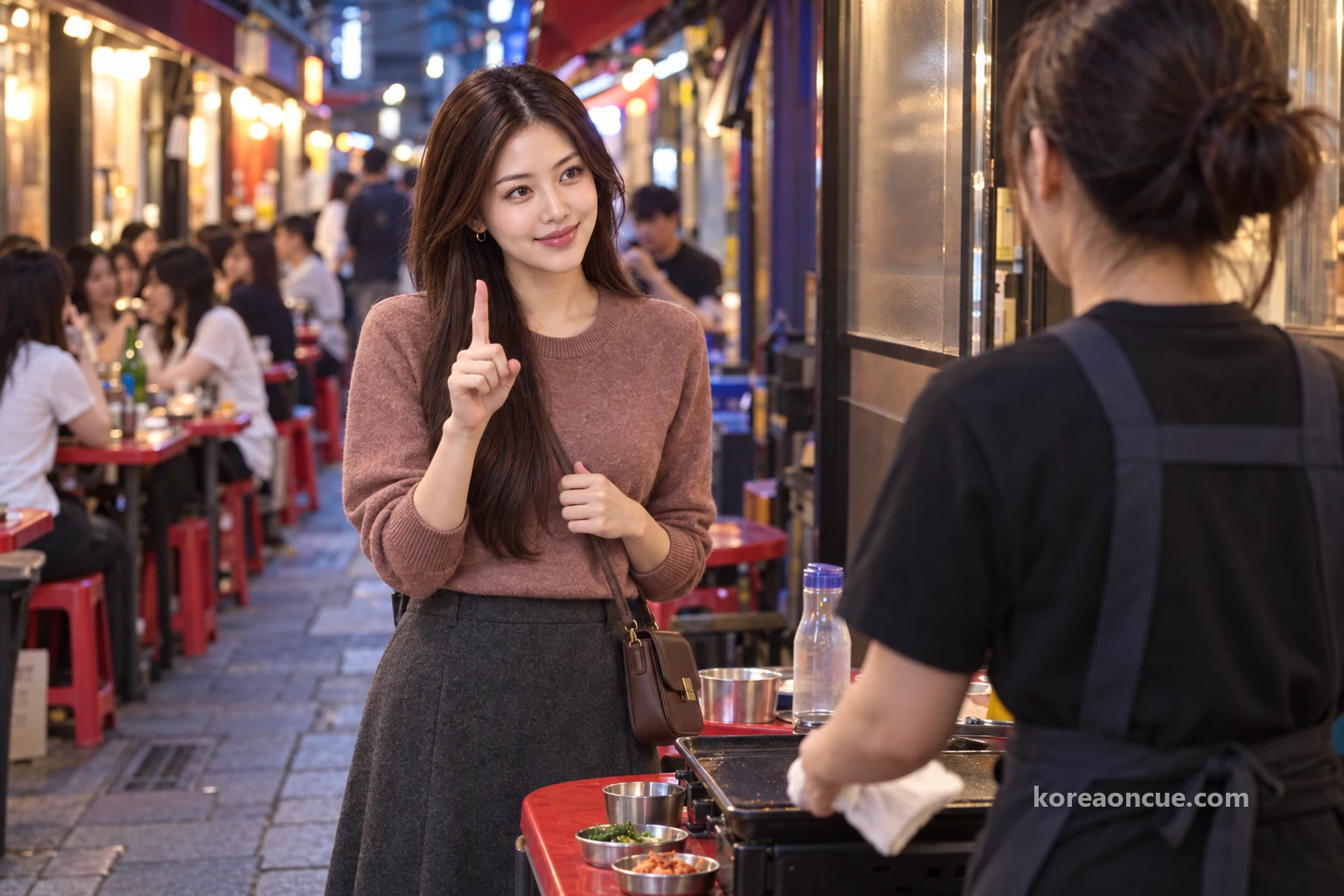
If you are coming alone, ask before sitting down, as Mali does. Holding up one finger and saying “one person” makes the situation clear before a chair is moved. Outdoor tables have been full around 8 p.m. even on a weekday, so arriving earlier will also make it easier to look around without rushing.
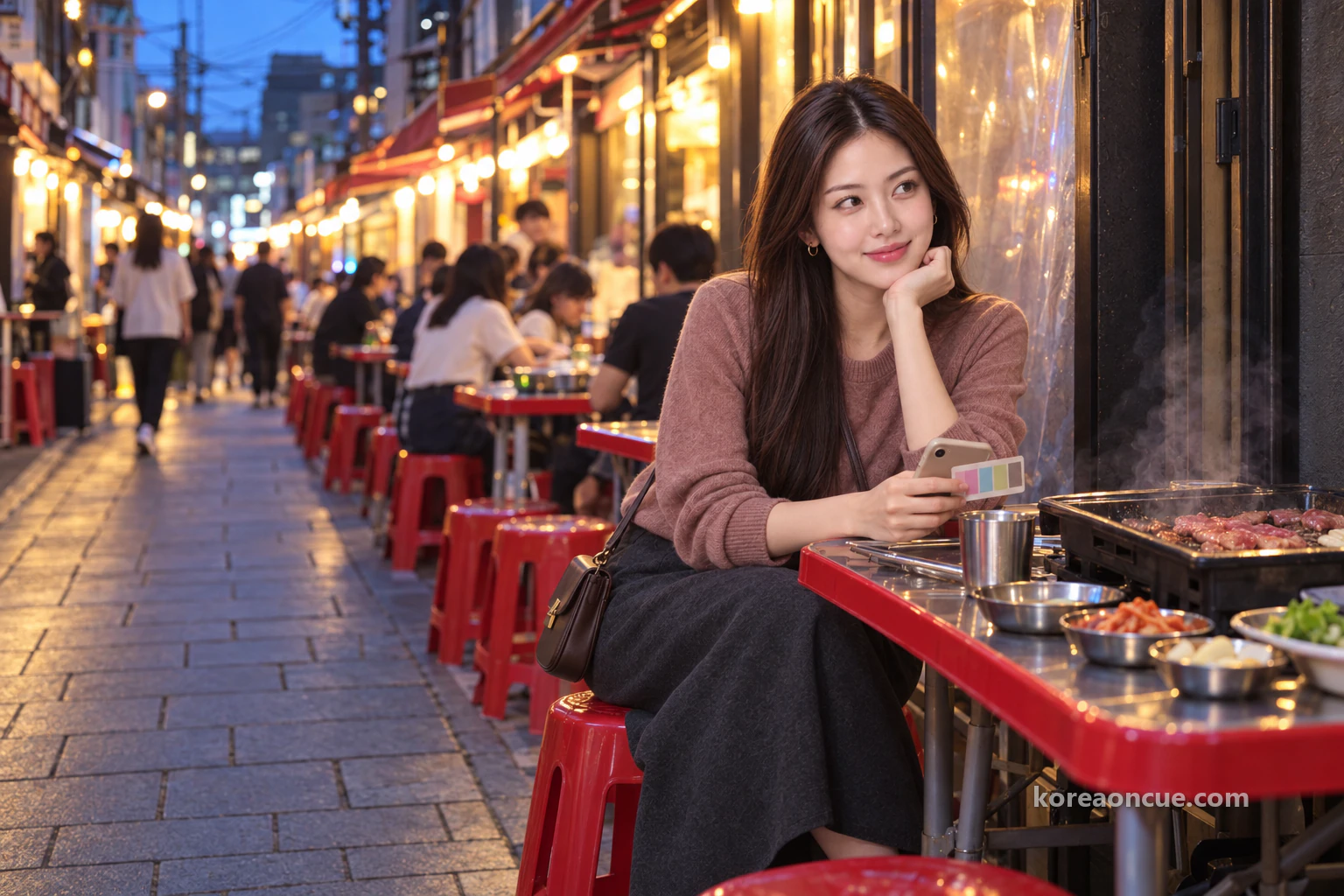
Once seated at the end table, Mali looks along the alley. From here, the row stretches into the distance, with smoke rising from one grill after another. Being alone no longer feels awkward. Instead, she notices things a conversation might have distracted her from — laughter at the next table, the sound of a grill heating up and the colour of the sky at the end of the lane.
Colour on the grill
Naturally, Mali chooses galmaegisal. The meat on the grill is deep red, with long fibres that remind her of the dictionary description. A muscle that moves with every breath, it said, and even a small piece has a dense grain like twisted thread. She picks up the tongs, spreads the pieces out one by one and watches their colour change over the heat.
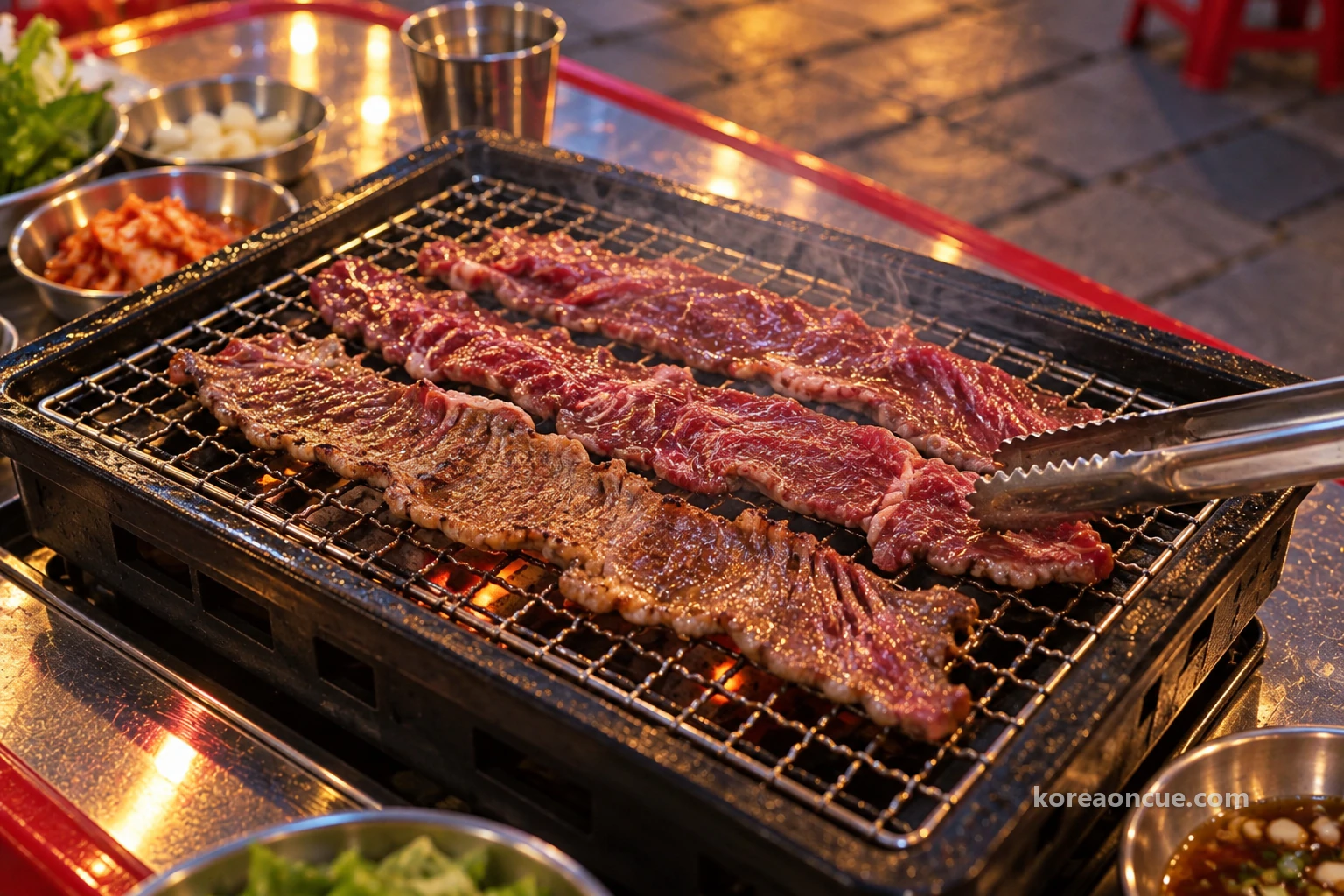
The red begins turning brown at the edges. First a fine brown border appears, then spreads inwards, with the spaces between the fibres darkening first. It is the same close attention she gives lipstick shades when the lighting changes at a magazine shoot, now directed at a grill. Under “Things I’ve seen”, she adds a line that might make someone else laugh: “Red → brown from the edges, grain darkens first.”
She wraps a piece in lettuce, takes a bite and nods slowly. She expected something tough, but finds a pleasantly chewy texture and a mild flavour, a surprise after imagining a fattier cut of pork. After hours discussing new products that afternoon, she is glad of a dinner she can wrap with her hands. Making her second lettuce wrap, she even finds herself thinking that, for a magazine photograph, light from the side would bring out the grain.
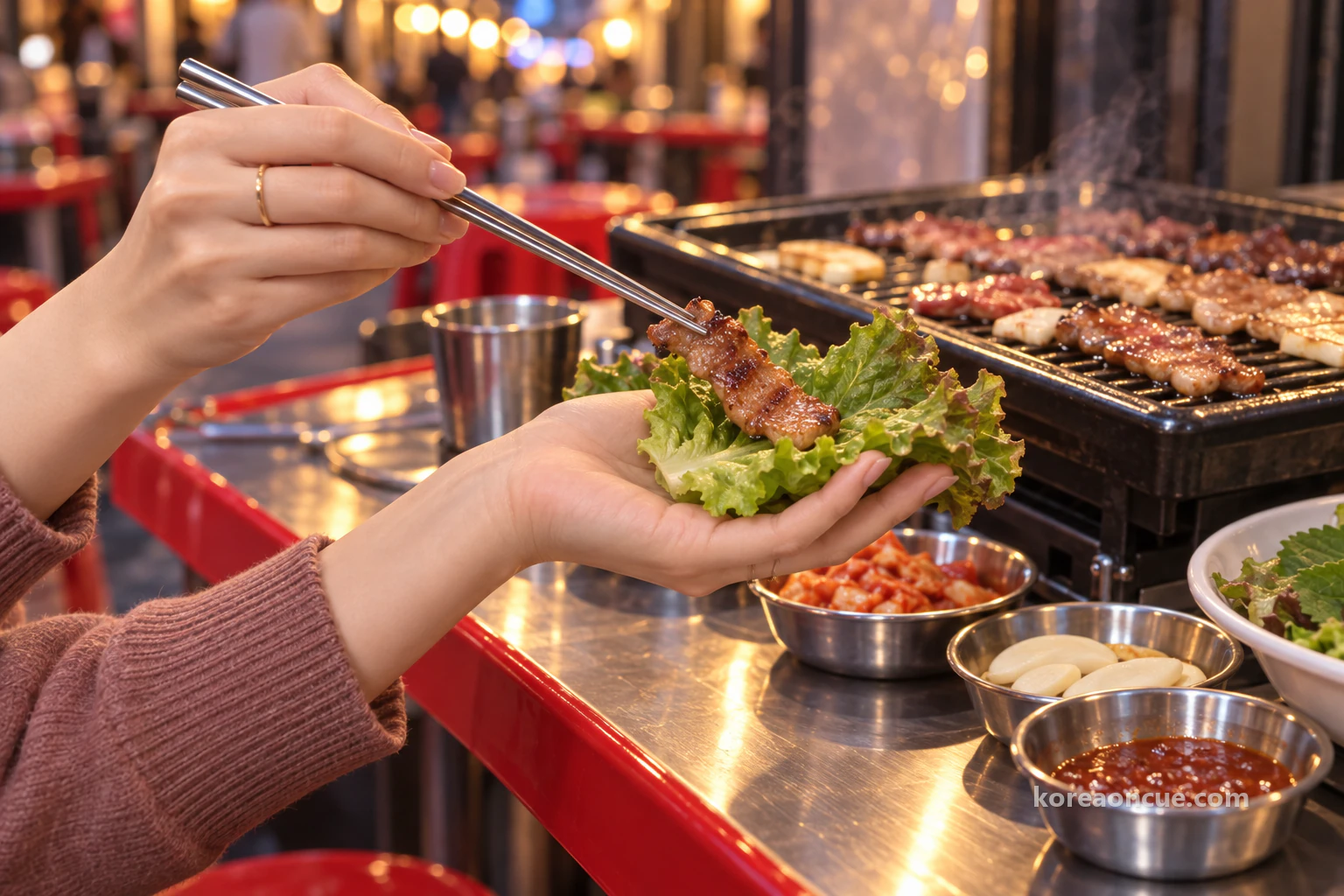
After finishing the wrap, Mali takes the worn colour card she always carries out of her bag. Holding its slightly frayed edge beside the chair, she sees that a red she would have called simply red in daylight looks one shade closer to brick beneath the restaurant lights. It is almost the same swatch as the colour on the meeting table that afternoon, and she smiles to herself. A colour from work and one found by chance over dinner have landed in the same square, making the day feel connected.
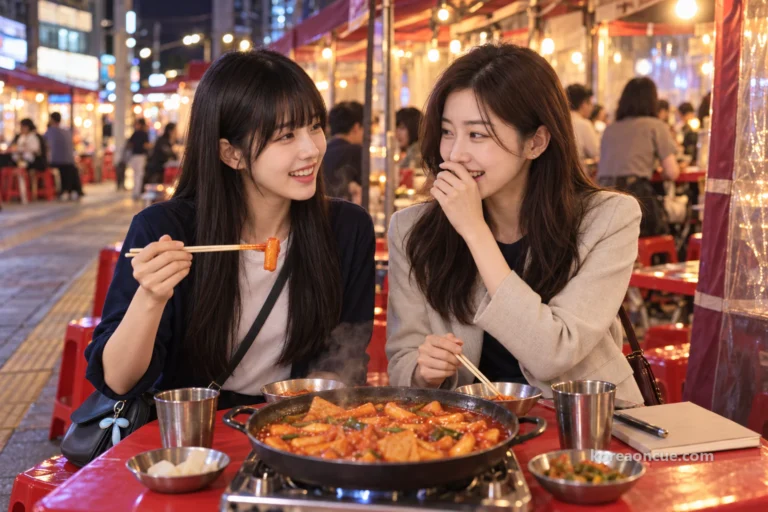
At the next table, a group who look like travellers pass the tongs between them, grilling meat and handing each other lettuce wraps. One person chews slowly and nods, as though trying the cut for the first time, and the others raise their glasses and clink them together. The Korean roadside barbecue evenings Mali has watched on her phone are happening at the next table, and she is struck again by the fact that she is sitting in the scene herself. She keeps the camera away from the group and takes a single photo of the meat on her own grill.
Eight o’clock, with every table taken
Once the sun has gone completely, the alley feels quite different. There are noticeably more people than when Mali sat down, with no empty tables in sight, and smoke and laughter fill the lane. As she expected, the red chairs look much deeper beneath the restaurant lights. She starts to take a photo, then lowers her phone to look at the scene first.
Eight o’clock crowds are not unique to this evening. At 8 p.m. on 16 July, smoke rose from grills on every red portable table outside the restaurants, with overseas travellers occupying many of them. On the weekday evening of 21 September, outdoor tables along Donhwamun-ro 11-gil and Galmaegi Alley were also full at 8 p.m., with overseas travellers accounting for two or three people in every ten seated. Across a 200 m stretch around Donhwamun-ro 11-gil, 43.7% of this year’s second-quarter sales fell between 5 p.m. and 9 p.m.
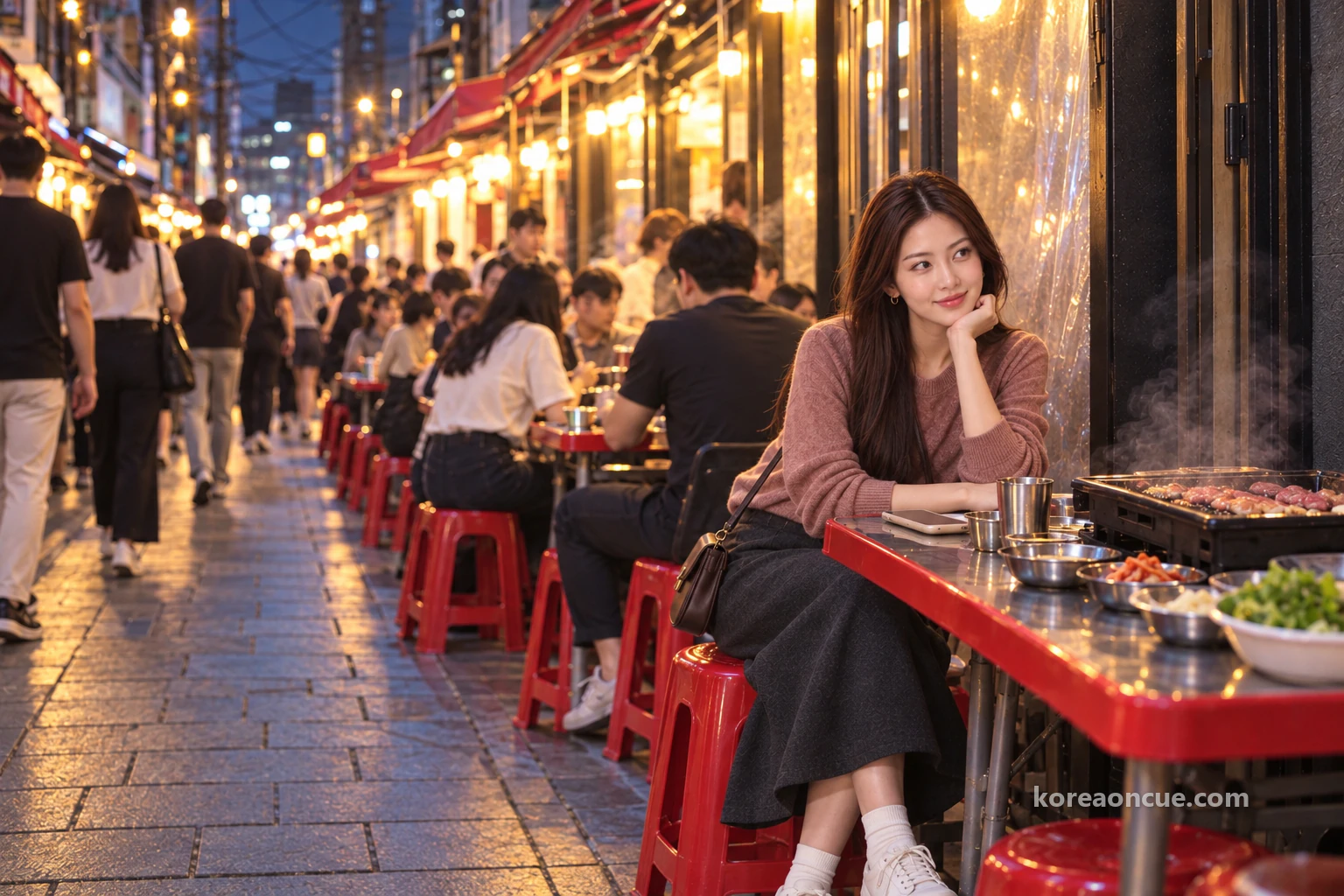
Arrive earlier than eight if you want a choice of table or are coming alone. For a larger group, an earlier arrival is even more useful. If you get here around eight, walk through the alley to look for tables becoming available rather than waiting a long time outside one restaurant. Keep the middle passage clear while you wait.
Looking around, Mali notices the range of ages at the tables. Office workers who seem to have come straight from work sit alongside friends her age and travellers with maps open in front of them. She hears English, Korean and several languages she cannot identify, all mingling in the same lane. She likes the mixture, and feels at ease with her solitary seat being just another place in the row.
Safety staff move slowly between the tables. A joint public–private safety team patrols the area from evening until late at night, watching pedestrian movement and responding to emergencies. Sitting alone, Mali finds their presence reassuring. If the crowd blocks the way or you need help, speak to one of the safety staff patrolling the lanes.
The day’s colour
Leaving her table, Mali walks back towards Exit 6. Ikseon-dong’s hanok lanes are a few minutes’ walk away, but she decides to leave them for another time and take this evening home as it is. Now she properly notices the yellow line on Donhwamun-ro 11-gil that she crossed without thinking earlier, with a safety worker walking slowly nearby. What first looked like a pattern on the ground now feels like an agreement the neighbourhood has made.
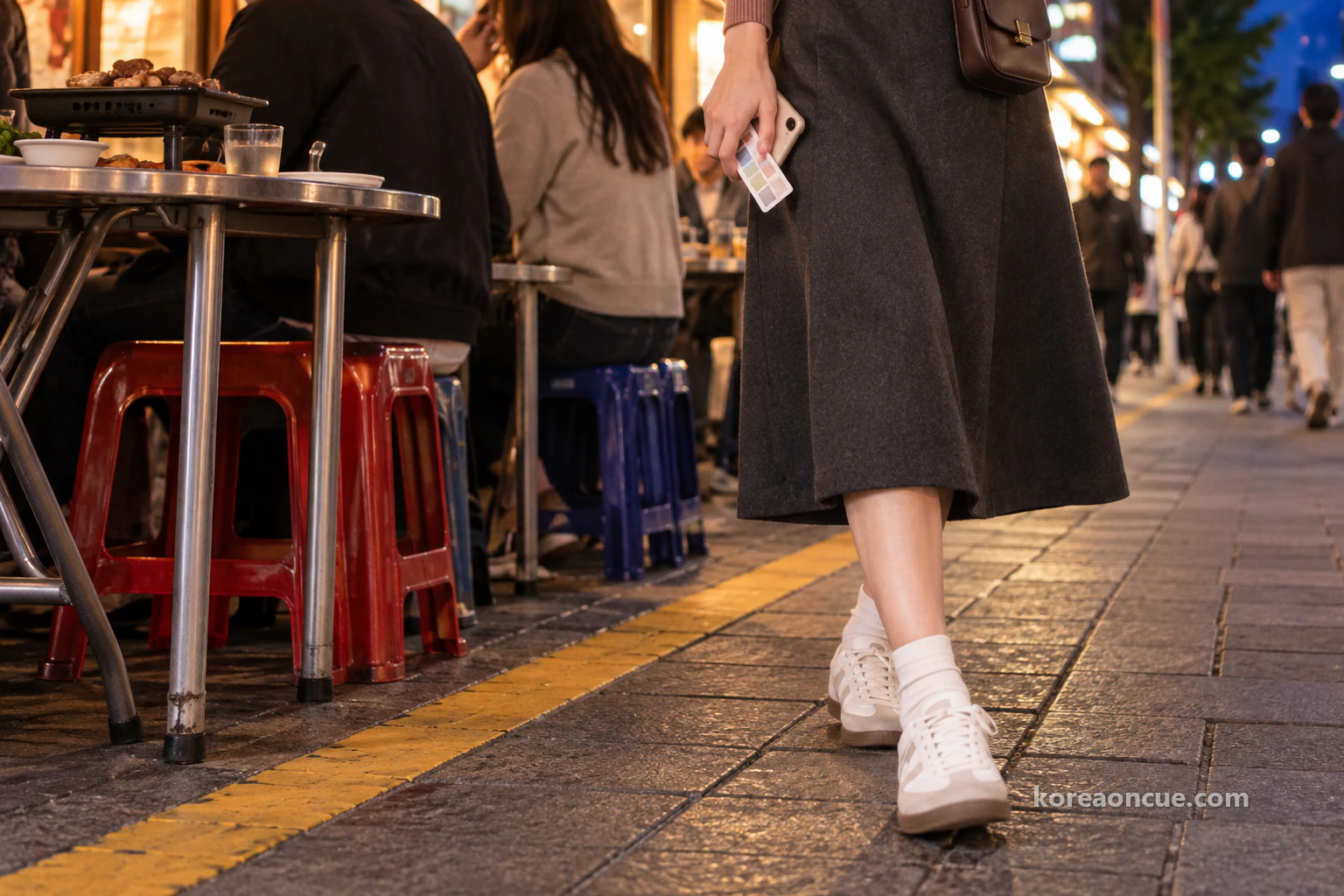
Before going down the station steps, Mali sends Rina two photos. One shows galmaegisal browning from the edges on the grill, the other the yellow line she has just photographed. “It wasn’t seagull. Pork, diaphragm.” Rina replies almost immediately: “Love those colours. I’ll try going there next time I’m in Seoul.” Mali likes how typically Rina it is to notice the colours first, and reads the message once more before turning off the screen.

While waiting for the train, she adds an idea for next month’s editorial meeting to the “For work” section of her notes. A short photo story could place daytime and night-time colours side by side, showing how red changes beneath Seoul’s evening lights. She likes the photos she has taken enough to imagine one becoming its opening image. Coming away from a barbecue alley with a piece of work in mind makes her smile, and she is pleased to have found it.
On the train back, Mali opens her notes again. She crosses out “Galmaegisal — what meat?” under “To find out”, then reads through “Things I’ve seen” from the top. Red chairs and tables, a yellow line, a cut of meat that gave an alley its name, colours changing on a grill. The brick red from the afternoon meeting has slipped further down the page.
At the top, she writes the day’s colour: “A yellow line, and the red inside it.” She has walked and eaten alone, but along the way she has worked out an unfamiliar word, learnt why the tables stand in one row and found a place for herself at its end. When she returns to Seoul in a month, she plans to come earlier in the evening and look for that end table first. Already, she is a little curious about what will go under “To find out” next time.
Common Mistakes
Arriving before six and expecting to sit outside straight away
outdoor trading begins at 6 p.m.
Looking up only “galmaegi” and being put off by the seabird
galmaegisal is meat from a pig’s diaphragm.
Pulling a chair into the passage
permanent shops are limited to one row of outdoor tables directly in front. Keep the middle clear.
Coming alone and sitting at any free table without asking
make clear that there is one person and ask before sitting down.
Arriving at 8 p.m. and waiting a long time outside one restaurant
outdoor tables have been full at this time even on a weekday. Come earlier for more choice.
FAQ
What kind of meat is galmaegisal?
It is meat from a pig’s diaphragm and has nothing to do with seagulls.
Where is Galmaegi Alley?
Immediately outside Exit 6 of Jongno 3-ga Station on Lines 1, 3 and 5.
When can I sit at an outdoor table?
Jongno 3-ga’s shared-street rules set outdoor trading hours from 6 p.m. to 4 a.m. the following morning.
Why is there only one row of tables outside each restaurant?
Under the shared-street rules, permanent shops can trade outdoors only in a single row directly in front. The middle remains a passage for pedestrians and restaurant staff.
Can I go alone?
Before sitting down, ask whether you can dine alone and whether a minimum order applies.
Does it get busy in the evening?
Outdoor tables have been full at 8 p.m. even on a weekday.
Recap — 30 seconds before you go
- Immediately outside Exit 6 of Jongno 3-ga Station
- Outdoor trading: 6 p.m. to 4 a.m. the following morning · arrive earlier than eight for more choice
- Galmaegisal = pork diaphragm meat
- One row of tables outside each restaurant · keep the passage clear
- Coming alone: ask for one before sitting down
Sources
- National Institute of Korean Language, Standard Korean Language Dictionary — GalmaegisalThe definition of galmaegisal as meat from a pig’s diaphragmchecked 2026-10-21
- National Institute of Korean Language, Saegugeo Sosik — The etymology of galmaegisal (June 1999, Cho Hang-beom)The distinction from seagull meat · the diaphragm · the history of removing the membrane · the author’s explanation of the namechecked 2026-10-21
- Seoul Media Hub — Around Jongno 3-ga Station (1 December 2021)The location of the galmaegisal alley beyond Exit 6 of Jongno 3-ga Stationchecked 2026-10-21
- Time Out — Jongno 3-ga: why this Seoul neighbourhood is the coolest in the world in 2026The 2026 coolest neighbourhood selection · barbecue restaurants around Exit 6 · hanok developed as housing in the 1920schecked 2026-10-21
- Sijung Ilbo — Managing Jongno 3-ga’s shared street (29 September 2026)Galmaegi Alley designated a shared street in October 2025 · permanent shops limited to one row outside · trading hours from 6 p.m. to 4 a.m.checked 2026-10-21
- Seoul Shinmun — Reporting from Jongno 3-ga’s shared street (23 September 2026)Yellow permitted-area markings on Donhwamun-ro 11-gil · full outdoor tables at 8 p.m. on 21 September 2026 · sales by time of day for the surrounding 200 m stretch in the second quarter of 2026checked 2026-10-21
- Kyunghyang Shinmun — Reporting from Jongno 3-ga’s outdoor dining streets (23 September 2026)Old-style and converted-hanok restaurants in Galmaegi Alley · overseas visitors · night-time safety patrolschecked 2026-10-21
- The Korea Economic Daily — Reporting from Jongno 3-ga’s galmaegisal alley (21 July 2026)Red outdoor tables and grill smoke at 8 p.m. on 16 July 2026 · the article’s analysis of independent travel, social media and demand for Korean after-work dining experienceschecked 2026-10-21
A Seoul story told with our AI characters. Place details are checked against public sources; the photos are AI-made illustrative images. How we use AI