SEOUL · JONGNO 3-GA
Nakwon Music Mall: An Afternoon Where the Road Runs Under the Building
Elena starts at Exit 5 of Jongno 3-ga Station, taking the day scene by scene: traffic beneath the building, a community arts centre below, instrument-shop corridors upstairs, board games on floor 1 and Tapgol Park
In the dramas Elena remembers, the instrument mall always began in a corridor upstairs. She decides to start before the staircase, on the road that runs beneath the building.
How to get there
Elena likes following scenes from dramas out into real streets. A 27-year-old visiting from Spain, she keeps noticing the same moment in stories about musicians: someone with a guitar case climbs the stairs of an old shopping building, and the next shot finds them in a corridor packed with instruments. What interests Elena is the gap between those shots. That, and the stretch of street before the stairs even begin.
Looking for somewhere in Seoul that resembles that scene, she adds Nakwon Music Mall in Jongno 3-ga to her notebook. A look at the map reveals something odd about the building. A main road runs underneath it. There are plenty of photographs of the mall, but few showing that road, and Elena thinks this must be the part the camera skips. She writes “Before the stairs” on the first line of her notebook and sets off.
This piece follows Elena’s weekday afternoon walk. She begins outside and beneath Nakwon Music Mall, 110 m from Exit 5 of Jongno 3-ga Station on Lines 1, 3 and 5, then visits the community arts centre under the building before climbing to the instrument-shop corridors on floors 2 and 3. Afterwards, she passes through floor 1, walks to the main gate of Tapgol Park and returns along Songhae-gil to Exit 5. One building stays at the centre of the day as she slowly makes a circuit around it.
This year, British travel publication Time Out named Jongno 3-ga the world’s coolest neighbourhood. Its evening food stalls and the hanok lanes of Ikseon-dong, lined with traditional Korean houses, often come to mind first. Elena, though, has decided to spend her afternoon with the large building between them. A few steps from lanes of hanok cafés stands a building from the late 1960s, and that closeness between different periods feels to her like the beginning of a drama.
The Cue — At a glance
Nakwon Music Mall is 110 m from Exit 5 of Jongno 3-ga Station, at 428 Samil-daero, Jongno-gu, Seoul. Traffic runs through floor 1, while around 300 instrument shops occupy floors 2 and 3. The community arts centre beneath the building opens Tuesday to Sunday, 10:00–21:00, closing at 18:00 on Saturdays and Sundays, and is closed on Mondays. Exhibitions in its history gallery change, so check the gallery section of the centre’s website before visiting. Exit 5 brings together the road beneath the building, the entrance to the older people’s recreation space on floor 1, Tapgol Park and Songhae-gil in one walk.
- Which exit: Exit 5 of Jongno 3-ga Station on Lines 1, 3 and 5. Nakwon Music Mall is 110 m away, and the community arts centre is about a two-minute walk towards Insadong.
- Closures: the community arts centre beneath Nakwon closes every Monday, on 1 January and during the Seollal (Korean Lunar New Year) and Chuseok (Korean harvest festival) holidays. It closes at 6 p.m. on Saturdays and Sundays. These are the centre building’s hours. Check exhibition details separately in the gallery section of its website.
- Tapgol Park: 09:00–18:00 from March to October and 09:00–17:00 from November to February. Alcohol is prohibited throughout the park.
- Driving: the community arts centre has no parking. Coming by underground is easier.
- Photography: the shops on either side of the corridors are workplaces. Keep photographs to the corridors, stairs and building exterior, avoiding shop interiors and people.
Exit 5, where Songhae-gil ends
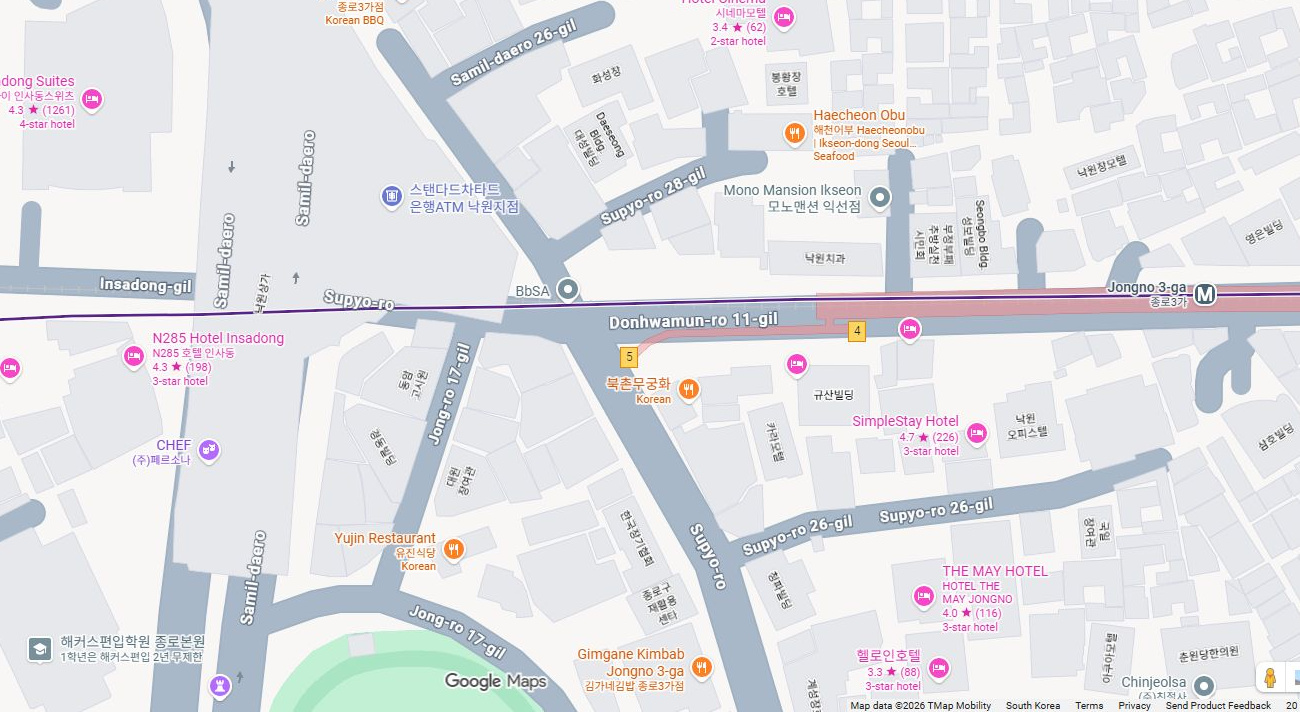
Emerging from Exit 5 of Jongno 3-ga Station, Elena looks around before choosing a direction. This is also the end of Songhae-gil, a 244 m street running from outside the Yukuijeon Building near Jongno 2-ga to Nakwon. Its official road name is Supyo-ro, while Songhae-gil is an honorary name. It honours the broadcaster Song Hae, who made Nakwon-dong his base for many years. A sculpture marking the street stands outside the exit.
What interests Elena is the way the street remembers someone who spent years in the neighbourhood, rather than a character who appeared on a screen. Streets in dramas usually pass without a name, but this one carries a person’s history in its name alone. Beyond the sculpture stretches the large building she has come to see. She looks up for a while, realising that its shape is unlike any of the shopping buildings she remembers from dramas.
Outside the exit are a bust of Song Hae and a freestanding panel with the lyrics to his song “Napalkkot Insaeng”. When he died in 2022, his hearse stopped here for a roadside memorial rite, and people still pause to take photographs. Elena briefly lowers her head before the bust, then reads the lyrics slowly through her phone’s translation app. The story of someone who treated this neighbourhood as a second home, gathered around one station exit, feels like a prelude to her first scene of the day.
Nakwon Music Mall is only 110 m from Exit 5. For a first visit, use the exit as a starting point rather than saving only a pin for “Nakwon”. The mall, the community arts centre beneath it and Songhae-gil are all close to the same exit, with Tapgol Park a few minutes away on foot. Elena writes “Exit 5 = today’s way in” in her notebook and starts towards the building.
The confusing part can come just as the building draws near. Nakwon stands where Insadong, Anguk-dong and Jongno connect, and beneath it the directions can become hard to keep straight. If you are looking for the community arts centre, remember “towards Insadong” from Exit 5. Elena herself looks around for a moment under the building, then turns her back to the exit and finds the Insadong direction before opening her notebook again.
Scene 1, traffic beneath the building
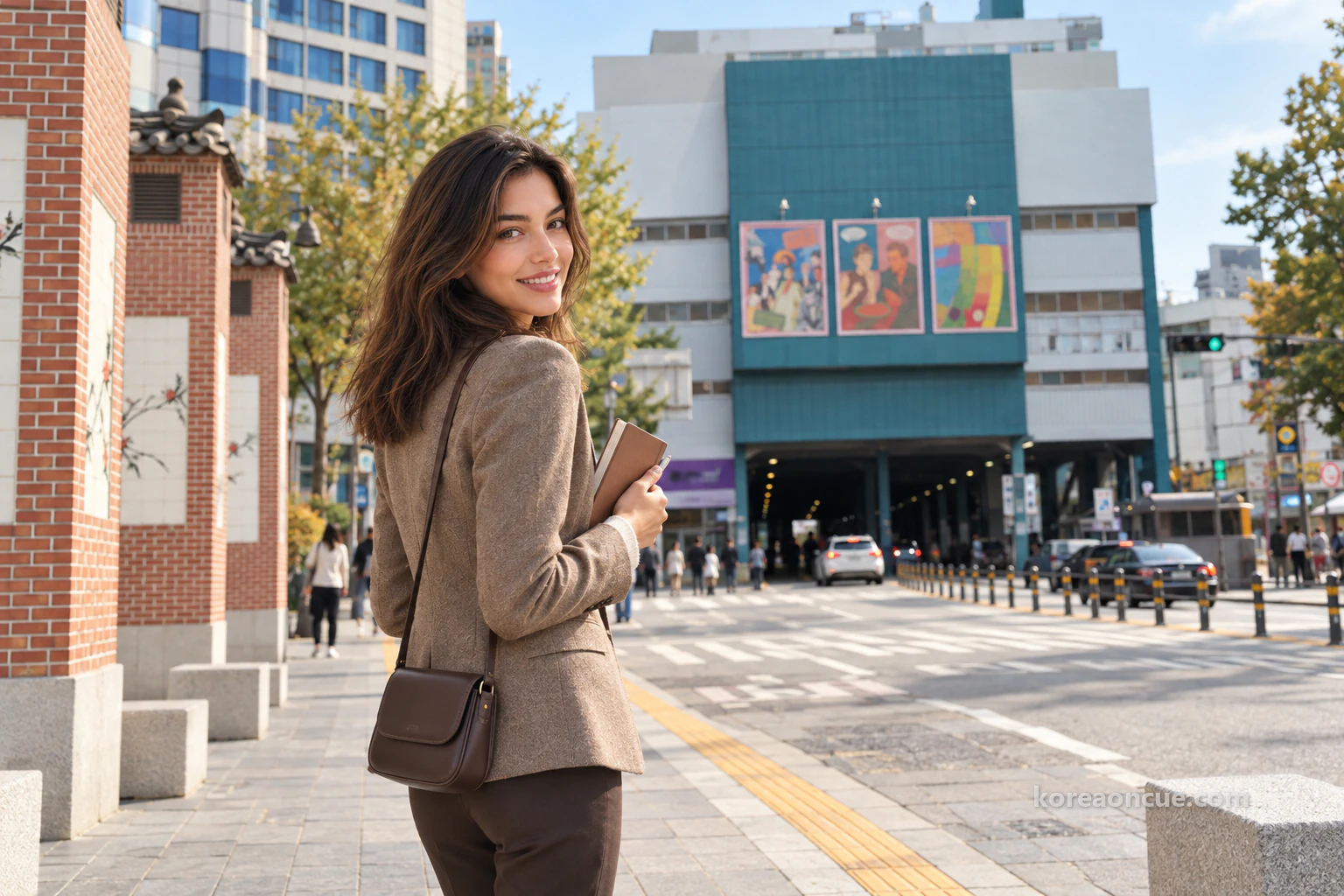
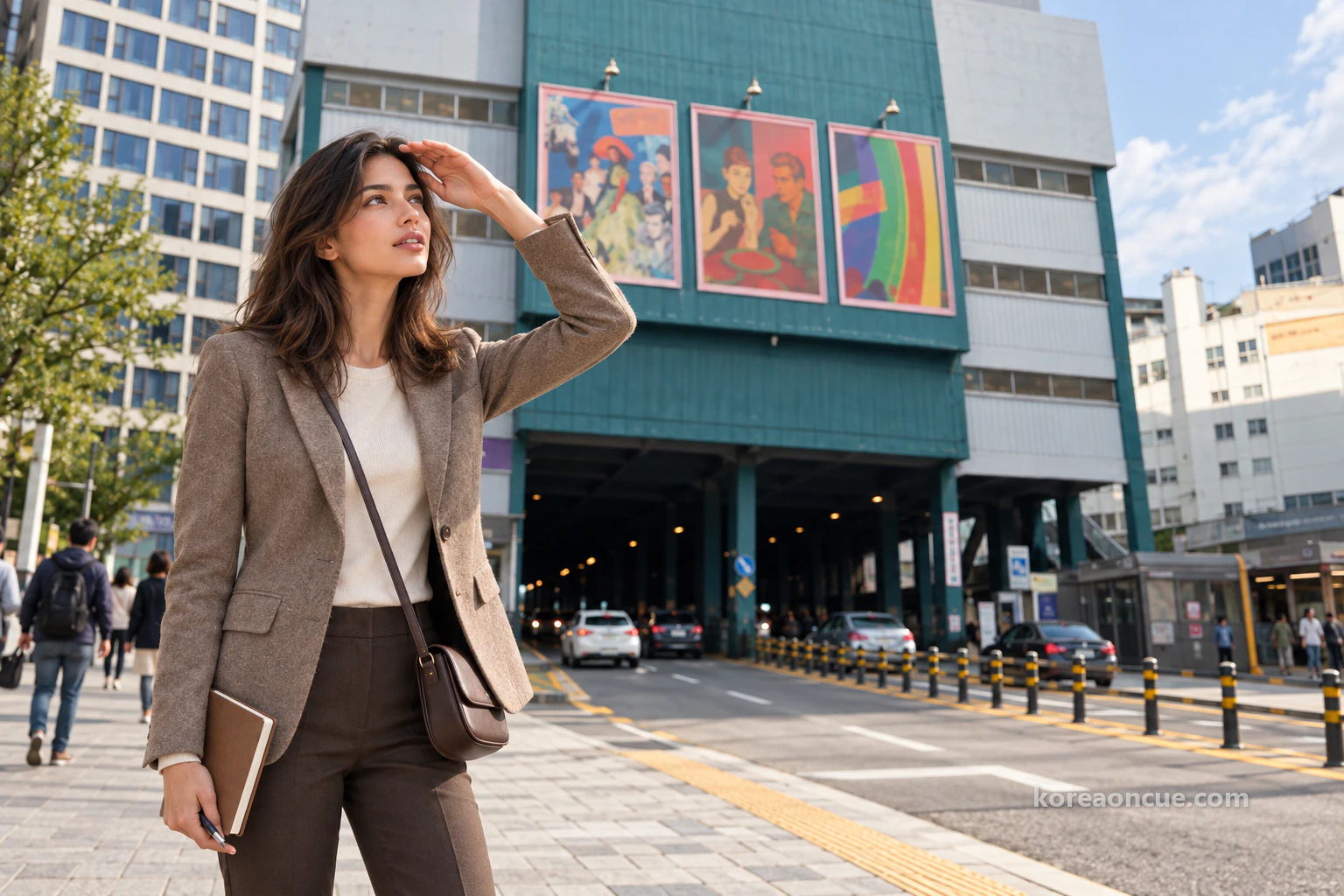
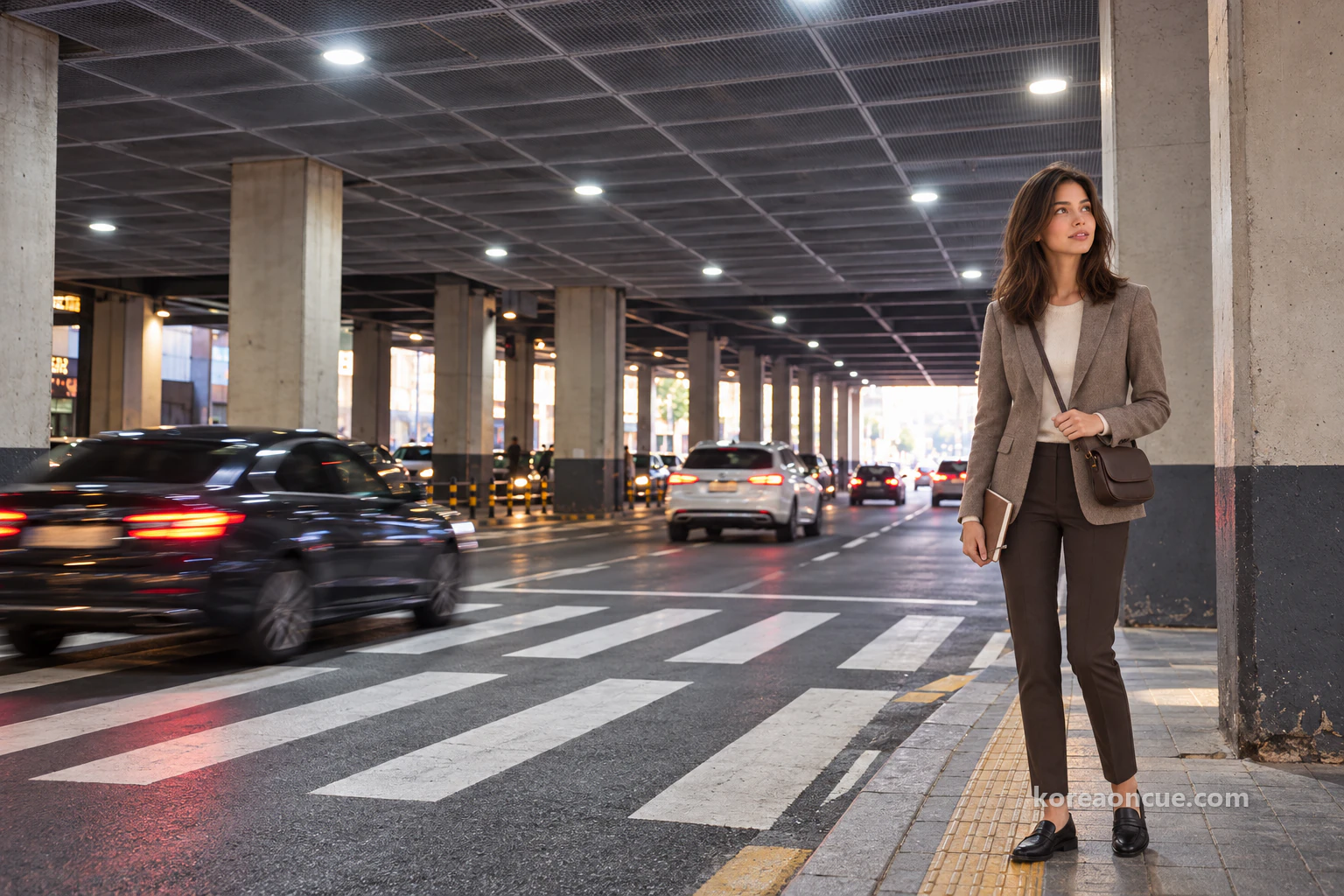
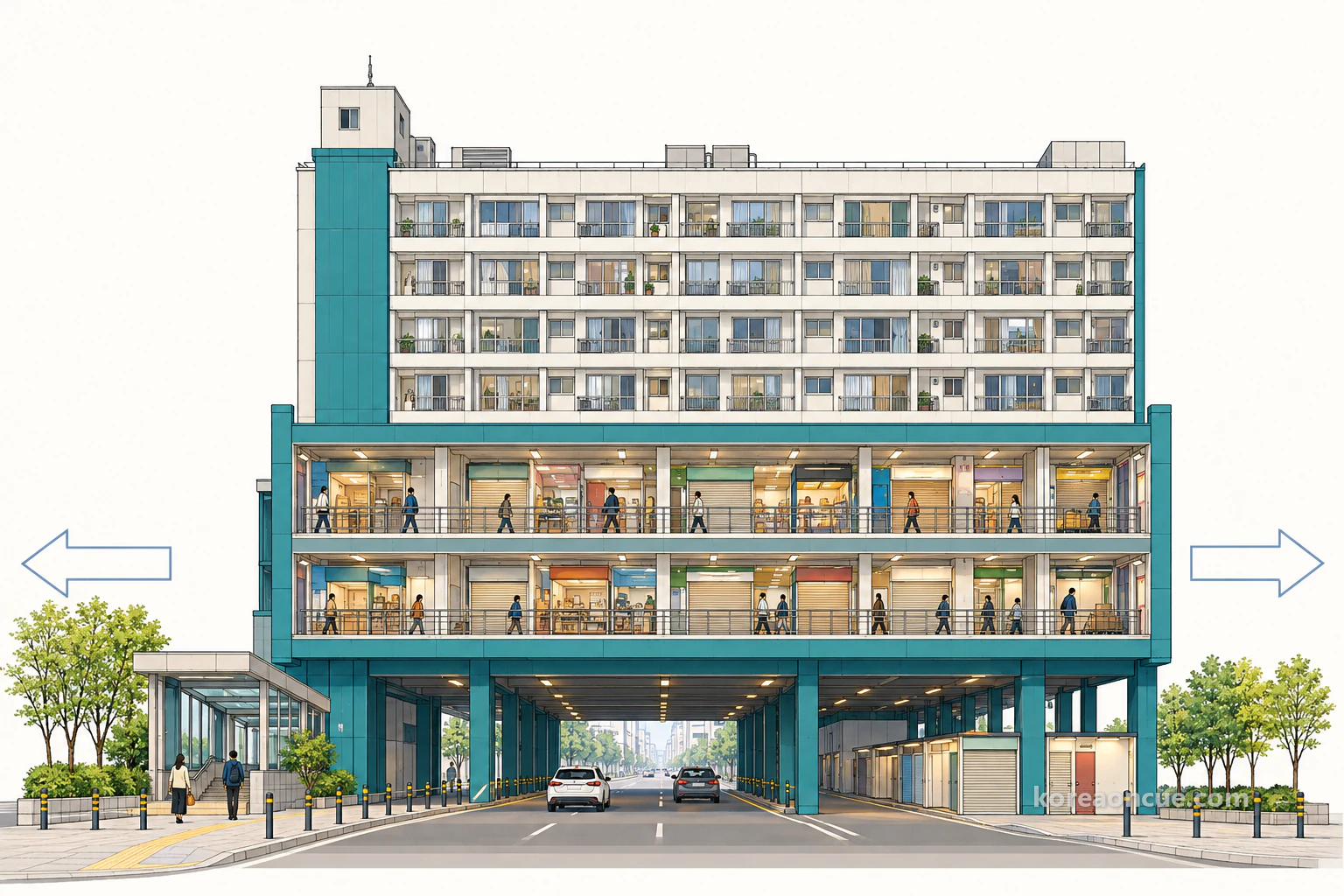
As Elena approaches the mall, the odd detail she spotted on the map appears in front of her. Cars are passing beneath the building. Nakwon was designed with a road running through floor 1, effectively placing the building over the street. Standing below it means having shops and homes overhead while traffic passes close beside her. Elena stops for a long look at the cars moving between the columns.
There is a reason for this arrangement. In the late 1960s, Seoul needed wider roads for its rapidly growing population, and a building with several uses went up over a new four-lane road connecting Yulgok-ro and Jong-ro. Nakwon has one basement level and 17 storeys above ground, combining shops and housing in one of Korea’s early mixed-use residential buildings. Seoul designated it as future heritage in 2013.
Before the building, this was the site of Nakwon-dong Market. Plans for the present structure followed a market redevelopment plan in 1965 and Seoul’s city-centre redevelopment programme in 1967. Having been drawn here partly by the name Nakwon, Elena has also looked into where it came from. Nakwon-dong became a neighbourhood name during the major administrative reorganisation of 1914, and an older story says the area was called Tapgol because of its many temples and pagodas. In a corner of her notebook, she writes “Tapgol → Nakwon”.
The building rests on 175 concrete columns. Roads pass beneath it in both north–south and east–west directions, and improvements have turned parts of the once dark space below into areas people can walk through. Looking along the rows of columns, Elena murmurs, “This feels more like a bridge than a building.” A drama might have passed over the place with one shot of its frontage and sign, yet here she finds the building’s strangest and most interesting scene.
Traffic still uses the road beneath the building. It is tempting to take photographs here, but stay in the pedestrian space rather than stepping into the carriageway. Elena takes out her phone and, instead of waiting for a gap in traffic, chooses a view from beside a column that includes both the structure and the passing cars. Cars driving straight through the lowest level of a building are unusual enough to make her want to keep taking pictures.
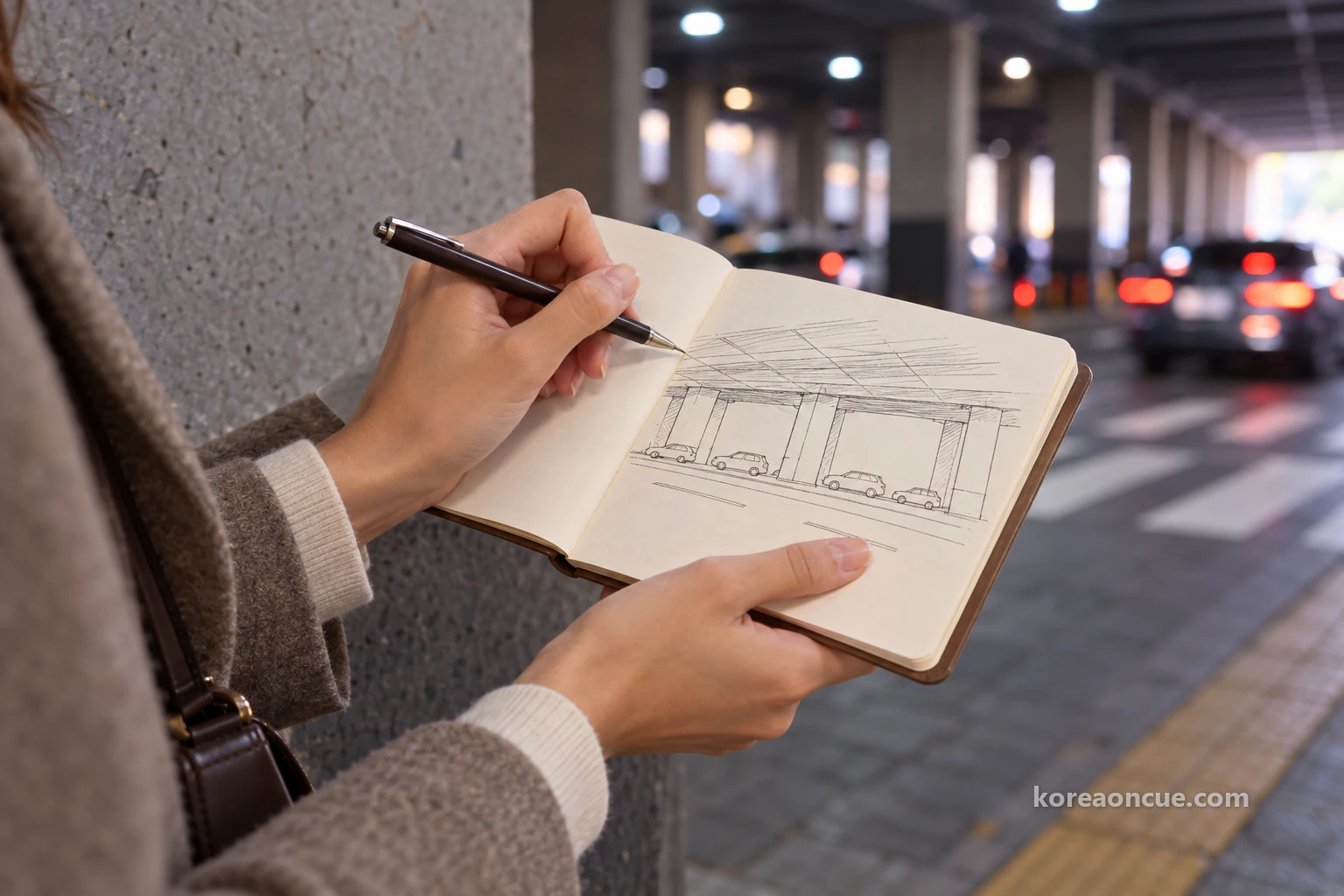
Beside a column, Elena opens her notebook and draws a cross-section of the building. She puts the road at the bottom, two bands of shops above it and a stack of floors over those. On screen, an “instrument mall” has always been a single corridor, but the Nakwon in her notebook brings a road, shops and homes together in one structure. Beside the drawing, she writes “Scene 1 — beneath the building”.
Drawing the upper floors makes Elena newly aware that the building also contains people’s homes. Nakwon brings a road, shops and housing together in one building. She takes only one or two photographs of the whole building from a distance and avoids lingering with her camera pointed at the upper windows. When photographing the building, concentrate on the shops and the space below, and give the homes above their privacy.
Scene 2, the community arts centre beneath Nakwon
A few more steps beneath the building bring a row of box-shaped spaces into view between the columns. This is the community arts centre beneath Nakwon, built as a series of connected cubes in the space below the mall. It opened in October 2020, occupying part of a former car park. The centre was created through an urban regeneration project for the city centre in front of Changdeokgung, directly alongside the music mall.
The centre has two main sections. One houses the information desk, meeting rooms and classrooms, while the other contains a multipurpose hall, practice rooms, studios and a workshop for repairing and making instruments. The practice rooms and classes support residents’ cultural activities, so the history gallery, with its changing exhibitions, is the more straightforward stop for a visitor dropping in. Programme and room-hire information appears on the centre’s website.
The two sections face different directions beneath the building. On an approach from Jonggak, the section with the information desk appears first, while an approach from Anguk-dong and Unhyeongung reaches the section with the practice rooms and studios first. Elena begins outside the information section, then walks between the columns to the creative facilities on the Anguk-dong side. Finding that the first space changes with the direction of approach prompts her to add another arrow to her cross-section.
The centre’s instrument donation scheme catches Elena’s attention. Instruments sitting unused at home are donated, repaired and passed on to places that need them, an activity that seems well suited to a space beside the instrument shops. The centre also gathers and shares archives about Nakwon-dong and popular music. Elena thinks of the mall as a place for buying and selling instruments, and the centre below as a place that passes their musical history on to someone else.
Elena’s reason for stopping here is simple. Before climbing the stairs, she wants to know something of the building and its neighbourhood. The history gallery was created to introduce Korean popular music history and the area around Nakwon Music Mall, and it also hosts changing exhibitions planned by residents. After slowly looking around the exhibition on display that day, Elena writes “Scene 2 — the public space below” in her notebook.
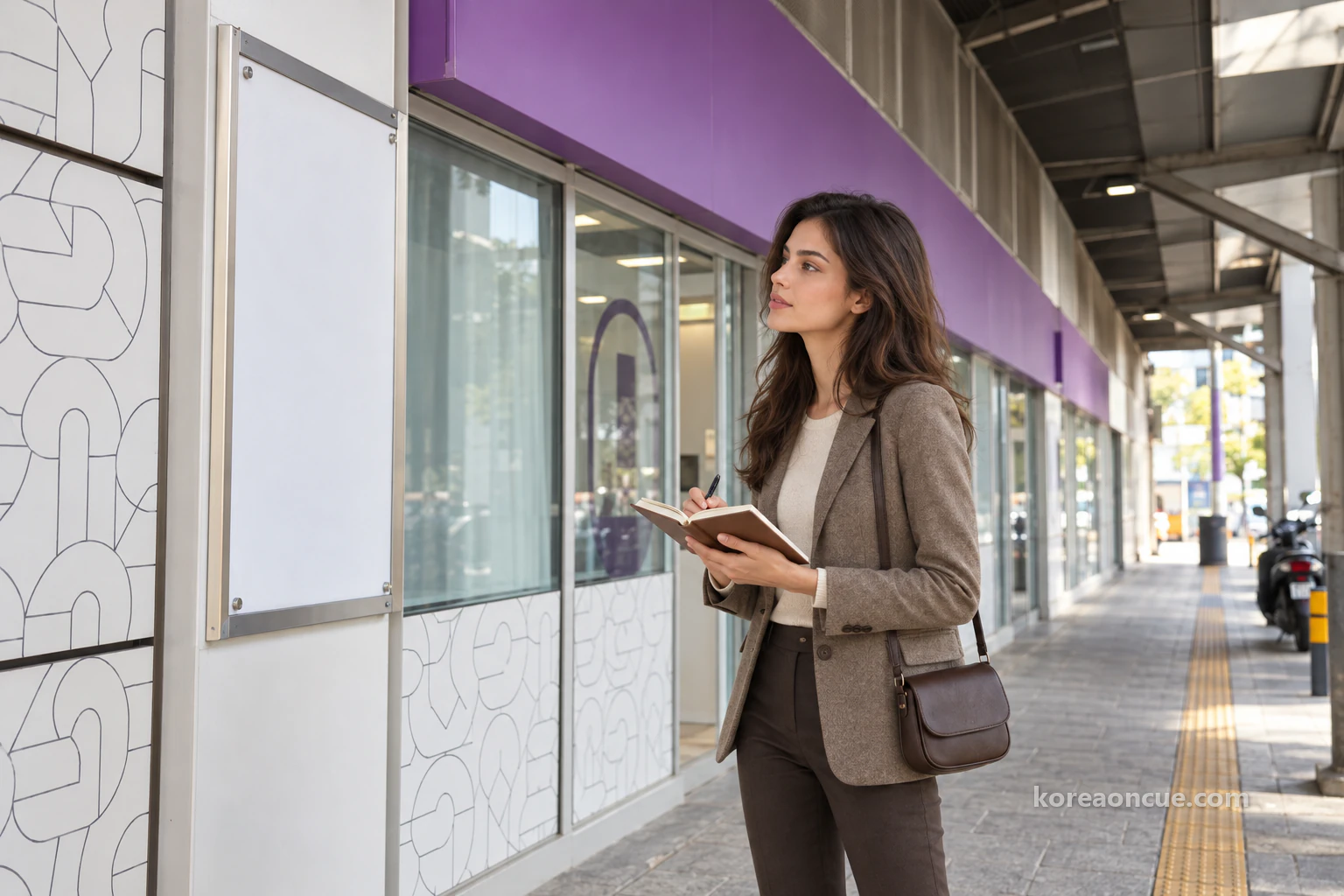
The centre opens Tuesday to Sunday from 10 a.m. to 9 p.m., with an earlier closing time of 6 p.m. on Saturdays and Sundays. It closes every Monday, on 1 January and during the Seollal and Chuseok holidays. These are the hours for the centre building as a whole, so check the history gallery section of its website for the current exhibition and visitor information before going. There is no parking, so leave the car behind.
As Elena leaves, she keeps thinking about how the space has changed its use. Empty areas beneath a building, where cars passed and parked, now hold places to learn instruments, listen to music and see exhibitions. On screen, the space beneath a building is usually somewhere a character shelters from rain or makes a quick phone call, but here it is a destination in its own right. Elena adds a few small boxes to the cross-section in her notebook.
Scene 3, up the stairs to floor 2
Leaving the centre, Elena finally stands at the stairs. The setting resembles the scenes she remembers, but this time she is the one about to climb. Nakwon’s roughly 300 instrument shops occupy floors 2 and 3. She begins counting the steps that a camera would have cut past in seconds, then soon gives up with a laugh. Instead, she listens to the sounds coming from above.
On floor 2, small shops stretch along both sides of the corridor. As Elena walks, instrument sounds mingle with sound from speakers in different directions. On screen, the music mall has always been a quiet scene beneath a single backing track, but here several sounds overlap at once. She rather likes it. Before anything else, her ears tell her that this is a working place, where people are still getting on with their day.
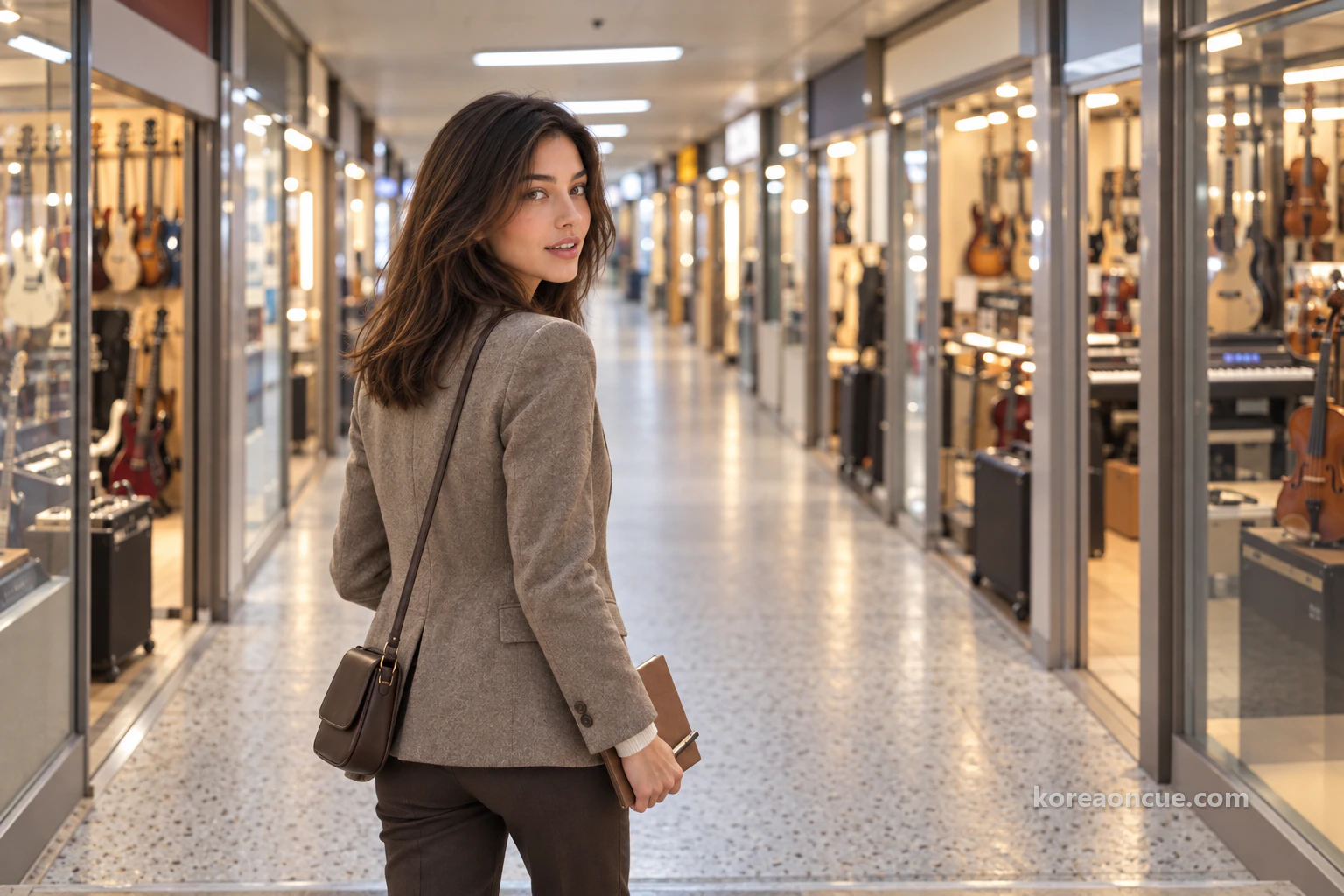
Elena hesitates before taking out her phone in the corridor. Anyone can walk through, but the spaces on either side are individual shops and workplaces. She keeps her camera away from people and shop interiors, taking just a few photographs along the length of the corridor and back towards the stairs. On a first visit, focusing on the corridors and building gives both the people working here and those looking around more room to feel comfortable.
Many shops have been here for years. People have spent long stretches of their working lives in the same place, and many businesses have passed from one family member to another. Walking along, Elena remembers how the instrument-shop owner in a drama usually gets only a few lines as a supporting character. Here, the people who have worked in these corridors for so long seem to her like people with long stories of their own.
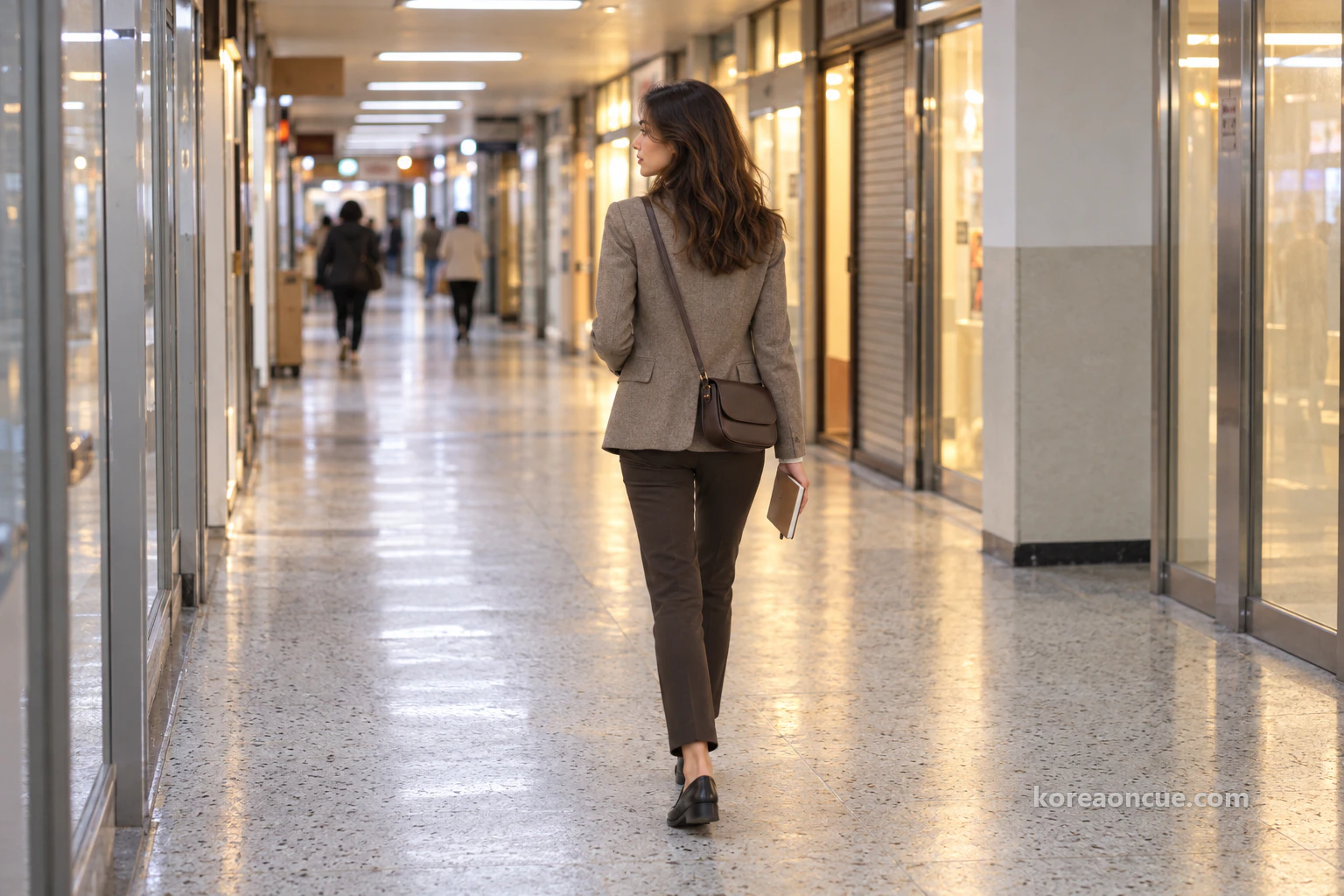
Elena walks slowly through the floor 3 corridor after floor 2. She has not come to buy an instrument, so she pays more attention to the corridors than to the goods inside the shops. She notices paths of similar width turning and continuing, sounds carrying on from one floor to another and people moving up and down the stairs. In her notebook, she writes “Scene 3 — above the stairs”, then adds “One shot on screen, two floors in real life”.
There is plenty to see here without buying an instrument. Around 300 instrument shops gathered on two floors of one building make an unusual sight even in Seoul. This is a trading mall, though, with shops carrying on their business. Keep towards the edge rather than stopping in the middle of a corridor for a long time, and take a look before reaching for a photograph.
When musicians came looking for work
Pausing at the end of the floor 3 corridor, Elena reopens the history of the mall she read before setting out. Nakwon began specialising in instruments around 1970. As bands and performance venues grew around the 1970s, musician numbers rose sharply, and the concentration of instrument shops naturally made the mall a place to exchange information about jobs. There was a time when people making a living from music climbed these stairs to find work.
In 1979, piano shops moved into the mall following work on Tapgol Park’s boundary wall, helping Nakwon establish itself fully as an instrument shopping centre. In the 1980s, the lifting of the night-time curfew gave late-night performance venues a new lease of life. More stages brought more bands, musicians and people looking for instruments. At its busiest as a meeting place for musicians, the mall drew 300–500 of them a day.
In the 1980s, the bowling alley on floor 3 and the cinema on floor 4 were also busy date spots for young couples. Late-night trading hours were reduced in the early 1990s, and the financial crisis and spread of karaoke machines later that decade left the musicians’ job market with almost none of its former role. Fewer musicians came looking for work, but the instrument shops remained above the stairs.
Elena puts her phone away and looks down the staircase she has just climbed. For the screen characters she remembers, stairs were simply a way to get to the next shot, but here they once carried musicians in search of news about work. Instrument shops brought musicians together, and jobs followed the musicians. Beside “Scene 3”, she writes “Here, the stairs were a route to work.”
Scene 4, board games on floor 1 and Tapgol Park
Back downstairs, Elena finds another scene on floor 1. A recreation space for older people opened here in February this year. It has 17 tables for janggi (Korean chess) and baduk (Go), and opens daily from 10 a.m. to 6 p.m., except on public holidays. Elena briefly looks towards the janggi boards from outside the doorway, then quietly moves on without entering the space where older people are spending their leisure time.
Its arrival is connected to changes at nearby Tapgol Park. In 2021, Time Out singled out the grandfathers gathered around the park as part of Jongno 3-ga’s real appeal. The park was designated a historic site in 1991, however, and the whole area inside and outside its walls is protected heritage land. As part of improvements, Jongno-gu began encouraging the removal of game boards and chairs in summer 2025. The janggi and baduk boards that left the park have now found a new home on floor 1 of Nakwon.
Elena is particularly taken with this story. Someone coming in search of the “grandfathers of Tapgol Park” from an old article or photograph might be puzzled not to find that scene in the park today. For Elena, who likes exploring the difference between screen and street, the biggest discovery of the day is that the scene has moved into a nearby building. She writes “Scene 4 — the janggi boards have moved” in her notebook.
She continues to the main gate of Tapgol Park, a few minutes’ walk from Nakwon. Seoul’s first modern park contains an octagonal pavilion where the Declaration of Independence was read on 1 March 1919, and the Ten-story Stone Pagoda at Wongaksa Temple Site, built in 1467 and standing 12 m tall, beyond its main gate, Samil-mun. As a heritage site associated with the March First Independence Movement, it calls for a quiet visit rather than noisy recreation.
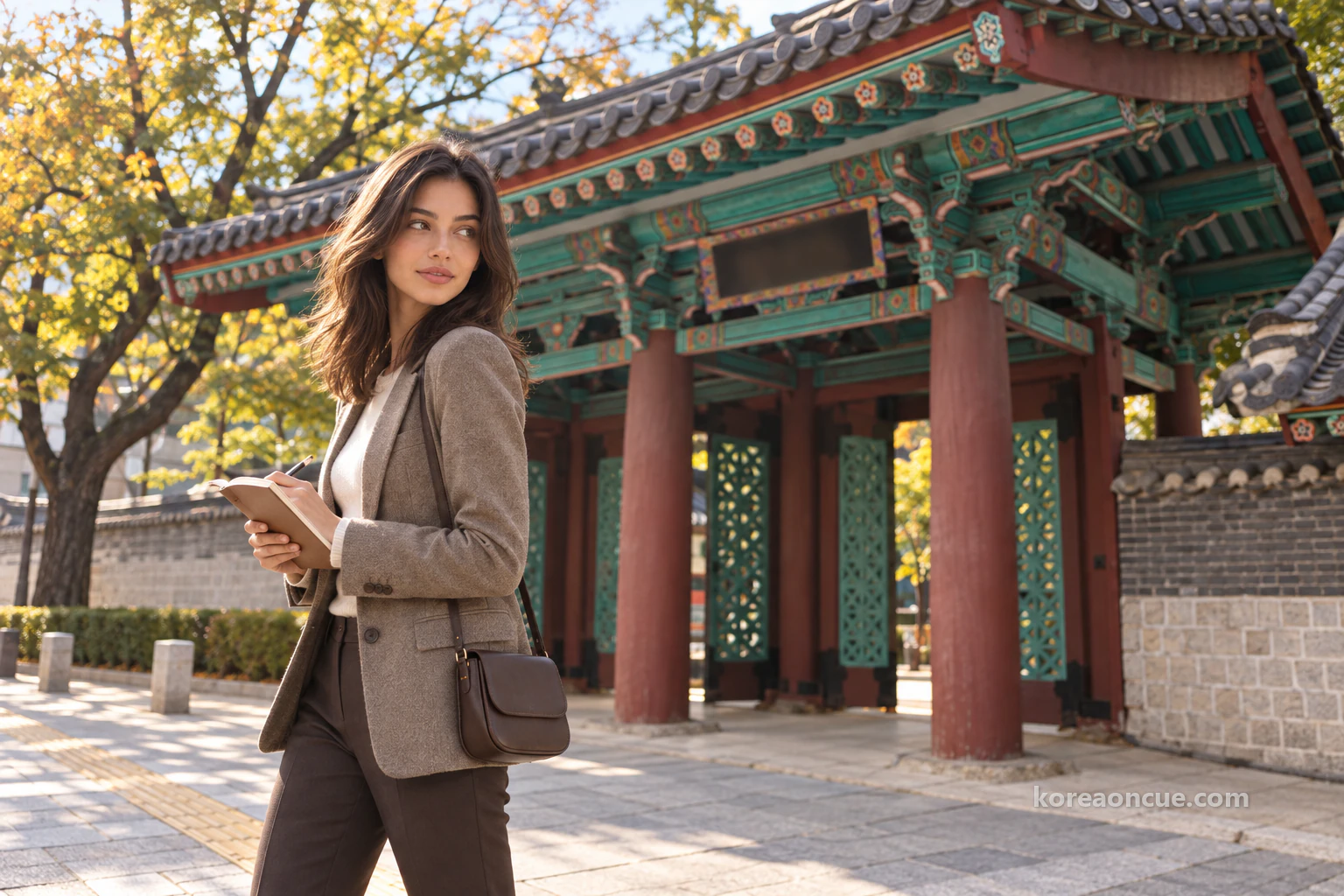
Tapgol Park opens at 9 a.m., closing at 6 p.m. from March to October and at 5 p.m. from November to February. Alcohol is prohibited throughout, with a 100,000 won fine for drinking introduced on 1 April this year, and games such as baduk and janggi, as well as buying and selling goods, are also prohibited. Elena does not linger inside today, stopping at the main gate to look back towards Nakwon and judge the distance between the two places. If you want a fuller visit to the park, keep its closing time in mind.
Following Elena’s order, with the centre and mall first and Tapgol Park last, is easier during the longer days from March to October. In winter, when the park closes at 5 p.m., visiting it before Nakwon leaves more time. At weekends, allow for the community arts centre closing at 6 p.m. too. Elena adds seasonal arrows beside the route in her notebook, leaving two possible orders for whoever comes next.
Scene 5, back along Songhae-gil to Exit 5
On her way back towards Exit 5 from Tapgol Park, Elena turns into Songhae-gil. Running beside the back of the park, the 244 m street connects the front of the Yukuijeon Building with Nakwon. Long-established restaurants and shops stand close together along both sides. Elena follows the width of the street and the pace of people walking beneath the signs, paying less attention to the names of the businesses. After an afternoon moving up and down one building, simply walking on level ground feels unhurried.
At the end of the street, Exit 5 and the Songhae-gil sculpture come into view again. The day has returned to the same exit, completing its loop. Elena looks up at Nakwon once more. Earlier it was simply a long, large building, but now each level brings back something she has seen, and she can read the layers.
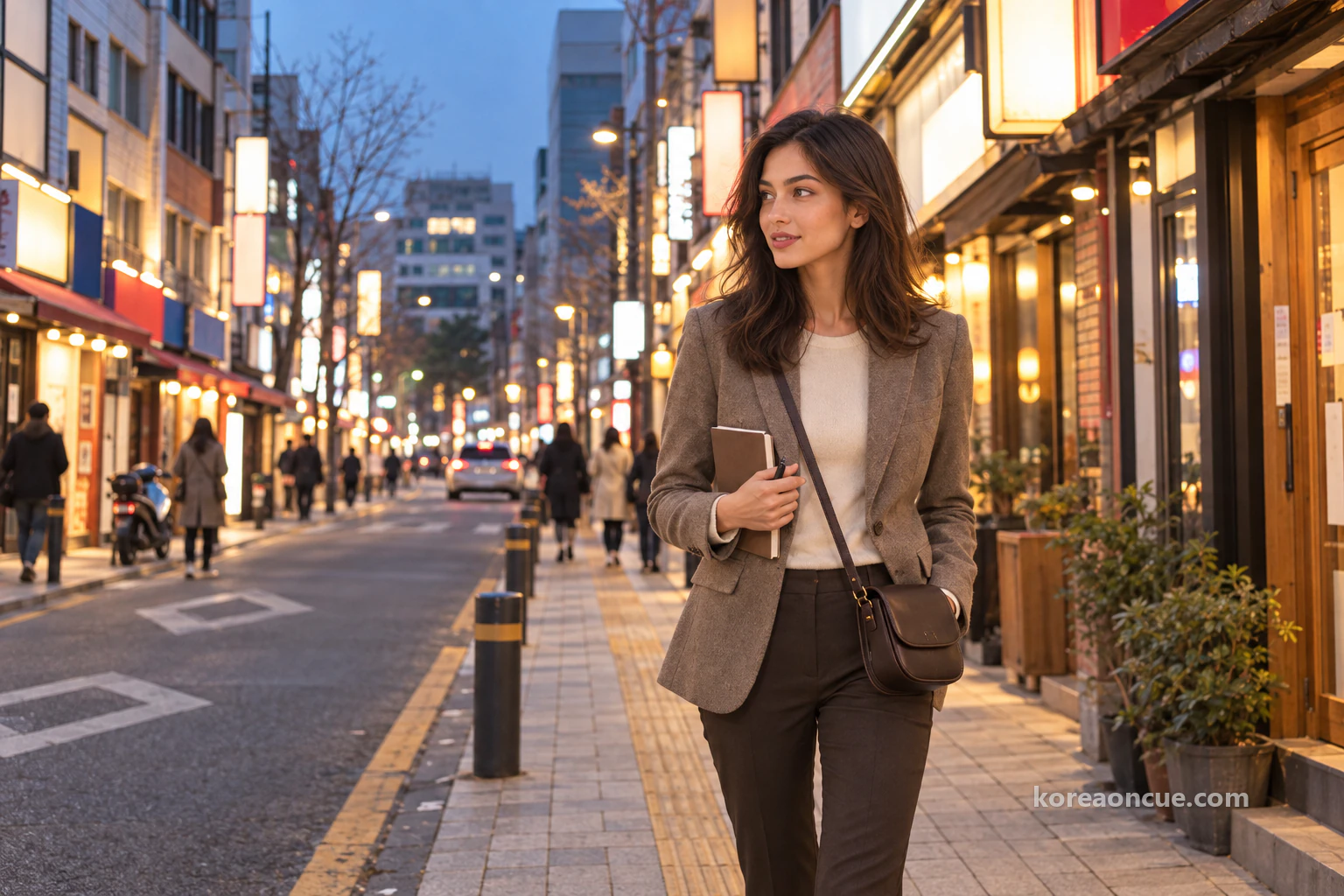
The neighbourhood changes again after sunset. Near Exit 6 of Jongno 3-ga Station, the pocha street, with its outdoor food stalls, has trading hours beginning at 6 p.m. under the shared-street rules, although individual opening times vary a little. An afternoon around Nakwon can lead into an evening there, and Ikseon-dong’s hanok lanes are also only a few minutes away on foot. Elena leaves those for another day, ending this one with a brief look towards the lights beginning to come on in the distance.
Before and after the stairs
On the underground back to her accommodation, Elena returns to “Before the stairs” at the top of her notebook. That morning, she had imagined only a short stretch of street before the staircase, but it has turned out to include a building over a road, public spaces beneath it and a park and streets beyond. She goes over the arrows beside her cross-section once more. On the last line, she writes “Next time I explain this place, start before the stairs.”
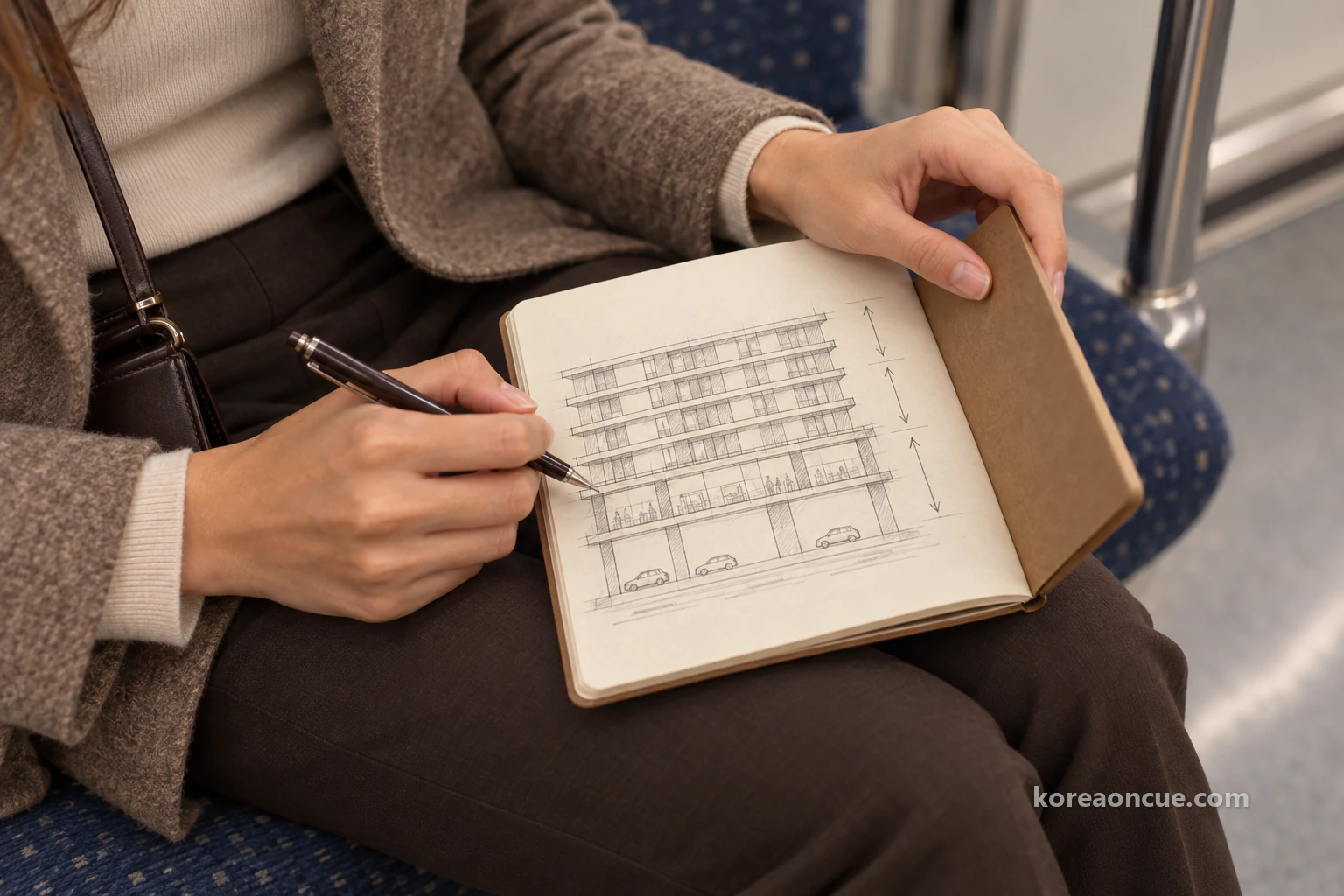
She then puts her pen away.
Common Mistakes
Saving only a map pin for “Nakwon”
directions can become confusing beneath the building. Use Exit 5 of Jongno 3-ga Station as the starting point: the mall is 110 m away, and the community arts centre is about a two-minute walk towards Insadong.
Including the community arts centre on a Monday
it closes every Monday. On Saturdays and Sundays, it closes at 6 p.m.
Stepping into the road beneath the building for a photograph
traffic still runs through floor 1. Take photographs from the pedestrian space.
Pointing the camera into shops from the corridor
the shops on either side are workplaces. Focus on the corridors, stairs and building exterior.
Reaching Tapgol Park too late
it closes at 6 p.m. from March to October and at 5 p.m. from November to February.
FAQ
Which exit should I use for Nakwon Music Mall?
Exit 5 of Jongno 3-ga Station on Lines 1, 3 and 5. The mall is 110 m away, at 428 Samil-daero, Jongno-gu, Seoul.
Which floors have the instrument shops?
Around 300 shops occupy floors 2 and 3. A road runs through floor 1, with the community arts centre beneath the building.
When does the community arts centre beneath Nakwon open?
The centre building opens Tuesday to Sunday, 10:00–21:00, with Saturday and Sunday hours of 10:00–18:00. It closes every Monday, on 1 January and during the Seollal and Chuseok holidays. Check the history gallery section of its website for exhibition details. There is no parking.
Is Tapgol Park nearby?
It is a few minutes’ walk from Nakwon. Hours are 09:00–18:00 from March to October and 09:00–17:00 from November to February. Alcohol is prohibited throughout the park.
Where is Songhae-gil?
It runs for 244 m from outside the Yukuijeon Building to Nakwon, ending at Exit 5 of Jongno 3-ga Station. Its official road name is Supyo-ro.
Recap — 30 seconds before you go
- Starting point: Jongno 3-ga Station, Exit 5 — mall 110 m away, community arts centre about two minutes towards Insadong
- Order: pavement beneath the building → community arts centre, open Tuesday to Sunday and closed Mondays → instrument shops upstairs on floors 2 and 3 → outside the older people’s recreation space on floor 1 → Tapgol Park → Songhae-gil, 244 m, back to Exit 5
- Tapgol Park: closes at 18:00 from March to October and at 17:00 from November to February · alcohol prohibited
- Evening: pocha street near Exit 6 — trading from 18:00 under the shared-street rules, individual opening times vary
Sources
- Seoul Future Heritage — Nakwon Music Mall428 Samil-daero · selected in 2013 · one basement level and 17 storeys above ground · road through floor 1 · around 300 instrument shops · history of the mall and its musicians’ job marketchecked 2026-10-21
- Seoul Media Hub — Jongno 3-ga and Nakwon Music Mall (2026-10-06)Nakwon Music Mall is 110 m from Exit 5 of Jongno 3-ga Stationchecked 2026-10-21
- Nakwon community arts centre — Visitor informationTuesday–Sunday 10:00–21:00, closing at 18:00 on Saturdays and Sundays · closed Mondays, 1 January and the Seollal and Chuseok holidays · about two minutes from Exit 5 towards Insadong · no parkingchecked 2026-10-21
- Seoul Media Hub — Beneath Nakwon (2020-12-03)Roads running north–south and east–west beneath the building · pedestrian-space improvements · instrument shops on floors 2 and 3checked 2026-10-21
- Seoul Media Hub — Nakwon community arts centre and history gallery (2023-08-18)Opened in October 2020 · converted from part of the parking area beneath the building · exhibitions on popular music and the Nakwon areachecked 2026-10-21
- Seoul Media Hub — Songhae-gil (2023-01-03)244 m from the front of the Yukuijeon Building to Nakwon · official road name Supyo-ro · honorary name Songhae-gil · monument outside Exit 5checked 2026-10-21
- Seoul Media Hub — Older people’s recreation space and Tapgol Park (2026-04-08)Recreation space on floor 1 of Nakwon · 17 janggi and baduk tables · 10:00–18:00 except public holidays · seasonal park hours and alcohol restrictionschecked 2026-10-21
- Seoul Media Hub — Tapgol Park’s historic sites (2022-09-19)Samil-mun main gate · Palgakjeong and the reading of the Declaration of Independence in 1919 · 12 m, ten-storey stone pagoda at the Wongaksa Temple site, built in 1467checked 2026-10-21
A Seoul story told with our AI characters. Place details are checked against public sources; the photos are AI-made illustrative images. How we use AI