SEOUL · JONGNO 3-GA
Seosulla-gil: A Saturday to Take a Step Back from the Shop Windows
Rina returns alone to the craft street she walked with a friend last week, taking her time between the stone wall, a jewellery showroom and a museum of saekdong (cloth made from bands of different colours)
Last week, Rina kept pace with a friend along the craft street. Returning alone, she visits the jewellery showroom and saekdong museum, trying out a line from her notebook: “Take a step back.”
How to get there
There is a line in Rina’s notebook from last Saturday: “Take a step back.” That was the day she first met Maya, a friend she had only spoken to on Instagram, and walked along Jongmyo’s stone wall with her. Rina kept leaning towards the workshop windows to inspect the finishing, until Maya’s photograph of the wall and eaves showed her something else: the setting around a small object could be worth looking at too. A week later, Rina decides to return to the same street on her own.
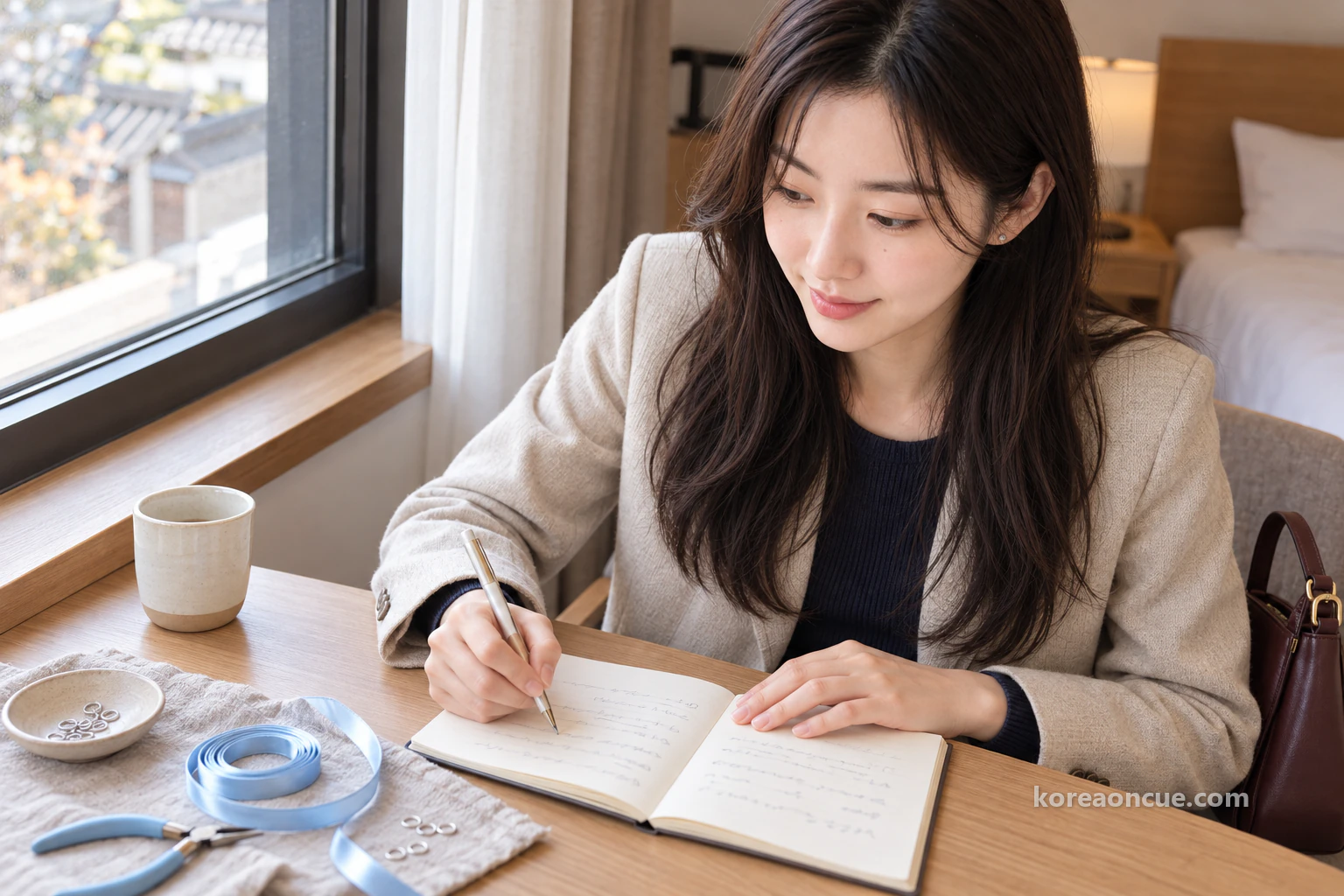
Two places they passed last time have stayed on her mind. She was enjoying their conversation so much that she only glanced at the jewellery showroom in a hanok (traditional Korean house) halfway along the wall and the saekdong museum. For someone who makes her own bag charms, both offer a chance to see what makers choose to show. Today, she has booked the museum in advance, plans to reach the showroom when it opens and has left herself plenty of time at the shop windows in between.
This is the story of that Saturday, and a way to explore Seosulla-gil beyond a walk beside the stone wall. The street follows Jongmyo’s western boundary, but it also brings together workshops working with metal, embroidery and paper. We’ll follow Rina from the station exit to the showroom and museum, with their opening days, entry arrangements and the reasons Saturday works well for this walk.
The Cue — At a glance
Exit 7 of Jongno 3-ga Station is all that is needed to start this walk. Follow Donhwamun-ro 10-gil to Jongmyo’s western wall, where Seosulla-gil begins. The jewellery support centre’s showroom is along the street, with the saekdong museum at the end of a lane just beside it. Both close on Sundays, Mondays and public holidays, while the street is traffic-free from 10 a.m. to 10 p.m. at weekends, making a Saturday that is not a public holiday the best fit for walking and visiting both. Book your museum visit at least a day in advance.
- When: a Saturday that is not a public holiday works best. The traffic-free hours (weekends, 10:00–22:00) overlap with the showroom and museum’s opening days (Tue–Sat).
- Which exit: Exit 7 of Jongno 3-ga Station. From the exit, the museum is 190 m away (2 min), the jewellery showroom 292 m (4 min) and Oedaemun, Jongmyo’s main gate, 332 m (4 min).
- Jewellery support centre: Tue–Sat, 11:00–19:00. Closed Sundays, Mondays and public holidays. The pop-up showroom occupies floors 1 and 2 of Building 2 at 83 Seosulla-gil.
- Saekdong museum: 85-7 Yulgok-ro 10-gil, Jongno-gu, Seoul. Visits are by advance reservation on Tuesday–Saturday afternoons, through saekdongmuse@naver.com, 02-765-9286 or Naver Booking. Closed Sundays, Mondays and public holidays. Admission is 6,000 won for adults and 5,000 won for children and teenagers. No museum parking.
- Jongmyo: the shrine grounds inside the wall close every Tuesday.
From Exit 7 to the stone wall
Rina comes out of Exit 7 of Jongno 3-ga Station at around 10:30 a.m. Last week, she met Maya outside Exit 6 and they crossed over together, but today she chooses the Seosulla-gil side from the start. From the exit, she follows Donhwamun-ro, turns into Donhwamun-ro 10-gil and walks until Jongmyo’s western wall comes into view, marking the start of Seosulla-gil. The street takes its name from the guards who once patrolled here, a story Rina told Maya last week, and the route already feels familiar.

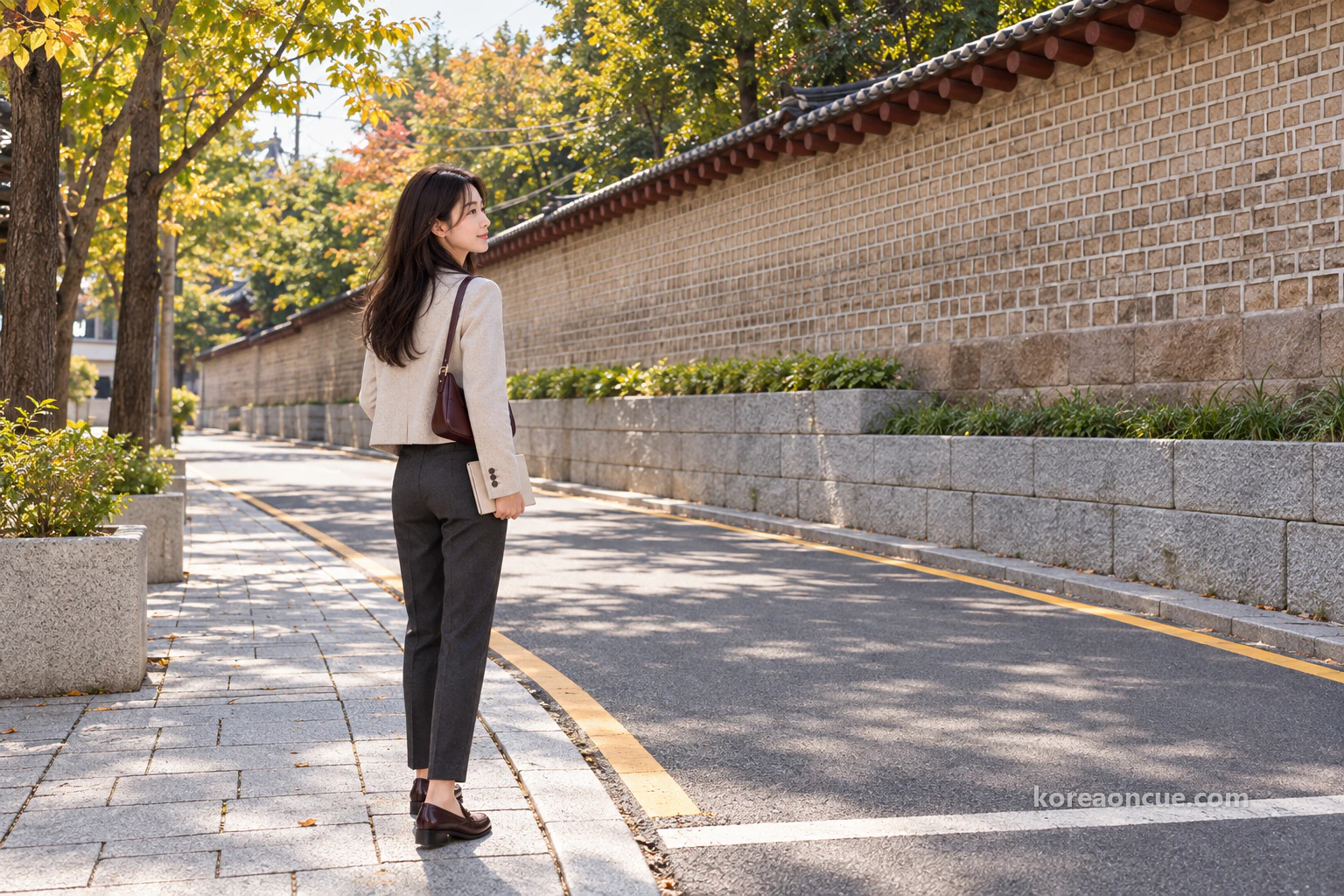
There is a reason she chose Exit 7: every stop today is close to it. The saekdong museum is 190 m away, a two-minute walk, while the jewellery showroom in Building 2 is 292 m away, about four minutes on foot. Even Oedaemun, Jongmyo’s main gate, is only 332 m from the exit, so remembering one exit number puts both the craft facilities and the shrine entrance within walking distance. Rina writes “7” at the top of a page and circles it.
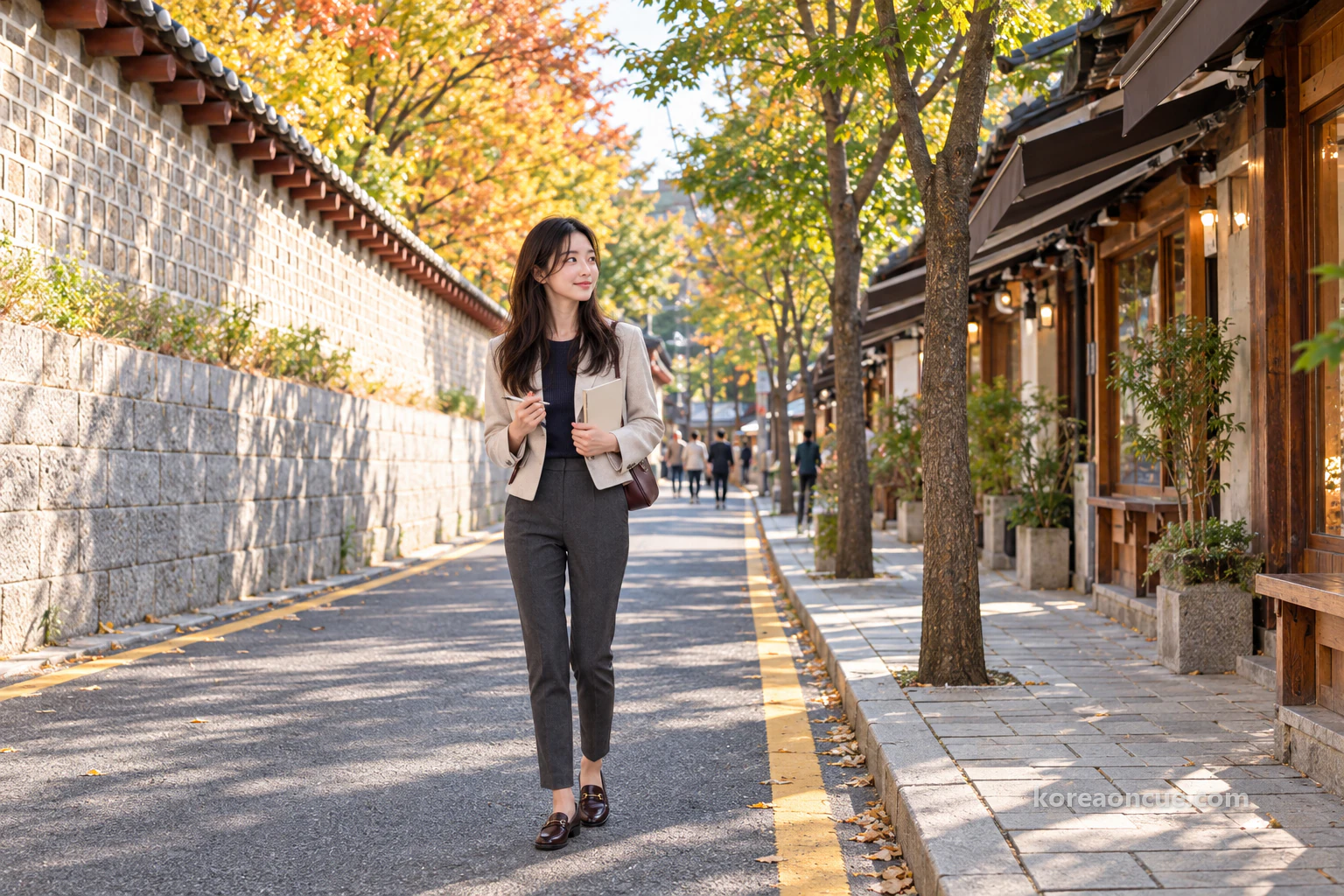
Seosulla-gil is quieter than she expected this Saturday morning. At weekends it is traffic-free from 10 a.m. to 10 p.m., so walking down the middle is possible, while weekday traffic runs one way and pedestrians need to keep to the side. A few shops have yet to open, and Rina takes her time along the wall-side edge. With the showroom opening at eleven, she has decided to spend the half-hour beforehand looking at the street itself.
Earlier this year, Seosulla-gil was chosen to represent Jongno-gu in Seoul’s 2026 selection of 25 places, decided by votes from 33,911 Seoul residents. Its description introduces an old Joseon-era patrol route now lined with hanok cafés and jewellery workshops, but “jewellery workshops” is the phrase Rina notices first. Last week she took in the street’s atmosphere, while today she has come to see what those workshops put on display and how they present it. Beneath “7”, she writes “Workshops today.”
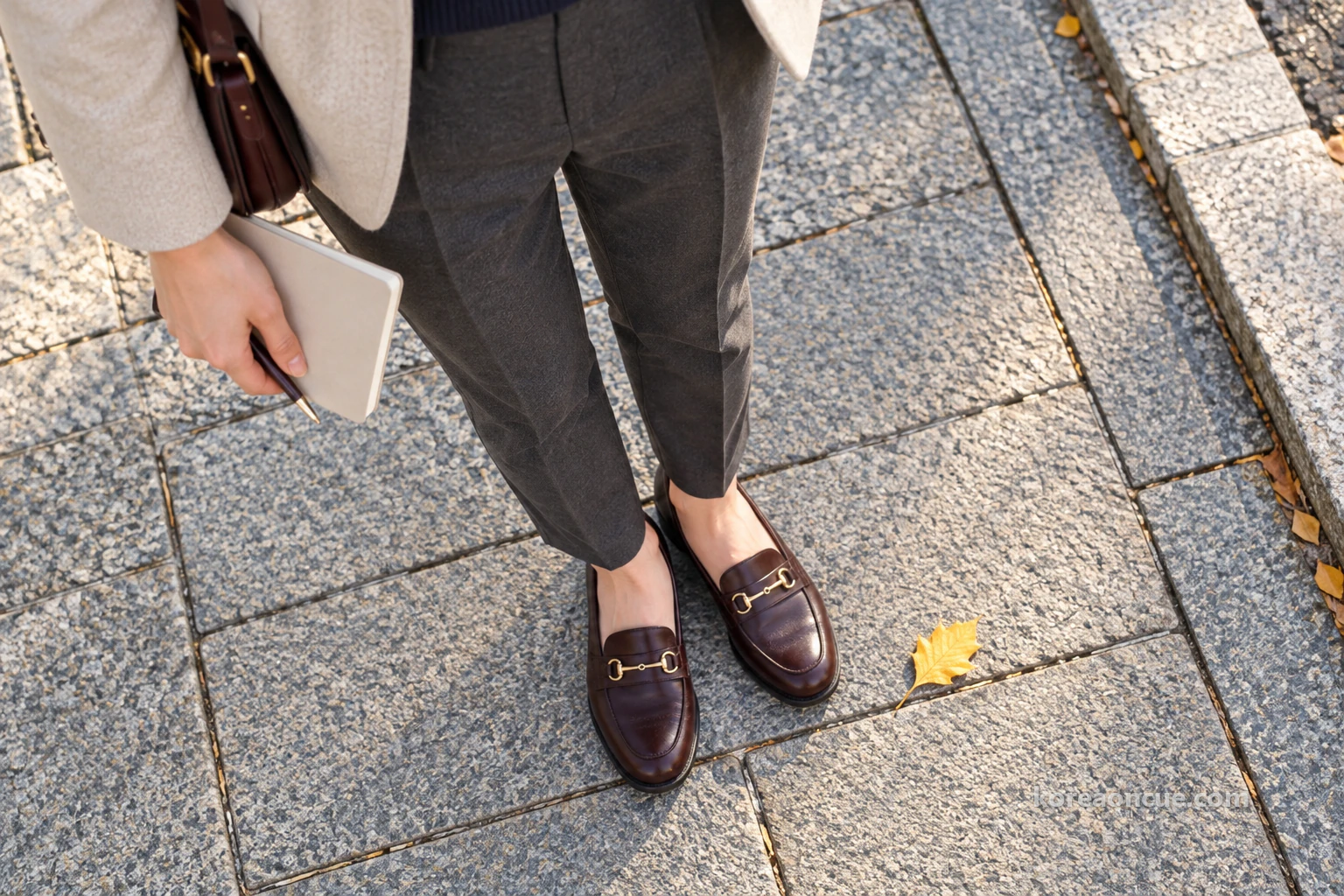
Her attention first drops to the ground. Seoul began developing Seosulla-gil in 1995, the year Jongmyo became a UNESCO World Heritage Site, and completed improvement works in 2020. Those works narrowed the roadway and doubled the pavement’s width to 3 m, creating a stone-paved walking route to suit Jongmyo’s wall. Rina follows the joins between the stones for a few steps, thinking that a street needs its edges finished too, rather like folding and stitching the end of a ribbon for a bag charm.
A step back from the shop windows
Seosulla-gil is a street devoted to craft. Once known for gold rings and silver necklaces, its emptying lanes gradually filled with metalworkers, embroiderers, makers of traditional domestic needlework and small shops. Seoul developed the street around that growing craft community and opened two jewellery support centre buildings to help jewellery and metal craftspeople. Small studios working with metal, horticulture, embroidery and paper remain tucked along the lanes, while converted hanok cafés, workshops and jewellery shops stand opposite the wall among small factories and shops that have been here for years.
At the first window, Rina leans towards the glass as she always does. Before the design, she notices how the rings and joins have been finished. It is where she starts when choosing materials in Dongdaemun, and where she began with Maya’s charm too. So far, this is just like last week, but then she remembers the line in her notebook and deliberately takes one step back.
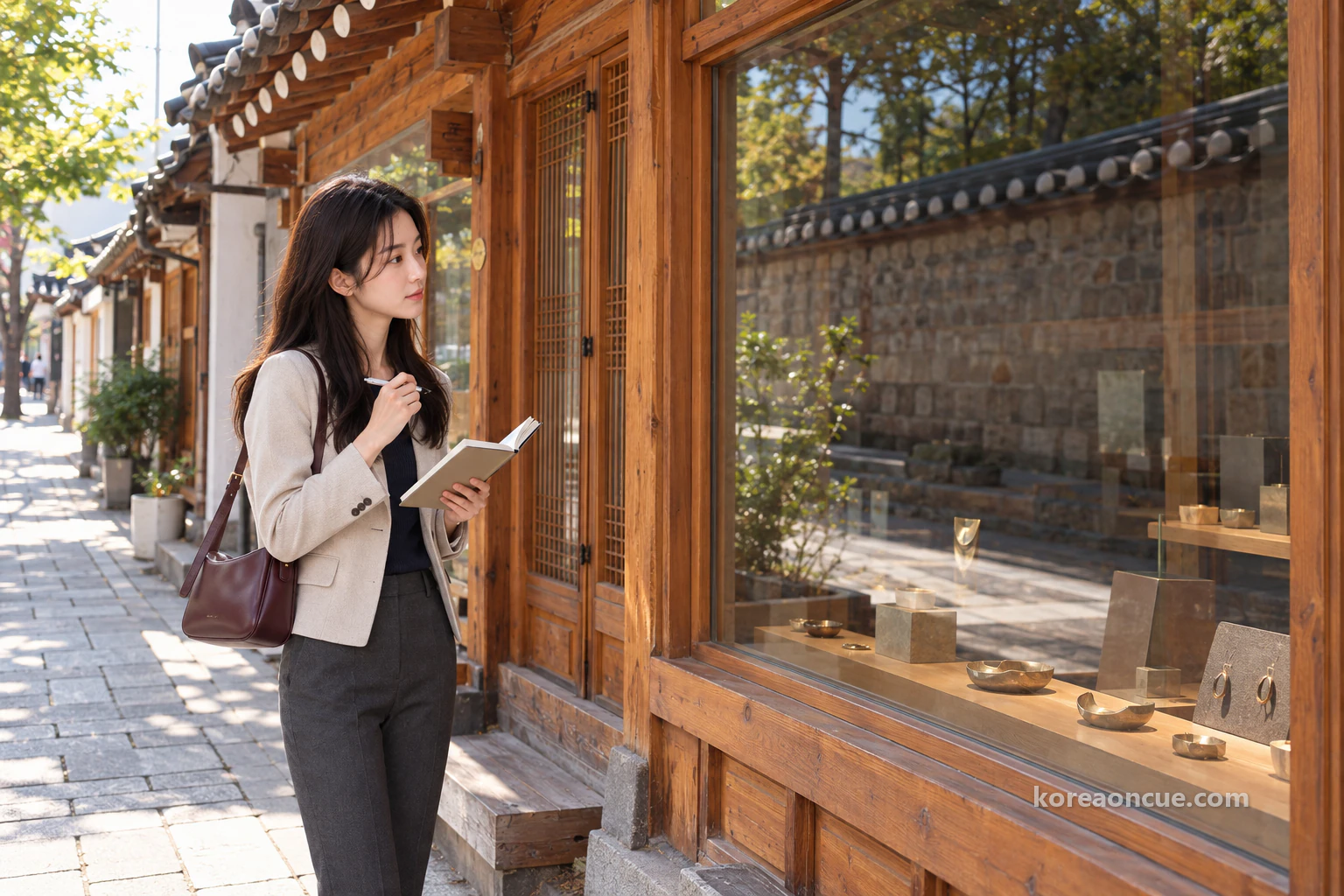
From there, she sees how much surrounds the display. The street is narrow enough for the opposite wall to reflect in the glass, leaving the pieces in the window suspended over its grey stones. Up close, she could only see the finishing, but a step back brings the stone wall into the background too. She divides a space in her notebook into two columns and writes “Close up — finishing / A step back — background.”
Try the same approach at the windows along Seosulla-gil. Opening hours and days off vary between workshops and small shops, but looking at the displays together with the wall gives a good sense of the craft street even without going inside. During traffic-free hours, you can step back towards the middle of the road, but if you linger at a window, glance around now and then to keep the way clear for people passing.
The jewellery lab: where the making happens
As eleven approaches, Rina stops outside Building 1 of the jewellery support centre at 89-8 Seosulla-gil before going to the showroom. Supported by Seoul and operated by a Korean foundation promoting the jewellery industry, the centre has two buildings on this street. Building 1 is the jewellery lab, with a prototyping workshop on floor 1, a photographic studio and library on floor 2 and a shared gem-testing room on basement level 1. It is a workspace where makers use equipment and facilities, rather than a showroom to browse.
Access works differently here too. Using the facilities involves membership and reservations for facilities and equipment training, with the official website listing training for 3D printers, laser engravers, arc welders and basic gem-testing equipment. Outside the entrance, Rina scrolls through the site and copies equipment names into her notebook. This is not a place she can use on a brief visit as a traveller, but after spending two evenings making one small charm at her accommodation desk, she is fascinated by how much equipment is gathered in a single building.
The photographic studio holds her attention longest. Its automated equipment can produce jewellery photographs, while the shared gem-testing room provides specialist equipment for examining jewellery. Maya’s photographs last week first made Rina realise how often even a small handmade charm has to speak through a single image. Showing something well takes learning too, and she adds another line to her notebook: “Photography is part of making.”
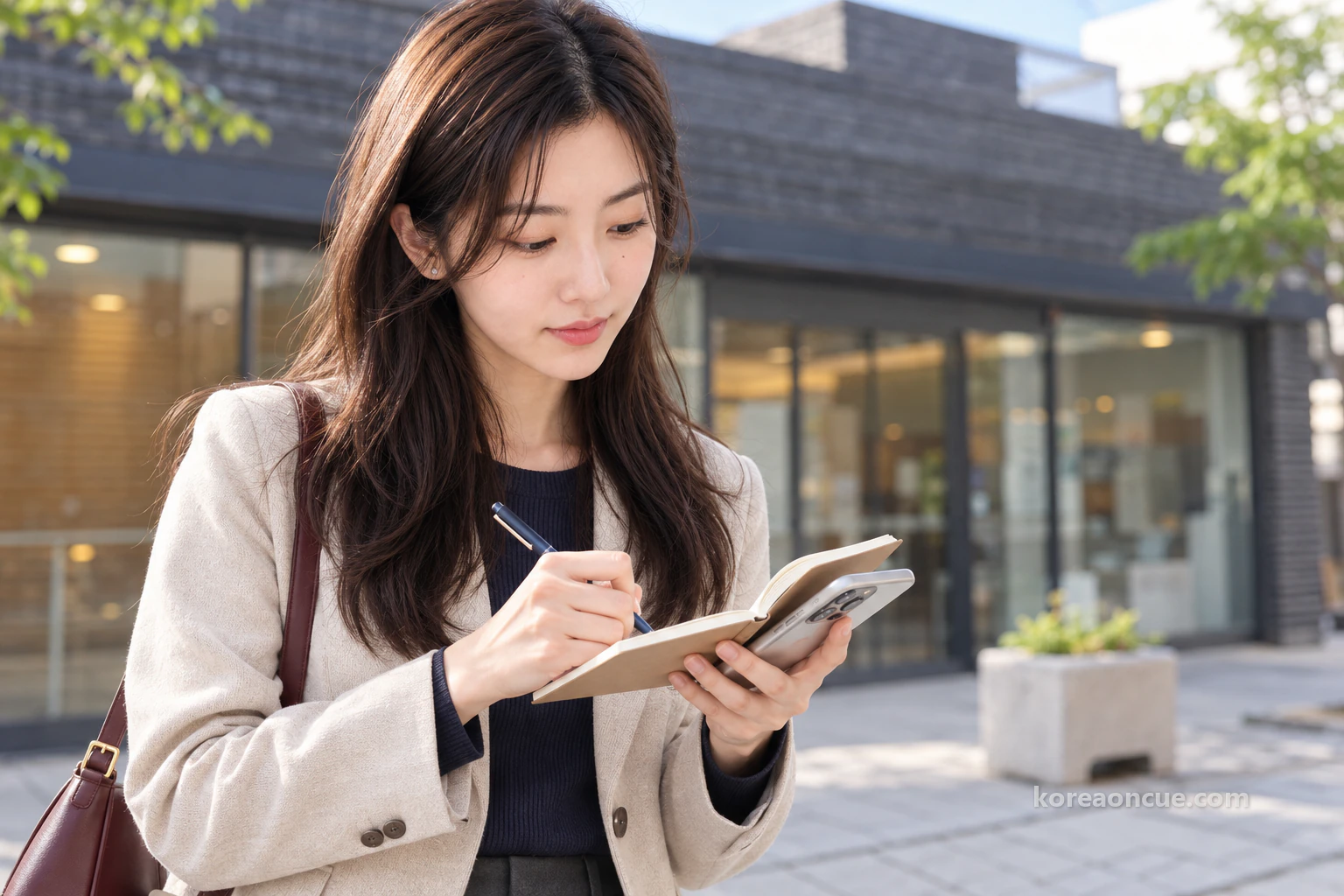
Seen through a maker’s eyes, the stops along this street begin to connect. Pieces take shape in the workshops, prototypes are refined and photographed in facilities such as Building 1, and then they need somewhere to meet the public. Knowing that Building 2, a few steps away, provides that final space changes how Rina thinks about the objects she saw in the windows earlier: each is at the end of a much longer process. She joins three words with arrows in her notebook: “Make → Refine → Show.”
The jewellery showroom: a first space for small brands
After eleven, Rina stands outside a hanok about halfway along the stone-wall street. This is Building 2 of the jewellery support centre, its jewellery showroom. Opened in 2017, the hanok at 83 Seosulla-gil has pop-up jewellery showrooms on floors 1 and 2, where emerging designers and small brands introduce and sell their work. Basement level 1 holds a business-to-business showroom and basement level 2 houses the operating office. The pop-up displays are on floors 1 and 2.
The showroom is part of the centre’s work supporting small brands. Building 2 serves people pursuing jewellery design and starting businesses, while the centre finds promising brands and helps with branding training, sessions to share their results and entry into physical shops. The pop-up showroom gives those brands a place to meet visitors directly. Before coming, Rina browsed the official website’s archive of past showroom pop-ups to see which brands had already spent time here.
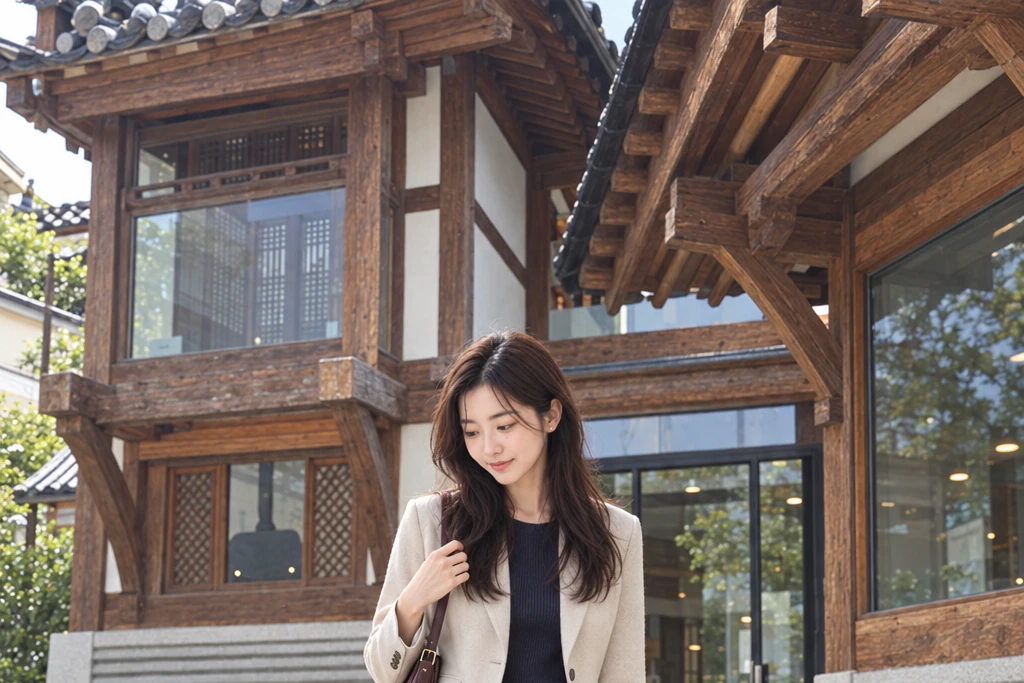
Before going in, Rina spends a while looking down at the decorated stone cubes outside. She pauses to study the patterns on their faces before turning towards the entrance. Inside, pieces from the pop-up display are arranged on floor 1. Rina first examines their rings and clasps one by one, then takes another step back to look at the whole display.
What stays with her longest is what the space does, more than any individual piece. Here, in a hanok halfway along a stone-wall street, someone working alone can show their work to the public for the first time, on the same street as Building 1’s work facilities. Rina hopes to show her own charms to someone one day, and her biggest discovery today is that finding a place to show them belongs to the making process too. She circles “Show” again at the end of her arrows.
The showroom opens Tuesday–Saturday from 11 a.m. to 7 p.m. and closes on Sundays, Mondays and public holidays. Both buildings are on Seosulla-gil, but they serve different purposes, so head to Building 2 if you want to browse. For a Sunday walk, plan to see the hanok exterior and decorative stonework from outside.
Once you have chosen a date, open the notices on the jewellery support centre’s website. Monthly operating notices are posted there, and this October’s notice lists closures for National Foundation Day (Saturday 3 October) and Hangeul Day, as well as the regular closures on 4–5 October. Even a Saturday opening is cancelled when it falls on a public holiday, so this notice can save a wasted trip if the showroom is central to your plans. Rina checked it the day before setting off to make sure this Saturday was an opening day.
Public holidays need one more check because they affect both stops. The jewellery support centre and saekdong museum close on Sundays, Mondays and public holidays, so both are closed even on a Saturday if it is a public holiday. Before leaving Japan, Rina looked through Korea’s public holidays while choosing her travel dates and noted in the corner of her notebook that this Saturday was not one. If you want to visit both places, check that first when picking a date.
Two in the afternoon at the saekdong museum
After lunch, Rina returns to the stone-wall street and heads to the saekdong museum for two o’clock. Its address is 85-7 Yulgok-ro 10-gil: from Exit 7, walk straight towards Changdeokgung, then turn right into the lane leading to a two-storey hanok at the end. From the Seosulla-gil side, it is 90 m from the showroom, a walk of a little over a minute, so she is still close to her morning route. She emailed the museum three days ago to reserve today’s two o’clock visit.
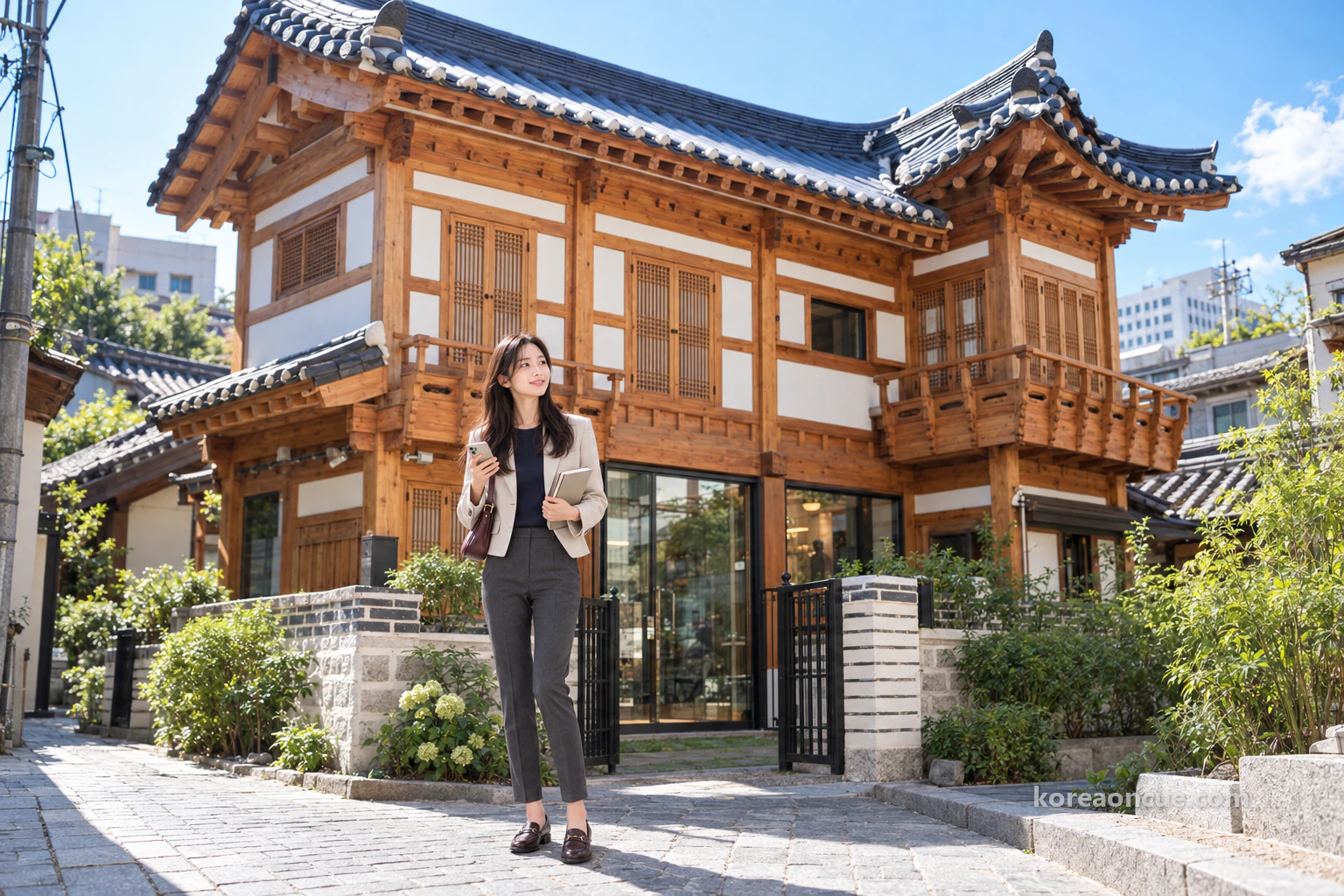
The first thing to arrange here is a reservation. Museum visits are by advance booking on Tuesday–Saturday afternoons, through email at saekdongmuse@naver.com, telephone on 02-765-9286 or Naver Booking. It closes on Sundays, Mondays and public holidays, with admission of 6,000 won for adults and 5,000 won for children from preschool age through to age 19. There is no museum parking, so the subway is the easier way to come.
A reservation also gives the day one fixed point. Rina booked the museum for two first, then fitted the showroom and shop windows around it. The showroom’s hours, from eleven to seven, make it easy to visit before or after the museum, while the wall and window displays can fill the gaps without a fixed appointment. If you are booking a visit during your trip, choosing the museum time first makes the rest easier to arrange.
The museum opened in March 2014 and holds around 1,000 saekdong-related objects, including wedding clothes and first-birthday outfits. It grew from more than 30 years of research and collecting by its founder, Professor Emerita Kim Ok-hyun, a saekdong researcher. She studied textile design at postgraduate level in the United States and taught in a university digital crafts department from 1984 to 2013, and reading that introduction before emailing made Rina think of this as a collection assembled by a maker. The building was also designed to bring traditional hanok architecture together with contemporary spaces.
The history of saekdong told by the museum stretches back around 1,700 years to the Three Kingdoms period, with an example visible in a noblewoman’s skirt in Goguryeo’s Susan-ri murals. Traditionally, children wore saekdong for their first birthday with wishes for health and a long life, and its uses extend from ceremonial, wedding and festive clothes to bojagi (wrapping cloths) and pouches. The museum presents it as a distinctly Korean cloth influenced by the colours associated with yin, yang and the five elements.
The permanent exhibition tells the story of saekdong and hanbok (traditional Korean clothing). Gallery 2 on floor 1 displays wedding clothes and accessories, children’s saekdong clothing, saekdong quilts and decorative panels used at the ends of traditional pillows. Gallery 1 on basement level 1 holds children’s saekdong clothing and a variety of traditional dolls dressed in hanbok. Rina takes her time on floor 1 before heading downstairs.
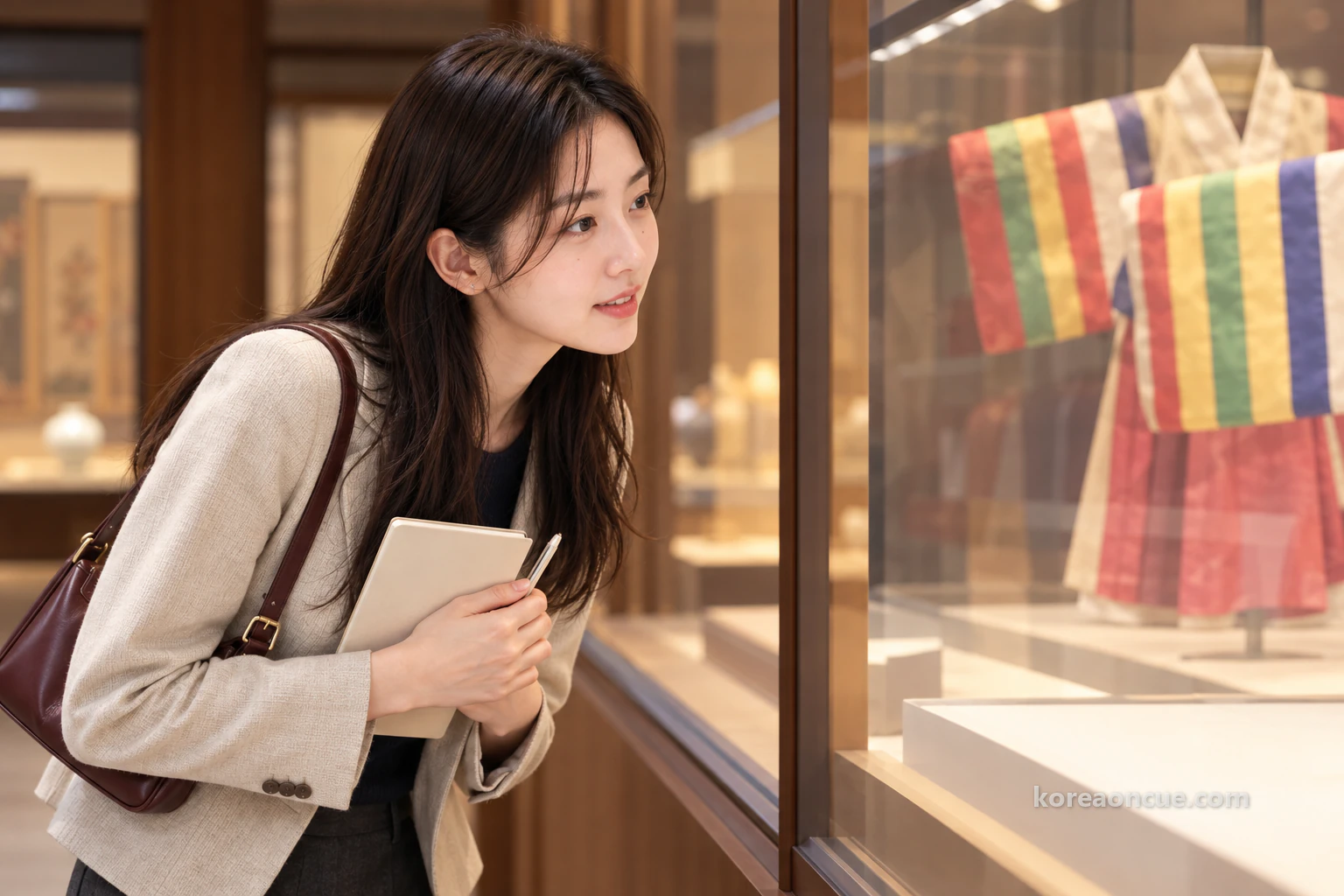
Once again, her eyes go straight to the joins. In front of the clothing’s parallel bands, she studies which colour follows which and how straight the boundaries are. When she chose the sky-blue ribbon and silver-coloured ring for Maya’s charm last week, it was the way the two colours sat beside each other that decided it. She takes out her notebook and writes “Saekdong — the spaces between the bands, rather than one band alone,” already wanting to start her next charm by deciding the gap between two ribbons.
As she leaves, she returns to the museum’s guiding idea. Its research and product development explore how saekdong can be used in contemporary clothes and objects, bringing traditional forms into everyday life today. The morning showroom gave her a place where today’s makers first present their work, while the museum traced how colours passed down over time become objects for the present. In small letters before “Make → Refine → Show”, she adds “Inherit”.
For a day on Seosulla-gil, it is easy to start with the showroom when it opens and visit the museum at the booked afternoon time. Like Rina, you can follow Donhwamun-ro 10-gil from Exit 7 to the wall, walk along the street to the showroom, then move to the museum 90 m away. Without the pauses at shop windows, the walking itself is not far, leaving little reason to hurry.
Jongmyo beyond the wall
Back beside the stone wall after the museum, Rina spends a while looking beyond it for the first time. This is Jongmyo’s western boundary, enclosing the shrine that houses the spirit tablets of Joseon’s kings and queens and became a UNESCO World Heritage Site in 1995. The trees above the wall are beginning to turn. Rina centres the line where the autumn colours meet the grey stone on her phone screen and takes a photograph.
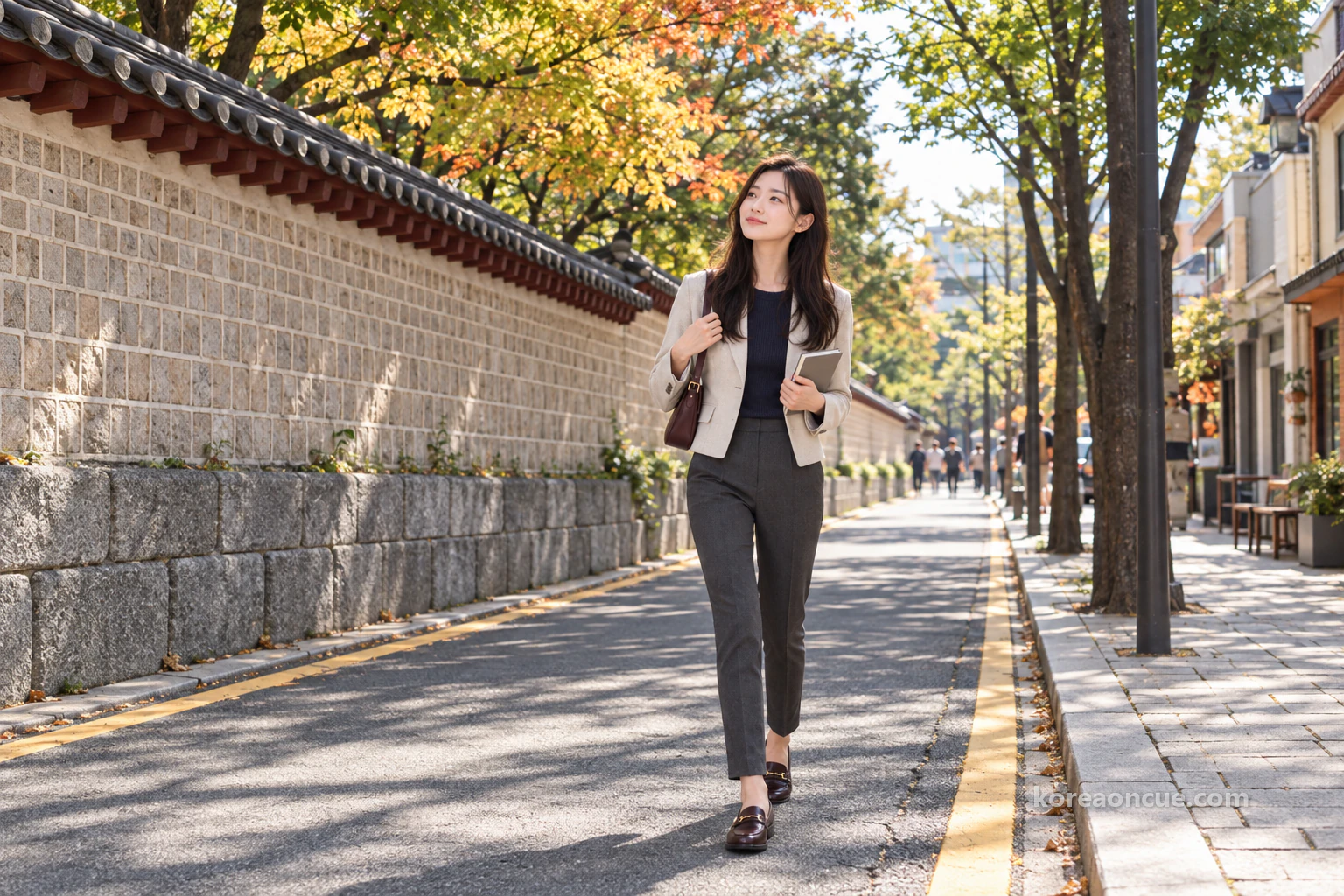
To enter Jongmyo, head to its main gate, Oedaemun, 332 m or a four-minute walk from Exit 7. The shrine closes every Tuesday, but Seosulla-gil outside the wall can be walked on any day. On Sundays and Mondays, when the showroom and museum close, you can combine the shrine grounds with the wall-side street, while Tuesday suits the street and craft facilities instead. Rina has set today aside for exploring outside the wall, so she simply writes “Next — Oedaemun, avoid Tuesday” in her notebook.
Towards sunset, when the wall lights come on
As six approaches, Rina checks the time. At weekends the street stays traffic-free until 10 p.m., so walking down the middle is still possible after the lights come on. She moves onto the pavement and reads back through her notes as the sun sets. “7”, “Close up — finishing / A step back — background”, the four words linked by arrows and “the spaces between the bands” have filled more lines than she expected.
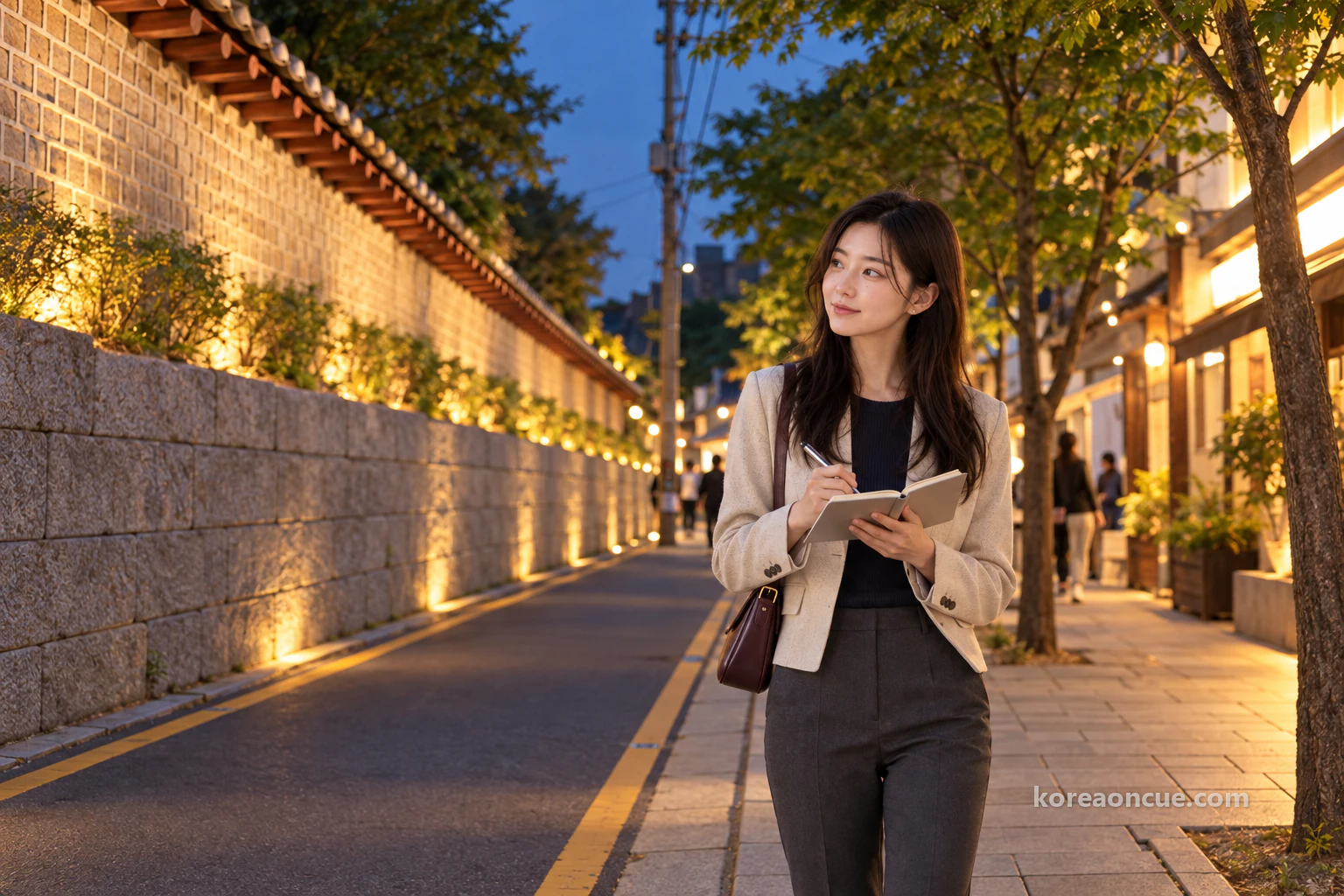
As daylight fades, soft lights come on along the wall. Earlier, she could pick out the shape of each grey stone, but now the wall reads as one long line. It reminds her of the day’s discoveries. The showroom connected making, refining and showing, while the museum traced a line from old colours to objects made for today.
She takes a photograph of the lit wall and sends it to Maya. “I came on my own today and took a step back,” she writes, and a reply soon arrives: “That framing is completely mine.” Rina smiles at the message, then folds the corner of the page with the showroom hours and museum booking details. If she walks this street with someone again, she will be ready to open it and show them.
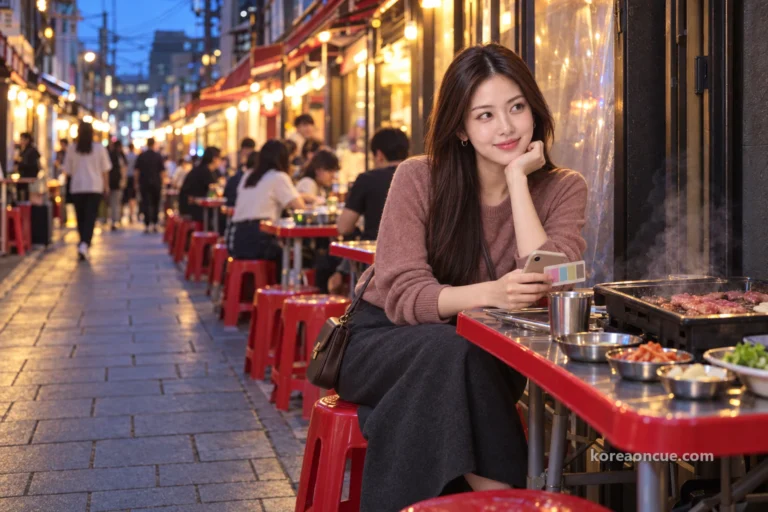
If you stay on Seosulla-gil into the evening, other stops are close on foot. Ikseon-dong Hanok Street is a few minutes’ walk away, an easy continuation through the hanok lanes as their lights begin to come on, while Jongno 3-ga Pocha Street, where Rina sat with Maya last week, opens after 6 p.m. Today, Rina goes nowhere else and returns to Exit 7 with several newly filled pages. She still likes to look closely, but there is now one more step to her habit.
Common Mistakes
Planning the showroom and museum for a Sunday, Monday or public holiday
both close on those days. A Saturday that is not a public holiday works best.
Arriving at the saekdong museum without a reservation
visits require advance booking. Arrange a time through email, telephone or Naver Booking.
Coming early and heading straight to the showroom
it opens at eleven. Walk beside the wall and look at the shop windows first.
Entering Building 1 to browse
the jewellery lab is a workspace used through membership and reservations for equipment training. Head to the showroom in Building 2 for a look around.
Adding the Jongmyo grounds to a Tuesday visit
Jongmyo closes every Tuesday. Seosulla-gil outside its wall can be walked on any day.
FAQ
Which exit should I use for Seosulla-gil?
Take Exit 7 of Jongno 3-ga Station on Lines 1, 3 and 5, then follow Donhwamun-ro 10-gil to Jongmyo’s western wall, where the street begins.
Can anyone visit the jewellery support centre?
The pop-up showroom on floors 1 and 2 of Building 2, at 83 Seosulla-gil, is open for browsing during its operating hours, Tue–Sat, 11:00–19:00. Building 1 is a workspace used through membership and reservations for equipment training.
How do I book the saekdong museum?
Book at least a day in advance by emailing saekdongmuse@naver.com, calling 02-765-9286 or using Naver Booking. Visits are on Tuesday–Saturday afternoons, with closures on Sundays, Mondays and public holidays. Admission is 6,000 won for adults and 5,000 won for children and teenagers.
What is on display at the saekdong museum?
The permanent exhibition tells the story of saekdong and hanbok through wedding clothes and accessories, children’s saekdong clothing, saekdong quilts, decorative pillow-end panels and traditional dolls dressed in hanbok.
When is the street traffic-free?
At weekends, from 10 a.m. to 10 p.m.
Recap — 30 seconds before setting off
- Exit: Jongno 3-ga Station, Exit 7 — museum 190 m · showroom 292 m · Jongmyo’s main gate, Oedaemun, 332 m
- Day: a Saturday that is not a public holiday — traffic-free street (weekends, 10:00–22:00) + showroom and museum opening days (Tue–Sat)
- Showroom: Building 2 of the jewellery support centre, 83 Seosulla-gil — Tue–Sat, 11:00–19:00, pop-ups on floors 1 and 2
- Museum: saekdong museum, 85-7 Yulgok-ro 10-gil — Tuesday–Saturday afternoons by reservation, saekdongmuse@naver.com · 02-765-9286, adult admission 6,000 won
- Jongmyo inside the wall closes Tuesdays · the stone wall is illuminated after sunset
Sources
- Seoul Media Hub — Seosulla-gil (2024-08-05)Exits 7 and 8 and the approach via Donhwamun-ro 10-gil · craft-focused streetchecked 2026-10-21
- Seoul Media Hub — Seosulla-gil improvements and crafts (2021-09-16)Development began in 1995 · improvements completed in 2020 · 3 m pavement · craft street and jewellery support centreschecked 2026-10-21
- Seoul Media Hub — A walk along Seosulla-gil (2025-06-05)Weekend traffic-free hours · soft lighting along the wall at nightchecked 2026-10-21
- Seoul Jewelry Industry Support Center — Official websiteBuilding addresses and floor layouts · Tue–Sat 11:00–19:00 · closed Sundays, Mondays and public holidays · equipment training and membership · showroom archive and monthly noticeschecked 2026-10-21
- Seoul Media Hub — Jewellery support centre (2025-07-07)Building 2’s hanok and pop-up showroom · support for emerging brands · Building 1’s photo studio and gem-testing facilities · stone features outsidechecked 2026-10-21
- Korea Saekdong Museum — Visitor informationAdvance bookings for Tuesday–Saturday afternoons · closed Sundays, Mondays and public holidays · adults 6,000 won, children and teenagers 5,000 won · booking contactschecked 2026-10-21
- Korea Saekdong Museum — Directions85-7 Yulgok-ro 10-gil · from Exit 7 towards Changdeokgung, then to the end of a lane on the right · no parkingchecked 2026-10-21
- Korea Saekdong Museum — Current exhibitionPermanent exhibition on saekdong hanbok · clothing, wedding garments, accessories and traditional dolls on floor 1 and in the basementchecked 2026-10-21
- Seoul Media Hub — Jongmyo visiting tips (2025-06-17)Visiting tips for Jongmyo inside the wallchecked 2026-10-21
- Jongno-gu — Seosulla-gil traffic-free hours extended (22 December 2025)Saturdays and Sundays 10:00–22:00 from 20 December 2025checked 2026-10-21
- Royal Palaces and Tombs Center — Visiting hours and closing daysJongmyo’s regular Tuesday closure; open when Tuesday is a public or substitute holiday, closed on the next non-holiday insteadchecked 2026-10-21
- Korea Saekdong Museum — Home pageReservation-only visits · book at least one day aheadchecked 2026-10-21
- Korea Saekdong Museum — About the museumOpened in 2014 · around 1,000 saekdong items · over 30 years of research and collectingchecked 2026-10-21
- Korea Saekdong Museum — Saekdong in KoreaFrom around 1,700 years ago · the Susan-ri mural · Professor Emeritus Okhyun Kimchecked 2026-10-21
- Seoul Media Hub — Seoul Edition 25 for 2026 (12 August 2026)33,911 residents voted · Seosulla-gil chosen for Jongno-guchecked 2026-10-21
A Seoul story told with our AI characters. Place details are checked against public sources; the photos are AI-made illustrative images. How we use AI