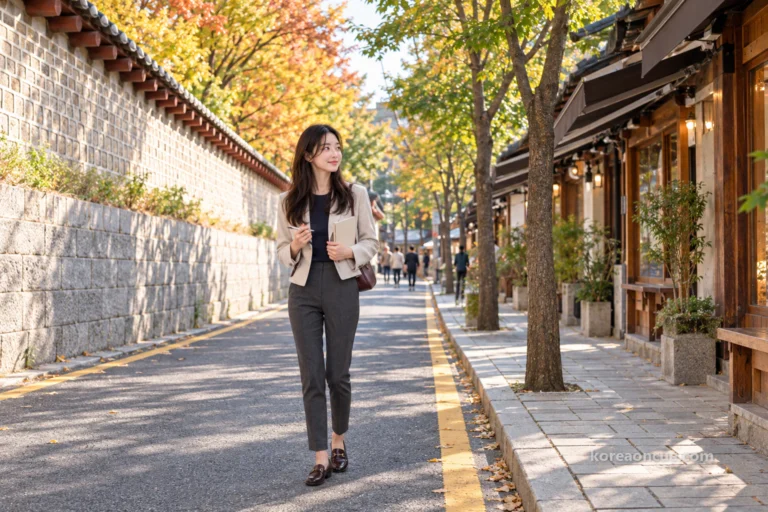
SEOUL · JONGNO 3-GA
Ikseon-dong’s Hanok Lanes: Once before Eleven, Once after
Lulu brings Maya too early on a weekday morning, leaving time to notice the tiled roofs and private gates missing from her saved photos
The shutters are still down. Lulu looks sheepish about bringing them so early, but Maya gets a clearer view of a hanok neighbourhood where shops and homes share the same lanes. A walk through Ikseon-dong, twice.

How to get there
On the Saturday night she first meets Rina, Maya sends Lulu a pair of photos showing the pocha street, lined with tented food stalls, by day and in the evening. The reply comes straight back: “Hang on, you went somewhere with good food without me. I’m coming next time.” A few days later, as they talk about that evening, Maya admits she barely saw Ikseon-dong on the way to the pochas because the crowd carried her through. Lulu immediately says, “That’s no way to see Ikseon-dong. I’ll take you this time,” turning “I’m coming next time” into an actual plan.

Lulu and Maya were friends before coming to Seoul, and they began this trip together. Lulu is Korean and has only recently started making beauty videos, trying new trends early and recording her honest reactions. Maya, visiting Seoul from Singapore for the first time, tends to notice how the scene in front of her differs from the one on her screen. This time Lulu wants to show her the lanes before the crowds arrive, so she suggests meeting outside Exit 4 at ten on a weekday morning.
Ikseon-dong is a small neighbourhood of hanok (traditional Korean houses) tucked across the road from Exit 4 of Jongno 3-ga Station. Built in the 1920s, it has a little over 110 hanok packed along narrow lanes, with converted houses now holding cafés, dessert shops, clothes shops and small workshops. When British travel publication Time Out names Jongno 3-ga the world’s coolest neighbourhood this year, it singles out Ikseon-dong as its hanok heart. A cluster of low tiled roofs survives between the tall buildings of central Seoul, making each turn feel like a step into another neighbourhood.
This is the story of Lulu and Maya walking through Ikseon-dong twice over half a day. They pass through the lanes before the shops open, watch the shutters rise one by one and return as people fill the streets after lunch. Along the way, we’ll look at why these small houses stand so close together and how to walk through lanes shared by shops and people’s homes.
The Cue — At a glance
Ikseon-dong’s hanok lanes are free to walk through at any time, but the shops only begin opening around eleven, with hours varying between businesses. Before they wake up, the houses and the shape of the lanes stand out around the closed shutters. Afterwards, cafés and dessert shops draw the attention. If you want to see both, arrive before eleven and stay as the shops open. There is no parking, so come by underground and use Exit 4 of Jongno 3-ga Station.
- When: shops begin opening around 11 a.m. Opening hours and days off vary between businesses. There is no admission fee for the lanes.
- Which exit: leave Jongno 3-ga Station (Lines 1, 3 and 5) through Exit 4 and enter the small lane across the road. Ikseon-dong Hanok Street is 123 m away.
- Driving: there is no parking. The underground is the easier option.
- Nearby: Nakwon Music Mall and Jongmyo are a few minutes’ walk away (Jongmyo normally closes on Tuesdays; holiday exceptions apply). Jongno 3-ga Pocha Street opens in the evening (the street operates from 6 p.m. to 4 a.m. the following morning, with individual opening hours varying).
- Enquiries: the tourist information centre in Insa-dong, +82-2-737-7885 (the enquiry number listed by VisitKorea).
Ten in the morning, a little too early
When they meet outside Exit 4, Lulu has a small phone tripod tucked into her bag. She has already decided how today’s video will begin: her first taste of a dessert that has lately been drawing queues in Ikseon-dong. They leave the exit, cross the main road and enter the small lane opposite. The hanok lanes are only 123 m from the exit, and almost before they notice, the path narrows beneath their feet and low walls and roof tiles appear on either side.
Open in Google Maps — Ikseon-dong Hanok Street

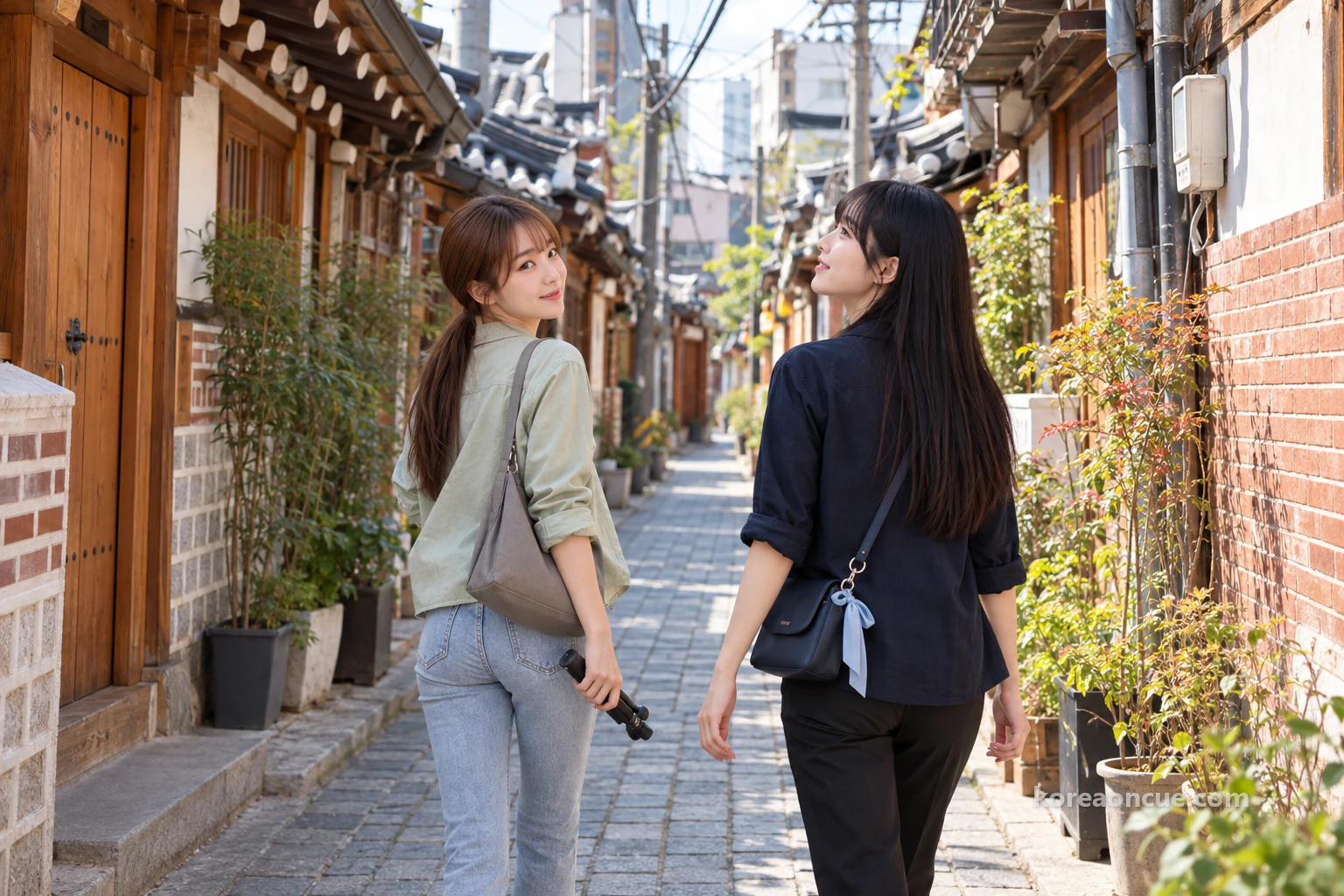
But the shutters are down when they reach the shop Lulu has saved. A circuit of the lanes turns up far more closed doors than open ones, and only then does she remember that she has always come here in the afternoon. “Oh. I’ve only ever been here in the afternoon.” She laughs, a little embarrassed after confidently leading the way as the local friend, then immediately opens her tripod and says it again in front of the closed shutters. Lulu’s way of handling a small mistake is to leave it in the video.
Most shops in Ikseon-dong begin opening around eleven, with only a few open earlier in the morning. Opening hours and days off vary, so there is no single timetable for the whole neighbourhood. If you have a particular shop in mind, planning for after eleven helps avoid a wasted trip. Arrive early, as Lulu does, and that time can go towards looking at the hanok and lanes instead.
Maya is rather pleased to have that time. On her previous visit at dusk, she could barely see the roof edges above people’s heads, but this morning only a few others are walking through the lane. She already knows how narrow it is, yet only now, with fewer people, can she properly see its width. Inside these blocks, the lanes generally average 2 m or less across, and the two of them almost fill the path walking side by side. “It’s fine. I think this is what I wanted to see.” At that, Lulu relaxes and folds away her tripod.
Why the little houses stand so close together
With fewer people around, the first thing Maya notices is the height of the roofs. The hanok are so low that the eaves seem almost within reach, while tall buildings along the main road rise beyond the tiles. She holds her phone upright, framing roof edges below and glass windows above. The buildings usually cropped out of the photos turn out to make up half the view.
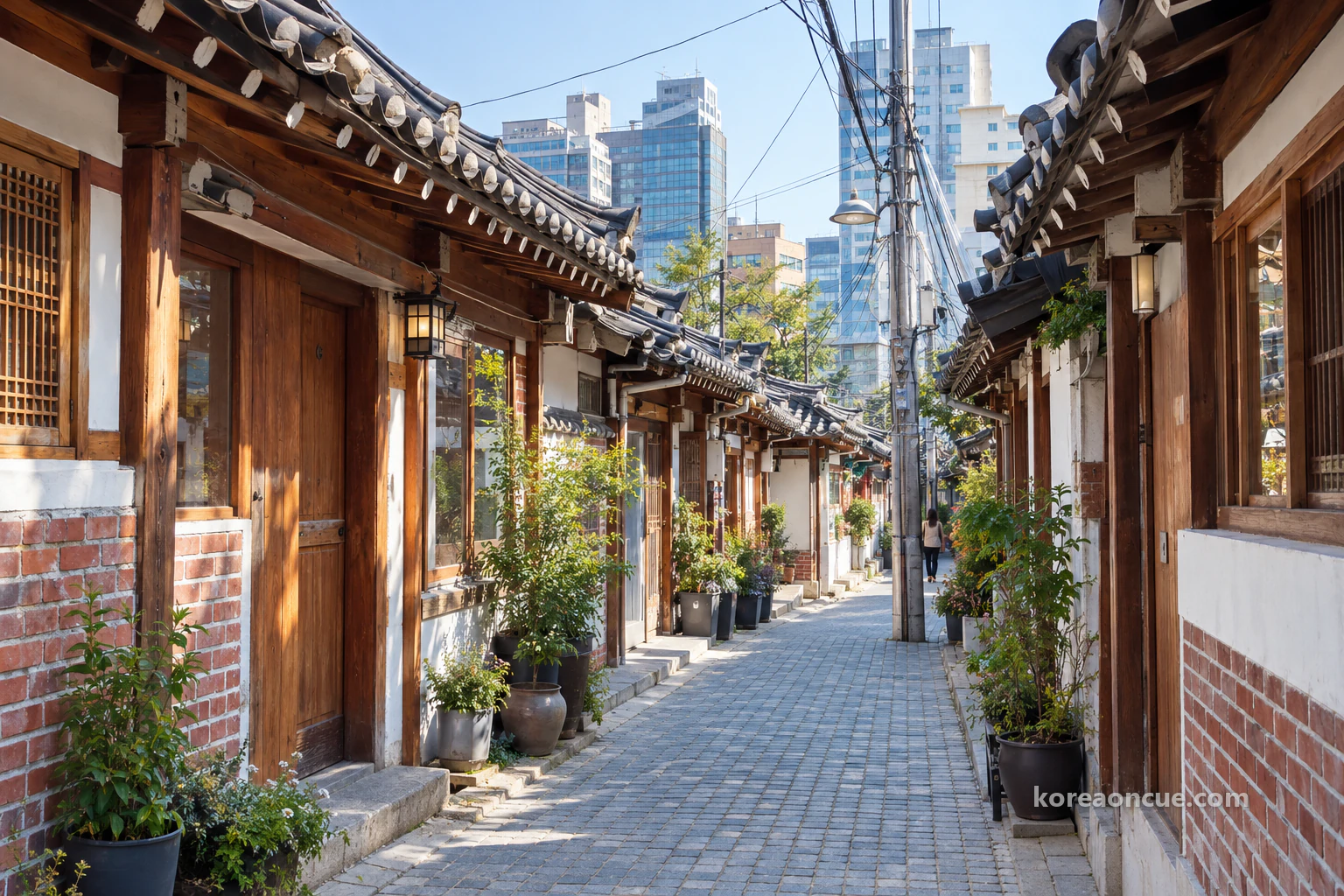
When Maya asks why the houses are so small and close together, Lulu pulls up the neighbourhood history she has saved on her phone. This was once the site of Nudonggung, the home of Jeongye Daewongun, King Cheoljong’s father. In the 1920s, Jeong Se-gwon of Geonyangsa bought land around the site and developed an urban hanok neighbourhood for Koreans, offering clean, convenient housing to ordinary people living in older homes such as thatched cottages. It was built as a dense neighbourhood of small homes rather than grand residences, which is why the hanok still stand shoulder to shoulder, with a maze of narrow lanes between them.
“So it was built for people to live in from the start.” Maya looks around again. The low walls, tiled roofs and wooden posts are much the same from house to house, but some have shutters down while others have wooden gates with no sign or menu outside. Before the doors open, it is hard to tell at a glance which buildings are shops and which are homes. In photos, Ikseon-dong always seems full of open shopfronts. With the shutters down, its beginnings as a neighbourhood of houses are much easier to see.

Closer up, the houses show different amounts of wear. Neatly aligned tiles that look recently repaired sit beside a house still bearing the marks of age. The neighbourhood was designated for redevelopment in 2004, and many houses received only basic repairs for years because they might eventually be demolished. The redevelopment plans dragged on for nearly a decade before falling through, and only afterwards did more people begin restoring the hanok for new uses. That stretch of time is still visible in the contrast Maya sees between old and newly repaired.
As soon as Lulu realises the wooden gate might belong to a home rather than a shop, she lowers her voice. People still live along the same lanes as Ikseon-dong’s businesses. After redevelopment fell through, owners welcomed tenants willing to repair the houses and run businesses, and cafés and restaurants began opening, but not every house became a shop. Many converted hanok retain their tiled roofs and exteriors, with changes made inside, leaving the lanes with the familiar face of a residential neighbourhood.
Eleven o’clock, and the shutters start to rise
As eleven approaches, sounds begin travelling through the lanes. Shutters roll upwards and small freestanding signs are set outside shops. People start arriving in the streets that were quiet a little earlier, and Lulu takes out her tripod again. “Now this is Ikseon-dong.” The houses themselves have not changed, but as the shutters rise, shops and homes that looked alike begin to separate.
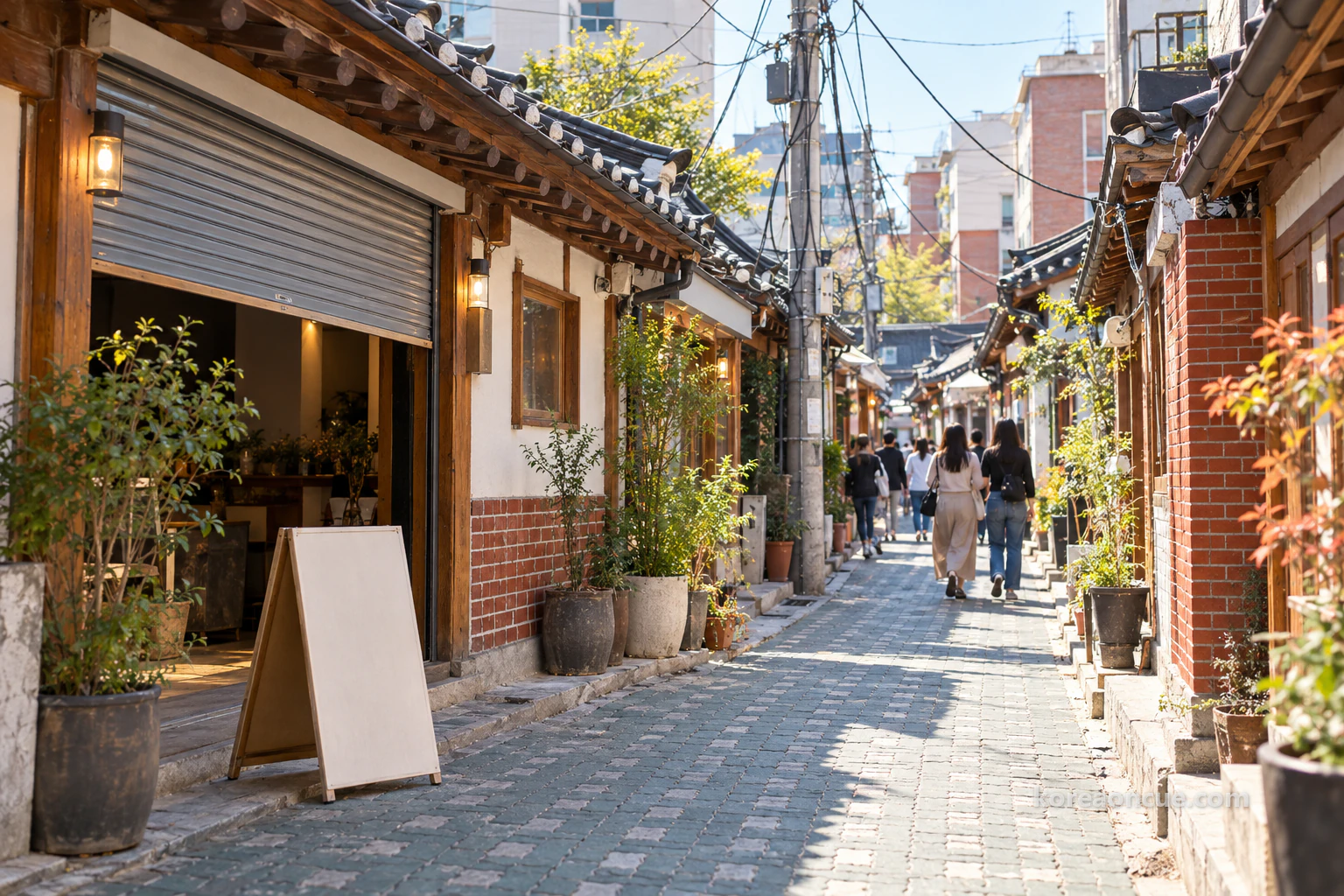
Each time a shutter goes up, Maya revisits her guesses about the houses she could not make sense of that morning. Glass doors and small signs emerge, while several wooden gates stay firmly closed. “That one’s a shop. That one isn’t.” Lulu joins in and gets one wrong, making them both laugh. It also shows how closely the shops still resemble the houses they occupy. If a wooden gate stays closed even at midday, remember that it may be someone’s home rather than a shop.
There is more than one kind of visitor in the lane. An older resident carrying a shopping bag walks a familiar path between couples and travellers with cameras around their necks. In this neighbourhood of old hanok and newer shops, older people going about their errands share the same routes as younger people looking around. Watching them, Lulu says, “Here, we share these lanes with the older residents.” Maya thinks that one line describes the neighbourhood rather well.
Lulu’s first snack is sogeum-ppang (salt bread), something often seen in travellers’ hands around Ikseon-dong lately. It has become popular through word of mouth and is also what viewers ask about most when they want to know what to eat here. Trying trends early is part of Lulu’s work, so she switches on the camera as soon as she gets the bread and takes her first bite. Its crust breaks with a crunch that brings a real look of surprise to her face, becoming the second shot in today’s video.
Maya chooses something else. Outside a shop further into the lanes, she spots a round sweet she has never seen before. Lulu explains that it is gaeseong juak, a traditional glazed sweet made with glutinous rice dough. Beside it sits yakgwa, a honey-soaked confection. “I’ve never seen this on my feed in Singapore,” Maya says as she picks one up, choosing something less familiar on screen rather than what everyone else is photographing. As it turns out, Lulu has never properly tried juak either, so this time Maya is the one introducing her to a first taste.

They swap half of each snack. Chewing the springy juak, Lulu says, “This has to go in the video,” while Maya photographs the bread’s crisp crust resting on her palm. Both find it funny that they have chosen such different things in the same lane at the same time. After eleven, as the shops begin waking up, it is a good time to browse the cafés and dessert shops. Many businesses are as small as the neighbourhood, though, and well-known places can draw queues. Pick one place you are willing to queue for, then use the rest of the time to walk and choose as you go.
The gate Lulu leaves out of the frame
By noon, the lanes are quickly filling with people. Lulu sets up her tripod in the middle of the path for the next shot, and people approaching from the other direction immediately stop to wait. Maya gently draws her towards the wall and passes on the habit she picked up while walking with Rina: take a picture, then move straight to the edge. Lulu folds the tripod, keeps it in her hand and stands close to the wall.

But when she reframes from beside the wall, the wooden gate they noticed that morning lands in the centre of the picture. Its old iron handle beneath the roof tiles looks more like Ikseon-dong than anything else she has filmed today, yet Lulu studies the screen for a while and turns the camera away. “Someone might live there. I don’t want people watching my video and queuing outside their gate.” Usually quick to choose a shot people will want to see, she deliberately gives this one up.
Instead, Lulu films the line of roof tiles above the gate and the buildings beyond. It is the same upright composition Maya chose that morning, now with Lulu’s face small at one edge. Maya smiles as she watches over her shoulder. This may be the first shot in one of Lulu’s videos where Lulu is not standing in the middle of the frame. “This is Maya’s framing,” Lulu says, making a note for the video description.
While they film, Maya asks Lulu the Korean names for parts of the hanok. There are giwa, the roof tiles, cheoma, the eaves extending beyond the walls, and daemun, the entrance gate. They are words Lulu knows so well that she has never had to explain them. Maya copies them into her notes in Korean and says she will use them instead of English in today’s photo captions. “Writing 처마 instead of ‘hanok roof’ sounds more like someone who’s walked through these lanes.” Lulu gives a slightly shy smile as words she uses every day become new entries in her friend’s notebook.
It helps to keep remembering that people live here as you walk. If you see an unsigned wooden gate between shop entrances, avoid lingering in front of it or photographing through gaps into the home. Keep your voice down a little and stand beside the wall without blocking the gate, leaving room for residents and other travellers to pass. After that, the two start reminding each other to lower their voices whenever they reach a gate, almost making a game of it.
A few turns later, both of them lose their bearings. Ikseon-dong’s lanes form a web, and getting lost is part of the pleasure of walking here. Even Lulu, who has only visited in the afternoon, laughs when she realises they have passed the same wall twice. Save Exit 4 of Jongno 3-ga Station as a reference point in your map app. However many turns the lanes take, knowing the direction of the main road and exit makes it easy to find a way out.
After lunch, the same lanes move at a different pace
After lunch, the pace changes sharply. In the morning they could see to the end of the lane. Now they walk behind the person in front. Queues stretch along the street outside well-known shops, mingling at junctions with people who have stopped to check maps. Maya switches between her morning photos and the lane in front of her, saying that watching the same spot change so much in half a day is part of what makes this neighbourhood interesting.
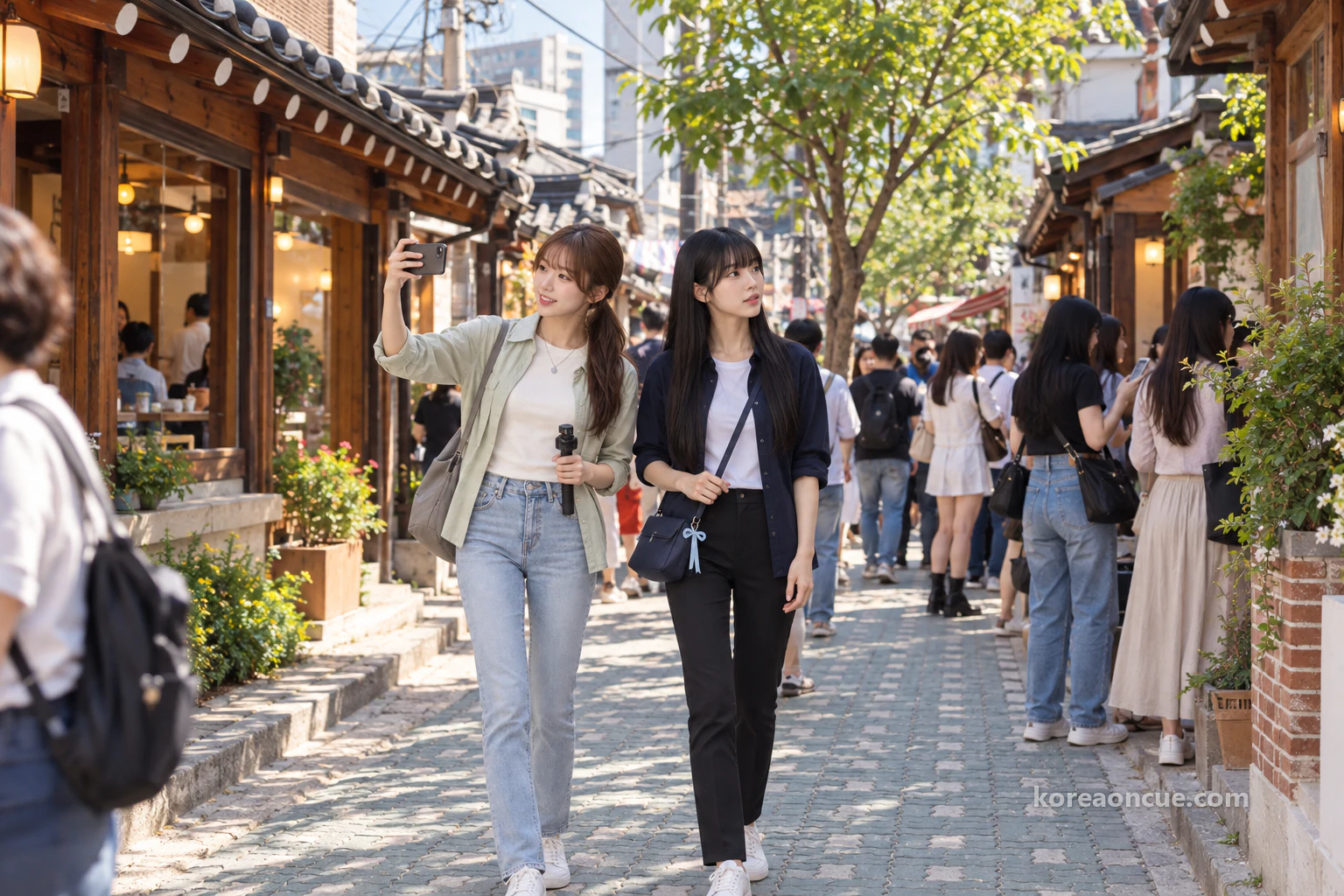
Here they make different choices again. Lulu wants to join the queue at the dessert shop that was closed that morning, while Maya would rather take another walk through the lanes on her own. “Queuing is content too.” Lulu raises her phone at the back of the queue, and Maya waves once before turning into the next lane. In a neighbourhood this small, they can go their separate ways and still meet again quickly.
Standing to one side of a lane while she waits for Lulu, Maya notices something. A few spots draw clusters of people taking photographs, yet the next lane is much quieter despite having the same tiled roofs. Only then does she realise that the Ikseon-dong she knows from her feed is really a handful of particular views. If you are walking here at a busy time, try moving just one lane away from the places where people gather.
Walking alone, Maya begins noticing the businesses that had been hidden behind shutters that morning. Small clothes shops and boutiques give way to a perfume-making workshop, a streetside photo booth and a fortune-teller within a few steps. Drawn first to clothes and styling, she spends a while outside a boutique window. Looking at clothes through glass beneath a tiled roof feels very different from browsing in a shopping centre. Outside the photo booth, couples and friends adjust each other’s hair as they wait their turn.
When Lulu leaves the queue, she pauses outside the fortune-teller’s. She says it is something friends have been trying together lately and would make good material for a video, but decides she has enough to film today and leaves it for another time. Instead, Maya draws her towards the photo booth, where they squeeze in for four pictures. Lulu makes the finger heart she always uses in her videos, while Maya smiles at Lulu rather than the camera. Holding the printed photos side by side, they laugh at how differently they face a camera even within the same picture.

Maya is struck by how closely today’s scenes match what Time Out highlighted in Jongno 3-ga. Older people shop and run errands in the old lanes, while young couples wait outside a photo booth, all sharing the neighbourhood without fuss. Lanes built in the 1920s as housing for ordinary people now welcome travellers from around the world, yet someone’s home still sits among them. If that is part of what makes this neighbourhood “cool”, Maya thinks, it is also a reason that does not show up easily in a single photograph.
A few steps beyond the lanes
As they leave the lanes, Nakwon Music Mall stands just outside. Maya passed this building, put up at the end of the 1960s, with Rina on her last visit. It is only a few minutes’ walk from Ikseon-dong. Jongmyo is also a few minutes away and easy to combine with a visit here. It normally closes on Tuesdays. If Tuesday is a public or substitute holiday, it opens that day and closes on the first following day that is neither a public nor a substitute holiday. Check the visiting date and admission times before planning to go inside. Lulu suggests going inside Jongmyo together next time and adds a date to her phone, then holds out the screen to Maya, saying she has checked the day of the week twice this time.
After sunset, Jongno 3-ga Pocha Street opens. The street operates from 6 p.m. to 4 a.m. the next morning, while actual opening hours vary between businesses. As soon as it comes up, Lulu brings back her reply from that Saturday: “That’s where you went without me.” Maya promises that Lulu can choose where they sit this evening. If you plan to stay until dinner, head out of Ikseon-dong towards Exit 6 so the day follows one direction.
What the two take away
With time left before the evening, they stand to one side of the street and scroll through Lulu’s footage together. It opens with Lulu in front of the closed shutters, saying, “I’ve only ever been here in the afternoon.” She starts to cut that shot, but keeps it when Maya says, “That’s the most useful bit.” Lulu sees that arriving too early without knowing the shops wake up around eleven might be the most helpful part of the video for someone else.

They reach the end without seeing the wooden gate once. Instead, there is “Maya’s framing” of the buildings beyond the tiled roofs, and a lane where an older person carrying a shopping bag passes in the distance, seen from behind. Maya thinks the gate Lulu chose not to film may be the most fitting decision in the whole video. Together, they have learnt that showing a neighbourhood where people live also means choosing what to leave out.
Lulu decides on the closing caption there and then. She wants one line asking people to pass quietly by unsigned gates, because homes sit among Ikseon-dong’s shops. It is a new kind of caption for her, and she rewrites it several times before settling on a short sentence: “This is someone’s home.” Today, the video from someone usually keen to show the latest trend also has something to say about how to walk through these lanes.
When Maya mentions Rina and says she would probably have spent longest studying the iron handle they saw that morning, Lulu laughs that if all three come next time, they must arrive after eleven. It is less a firm plan than another chance to tease herself about today’s mistake. Maya takes the four-frame photo out of her wallet for another look, then makes a short note: this time, what she liked most was not the difference between the screen and real life, but the different ways two friends saw the same lane.
Common Mistakes
Heading straight for shops early in the morning
shops begin opening around 11 a.m., with hours varying between businesses. Arrive early and use that time to look at the hanok and lanes.
Filming for too long in the middle of a lane
lanes inside the blocks generally average 2 m or less across. Take a picture, then move towards the wall.
Lingering outside an unsigned wooden gate
people still live among the shops. Leave gates clear and keep your voice down.
Bringing a car
there is no parking. Exit 4 of Jongno 3-ga Station is convenient.
Adding Jongmyo without checking its closing day
Jongmyo normally closes on Tuesdays. If Tuesday is a public or substitute holiday, it opens that day and closes on the first following day that is neither a public nor a substitute holiday.
FAQ
When is a good time to visit Ikseon-dong’s hanok lanes?
Shops begin opening around 11 a.m., with hours varying between businesses. Before they open, the hanok and lanes stand out. Afterwards, there are cafés and dessert shops to browse.
Which exit should I use?
Take Exit 4 of Jongno 3-ga Station (Lines 1, 3 and 5) and enter the small lane across the road. Ikseon-dong Hanok Street is 123 m away.
Is there an admission fee?
No. Anyone can walk through the lanes.
When was Ikseon-dong built?
It was developed in the 1920s as an urban hanok neighbourhood for ordinary people. A little over 110 hanok remain, with homes, cafés and shops sharing the same lanes.
What else is nearby?
Nakwon Music Mall and Jongmyo are a few minutes’ walk away. Jongmyo normally closes on Tuesdays. If Tuesday is a public or substitute holiday, it opens that day and closes on the first following day that is neither a public nor a substitute holiday. Jongno 3-ga Pocha Street opens in the evening (the street operates from 6 p.m. to 4 a.m. the following morning, with individual opening hours varying).
Recap — 30 seconds before you go
- Exit: Jongno 3-ga Station, Exit 4 → the small lane across the road (123 m)
- Before 11 a.m.: hanok roofs and lanes / after 11 a.m.: cafés, desserts and small shops (hours vary)
- Narrow lanes (averaging 2 m or less): take a picture and step aside, leaving wooden gates clear
- No parking · Jongmyo normally closed on Tuesdays (holiday exceptions apply) · pocha street open from the evening (hours vary between businesses)
Sources
- Seoul Metropolitan Government — Draft Ikseon district unit plan (March 2018)Urban hanok housing developed by Jeong Se-gwon of Geonyangsa in the 1920s · Nudonggung site · homes for ordinary people · internal lanes generally averaging 2 m or less · redevelopment area designation in 2004; draft building and business rules are not usedchecked 2026-10-21
- Seoul Media Hub — Ikseon-dong (19 March 2021)The neighbourhood’s formation in the 1920s · cafés and small restaurants in repaired hanok after redevelopment fell through in 2014checked 2026-10-21
- Seoul Media Hub — Ikseon-dong (19 June 2025)Around 110 hanok · shops retaining the houses’ exteriors · homes and shops sharing the lanes · daytime crowds observed on the writer’s visitchecked 2026-10-21
- VISITKOREA — Ikseon-dong Hanok StreetHours and days off vary by shop · free entry · no parking · Insadong N-Info Center enquiry number · a neighbourhood connecting generationschecked 2026-10-21
- Time Out — Jongno 3-ga: why this Seoul neighbourhood is the coolest in the world in 2026Shops begin opening around 11 a.m. · cafés, boutiques, fortune-telling, photo booths and perfume · salt bread, gaeseong juak and yakgwa · a web of laneschecked 2026-10-21
- Seoul Media Hub — Jongno 3-ga, Time Out’s coolest neighbourhood in the world (6 October 2026)Ikseon-dong 123 m from Jongno 3-ga Station Exit 4 · nearby Nakwon Music Mall, Seosulla-gil and pocha streetchecked 2026-10-21
- Seoul Media Hub — Jongmyo visiting tips (17 June 2025)Tips for adding Jongmyo to a nearby visitchecked 2026-10-21
- Royal Palaces and Tombs Center — Visiting hours and closing daysJongmyo’s regular Tuesday closure; open when Tuesday is a public or substitute holiday, closed on the next non-holiday insteadchecked 2026-10-21
A Seoul story told with our AI characters. Place details are checked against public sources; the photos are AI-made illustrative images. How we use AI