
SEOUL · ANGUK
Losing a passport in Seoul over the weekend: how Hina got to the Embassy of Japan's consular section on Monday morning
With Noah, whom she met at a police box on Sunday — from one letter on a report to a nine-minute walk from Anguk Station Exit 6
On Saturday night Hina tipped out her whole bag and the passport wasn't there. The embassy wouldn't open until Monday. At a police box on Sunday, Noah spotted one wrong letter.

How to get there
Hina comes to Seoul about twice a month. She works for a marketing company in Tokyo, and whenever her favourite group plays a show or a goods drop appears that you can only buy in Korea, she gets on a plane straight after work on Friday. This weekend was no different. A concert on Saturday, one more pop-up on Sunday afternoon, then a Sunday night flight home and straight into a Monday morning meeting.

It all went wrong in her hotel room on Saturday night. She opened her bag to pack early for the next day and reached for the zip pocket where her passport always lives, and her fingers found nothing. Hina tipped the whole bag out onto the bed. Concert stickers, three new keyrings, her wallet and a charging cable tumbled out, but the navy cover never appeared.
The truth is, her passport had become almost too familiar. Flying in and out twice a month, she took it out at passport control and slipped it back after landing without really thinking. It was only after unzipping the empty pocket for the fourth or fifth time that Hina realised how little you remember about where you put the things you handle most. Her phone said it was past 11 p.m., and the flight was the next night.
This piece is the story of that weekend, and a practical guide for Japanese travellers who lose a passport in Seoul. Following Hina, we’ll go through what to search again first, what to check when you report the loss to the Korean police, when the consular section of the Embassy of Japan in Korea takes applications and what to bring, and how to walk there from the subway. Noah, a Canadian traveller Hina met at a police box on Sunday morning, comes along too.
The Cue — At a glance
If you lose your passport in Seoul and need to return to Japan soon, the consular section of the Embassy of Japan in Korea can issue a "travel document for return to Japan" (帰国のための渡航書) to use in place of a passport. The order is: search again → report the loss to the Korean police and get a "Lost Property Report" (분실신고접수증) → prepare two passport photos → apply at the consular section. The consular section takes applications only on weekdays, 9:30 a.m.–12:00 and 1:30–5:00 p.m., and not on Saturdays, Sundays or holidays. If you lose it at the weekend, search again first, then compare the next day the consular section is open with the time of your flight home. If you won’t make your flight, ask the airline to change it in advance. The fee is paid in Korean won cash only, when you collect the document.
- When: Weekdays 9:30–12:00 and 13:30–17:00; not on Saturdays, Sundays or holidays. Allow about 1–2 hours from application to issue; for same-morning issue arrive 9:30–10:30, for the afternoon 13:30–15:30.
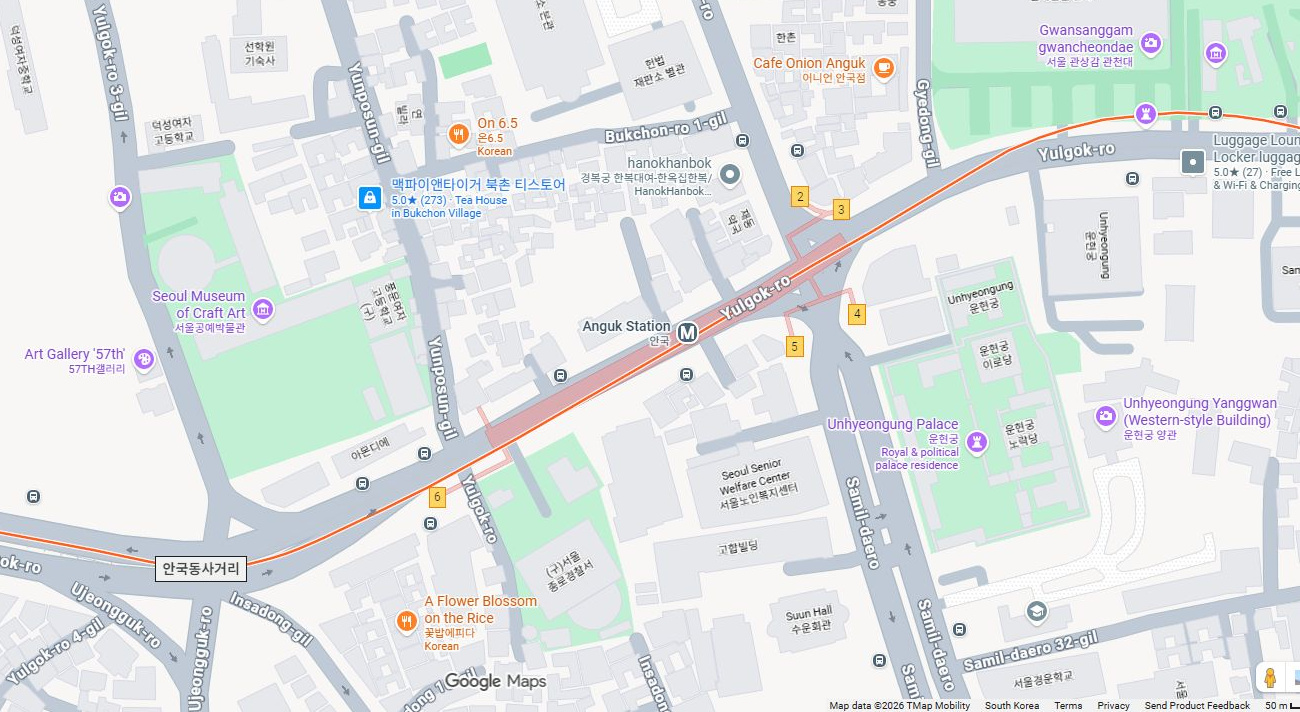
- Where: Twin Tree Tower A, 8F, 6 Yulgok-ro, Jongno-gu, Seoul. About 9 minutes on foot (450 m) from Anguk Station (Line 3) Exit 6.
- Bring: Korean police Lost Property Report · two passport photos taken within the last six months (4.5 cm high × 3.5 cm wide) · Korean won cash · your return flight number · one form of ID · one Japanese family-register certificate proving nationality (koseki tōhon or shōhon). If you don’t have it, sign a written pledge at the counter, then post the family-register certificate to the embassy after returning to Japan.
- Fee: Travel document for return: ₩34,000, in won cash when you collect it. No cards, no yen.
- Phone: Consular section main line 02-739-7400.
To the bottom of the bag
The first thing Hina did wasn’t to report anything; it was to search again. The embassy itself tells you to check your bag, your clothes and the places you visited first, because once a travel document is issued your old passport is cancelled and can’t be used even if it turns up. Hina turned out every coat pocket and reopened the little bag she’d taken to the concert. The last time she remembered holding the passport was Saturday afternoon, and after that her memory was simply blank.

Next came her phone. The embassy’s page points to Lost112, the Korean National Police Agency’s lost-property site, where you can search for items found on the subway, buses, taxis and at airports, and it notes that a Japanese passport is searched for with the Korean words 일본 여권. Hina pasted those four characters into her notes and then into the search box. No results, but the page also warned that found items can take time to appear in the system and suggested checking again, so she set an alarm.
The subway was a possibility too. On Seoul Metro’s Lines 1–8, items handed in at stations are first registered on Lost112 and then passed to the lost-property centre for that line: City Hall Station for Lines 1 and 2, Chungmuro for Lines 3 and 4, Wangsimni for Lines 5 and 8, and Taereung for Lines 6 and 7. When you ask at a station, the more precisely you can say what time you got off, which direction you were travelling and where you boarded and alighted, the better your chances, so Hina went back over that day’s trains and wrote down the times and station names one line at a time.
After an hour of this, Hina finally began to treat "finding it" and "getting home" as two separate jobs. She had no idea whether the passport would turn up tomorrow, but the Monday morning meeting wasn’t going anywhere. True to form for someone who maps out flights and venue routes the moment a concert is announced, she opened a new note on her phone and called it "The way home". The first line was step two on the embassy’s page: report it to the police.
Sunday morning at the police box
On Sunday morning Hina went to the local police substation (jigudae, a neighbourhood police box) nearest her hotel. According to the embassy, if you report the loss at a local police box or station you receive a certificate called a Lost Property Report (분실신고접수증), and you’ll need it for the embassy’s procedure. In case her Korean ran out, she also had the embassy’s ready-made Korean phrases on her screen: "I have lost my passport", "I am Japanese", "I need a lost property report", plus spaces for her name and date of birth.

On the bench beside her sat a man with curly brown hair, an olive backpack on his shoulders and a small notebook open on his knee. She learned later that Noah, from Canada, had come to hand in a card wallet he’d found on a bench outside a station the evening before. Hina had lost something and Noah had found something, and the oddness of it made them both smile a little the first time their eyes met.
Noah is twenty and walking Seoul on his own. Rather than ticking off famous sights, he picks one neighbourhood and walks it all day, noting in his notebook where the lanes lead and where the signs and the map stop agreeing. He’d found the card wallet while sitting on that bench copying the day’s route into his notebook. Having only just come in, he was waiting his turn and quietly watching Hina hold her phone out to the officer at the counter.
Things are slightly different if your passport was stolen. The embassy asks you to get the appropriate certificate if it was lost to theft or fire rather than simply mislaid, and if you’re in danger right now, calling 112 comes first. Hina didn’t know exactly when or where she’d lost hers, but she had no memory of anyone taking it, so she reported it as lost. While she was filling in the form, the alarm she’d set to recheck Lost112 went off once, but the search still came up empty.
The embassy’s Korean phrases turned out to be a bigger help than she’d expected. Hina can manage a hello in Korean, but explaining a lost item, a date and a place is a world away from the words you use at a concert. Showing the three sentences one after another made the conversation much easier, and she could read out her name and date of birth exactly as she’d typed them below. If this ever happens to you, it’s worth screenshotting those phrases in advance.
One letter in her name on the report
Report in hand, Hina had bowed her thanks and was about to turn away. Following the embassy’s advice, she brought up her flight booking on her phone to check the name. Noah, still waiting his turn beside her, is the kind of person who stops dead on a walk if a sign and his map app disagree by a single letter. His eyes went once from the paper in her hand to the screen and back, and he said, "Hang on," and pointed at one line.
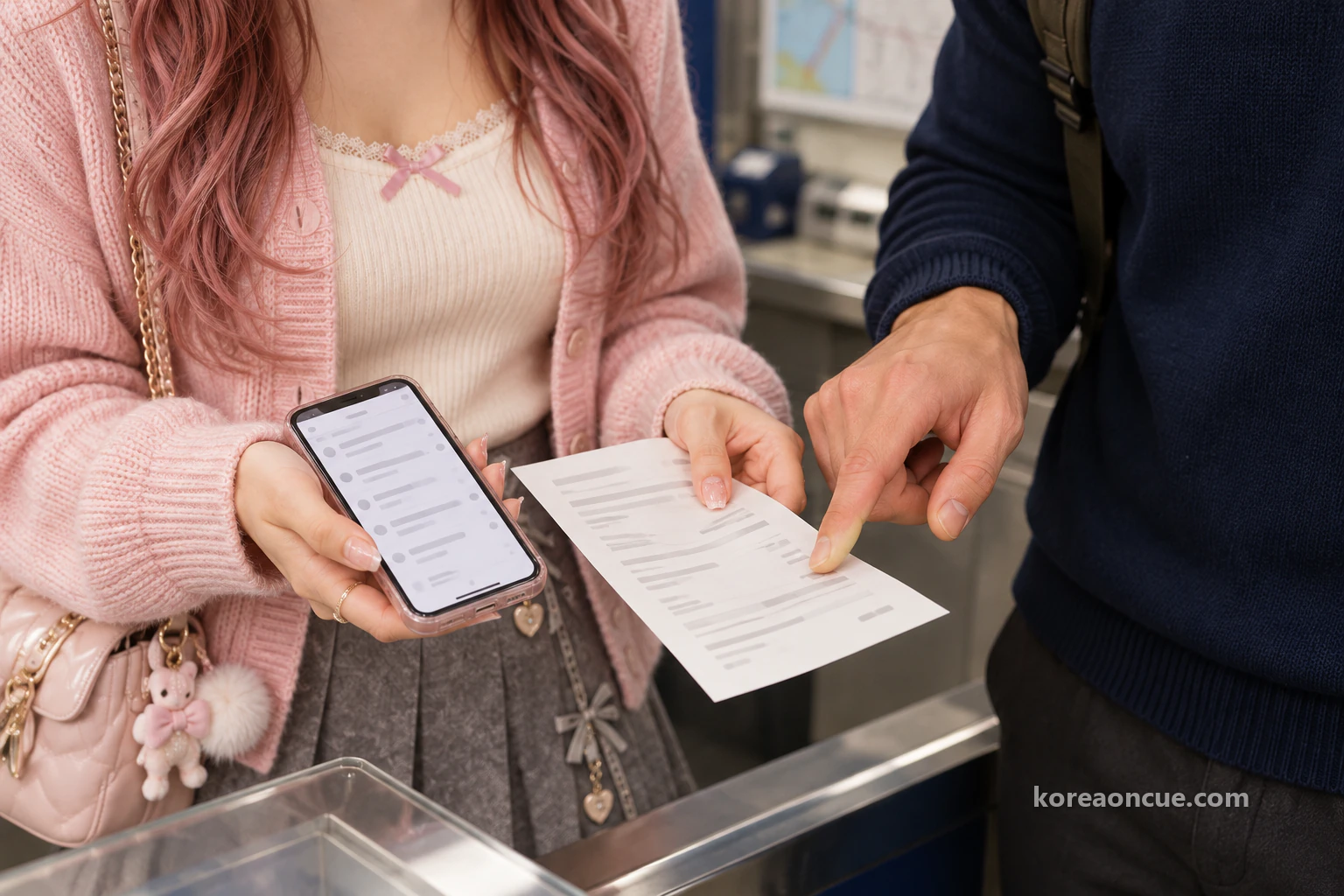
The name on her ticket and the name on the report differed by one vowel. The embassy page does tell you to check the alphabet spelling of your name and your date of birth as soon as you get the report, and Hina had read that line, but with the paper finally in her hand she’d skipped it. Only when she lined the two names up herself did she see the letter. She told the officer the spelling was different, asked for it to be corrected, and checked the corrected spelling again before putting the report away.
Noah shrugged it off. On a walk, he said, a name on a sign and a name in a map app are a letter apart more often than you’d think, and if you ignore it you end up down the wrong lane. A piece of paper is the same, he said: a document with a different spelling might not be read as yours at the next counter. Listening, Hina felt a little indignant that the habit she has of checking the name on every concert ticket two or three times had chosen today to switch off.
"I’m so glad we caught it here. If I’d only noticed at the counter on Monday, sorting it out would have been a pain." As she zipped the report into her pocket, Noah looked up from something he was writing. He’d planned to spend the day walking the neighbourhoods north of the centre, and when he heard that the place Hina needed to go tomorrow was near Anguk Station, he said, "I’ll be passing there today." On the steps outside the police box they compared travel plans briefly and swapped Instagram accounts.
The embassy opens on Monday
The first thing Hina checked after leaving the police box was the consular section’s hours. Its passport and certificate counter takes applications only on weekdays, 9:30 a.m.–12:00 and 1:30–5:00 p.m., and not on Saturdays, Sundays or holidays. When Monday is a working day for the consular section, as it was this weekend, you can report on Sunday and apply on Monday morning. If Monday is an embassy holiday, though, you’ll have to wait for the next day it takes applications, so check the holidays the embassy announces first. Either way, Hina’s Sunday night flight had become a plan she could never have kept.

The embassy also asks you to change your flight in advance if you won’t make it. Allow an hour or two from application at the counter until the document is ready, and if you want it the same morning, arrive between 9:30 and 10:30. Having already searched everywhere she could, Hina moved her flight then and there to a Monday afternoon departure and sent her company a short email saying she’d miss the Monday morning meeting. Her fingers paused a few times over the subject line, but once it was sent her head felt clearer.
The document Hina needed was the travel document for return to Japan, which the embassy prepares in place of a passport for people who have to go home straight away; it’s valid for about seven days. If you’re not going home soon and will stay on in Korea, you can apply for a new passport instead, following the same procedure as any new passport application. For Hina, leaving on Monday afternoon and back in Tokyo by the evening, the travel document was the right choice.
The fees are different if you apply for a new passport. Since 1 July 2026, a ten-year ordinary passport for applicants aged 18 or over, applied for on paper at the counter, is ₩85,000, and the five-year passport issued to under-18s is ₩44,000. The embassy separates the two cases: a travel document for those who need to return urgently, and a new passport for those not returning straight away. With a Monday flight home, Hina chose the travel document. Questions can go to the consular section’s main number, 02-739-7400; the contact hours listed by the embassy are 9:30 a.m.–12:15 and 1:15–6:00 p.m.
Noah listened and jotted the times down in his notebook: applications open at 9:30, arrive by 10:30 for same-morning issue, an hour or two to prepare, then an afternoon flight. Once the numbers were lined up, Hina said, she could finally picture what Monday would look like. "Then let’s meet at the station exit at 9:20. I’ll walk the route this afternoon," Noah said, closing his notebook.
What to sort before evening
Sunday afternoon was for the paperwork. The embassy wants two passport photos taken within the past six months, 4.5 cm high by 3.5 cm wide (±2 mm), the same as the Korean standard. It notes that there are several photo studios around the embassy, and that photos from an instant booth in a subway station are fine too as long as they meet the rules. Hina used the booth at the station near her hotel, and only pressed the button after fixing her fringe several times.

Then the cash. The fee for the travel document for return is ₩34,000, paid in Korean won cash only when you collect it; no cards and no yen. Having paid for nearly all her concert goods by card, Hina had very little won left, but thanks to a message from Noah she withdrew some on Sunday evening. It read simply "fee is cash only", followed by a short wave.
Beyond that, the application needs one police report, your return flight number, one form of ID and one Japanese family-register certificate (koseki tōhon or shōhon) to prove Japanese nationality. The embassy gives examples of ID such as a My Number card, a driving licence or a health insurance card. Luckily Hina had her driving licence in her wallet, but of course she didn’t have her family-register certificate with her. In that case, the embassy asks you to sign a pledge to submit it later and post the document to them after you return.
If you have no ID at all, go to the consular counter and tell them so. And if you’re travelling as a family and it’s a child’s passport that’s missing, there’s one more thing. Under-18s need the consent of a parent or other legal guardian, and if the guardian can’t come to the consular section with them, a consent form for the travel document application is required, so the embassy asks you to consult them before you visit. It didn’t apply to Hina, travelling alone at twenty-one, but on a family trip it’s the first thing to sort out.
Even if you haven’t managed to get the photos or the cash, you’re not completely stuck. In an emergency, the embassy says, you can register your application first and pop out to get the photos and cash. Still, Hina wanted Monday morning to be as light as possible, so she put the police report, two photos, the cash and her licence into a clear plastic folder in that order, with a sticky note showing her new flight number on top.
With everything ready, her Sunday evening was suddenly free. By the original plan she’d have been on her way to the airport. After a moment’s thought, Hina decided to drop into just one of the pop-ups she’d meant to visit, the one closest to her hotel. She didn’t want the weekend she lost her passport to be one long heavy memory, and having done everything she needed to, she could enjoy the time she had left. The photo she sent Noah that night showed one new keyring lying next to the clear folder.
Anguk Station Exit 6, 9:20 a.m.
On Monday morning Noah was at Exit 6 of Anguk Station on Line 3 a little before they’d agreed. According to the embassy, the consular section is about 9 minutes and 450 m on foot from Anguk Exit 6. From Exit 2 of Gwanghwamun Station on Line 5 it’s also about 9 minutes, around 520 m, and from Exit 2 of Jonggak Station on Line 1 it’s 13 minutes, about 790 m. Anguk was the station Hina could reach from her hotel without changing trains, so it had been the meeting point from the start.

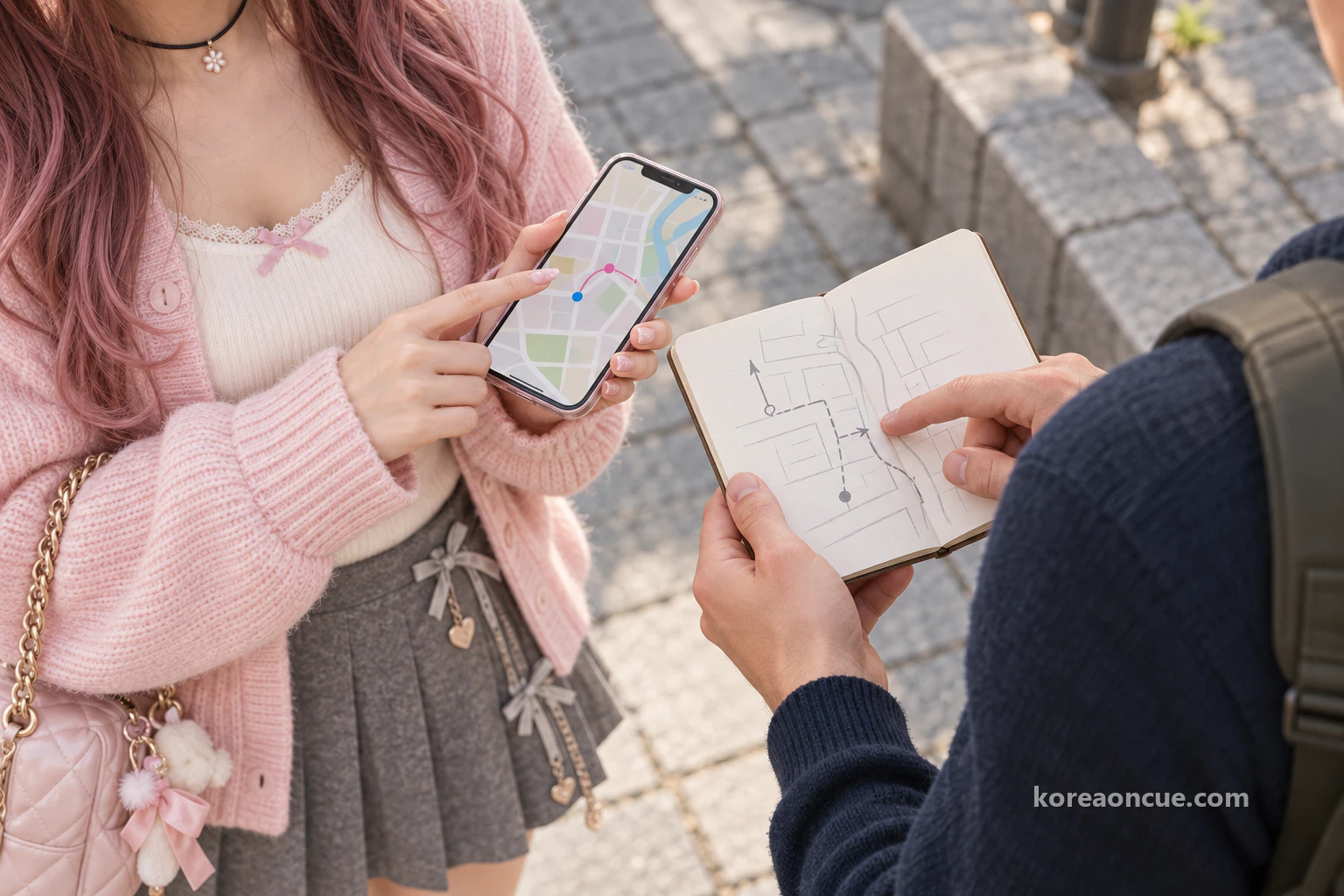
Choose your exit by whichever line is closest to where you’re staying. If the area is new to you, put the consular section’s Korean address into your map app before you set off and get your bearings as soon as you’re out of the exit. Hina came up the stairs and glanced back and forth between the little map Noah had drawn her and the map on her phone. The destination was Twin Tree Tower A, 8F, and Noah scanned the road ahead for the building’s name.
Noah really had walked the route the afternoon before. He’d sketched in his notebook which way to turn out of the exit and where to cross after following the main road. As they walked, he gave her just one piece of advice: "Don’t just follow the arrow in the app — when you can see a building name, match it." Hina did exactly that, and when a pair of towers standing side by side came into view across the road, she checked the address and building name on her phone once more.
The consular section’s address is Twin Tree Tower A, 8F, 6 Yulgok-ro, Jongno-gu, Seoul. The embassy suggests showing the Korean address to the driver if you take a taxi, and Hina had screenshotted it just in case. When she stood outside Tower A a little after 9:30, she laughed that she was "less nervous than in a concert entry queue". Noah looked up once at the building’s name and then stepped back, as if this was as far as his part went.
The 8th-floor counter
You have to apply in person at the counter. Before Hina went up to the 8th floor, Noah said he’d walk the streets nearby a bit more. Since the embassy says it takes an hour or two from application until the document is ready, they agreed she’d message him once she had it, and spent the time apart. The consular section suggests arriving at least 30 minutes before the counter closes because the process takes time, but having come early in the morning, Hina barely needed to look at the clock.
Someone returning urgently submits two things: the application for the travel document for return, and a notification that the passport has been lost. Hina took the police report, photos, driving licence and flight-number note out of her folder in order, and in place of a family register she signed a pledge to post it after returning home. Having sorted the folder in order the day before really paid off at this point, she told Noah later, a little proudly.

Meanwhile Noah walked the side streets and redrew that morning’s route in his notebook: from the exit to the building, where they crossed, where the building’s name first came into view. After handing in her papers, Hina sent a quick message: "Photos and application in. I pay the cash when I collect it." Instead of a short reply, Noah sent a photo of his notebook with the route from Exit 6 to Tower A drawn in little arrows.
Going back and forth to the counter, Hina said, she kept thinking about the name on the report. Imagining what might have happened to that piece of paper if she hadn’t fixed it at the police box the day before sent a chill down her back. While she waited, Hina mentioned that she’d be back in Seoul for another concert next month, and Noah said he’d still be in the city then. Only a few lines of messages, but two people who hadn’t known each other’s names until yesterday morning were already talking about next month.
The travel document in hand, valid for about seven days
When Hina came out of the building a little after 11, the travel document for return was sitting at the top of her clear folder. Valid for about seven days, it was more than enough for that afternoon’s flight. The moment it was issued, the passport she lost on Saturday was cancelled, so she switched off the Lost112 alarm on the spot. It was a passport she couldn’t use now even if it turned up.

Before heading to the airport, Hina opened the Instagram chat they’d started the day before. She showed Noah a line from KOC’s travel help: you go through departure immigration when you leave Korea too, so if you’re flying on an emergency document, check that the airline and any transit country will accept it. Her booking was a direct flight to Tokyo, so no transit country was involved. But even on a direct flight you need to confirm with the airline that you can board with that document, and she said she’d asked exactly that when she changed her flight. "I’ll use this if I ever lose mine," Noah said, and that was the one line he copied into his notebook.
Just before they parted, Hina zipped the folder into her bag pocket and said, "When I’m back next month, it’s my turn to show you the way. I know the route to the concert venue better than anyone." Noah nodded with a smile and wrote the date of her concert on the back page of his notebook. The keyrings that had spilled across the bed on Saturday night were now swinging outside her bag in time with her steps.
That afternoon, through departure immigration, Hina sent Noah one more message from near the gate: a quick photo of the view from the gate window and a single line, "Through safely. Next time I’m photographing my passport first." Noah’s reply was a photo of a notebook page headed "Hina — route to the concert venue, next month". It felt a little strange that a lost passport had started it, but Hina pinned that photo just under "The way home" in her notes.
Common Mistakes
Getting the travel document first and searching later
once it’s issued, your original passport is cancelled. Check your bag, the places you visited and Lost112 first.
Walking out with the police report unchecked
check the alphabet spelling of your name and your date of birth on the spot. You’ll need this report at the embassy.
Losing it at the weekend and leaving your flight as it is
the consular section doesn’t take applications on Saturdays, Sundays or holidays. Compare the next day it’s open with your flight time, and change the flight in advance if you won’t make it.
Bringing only a card or yen
the fee is paid in Korean won cash only, when you collect the document.
Skipping the airline check because it’s a direct flight
you don’t need a transit country check, but confirm with the airline that you can board with that document.
Arriving just before the counter closes
preparation takes an hour or two. For same-morning issue, arrive between 9:30 and 10:30.
FAQ
Where is the consular section of the Embassy of Japan in Korea?
Twin Tree Tower A, 8F, 6 Yulgok-ro, Jongno-gu, Seoul — about 9 minutes (450 m) on foot from Anguk Station (Line 3) Exit 6.
Can I apply on a Saturday or Sunday?
No. Applications are taken on weekdays 9:30–12:00 and 13:30–17:00, not on Saturdays, Sundays, holidays or embassy closing days.
What should I bring?
One police Lost Property Report, two passport photos (4.5 cm × 3.5 cm), won cash, your return flight number, one form of ID and one Japanese family-register certificate. Without it, sign a pledge at the counter and post the certificate after returning to Japan.
How much is the fee?
The travel document for return is ₩34,000, paid in won cash when you collect it. If you stay on and get a new passport instead, a paper application at the counter costs ₩85,000 for a ten-year passport (aged 18 or over), or ₩44,000 for the five-year passport for under-18s.
How long does it take?
About 1–2 hours at the counter from application to issue.
How long is the travel document valid?
About seven days.
Can I use photos from a station photo booth?
Yes, if they meet the standard (4.5 cm × 3.5 cm, taken within six months).
Recap — 30 seconds before you go
- Search again first: bag, clothes, places you visited, and Lost112 with 일본 여권.
- Report to the police → check the alphabet spelling of your name and your date of birth on the report.
- The consular section is weekdays only (except closing days). Compare the next open day with your flight; change it in advance if you won’t make it.
- Two photos (4.5 × 3.5 cm) · ₩34,000 in won cash (paid on collection) · flight number · ID · family register (or a pledge).
- Anguk Station Exit 6, about 9 minutes on foot, Twin Tree Tower A, 8F. For same-morning issue, arrive 9:30–10:30.
Sources
- Embassy of Japan in Korea — what to do if you lose your passport (28 March 2024)Searching again and Lost112 · the police Lost Property Report and checking name and date of birth · two 4.5 × 3.5 cm photos · weekday hours 9:30–12:00 and 13:30–17:00 · 1–2 hours to prepare · documents for the travel document and its roughly seven-day validity · the old passport being cancelled · the pledge and the rule for under-18schecked 2026-10-22
- Embassy of Japan in Korea — consular section guide (20 March 2025)Address at Twin Tree Tower A, 8F · walking times from Anguk Exit 6 and other stations · contact hours · arriving 30 minutes before closingchecked 2026-10-22
- Embassy of Japan in Korea — consular fees (from 1 July 2026)Travel document ₩34,000 · new passport ₩85,000 or ₩44,000 · won cash only, no cards or yenchecked 2026-10-22
- Seoul Media Hub — finding items lost on the subwayStation items registered on Lost112 and passed to line lost-property centres · noting time, direction and positionchecked 2026-10-22
- KOC travel help — if you lose your passportReporting theft and 112 · checking with the airline and any transit country when flying on an emergency documentchecked 2026-10-22
A Seoul story told with our AI characters. Place details are checked against public sources; the photos are AI-made illustrative images. How we use AI

