
SEOUL · SINSEOL-DONG
Mali’s third work trip to Seoul: exploring Seoul Folk Flea Market’s seven colour zones with Rina
Five minutes from Sinseol-dong Station Exits 9 and 10, from second-hand clothes and old radios downstairs to LPs, cameras and Cheongchun 1beonga upstairs — closed Tuesdays, best visited before 5 p.m.
Before Mali’s third work trip, Rina sends a message: “Let’s go and look at vintage fabric.” They arrange to meet at Sinseol-dong Station for a market whose seven zones run from red to purple.
How to get there
About a month after their walk along Gyeongui Line Forest Park, Mali’s third work trip to Seoul was confirmed. She works for a beauty magazine in Bangkok, and once again her diary was packed with daytime meetings and evenings sorting photographs, apart from one Wednesday free from morning until late afternoon. As soon as her flight ticket arrived, she sent Rina the date. It was the very day they had marked with a little sun beside her next trip in her phone calendar when they last said goodbye.
Rina’s reply is short: “Let’s go and look at vintage fabric. Old clothes have colours that new fabric never does.” Mali immediately thinks of the fifth floor and the second and third floors at Dongdaemun Shopping Complex, but Rina suggests somewhere unfamiliar instead: Seoul Folk Flea Market, near Sinseol-dong Station. Another line follows: “The market’s divided into colour zones — red, orange, yellow and so on. Just the place for someone who works with colour.” Mali laughs and writes “Market with colour names” at the top of the “Things to look at for work” section in her notes.
They ask Maya along too, but their schedules do not line up this time. The three of them save their promise to return to the forest park for another morning, while Wednesday at the market will be just Rina and Mali. The evening before, Rina opens the market’s floor guide and copies the ground-floor and first-floor colour zones into her notebook. Sketching the floors first is a habit of hers, whether she knows a place or is going for the first time.
This is the story of their Wednesday, with a guide to visiting Seoul Folk Flea Market for the first time. Their route covers which Sinseol-dong Station exits to use and when to arrive for an unhurried look round. It also explains how the seven colour zones and upstairs Cheongchun 1beonga fit together, and where to look for second-hand clothes, LPs and cameras.
The Cue — At a glance
Seoul Folk Flea Market is an indoor flea market in Sinseol-dong, Dongdaemun-gu, within walking distance of Sinseol-dong Station on Lines 1 and 2. Take Exit 9 or 10 and walk towards Dongdaemun Post Office and Dongdaemun Library for about five minutes. The market opens from 10 a.m. to 7 p.m. and closes every Tuesday, while Cheongchun 1beonga upstairs closes at 6 p.m. Arrive before 5 p.m., as the market recommends, for more to see.
- When: 10:00–19:00, closed every Tuesday. The food alley stays open until 22:00, and Cheongchun 1beonga upstairs opens 10:00–18:00. The market recommends arriving before 5 p.m.
- Weekends only: The traders’ weekend market runs 10:00–18:00 at weekends. The outdoor market also opens only at weekends.
- Where: Seoul Folk Flea Market, 21 Cheonho-daero 4-gil, Dongdaemun-gu, Seoul, in Sinseol-dong.
- Subway: Sinseol-dong Station (Lines 1 and 2), Exit 9 or 10 → towards Dongdaemun Post Office and Dongdaemun Library → about five minutes on foot.
- Zones: Seven colour zones — red, orange, yellow, green, blue, indigo and purple — plus Cheongchun 1beonga upstairs. The ground floor has orange, yellow and green, with part of red. The first floor has indigo, blue and purple, the rest of red, and Cheongchun 1beonga.
- Payment: Credit card acceptance varies by stall. Bring a little cash.
- Accessibility: The main entrance is step-free and allows wheelchair access. An accessible toilet is inside the market in the green zone.
- Parking: Seoul Folk Flea Market public car park, 16 Nangye-ro 28-gil, costs ₩360 per five minutes. A purchase at the market comes with a ticket for one hour and 30 minutes of free parking.
- Phone: Management office 02-2232-3367.
From Sinseol-dong Station Exits 9 and 10 to Seoul Folk Flea Market
A little before ten on Wednesday morning, Mali comes through the ticket barriers at Sinseol-dong Station and follows Rina’s instructions towards Exit 9. The way to the market is towards Dongdaemun Post Office or Dongdaemun Library, through Exits 9 and 10 on the Line 2 side. With both Lines 1 and 2 serving the station, the exit numbers can be confusing on a first visit, but these are the two to remember. Outside, Rina is already waiting with her notebook.
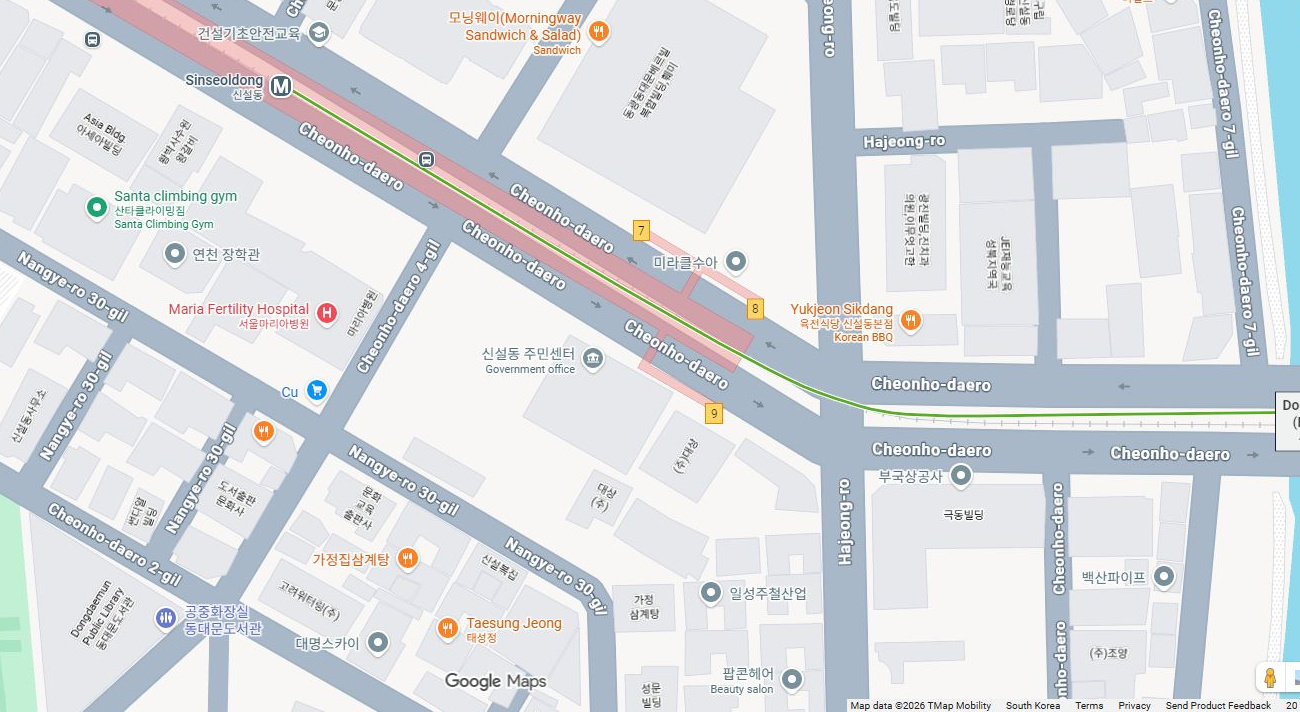
“We’ve kept our morning promise, then. Just not at the forest park,” Mali says with a smile, and Rina opens her notebook to “Sinseol-dong — 9·10 — 5 minutes”, another of her three-part notes. From either Exit 9 or Exit 10, the market is about five minutes away on foot. They soon cover the distance while chatting, and searching for 서울풍물시장 in a phone map makes the route straightforward even on a first visit.
As they walk, Rina runs through the opening hours: 10 a.m. to 7 p.m., closed every Tuesday. That is why she deliberately chose Wednesday. Cheongchun 1beonga upstairs finishes at 6 p.m., and arriving before 5 p.m. gives visitors more to see. “We’re going in at opening time, so there’s plenty of time to take it slowly,” she says. Mali writes down “Tuesday — closed” and “Before 5”.
At the market, Rina points to the ground at the entrance. There is no step at the main entrance, so wheelchair users can enter, and the accessible toilet is in the green zone inside. On her first visit, Rina spent ages walking round because she did not know where the toilets were, so this time she put that information in her notebook first. Mali laughs that having a friend think of these little things feels much more reassuring than her work-trip schedule.
Finding your way around the seven colour zones and two floors
Before they go in, Rina shows Mali the plan she drew the night before. The market has seven zones — red, orange, yellow, green, blue, indigo and purple — alongside the themed space Cheongchun 1beonga. Its two floor plans put yellow, green, orange and part of red on the ground floor, with indigo, blue, purple, another part of red and Cheongchun 1beonga on the first floor. Rina’s sketch follows exactly that arrangement.
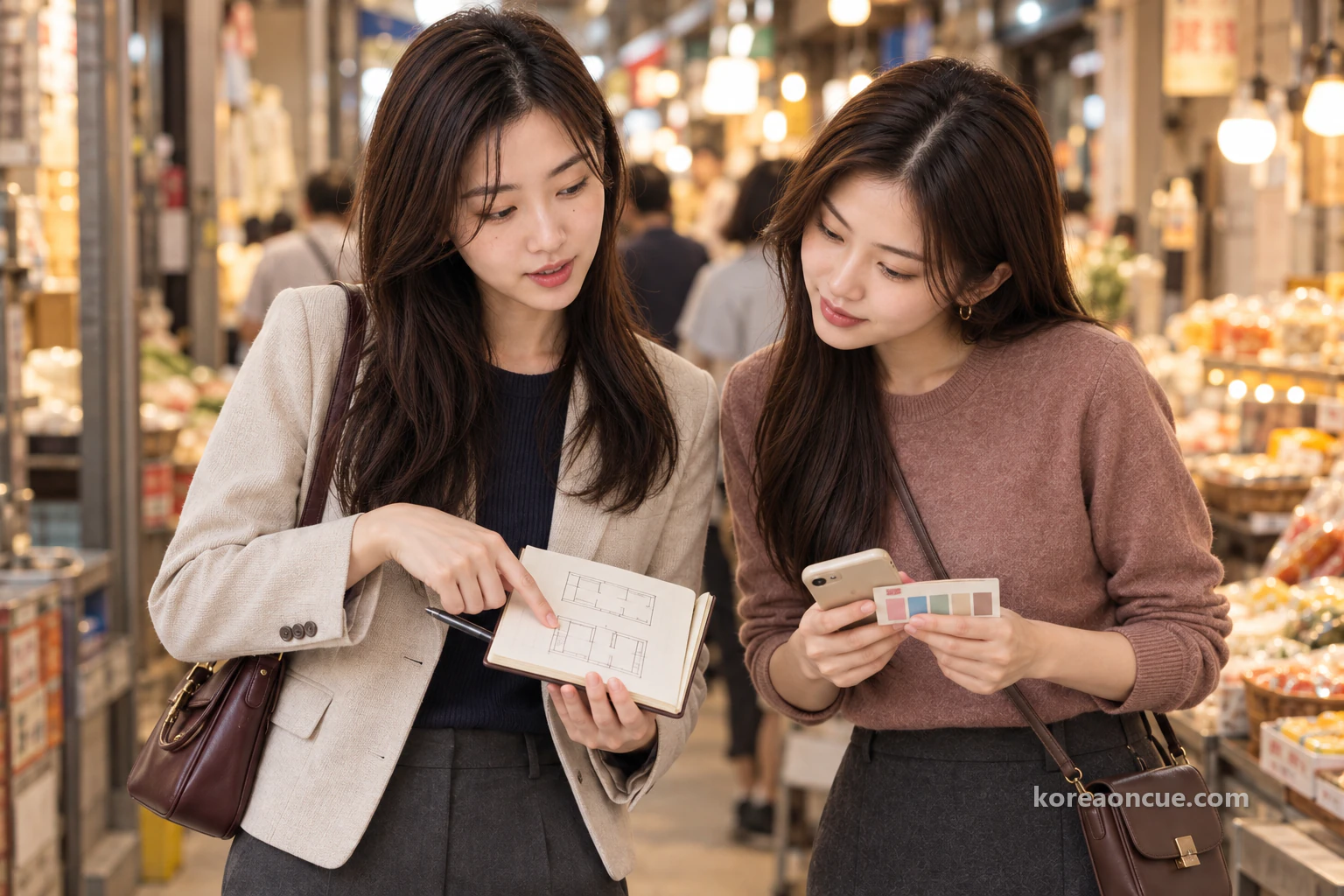
Mali reads the seven colour names aloud, then pauses at indigo. “They give blue and indigo separate names. If we put those two under one name in the magazine, readers always complain.” For someone whose work involves distinguishing dozens of lipstick shades, a market divided into the seven colours of the rainbow is an amusing discovery. Rina explains that the colours are there to help people find their way, rather than describe what each zone sells.
That distinction helps on a first visit too. Red is the food alley, spread across both floors, with stalls serving beef-head soup with rice, blood sausage soup, boiled pork head, offal, mung bean pancakes, noodles and Korean snack dishes. Orange mainly sells fashion and second-hand clothing, while yellow mixes clothing and second-hand clothes with household goods and hobby supplies. Green is for antiques and crafts, and indigo upstairs mainly sells household goods. Rina’s plan is to start with clothes in orange and yellow, pass through green, then head upstairs.
Checking seams and finishes on second-hand clothes in orange and yellow
In the orange zone, rows of clothes on hangers stretch along both sides of the aisle. Clothing and second-hand clothing stalls fill much of this area, with some also selling watches, accessories and shoes. These old clothes are what Rina meant by “vintage fabric”. She has come to look at colours softened by repeated washing and sunlight, colours that fresh fabric does not have.
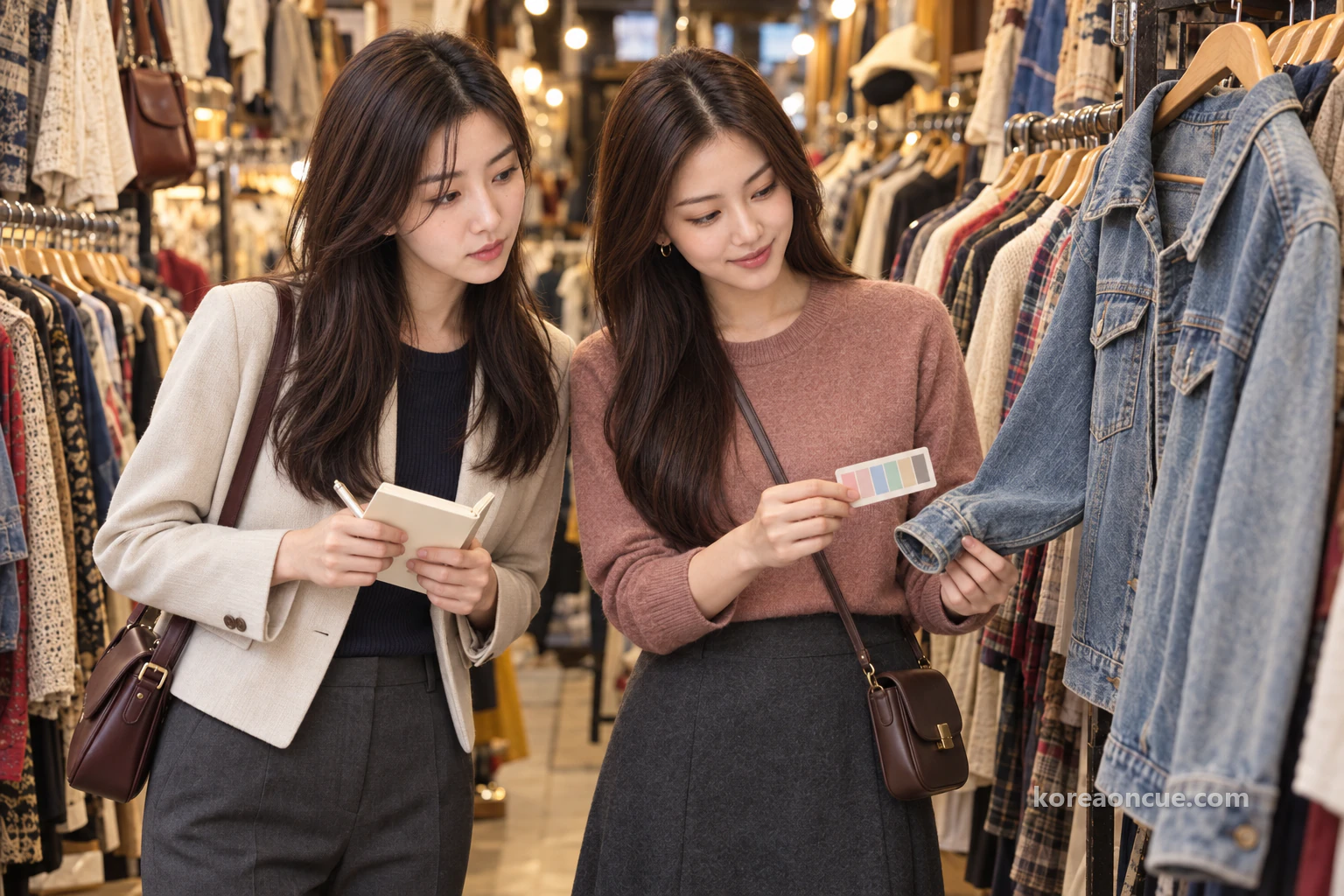
Rina looks at cuffs, button fixings and inside seams before she looks at colour. It is the same check she showed Mali on the day they first met in Dongdaemun. Without touching the clothes, she points out that even a beautiful colour will not make an old garment easy to wear again if its seams are coming apart or its buttonholes have stretched. Beside her, Mali takes a small colour card from her bag and holds it towards the clothing. Comparing a colour with a reference beside it in the same light is the method she taught Rina in Dongdaemun.
“There’s more green in this indigo than I expected, now it’s beside the card.” Rina writes “Orange zone — indigo denim — some green” in her notebook. Mali takes out her phone by habit, remembers that the clothes belong to the stall and puts it away again. Instead, she photographs only her own colour cards and Rina’s notebook sketch. They have both known since their first meeting to ask the owner before photographing anything for sale.
The mix changes slightly in yellow. Household goods and hobby supplies appear between the clothing and second-hand clothing stalls, and several places stock military clothing too. Rina spends a long time looking at a military jacket made from thick cotton. Its close stitching and firmly folded pocket corners, she says, show a different approach to construction from fashion clothing. Mali holds a card beside the khaki and shakes her head at how different it looks from khaki under shop lighting.
Rina’s order of checks is useful for anyone browsing second-hand clothes. Once a colour catches your eye, start with the seams, buttons and zips — the parts that can be difficult to repair — then check for stains and fading. Take time to inspect anything you like there and then, and ask about anything unclear. Rina chooses nothing today, but her notebook already has five lines recording zones, colours and details of the finish.
Old radios, clocks and antique furniture in the green zone
Further into the ground floor, they reach green. Antiques and crafts are the focus here. Stalls sell old and antique furniture, antique ceramics, stone carvings and old books, while others display old keyboards, radios, picture frames, clocks and ornaments together. After the long clothing racks in orange, their pace changes.
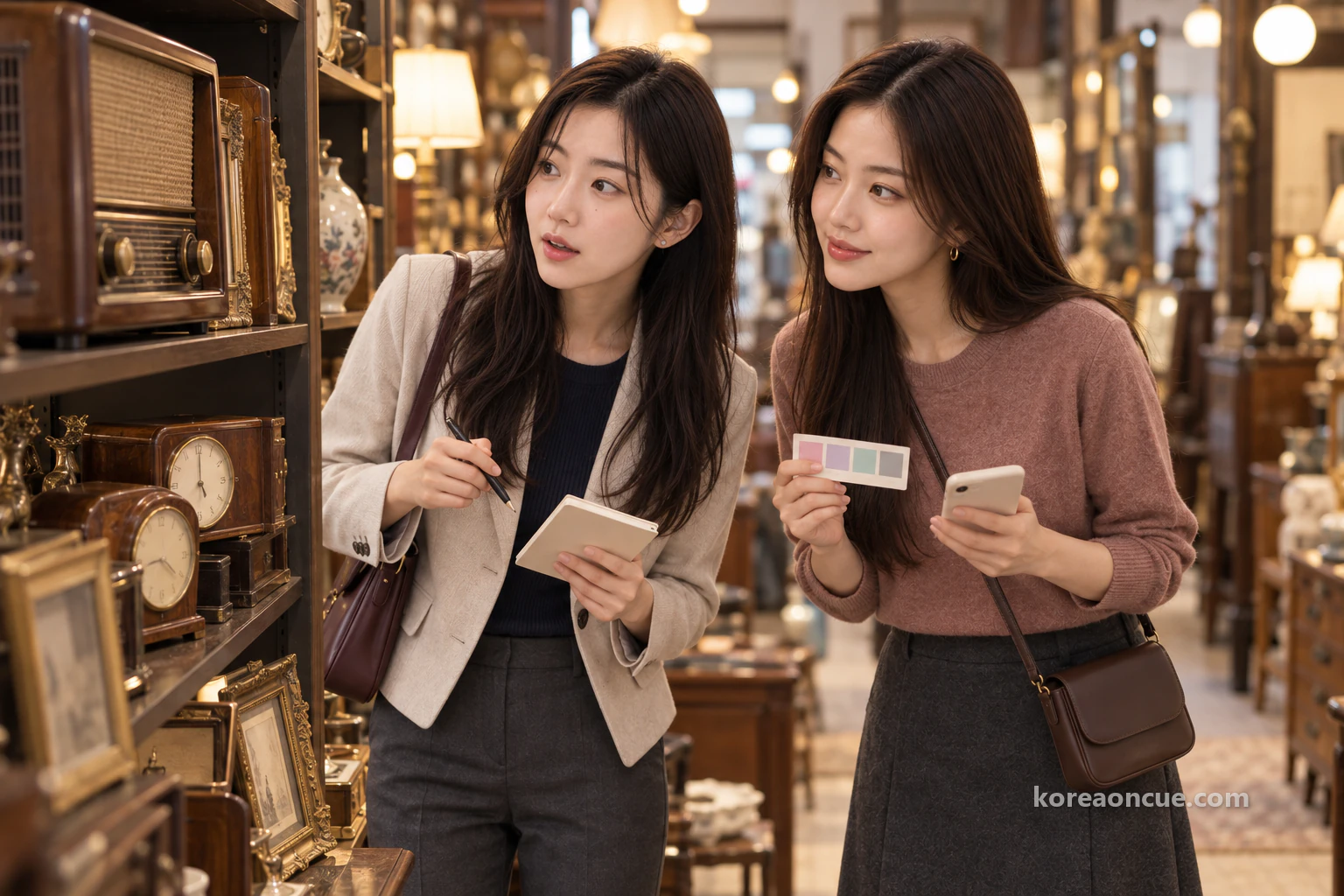
Mali stops for a long time in front of an old radio in a wooden case. She likes the dark brown grain beside the faded fabric covering its speaker. “If we tried to recreate this brown for a magazine shoot, it would look too new. It takes age to get this colour.” It echoes what she said beside the rusty railway tracks on their last forest-park walk. Rina writes “Green zone — radio — don’t recreate” in her notebook.
Rina points out that this is not the only zone selling clocks and watches. Those stalls are scattered around the market, as are instrument repairers and places selling audio equipment and speakers. Anyone looking for one particular thing shouldn’t assume it is unavailable after checking only one zone. That is also why Rina wants to go all the way round the ground floor before heading upstairs.
They pass an LP stall in green, but Rina suggests taking their time over records upstairs, where there are more. As they walk, she gives Mali a brief history of the market. When the Cheonggyecheon restoration project began, the Hwanghak-dong flea market moved into the former Dongdaemun Stadium as the Pungmul Flea Market. The present Seoul Folk Flea Market later opened on the former site of Sungin Girls’ Middle School at Cheonggye 8-ga in April 2008. It was designated Seoul Future Heritage in 2015.
The Hwanghak-dong market was once also called Dokkaebi Market, a name linked to the goblin-like figures of Korean folklore. There are two stories behind it. One describes the daytime crowds disappearing like an ebbing tide after dark, while the other links the name to goods so old and worn they might belong to dokkaebi. Thinking of the radio they have just seen, Mali laughs. “So that radio belongs to a dokkaebi, then.”
LPs and cameras upstairs in indigo, blue and purple
At the top of the stairs, Rina opens her notebook to the first-floor sketch. The first floor contains indigo, blue and purple, along with part of the red food alley and Cheongchun 1beonga. Indigo mainly sells household goods, including electrical appliances, while blue mixes household goods and clothing. Purple has clothing, household goods and hobby supplies, including stalls selling US military clothing.
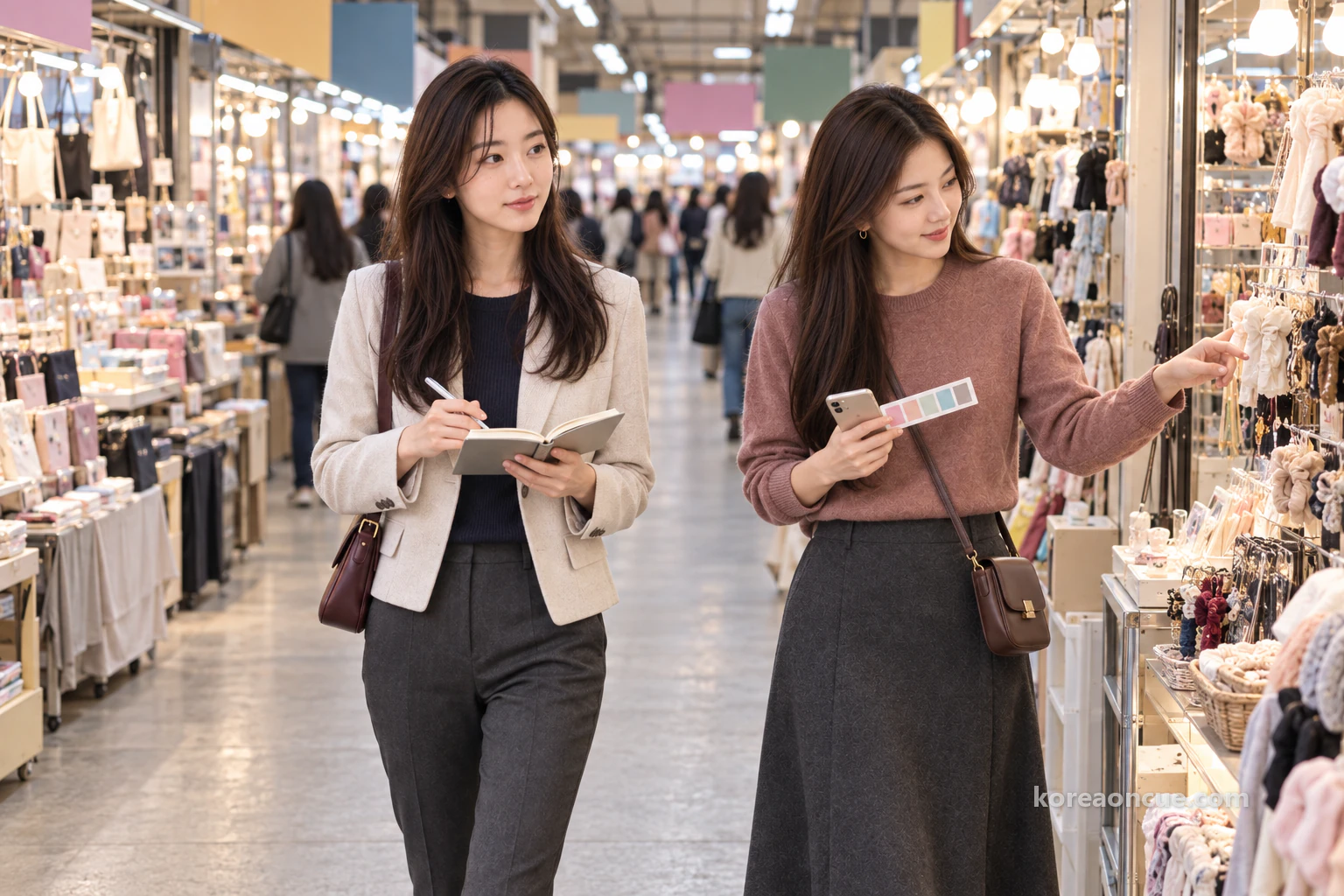
LPs are what Mali is most looking forward to upstairs. A senior colleague at her Bangkok office collects records and asked her to find out where to browse them in Seoul. Rina has already warned her that record stalls are spread out rather than grouped in one place. Indigo has several record shops, including stalls carrying records, CDs, LPs and cassette tapes together, and purple upstairs also has an LP stall. Downstairs, yellow has stalls selling records, CDs, tapes and film DVDs, while green has the LP stall they passed earlier.
In an indigo aisle, Mali stops beside a stall stacked with cassette tapes. Each case has faded to a slightly different colour, and she takes out her colour cards without thinking. Then she laughs to herself and puts them back. “Whatever I look at today, the cards come out first.” Rina smiles too, remembering the same woman alternating between her phone and her colour cards when they first met in Dongdaemun.
Cameras follow much the same pattern. There is a camera stall in green downstairs, while upstairs indigo has second-hand cameras, blue has cameras and accessories, and purple has cameras, projectors and film props. Mali lingers in front of a projector in purple. She peers at its lens from different angles, wondering how different the colour temperature of its light must have been from the lighting used on magazine shoots.

For an LP or camera search, noting the floors and zones as Rina does makes the visit easier. An order such as “First-floor indigo → purple → ground-floor yellow and green” saves repeated trips up and down the same stairs. Rina puts together a note for Mali’s colleague, and Mali photographs the notebook page and sends it straight over. “LPs — upstairs indigo first — downstairs too.” Another three-part note in Rina’s style.
Cheongchun Dabang and themed photo spots at Cheongchun 1beonga
Cheongchun 1beonga occupies one side of the first floor. Styled after a Seoul shopping street of the 1960s and 1970s, it includes names such as Cheongchun Dabang, Pungmul Hair Salon and Cheongchun Ilbeonga Theme Photo. The name appears in both forms, Cheongchun 1beonga and Cheongchun Ilbeonga. It opens from 10 a.m. to 6 p.m., an hour earlier than the market’s closing time, so visitors arriving late in the afternoon should start here.
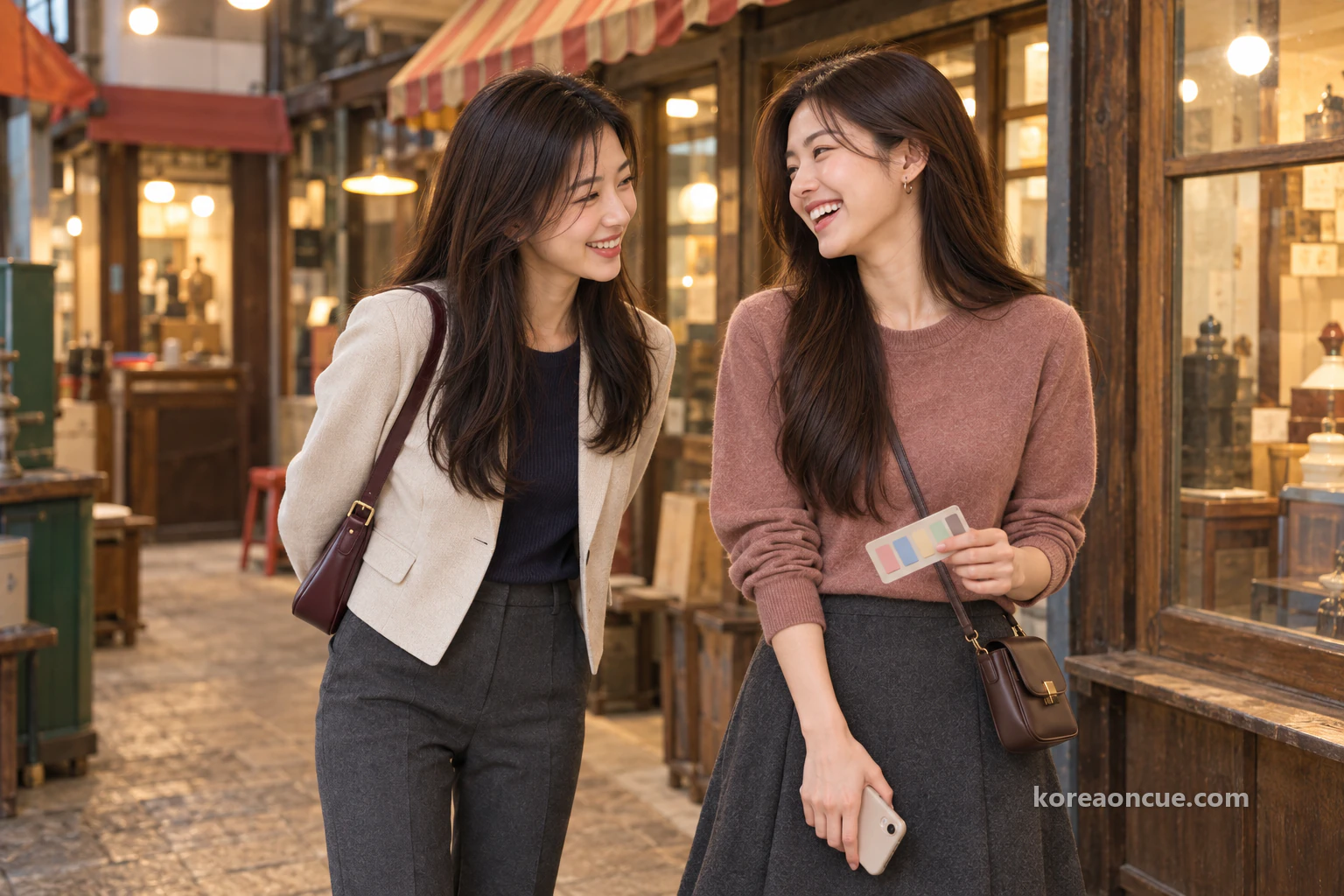
On entering Cheongchun 1beonga, Mali raises her phone camera instead of a colour card for the first time that day. This time, she wants a photograph of them together rather than anything for sale. Rina stands awkwardly in front of the old shopping-street setting, hiding her notebook behind her back, while Mali takes a few pictures and says, “I’ve never seen you without your notebook.” On screen, Rina is smiling in a way Mali has not seen in Dongdaemun or at the forest park.
Looking through the pictures, Mali notices something. Side by side, the colour-card photograph from the ground-floor aisle and the one from Cheongchun 1beonga make the same card look completely different under the lighting. “It’s the same market, but the light changes between floors. We need to remember that when we’re choosing clothes.” Rina writes “Colour — different on each floor” in her notebook. Between them, they have found another useful check: look at a garment in a brighter part of the aisle as well, rather than relying only on the light where it is hanging.
Lunch in the red zone food alley
It is past noon when they leave Cheongchun 1beonga. They head for red, the food alley. Spread across the ground and first floors, it has stalls serving beef-head soup with rice, blood sausage soup, boiled pork head, offal, mung bean pancakes, noodles and Korean snack dishes. The market closes at 7 p.m., but the food alley stays open until 10 p.m.

Mali chooses a mung bean pancake, and Rina orders noodles. Looking at the pancake’s golden edges, Mali starts talking about colour again. “That brown is quite close to the radio earlier,” she says, and Rina laughs: “Whatever we eat today, you’re going to describe it by colour.” Over lunch they go back through the morning’s finds. The indigo denim in orange, the khaki in yellow, the radio in green and the cassette tapes in indigo have each stayed with them as a colour.
Individual food stalls keep different hours, so anyone planning a late dinner should check on site that the place they want is open. Browsing in the morning and eating lunch in the food alley, as Rina and Mali do, also takes care of arriving before the market’s recommended 5 p.m. Mali copies the order into her notes. “Morning browsing — lunch in red.”
Payment and returns when choosing things at Seoul Folk Flea Market
As she opens her wallet to pay for lunch, Mali asks Rina a question. Can she use a card here? Credit card acceptance varies from stall to stall. Rina says that is why she always brings a little cash. Some stalls accept cards, but having cash makes things easier when others do not.
There is something else to remember when choosing old objects, Rina says. The market follows the Korea Consumer Agency’s refund rules and recommends settling disagreements during a sale directly between buyer and seller. With second-hand clothes and old machines, whose condition varies item by item, it makes sense to inspect them thoroughly before paying and ask any questions on the spot. That is why Rina has spent the morning looking at seams and buttons first.
Mali thinks back over her own behaviour that morning. Once she likes a colour, she tends to stop assessing anything else. “I’ve often bought something just for the colour, then got home and found a loose button.” Taking her cue from Rina’s notebook, she writes three words in her own notes: “Colour — finish — questions.” This time, Rina takes the photograph.
Walking to Hwanghakgyo Bridge on Cheonggyecheon
After lunch, they leave the market and walk towards Cheonggyecheon. Hwanghakgyo Bridge is about six minutes on foot from Seoul Folk Flea Market. Rina has chosen this walk because of the history she told Mali that morning. Since the market moved from Hwanghak-dong with the Cheonggyecheon restoration, she wants to walk to the bridge that still carries the name.
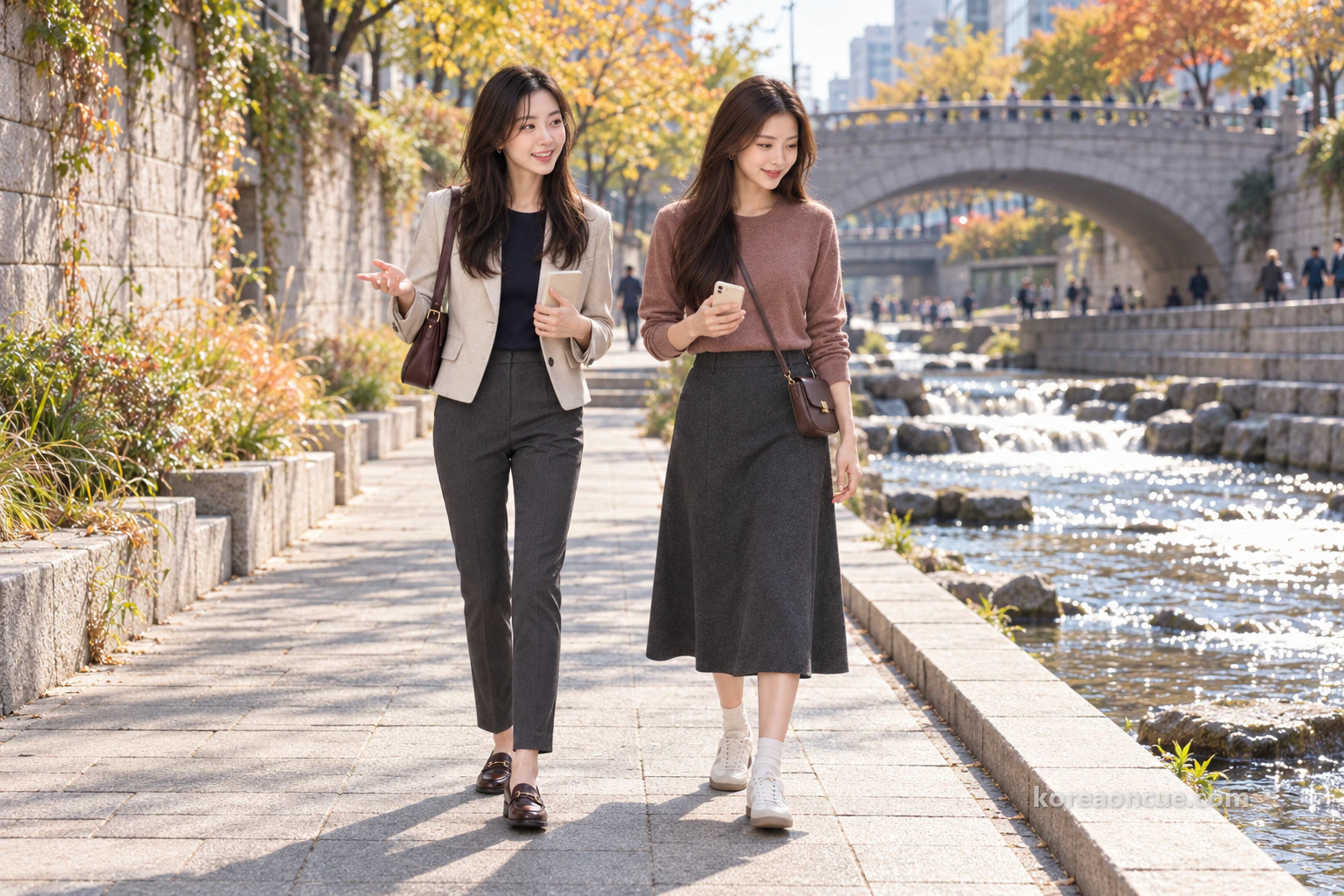
Beside the water, Mali takes out her colour cards once more. In the sunlight, the card looks different again from how it looked in the ground-floor aisle and upstairs. She lines up three photographs on her phone — ground floor, first floor and Cheonggyecheon — and shows Rina. “Same card, three different colours in one day.” Rina studies the screen for a while, then says she is going to start carrying a colour card too.
A Dongdaemun-gu market exploration route runs from the Cheonggyecheon bridges to Seoul Folk Flea Market, then Gyeongdong Market and Cheongnyangni Market. Today they have walked a small part of it in reverse. Rina opens her notebook and writes “Cheonggyecheon — Pungmul — Gyeongdong” on an empty line. That is the order she wants to try when Mali next comes to Seoul. With enough time, first-time visitors can also link the markets into a longer walk.
A colour card and a notebook page for the next work trip
Near Hwanghakgyo Bridge, Mali checks the time because she still has an afternoon meeting. Before they part, she takes a single colour card from her bag and offers it to Rina. It is the same kind she was carrying on the day they first met in Dongdaemun. “You said you’d start carrying one. Start with this.” Rina slips it inside the front of her notebook.
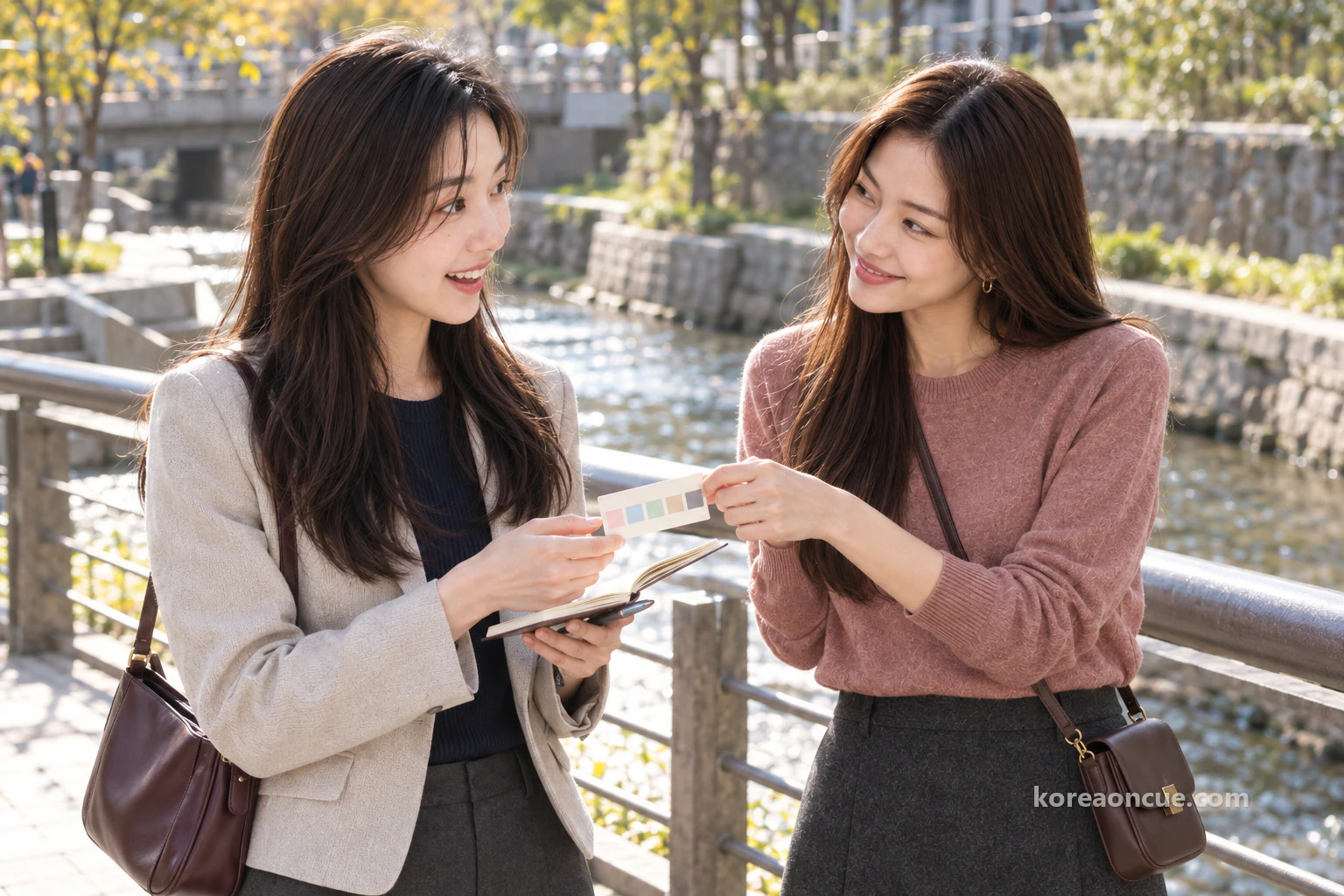
Rina has something to give her too. She carefully tears out the page of notes from today and hands it over. It lists the indigo denim in orange, the khaki in yellow, the radio in green, the order for browsing LPs upstairs and, at the bottom, “Colour — different on each floor”. Mali tucks it inside her notepad cover and says she will take it to her next magazine-shoot meeting.
Mali opens her phone calendar and checks the date of her next work trip again. Beside the little sun she drew last time, she adds “Cheonggyecheon — Gyeongdong”. Then she messages Maya: “All three of us next time. Forest park in the morning, market during the day.” Before the reply comes, Mali turns towards Sinseol-dong Station, and Rina waves with her notebook held to her chest.
On the train, Mali reopens “Things to look at for work”. “Market with colour names”, “Tuesday — closed”, “Before 5”, “Colour — finish — questions”. It reads more like a record of a day with a friend than notes from a work trip. On the day they first met in Dongdaemun, they each shared a way of choosing things, and this time they have left carrying those methods with them. Rina has the colour card, and Mali has her three-word note.
Common Mistakes
Going on a Tuesday
Seoul Folk Flea Market closes every Tuesday.
Arriving late in the afternoon
the market opens 10:00–19:00, but Cheongchun 1beonga upstairs closes at 18:00. The market recommends arriving before 5 p.m.
Bringing only a card
credit card acceptance varies by stall. Bring a little cash.
Guessing what a zone sells from its colour
the colours are wayfinding names. Red is the food alley, orange sells clothing and second-hand clothes, and green sells antiques and crafts.
Looking for LPs or cameras in just one zone
LPs are spread across indigo and purple upstairs and yellow and green downstairs. Cameras are in green, indigo, blue and purple.
Buying without checking the condition
inspect old items thoroughly on the spot. If a disagreement arises during a sale, the market recommends discussing it directly with the seller.
FAQ
How do I get to Seoul Folk Flea Market?
Take Exit 9 or 10 at Sinseol-dong Station on Lines 1 and 2, then walk towards Dongdaemun Post Office and Dongdaemun Library. It takes about five minutes.
When is it open?
10:00–19:00, closed every Tuesday. The food alley stays open until 22:00, and Cheongchun 1beonga upstairs opens 10:00–18:00.
How are the zones arranged?
There are seven colour zones — red, orange, yellow, green, blue, indigo and purple — plus Cheongchun 1beonga upstairs. Orange, yellow and green are on the ground floor, with indigo, blue, purple and Cheongchun 1beonga on the first floor. Red, the food alley, is spread across both floors.
Can I pay by card?
Credit card acceptance varies by stall. A little cash is useful.
Does anything open only at weekends?
The traders’ weekend market runs 10:00–18:00 at weekends, and the outdoor market also operates only at weekends.
Can wheelchair users enter?
Yes. The main entrance is step-free and allows wheelchair access. An accessible toilet is inside the market in the green zone.
Can I drive there?
Seoul Folk Flea Market public car park costs ₩360 per five minutes. A purchase at the market comes with a ticket for one hour and 30 minutes of free parking.
Recap — 30 seconds before you go
- Sinseol-dong Station (Lines 1 and 2), Exit 9 or 10 → towards Dongdaemun Post Office and Dongdaemun Library → about five minutes on foot.
- 10:00–19:00, closed Tuesdays. Cheongchun 1beonga closes at 18:00 — arrive before 5 p.m.
- Ground floor: orange and yellow for clothes, green for antiques. First floor: indigo, blue, purple and Cheongchun 1beonga. Red is the food alley.
- LPs and cameras are spread across several zones.
- Card acceptance varies by stall. Bring a little cash.
Sources
- Seoul Folk Flea Market — Map and directionsFrom Sinseol-dong Station towards Dongdaemun Post Office or Dongdaemun Library · Line 2 Exits 9 and 10 · address and management office phonechecked 2026-10-23
- Seoul Folk Flea Market — Visitor informationOpen 10:00–19:00, restaurants until 22:00 · closed every Tuesday · card payment varies by stall · public car park fee and free parking ticketchecked 2026-10-23
- Seoul Folk Flea Market — November 2026 opening scheduleCheongchun 1beonga 10:00–18:00 · visiting before 5 p.m. recommended · weekend traders’ market and weekend outdoor marketchecked 2026-10-23
- Seoul Folk Flea Market — Floor guideGround-floor and first-floor plans and the seven colour zones · Cheongchun 1beonga theme zone upstairschecked 2026-10-23
- Seoul Folk Flea Market — Stall directoryTrades by zone (red zone food alley, orange zone clothing and second-hand clothing, green zone antiques and crafts, and more) · zones with LP, record and camera stalls · Cheongchun 1beonga entrychecked 2026-10-23
- Seoul Folk Flea Market — Refund policyFollows the Korea Consumer Agency refund rules · disagreements during a sale best settled directly between buyer and sellerchecked 2026-10-23
- Korea Tourism Organization, Accessible Travel — Seoul Folk Flea MarketHistory from the Hwanghak-dong flea market · Seoul Future Heritage in 2015 · closing day · step-free main entrance and accessible toilet in the green zonechecked 2026-10-23
- Dongdaemun-gu culture and tourism — Cheonggyecheon and market explorationCourse: Cheonggyecheon bridges → Pungmul (Folk Flea) Market → Gyeongdong Market → Cheongnyangni Marketchecked 2026-10-23
A Seoul story told with our AI characters. Place details are checked against public sources; the photos are AI-made illustrative images. How we use AI
More from this area
Gwangjang Market on Sunday: the Food Alley stays open
When a friend asks whether it is all right to go on a Sunday, Lulu, who has only ever been to Gwangjang Market on weekdays, decides to go on Sunday morning and film it instead of replying.
Dongmyo Flea Market: partly open on weekdays, all day at weekends
The answer for Dongmyo Flea Market came down to one line: partly open on weekdays, all day at weekends.