
SEOUL · GWANGJANG MARKET
Gwangjang Market on a Sunday: Lulu looks at the shuttered side first and reworks her “Sunday running order”
The Food Alley is open on Sundays too, 09:00–23:00 · the market’s standard closing day and the vintage arcade’s closing day are Sunday · 62 m from Exit 8 of Jongno 5-ga Station on Line 1 · to see all three areas, go Monday to Saturday, the standard opening days, before 6 p.m.
When a friend asks whether it is all right to go on a Sunday, Lulu, who has only ever been to Gwangjang Market on weekdays, decides to go on Sunday morning and film it instead of replying. The side with its shutters down and the side where the griddles are hot: she puts both faces into one video.
How to get there
On Saturday night, a message from Rina popped up in the group chat the four of them share. “Is it all right to go to Gwangjang Market on a Sunday?” It was a very Rina question, from someone who writes days and times down in separate boxes. She is the kind of person who asks whether a place will be open before she goes, so the Sunday box in her notebook was probably still empty. Lulu, born and raised in Seoul, started to type an answer straight away, then stopped. She had been to Gwangjang Market many times, but always on a weekday afternoon.

When Lulu tells friends about a place, she sends a video before she sends words. So this time, instead of a long reply, she sent just one line. “I’ll go tomorrow and film it for you.” Looking up the opening hours before bed, she found that Sunday is the market’s standard closing day and the vintage arcade’s closing day, and that the Food Alley opens that day as well. Filming only the open side would give her friends half an answer, she thought, so on the first line of her notes app Lulu wrote “Sunday — Food Alley open / market standard closing day · vintage arcade closed”.
The Cue — At a glance
The Food Alley is open on Sundays too. The market’s standard closing day and the vintage arcade’s closing day are both Sunday. The Food Alley opens every day from 09:00 to 23:00, all year round, with no closing days. From Exit 8 of Jongno 5-ga Station on Line 1 it is 62 m to the market, and from Exit 4 of Euljiro 4-ga Station on Lines 2 and 5 it is 100 m.
- Station and exit: Jongno 5-ga Station (Line 1) Exit 8 (62 m to the market, and the station lift is at Exit 8 too) · Euljiro 4-ga Station (Lines 2 and 5) Exit 4, 100 m. The address is 88 Changgyeonggung-ro, Jongno-gu, Seoul.
- Sunday: The Food Alley is open on Sundays too, 09:00–23:00, all year round. The market’s standard closing day and the vintage arcade’s closing day are Sunday.
- Monday to Saturday: market standard hours 09:00–18:00 · vintage arcade 10:00–19:00 · Food Alley 09:00–23:00. Hours vary from shop to shop.
- Public holidays: The vintage arcade opens as normal.
- Gates to the Food Alley: East Gate, North Gate 2 and South Gate 1.
- Bus: the “Jongno 5-ga.Gwangjang Market” median-lane stop.
- Car: Use the Jongmyo Parking Lot in Jongno 4-ga.
- Enquiries: Gwangjang Market 02-2267-0291 · Gwangjang Market Merchants’ Association 02-2272-0967.
What opens and what closes on a Sunday — the hours on one line
The Food Alley is open on Sundays too, from morning until night. It opens at 9 a.m. and closes at 11 p.m. every day, with no closing days all year. Sunday is the market’s standard closing day and the vintage arcade’s closing day, so on a Sunday it makes sense to decide where to go before worrying about what time things close. That was why Lulu drew a circle round the Food Alley line in her notes. From the start, the Food Alley was going to be the centre of the Sunday video.
Open in Kakao Map — Jongno 5-ga Station
From Monday to Saturday, the hours are much easier to follow once you put them on one line. Lulu wrote five numbers side by side in her notes: “9 — 10 — 18 — 19 — 23”. At 9 a.m. the market’s standard hours begin, and so does the Food Alley, and at 10 the vintage arcade opens. At 6 p.m. the market’s standard hours end first, and at 7 the vintage arcade closes. After that, the Food Alley carries on until 11 p.m.
With the five numbers in a row, it was clear at a glance why Sunday is different. From Monday to Saturday, the standard hours of all three areas overlap for eight hours, from 10 a.m. to 6 p.m. On Sundays, those eight hours fall on the market’s standard closing day and the vintage arcade’s closing day, while the Food Alley stays open as usual. Rather than explain the difference at length, Lulu decided to show it as number bars in the first shot of the video. Rina, she thought, would copy the bars straight into the boxes in her notebook.
Which exit to use — 62 m from Exit 8 of Jongno 5-ga Station
On Sunday morning, Lulu got off at Jongno 5-ga Station on Line 1 and came out of Exit 8. From Exit 8 it is 62 m to Gwangjang Market. The station lift is at Exit 8 too, so even on a day with lots of luggage or a pushchair, this one exit is all you need to remember. If it is your first time, putting the address, “88 Changgyeonggung-ro”, into the map on your phone gives you extra peace of mind. Lulu, too, settled on a single exit number for her friends: Exit 8.
If you are on Line 2 or 5, there is no need to change. Get off at Euljiro 4-ga Station and come out of Exit 4. From there it is 100 m to the market, so the walk is not much longer than the 62 m on the Line 1 side. By bus, get off at the “Jongno 5-ga.Gwangjang Market” median-lane stop, and if you are driving, use the Jongmyo Parking Lot in Jongno 4-ga. Lulu wrote the two subway routes and the bus stop name at the bottom of her notes, one line each. Whichever hotel her friends set out from, one of the three would suit them.
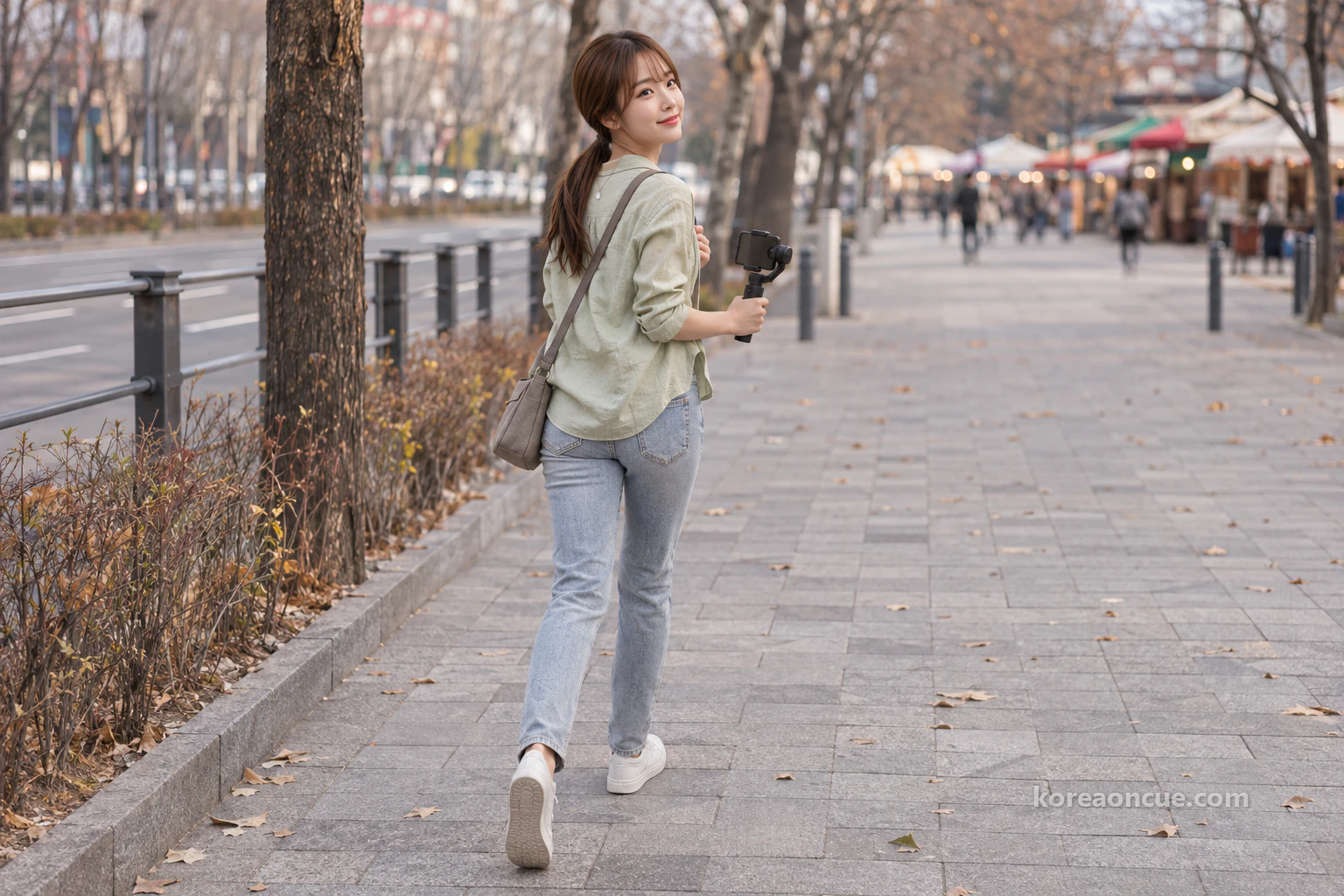
On the short walk from the exit to the market, Lulu changed the order of the video once more. She had meant to start with the Food Alley, but she changed her mind and decided to film the closed shops first. The first thing to surprise someone visiting on a Sunday for the first time would probably be the lowered shutters. In her notes she wrote “Closed side first, open side after”. Film it in the order her friends would see it, Lulu reckoned, and the video itself would work as directions.
What the closed side looks like on a Sunday — a passage with its shutters down
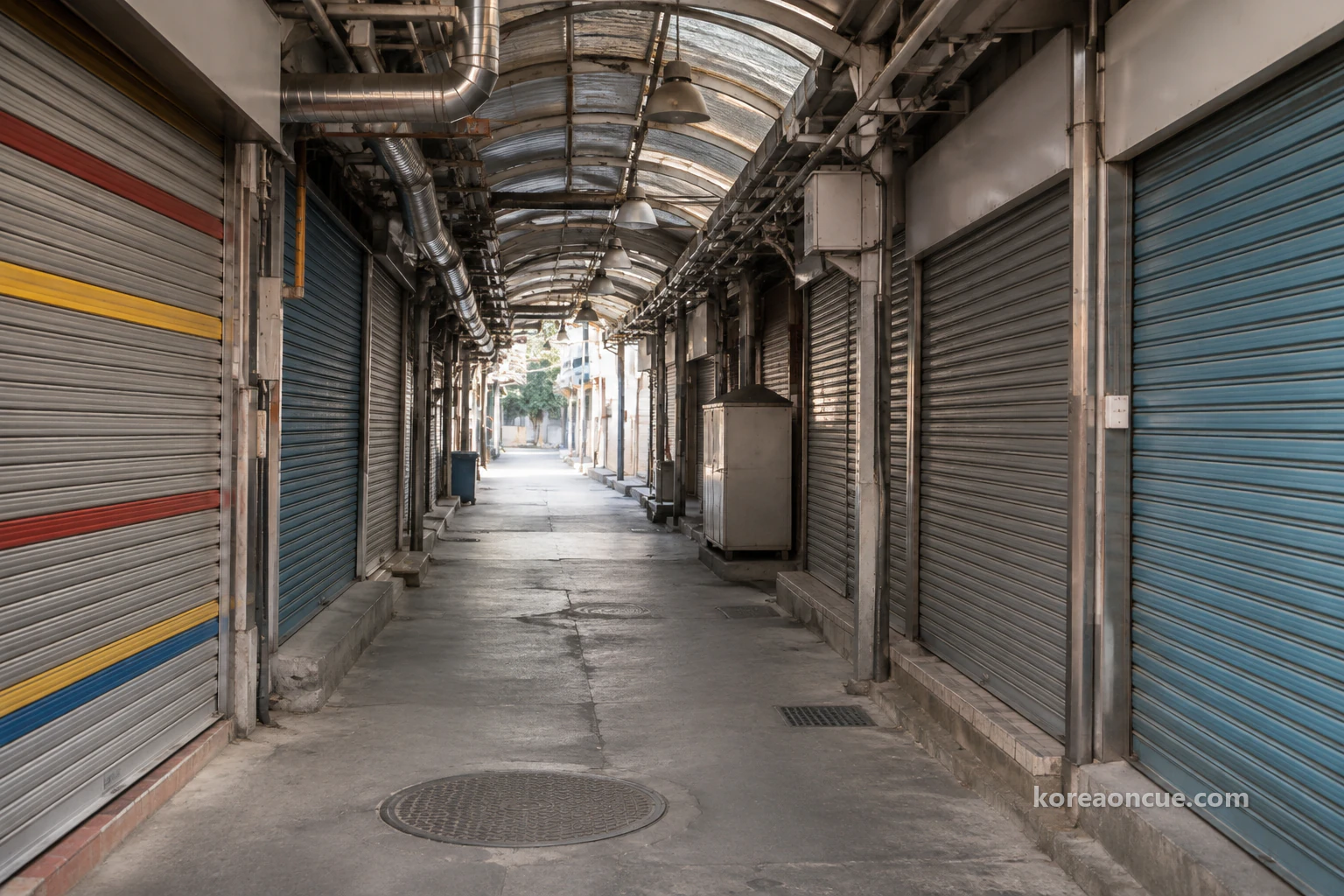
Sunday is the market’s standard closing day. As soon as Lulu turned into a passage away from the Food Alley, the mood changed completely. The shops along it had their shutters down, and the flow of people she was used to on weekday afternoons wasn’t there. Without thinking, Lulu said to herself, “Oh, this side’s closed today.” She had known before she came, but seeing it with her own eyes, it was far quieter than she had expected.

As always, Lulu started filming from the floor. She caught the gap under the shutters and the cement floor from low down, then slowly raised the gimbal to show the line of shutters all the way to the end of the passage. Her habit of filming new places from the ground up came in handy this time. The row of shutters showed up much better from a low angle. Lulu made this the second shot of the video, straight after the time bars.
While she filmed the closed side, Lulu also settled on a line for the captions. The market’s standard opening days are Monday to Saturday, so to see this passage with its shutters up, you need to come on one of those days. If you come on a Sunday, this passage is something to see once on video and walk past. Lulu nodded to herself and slowly lowered the gimbal. She kept the caption short: “This side: Mon–Sat”.
There is no reason to linger in a closed passage on a Sunday. If you find yourself in a passage lined with shutters, turn back and head for the gates that lead to the Food Alley. Lulu, too, walked the closed passage only for as long as she needed to film it, then turned round. Seeing that the shuttered passage was “closed today” was enough. That small check, she thought, would save her friends quite a bit of time.
What lies behind the shutters — a big wholesale market, and a name that means “to gather widely and keep”
Behind the shutters are the shops that Gwangjang Market has kept going for a long time. The market has grown into a large wholesale market selling all sorts of goods, from upholstery to imported goods and traditional goods. Silk and dress material, clothing, bedding, handicrafts and lacquerware inlaid with mother-of-pearl are all sold here. It is also a market where Korean tradition is very much alive, with everything needed for weddings and ancestral rites. Walking past the shuttered passage, Lulu thought of the things she had seen beyond it on weekday afternoons.
Standing by the shutters, Lulu thought about what the market’s name means. The name Gwangjang carries the meaning “to gather widely and keep”. It is written with 廣, “wide”, and 藏, “to store”, so although it sounds the same in Korean as 廣場, a public square where people gather, the characters are different. Looking at the passage with its shutters down, she read the name a little differently. Sunday felt like the day when everything gathered so widely is put away and kept safe for a day.
The market’s history goes back to the Gwangjang Company, founded by Korean merchants. When Japan’s currency reorganisation shook the footing of Korean merchants, they pooled their strength and set up the company. Gwangjang Market is also introduced as Korea’s first permanent market. In English, the name is explained as “to gather from afar and keep altogether”. Lulu copied this English explanation to the top of the video description for her friends from abroad.
So Lulu decided to put this passage in the video as “the side with its shutters down today”. If you plan to look at fabric, hanbok or bedding, you will find it easier to come on Monday to Saturday, the market’s standard opening days, rather than on a Sunday. If you are coming for the Food Alley, Sunday is a good day too. Even in the same market, the right day depends on what you are coming to see. Lulu wrote a short line in her notes: “Pick the day by what you’re coming to see”.
Even standing in the closed passage, she could faintly smell the Food Alley. In this market, a savoury smell always hangs between shops that have been going for decades, and even on a day of lowered shutters, the smell didn’t seem to take a break. When she briefly lost her bearings by the shutters, a few steps towards where the smell grew stronger soon brought the sound of people. Lulu thought the smell was the easiest sign to follow on a Sunday. But a video can’t carry a smell, so she decided to leave that job to the names of three gates.
Is the vintage arcade closed on Sundays — closed on Sundays, open as normal on public holidays
The vintage arcade is closed on Sundays. Gwangjang Market’s imported vintage arcade is a kind of heaven for vintage fashion, full of clothes you won’t find among ready-made goods. Her friends always replay clothes-picking scenes the most, so Lulu had really wanted to put this arcade in the video. But today, a Sunday, it was behind shutters too. Lulu pouted in disappointment for a moment, then lifted the gimbal again, telling herself this was a scene her friends needed to see as well.
The vintage arcade’s hours are an hour off from the market’s standard hours at each end. The market’s standard hours start at 9 a.m. and end at 6 p.m., but the vintage arcade opens at 10 a.m. and closes at 7 p.m. So if you arrive at 9 on a Saturday morning, you will have to wait until 10 for the vintage arcade, and in the evening you can browse it for one more hour after 6 p.m. Lulu decided to mark this one-hour difference with the colours of the number bars rather than with captions. The market’s standard hours were a dark colour, and the vintage arcade a lighter colour shifted one step along.

The vintage arcade has its own rule for public holidays as well. It is closed on Sundays but opens as normal on public holidays. Lump the closing days together in your head and it is easy to get confused here, so it helps to write Sundays and public holidays down side by side. Lulu decided this line had to go in the video description. Her notes gained one more line: “Vintage — Sun: closed / public holidays: open”.
For friends who find their way with English guides, Lulu noted down the names as well. In English tourist information, the vintage arcade appears as “Vintage shop” or “Charity stores”, and the Food Alley as “Food street” or “Food Alley”. Some timetables put the word “Daily” and “Closed Sundays” on the same line, so don’t take “Daily” on its own to mean it is open on Sundays. Lulu copied these four English names to the very bottom of her notes, each one paired with its Korean name. That way her friends wouldn’t get muddled when the same place turned up under a different name.
Which gates lead to the Food Alley — East Gate, North Gate 2 and South Gate 1
The Food Alley connects to the East Gate, North Gate 2 and South Gate 1. The Food Alley linked to these three gates is the most popular part of Gwangjang Market. So on a Sunday, knowing the names of the three gates makes the open lanes much easier to find. Instead of wandering through closed passages, walk towards these gates and you will reach the Food Alley directly. Once she had finished filming the closed side, Lulu followed the gate names to the Food Alley.
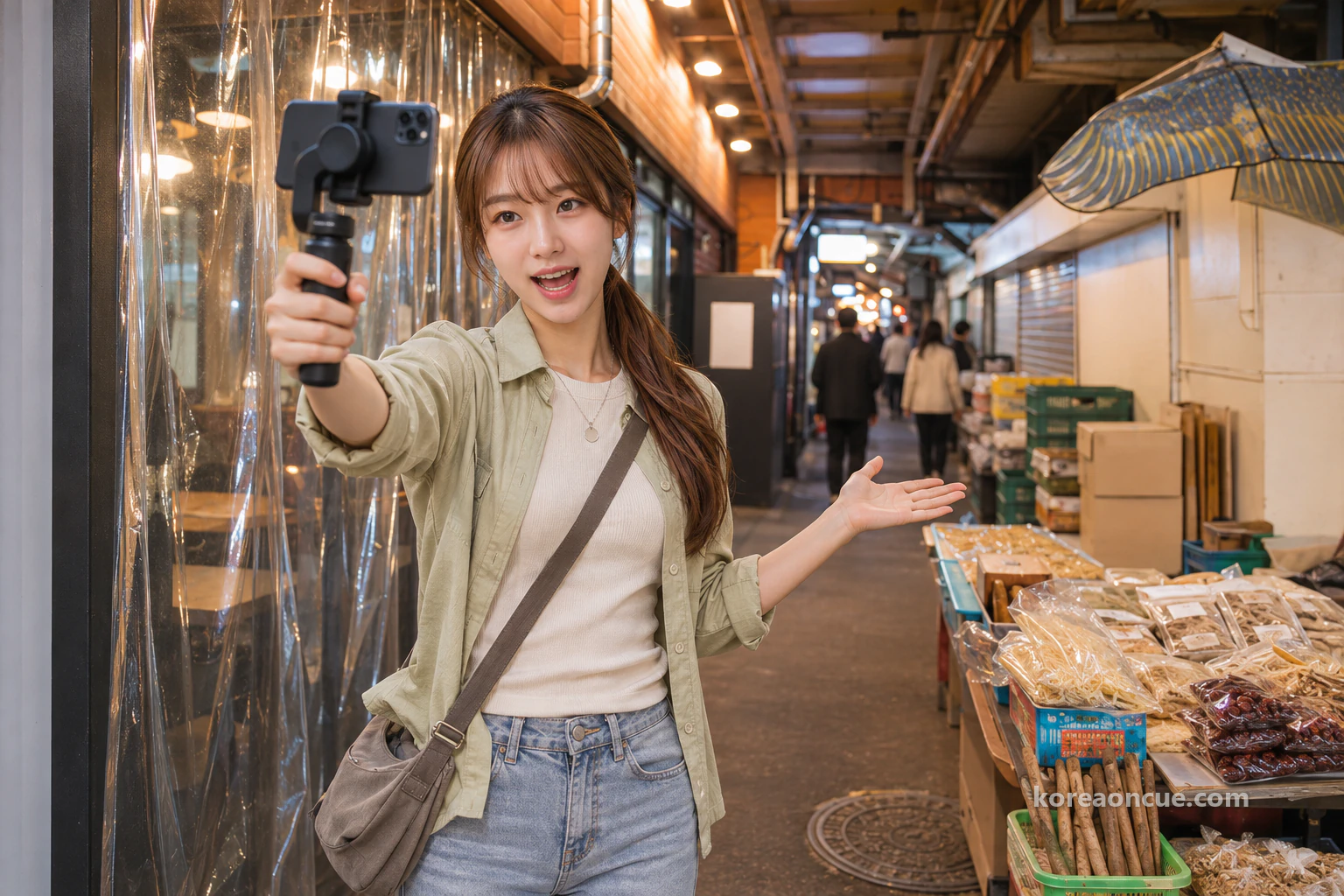
The moment she stepped into the Food Alley, even the air was different. Unlike the quiet by the shutters, here a savoury smell and the spatter of oil on the griddles reached her first. Along one side of the narrow covered passage ran restaurant entrances hung with clear plastic curtains, and pipes and ducts were exposed on the ceiling. Lulu decided to use this sound as the transition in the video. If the sound of the griddles came straight after the shutter shot, nobody would need to be told where to go on a Sunday.
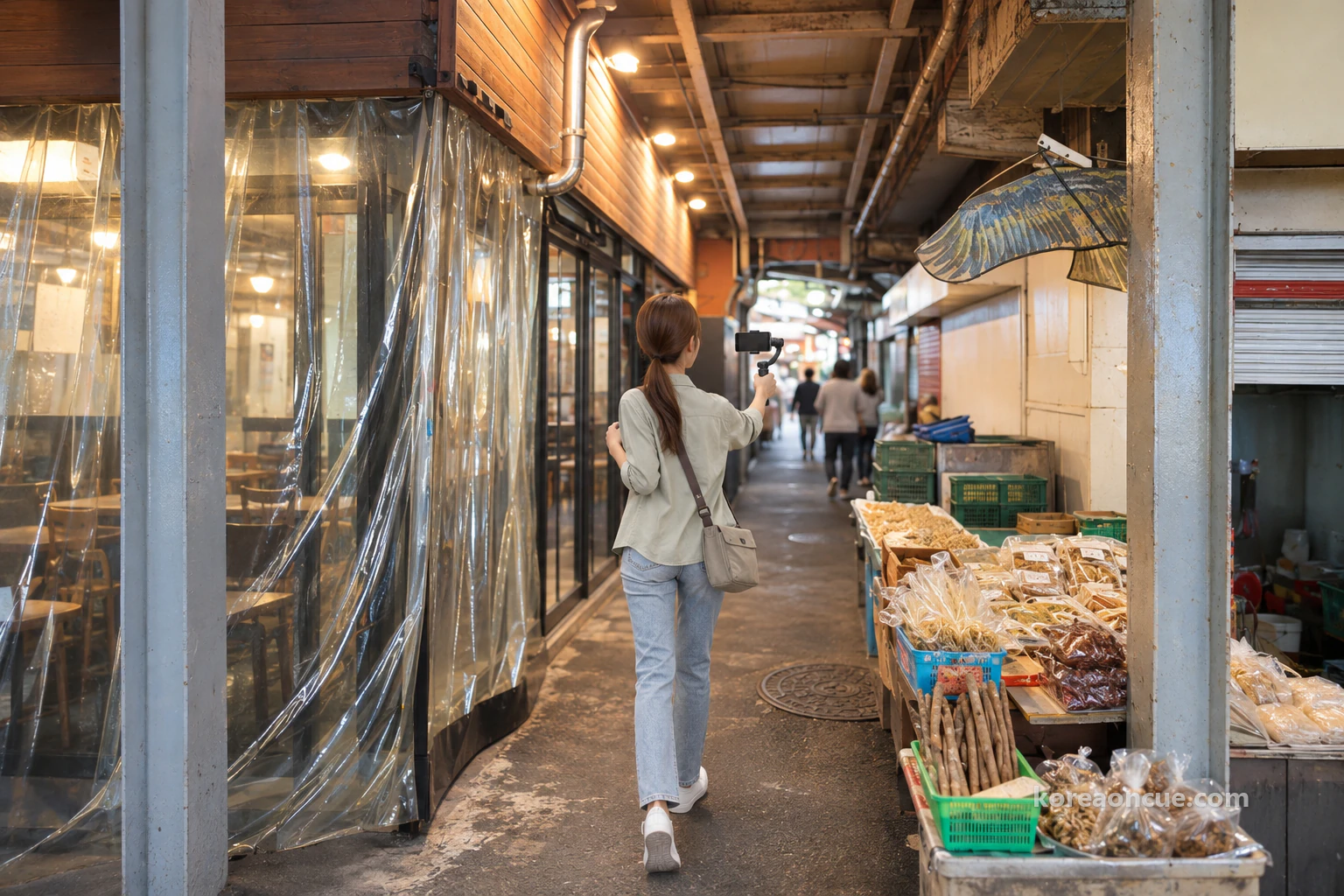
It was the same market, yet a few steps seemed to change the day of the week. The stream of people, broken on the shutter side, ran on and on along this passage. Lulu filmed those few steps from the shutters into the Food Alley in one take, without cutting. She wanted her friends to see for themselves how close the closed side and the open side are. In her notes she wrote in big letters “Gates = East Gate · North Gate 2 · South Gate 1”.
What Lulu filmed in the Food Alley on a Sunday — the bindaetteok griddle and the brass plates
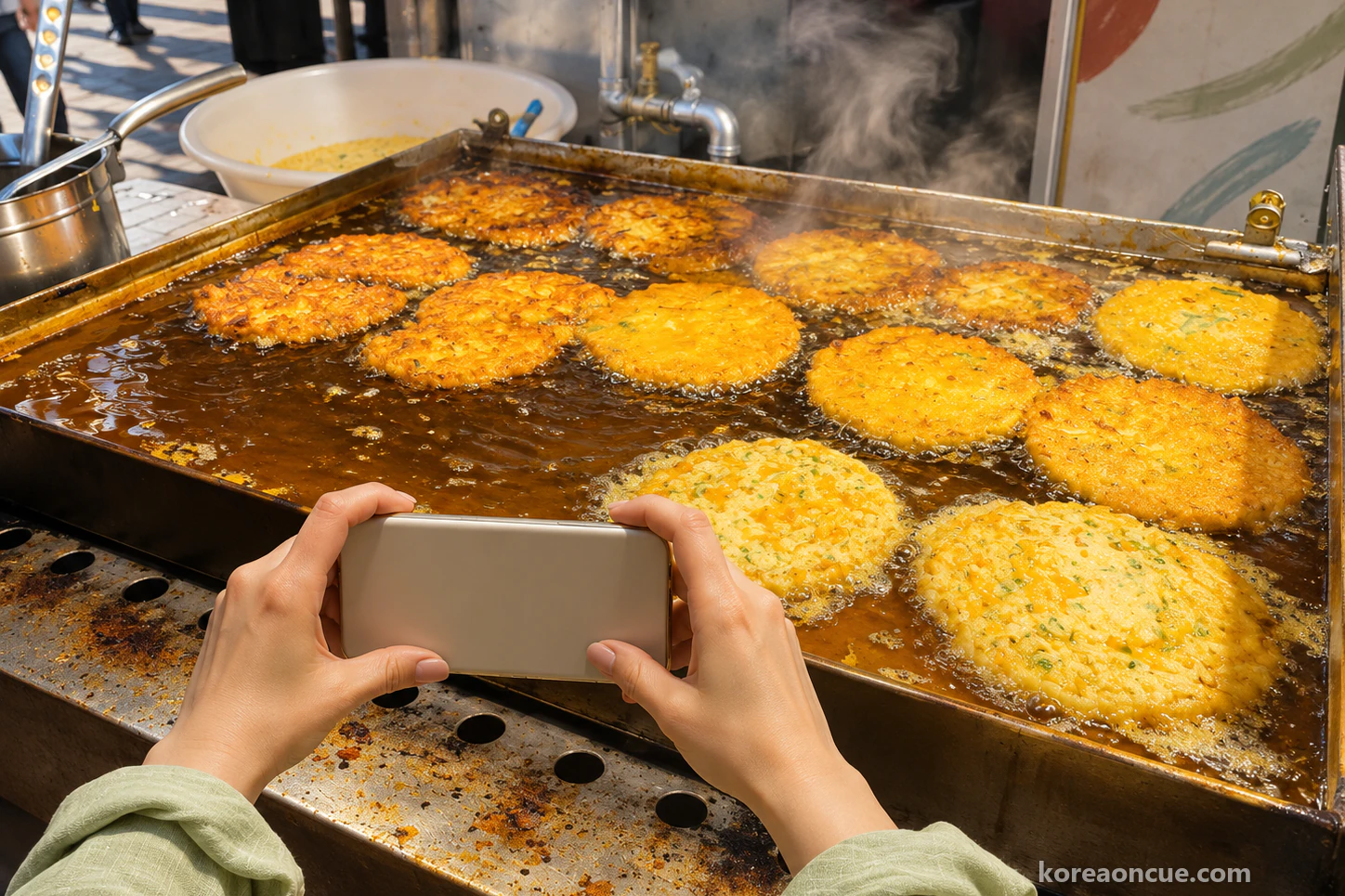
The Food Alley is where Gwangjang Market’s signature dishes come together. Its wide range of food is also why the market is loved by people from all over the world. Mung bean bindaetteok and modum-jeon (assorted savoury pancakes), mayak gimbap, sundae (Korean sausage) and head meat, yukhoe (beef tartare), donggeurangttaeng (Korean-style meatballs), gimbap and tteokbokki, and chapssal sundae made with glutinous rice are all favourites here. Rather than squeeze every one of these names into the captions, Lulu decided to pick just two shots with sound and steam. The star of the Sunday video was not a list of food but the fact that “this side is open”.
The first was the big griddle where mung bean bindaetteok was frying. A dozen or so pancakes were sizzling in oil at once on the wide griddle. Lulu held her phone sideways and filmed low, at the height of the griddle. So that the sound of the pancake edges crisping up would come through clearly, she kept her hands still for a while and even steadied her breathing. This was the transition shot that would go straight after the shutters.
The second was a row of round brass plates lined up on a stainless steel worktop. Each plate held pyeonyuk (pressed boiled meat), mung bean sprouts and shredded spring onion, laid out neatly. Lulu followed the row slowly from the side as she filmed. After the hot sizzle of the griddle, this calm row would give the video a moment to breathe, she thought. Playing the clip back, she came to the moment when the steam had misted the lens, and Lulu burst out laughing.
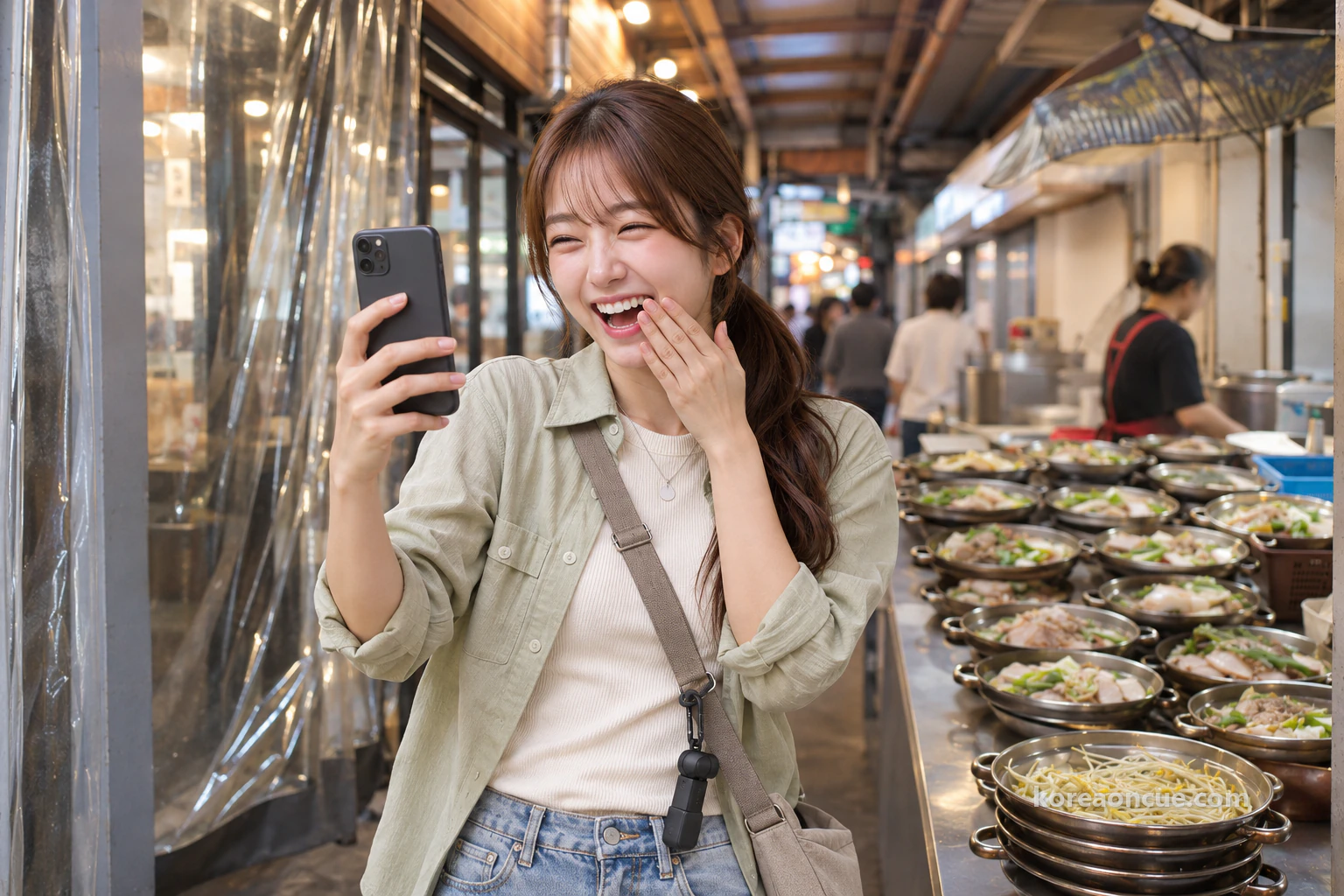
Lulu explained in the video description why she had kept the Food Alley to two shots. She had already shown plenty of eating scenes in earlier videos, and this one had only one question to answer. It was Rina’s question: “Is it all right to go to Gwangjang Market on a Sunday?” So in this video, which way to go in mattered more than what to eat. One burst of griddle sound and one row of brass plates, Lulu judged, were enough to get the answer “it’s open” across.
Lulu also has an order she sticks to when filming in a narrow passage. First, she steps aside close to one wall and finds a spot where she isn’t in anyone’s way. Next, she keeps the camera on the food, such as the griddle and the plates, not on the inside of the shops or the faces of the people working there. As soon as she has a shot, she lowers her phone and walks on. Lulu added this order to the video description too, so her friends could follow it when they came to film on a Sunday.
What time to go on a Sunday — from 9 a.m. to 11 p.m.
On Sundays, the Food Alley is open from 9 a.m. to 11 p.m. If you are coming for the Food Alley, you have plenty of time on a Sunday, morning or evening. That said, 9 and 11 are the hours of the alley as a whole, and hours vary from shop to shop. If you have a particular place in mind, it is worth checking its own hours separately. That is why Lulu decided to suggest the middle of the day to her friends, rather than early morning or late at night.
There was one more reason for choosing the middle of the day. The Food Alley is open until 11 p.m., so on a Sunday there is no need to rush. You can look round somewhere else in the morning and come at lunchtime, and the alley will still be open. Lulu gave the Food Alley a slot in her Sunday plan and wrote that it should be left roomy. On a Sunday, putting the Food Alley at the centre of the day actually makes things easier.
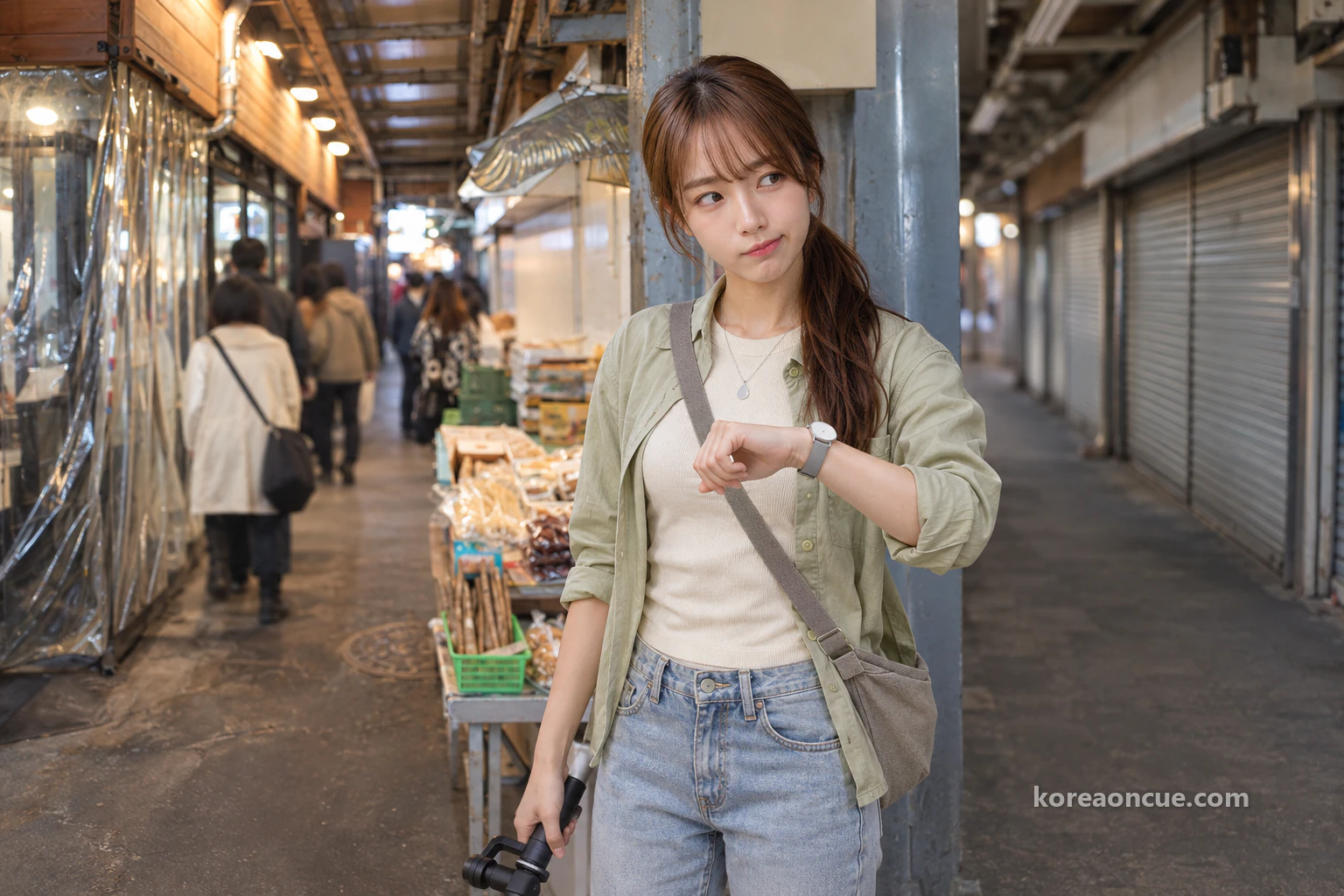
The maths is the same if you come on a Sunday evening. Sunday is the market’s standard closing day and the vintage arcade’s closing day, so the two closing times of 6 p.m. and 7 p.m. drop out of a Sunday plan. Check the closing time of the place you want to go to in the evening first. On a weekday you would need to keep an eye on the hours ending one after the other at 6 and 7, but on a Sunday those two numbers are crossed out from the start. On the Sunday line of the number bars, Lulu crossed out 18 and 19 and left 23.
If you still have questions, you can ask the market directly. Gwangjang Market’s phone number is 02-2267-0291, and the Gwangjang Market Merchants’ Association is on 02-2272-0967. Lulu decided to put both numbers at the bottom of the video description. For someone like Rina, who fills in her boxes in advance, a phone number makes a reassuring entry. And so the Sunday side of her notes ended with “Food Alley 9–23 / call 0291”.
When to go to see all three areas — Monday to Saturday, in closing order
If you plan to look round the fabric, hanbok and vintage shops as well, aim for Monday to Saturday, the standard opening days. The standard hours of the three areas overlap from 10 a.m. to 6 p.m. Lulu decided to add one more scene, “If you want to see it all”, to the end of the Sunday video. A friend who had been on a Sunday would surely want to see all three areas next time. She worked out the order backwards from the closing times, looking at the number bars.
The rule was to start with whatever closes first. The market’s standard hours end first, at 6 p.m., so look round the fabric and hanbok side first. The vintage arcade closes at 7 p.m., so go there next. The Food Alley is open until 11 p.m., so drop in last and have dinner there. In her notes she wrote it with two arrows: “Saturday = fabric → vintage → Food Alley”.

If you like an early start, you can plan in opening order instead. The market’s standard hours begin first, at 9 a.m., and the vintage arcade opens an hour later, at 10. So if you arrive at 9 and look at the fabric side first, then move on to the vintage arcade after 10, one leads into the other with no waiting. For lunch, head to the Food Alley, which is open from 9. Lulu noted this morning order as “9 fabric → 10 vintage → lunch at the Food Alley”, and put it in the video side by side with the evening order.
Lulu picked Saturday because it is an easy day for friends to go together. That was why she had written “Saturday” in her notes. But the market’s standard opening days are Monday to Saturday, so a traveller with a free weekday has no need to wait for Saturday. Plan your visit to the three areas for Monday to Saturday, the standard opening days. Lulu kept this line as the last caption of the “If you want to see it all” scene.
The “Sunday running order” Lulu sent her friends, and Rina’s boxes
In the evening, at her desk at home, Lulu put the video together again from the start. First come the time bars drawn from the five numbers, then the shuttered passage filmed from the floor up. At the end of the shutter shot, the sound of the griddle comes in and carries it into the bindaetteok shot. After the row of brass plates, the morning and evening routes round the three areas close the video as a single scene. She used only two captions.
The first caption was “The Food Alley is open on Sundays too”, and the second was “To see it all: Mon–Sat, before 6”. At first Lulu wrote longer captions, then deleted them. Just cutting from the shutter shot to the griddle shot showed the Sunday answer clearly enough on screen. Showing the two faces side by side, she felt, would reach her friends faster than a long explanation. The video came in at just under a minute.

Not long after she posted the video in the group chat, Rina replied. “I’ll put the Food Alley in my Sunday box. Fabric moves to the Saturday box.” Under the message was a photo of her notebook, and Lulu’s number bars had been copied straight into the boxes she keeps for each day. Lulu laughed at the photo for a long time. A video of one Sunday had become a whole week of boxes in her friend’s notebook.
On the last line of her notes, Lulu wrote down what the day had come to. It was “Sunday = Food Alley, Mon–Sat = all three areas”. Coming on a Sunday to a market she had only ever visited on weekdays, she found that the same market becomes a completely different place depending on the day. She also found that filming the closed side first had made the open side stand out more clearly. Lulu decided that next time she would film a walk starting at the fabric side at 9 on a Saturday morning, and put her phone down.
Common Mistakes
Going on a Sunday to look at fabric, hanbok or bedding
plan to look round on Monday to Saturday, the market’s standard opening days.
Going to the vintage arcade on a Sunday
go to the vintage arcade Monday to Saturday. It opens as normal on public holidays.
Thinking the Food Alley closes on Sundays too
drop in at the Food Alley on a Sunday too.
Starting with fabric on a Saturday evening
go round in closing order: fabric → vintage → Food Alley.
Wandering the closed passages looking for the Food Alley
walk towards the East Gate, North Gate 2 or South Gate 1.
Heading late in the evening to a place you have in mind
check that place’s closing time first.
FAQ
Can I go to Gwangjang Market on a Sunday?
Yes. The Food Alley is open on Sundays too. The market’s standard closing day and the vintage arcade’s closing day are Sunday.
When should I go to see the fabric and hanbok shops too?
Aim for Monday to Saturday, the standard opening days. Start with the fabric side, before 6 p.m.
Is the vintage arcade open on public holidays?
Yes, it opens as normal on public holidays. It is closed on Sundays.
Which gate do I use for the Food Alley?
The East Gate, North Gate 2 and South Gate 1 connect to the Food Alley.
Which exit do I take?
Exit 8 of Jongno 5-ga Station on Line 1. The lift is at Exit 8 too.
Recap — 30 seconds before you go
- Jongno 5-ga Station (Line 1) Exit 8 → Gwangjang Market (88 Changgyeonggung-ro)
- On Sunday, the Food Alley — in through the East Gate, North Gate 2 or South Gate 1
- To see all three areas: Monday to Saturday, fabric → vintage → Food Alley
- The market’s standard closing day and the vintage arcade’s closing day are Sunday · the vintage arcade opens as normal on public holidays
Sources
- Gwangjang Market website — Opening hoursMarket 9 a.m.–6 p.m., closed Sundays · vintage arcade 10 a.m.–7 p.m., closed Sundays, open as usual on public holidays · Food Alley until 11 p.m., open all yearchecked 2026-11-03
- Gwangjang Market website — DirectionsJongno 5-ga Station (Line 1) Exit 8 · Euljiro 4-ga Station (Lines 2 and 5) Exit 4, 100 m · parking at Jongmyo car park, Jongno 4-ga · 02-2267-0291checked 2026-11-03
- VisitSeoul (Seoul Tourism Organization) — Gwangjang MarketSubway Line 1 Jongno 5-ga Station Exit 8, 62 m · Food Alley daily 09:00–23:00, open year round · bindaetteok, modum-jeon, mayak gimbap, sundae and head meat, yukhoe, Korean-style meatballschecked 2026-11-03
- Korea Tourism Organization accessible travel — Gwangjang Market hanbok shopsStation lift at Jongno 5-ga Station (Line 1) Exit 8 · bus stop “Jongno 5-ga.Gwangjang Market (central)”checked 2026-11-03
- Gwangjang Market website — About the marketGwangjang (廣藏): “gather widely and keep” · everything needed for weddings and ancestral rites · imported vintage arcade · the savoury smell between shops kept for decadeschecked 2026-11-03
- VisitKorea (Korea Tourism Organization) — Gwangjang Market (광장시장)Food street 09:00–23:00, closed Sundays (Food Street open all year round) · the food street connects to the East Gate, North Gate 2 and South Gate 1 · silk, dress fabric, clothing, bedding, handicrafts, mother-of-pearl lacquerwarechecked 2026-11-03
- Jongno-gu Office — Jongno-Cheonggye Tourist Zone: Gwangjang MarketMung bean pancakes · gimbap and tteokbokki · glutinous-rice sundae and head meat · yukhoe · donggeurangttaengchecked 2026-11-03
A Seoul story told with our AI characters. Place details are checked against public sources; the photos are AI-made illustrative images. How we use AI
More from this area
Dongmyo Flea Market: partly open on weekdays, all day at weekends
The answer for Dongmyo Flea Market came down to one line: partly open on weekdays, all day at weekends.
Bangsan Market: the order for finding packaging materials
This market is closed on Sundays and done by 3 p.m. on Saturdays. With her last day in Seoul falling on a Saturday, Mali draws up a timetable before she looks at a map. The winter-issue colours a palm-sized card couldn’t settle will now go up against real paper and real boxes.