
SEOUL · MYEONGNYUN-DONG
Daeseongjeon after 35 months of restoration, and Elena beneath the Myeongnyundang ginkgo
Walk from Hyehwa Station Exit 4 to Munmyo Shrine and Sungkyunkwan, Seoul — first the new roof tiles and blue bands of Daeseongjeon, then the Natural Monument ginkgo in the courtyard behind
On screen, the scholars always open their books beneath a huge courtyard tree. Elena sets out to see how that courtyard actually fits together, starting with the newly restored Daeseongjeon and the old ginkgo behind it.
How to get there
Elena likes to find out what the places in television dramas look like beyond the frame. She is twenty-seven, from Spain, and gives each scene a number in her notebook. On the page she opens today is a familiar setting from stories about Joseon scholars and the places where they studied. A broad courtyard, low buildings with tiled roofs, and one enormous tree standing in front. The camera always cuts straight to someone opening a book in its shade, leaving Elena wondering how wide the courtyard really is, and how big that tree might be.
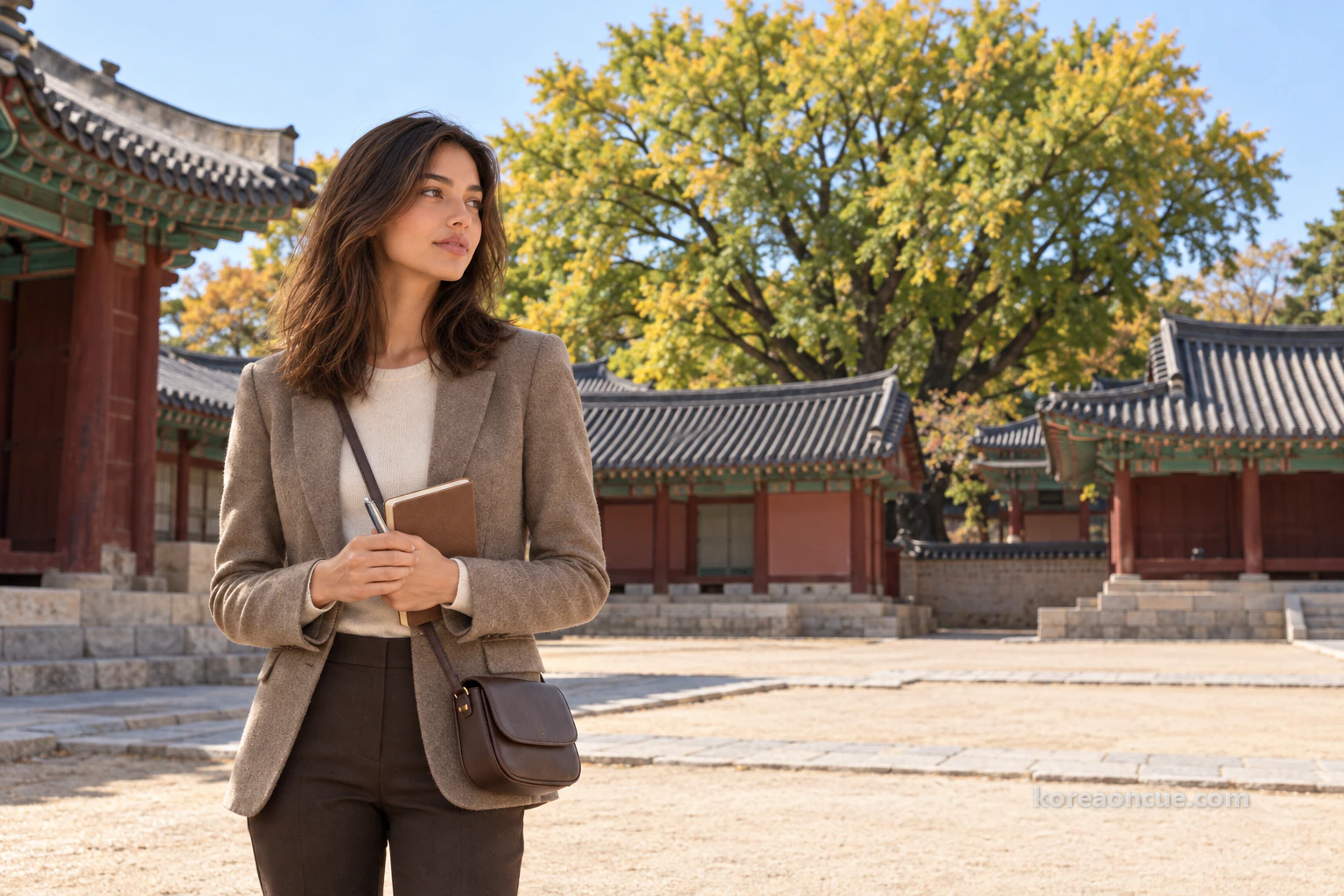
For the closest match, Elena has chosen Munmyo Shrine and Sungkyunkwan, Seoul, in Myeongnyun-dong, Jongno-gu. Within the same enclosure stand Myeongnyundang, where scholars studied, and a shrine housing the spirit tablets of Confucius and other sages. This August, Daeseongjeon, the main shrine hall, held its completion ceremony after 35 months of dismantling and repair. The chance to see its newly tiled roof and the Natural Monument ginkgo in the Myeongnyundang courtyard behind it settles Elena’s autumn plans.
This piece follows her walk in order. From Hyehwa Station Exit 4 on Line 4, she walks to Sungkyunkwan, takes her time looking at the restored Daeseongjeon from its ritual courtyard, then heads behind it to Myeongnyundang, the place of learning, and stands beneath the ginkgo. Her notebook takes us through what to look for and where, what changed during the repairs, and how to look at and photograph the tree.
There is another reason Elena has chosen this place. She knows that the scholars’ surroundings on screen are often assembled from sets and scenes filmed in different locations. Standing somewhere scholars actually studied might reveal what the editing leaves out, particularly how the shrine and lecture hall sit in relation to each other. Before leaving her accommodation, she writes on the first line of her notebook: “Rites → study, front → back.”
The Cue — At a glance
Munmyo Shrine and Sungkyunkwan, Seoul, is a designated Historic Site at 31 Sungkyunkwan-ro, Jongno-gu, Seoul. At the front is the Daeseongjeon area, housing the spirit tablets of Confucius and other sages, with the Myeongnyundang area for learning behind it. Daeseongjeon underwent 35 months of dismantling and repair from September 2023, followed by a completion ceremony on 24 August 2026, while a 26 m Natural Monument ginkgo stands in the courtyard before Myeongnyundang. The walk from Hyehwa Station Exit 4 on Line 4 takes about ten minutes.
- Where: Munmyo Shrine and Sungkyunkwan, Seoul, at 31 Sungkyunkwan-ro, Jongno-gu, Seoul. The site is a Historic Site, and five buildings, including Daeseongjeon and Myeongnyundang, are designated Treasures.
- Subway: Hyehwa Station (Line 4) Exit 4, about ten minutes on foot. Route reference: Sungkyunkwan, “Directions”.
- Look for first: Daeseongjeon at the front, with the roof tiles renewed in August 2026 and its restored jugeundobae painted decoration, including blue bands.
- Then: The Natural Monument ginkgo in the courtyard before Myeongnyundang, behind Daeseongjeon. It is 26 m tall and measures 12.09 m around at chest height.
- Phone: Sungkyunkwan, 02-760-1472.
- On the walk: This is still a place with a shrine where spirit tablets are enshrined and rites are performed. Keep voices low and take your time.
Walking from Hyehwa Station Exit 4 to Sungkyunkwan
Elena gets off at Hyehwa Station on Line 4 late in the morning. She has written down just one exit, number 4, for the walking route to Sungkyunkwan. The walk takes about ten minutes. If this is a first visit, putting “Munmyo Shrine and Sungkyunkwan, Seoul” or “31 Sungkyunkwan-ro” into a phone map before leaving the station makes the start easier.
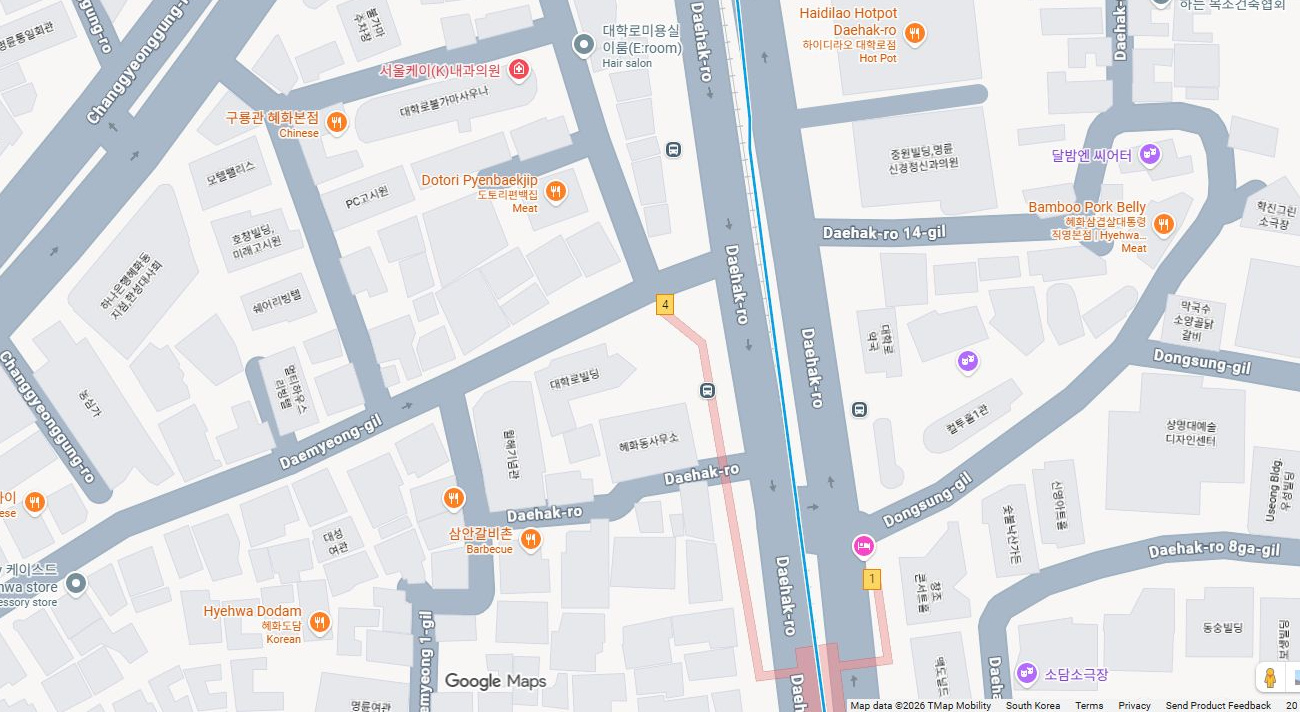
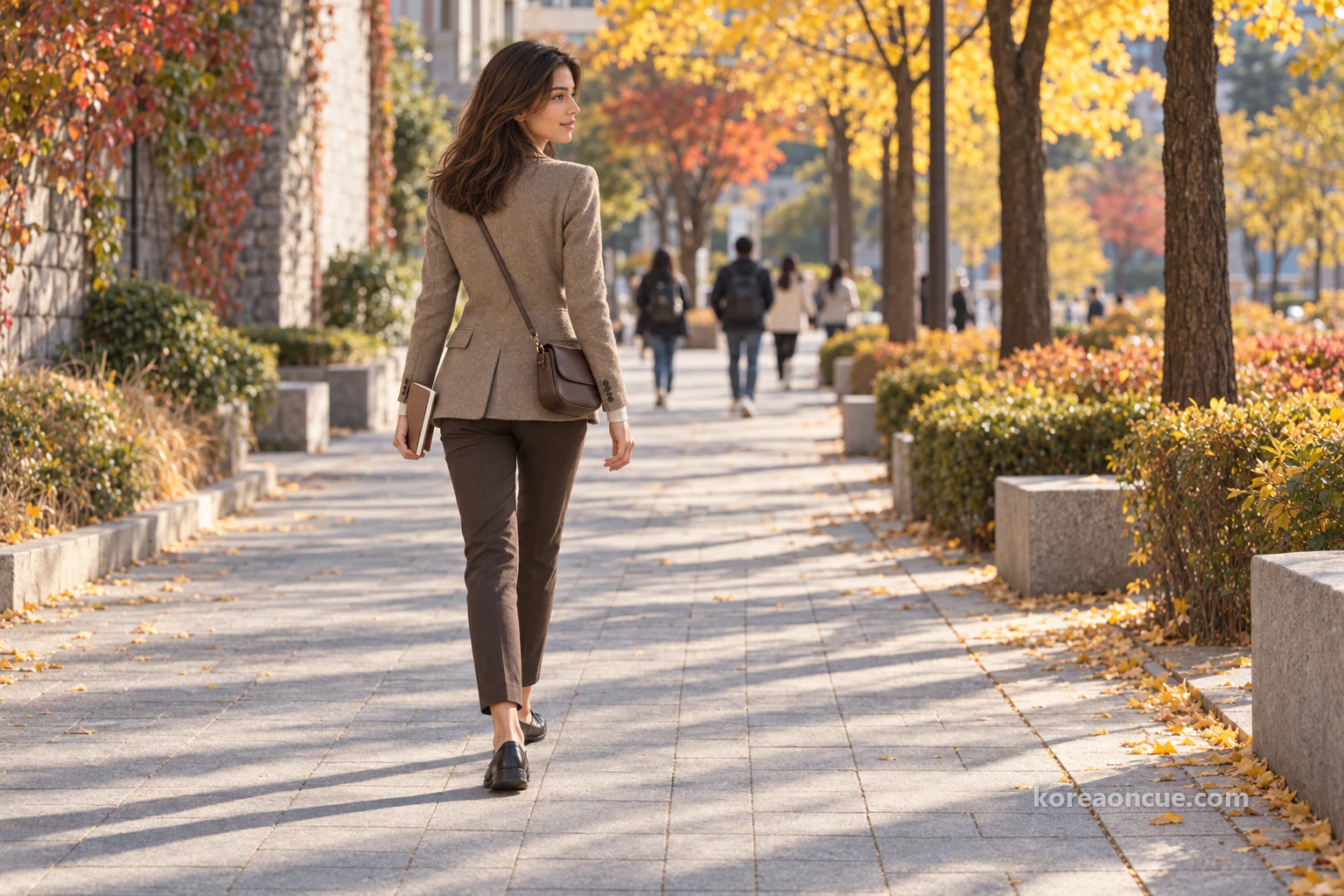
The neighbourhood around Hyehwa Station is better known as Daehangno. Young people hurry past the exit, and Elena feels an unexpected connection between their energy and the old school she is heading towards. Hundreds of years ago, she thinks, young people would have gathered around here to study too. She takes her time, walking on as the streets gradually grow quieter.
Once the street is less busy, Elena puts today’s scene numbers in order again. Number 1 is the width of the Daeseongjeon courtyard, number 2 the colours of the restored painted decoration, number 3 the walk through to Myeongnyundang, and number 4 the size of the ginkgo. Each might pass in a single shot on screen, but she intends to give every one time in the actual place. This is often how Elena begins a walk, working backwards from what the camera shows.
Autumn makes Seoul pleasant to walk in, and Elena has decided to give the whole day to this one place. Her travels have taught her that staying longer reveals the bits a screen skips, which a hurried round of several stops would leave out. Her bag holds only her notebook, a pencil and a bottle of water. With little to carry, she can open the notebook whenever something catches her eye.
Munmyo and Sungkyunkwan: the shrine at the front, the school behind
On reaching Sungkyunkwan, Elena first checks how the spaces fit together. Munmyo is a Confucian shrine where spirit tablets of Confucius, who brought together Confucian teachings, and other sages are enshrined and rites are performed. The site has two main areas: Daeseongjeon, with its buildings for rites, and Myeongnyundang, with its buildings for learning. The arrangement, with the shrine at the front and the school behind, is called jeonmyohuhak. This is the “front → back” on the first line of Elena’s notebook.
The first buildings went up here in 1398, the seventh year of King Taejo’s reign during the Joseon dynasty. They burnt down in 1400, the second year of King Jeongjong’s reign, and the buildings rebuilt in 1407, the seventh year of King Taejong’s reign, were themselves destroyed by fire during the Imjin War. The buildings standing today were rebuilt after that war. Daeseongjeon dates to 1601–1602, the thirty-fourth and thirty-fifth years of King Seonjo’s reign, and Myeongnyundang to 1606, his thirty-ninth year. Writing the dates side by side, Elena notices that their building sequence follows their physical arrangement, with the shrine established first and the place of study a few years later.
Munmyo Shrine and Sungkyunkwan, Seoul, was designated a Historic Site in 1964. A year earlier, in 1963, five buildings received Treasure status: Daeseongjeon, Dongmu, Seomu, Sammun and Myeongnyundang. Elena decides she needn’t memorise the designation history, only remember that five of the buildings before her are valued enough to be recognised individually. She starts with Daeseongjeon, the one at the front.
Daeseongjeon’s courtyard and its 35-month restoration
Stepping into the courtyard before Daeseongjeon, Elena keeps her notebook tucked away for a while. Scene 1 is the courtyard’s width, and she wants to get a sense of it on foot first. Rebuilt in 1602, the thirty-fifth year of King Seonjo’s reign, Daeseongjeon is a nationally designated Treasure housing the spirit tablets of Confucius, the four sages Zengzi, Mencius, Yanzi and Zisi, Confucius’s ten distinguished disciples, six sages of the Song dynasty and eighteen eminent Korean scholars. Remembering whose names are enshrined ahead of her, Elena finds herself making less noise as she walks.
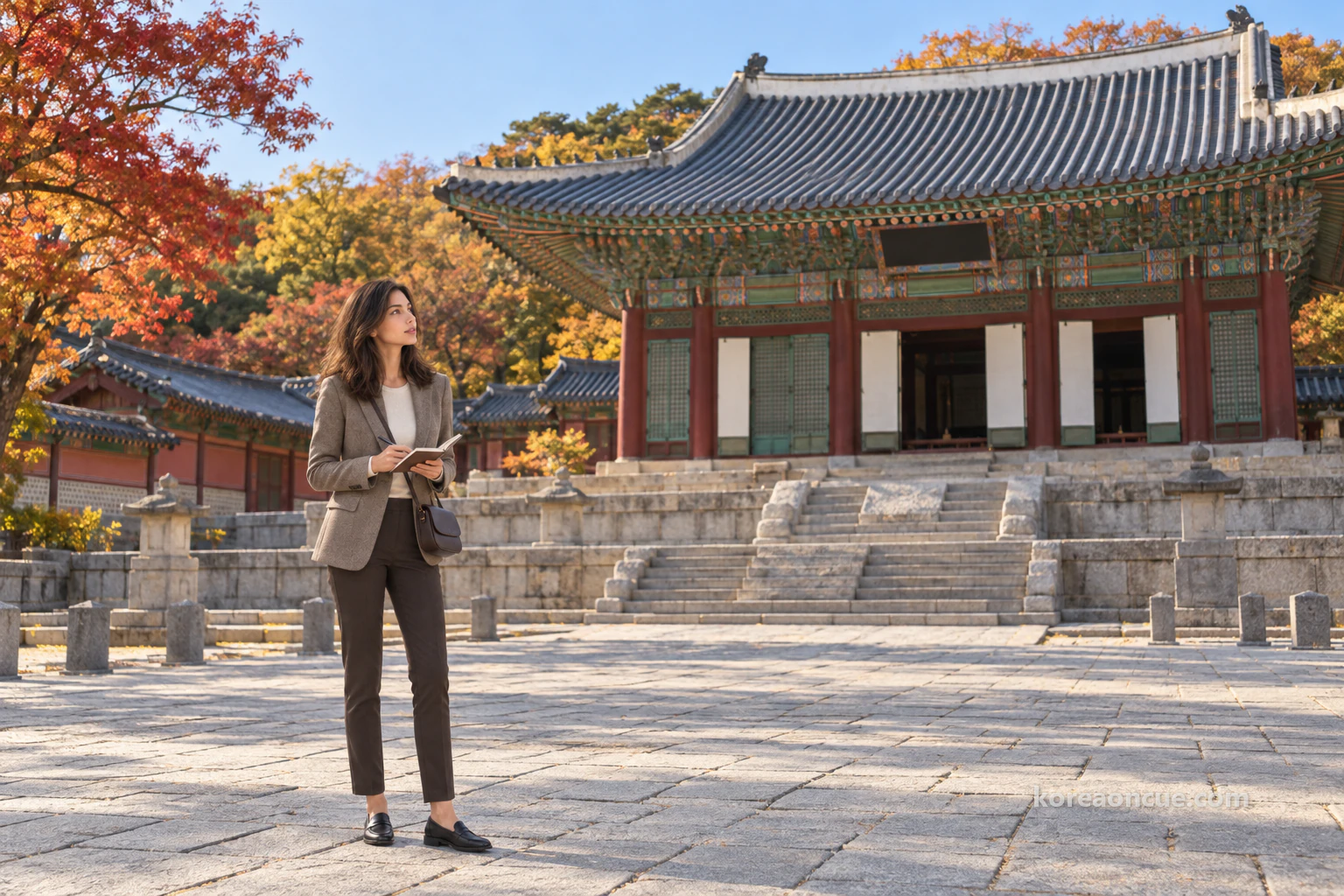
The dismantling and repair began in September 2023 and continued for 35 months until August 2026, at a cost of about ₩7.7 billion. On 24 August 2026, the completion ceremony took place in the courtyard before Daeseongjeon. That same day, Sungkyunkwan also completed the careful restoration of the 39 spirit tablets, including Confucius’s, and the hwanan haengcha procession returning them to their places. Elena is standing in the very courtyard where the completion ceremony was held.
She gives hwanan haengcha its own line in her notebook. Understanding that it means returning the spirit tablets to their rightful places changes how she thinks about the ceremony. The names enshrined here came back to the repaired hall, and the courtyard returned to its original purpose. Elena wasn’t there that day, but looking across the quiet space, she tries to picture it.
With that in mind, she makes a slow circuit of the courtyard. In the stories she watches, such spaces tend to pass as backgrounds where characters gather, yet standing here she feels how the courtyard draws attention towards the building. She writes, “Courtyard = a place to look at the hall, not just a stage.” Her answer to scene 1 is a courtyard much wider, and much quieter, than she expected.
Finding the blue painted bands and looking up at the new roof
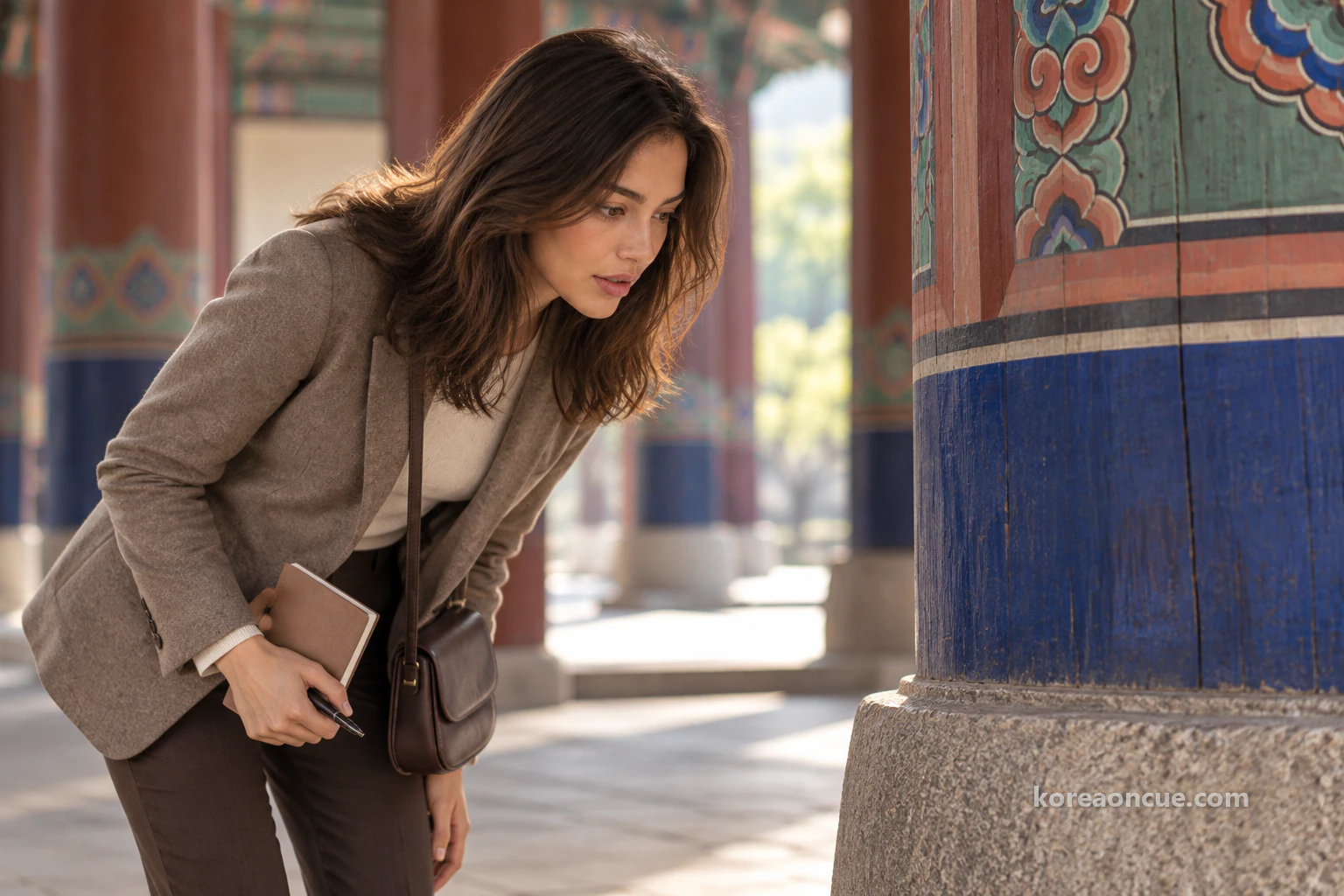
After circling the courtyard, Elena moves a little closer to Daeseongjeon. She is ready for scene 2, the freshly restored colours. The repairs restored the dancheong, the building’s decorative paintwork, using traditional pigments, bringing back its earlier jugeundobae scheme with blue bands. Elena studies the lower part of a pillar until she finds the blue, then gives a small smile. Here is a colour the characters’ faces always seemed to hide on screen.
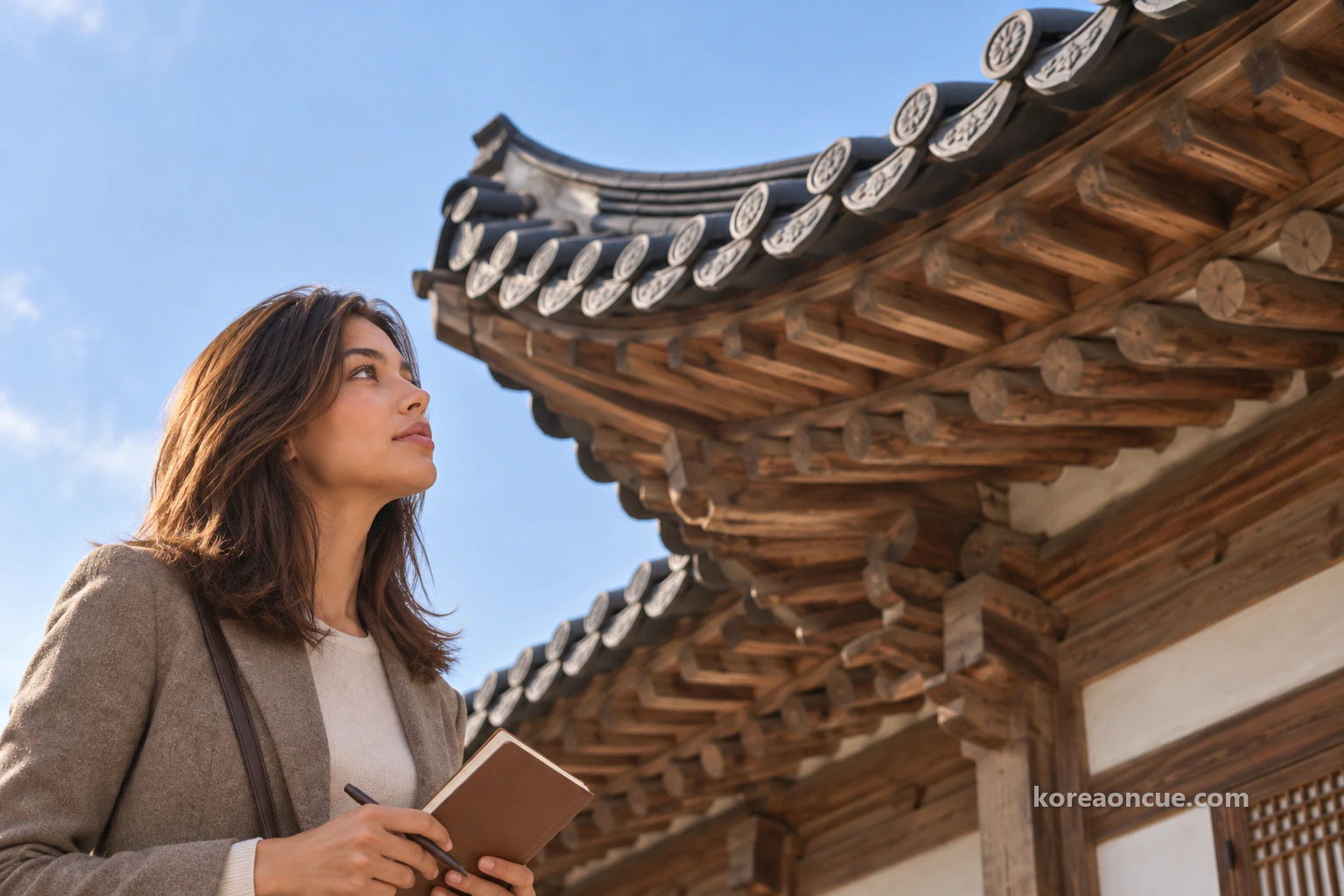
Above her is the roof. All of Daeseongjeon’s tiles were replaced with traditional handmade tiles lighter than the previous ones. As much of the old timber frame as possible was retained, with only one pillar, two corner rafters and two purlins replaced by new members. Elena spends a while following the curve where the roof meets the sky. In her notebook, she wonders whether the new tiles look so at home because they have been laid in the old way over the surviving frame.
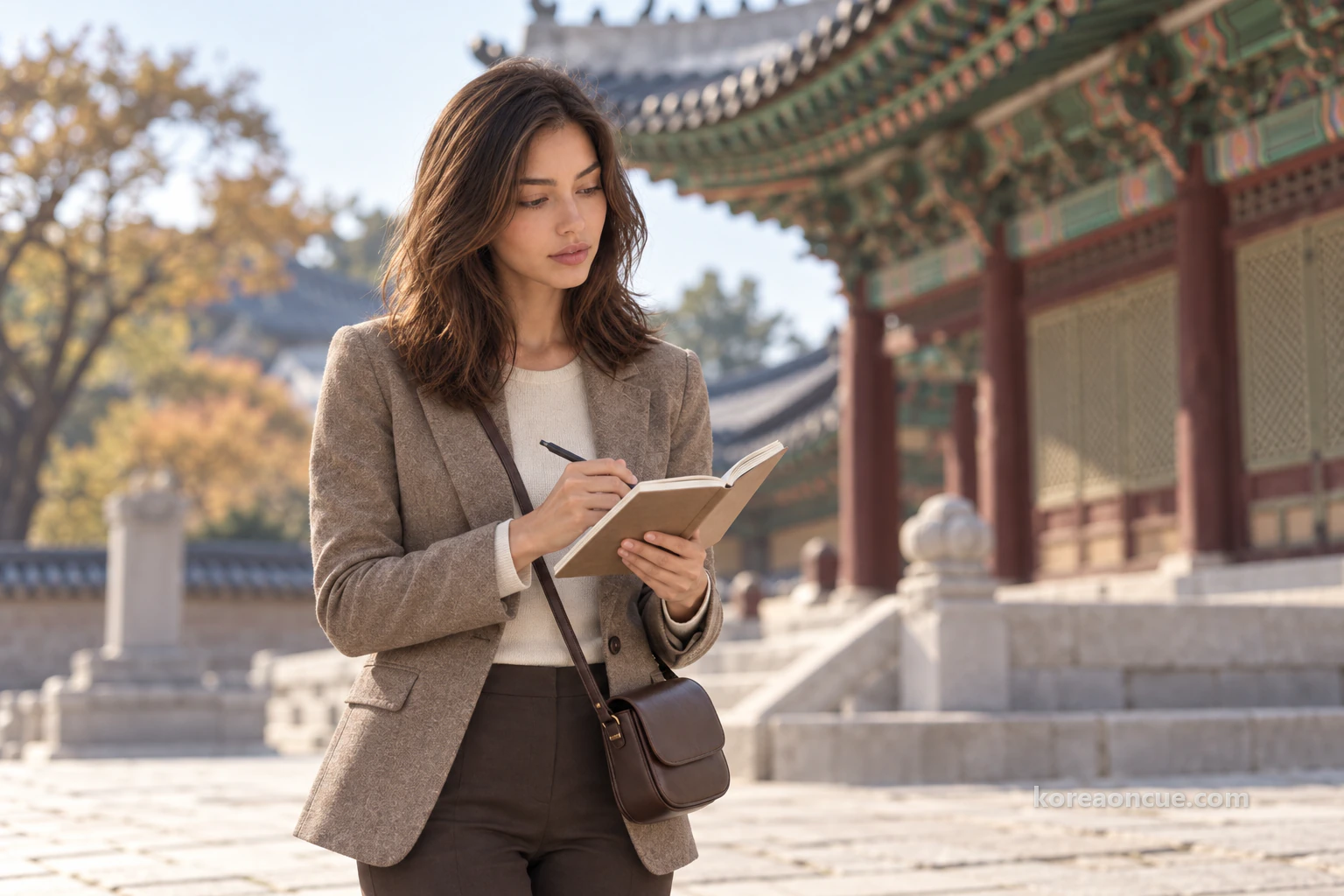
For a closer look, it is better to stand a step back without touching the building. Elena keeps both hands on her notebook and simply leans forward to examine the pillars and paintwork. The hall has only just been repaired, and it remains a shrine housing spirit tablets. When taking photographs, she also chooses a spot at the courtyard’s edge rather than directly in front of the hall, keeping other people’s views clear.
If it is hard to decide where to start, try Elena’s order. First take in the whole front of the hall from the far side of the courtyard, then move closer to find the blue bands low on the pillars, before looking up along the new tiles and eaves. Moving the gaze from bottom to top brings the visible changes from the restoration into view in turn. Elena records the sequence with three arrows in her notebook.
What the repairs revealed: an ink inscription and Korea’s longest pyeonggodae
There is another reason Elena lingers before Daeseongjeon. The repairs brought to light stories that had been hidden inside the building. In 2024, an ink inscription recording the construction process at the time of the ridge-beam raising was discovered on the central ridge purlin and made public for the first time. Written in ink on timber at the highest part of the roof, the record had remained there for hundreds of years. Elena thinks it has more drama in it than the scenes of old books she remembers from television.
The work also identified a pyeonggodae, a timber supporting the outer edge of the eaves, as the longest single member of its kind in Korea. Elena follows the eaves sideways with her eyes, imagining that line of wood stretching from one end of the building to the other. A small sketch of the eaves in cross-section joins the pages of her notebook. Drawings like this often help her remember a place better than photographs do.
For 35 months, the work inside and around Daeseongjeon involved examining pillars and purlins individually, reusing as much sound timber as possible and covering the roof with new tiles. Elena looks back at the tidy hall, thinking about the time it took to bring it to this point. On screen, the building simply appears complete, while here she can think about the people who have spent their time caring for it. At the bottom of her Daeseongjeon page, she writes “35 months” in large figures.
Walking behind Daeseongjeon to Myeongnyundang
Having taken her time at Daeseongjeon, Elena moves on to scene 3. Myeongnyundang stands behind it. This short walk from the ritual space at the front to the study space at the back is the part she has most looked forward to. She can hardly remember a screen showing shrine and lecture hall together in one shot. She wants to walk those few steps herself and feel how the purpose of the space changes.
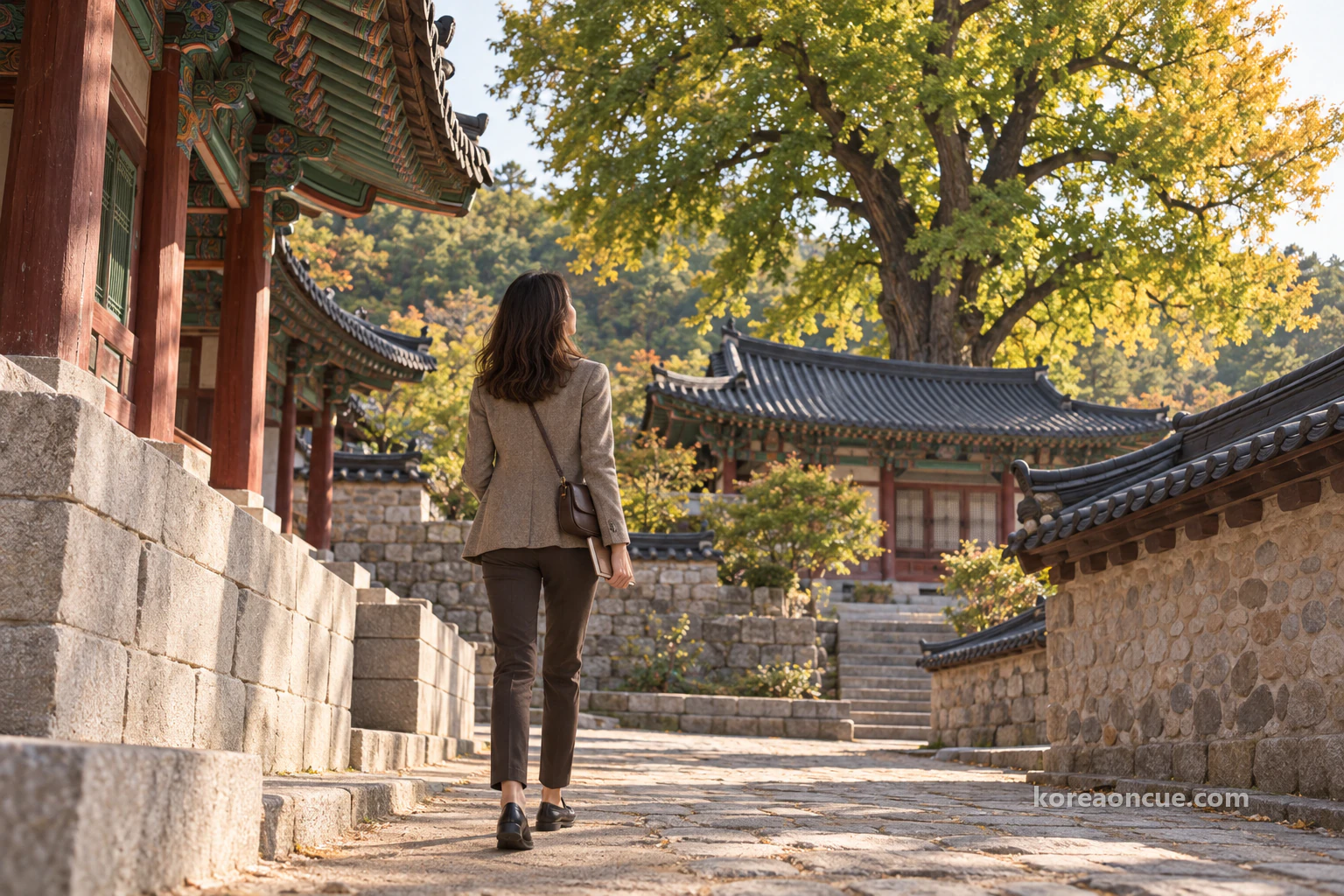
As she walks, Elena notices a slight change in atmosphere. The courtyard before Daeseongjeon directs attention towards the shrine, while the Myeongnyundang area feels more open, somewhere people would have sat together and moved about. Built in 1606, Myeongnyundang is one of the five buildings designated as Treasures alongside Daeseongjeon. Elena studies it for a while, then writes that this must be the sort of place where the scholars on screen would have opened their books.
On entering the Myeongnyundang courtyard, she stops without meaning to. A huge ginkgo occupies one side of the space. The “big tree” on screen has always been background to the characters, but this one feels too central to the whole courtyard for that description. Scene 4 begins before she can even open her notebook.
The Myeongnyundang ginkgo: a 26 m Natural Monument
This is the Natural Monument named Ginkgo Tree of Munmyo Shrine, Seoul. It was designated on 7 December 1962, with one tree protected under that designation. Estimated to be about 400 years old, it stands 26 m tall and measures 12.09 m around at chest height. Elena writes down the circumference, then walks slowly around the tree, trying to put that number into steps.
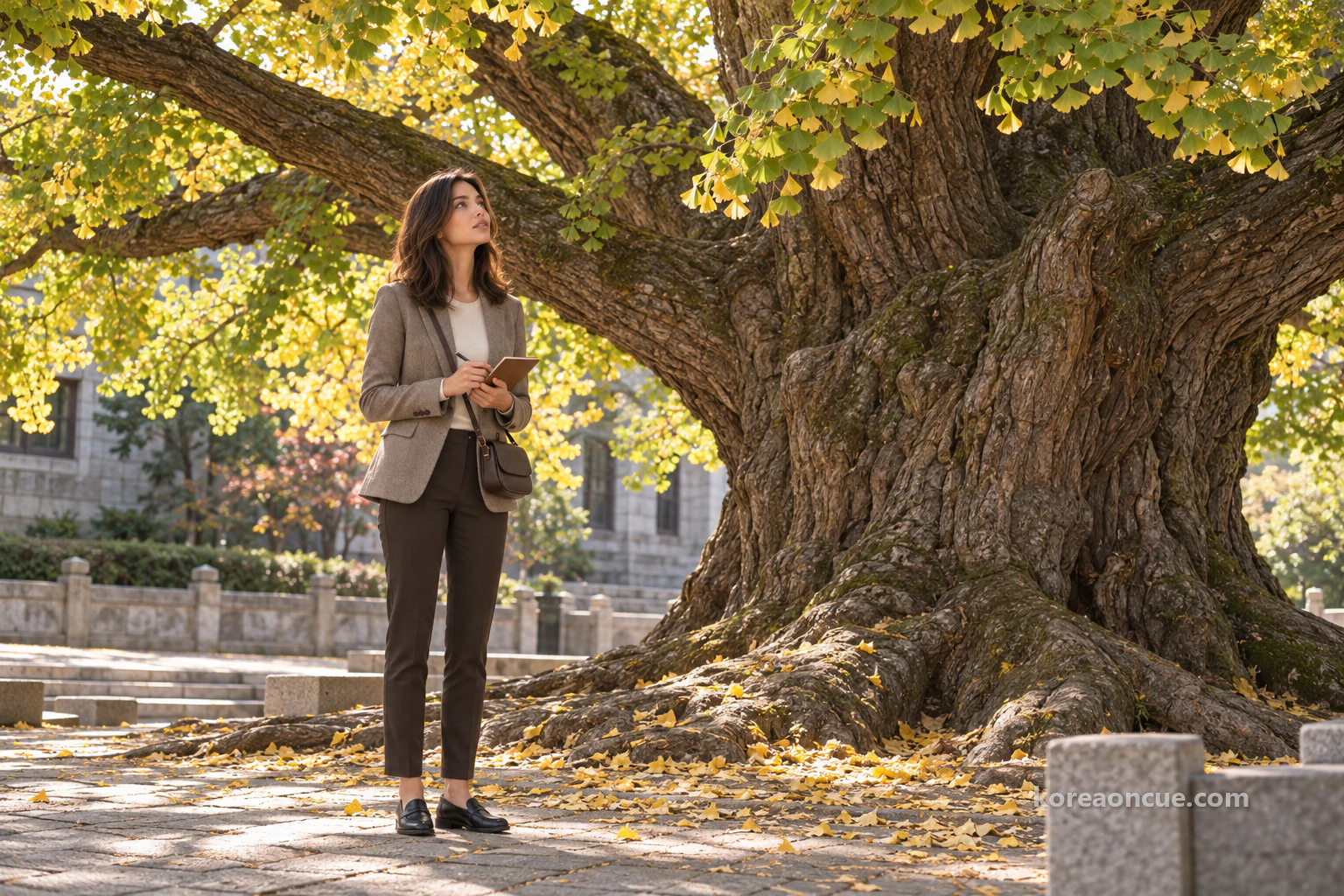
The tree is thought to have been planted in 1602. That was when Munmyo was rebuilt after being destroyed by fire during the Imjin War in 1592. If so, the ginkgo took root here at almost the same time as the present Daeseongjeon was built. Thinking of the hall she has just left and the tree before her sharing those centuries, Elena draws the two scenes side by side on one notebook page.
Looking back through her dates, she spots another detail. If the tree was planted in 1602, it was already here a few years before Myeongnyundang was built in 1606. The tree symbolising study would have stood in the courtyard before the building used for it. Elena likes that order and adds a small “1602 → 1606” beside her drawing.
There is a reason for the ginkgo’s presence here too. The ginkgo is a symbol of Confucianism. That symbolism comes from the story of the haengdan, or apricot altar, where Confucius taught his disciples. The tree therefore carries the meaning of a place of learning, beyond its role in the courtyard’s appearance. For the first time, Elena finds an explanation in the place itself for those scholars always opening their books beneath a large tree.
She spends a long time looking up from beneath the branches. On some, the leaf tips are beginning to turn yellow, colour spreading inwards from the edges among the green. Watching them, Elena thinks that even a single leaf has its own sequence of changes, rather like a scene transition. She leaves a short note in her book: “Green → yellow, from the tips inwards.”
After a while beneath the tree, the shape of the trunk begins to hold her attention too. Measuring more than 12 m around at chest height, it is so broad that one person’s outstretched arms could not span even one side. Elena stands a step away without touching it, studying where the trunk rises from the ground and divides into thick branches. Imagining it looking down on centuries of people studying in this courtyard, she begins to understand why the great tree on screen always seemed to hold the scene together.

Photographing the ginkgo and Myeongnyundang together
Elena takes quite a while to settle on a photograph. The tree is so large that up close she gets only the trunk, while from farther away she keeps finding the building filling the frame. After moving several times, she settles on stepping well back towards the courtyard’s edge and holding her phone vertically. That brings the thick trunk and branch tips into one frame, with a little of Myeongnyundang’s roof along the bottom. On a first visit, this portrait framing is a useful place to start.
When someone else is taking a photograph in front of the tree, a brief wait makes things easier for everyone. Elena tidies her notebook at the courtyard’s edge while a family takes theirs. With branches spreading so widely, there is plenty of shade without standing right against the trunk. From a little farther away, she takes one more photograph of branches overlapping the sky.
Once the photographs are done, it is worth putting the phone down to spend a quiet moment simply looking at the tree. Elena eventually swaps her camera for her notebook, drawing the trunk and branches in just a few lines. She feels that sketching makes its scale clearer in her memory, even when it is difficult to fit into a photograph. Beneath the ginkgo, she is happy to stay and take her time.
Comparing the courtyard with the scholars’ scenes on screen
Standing in the tree’s shade, Elena opens her notebook and works through today’s scene numbers again. Much of what she remembers from stories set in places where Joseon scholars studied resembles this courtyard. There is the broad open space, the low tiled roofs and the large tree filling the gap between them. Here, though, she can also see what the screen left out: Myeongnyundang behind the tree, the route back towards Daeseongjeon, and, above all, the order in which they stand.
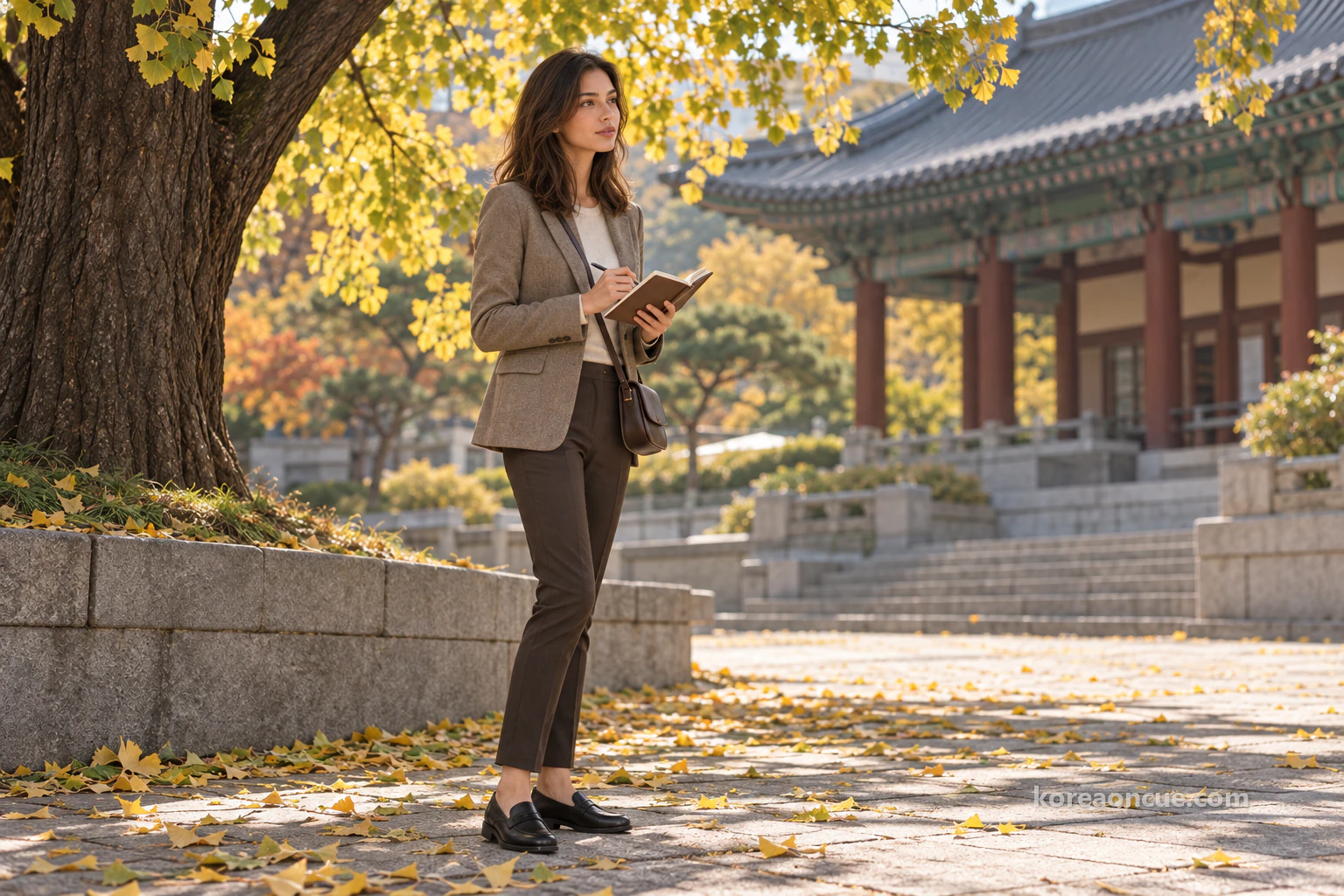
Elena thinks she can understand why the screen cuts that sequence short. A story needs to follow faces and conversations, so a single shot might be enough for the few steps between the shrine at the front and the lecture hall behind. Walking them herself, she finds those steps explain more clearly than anything else what sort of school this was — first past the place honouring the sages, then on to the place for opening books.
She finds herself wanting other visitors to follow that order too: starting with the restored Daeseongjeon and the breadth of its courtyard, then heading behind it to Myeongnyundang to stand beneath the ginkgo. Walking the other way would reveal the same things, but going from front to back makes the site’s original purpose easier to follow. At the bottom of her notebook, Elena writes in large letters: “Walk from front to back.”
Her biggest discovery today is how much lay outside the frame. The large tree and broad courtyard from those stories are here, with a shrine and lecture hall connected in a sequence around them. Next time Elena watches a similar story, she thinks the tree behind the characters will bring this courtyard to mind. All four scene numbers now have their answers.
A quiet afternoon and the walk back to Hyehwa Station
Later in the afternoon, Elena takes one more look around the Myeongnyundang courtyard, then walks slowly back towards Daeseongjeon. As the sun lowers, the new tiles catch the light differently from when she arrived that morning. She pauses at the courtyard’s edge for another look at the roof. Seeing the hall on such a clear day after its 35 months of repair feels like the day’s greatest piece of luck.
She decides to return to Hyehwa Station Exit 4, the way she came. For a first visit, retracing the outward route is the least confusing way back. As she walks towards Daehangno, the voices around her grow louder, and the shift from the quiet courtyard back into the city feels like a scene change in itself. The day now falls into a sequence in her mind, with a beginning and an end, like a short story.
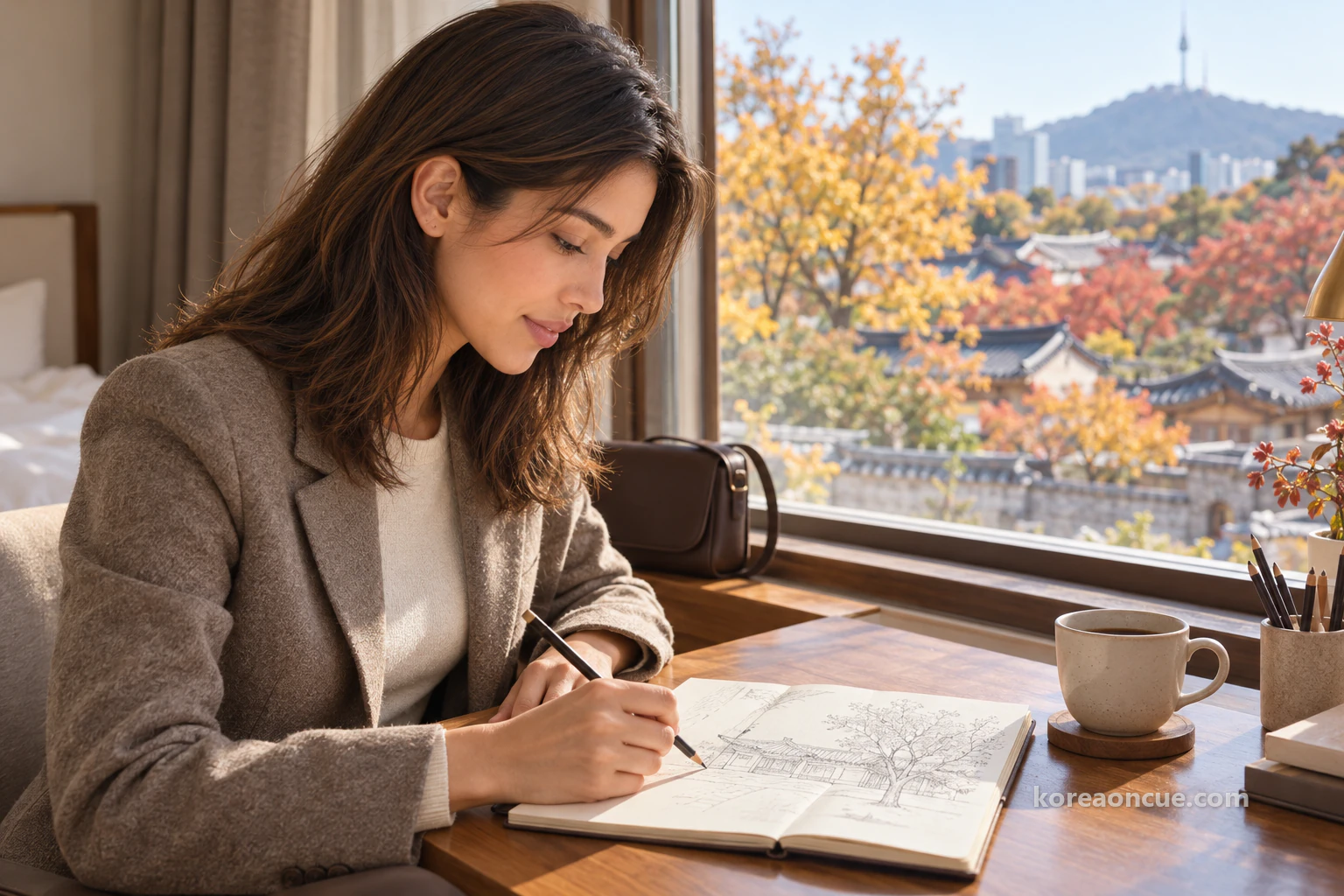
Back at her accommodation, Elena turns through her sketches from the beginning. There is Daeseongjeon’s broad courtyard, the blue band low on a pillar, a cross-section of the eaves, then the ginkgo before Myeongnyundang and the branches whose leaf tips are beginning to yellow. Scenes that would pass in seconds on screen now fill several notebook pages. On the last page she draws the ginkgo once more, then writes beneath it the season when she would like to see it again.

At the desk, Elena lays the two pages side by side. One holds the roofline of the newly restored Daeseongjeon; the other, the ginkgo in front of Myeongnyundang. Drawing them, she finally feels how the place of ritual and the place of study follow each other within one compound, front to back. Next time, she decides, she will come back when the leaves are more golden and draw the same tree from the same spot.
Common Mistakes
Heading straight to Myeongnyundang and passing Daeseongjeon by
the Daeseongjeon area is at the front, with Myeongnyundang behind. Walking from front to back starts with Daeseongjeon, whose repairs finished in August 2026.
Mistaking a tree in front of Daeseongjeon for the Natural Monument
the designated Ginkgo Tree of Munmyo Shrine, Seoul, is the single tree in the courtyard before Myeongnyundang.
Looking only at the roof
the restored jugeundobae decoration with blue bands is low on the pillars. Lower your gaze to find it.
Talking loudly in front of the shrine
Daeseongjeon still houses 39 spirit tablets of Confucius and other sages. Keep voices low as you walk.
Photographing the ginkgo only from close up
at 26 m tall, it will not fit in the frame from beside the trunk. Step back towards the courtyard’s edge and try holding the phone vertically.
FAQ
Which station and exit should I use?
Hyehwa Station (Line 4) Exit 4, followed by about ten minutes on foot. The address is 31 Sungkyunkwan-ro, Jongno-gu, Seoul.
Are the Daeseongjeon repairs finished?
Yes. After 35 months of dismantling and repair from September 2023, the completion ceremony took place on 24 August 2026. The procession returning the spirit tablets was also completed that day.
What changed during the repairs?
The dancheong was restored using traditional pigments, bringing back the jugeundobae scheme with blue bands. All the roof tiles were replaced with traditional handmade tiles lighter than the previous ones.
How big is the Myeongnyundang ginkgo?
It is 26 m tall and measures 12.09 m around at chest height. Its estimated age is about 400 years, and it is thought to have been planted when Munmyo was rebuilt in 1602.
Why is there a ginkgo at Sungkyunkwan?
The ginkgo symbolises Confucianism, a connection originating in the story of the haengdan, where Confucius taught his disciples.
Who can I contact?
Sungkyunkwan’s main phone number is 02-760-1472.
Recap — 30 seconds before you go
- Hyehwa Station (Line 4) Exit 4 → about ten minutes on foot → Munmyo Shrine and Sungkyunkwan, Seoul, at 31 Sungkyunkwan-ro.
- Daeseongjeon for rites at the front, Myeongnyundang for study behind — walk from front to back.
- Daeseongjeon: repairs completed in August 2026, restored blue-band jugeundobae decoration and traditional handmade roof tiles.
- Myeongnyundang courtyard: the Natural Monument ginkgo, 26 m tall and 12.09 m around at chest height.
- Keep voices low around the shrine.
Sources
- Korea Heritage Service — Historic Site: Munmyo Shrine and Sungkyunkwan, SeoulDesignated a Historic Site in 1964, and its area · the Daeseongjeon area for rites and the Myeongnyundang area for learning · founded in 1398 and rebuilt after the Imjin Warchecked 2026-10-23
- Korea Heritage Service — Treasure: Munmyo and Sungkyunkwan (Daeseongjeon, Dongmu, Seomu, Sammun, Myeongnyundang)Daeseongjeon built 1601–1602, Myeongnyundang in 1606 · the spirit tablets enshrined in Daeseongjeon · Myeongnyundang behind Daeseongjeonchecked 2026-10-23
- Korea Heritage Service press release — Repair of Daeseongjeon at Munmyo and Sungkyunkwan completed35 months from September 2023, about KRW 7.7 billion · completion ceremony on 24 August · replaced members and traditional handmade tiles · restored blue-band jugeundobae · ridge-beam inscription and Korea’s longest pyeonggodaechecked 2026-10-23
- Sungkyunkwan notice — Autumn Seokjeon for the 2577th birthday of ConfuciusDaeseongjeon completion ceremony on 24 August and the return of 39 spirit tabletschecked 2026-10-23
- Korea Heritage Service — Natural Monument: Ginkgo Tree of Munmyo Shrine, SeoulDesignated in 1962, one tree · estimated at about 400 years old · 26 m tall, 12.09 m around at chest height · in the Myeongnyundang grounds, thought to have been planted when Munmyo was rebuilt in 1602 · address 31 Sungkyunkwan-rochecked 2026-10-23
- Sungkyunkwan — SymbolsThe ginkgo as a symbol of Confucianism, from the story of the apricot altar (haengdan)checked 2026-10-23
- Sungkyunkwan — DirectionsAbout ten minutes on foot from Line 4 Hyehwa Station Exit 4 · address 31 Sungkyunkwan-ro, Jongno-gu, Seoul · main phone numberchecked 2026-10-23
A Seoul story told with our AI characters. Place details are checked against public sources; the photos are AI-made illustrative images. How we use AI
Next Cue — What to read next

The Hyundai Christmas Village: the waitlist for overseas visitors
Hina puts lines like “Booking opens 11:00” on posters for a living, and she missed exactly that 11 o’clock.

Dongdaemun markets on Sunday: open and closed
Lulu had planned to buy wrapping supplies at Bangsan Market on Sunday morning for the small year-end gift boxes she wanted to fill.
Culture Station Seoul 284: getting in without registering in advance
Elena wrote “11 a.m., the door of the old station” on the first line of her scene notes. It was opening day, and on the first day alone the doors opened at 3 p.m. Elena spent the four hours on Seoullo 7017, then put the eye she uses to tell real from fake to the test in front of a deepfake film.