
SEOUL · NAMDAEMUN
When and where to see Unfold X 2026: Elena four hours early on opening morning, and the deepfake film DUCK
Culture Station Seoul 284, 26 November–9 December, open every day · opening day 26 November from 3 p.m., other days 11 a.m.–7 p.m. (last entry 6.30 p.m.) · free, walk-in registration · Seoul Station Exit 2
Elena wrote “11 a.m., the door of the old station” on the first line of her scene notes. It was opening day, and on the first day alone the doors opened at 3 p.m. Elena spent the four hours on Seoullo 7017, then put the eye she uses to tell real from fake to the test in front of a deepfake film.
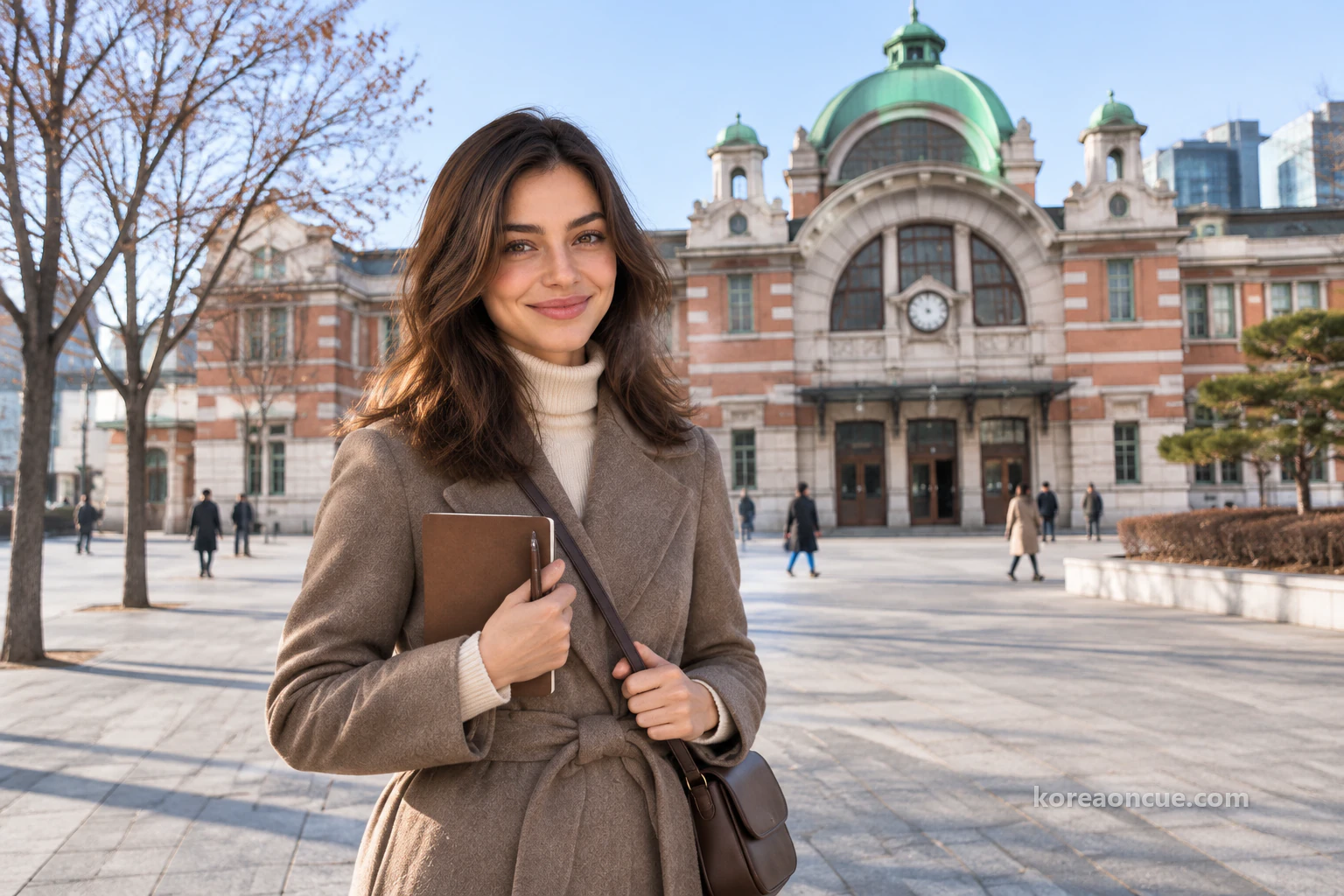
How to get there
At 10.58 a.m. on Thursday 26 November, Elena came up out of Exit 2 of Seoul Station on Line 1. Elena is twenty-seven, from Spain, and she likes to hold scenes she has seen on screen up against the real Seoul. She had spent the whole trip walking the alleys and palaces of Korean dramas, but today she had come to see a film in which neither the faces nor the voices were real. From the day she read that it would be shown in the old Seoul Station building, she had been writing out, in her notebook, the scene of herself standing in front of it. The first line read “[S#1. 11 a.m., the door of the old station — the doors open]”.

What Elena had come for was Unfold X 2026, “Reality Check”. It is a media art exhibition put on by the Seoul Metropolitan Government and the Seoul Foundation for Arts and Culture, and this year artists from eight countries have filled Culture Station Seoul 284, the old Seoul Station building. The work that caught Elena’s eye was DUCK, a short film made with deepfakes. Elena is always comparing the screen with reality, so a film that starts by asking whether the people on screen are even real was not one she could walk past. But the time on the first line of her notebook was already wrong.
Unfold X 2026 is held at Culture Station Seoul 284, which you reach from Exit 2 of Seoul Station on Lines 1 and 4. Following Elena’s day, this piece sets out when it is on and until when, what time it closes, whether it is free, whether you really have to register in advance, and what is worth seeing. It also covers the Seoul Station exits that differ by line, the dates of the English tours you book separately, and the walks around Seoul Station you can still use after the exhibition has ended. Elena found out first-hand that opening day keeps different hours, so let us start there.
The Cue — At a glance
Unfold X 2026 “Reality Check” is free, open every day until 9 December, and you can get in without registering in advance. The catch is that it does not open at the same time every day. Only opening day, 26 November, starts at 3 p.m., and every other day starts at 11 a.m., so if you are aiming for the first day, plan from the afternoon. If you want an English tour or an evening performance as well, those are the only things you need to book.
- Where: Culture Station Seoul 284 (1 Tongil-ro, Jung-gu, Seoul, the old Seoul Station building).
- Station and exit: Seoul Station (Lines 1 and 4) Exit 2 · on the Gyeongui–Jungang Line, Seoul Station Exit 1.
- When to avoid: The morning of opening day, 26 November (it opens at 15:00 that day).
- Do beforehand: Book online if you plan to go to a talk, an Evening or a tour.
- Car: Use a car park near Seoul Station.
When and where is Unfold X 2026? 26 November to 9 December at Culture Station Seoul 284
The exhibition runs from Thursday 26 November to Wednesday 9 December 2026, exactly fourteen days. There are no closing days in between, so it is open even on a Monday. On every day except opening day it opens at 11 a.m. and closes at 7 p.m., with last entry at 6.30 p.m. Only on opening day, 26 November, can you see it from 3 p.m., and admission is free. It is hosted and organised by the Seoul Metropolitan Government and the Seoul Foundation for Arts and Culture, with Alain Thibault of the Canadian organisation Elektra as artistic director and Sookyun Yang as producer.
Open in Kakao Map — Seoul Station
| What | Unfold X 2026 |
|---|---|
| Dates | 26 November (Thu)–9 December (Wed), no closing days |
| Opening hours (except opening day) | 11:00–19:00, last entry 18:30 |
| Opening day (26 November) | Open from 15:00 · opening ceremony 16:00 in the Central Hall |
| Admission | Free |
| How to get in | Walk-in registration · advance registration for faster entry |
| Venue | Culture Station Seoul 284 (1 Tongil-ro, Jung-gu, Seoul) |
The dates and times in the table are as announced in November 2026.
As she copied the table into her notebook, Elena drew a line between the second and third rows. It meant that an ordinary day and the first day were not the same. On opening day, 26 November, you can see the exhibition for just four hours, from 3 p.m. to 7 p.m., and the opening ceremony is held in the Central Hall at 4 p.m. The other thirteen days all run on the same timetable, 11 a.m. to 7 p.m. If you are choosing the day of your first visit, leave the morning of opening day free and plan from the afternoon.
The name “Reality Check” comes from the idea that, at a time when the “self” is expanding through networks, algorithms and AI agents, reality is no longer something firmly fixed. So the question the exhibition asks is not “what is reality?” but how we decide what becomes reality for us. After reading that, Elena wrote in small letters at the very top of her notebook: “[Theme: not whether it is real, but what becomes real]”.
What time does it open on opening day? Only the first day starts at 3 p.m., and Elena was four hours early
It was just before 11 when Elena stood in front of the door of the old station. It was quiet at the door, and no one was going in. Elena opened the visitor information on her phone again and read the times line from the top. Right under “11:00-19:00” were two small lines with asterisks, and the second one said “※ Exhibition opens at 3 PM on opening day”.

“The lead actress has turned up on set four hours early.” Elena said it to herself and could not help laughing. She had looked only at the time on the first line and skipped the asterisk lines. Elena struck through the first line in her notebook and wrote underneath it again: “[S#1. 3 p.m., the door of the old station — the doors open]”. If you are going on opening day, do read down to the asterisks under the times line. If you are set on the first day, come for 3 p.m.
Four hours was a long time just to wait at the door. Elena scrolled the information page to the bottom and stopped her finger at the paragraph on how to register. She settled on two things to do with the time she had. One was to register as that paragraph explained, and the other was to spend a long time looking at the old station from outside. There were still far too many blank lines in her notebook to let four hours slip by standing at the door.
Do you have to register in advance? Anyone can register on site, and registering early gets you in faster
You can see Unfold X 2026 without registering in advance. Anyone can get in by registering on site, and if you register beforehand through “Go to Registration” on the visitor information page, you get in faster. The sign-up page can be switched between Korean and English. Registering and booking are two different things, though: talks, Evening performances and tours have to be booked online separately through “Go to Booking”. Groups of ten or more coming together, such as schools, organisations or clubs, also book separately.
Most of the scenes Elena had wanted to see on this trip to Seoul had needed booking first. On the Namsangol evening early this month, and on the Changgyeonggung evening in the middle of the month, the scene only began once she had a ticket. She had assumed this exhibition would also turn her away without advance registration, but registering was not a condition of entry, just a way to shorten the queue. For Elena, who only meant to see the exhibition, registering was all she needed. Elena switched the page to English and decided to register before she left the door.
Which Seoul Station exit? Exit 2 for Lines 1 and 4, Exit 1 for the Gyeongui–Jungang Line
For Culture Station Seoul 284, come out of Exit 2 of Seoul Station if you are on subway Lines 1 or 4, and Exit 1 if you came on the Gyeongui–Jungang Line. Even at the same Seoul Station the exit number differs by line, so check which line you arrived on before you pick your exit. Elena came on Line 1 and went up through Exit 2.
| How you arrive | Exit or route |
|---|---|
| Subway Lines 1 and 4 | Seoul Station Exit 2 |
| Gyeongui–Jungang Line | Seoul Station Exit 1 |
| Branch buses | 7011, 7017, 7019, 7021, 7022, 8000 |
| Trunk buses | 103, 163, 202, 405, 421, 500, 505, 506, 603, 702A, 702B |
| Wide-area buses | 9401, 9701, 9703, 9709, 9713, 9714, 9716 |
Plenty of buses come this way too. The branch, trunk and wide-area routes in the table are all listed as buses that serve Culture Station Seoul 284. If you are coming by car, use a car park near Seoul Station. Seoul Station is also a stop on the Airport Railroad, so it fits nicely into half a day on the day you land in Seoul or the day you leave.
If you need a wheelchair or a pushchair, just ask the staff at the entrance. Culture Station Seoul 284 has two wheelchairs and three pushchairs. Any other questions can go to the enquiry email on the visitor information page. Elena copied these two lines into her notebook as well. She was travelling alone, but they were worth keeping for a day when she might come back with someone.

A walk that is still useful after the exhibition: the old Seoul Station building and Seoullo 7017
Culture Station Seoul 284 is a cultural complex made by restoring the old Seoul Station building, Historic Site No. 284. While Unfold X is on it opens with no closing days, but outside the event its opening hours depend on whichever exhibition is running at the time. Even so, you can see the outside of the building from the Seoul Station plaza, so even if you get off at Seoul Station after 9 December, the face of the old station is still there to meet you.
Where Elena spent her remaining four hours was Seoullo 7017. It is the old Seoul Station overpass rebuilt as a walkway for people, and the walkway is open around the clock. Once she was up on the high walkway, the cold wind felt noticeably stronger than it had on the plaza. Elena pulled her coat collar together, finished registering on her phone, and only after switching off the screen did she look down.
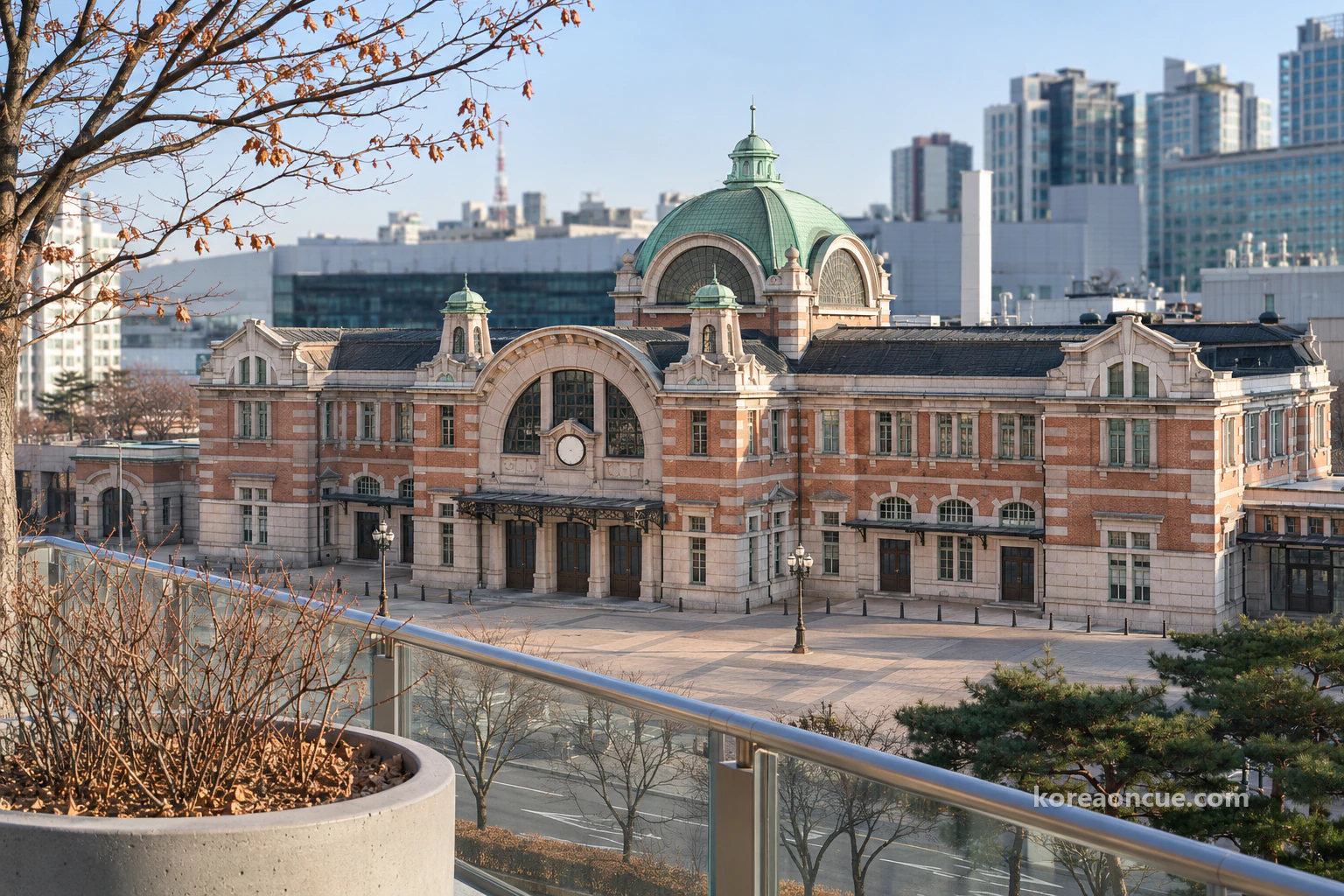
From Seoullo 7017 you can see Culture Station Seoul 284, the old Seoul Station building. Elena leaned on the railing and looked at its roof for a long while. From the door it had looked like nothing more than a place to get into, but from above it was an old station standing side by side with the new one. Elena slipped a new line into her notebook: “[S#0. The old station from above — before the doors open]”. A scene she had not planned had appeared ahead of her first one.
If you would like to walk this route with a guide, there is a walking course called “Seoullo 7017: From Hanyang to Seoul”. It starts at Exit 2 of Seoul Station on Line 1 and passes Culture Station Seoul 284, Seoullo 7017, Sungnyemun, the Seoul City Wall and Baekbeom Square. Even after Unfold X has ended, Exit 2 of Seoul Station alone takes you on foot to the old station, the elevated walkway and on to Sungnyemun. Elena drew a small arrow next to Sungnyemun in the course name. The exhibition came first today, but it was more than good enough as a candidate for the opening scene of the next day she got off at Seoul Station.
What to see: five key works in “Reality Check”
Among the works by artists from eight countries, five names are worth knowing first: Rachel Maclean’s DUCK, Varvara & Mar’s A Needle in a Haystack, LEE Jin’s MORA, OH Myungseok’s The Reciting Machine and Alexandra Daisy Ginsberg’s The Substitute. Elena wrote the five names down one page of her notebook and put square brackets round only the first two. One was a work about the people on a screen, and the other about a machine’s hand.
At 2.50 p.m., Elena stood at the door of the old station once more. This time she was ten minutes ahead of the opening. Having registered in advance, she had less to worry about in the queue. When 3 p.m. came, Elena drew a small circle next to the S#1 line in her notebook. The first scene had started four hours late, but in the meantime one more scene had been added.
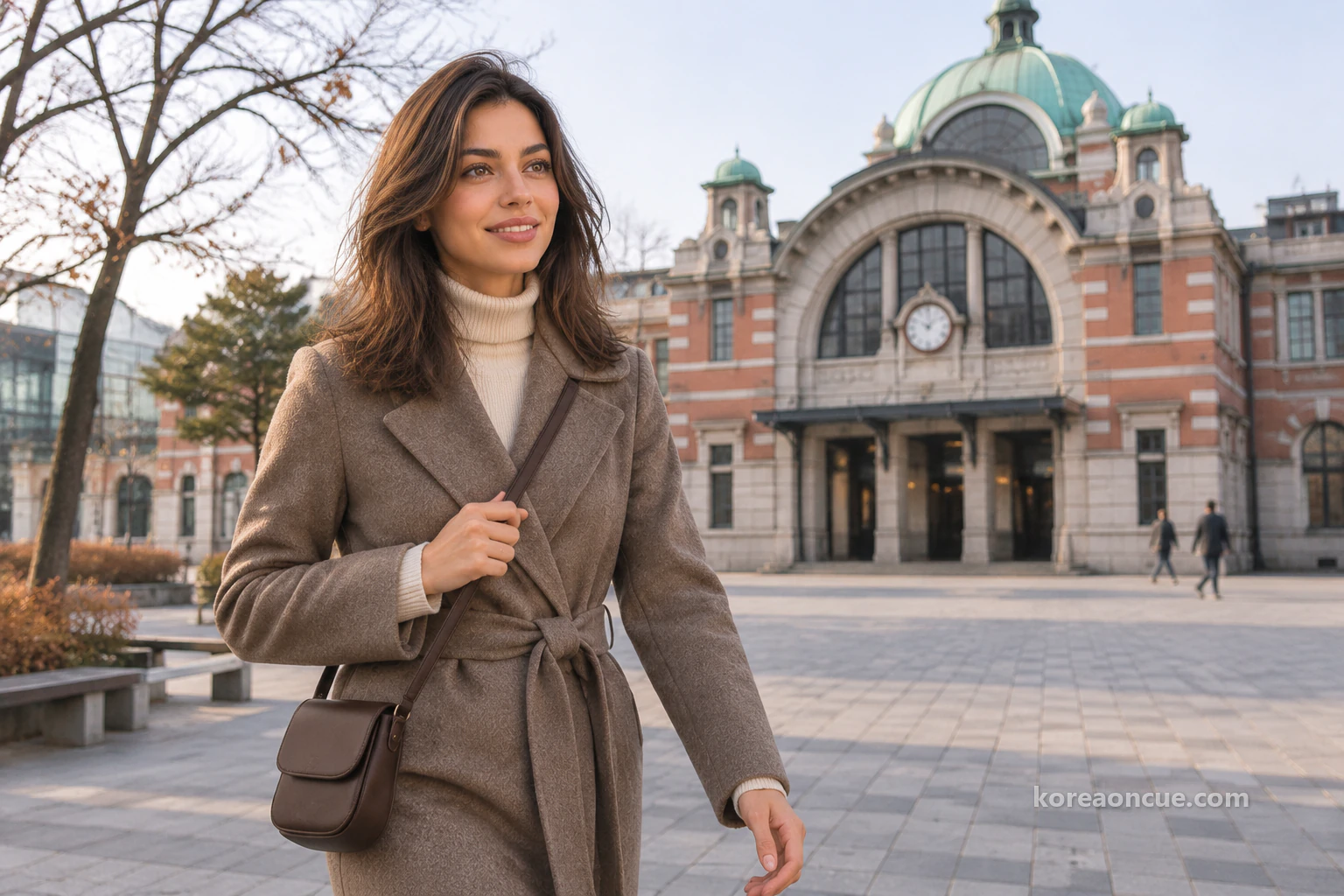
What is DUCK? A sixteen-minute deepfake short film that brings actors back with AI
DUCK is a sixteen-minute single-channel video made in 2023 by Rachel Maclean, an artist and filmmaker based in Glasgow, Scotland. It is a deepfake short film set in a British spy thriller, with both the picture and the sound made by deepfake, using AI to bring old Hollywood actors back to life. The artist played every character in the film herself, built the settings with green screen and 3D modelling, and added the texture of 35mm film in the colour grade. The work won a Prix Ars Electronica award and was supported by the British Council in Korea. At sixteen minutes, it is a good length to watch from start to finish in one go.
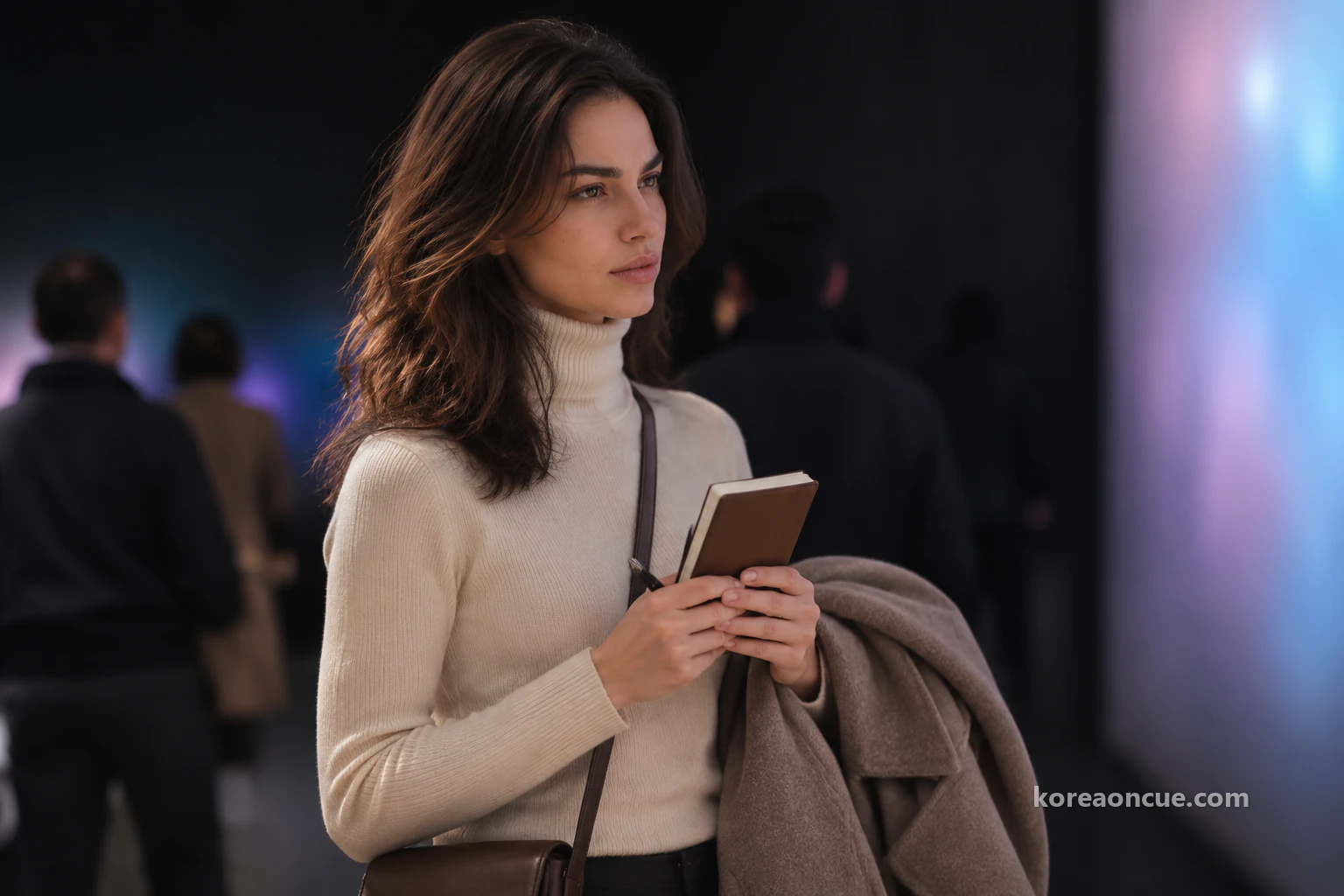
Once inside, Elena took off her coat and hung it over her left arm, and before stepping up to the screen she wrote one line in her notebook: “[S#2. Spot the fake — do not look away]”. After a whole trip of holding scenes on screen up against the real Seoul, she felt sure she could at least tell where the fake parts were. For sixteen minutes, every time she caught a moment when the actor’s shoulders stiffened awkwardly or his gaze wavered slightly, Elena pressed the corner of her notebook with a finger. Once the awkward moments passed ten, she found herself less sure, not more.
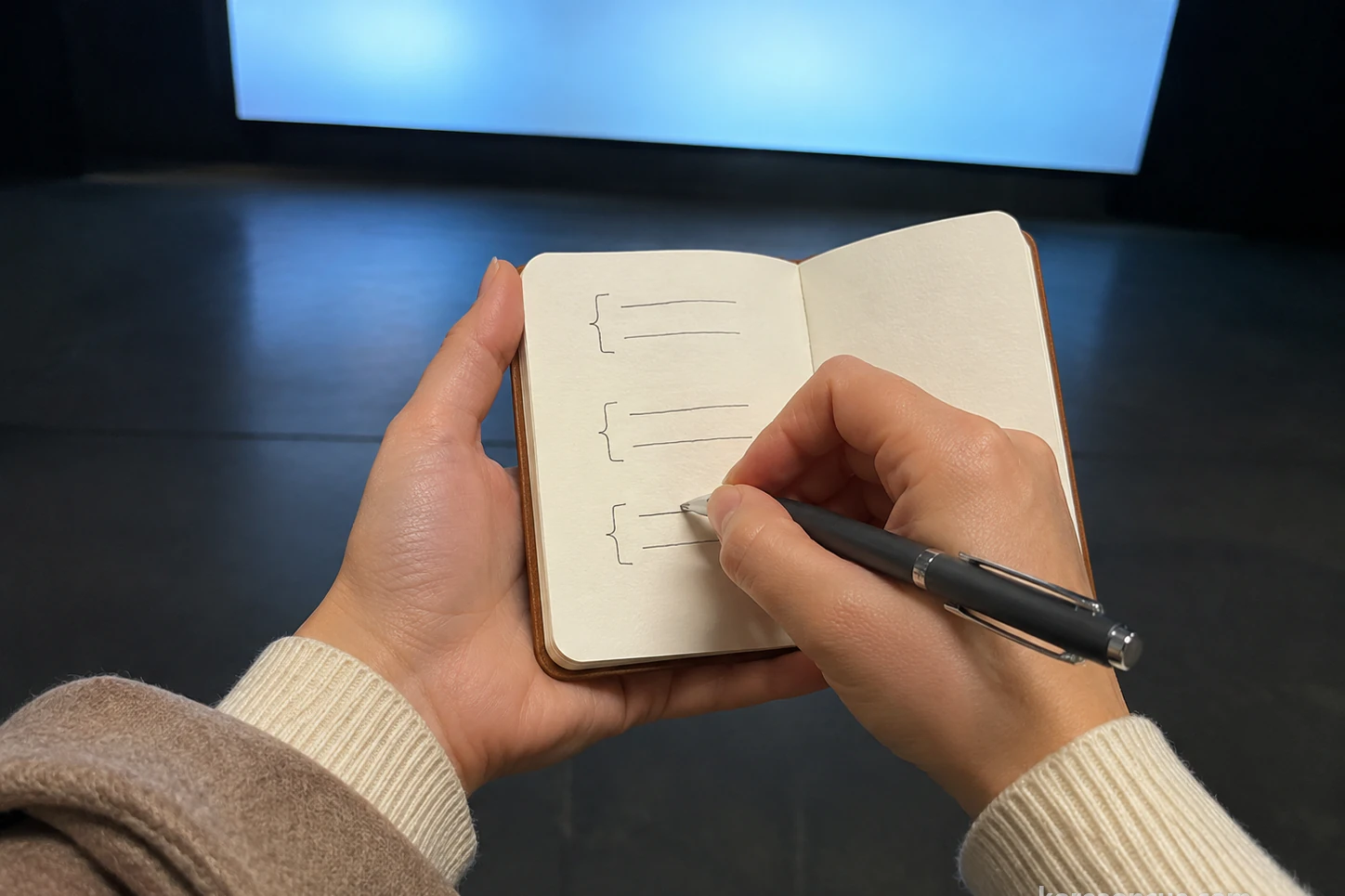
The reason was in the introduction she had left half-read up on Seoullo. The artist deliberately performs differently from the original actors, so the actor on screen looks awkward and uneasy in his own skin. Elena could never quite tell whether the awkwardness she had found was a gap in the deepfake or acting the artist had put there on purpose. The artist started the work from the saying “If it looks like a duck and quacks like a duck, it’s probably a duck”. Only after the screen went dark did Elena really feel that this was a film about what happens when our instinct to trust what we see stops working.
The grainy texture on the screen pointed the same way. For those sixteen minutes, Elena had tried to judge from that grain which decade the film came from, but when she finished reading the introduction she found it was the texture of 35mm film, deliberately added in the colour grade. The artist had built the picture to blur time and place, so it was no wonder Elena could not name the year. For Elena, who had spent the trip matching scenes on screen to real places, it was a picture that had erased the very thing she would have matched it against.
Elena did not strike through the S#2 line. Instead, she added another one under it: “[Looking for the fake, I saw real acting]”. Maclean sees film as a medium that makes us believe what is not true while still revealing truths about life, and she says that in the age of deepfakes something can be fake and true at the same time. To Elena, who had walked Seoul in search of scenes from dramas, that sounded like the story of her own trip. When you watch DUCK, try standing in front of it as Elena did, set on finding the fake. How that resolve changes over sixteen minutes is the fun of this work.
What is A Needle in a Haystack? When the robot arm finds the needle, a bell rings
Varvara & Mar is an artist duo formed in 2009 by Varvara Guljajeva and Mar Canet Sola. In their 2024 work A Needle in a Haystack, a robot arm is given just one task: to find a needle hidden in a pile of hay. The robot feels its way through the hay one section at a time, picks it up and brings it to a magnet, checks whether the needle has stuck, and carries on searching. When it finally finds the needle, it rings a bell to announce its success. The work is made of a robotic installation, sensors, a computer, a magnet, a bell and hay.
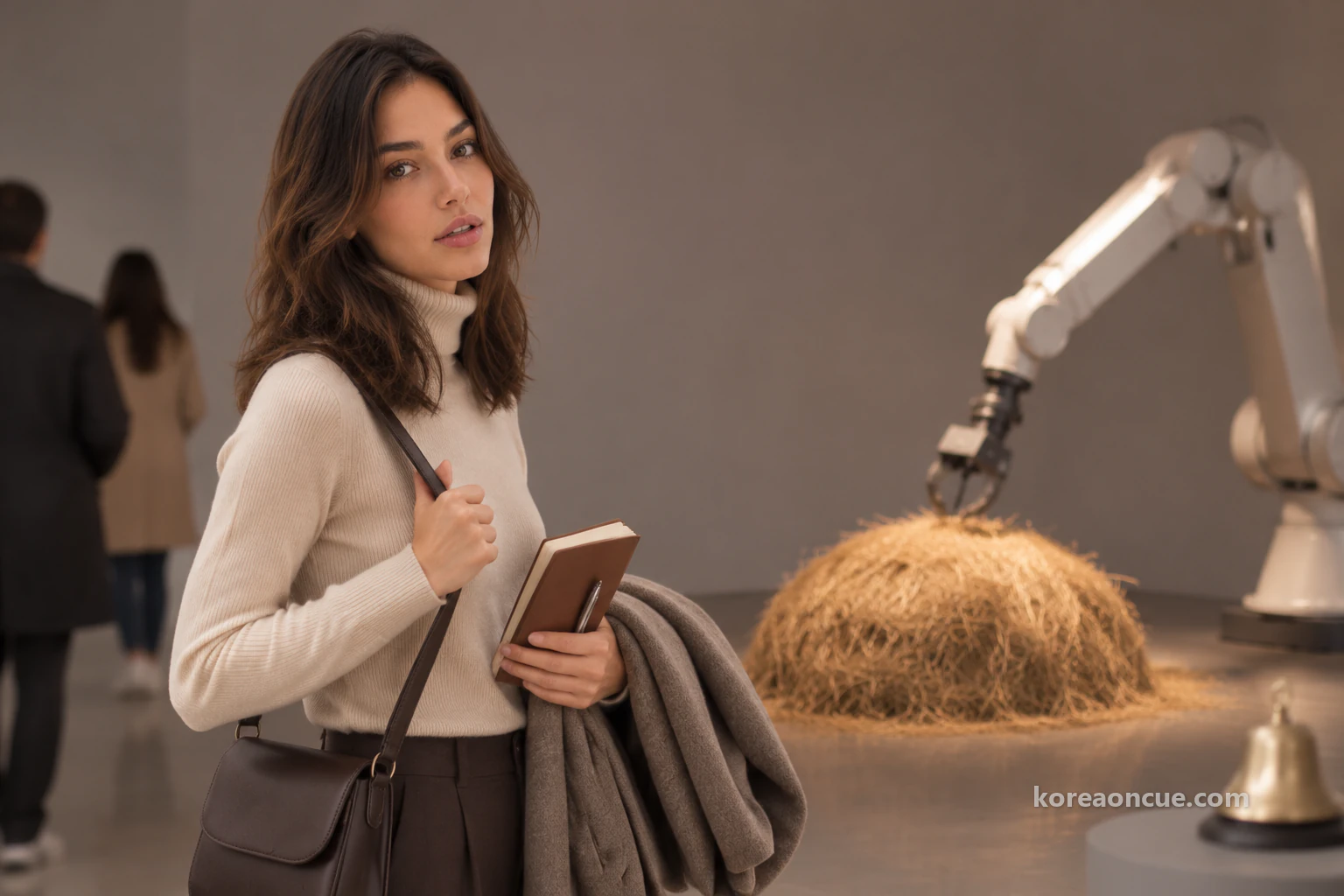
Elena decided to wait for the moment the bell rang. In her notebook she wrote only “[Cut when the bell rings]”. But for the few minutes Elena watched, the robot arm just kept picking up hay, holding it to the magnet and putting it down again. “How many takes does this actor need for one line?” Laughing, Elena left the cut line empty and moved on to the next work.
The introduction starts from the fact that “finding a needle in a haystack” means a task so hard it is close to impossible, and asks whether it is still impossible for a machine. It then likens the search to the task facing AI in the age of big data: picking out meaningful information from an enormous amount of data. It also shows that behind a movement that looks simple lie cameras, sensors, software, computing resources and a great deal of human engineering effort. Setting the robot’s precision beside the untidiness of the hay, the work asks whether a machine can find the needle, and what is used up in doing so. The longer the bell stays silent, the clearer that question becomes — that was the note Elena added beside the empty cut line.
Reading that, Elena thought of herself that morning. The introduction had a passage saying that even powerful large language models struggle to find information buried in a wide context, and Elena had missed a single asterisk line buried on one information page and waited four hours because of it. “My needle was right under the times line.” Elena murmured it, and this time laughed without a sound. Finding the one line you really need in a long text is hard, it seemed, for people and machines alike.
What you can follow in English: book the tours and talks separately for set dates
The programmes overseas visitors can follow in English run on set dates. The tour by artistic director Alain Thibault is in English, at 2 p.m. on Saturday 28 November and Saturday 5 December, for about an hour. Talk 1 has simultaneous interpretation, and Talk 2 is held in Korean with English subtitles. All of these programmes need booking online, so pick your date first and then sign up.
If you are going to the exhibition on your own, read the website first. The Unfold X website is in Korean and English, and each key work has its own introduction and artist profile in both languages. Up on Seoullo after registering, Elena too read the English introductions to DUCK and A Needle in a Haystack once each. Worried that knowing the ending would spoil the scenes, she read only the first paragraph about DUCK and switched off the screen. Knowing just the title, the year and the length of each work makes it much easier to choose what to see first once you are inside.
| Programme | Date | Time | Language and venue |
|---|---|---|---|
| Tour by Alain Thibault | 28 November (Sat) · 5 December (Sat) | 14:00, about 1 hour | English |
| Tour by Sookyun Yang | 28 November (Sat) · 5 December (Sat) | 15:00, about 1 hour | Korean (28 November is for sponsors only) |
| Talk 1 (Quantum, Reality, and Art) | 27 November (Fri) | 15:00–18:10 | Simultaneous interpretation · 3rd Class Waiting Room |
| Talk 2 (Discovering Beings Reconfigured by Technology) | 4 December (Fri) | 14:30–18:00 | Korean with English subtitles · 3rd Class Waiting Room |
| Evening (night performances) | 27 November (Fri) · 28 November (Sat) · 5 December (Sat) | From 19:30 | Central Hall |
The Evening performances in the bottom row of the table start at 7.30 p.m. They are a separate programme that runs after the exhibition closes at 7 p.m. If you want to see the exhibition by day and carry on to an evening performance, book that day’s Evening in advance and keep the half hour in between free. The English tours and Talk 1 fall on Saturdays and a Friday, so check them against the dates you are in Seoul first.
Elena looked at the Saturday 28 November entries in this table for a long time. To Elena, a tour given in English by the artistic director himself was like a scene with the director’s commentary. She did not book straight away, but simply wrote in the margin of her notebook: “[Next scene candidate — Saturday 2 p.m., director’s commentary]”. Setting up the next scene before she had finished filming today’s was an old habit of Elena’s.
How late can you stay? It closes at 7 p.m., with last entry at 6.30 p.m.
The exhibition closes at 7 p.m., and last entry is at 6.30 p.m. If you walk in right at 6.30 p.m. you have only half an hour left, so by the time you have watched DUCK you are nearly done. If you want to take your time over several works, aim to go in by mid-afternoon at the latest. On opening day, when it opens at 3 p.m., you need to go in as soon as the doors open to use all four hours until 7 p.m.

The exhibition is not confined to Culture Station Seoul 284. Under the name Unfold X Screen, media art also plays from October to December on three large LED screens in the city: Seoul Station Platform111, COEX Artium and Gwanghwamun Luux. If you are coming via Seoul Station, you can catch the exhibition’s media art even outside the venue. Elena copied the three names onto the last page of her notebook and added beside them: “[Three locations, one theme]”.
As 6.30 p.m. drew near, Elena passed in front of DUCK one last time. The first time she had counted the awkward moments, but the second time she found herself watching not the actor’s face but her own urge to believe it. Elena did not watch it through again. She stood for the first few minutes and then turned away. The scenes she had written that day already ran past two pages of her notebook.

The scene rewritten in front of the old station: not whether it is real, but what becomes real
When Elena came out at about 6.50 p.m., the Seoul Station plaza was already dark. The wind was cold, so Elena put back on the winter coat she had carried over her arm all afternoon and, pulling the collar together, looked back once at the old station. That morning she had laughed in front of its closed doors, at midday she had looked down on it from the overpass, and in the afternoon she had hunted for fakes inside it. She had seen the same building from three sides in one day.
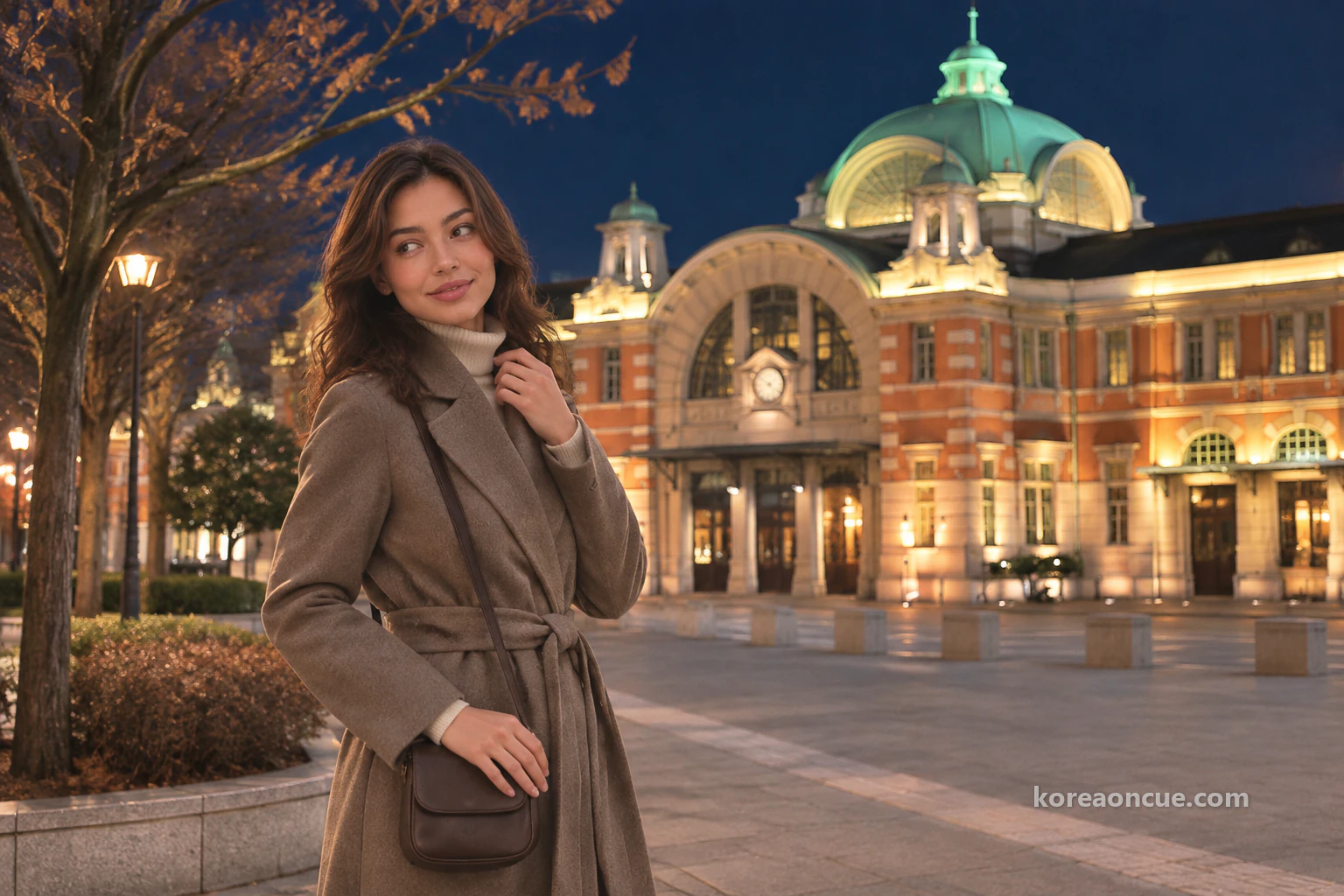
Elena sat on a bench at the edge of the plaza and read her notebook again from the beginning. The theme line at the top, the struck-through 11 a.m. and the newly written 3 p.m., the S#0 she had slipped in up on Seoullo, the line about looking for the fake and seeing real acting, and the bell line she had left empty came into view one after another. Elena underlined the theme line at the top once. “[Not whether it is real, but what becomes real]”. When she copied it out that morning it had been the exhibition’s sentence, but reading it again in the evening, it had become Elena’s own stage direction, tying the day together.
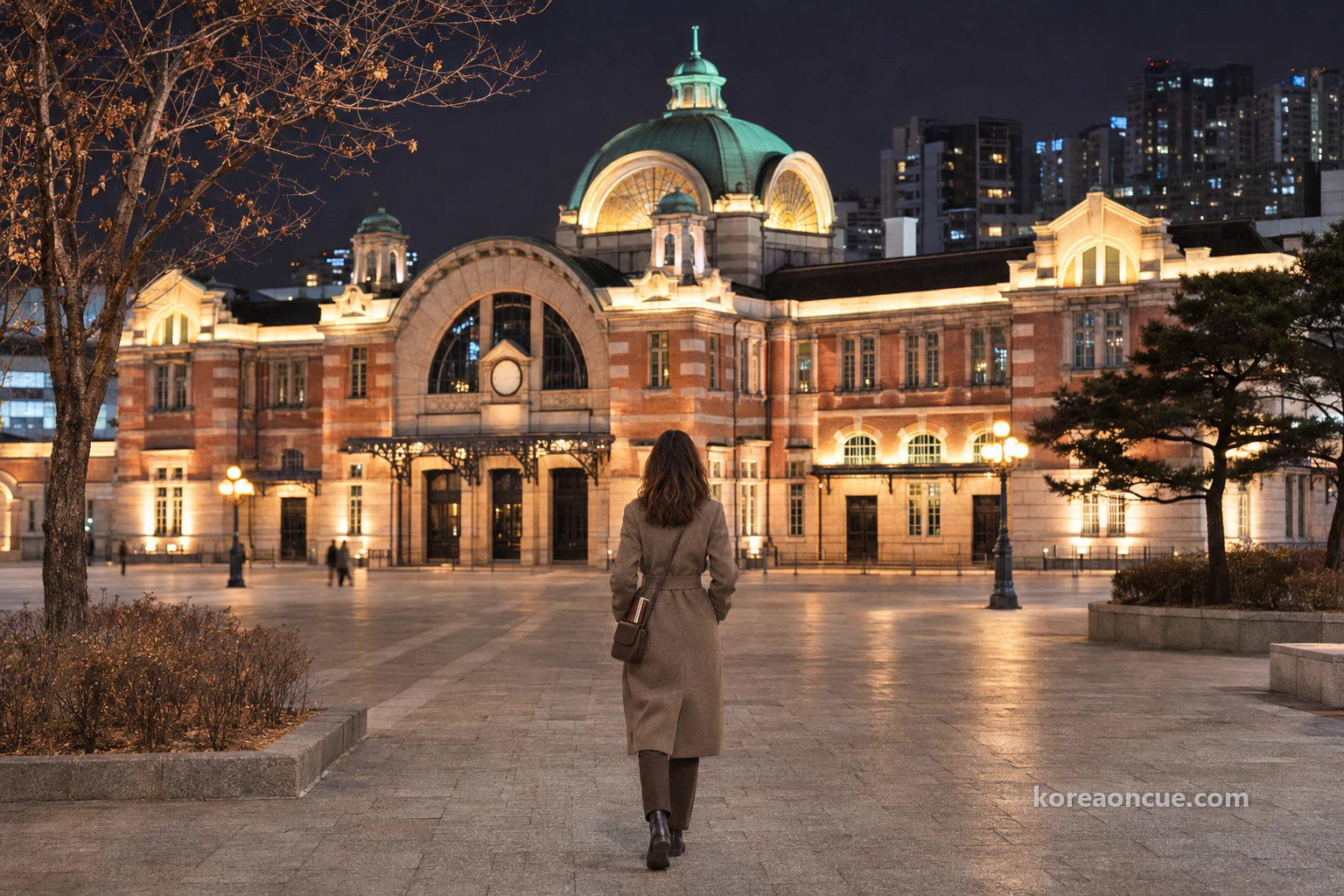
Before closing her notebook, Elena looked once more at the margin of the last page. The line for the 2 p.m. Saturday English tour was still marked only as a “candidate”. Heading down into Exit 2 of Seoul Station, Elena decided that next time she came to this building, she would read everything from the time on the first line down to the asterisks. Thinking that a mistake like today’s might be worth making once more, Elena smiled a little to herself.
Common Mistakes
Going on the morning of opening day
Elena looked only at the 11 a.m. on the first line and waited four hours at a closed door. The first day starts at 3 p.m.
Thinking you cannot get in without registering in advance
Elena thought so too, but walk-in registration gets you in.
Assuming registration covers tours and performances
Registering and booking are separate. Elena wrote down the English tour date but had not booked it yet.
Learning just one Seoul Station exit
Check which line you came on first. Only the Gyeongui–Jungang Line uses a different exit.
Arriving just in time for last entry
Watching DUCK alone takes you almost to closing time.
FAQ
Can more than ten of us go together?
Groups of ten or more, such as schools, organisations or clubs, book separately.
Can I join the 3 p.m. Korean tour on 28 November?
That day’s 3 p.m. tour by Sookyun Yang is for sponsors only. Look at the 3 p.m. session on 5 December instead.
Can I follow the talks in English?
Talk 1 on 27 November has simultaneous interpretation, and Talk 2 on 4 December has English subtitles.
Recap — 30 seconds before you go
- Remember that only the first day opens at 3 p.m., while every other day it opens at 11 a.m. with no closing days.
- The exhibition is free and needs only registration, while tours and performances need booking as well.
- Even after the event, Exit 2 of Seoul Station still links the old station and Seoullo 7017.
Sources
- Unfold X 2026 — Visit & Register (Korean and English)26 November–9 December 2026 · 11:00–19:00, last entry 18:30 · opening day from 3 p.m. · no closing days · free admission · walk-in registration for everyone, advance registration for faster entry · online booking for talks, Evenings and tours, group booking for 10 or more · 1 Tongil-ro, Jung-gu, Seoul, Seoul Station Exit 2 (Lines 1 and 4), Seoul Station Exit 1 (Gyeongui–Jungang Line) · bus routes · car parks near Seoul Station · enquiry emailchecked 2026-11-14
- Unfold X 2026 — Program (Korean and English)Opening ceremony 16:00 on 26 November in the Central Hall · tour by Alain Thibault 28 November and 5 December, 14:00, about 1 hour, English · tour by Sookyun Yang same days 15:00, Korean (28 November session for sponsors only) · Talk 1, 27 November 15:00–18:10, 3rd Class Waiting Room, simultaneous interpretation · Talk 2, 4 December 14:30–18:00, 3rd Class Waiting Room, Korean with English subtitles · Evenings 27 and 28 November and 5 December, 19:30, Central Hall · Unfold X Screen at Seoul Station Platform111, COEX Artium and Gwanghwamun Luux, October–Decemberchecked 2026-11-14
- Unfold X 2026 — About (Korean and English)Curatorial statement for “Reality Check” · a self expanding through networks, algorithms and AI agents · not “what is real” but how we decide what becomes real to us · artistic director Alain Thibault (Elektra, Canada) · producer Sookyun Yangchecked 2026-11-14
- Unfold X 2026 — Rachel Maclean, DUCK (Korean and English)2023, single-channel video, 16 minutes · deepfake short film set in a British spy thriller, picture and sound both deepfake · the artist plays every character · green screen, 3D modelling and a 35mm film texture added in the colour grade · Prix Ars Electronica · supported by the British Council in Koreachecked 2026-11-14
- Unfold X 2026 — Varvara & Mar, A Needle in a Haystack (Korean and English)Artist duo formed in 2009 · 2024 work · a robot arm searches the hay for a needle with a magnet and rings a bell when it finds it · robotic installation, sensors, computer, magnet, bell and haychecked 2026-11-14
- Seoul Metropolitan Government, Fun Seoul — Unfold X 2026 (Korean)26 November–9 December 2026 · 11:00–19:00 · Culture Station Seoul 284 · introduction to the “Reality Check” themechecked 2026-11-14
- Seoul Foundation for Arts and Culture — Press release on the opening of Unfold X 2026 (Newswire, Korean)Opens 26 November, runs with no closing days until Wednesday 9 December · Culture Station Seoul 284 · artists from eight countries · free · key works LEE Jin’s MORA, OH Myungseok’s 읊는 기계 and Alexandra Daisy Ginsberg’s The Substitutechecked 2026-11-14
- Culture Station Seoul 284 — Getting here (Korean)1 Tongil-ro, Jung-gu, Seoul · Seoul Station Exit 2 (Lines 1 and 4), Seoul Station Exit 1 (Gyeongui–Jungang Line) · bus routes · car parks near Seoul Station · two wheelchairs and three pushchairs, ask the staff at the entrancechecked 2026-11-14
- Korea Craft & Design Foundation — About Culture Station Seoul 284 (Korean)Cultural complex made by restoring the old Seoul Station building (Historic Site No. 284)checked 2026-11-14
A Seoul story told with our AI characters. Place details are checked against public sources; the photos are AI-made illustrative images. How we use AI
More from this area

Seoullo 7017: a walk on the road above the tracks
Seoullo 7017 is a walkway on the old Seoul Station overpass, 180 metres from Exit 1 of Seoul Station on Lines 1 and 4, and it is open all day and night.

Sungnyemun: the South Gate through old photographs
Old photographs show Sungnyemun with different walls on either side.