SEOUL · NAMSAN
Mali’s fifth Seoul work trip, and the first walk she and Rina choose together: the Namsan Dulle-gil Autumn Picnic
The 2026 Namsan Dulle-gil Autumn Picnic — from Myeongdong Station to the North Ringway by Namsan Cable Car, past the photo exhibition outside the Jungbu Park Leisure Center and Seokhojeong, then along the Forest Path and Wildflower Garden Path to the second exhibition near Ikkiwon in the Korean Forest Garden (exhibition open throughout, 1–30 November)
They had agreed to choose the next walk together. Mali asked for autumn colour, Rina asked for a path with a name, and the answer they found between them was the Namsan Dulle-gil, where photographs line the path for a whole month.
How to get there
Mali’s fifth work trip to Seoul comes round sooner than she expected. She works for a beauty magazine in Bangkok, and only last week, on her fourth trip, she flew home with background colours for a late-autumn shoot. Then the shoot was brought forward, and another Seoul meeting landed in the very next week. This time her travel calendar has no place pencilled in ahead, because on the day they walked along Cheonggyecheon, Mali decided she wanted to choose the next walk with Rina and left that box empty on purpose.
This time it is Mali who sends the first condition. “This time I really need autumn colours — the colours of trees turning.” The sunset-apricot card she found on the Ichon Sunset Trail suited the waterside scenes, but the shoot still needs one more colour, from a forest in autumn leaf. Rina’s reply comes quickly: “Then mine is a path with a name, one I can split into boxes.” That evening they swap a few places each, until both of them stop at the same moment on the one spot that meets both conditions.

Mali sends an event notice from Seoul’s parks news, and Rina sends a leaflet for the trail that circles the same mountain. Mali’s link is for the “2026 Namsan Dulle-gil Autumn Picnic”, with the slogan “An autumn picnic, following the leaves!” It announces outdoor photo exhibitions along the North Ringway and in the Korean Forest Garden on Namsan, the wooded mountain in central Seoul, throughout November. Rina’s leaflet divides the trail into six named sections, among them the North Ringway, the Forest Path and the Wildflower Garden Path. “The photos are yours and the path names are mine,” Rina writes, and with that, the first place they have ever chosen together is settled.
Today’s walk is in Namsan Park, right in the middle of Seoul. They climb from Myeongdong Station to the front of Namsan Cable Car, follow the car-free North Ringway to the photo exhibition outside the Jungbu Park Leisure Center, pass the archery ground at Seokhojeong, and cross to Namsan’s southern slopes on the Forest Path and the Wildflower Garden Path. The last stop is the Korean Forest Garden, opened this June on the site of the old outdoor botanical garden, where a second photo exhibition stands near Ikkiwon. Following their route, this piece sets out how to read the event’s dates, where to start and which order to walk in to see both exhibitions.
The Cue
The 2026 Namsan Dulle-gil Autumn Picnic is run by the Seoul Metropolitan Government’s Jungbu Park Leisure Center around Namsan Park from 1 to 30 November. The part you can see on any day in November is the outdoor photo exhibition, the Dulle-gil Gallery “Gardens and Strolls”, set up on the North Ringway (outside the Jungbu Park Leisure Center) and in the Korean Forest Garden (near the Moss Garden). Tours and activities run on just two days, Saturday 7 and Sunday 8 November, with advance booking on the Seoul Public Service Reservation site, and the Seokhojeong traditional archery contest is on Saturday 14 November. Namsan Park is open at all times, and parking inside the park is difficult, so come by public transport.
- Photo exhibition: the Dulle-gil Gallery “Gardens and Strolls”, open throughout from Sunday 1 to Monday 30 November. Two outdoor sites: the North Ringway (outside the Jungbu Park Leisure Center) and the Korean Forest Garden (near the Moss Garden).
- Tours and activities: Saturday 7 – Sunday 8 November, 10:00–17:00. Book ahead by searching for “Namsan Dulle-gil Autumn Picnic” on the Seoul Public Service Reservation site. For families with children and for adults, with each programme setting its own audience.
- Extra programmes: the Dulle-gil park photo studio, “Park One Shot” photo keyrings and the “Art Garden” colouring activity, 7–8 November 10:30–16:30 at the Namsan Korean Forest Garden, open to everyone. They finish early once the prepared stock runs out.
- Traditional archery contest: Saturday 14 November 09:00–17:00 at Seokhojeong on Namsan, entries 2–8 November. For adults, and entrants bring their own bows and arrows.
- Booked programmes: arrive at least 10 minutes before the start, and cancel up to 3 days ahead from My Page on the booking site. Wear comfortable trainers and light, easy clothes.
- What to bring: your own water and a tumbler. The park asks visitors to cut down on plastic.
- Bags: lockers in the runners’ shower room on the ground floor of the Jungbu Park Leisure Center, daily 06:30–22:00, free for everyone. Collect your things the same day.
- Cars: ordinary cars and taxis cannot drive into Namsan Park (vehicles of disability card holders, grades 1–3, are the exception). Use the green Namsan loop bus 01A or 01B.
- Contacts: event — Jungbu Park Leisure Center 02-3783-5993 · Korean Forest Garden — Namsan Park Management Office 02-3783-5900 · Dasan Call Center 02-120.
Choosing together: the dates for the exhibition, activities and archery contest
Picking the date falls to Rina once again. But it is Mali, the first to open the event notice, who tilts her head. The event period box at the top of the page says “2026-11-07 ~ 2026-11-08”, just two days, while the first line of the text says 1 to 30 November. “Is it a month or two days?” Rina reads the notice right to the end and sorts it out: the box at the top only covers the two activity days, and the event as a whole runs for the month.
Open in Kakao Map — Myeongdong Station
Three lines appear in Rina’s notebook that night: “Exhibition — 1–30 — any day”, “Activities — 7·8 — booking”, “Archery — 14 — contest”. The photo exhibition is outdoors and open on any day from 1 to 30 November, while the tours and activities run for two days, Saturday 7 and Sunday 8, from 10 a.m. to 5 p.m., with advance booking. The Seokhojeong traditional archery contest is on Saturday 14 from 9 a.m. to 5 p.m., with entries taken from 2 to 8 November. If you are going, jot it down in three strands as Rina does, and the dates stop getting tangled.
The two activity days are full of choices. A nature and history tour sets off from Namsan Palgakjeong Pavilion with views over the city and stories of the Seoul City Wall, and another tour walks the Korean Forest Garden in autumn, each running three times a day for about 90 minutes. Families can pick the “Birds of Namsan” Family Exploration, the Autumn Forest Seed Explorers or A Garden in My Hand, adults can pick the Dulle-gil Weaving Class, the Knitting Garden or the Dulle-gil Autumn Workshop, and there is an autumn archery experience for learning traditional Korean archery at Seokhojeong and a traditional games session for families with children at Hohyeondang. Mali can’t take her eyes off the woven keyring class for ages, but she has to be in Bangkok that weekend.
So the day they choose is Friday 13 November, when Mali is free from morning to evening. The exhibition is open throughout, so it is all there on a weekday too, and Seokhojeong, where the contest takes place the next day, sits right on their route. Rina has drawn the six boxes of the Namsan Dulle-gil on a fresh page in advance, but this time she adds one more box underneath and leaves it empty on purpose. In that Korean Forest Garden box at the very end, there is nothing but “Mali — ?”.
From Myeongdong Station Exits 3 and 4 to the North Ringway entrance by Namsan Cable Car
A little after 10 on Friday morning, they meet at Myeongdong Station on Line 4. The west end of the North Ringway is the rest area in front of Namsan Cable Car, about a 10-minute walk from Myeongdong Station Exit 3 or 4 in the direction of the cable car. When Mali looks up the slope and stops to catch her breath, Rina tells her about the Namsan Oreumi near Exit 4. It is an inclined lift that climbs about 70 m up Namsan’s slope in roughly two minutes, free of charge, and when you step out, Namsan Cable Car is on your left.
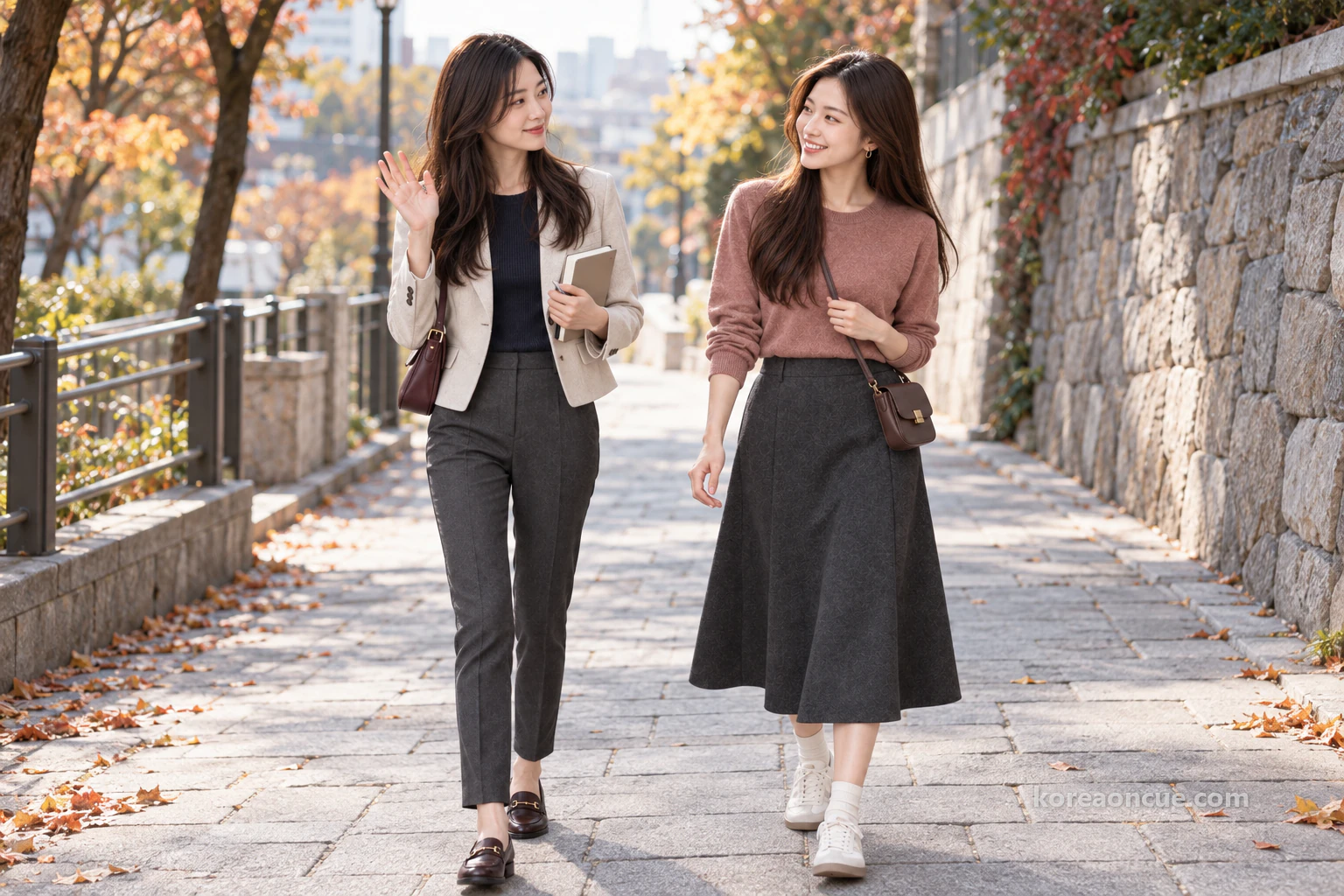
At the rest area by the cable car, Rina opens her notebook. The first box holds three short entries: “North Ringway — 3,420 m — gentle”. The North Ringway runs 3,420 m from the rest area in front of Namsan Cable Car to the North Ringway Entrance outside the National Theater of Korea, and of the six sections of the Namsan Dulle-gil it is the longest and widest, with a gentle slope. That is exactly why Rina put it in the first box. Mali, who has been worrying about climbs, taps the word “gentle” twice with her finger and smiles with relief.
Each of the six boxes in Rina’s notebook holds one section name and its length. North Ringway 3,420 m, Forest Path 910 m, Wildflower Garden Path 880 m, Nature and Ecology Path 1,650 m, History and Culture Path 640 m, Namsan Sky Forest Trail 1,630 m. Rina deliberately doesn’t add the numbers up, saying only the first three are for today and the other three are names saved for next time. On a first visit, splitting the trail by section name like this makes it much easier to decide how far to walk.
The car-free North Ringway, Namsan’s old names and the first box
Once they are on the North Ringway, everything goes quieter. Cars and bicycles are not allowed here, so the path belongs to people on foot. Across Namsan Park as a whole, ordinary cars and taxis have been kept out since 1 May 2005, and since August 2021 large vehicles such as tour coaches cannot come in either. Mali walks out into the middle of the wide path and says that with the traffic gone, she can hear the leaves landing on the ground.
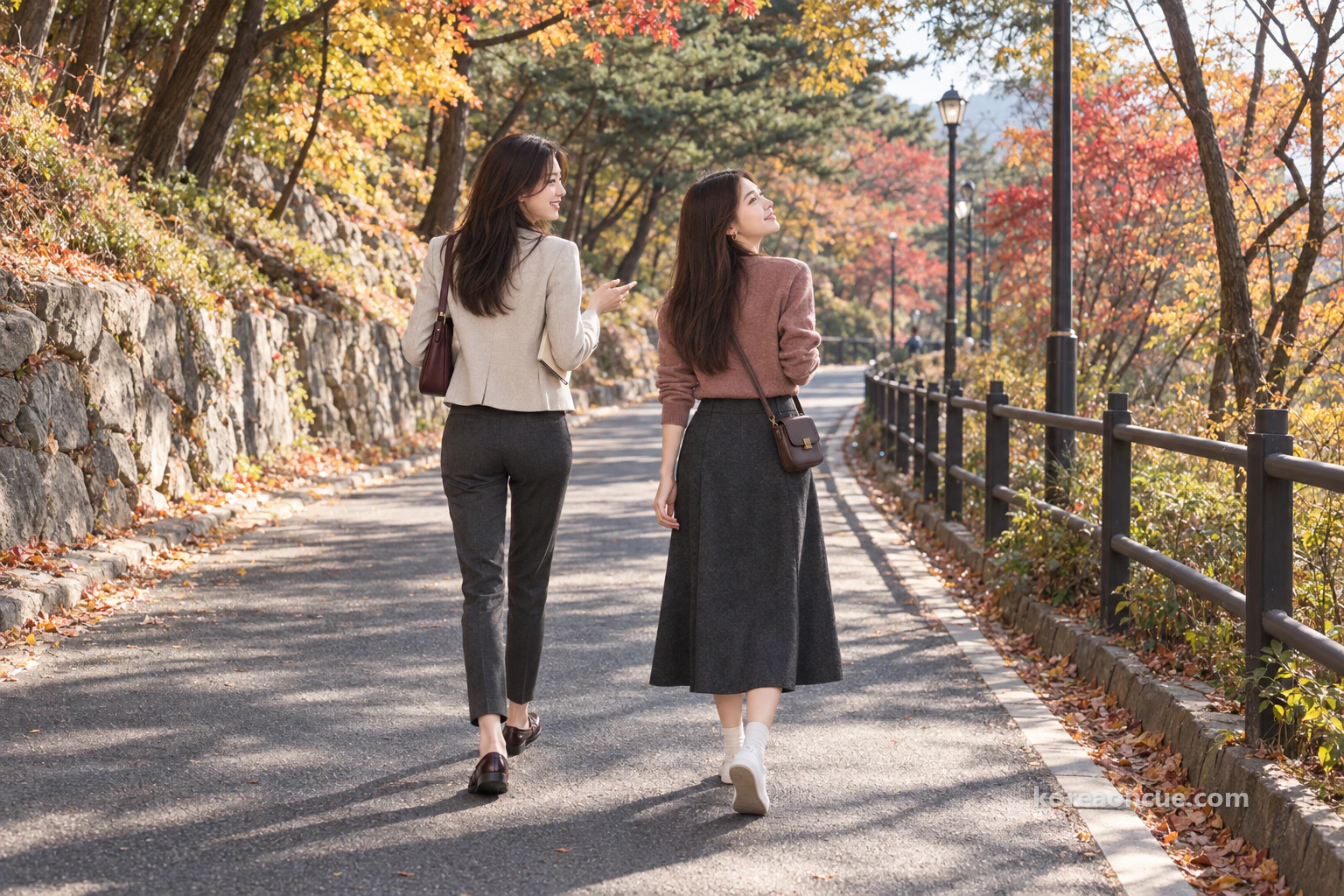
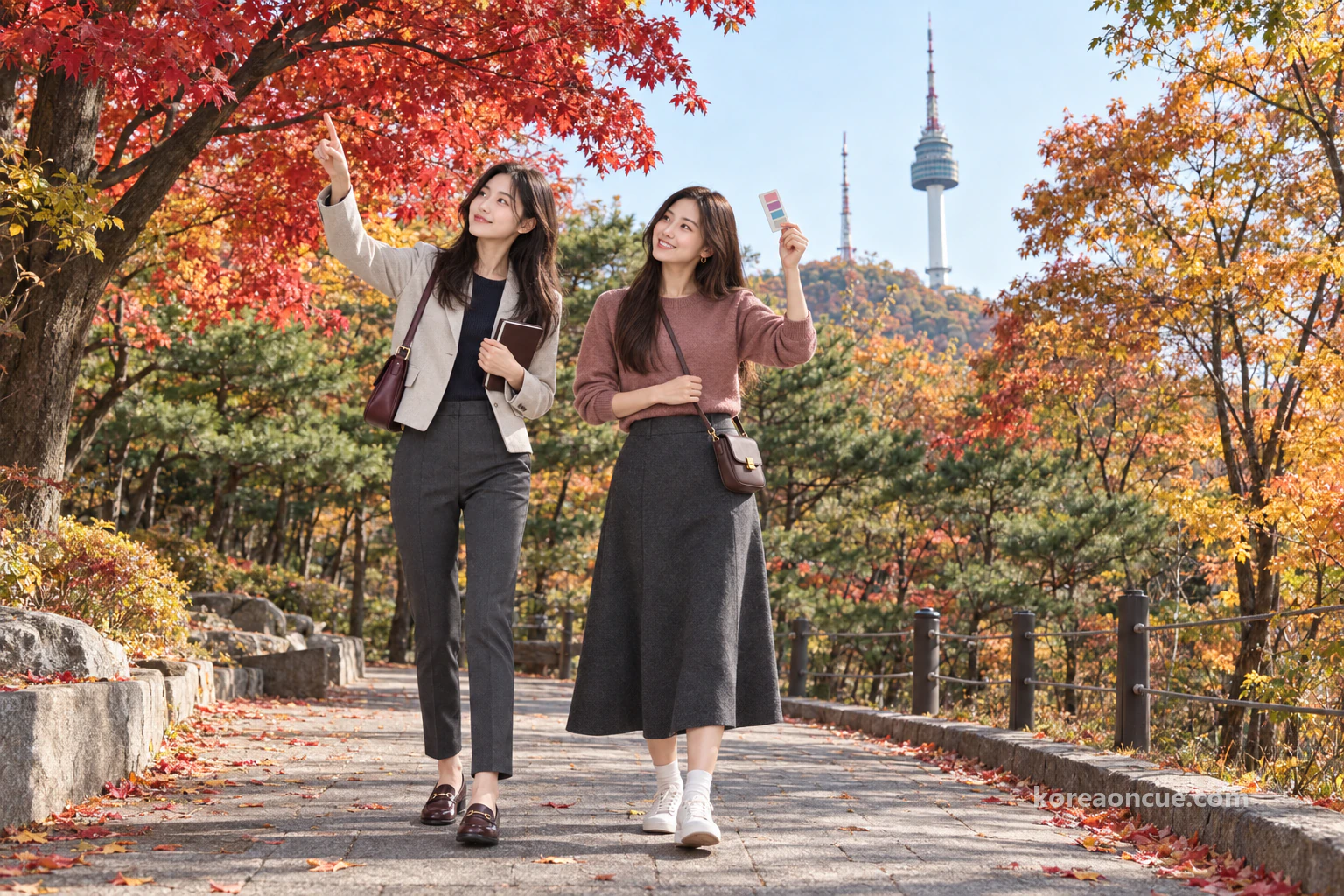
As soon as they set off, Mali takes out her bundle of colour cards. In front of one roadside tree she holds up a yellow card, then an orange one, then names the yellow “Cable Car Ginkgo”. On her first trip to Seoul she compared colours only in photos, but holding up a card and naming it on the spot has since become a habit. With two cards, Mali has more or less worked out why the event notice calls this path “the North Ringway, dyed with autumn leaves”.
As they walk, Rina brings up the mountain’s names. Namsan was originally called Inkyeongsan, and after King Taejo moved the capital from Gaeseong to Seoul in 1394, it became Namsan, the mountain to the south. When a shrine was built to honour the mountain spirit Mongmyeok Daewang, it also gained the name Mongmyeoksan. “One mountain with three names,” Mali says, and Rina writes “Inkyeong — Nam — Mongmyeok” in the corner of her notebook, laughing that today’s name collection has already begun.
Namsan Park stands 270 m high, covers a little over 2.9 million m² and is open at all times. It was designated a park on 12 March 1940 and opened on 10 September 1968. On the leaflet map, the points along the North Ringway run from the west: the Hoehyeon Jarak rest area, Waryongmyo Shrine, the Namsan North Forest Path, the Jungbu Park Leisure Center, the Pildong rest area, Seokhojeong and the Namsan Pine Healing Forest. Rina has marked them as small dots inside the first box, and the two of them touch each dot with a finger as they pass it.
The Dulle-gil Gallery outside the Jungbu Park Leisure Center
Outside the Jungbu Park Leisure Center, a line of frames stands along the edge of the path. This is the first photo exhibition, the Dulle-gil Gallery “Gardens and Strolls”. It is an outdoor show of Namsan’s newest scenery, such as the Namsan Korean Forest Garden and the Namsan Sky Forest Trail, recorded by Seoul’s park photographers, and you see it by walking along the autumn path. There is no door to go through, so slowing down a little is all it takes.

Mali studies one photograph for a long time, then turns to look at the real tree beside the frame. Inside the frame is another season and another corner of this park, and right next to it is the path as it is now, in November. Being able to compare the two in one spot, Mali says, is what makes this exhibition fun. “Shoots work the same way — you put the colour you photographed next to the colour in front of you and choose.” She raises a card, not towards the frame but towards the tree beside it.
Rina notices the spacing and order of the frames before the photographs themselves. Walking along the path, the pictures appear one after another, and to Rina it feels a lot like turning pages. She writes “Gallery 1 — outside the centre — on the path” in her notebook. Underneath, she adds one more line: there are two exhibitions today, and the second is near the Moss Garden in the Korean Forest Garden.
Outside the centre, Mali hitches the bag on her shoulder back into place. She has a meeting in the afternoon, so her laptop is in there too. The runners’ shower room on the ground floor of the Jungbu Park Leisure Center has lockers, free for anyone from 6.30 a.m. to 10 p.m. every day. Anything left there has to be collected the same day, though, so on a route like today’s, ending on the Korean Forest Garden side, you would have to come back for it. They decide to carry their bags, and if you plan to return the same way, the lockers make things easy.
The pine forest at Seokhojeong and the 14 November archery contest
Past the Pildong rest area, the pines along the path grow thicker. On the leaflet map, the dot after the Pildong rest area is Seokhojeong, a traditional archery ground. Rina stops in front of it and opens the event notice on her phone again. Tomorrow, Saturday 14 November, the traditional archery contest takes place right here.

Rina reads the notice out and Mali counts along on her fingers. The contest is an individual event for adults, split into senior (65 and over), men’s, women’s and dan-holders’ divisions, with around 120 competitors. Entry costs 2,000 won, half price for those aged 65 and over, people of national merit and disabled people, and everyone brings their own bow and arrows. Rina reads the last line: “They shoot at a target 145 m away, with the pine forest behind it.”
“145 metres?” Mali asks in surprise, and Rina, thinking of the North Ringway’s 3,420 m, says the target is just a tiny slice of that path away. Neither of them has ever held a bow, and neither has any equipment, so for them the contest ends with reading tomorrow’s schedule. Instead, Mali holds a card up between the pines and names a deep green one “Pine Needle Deep Green”. If you want to learn traditional Korean archery yourself, the Seokhojeong autumn archery experience on the activity weekend of 7–8 November (advance booking) is the one to go for, and the contest is for adult entrants with their own equipment.
From the North Ringway Entrance onto the 910 m Forest Path and 880 m Wildflower Garden Path, linking north and south
Past the Namsan Pine Healing Forest and the sports facilities comes the east end of the North Ringway, the North Ringway Entrance outside the National Theater of Korea. There is a Namsan loop bus stop here, so you can also take green loop bus 01B from the stop behind Dongguk University Station Exit 6, get off here and walk the North Ringway the other way round. The green loop bus starts from the Namsan Yejang bus transfer car park and runs in turn via Chungmuro Station Exit 2, Dongguk University Station/Jangchung-dong, National Theater/Banyan Tree Hotel, N Seoul Tower, Namsan Library/Yongsan Library and Namsan Cable Car/Namsan Walkway Entrance. Rina draws a circle at the end of the first box and moves her pen to the second.
The second box, the Forest Path, runs 910 m from the North Ringway Entrance to the wildflower garden, mostly through woodland. It was built to link the northern and southern sides of the trail, so unlike the broad, paved North Ringway, each step feels much closer to the forest. Rina wrote “Forest — 910 — linking path” in this box, and now that she is walking it, she says it is just what the name promises, a thread stitching north and south together. Only once they are on the forest trail does Mali see why the event notice made such a point of trainers.
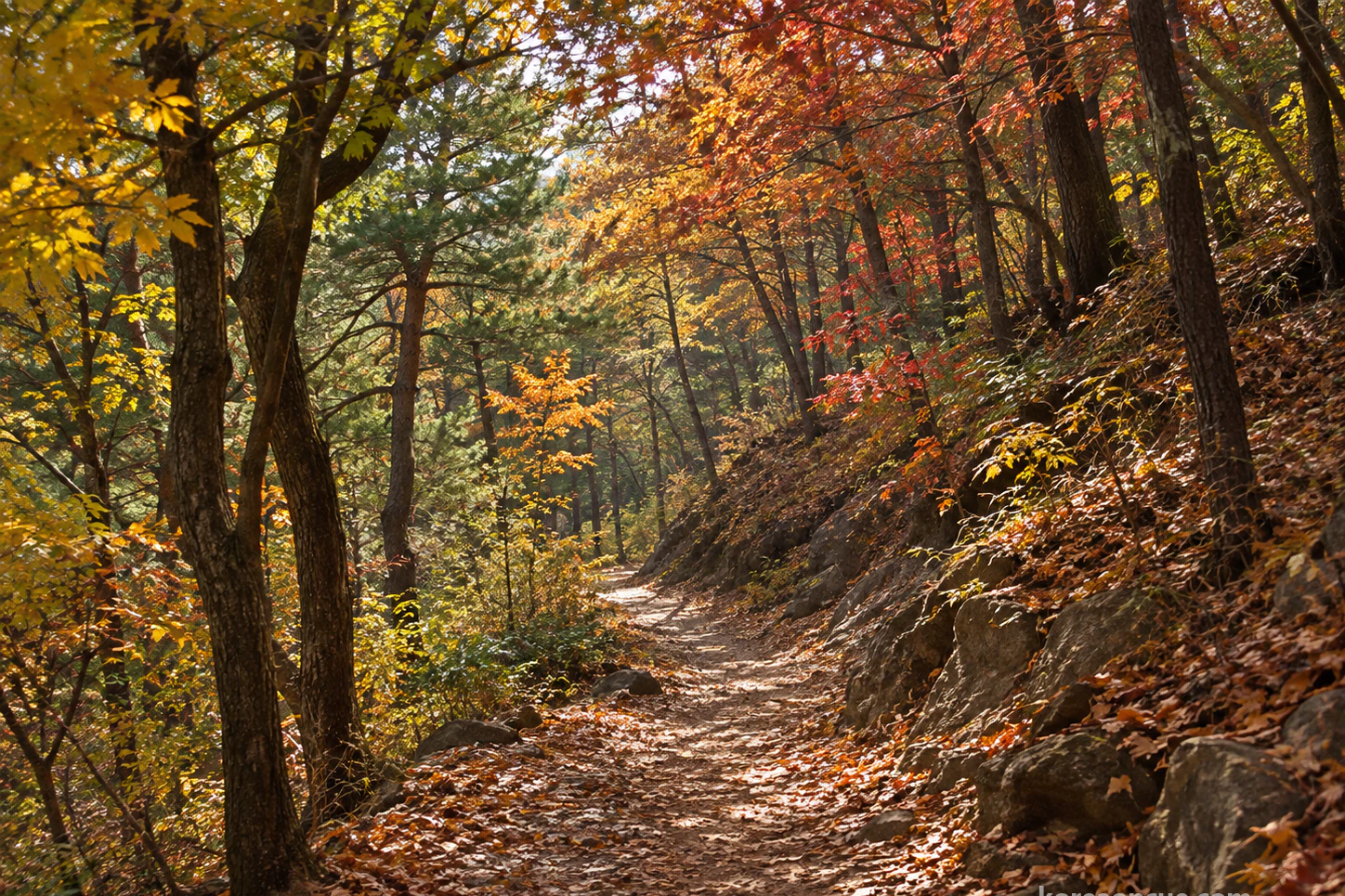
The third box, the Wildflower Garden Path, runs 880 m from the Namsan wildflower garden to the outdoor botanical garden rest area, an easy path for wandering past flowers and trees. Along the way, the Paldo Pine Collection brings together pines from all over the country in one grove. Here Mali takes out her “Pine Needle Deep Green” card again and says that even for the same tree, these pines are a shade lighter than the ones on the North Ringway, drawing a small arrow beside the card. Rina reckons the name tags will change depending on where each pine came from, and suggests they read those names first next time.
Following the Wildflower Garden Path brings you to the site of the Namsan outdoor botanical garden and the Hannam Forest Experience Centre for Children. On the activity weekend it serves as the meeting point for the Dulle-gil autumn classes, but normally only children aged 5 to 7 from kindergartens and nurseries, and families with primary school children, can go in. The two of them simply walk past. Rina finishes circling the third box, then turns to the empty last box and holds the notebook out to Mali.
The 11 gardens of the Korean Forest Garden, with names from Damyang, Uljin, Jeju and Gangjin
The Korean Forest Garden is a makeover of the area around Namsan’s outdoor botanical garden, fully opened to the public on 27 June 2026. Across 30,000 m², it holds 11 gardens under three themes: tradition and culture, nature and ecology, and recreation and rest. The land was once home to housing for foreigners, restored in the 1990s under the project to return Namsan to its original form and opened in 1997 as an outdoor botanical garden. If you are coming just for the Korean Forest Garden, take bus 405 from Hangangjin Station Exit 2 on Line 6, get off at the Hyatt Hotel and walk for two minutes.
“From here on, you decide, Mali.” Faced with the blank box Rina is holding out, Mali hesitates for a moment, because she is used to walking the route Rina has drawn first and being asked to set the order feels new. So she decides to do it the way she does best. She reads the names of the 11 gardens from the garden guide aloud and, for each name, picks the colour card it brings to mind and puts them in order.

Every garden name has a home town. Jidangwon and Jungnimwon take their motifs from the pavilions and streams of Soswaewon and Juknokwon in Damyang, Yeongjiwon from the pond and crape myrtles of Myeongokheon in Damyang, Solsupwon from the Geumgang pine forest in Uljin, Ikkiwon from the moss forests of Gotjawal in Jeju, and the viewing space Namsan Maru from the viewpoint at Dasan Chodang in Gangjin. As soon as she hears the names, Rina writes “Damyang — Uljin — Jeju — Gangjin” under the box. Forest names from all over Korea gathered on one slope of Namsan turn out to be Rina’s biggest find of the day.
Mali’s first pick is Jidangwon. It gives a modern twist to the layout of a traditional pavilion and to chagyeong, the technique of borrowing the scenery beyond, and it is a place for leisure where a bamboo grove and a pond meet. The pavilion’s glass roof was designed with the frit glass method, so the scenery outside reflects in it naturally while the summer sun is kept out, and beside Jidangwon there is a barefoot path through the woods. Mali holds a card up to the leaf colours reflected in the glass roof and sets aside a separate card for that colour, half a shade darker than the real leaves.
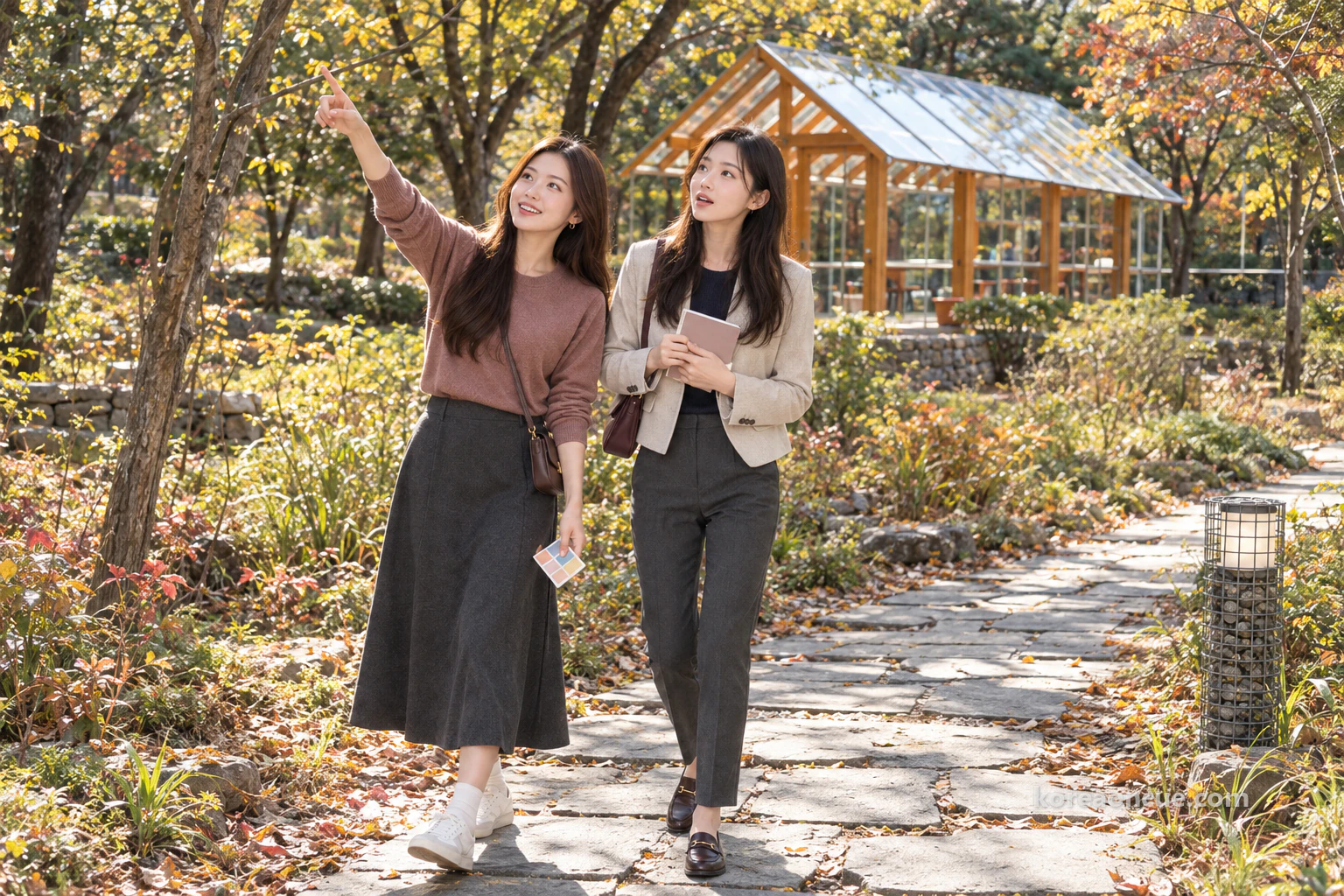
Mali’s second choice is Yeongjiwon, then Solsupwon. Yeongjiwon is a garden where crape myrtles and woodland are mirrored in a still pond, and Solsupwon is a restorative space built around Namsan’s pine forest, with an earth path you can walk barefoot. The gardens are planted mainly with plum trees, crape myrtles and bamboo that represent Korea, along with native species, and the paths, rest spots and viewing spaces follow the lie of the land, so whichever order you take, the route flows on naturally. Each time Mali settles on the next garden, Rina writes its number in the box without a word of argument.
The second photo exhibition near Ikkiwon, and the names “Moss Garden” and “Ikkiwon”
The garden Mali saves for second to last is Ikkiwon. It is a garden of moss landscapes blending into Namsan’s forest, with a stillness and sense of space that are hard to find in the city. The second photo exhibition stands nearby, so Mali has deliberately put it near the end. She wants to begin the day with the exhibition on the North Ringway in the morning and close it with the exhibition of the same name.
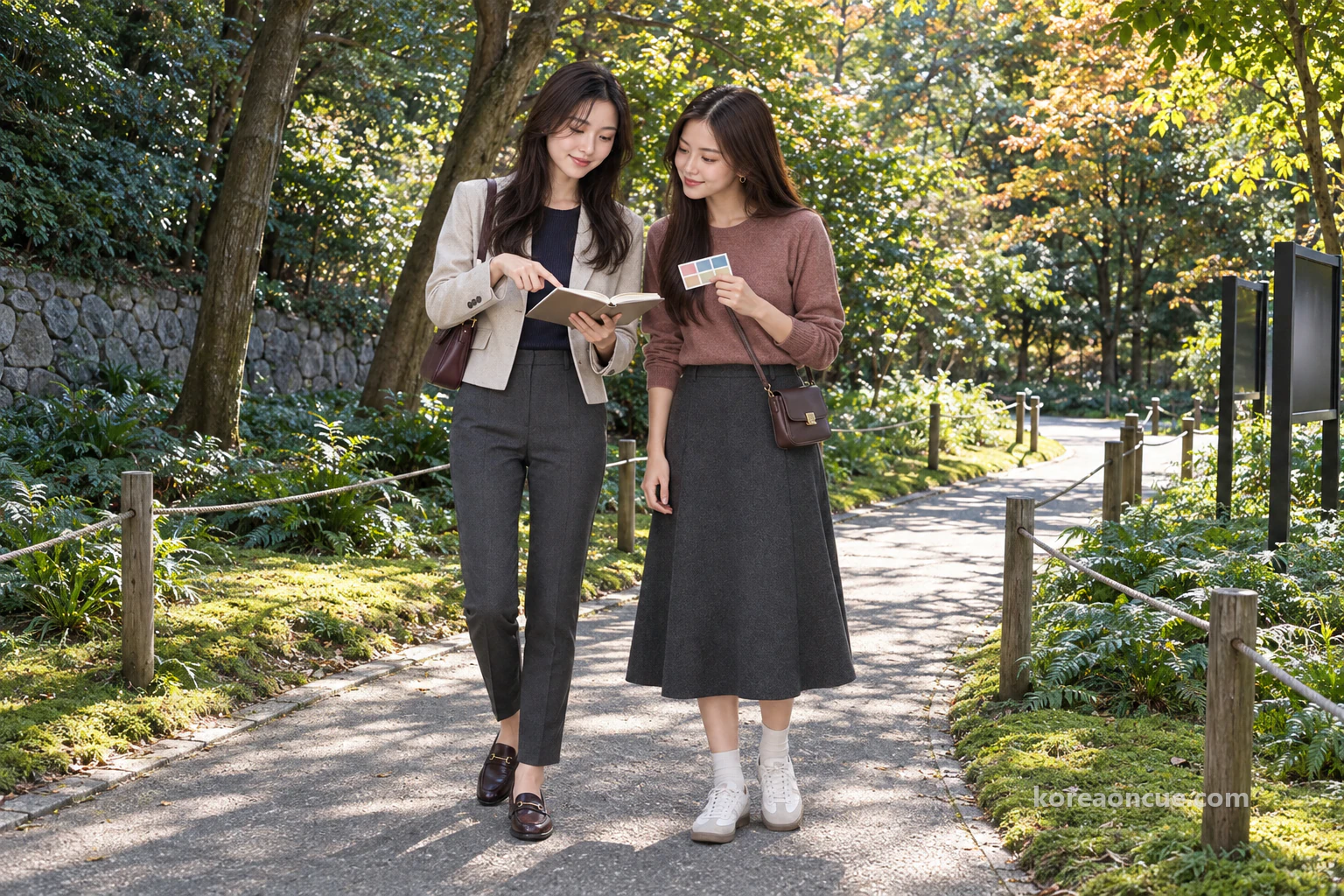
In front of Ikkiwon, Rina makes a small discovery. The event notice gives the exhibition’s location as “near the Moss Garden”, while the garden guide lists the same place as “Ikkiwon”. “They call the same place by two names, so I’ll write both in the notebook.” Rina writes the two names side by side in the box and draws an equals sign between them. If you are visiting for the first time, just remember the two names mean the same place, and you won’t get lost even if the signs and notices word it a little differently.
Mali holds a card up towards the shade of Ikkiwon and adds one more name, “Moss Shade”. The cards she has collected since the morning now number four: Cable Car Ginkgo, Pine Needle Deep Green, the leaves reflected in Jidangwon’s glass roof, and Moss Shade. Walking slowly past a few frames of the second exhibition, Mali says the morning’s show and this one in the forest shade stand under the same title in completely different light. They have seen the Namsan scenes captured by the park photographers twice in one day, split between the northern path and the southern forest.
The last box, filled in at the Namsan Maru viewing deck
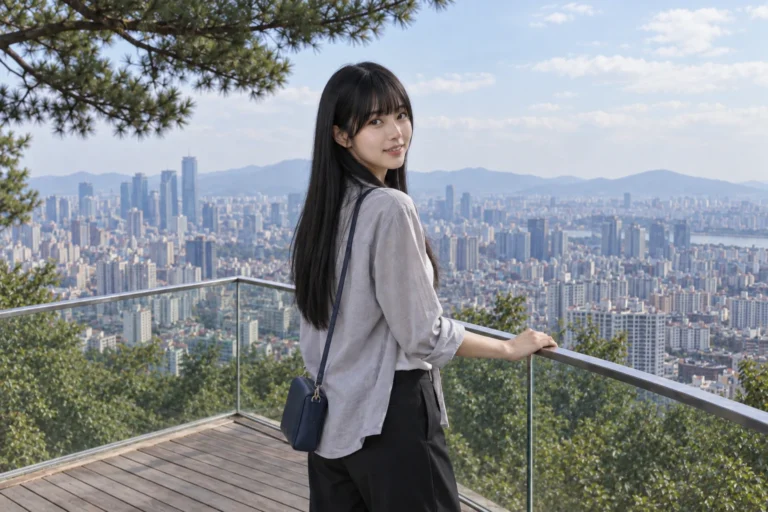
The last stop on Mali’s list is Namsan Maru. It is a viewing space that takes in Namsan’s natural scenery and central Seoul at a glance, built with a steel grating floor and a clear railing so you can see the forest below your feet and the city together. Rina inches forward one step at a time, looking down at the forest through the grating, and Mali can’t stop laughing at her. It is the first moment all day that Rina, who has led the way since the morning, falls half a step behind.
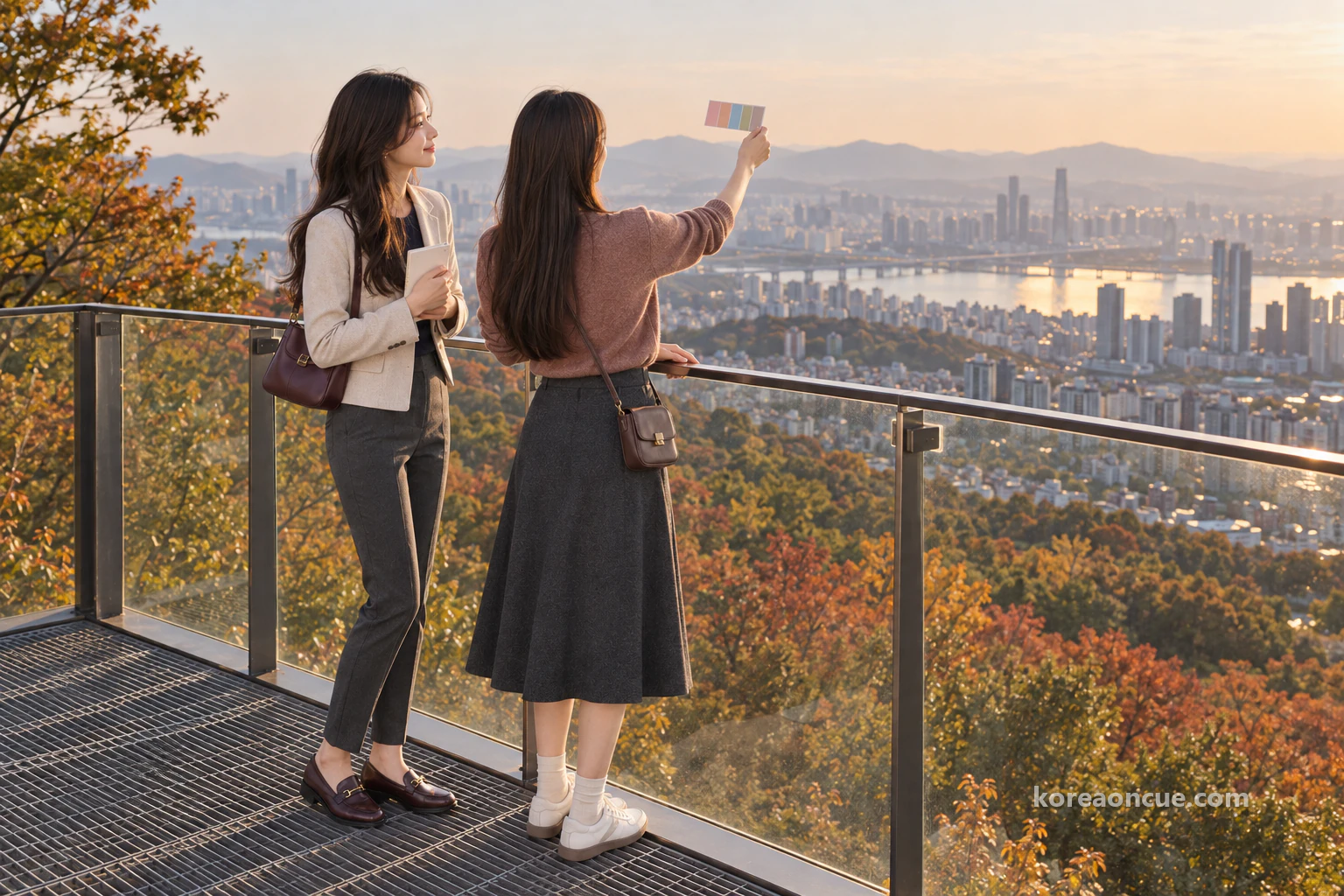
On the viewing deck, Mali picks her last card. It is the colour of the late-afternoon light slanting down over the city, and she names it “Namsan Maru Brick”. Then she takes Rina’s notebook and writes today’s garden order into the last box, the one left blank, in her own hand: “Jidang — Yeongji — Solsup — Ikki — Maru”. Rina’s three-entry rule goes out of the window again, but Rina says that line is her favourite in the notebook today.

On the way down, Rina points at Mali’s phone. Their plan with Maya, to walk Gyeongui Line Forest Park together one morning, the three of them, has been put off for several trips now. This time, they agree, they should settle that one together as well, so they write a message to Maya between them, one asking about dates and the other typing the place. “Next trip, a morning, the forest path, the three of us. Let’s pick the date together.” Before a reply arrives, the Hyatt Hotel bus stop comes into view. When you leave the Korean Forest Garden, bus 405 from this stop to Hangangjin Station connects you to Line 6, so there is no need to walk back the way you came.
In the “To look at for work” box of Mali’s notes, five colours from today have piled up, and at the top, as the colour of the day, sits “Moss Shade”. In Rina’s notebook, three of the six boxes are circled, and the names in the other three, the Nature and Ecology Path, the History and Culture Path and the Namsan Sky Forest Trail, are left just as they were. On the day they first met they handed each other a way of choosing, and last time they wrote the same things together on a single sheet, but today they split even the choice of place half and half. When and with whom they will walk the remaining three boxes, neither of them is going to decide alone any more.
Common Mistakes
Thinking the event lasts two days
7–8 November, in the box at the top of the event notice, are the activity dates. The photo exhibition is open throughout, 1–30 November.
Turning up for activities without booking
tours, classes and the archery experience on 7–8 November need advance booking. Search for “Namsan Dulle-gil Autumn Picnic” on the Seoul Public Service Reservation site.
Mistaking the archery contest for a taster session
the 14 November contest is an individual event for adults, and entrants bring their own bows and arrows. To learn traditional Korean archery from scratch, look at the Seokhojeong archery experience on the activity weekend.
Trying to drive up
ordinary cars and taxis cannot enter Namsan Park, and parking is difficult. Use the subway and the green Namsan loop bus 01A or 01B.
Seeing only one exhibition site
the photo exhibition is in two places: the North Ringway (outside the Jungbu Park Leisure Center) and the Korean Forest Garden (near the Moss Garden).
Leaving bags in the lockers and finishing on the other side
the lockers on the centre’s ground floor are for same-day collection. They are handy if you return the same way.
FAQ
When is the 2026 Namsan Dulle-gil Autumn Picnic?
From Sunday 1 to Monday 30 November. The photo exhibition is open throughout, tours and activities are on 7–8 November, and the traditional archery contest is on 14 November.
Where can I see the photo exhibition?
It is outdoors in two places: outside the Jungbu Park Leisure Center on the North Ringway, and near the Moss Garden (Ikkiwon) in the Korean Forest Garden.
How do I get to the exhibition?
From Myeongdong Station (Line 4) Exit 3 or 4, walk 10 minutes towards Namsan Cable Car to reach the rest area at the west end of the North Ringway. You can also ride up the slope on the free Namsan Oreumi near Exit 4.
What if I only want to visit the Korean Forest Garden?
Take bus 405 from Hangangjin Station (Line 6) Exit 2, get off at the Hyatt Hotel and walk for two minutes.
Who can join the tours and activities?
Families with children and adults, with each programme setting its own audience. Book ahead on the Seoul Public Service Reservation site.
Can I just watch the archery contest?
The contest is on Saturday 14 November, 09:00–17:00, at Seokhojeong, which sits on the North Ringway. Entrants are adults and bring their own equipment.
Who do I contact?
For the event, the Jungbu Park Leisure Center on 02-3783-5993. For the Korean Forest Garden, the Namsan Park Management Office on 02-3783-5900. Or the Dasan Call Center on 02-120.
Recap — 30 seconds before you go
- Photo exhibition “Gardens and Strolls”, open throughout 1–30 November — two sites, the North Ringway (outside the Jungbu Park Leisure Center) and the Korean Forest Garden (near the Moss Garden)
- Tours and activities 7–8 November with advance booking · Seokhojeong traditional archery contest 14 November (adults, own equipment)
- Myeongdong Station Exit 3 or 4 → 10 minutes towards Namsan Cable Car → the 3,420 m North Ringway (no cars or bikes, gentle slope)
- Forest Path 910 m → Wildflower Garden Path 880 m → Korean Forest Garden (Hangangjin Station Exit 2 → bus 405 → Hyatt Hotel, 2 minutes)
- Trainers, your own water and a tumbler, and the subway and green Namsan loop bus 01A or 01B instead of a car
Sources
- Seoul Parks news — 2026 Namsan Dulle-gil Autumn PicnicEvent name and slogan · 1–30 November; exhibition open throughout, activities 7–8 November 10:00–17:00, archery contest 14 November 09:00–17:00 (entries 2–8 November) · the two photo exhibition sites · advance booking on the Seoul Public Service Reservation site and who can take part · tours, autumn classes, the Seokhojeong archery experience and extra programmes · contest divisions, about 120 entrants, fee and own equipment · notes (arrive 10 minutes early, cancel 3 days ahead, trainers) · public transport, own water and tumblers · contactschecked 2026-10-27
- Seoul Metropolitan Government, Seoul Mediahub — Namsan autumn picnic tours and activities in NovemberRun by the Jungbu Park Leisure Center · the “Gardens and Strolls” photo exhibition and Namsan scenes recorded by Seoul’s park photographers · a target 145 m away against a pine forest backdrop · booking by searching for the event name · Dasan Call Centerchecked 2026-10-27
- Jungbu Park Leisure Center — Namsan Dulle-gil leaflet (as of February 2026)Names and lengths of the six sections · North Ringway closed to cars and bicycles, the longest and widest section with a gentle slope · order of points along the North Ringway · Forest Path, Wildflower Garden Path and the pine collection from every province · Green Circular Bus 01B routechecked 2026-10-27
- Seoul Parks — Namsan ParkOpen at all times, 270 m high, area, designated 1940 and opened 1968 · the names Inkyeongsan, Namsan and Mongmyeoksan · 10 minutes on foot from Myeongdong Station Exits 3 and 4, the Namsan Oreumi incline lift, bus 01B from Dongguk University Station Exit 6 and bus 405 from Hangangjin Station Exit 2 · lockers in the runners’ shower room · vehicle restrictions (2005 and 2021, with an exception for disability card holders) · who may enter the Hannam Forest Experience Centre for Childrenchecked 2026-10-27
- Seoul Metropolitan Government, Seoul Mediahub — Korean Forest Garden opens on NamsanFully open from 27 June 2026 · 30,000 m², 11 gardens in 3 themes · garden motifs taken from Damyang, Uljin, Jeju and Gangjin · Jidangwon, Yeongjiwon, Solsupwon, the Moss Garden and Namsan Maru · Namsan Park Management Office contactchecked 2026-10-27
- Seoul Metropolitan Government press release — Korean Forest Garden opens on the 27thFormer foreigners’ housing site, the Namsan restoration project and the 1997 outdoor botanical garden · the glass roof of Jidangwon and the barefoot forest path · plum, crape myrtle, bamboo and native species · the steel grating and clear railing of Namsan Maruchecked 2026-10-27
A Seoul story told with our AI characters. Place details are checked against public sources; the photos are AI-made illustrative images. How we use AI