
SEOUL · NOWON
Harmony on the 1st floor, Network on the 2nd: Noah’s time map of the Seoul Science Center, drawn floor by floor
1.2 km from Hagye Station Exit 3, about a 15-minute walk · free permanent exhibition · closed 2, 9, 16, 23 and 30 November — Halls G and Y on the 1st floor, the 11 m Dynamic Tornado, then Halls O and B on the 2nd floor
Noah’s time maps have always been drawn on streets. But today he is going to floors, not streets. To draw a map upwards for the first time, Noah heads out of Hagye Station Exit 3 on Line 7.
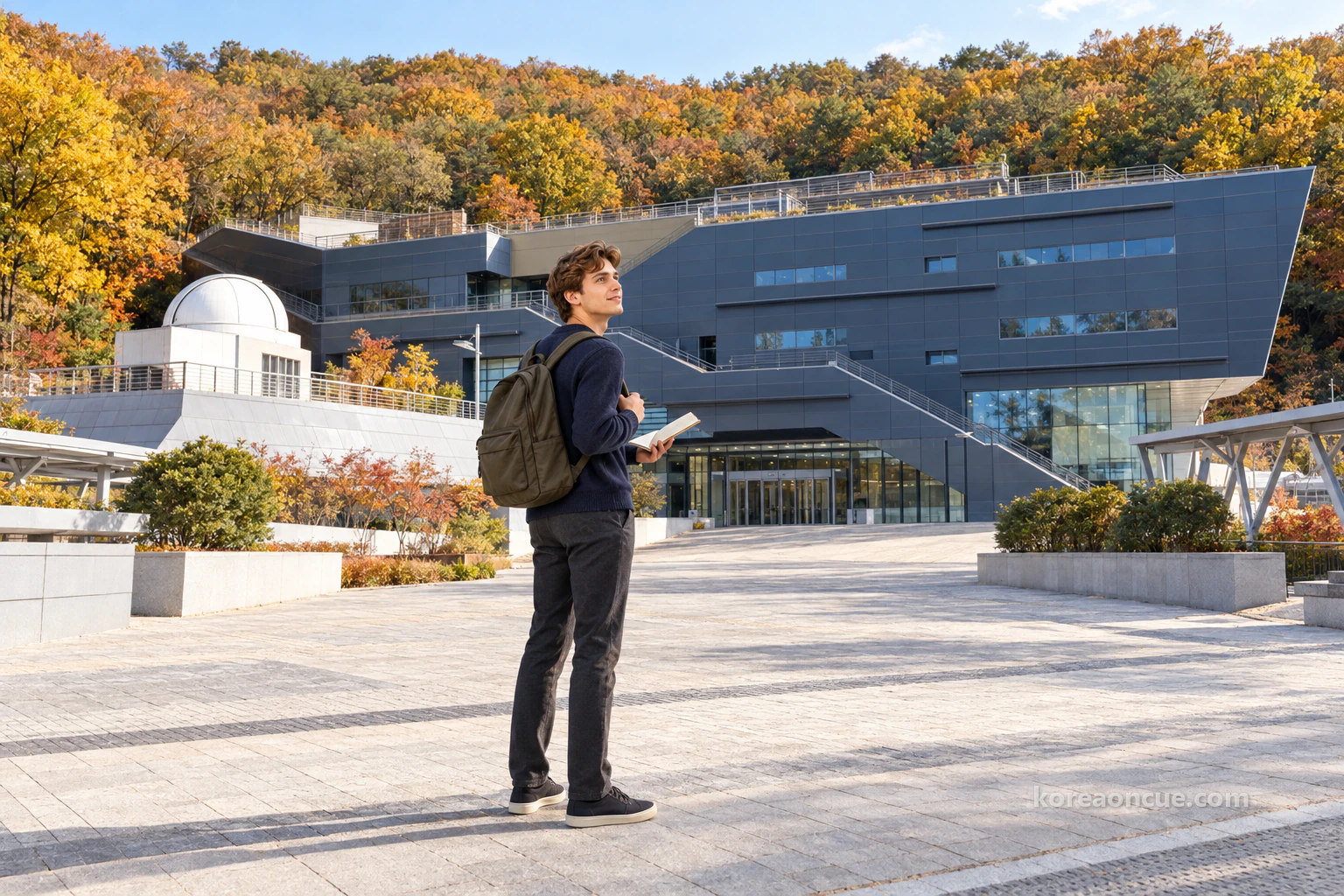
How to get there
On Thursday morning in the third week of November, Noah opens his notebook on the desk at his accommodation. Noah is twenty, from Canada, and he draws a map in his notebook of every neighbourhood he walks for the first time. He adds times to those maps too, and calls them “time maps”. The Gyeongchun Line Forest Trail, Yangnyeongsi, Seoul Botanic Park, the Seoul Museum of History: that makes four already. The fifth map he will draw today has to be different from the other four, starting with its shape.
That is because today he is going to a building, not a street. Until now, Noah’s maps have started at an exit and stretched out sideways. But at a science centre, the floors you go up and down matter more than the distance you walk. On a blank page, Noah draws two horizontal lines to make three boxes, one above the other. He writes “1F” in the bottom box, “2F” above it and “3F” at the top, and for the first time he has a map that stands upright.
Today Noah is heading to the Seoul Science Center, at 160 Hangeulbiseok-ro, Nowon-gu. The building has one floor below ground and three above, and it opened in May 2017. It was built to bring more science and culture facilities to Gangbuk, the part of Seoul north of the Han River, and close the gap between areas of the city. The centre describes itself as “a basic science centre for teenagers”. Admission to the permanent exhibition is free, so adult travellers can easily spend half a day here too.
This piece follows Noah’s day floor by floor. First, he walks from Hagye Station Exit 3 on Line 7 to the science centre. On the 1st floor, he sorts out the difference between free entry and experience tickets, then sees Hall G, Hall Y and the Dynamic Tornado. After lunch, he walks Halls O and B on the 2nd floor, and at the end he looks at what the 3rd floor and the annexe are for. What time Noah was on which floor is noted too, just as it is in his notebook.
The Cue
The Seoul Science Center (160 Hangeulbiseok-ro, Nowon-gu) is a science centre with one floor below ground and three above, opened in May 2017. Admission to the permanent exhibition is free, while special exhibitions, hands-on activities and education programmes may cost extra. It opens 09:30–17:30, closes every Monday, and when a Monday is a public holiday it closes on the Tuesday instead. In November 2026, it is closed on the 2nd, 9th, 16th, 23rd and 30th. The 1st floor has Hall G (Harmony) and Hall Y, the 2nd floor has Hall O (Life) and Hall B (Network), and its signature exhibit is the Dynamic Tornado, an artificial tornado machine 11 m high. It is 1.2 km, about a 15-minute walk, from Hagye Station Exit 3 on Line 7.
- Subway: Hagye Station (Line 7) Exit 3 → 1.2 km, about a 15-minute walk.
- Changing to a bus: Hagye Station Exit 3 → bus 1141 from the Hagye Miseong Apartment stop → get off at the Samik Seongyeong Apartment Back Gate stop. Buses 1141, 1132 and 1221 serve the centre.
- Address and enquiries: 160 Hangeulbiseok-ro, Nowon-gu, Seoul · information desk 02-970-4500.
- Hours: 09:30–17:30 (the same whatever the day or season).
- Closed: every Monday. When a Monday is a public holiday, it closes on the Tuesday. Also closed on 1 January, Seollal (Lunar New Year’s Day) and Chuseok day.
- Closed in November 2026: 2, 9, 16, 23 and 30 November (all Mondays).
- Admission: permanent exhibition free. Exhibition-linked activities (such as the brainwave experience) need a free ticket from the ticket machine in Hall G on the 1st floor, on the day. Special exhibitions, education programmes and workshops may cost extra.
- What to see: the Dynamic Tornado (11 m high) · the Han River, Bamseom and earthquake exhibits in Hall G on the 1st floor · “Everyone’s Seoul” in Hall O and the “Gwancheondae Projection Room” in Hall B on the 2nd floor.
When to go: 09:30–17:30, closed on Mondays (on Tuesday when Monday is a public holiday)
The science centre opens at the same times every day. It opens at 9:30 am and closes at 5:30 pm. The hours do not change with the day of the week or the season, so planning is easy. It is closed every Monday. It also closes on 1 January, Seollal and Chuseok day.
Open in Kakao Map — Seoul Science Center
Noah pauses for a moment at the line about closing days. The rule he copied at the Seoul Museum of History two days ago is still in his notebook, unchanged. That museum opens when a Monday is a public holiday. The Seoul Science Center does the opposite: when a Monday is a public holiday, it closes on the next day, Tuesday. Noah strikes through the old line and rewrites it as “Mon holiday → closed Tue”.
In November, all five Mondays are closing days. They are 2, 9, 16, 23 and 30 November. This November has no public holidays on a Monday, so there are no Tuesday closures. On closing days, none of the hands-on programmes run either. In the corner of the calendar in his notebook, Noah puts a small cross on each of the five November Mondays.
Which exit to use: Hagye Station Exit 3 on Line 7, 1.2 km, about a 15-minute walk
By subway, come out of Exit 3 at Hagye Station on Line 7. This exit is the only subway route recommended by the science centre. From the exit to the centre is 1.2 km. It takes about 15 minutes on foot. Put the address, “160 Hangeulbiseok-ro”, into your phone map and you can walk without worrying.
At 9:10 am, Noah comes out of Hagye Station Exit 3. Nowon-gu is the district where Noah drew his first time map. Back then he walked a long way sideways along the Gyeongchun Line Forest Trail, and today, in the same district, he draws his first map that goes upwards. Beside the exit, Noah writes “9:10 exit” at the bottom of his upright map. Then he decides to split the 15-minute walk into five parts and mark a tick every three minutes.
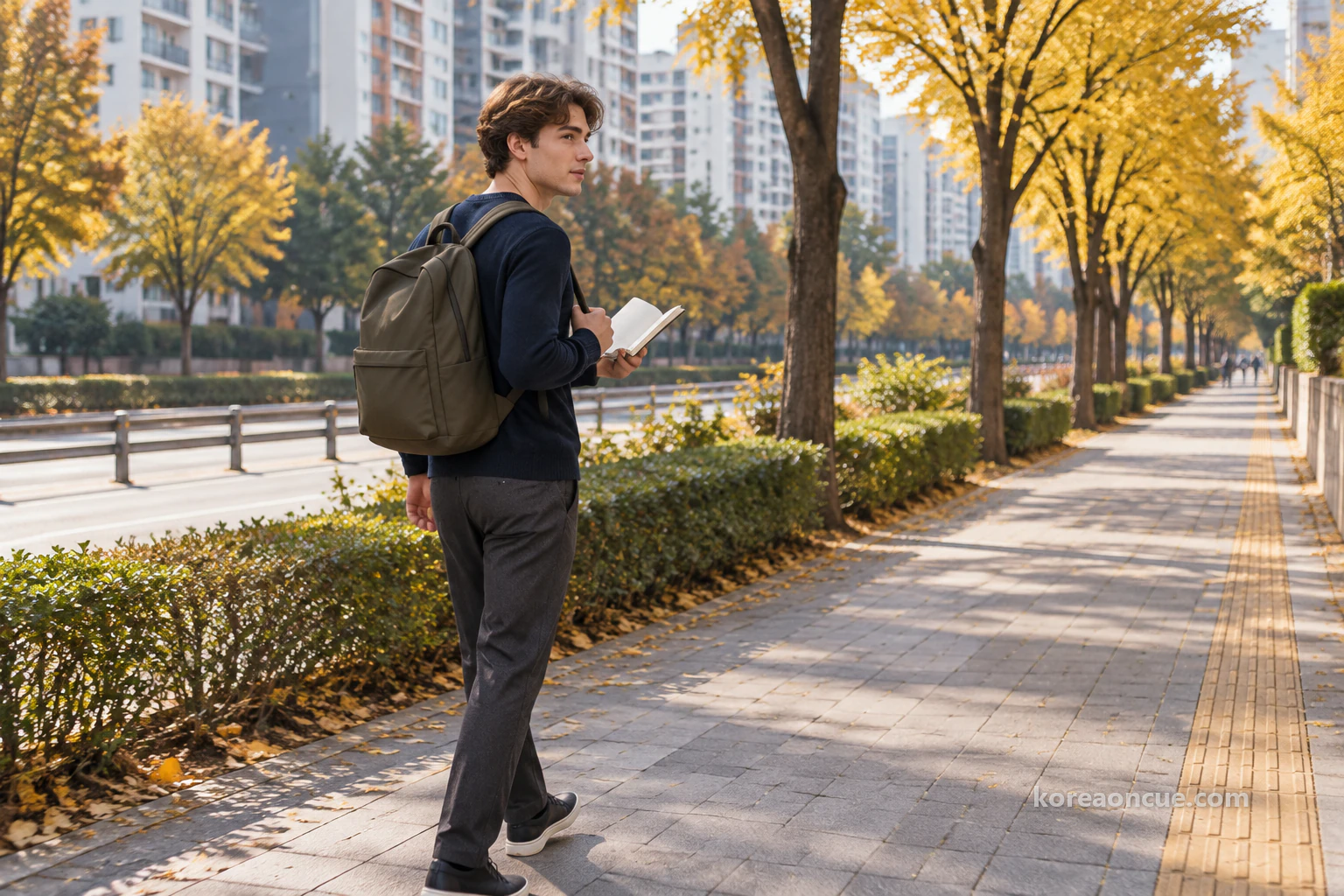
If the walk feels like too much, you can change to a bus once. Come out of Exit 3 and take bus 1141 from the Hagye Miseong Apartment stop. Get off at the Samik Seongyeong Apartment Back Gate stop. The buses to the science centre are 1141, 1132 and 1221. Noah notes the bus route as just one small square beside his map, and today he chooses to walk and mark his ticks instead.
At about 9:25, a building with a forest behind it appears at the end of the road. Clad in dark blue-grey panels, it stands in front of trees turned yellow. Noah waits about five minutes on the wide plaza in front of the building until it opens at half past nine. While he waits, he spots a white dome sitting on an outdoor deck on one side of the building. Noah draws a small semicircle just outside the 2F box of his upright map.

What to sort out first on the 1st floor: the permanent exhibition is free, experience tickets come from the machine in Hall G
You don’t need a ticket for the permanent exhibition: just walk in. Admission is free. But programmes outside the permanent exhibition, such as special exhibitions and hands-on and education programmes, may cost extra. On a first visit, it is easy to mix the two up. Noah gets confused too, the moment he comes through the door.
The 1st-floor lobby has a desk that handles both information and tickets. Seeing the word “Tickets”, Noah takes out his wallet out of habit. But the permanent exhibition is free, so there is no ticket to buy. You can walk straight into the exhibition halls on the 1st and 2nd floors. Putting his wallet away, Noah gives a slightly sheepish smile and writes “Free” in big letters in his notebook first.

There is one more reason he got confused. Exhibition-linked programmes need an experience ticket, which you collect on the day from the exhibition-linked programme ticket machine inside Hall G on the 1st floor. It is not a ticket you pay for, but one that holds your place on a free programme with limited spaces. Noah draws three lines beside his notes. They are “Free”, “Ticket (free)” and “Money”.
You can collect experience tickets on site from 9:30 am that day. Ticketing for each session closes five minutes before it starts. You can collect afternoon tickets in the morning too, so if there is an activity you want to do, go to the ticket machine as soon as you arrive. At the machine, Noah collects a free experience ticket for the brainwave experience in Hall B on the 2nd floor. “Brainwave ticket” is the very first thing to go into the 2F box of his upright map.
What to see in Hall G on the 1st floor: Han River fish, a model of Bamseom and real-time earthquake monitoring
Hall G on the 1st floor is about how a city and nature live together. Its theme is “Harmony”. Through hands-on exhibits, it shows that nature and the city, people and man-made things, are not separate pieces but move together, each linked to the others. At 1,023 m², it is the largest hall on the 1st floor. Noah gives most of the 1F box on his upright map to Hall G, and leaves the small space that remains for Hall Y.
What catches Noah’s eye first is how many of the exhibit titles are questions. They go like this: “What plants and animals live in the Han River?”, “Why is it hotter in the city?” and “What principles make a bridge structure safe?”. In the Han River exhibit, you look at the river’s main fish species through living fish in an aquarium and graphic panels. In the Bamseom exhibit, you look at a scale model and observe the birds that live on Bamseom through a scope vision viewer. Noah has walked the Han River banks many times in Mangwon and Ttukseom, but this is the first time he has looked inside the river.
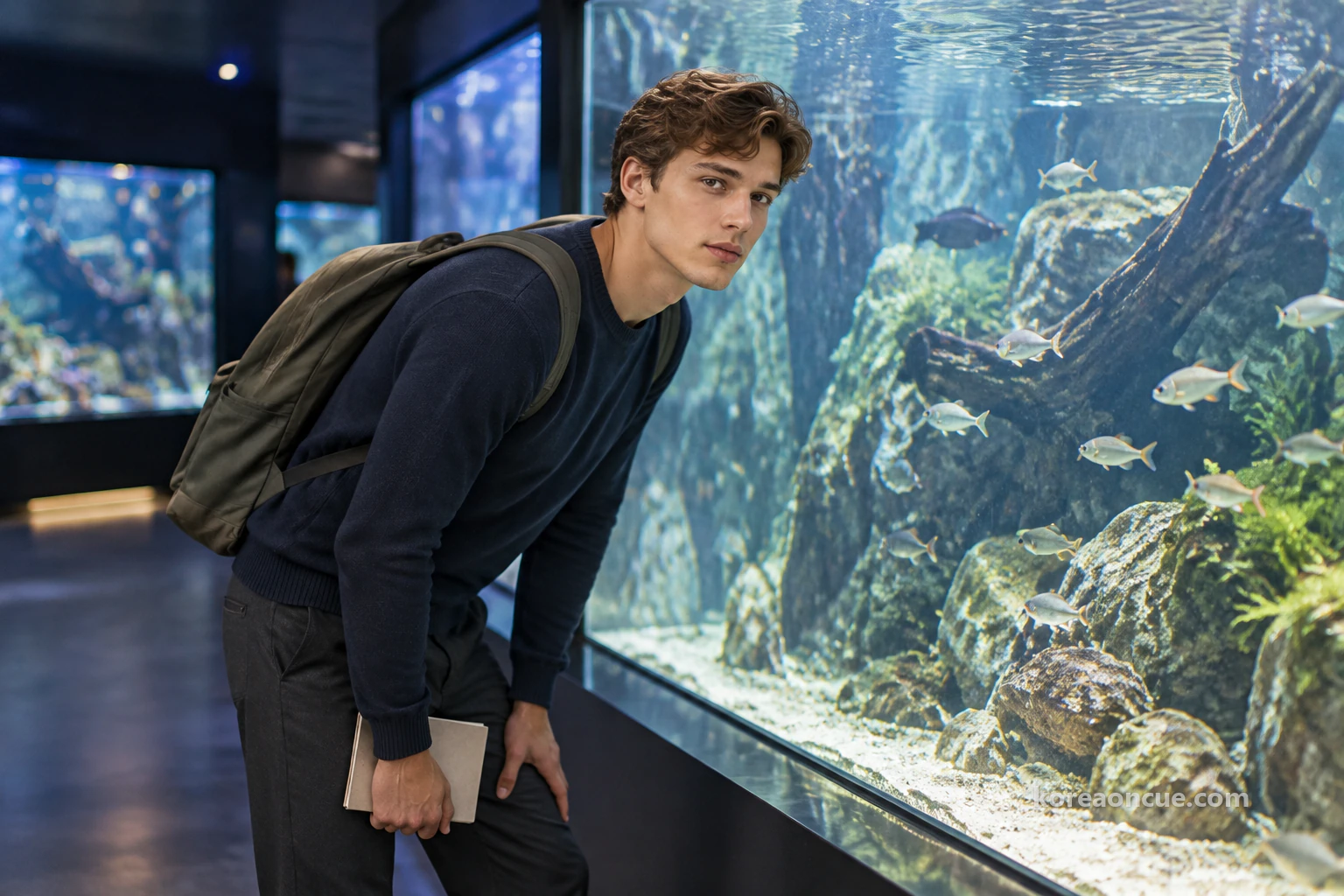
Next to the Han River exhibit is the story of Dr Choi Ki-chul, known as “Grandpa Fish”. A pioneer of ecology in Korea, he made more than 200,000 fish specimens of 147 species in all. Noah stops writing for a moment as he copies the numbers into his notebook. One person recording a single river for so long does not feel like someone else’s story to Noah, who draws maps. Beside the Hall G box, Noah draws a small fish and writes “147” next to it.
Hall G also has exhibits about earthquakes. “How are earthquakes recorded?”, “Real-time earthquake monitoring” and “Major earthquakes of the world” follow one after another. There is an exhibit about the strength of typhoons too. Noah stands for a long time in front of the word “real-time”. A screen showing the ground moving at this very moment has something in common with Noah’s maps, which record times.
The 11 m Dynamic Tornado: timetabled sessions and a “guerrilla” live show
If you only see one thing at the science centre, make it the Dynamic Tornado. This artificial tornado machine, 11 m high, is the largest of its kind in Asia. It is also the Seoul Science Center’s signature exhibit. The weekday timetable posted from 13 October 2026 lists sessions at 10:30, 11:30, 14:30 and 17:00. The weekend timetable posted from 10 October has one more, at 15:30.
Coming out of Hall G, Noah stands in front of the tornado. A regular session lasts 5 minutes, and the live show 15 minutes. The live show, a participatory programme run by a science interpreter together with visitors, is held “guerrilla” style. That means it starts with no time announced in advance, separately from the timetabled sessions. So on today’s map, Noah draws the tornado not as a single time but as a thick vertical line running through the 1F box.
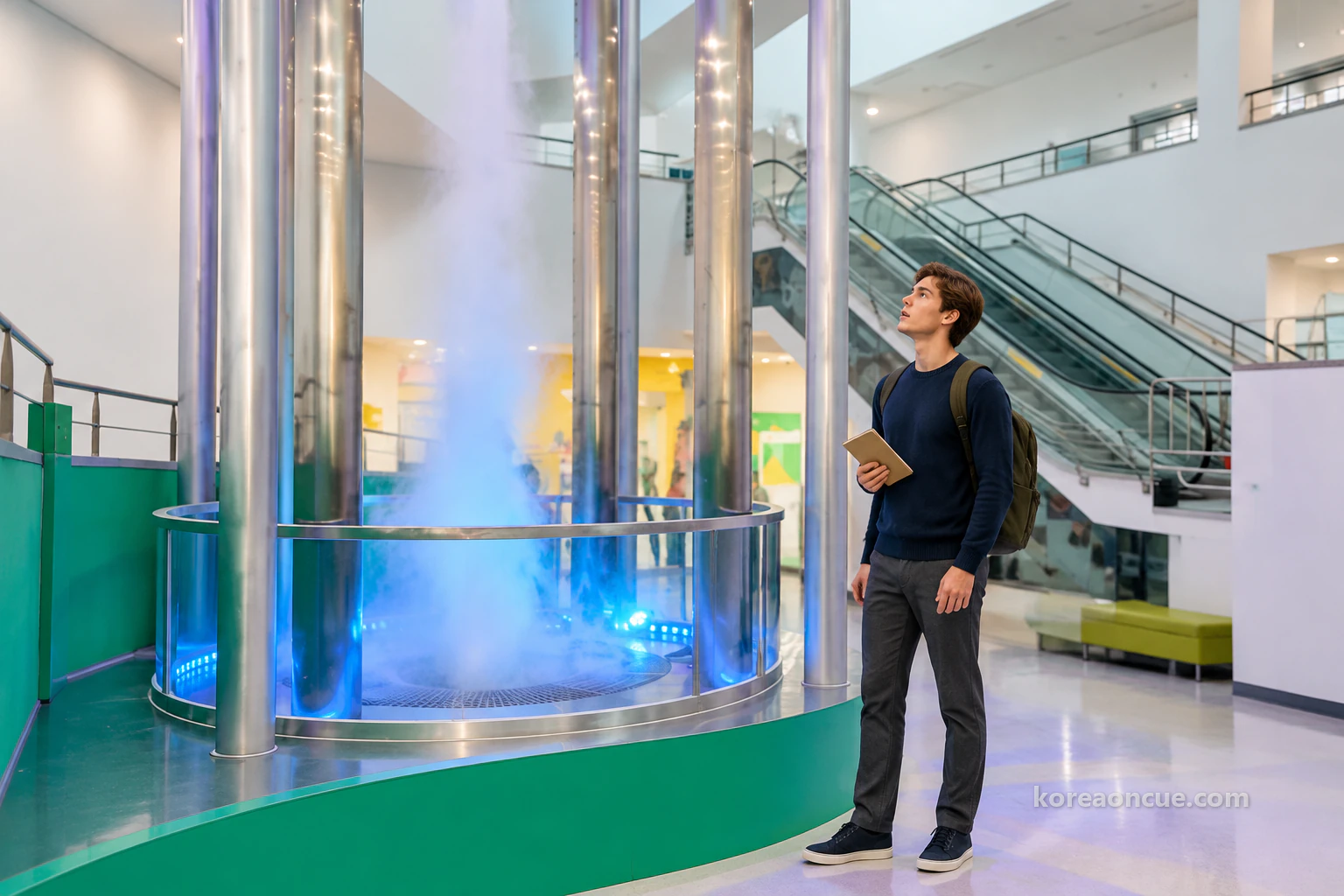
After seeing the tornado, Noah realises something. The machine rises so high that it would be a shame to see it only from the 1st floor and move on. There are several sessions a day on the timetable, so you could plan to see it once at the start of your visit and once at the end. Before you go, check the exhibition-linked programme timetable on the science centre’s website and pick the sessions you want to see. Beside the thick vertical line, Noah copies the session times from the timetable in small figures.
Hall Y on the 1st floor, and lunch: from dawn to the four seasons, then the 1st-floor terrace
Hall Y on the 1st floor is a room you walk through following the course of a day. Its theme is “Time”. Its eleven exhibit titles run in the order of a day. It starts with “Dawn has come”, then moves on to “The morning sky is cloudy”, “Pitter-patter raindrops” and “The rain stopped at lunchtime”. Further on are “The moon changes shape” and “The four seasons the sun makes”.
Noah laughs for a good while in this room. The way he writes times in his notebook is exactly the way this hall lines up the weather. Inside the Hall Y box, Noah draws a small clock, with a sun and a moon instead of hands. At 261 m², it is not a big room, so you can get round it quickly even reading each title as you go. It is a good place to drop into after Hall G, before going up to the 2nd floor.
After a first lap of Hall O on the 2nd floor at 11:40, Noah comes back down to the 1st floor at half past twelve. He eats lunch on the 1st-floor terrace between the main building and the Maker Studio in the annexe. Eating is allowed here, and it seats up to 66 people. The community space inside Hall Yy on the 2nd floor (up to 40 people) is also somewhere you can eat. You can eat in both, but you cannot cook.
Eating a sandwich he bought near his accommodation, Noah tidies up his morning map. The 1F box has filled up faster than he expected, while the 2F box still holds only “Brainwave ticket” and a few lines about Hall O. Noah separates before lunch and after lunch with a single horizontal line. Writing times on a floor map means that even on the same floor, when he came back down is recorded too. It is a shape he could never see on a street map.
What to see in Hall O on the 2nd floor: Seoul as foreigners picture it, in “Everyone’s Seoul”
Hall O on the 2nd floor is about the human body and materials. Its theme is “Life”. It looks at scientific phenomena in human life and everyday living, and observes the properties and changes of the materials around us. The exhibits carry titles such as “How does heredity work?”, “What can you find on the periodic table?” and “The many transformations of iron”. Noah stands longest in front of “Can you play a game with just your eyes?”, imagining choosing a road with his eyes instead of his hands.
Exhibit No. 1 in Hall O is “Everyone’s Seoul”. It is a work of Sci-art that symbolically shows the many faces of the people who make up Seoul, including their ethnicity, gender, age and occupation. Its description lists the words foreigners came up with when they pictured Seoul: lively, friendly people, a city both traditional and modern, new culture, excellent public transport and fantastic night views. Noah, from Canada, silently reads along the list one item at a time, thinking about which words he would choose himself.
In his head, Noah circles “excellent public transport” on the list. This morning, after all, he came all the way to Hagye Station on Line 7. Only then does it occur to him that all five time maps he has drawn so far started at a subway exit. Beside the Hall O box, Noah draws a small exit sign. It is a moment when other travellers’ Seoul and the Seoul in his own notebook overlap on a single line.
Hall O also has an OPEN-LAB about materials. Checking that Halls O and B are on the same floor, Noah divides the 2F box into two rooms. Hall O is 544 m², and Hall B next to it is 1,168 m², the largest hall in the science centre. Hall B’s ceiling is 6 m high too, the highest of all the centre’s exhibition spaces. Noah had saved the big room for the afternoon and gone down for lunch.
What to see in Hall B on the 2nd floor: transport cards, motion sickness, the brainwave experience and the “Gwancheondae Projection Room”
Hall B on the 2nd floor shows how the world is connected. Its theme is “Network”. It covers the scientific principles inside complex systems, from transport systems, the brain’s networks and information networks to the stars and space. At half past one, Noah looks up at the ceiling as soon as he walks into this room. It is the widest and tallest room in the science centre, so it needs the biggest box on his upright map too.
The first thing to stop Noah in his tracks is “How is information stored on a transport card and passed on?”. The card he taps at the ticket gates every day turns out to be this room’s first question. Next to it come “How do planes fly?”, “Why do we get motion sickness?” and “Mars exploration at a glance: Curiosity”. In front of “Can you be faster than a chimpanzee?” is the story of Ayumu the chimpanzee. Ayumu is a chimpanzee who beat a world memory champion at the age of eight.
Exhibit No. 28 in Hall B is about ways of watching the sky. Its title is “How did people in the Joseon dynasty observe what happened in the sky?”. In a projection room modelled on the Gwancheondae, an astronomical observatory structure of the Joseon dynasty, you think about different ways of looking at the sky and watch a film. It is not a facility you buy a separate ticket for, but one exhibit inside Hall B. Noah draws this projection room as a small circle inside the 2F box, in Hall B’s space.
The experience ticket Noah collected in the morning is for “How well can I concentrate? (brainwave experience)” in this room. The weekday timetable posted from 13 October 2026 lists the brainwave experience three times, at 10:00, 15:00 and 16:30. Each session lasts 25 minutes and takes 8 people, and it is open to anyone from the first year of primary school up. The same room has exhibits such as “Does a bigger brain make you smarter?” and “Can light be split and put back together?”.
BOOT, the 2nd-floor outdoor observatory beside the entrance to Hall B: the public solar observation timetable posted from 13 October
Outside, beside the entrance to Hall B, is the 2nd-floor outdoor observatory. It is called BOOT. The name carries the idea of sparking curiosity about the stars and space, and starting up the engine of imagination and creativity. Its exterior is modelled on a spaceship sailing through space, and it has two shell-shaped observation domes. The main telescope is a 200 mm refracting telescope.

The weekday timetable posted from 13 October 2026 lists public solar observation at 11:00–11:30 and 14:30–15:00. On the weekend timetable posted from 10 October, it is 14:30–15:20. But the observatory has closed in winter before. Last winter, to prevent accidents in the cold season, it did not operate from 22 December 2025, and it reopened on 6 June 2026. If you go from late autumn onwards, check the exhibition-linked programme timetable on the science centre’s website before you set off.
Only now does Noah realise that this observatory is the white dome he saw from the plaza in the morning. So beside the semicircle he drew outside the 2F box, he writes its location: “beside Hall B entrance”. Below that, he writes the observation times from the timetable, along with “12.22– winter” for last winter. Noting place and time together makes them easier to match with the timetable next time. Noah leaves the semicircle as a dotted line rather than a solid one, as a sign that it is a spot to come back to after checking the timetable.
The 3rd floor and the annexe are separate: paid classes and workshops, and the free Sunday “Everyday Lab”
At half past four, Noah goes up to the 3rd floor last, where there are Hall X (the special exhibition hall), classrooms and the Star Hall. If the 1st and 2nd floors are the permanent exhibition, the 3rd floor is closer to a floor for education and talks. Noah realises that most of the “Money” line, one of the three lines he drew in the morning, has to go in this box. So the top box of his upright map fills up with dotted lines. It is the very same dotted line he used to separate the free and paid areas on his Seoul Botanic Park map.
On Sundays 1, 8, 15 and 22 November, the family science experiment class “Steeped in Science” runs in the 3rd-floor classrooms. It is for adults (guardians) and children from the fourth year of primary school up, and costs ₩10,000 per person (minimum two people). It is a programme you apply for in advance, with applications opening at 10:00 on 15 September. The adult classes are “Hormone Diary”, from 3 to 10 November for ₩10,000, and “Plant Atelier: Observation and Specimens”, from 10 to 24 November for ₩15,000. Noah does not copy these names onto his map, and writes just one line in the top box: “Apply ahead”.
The “Science × Art Workshop” takes place in the Maker Studio in the 1st-floor annexe. It costs ₩5,000, and you book online in advance. The whole series runs from 20 October to 22 November 2026. On Saturdays 7 and 14 November, 14:00–16:00, there is “When Does Stone Become Colour?”, where you grind stones collected from Seoul’s streets into pigment. On Sundays 15 and 22 November, 10:00–12:00, “Imagine, Daydream” is held for adults.
If you want to drop in without booking, there is the Sunday “Everyday Lab”. It is a free programme held in the Maker Studio in the 1st-floor annexe from 1 pm to 5 pm on 1, 8, 15, 22 and 29 November. No booking is needed. There are two labs: “The Fingerprints of Stars: Spectra” and “Drawing with Light: Photography”. On Sunday 29 November, there is also a free science book talk, “A Physicist Goes to the Art Museum”, in the Star Hall on the 3rd floor.
Back to Hagye Station before closing at 5:30 pm: the upright map sent to Hina
At about 5 pm, Noah comes down to the 1st floor and passes the tornado machine once more. In the morning he looked only at the bottom, but this time he gazes up for a long while towards the top, 11 m high. Ending the day where it began, the bottom of his upright map and its very last mark meet in one place. The science centre closes at 5:30, so spend the last half-hour or so wrapping up slowly on the 1st floor. At the end of the thick vertical line in the 1F box, Noah writes “17:30 out”.
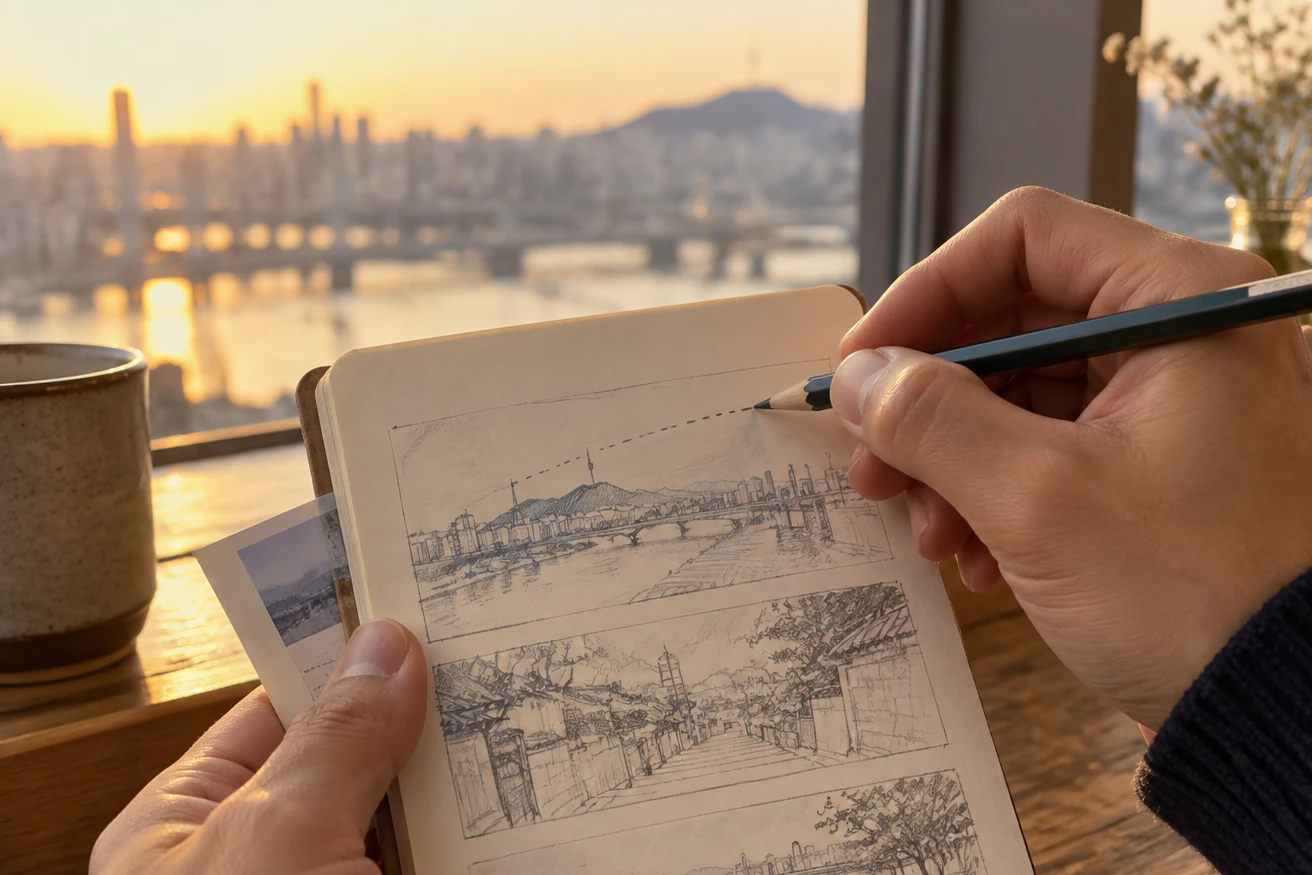
When he leaves the science centre, the sky has tipped into late-autumn evening light. The way back, like the way there, is 1.2 km to Hagye Station Exit 3, about a 15-minute walk. As he walks, Noah photographs today’s upright map with his phone. At the very back of his notebook, the time map Hina gave him in Ttukseom on Halloween night is still tucked in. Since then, Noah has sent maps drawn the same way to Hina in Tokyo, and today’s is the fifth.
Under the photo, Noah sends a short message. “Today it was floors, not streets, so for the first time I drew my map upwards.” After sending it, Noah looks down once more at the dotted lines in the top box. They do not mean the box is empty, but that it is one he can fill by applying ahead. Tokyo is on the same time as Seoul, so Hina will see the photo sometime in the evening. Noah puts his phone in his pocket and walks to the station, counting the ticks he has left.

If you visit the Seoul Science Center, avoid Mondays and head for the ticket machine in Hall G on the 1st floor as soon as you arrive. The easiest order is Hall G, Hall Y and the tornado on the 1st floor, then up to Halls O and B on the 2nd. The permanent exhibition is all free, and so are the experience tickets. The paid classes and workshops are programmes you apply for in advance, so there is nothing to agonise over on the spot. Check the website timetable before you go and pick your tornado and activity sessions, and your day will be much easier.
Common Mistakes
Going on a Monday
the science centre is closed every Monday. In November 2026, it is closed on the 2nd, 9th, 16th, 23rd and 30th.
Assuming it opens when a Monday is a public holiday
this science centre does the opposite. When a Monday is a public holiday, it closes on the Tuesday.
Trying to buy a ticket at the ticket desk
the permanent exhibition is free. Walk straight into the halls on the 1st and 2nd floors.
Leaving experience tickets until later
exhibition-linked programmes such as the brainwave experience have limited spaces, and ticketing closes five minutes before each session. Collect yours from the machine in Hall G on the 1st floor as soon as you arrive.
Looking for a separate planetarium
there is no planetarium you buy a separate ticket for. The “Gwancheondae Projection Room” inside Hall B on the 2nd floor is an exhibit where you watch a film.
Trying to sign up for paid classes on the day
programmes such as “Steeped in Science” and the Science × Art Workshop need applying for in advance. To go without booking, choose the free “Everyday Lab” on Sunday afternoons.
Waiting for the tornado live show at a set time
the live show with a science interpreter is held guerrilla style. Plan your route around the sessions on the weekday timetable posted from 13 October 2026 (10:30, 11:30, 14:30, 17:00), and check the website timetable before you go.
FAQ
Is there an admission fee?
The permanent exhibition is free. Special exhibitions, hands-on activities and education programmes may cost extra.
What time does it open and close?
09:30–17:30. The hours do not change with the day of the week or the season.
When is it closed?
Every Monday. When a Monday is a public holiday, it closes on the Tuesday. It is also closed on 1 January, Seollal and Chuseok day. Closing days in November 2026 are the 2nd, 9th, 16th, 23rd and 30th.
Which station and exit should I use?
Hagye Station (Line 7) Exit 3, 1.2 km, about a 15-minute walk. To change to a bus, take bus 1141 from the Hagye Miseong Apartment stop and get off at the Samik Seongyeong Apartment Back Gate stop.
How do I get an experience ticket?
From the exhibition-linked programme ticket machine in Hall G on the 1st floor, from 9:30 am on the day. It is free, and ticketing closes five minutes before each session starts.
Is there a planetarium?
There is no separately run planetarium. Hall B on the 2nd floor has a projection room exhibit modelled on the Gwancheondae, and BOOT, an outdoor observatory, is outside on the 2nd floor.
When can I see the Dynamic Tornado?
The weekday timetable posted from 13 October 2026 lists sessions at 10:30, 11:30, 14:30 and 17:00, and the weekend timetable posted from 10 October lists 10:30, 11:30, 14:30, 15:30 and 17:00. A regular session lasts 5 minutes and the live show 15 minutes. Check the website timetable before you go.
Is there somewhere to eat?
You can eat on the 1st-floor terrace (between the main building and the Maker Studio, up to 66 people) and in the community space inside Hall Yy on the 2nd floor (up to 40 people). Cooking is not allowed.
Can I go by car?
The car park is small, so the science centre recommends public transport. Parking costs ₩150 per 5 minutes, ₩1,800 an hour, up to ₩14,400 a day.
Who do I contact with questions?
The information desk, on 02-970-4500.
Recap — 30 seconds before you go
- Hagye Station (Line 7) Exit 3 → 1.2 km, about a 15-minute walk → Seoul Science Center (160 Hangeulbiseok-ro).
- 09:30–17:30 · closed Mondays (Tuesday if Monday is a public holiday) · closed 2, 9, 16, 23 and 30 November.
- Permanent exhibition free · experience tickets free too (machine in Hall G on the 1st floor, closes 5 minutes before each session).
- 1st floor: Hall G, Hall Y and the Dynamic Tornado → 2nd floor: “Everyone’s Seoul” in Hall O and the “Gwancheondae Projection Room” in Hall B.
- Paid classes and workshops: apply ahead · Sunday afternoon “Everyday Lab”: free, no booking.
Sources
- Seoul Science Center — Directions1.2 km on foot from Hagye Station (Line 7) Exit 3 · Exit 3 → bus 1141 from the Hagye Miseong Apartment stop → get off at the Samik Seongyeong Apartment Back Gate stop · branch buses 1141, 1132 and 1221checked 2026-10-29
- Seoul Science Center — Visitor informationHours 09:30–17:30 · closed every Monday (on the Tuesday when Monday is a public holiday) · closed on 1 January, Seollal and Chuseok day · permanent exhibition free, extra charges possible for special exhibitions, hands-on activities and education programmes · information desk 02-970-4500checked 2026-10-29
- Seoul Science Center — November closing daysClosed 2, 9, 16, 23 and 30 November 2026checked 2026-10-29
- Seoul Science Center — General overviewWhy it was built (narrowing the science-culture gap north of the Han) · one floor below ground and three above · opened May 2017 · “a basic science centre for young people” · floor area and ceiling height of each hallchecked 2026-10-29
- Seoul Science Center — Hall GTheme “Harmony” and introduction · Han River and Bamseom exhibits · the “fish grandfather” Dr Choi Ki-chul’s 200,000-odd specimens of 147 fish species · titles of the earthquake and typhoon exhibitschecked 2026-10-29
- Seoul Science Center — Hall OTheme “Life” and introduction · exhibit no. 1, the sci-art piece “Everyone’s Seoul”, and how foreigners picture Seoul · titles of the heredity, periodic table, iron and eye-controlled game exhibits · the Open Labchecked 2026-10-29
- Seoul Science Center — Hall BTheme “Network” and introduction · titles of the transport card, aeroplane, motion sickness, Curiosity, brain and light exhibits · “How focused am I? (brainwave experience)” · Ayumu the chimpanzee · exhibit no. 28, the projection room modelled on the Gwancheondaechecked 2026-10-29
- Seoul Science Center — Dynamic TornadoAn artificial tornado generator 11 m high, the largest in Asia · the centre’s signature exhibitchecked 2026-10-29
- Seoul Science Center — Exhibition-linked programmesWeekday (from 13 October 2026) and weekend (from 10 October) timetables · tornado sessions, 5 minutes regular and 15 minutes live show, live show held guerrilla style · brainwave experience at 10:00, 15:00 and 16:30 (25 minutes, 8 people, from first grade of primary school) · public solar observation times · ticket machine in Hall G on the 1st floor on the day, from 09:30, closing 5 minutes before each session · no programmes on closing dayschecked 2026-10-29
A Seoul story told with our AI characters. Place details are checked against public sources; the photos are AI-made illustrative images. How we use AI
More from this area

After Hina returns to Tokyo: Noah’s Tuesday walk along the Gyeongchun Line Forest Trail to Nowon Light Garden
On Halloween night at Ttukseom, Hina gave Noah a map with times written along the route.

A neighbourhood park for a change: Maya and Rina spend a weekday afternoon at Dream Forest and its observatory
After days of palaces, markets, Hongdae and Seokchon Lake, Maya sends Rina a simple request: “This time, could we go somewhere other than a tourist sight? A park where people in Seoul walk on a weekday.” Rina chooses Dream Forest in Gangbuk-gu.