
SEOUL · GONGNEUNG
After Hina returns to Tokyo: Noah’s Tuesday walk along the Gyeongchun Line Forest Trail to Nowon Light Garden
From the 1.9 km Gongneung-dong section past old Hwarangdae Station, Nowon Train Village and the Tram Library to lights that come on 30 minutes before sunset — a half-day plan with the times written in
On Halloween night at Ttukseom, Hina gave Noah a map with times written along the route. After she returned to Tokyo, he decided to try her method on a railway that had become a forest trail.

How to get there
The day after Hina returns to Tokyo, Noah spends a long time studying a sheet of paper tucked into the back of his notebook. It is the map she gave him on Halloween night at Ttukseom, a line from the station exit to the waterside stage with times written along it. Noah is twenty and travelling alone from Canada, and he has drawn routes through every new Seoul neighbourhood he visits, but he has never put times on those drawings. His last message to Hina from the platform that night was, “Next time, I’ll write the times in too.” Now he starts looking for a walk that will let him keep his word.

He chooses the Gyeongchun Line Forest Trail in Nowon-gu. Trains once ran along this route, and the path now leads into Hwarangdae Railway Park, where a garden lights up around sunset. With the old railway by day and the lights by night along the same route, Noah thinks it is a good place to try drawing his first map with times. To someone who draws routes, an old railway already looks rather like a map left behind. This time he will walk alone, then send the finished page to Hina in Tokyo.
This piece follows Noah’s Tuesday, with a half-day walk from the Gongneung-dong section through Hwarangdae Railway Park to Nowon Light Garden. Along the way, we’ll cover which stations to use and the length and walking time of each section. Noah’s notebook also keeps track of closing times at old Hwarangdae Station, Nowon Train Village and the Tram Library, followed by the Light Garden’s lighting hours and days off.
The Cue
The Gyeongchun Line Forest Trail is a railway park running for about 6 km in three sections, from Nokcheon Middle School in Wolgye-dong to Seoul’s city boundary. The Gongneung-dong section is about 1.9 km, or roughly 23 minutes on foot, reached from Gongneung Station on Line 7 or Taereungipgu Station on Lines 6 and 7, while the Hwarangdae Railway Park section is about 3.0 km, or roughly 40 minutes, reached from Hwarangdae Station on Line 6. Inside Hwarangdae Railway Park, Nowon Light Garden is free and illuminated Tuesday to Sunday, from 30 minutes before sunset until 10 p.m. It is closed on Mondays and in bad weather, including rain, typhoons and extreme cold.
- When: Nowon Light Garden, Tue–Sun, from 30 minutes before sunset to 22:00. Closed Mondays and in bad weather, including rain, typhoons and extreme cold.
- Where: Nowon Light Garden, 608 Hwarang-ro, Nowon-gu, by the Korea Military Academy main gate. About 10 minutes’ walk (898 m) from Hwarangdae Station on Line 6.
- Subway: For the Gongneung-dong section, use Gongneung Station (Line 7) or Taereungipgu Station (Lines 6 and 7). For the Hwarangdae Railway Park section, use Hwarangdae Station (Line 6).
- Section lengths: Hagye-dong, about 1.1 km (15 minutes) · Gongneung-dong, about 1.9 km (23 minutes) · Hwarangdae Railway Park, about 3.0 km (40 minutes).
- Daytime visits: Hwarangdae Station History Hall, 10:00–18:00 · Nowon Train Village, 10:00–19:00, last entry 18:00 · Tram Library, 10:00–19:00. All closed Mondays.
- Admission: The Light Garden is free. Nowon Train Village costs ₩4,000 for adults and ₩2,000 for children and teenagers.
- By car: None of the park’s sections has its own car park. Take public transport.
Tuesday instead of Monday: when the railway park’s attractions close
At first, Noah plans to go on the Monday just after Hina leaves. He feels a little flat after their night at Ttukseom, and walking usually helps him sort things out. But as he copies the Light Garden’s details into his notebook, his pen stops at a line in brackets. Closed Mondays. He opens the pages for Hwarangdae Station History Hall, Nowon Train Village and the Tram Library in turn, and all three close on Mondays too.

The indoor attractions at Hwarangdae Railway Park and the Light Garden share that Monday break. Unless the railway walk itself is the whole point of the visit, choose another day. Noah draws seven boxes for the days of the week on the first page of his notebook, crosses out Monday and circles Tuesday. The first thing he adds to his map with times is a day rather than an hour.
There is the weather to consider too, as the Light Garden also closes in rain, typhoons, extreme cold and other bad conditions. Noah checks Tuesday’s forecast, sees no rain expected and writes the sunset time in a corner of the page. The lights come on “30 minutes before sunset”, so he needs that time before he can work out the end of his day. Sunset shifts with the seasons, and checking the time in a weather app the day before makes planning easier.
Then he remembers something Hina often says: “I start with the show time.” She fixes the start of a performance first, then works backwards to decide when to leave. Today’s show is the lights coming on 30 minutes before sunset, with the daytime attractions that close at 6 p.m. before that, and the roughly 23-minute Gongneung-dong walk earlier still. For the first time, Noah draws his route backwards from the end, and his departure time falls into place.
Starting at Gongneung Station: the 1.9 km Gongneung-dong section
On Tuesday afternoon, Noah gets off at Gongneung Station on Line 7. The Gongneung-dong section can be reached from here or from Taereungipgu Station on Lines 6 and 7, while Hwarangdae Station on Line 6 serves the Hwarangdae Railway Park section. He has deliberately chosen Gongneung because he wants to arrive on foot along the railway rather than go straight to the Light Garden. If he is going to put times on his map, he wants to walk through that time himself.
Choose a starting station to suit the time available. For a slower walk along the trail with a look at the surrounding neighbourhood, start on the Gongneung-dong section from Gongneung or Taereungipgu Station. For just the Light Garden and old Hwarangdae Station, the shorter approach is from Hwarangdae Station on Line 6. Following Noah’s route from Gongneung-dong into the railway park also lets you leave from Hwarangdae Station without retracing the walk.
The Gongneung-dong section is called “Village Garden”. About 1.9 km long, with a walking time of roughly 23 minutes, it was the first section of the Gyeongchun Line Forest Trail where the park project began. It passes through a neighbourhood of multi-family houses, with homes and lanes close beside the path. Along it are Deulkkot Sanchaek-gil (the wildflower walk), Dokkaebi Madang, the Workation Centre, Citizen Participation Garden, Cheolgil Supgil (the railway forest path), Village Gallery, Cheolgil Sanchaek-ro (the railway walk), and Beotnamu-gil (the cherry-tree path). Noah marks their names one by one as small dots along the line in his notebook.
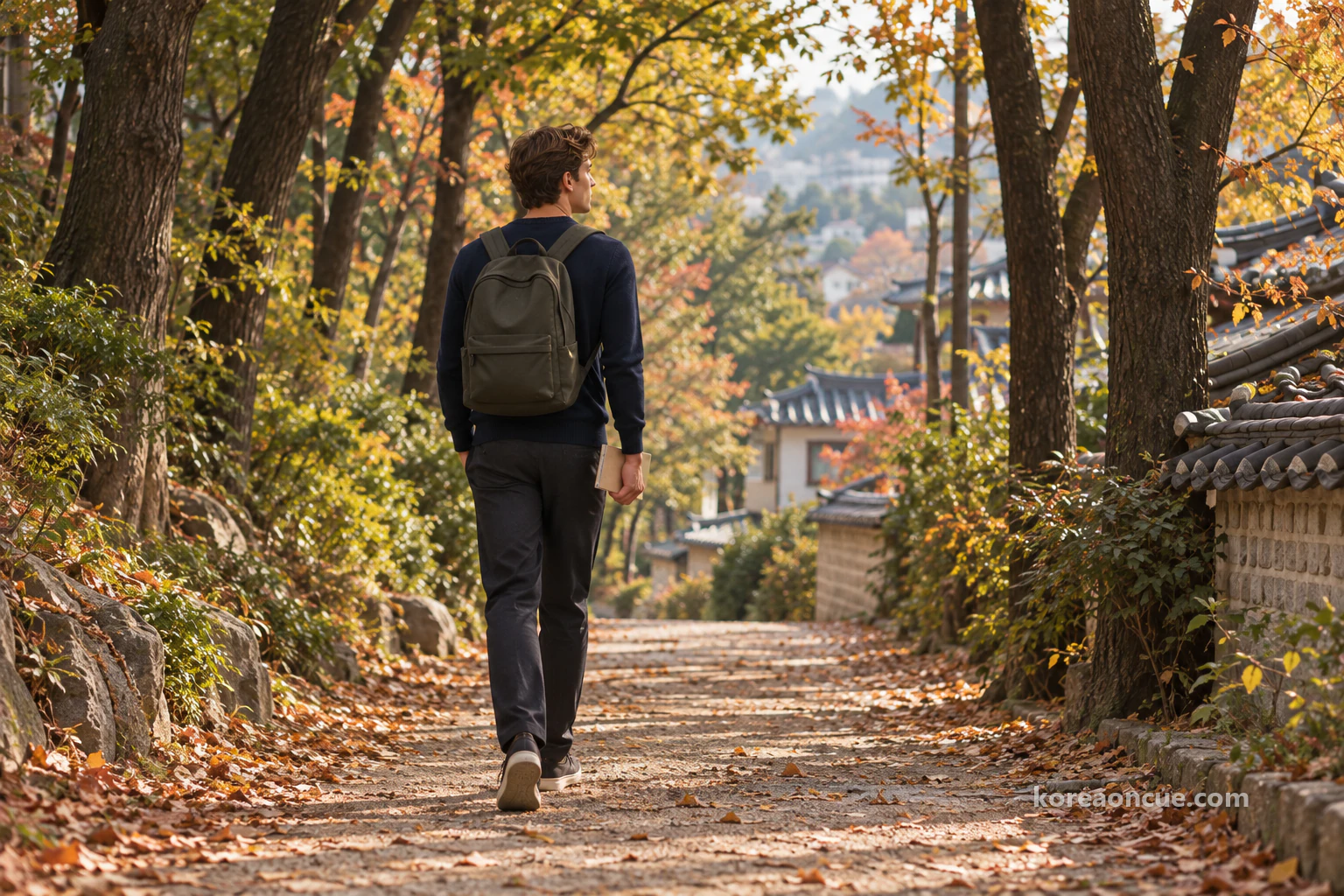
As he walks, he notices how thickly the trees grow along this stretch. The land spent years closed off as disused railway ground, allowing the trees to grow into the dense woodland that now surrounds the rails. Noah slows in the shade and watches local people out for a leisurely stroll overtake him. Walking here, he understands why the section is called Village Garden: the former train route has become the neighbourhood’s shared outdoor space.
Each time he passes a named spot, Noah draws a short tick across his line and writes the time beside it. It feels awkward at first, but after a few goes he realises that the gaps between the times tell him more than the length of the line. The numbers show where he lingered and where he walked straight through. On a first visit, remembering even one or two names along the way also makes it easier to work out where you are on the return journey.

How a railway that ran for 71 years became a forest trail
As he walks, Noah rereads the railway’s history on his phone. The Gyeongchun Line opened in July 1939 as a private railway operated by the Gyeongchun Railway Company between Seongdong and Chuncheon. The last Mugunghwa train ran on 20 December 2010, and the double-track electrified line opened the next day, 21 December, closing the old stretch between Seongbuk and Hwarangdae. After 71 years of trains, the route fell silent overnight, and Noah writes those two dates side by side.
Work to turn the abandoned railway into a park began in October 2013. Seoul developed it in stages from 2013, completing all three sections in November 2017, about 6 km from Nokcheon Middle School in Wolgye-dong to the city boundary. The Hagye-dong section, “Community Garden”, is about 1.1 km, or 15 minutes on foot, the Gongneung-dong section Noah is walking is about 1.9 km, or 23 minutes, and the Hwarangdae Railway Park section is about 3.0 km, or 40 minutes. Choosing which section to walk that day makes planning easier than setting out to cover all three at once.
Noah draws three bars across the top of his notebook to compare their lengths. The longest represents the Hwarangdae Railway Park section, where he will spend the evening. The Hagye-dong section keeps the original tracks, with tall poplars, wildflowers and shrubs planted along them, so he puts a star beside that bar for another day. Reaching Hwarangdae before sunset matters more today than trying to walk the lot.
Into Hwarangdae Railway Park: the old station and platform plaza
Beyond the Gongneung-dong section, the view opens out as Noah enters the Hwarangdae Railway Park section. This stretch was designed around Hwarangdae Station, retaining its broad spaces and platforms while preserving the station’s distinctive setting. It brings together the Railway Garden, Nowon Light Garden, Culture Plaza, the old Hwarangdae Station building, Hwarangdae Station Platform Plaza, the Time Museum and the Clock Walk. Noah draws one large rectangle to mark the moment the tree-lined path opens into the space in front of the station.

The old Hwarangdae Station building stands to one side of the platform plaza. Built in wood in a modern architectural style in 1939, it opened as Taereung Station and took the name Hwarangdae Station in 1958. It was Seoul’s last country station, and the building is heritage-listed. Noah underlines the change of name, interested, as ever, in a place that once appeared on maps under another name.
Opposite the building, a wetland follows the natural dip in the ground, while full-size trains stand on the old tracks. Noah walks slowly alongside one, counting out its length in footsteps until he loses count halfway and laughs to himself. In 2023, the park was also selected for the Ministry of Culture, Sports and Tourism’s Local 100, a list of 100 places with distinctive local cultural appeal. By day, the trains and old station are the focus, and by night the same setting becomes the Light Garden.
Inside Hwarangdae Station History Hall: unstaffed, closing at 6 p.m.
Noah’s first stop is Hwarangdae Station History Hall, an exhibition space inside the old station building. At 610 Hwarang-ro, it opens Tuesday to Sunday from 10 a.m. to 6 p.m. It is closed on Mondays and on Seollal and Chuseok themselves, and currently operates without staff on site. Inside are the old waiting room, station office and night-duty room. “18:00” becomes the first closing time on Noah’s map.
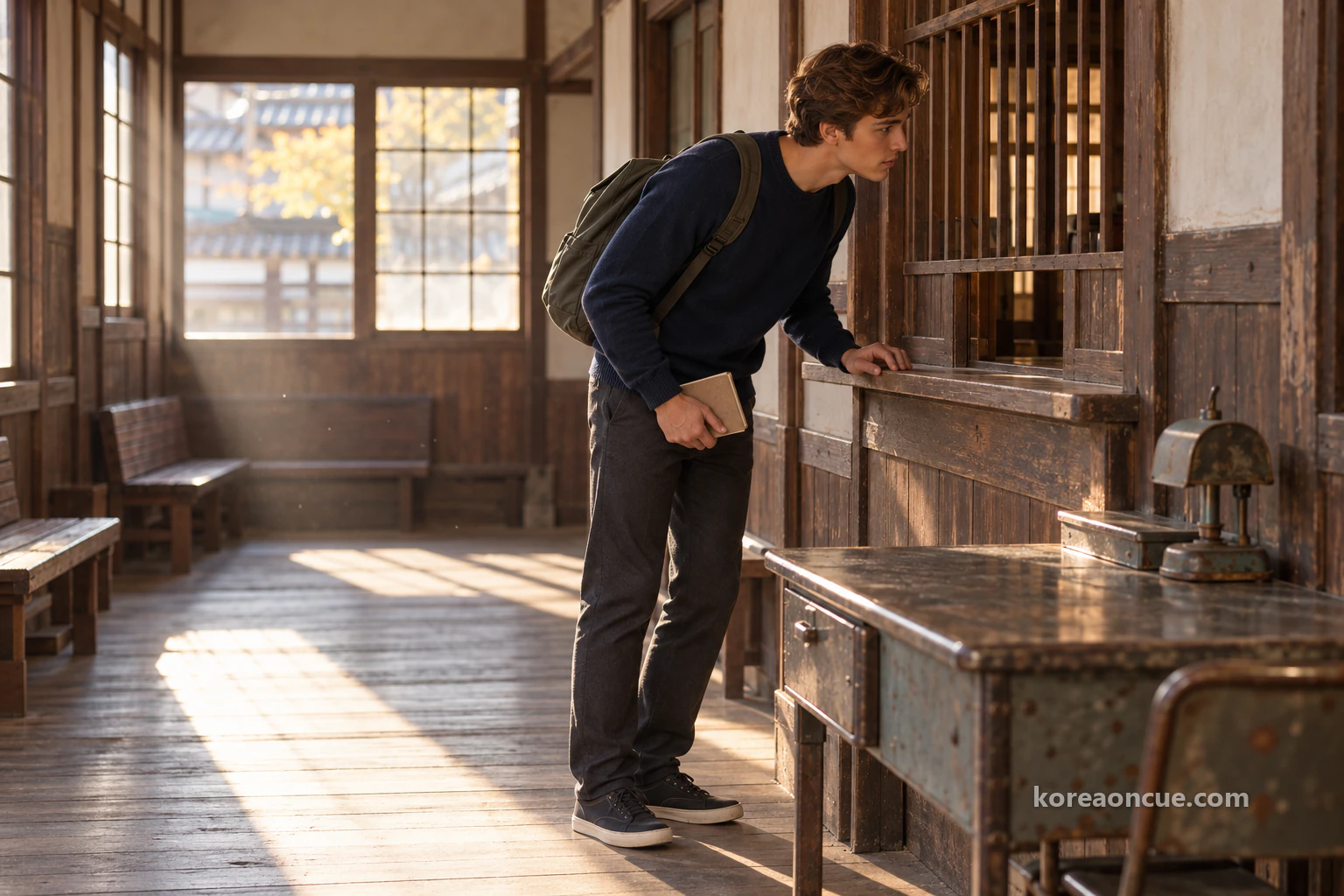
Digital displays explain the station’s layout and chronology, along with the history of the Gyeongchun Line. The ticket office, metal desk and nostalgic train-themed space help bring the old station into focus. Noah lingers at the ticket window, struck by the small opening where people once bought their tickets. It feels like a marker of what this path used to be for, and at weekends there is also a free chance to try on period outfits, including a stationmaster’s uniform, so allow a little longer for that on a weekend visit.
Before leaving, Noah sketches a small floor plan in the margin of his notebook. He joins the waiting room, station office and night-duty room with lines, imagining which door a passenger would enter, where they would buy a ticket and how they would leave to catch the train. For someone who draws routes, even a single station can look like a small neighbourhood. He remembers to add the time beside the plan, counts on his fingers how much time remains until closing, then moves on.
Nowon Train Village’s Swiss and Italian halls: admission and last entry
From the History Hall, Noah heads to Nowon Train Village. At 622 Hwarang-ro, it has two parts, the Swiss and Italian halls. It opens Tuesday to Sunday from 10 a.m. to 7 p.m., with last entry at 6 p.m., and closes on Mondays and on Seollal and Chuseok themselves. As Noah writes “last entry 18:00”, he notices that it matches the History Hall’s closing time. Arriving late in the afternoon would leave little time to see both.
Standard admission is ₩4,000 for adults and ₩2,000 for children and teenagers. Seniors, disabled visitors and people with recognised national merit receive a 50% discount, while Nowon-gu residents pay ₩2,000 for adults and ₩1,000 for children and teenagers (discounts cannot be combined). The Light Garden is free, but some cultural attractions inside the park, including Train Village, charge separately. Noah buys his ticket and starts with the Swiss hall.
The Swiss hall recreates places including Bern, the Matterhorn, the Jungfrau and Geneva in detailed 1:87 scale. The ground floor holds the diorama, while the first floor displays unusual railway exhibits such as the Gustav railway gun and a roundhouse and turntable display. Downstairs, the lighting changes every ten minutes, taking the Swiss landscape from day to night. Noah waits out the full ten minutes beside the mountain models to watch the change. It feels like a miniature preview of what he will see outside that evening.
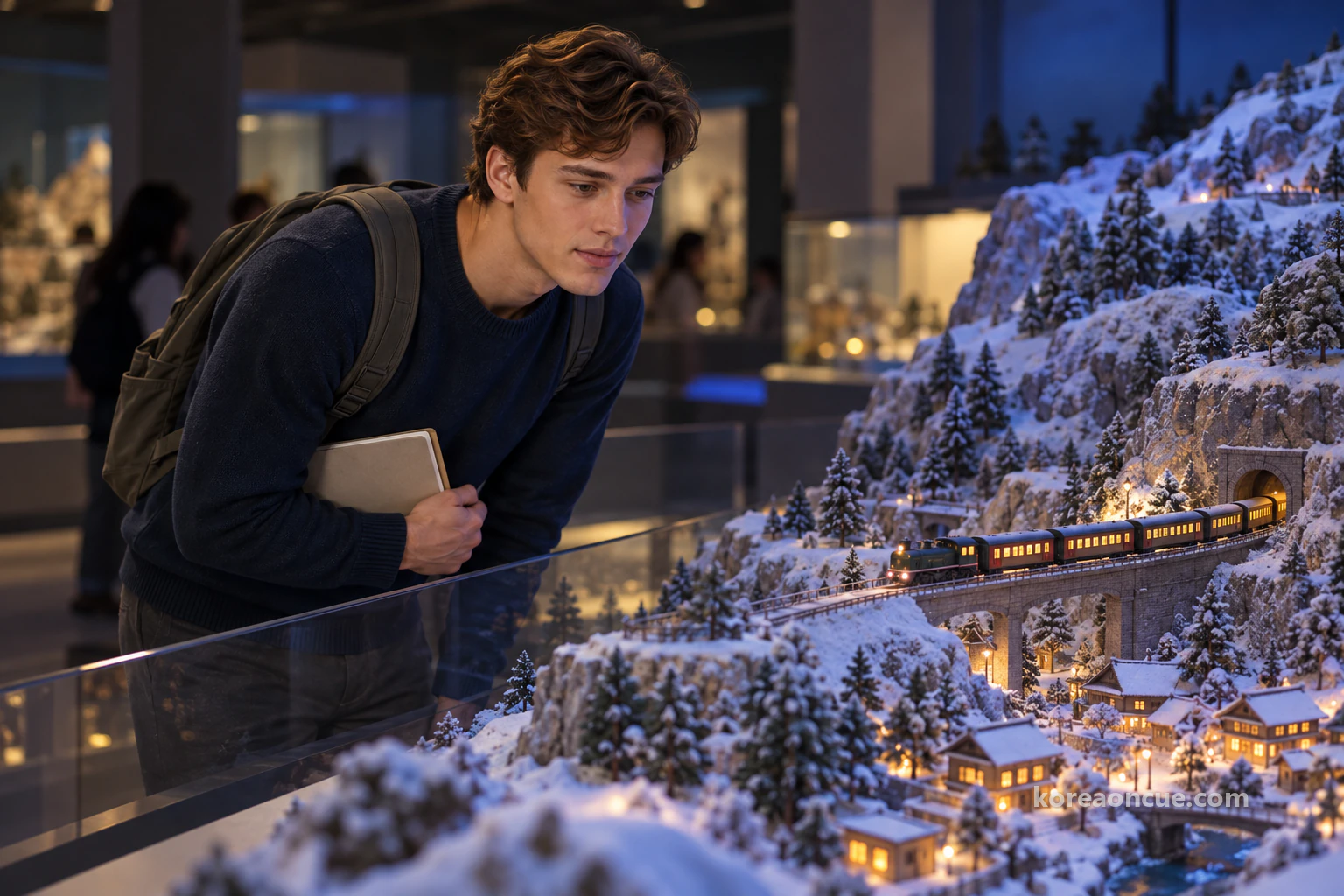
In the Italian hall, landmarks including St Peter’s Basilica, the Colosseum and Florence Cathedral appear at the same 1:87 scale. There are 26 moving scenes, including an eruption of Mount Vesuvius, a cruise ship and a chariot race. Noah follows a small train with his eyes, drawing arrows in his notebook to record the order of the places it passes. These are cities he is seeing for the first time, yet he can read how their routes connect across the models.
The Tram Library and Forest Trail Gallery: different closing times
When Noah leaves Train Village, the sun is a little lower. Each cultural attraction in Hwarangdae Railway Park keeps its own hours, and his notebook is steadily filling with deadlines. The Tram Library occupies a single tram car measuring 30 m². At 610 Hwarang-ro, it opens Tuesday to Sunday from 10 a.m. to 7 p.m. and closes on Mondays and public holidays. Loans and returns finish at 5:30 p.m., and after 6 p.m. visits are limited to looking around the space.

Noah takes a slow look around inside the tram. Food and drink cannot be brought into the library, so keep a water bottle tucked away in a bag. Seeing a former vehicle turned into a reading space, he realises that his day has followed a whole series of places where transport has stopped moving and found another use. He writes a short version of that thought beside the dot for the Tram Library.
Near the heritage-listed Hwarangdae Station building is the Gyeongchun Line Forest Trail Gallery. This arts space has a 134 m² exhibition room, storage and an outdoor stage, and opens from 2 p.m. to 8 p.m. Tuesday to Friday and from noon to 8 p.m. on Saturdays and Sundays. It is closed on Mondays and public holidays. Its weekday afternoon opening makes it a convenient short stop before the lights come on for anyone arriving on a Tuesday afternoon, as Noah does.
Written out like this, the deadlines form a staircase down his notebook page. Tram Library loans at 17:30, Hwarangdae Station History Hall at 18:00, Train Village last entry at 18:00, the Tram Library at 19:00, the gallery at 20:00 and, finally, the Light Garden at 22:00. Seeing them together makes the order clear: daytime attractions first, then the lights. To visit both the History Hall and Train Village, work backwards from 6 p.m. and plan to reach the park with plenty of time before then.
Thirty minutes before sunset: when Nowon Light Garden comes on
Noah stops where he can see the wetland opposite the station and checks the sunset time he wrote down that morning. Nowon Light Garden adds an evening landscape to Hwarangdae Railway Park, the former Gyeongchun Line railway turned forest trail, and was Seoul’s first light garden. It operates Tuesday to Sunday, from 30 minutes before sunset until 10 p.m. Admission is free for everyone. Waiting for half an hour before sunset, rather than sunset itself, takes a little getting used to.
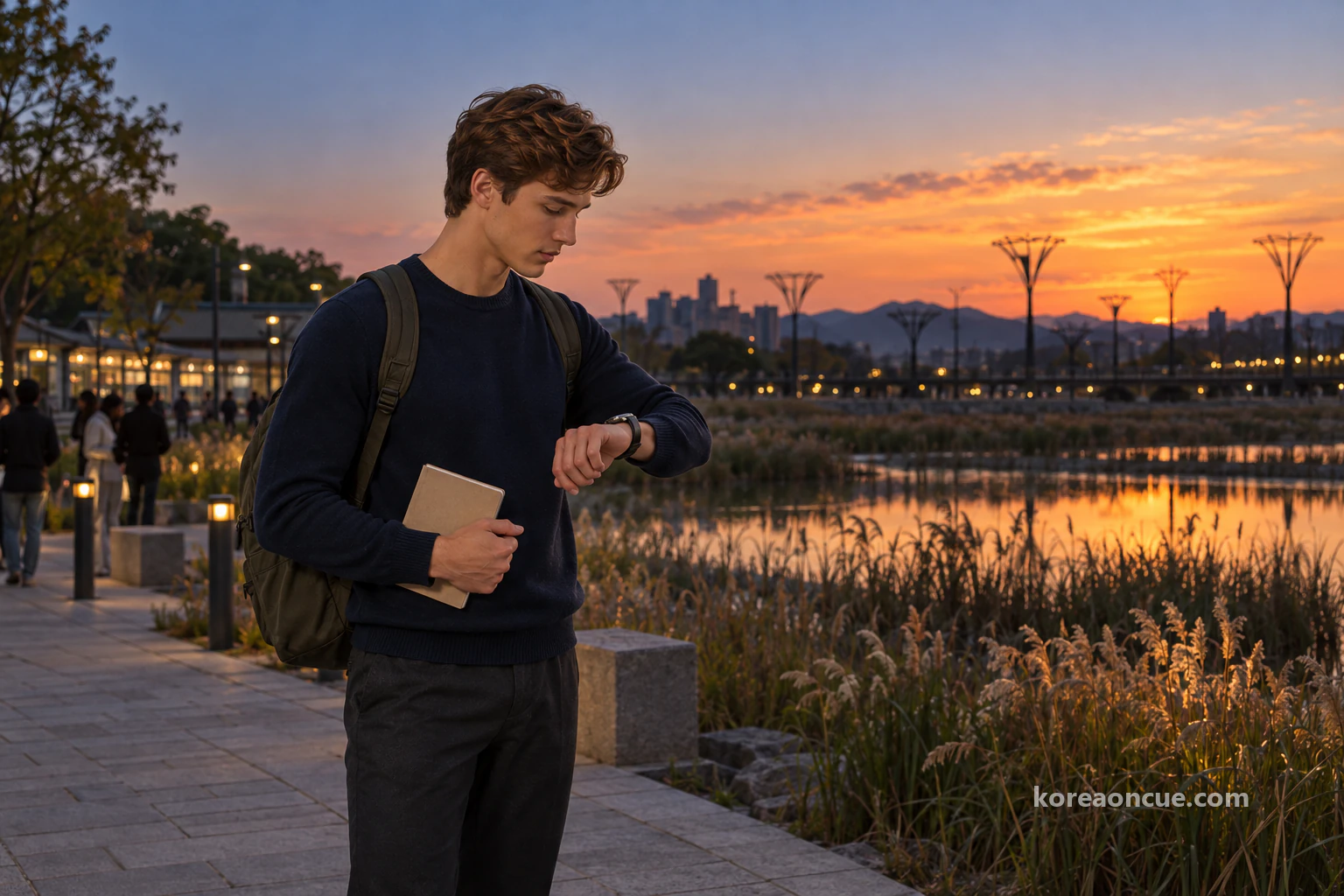
As sunset approaches, the park gradually changes. By day, the full-size trains on the old tracks, railway-themed cultural attractions and natural surroundings draw attention, while around sunset the evening illuminations turn it into the Light Garden. Noah draws a heavy line across the time column in his notebook to mark that change. Above it is his daytime map, and below it his night-time one.
The Light Garden is at 608 Hwarang-ro, Nowon-gu, by the Korea Military Academy main gate. The walk from Hwarangdae Station on Line 6 is about ten minutes, covering roughly 898 m, and none of the park’s sections has its own car park, so take public transport. If the Light Garden is the main aim, rather than Noah’s longer walk from Gongneung Station, start at Hwarangdae Station and arrive a little earlier than 30 minutes before sunset. That leaves time to watch the change from day to night too.
What to see in the Light Garden: the light tunnel, fantasy station, media train and Avatar Tree
The first thing Noah notices when the lights come on is the multicoloured light tunnel. He pauses at the entrance, then walks slowly in, following the line of light. It feels like walking the railway again, this time traced in colour. At the other end, he writes down the time and adds a short label: “Path of light”.
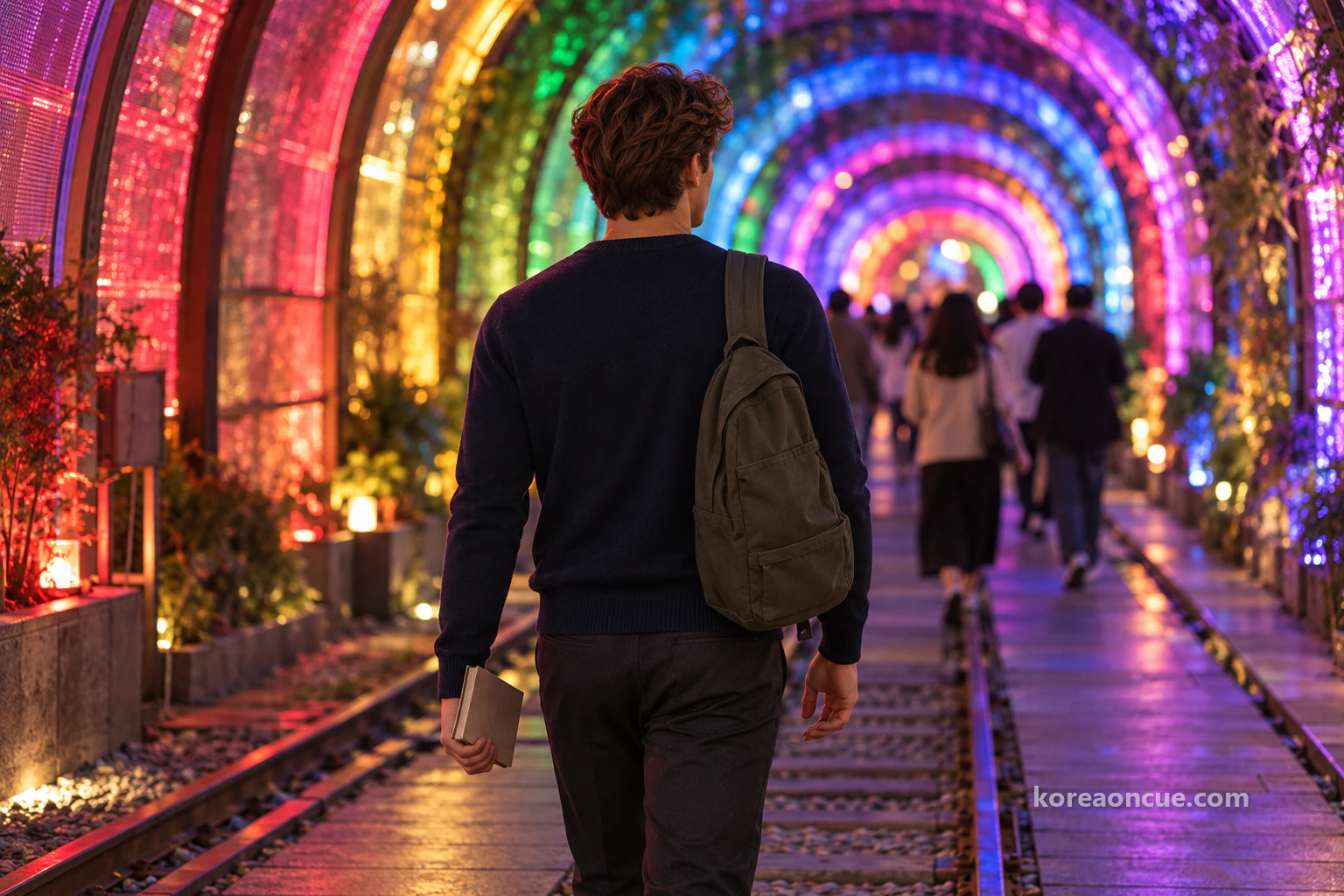
After the tunnel comes the laser “fantasy station”. In the same park where he saw the old station by day, he now finds a station made from light. The media train makes images appear to float in mid-air, and Noah notes that he has seen both a real train and a train of light in a single day. At the Avatar Tree, which resembles a giant Christmas tree, people stop to take photographs.

Noah raises his phone beneath the Avatar Tree, then opens his notebook instead. From the start, he has decided that what he sends Hina will be a map with times, rather than a photograph of the sights. Under the lights, he extends the daytime line through the places he visits that evening and writes an arrival time beside each one. Only now does he understand the difference: a photograph holds a moment, while a map with times can hold the way an entire half-day unfolded.
A little planning helps with the Light Garden visit. The park’s cultural attractions have different opening hours, and many will already be closed if you leave them until after the lights. Visit the daytime attractions before the illuminations come on, then finish with the Light Garden. In rain, typhoons, extreme cold or other bad weather, the Light Garden closes, so save it for another day.
Back to Hwarangdae Station: sending Hina the finished map
Noah leaves the Light Garden and walks to Hwarangdae Station on Line 6. Having arrived at Gongneung Station on Line 7 and followed the trail, he has used a different subway line at each end of the day. There are also bus stops within a five-minute walk of each park entrance, so a bus may suit anyone staying closer by that route. Noah chooses the subway because he wants to finish his map while he waits for the train.

On the platform, he looks over the day’s map from the beginning. The line starts at Gongneung Station, passes between the trees of the Gongneung-dong section, widens in front of old Hwarangdae Station and continues through Train Village and the Tram Library to the Light Garden. Times along the route sit beside the closing times for each place. Noah photographs the page and sends it to Hina in Tokyo with a message: “As promised. I’ve put the times in this time.”
Her reply arrives around the time he changes trains: “You even wrote down when the lights come on. Now it looks like a proper map.” It is a short line, very much like Hina. Before closing the notebook, Noah writes “Possible quiet walk” in small letters at the bottom of the page. They have not decided where they will take the quiet walk they talked about, but having one possibility makes today’s route feel as though it stretches a little further.
The Gyeongchun Line Forest Trail does not need to be walked all at once. Like Noah, you can spend half a day between the Gongneung-dong section and Hwarangdae Railway Park, then return for Hagye-dong another day. Remember that the railway park’s indoor attractions and Light Garden close on Mondays, and that the lights come on 30 minutes before sunset. With those two details in place, a single map with the times written in can give the day its shape.
Common Mistakes
Going on a Monday
Nowon Light Garden, Hwarangdae Station History Hall, Nowon Train Village and the Tram Library all close on Mondays.
Arriving after sunset
the Light Garden comes on 30 minutes before sunset. Arrive earlier to watch the change from day to night.
Seeing the lights before visiting Train Village
last entry to Train Village is 18:00, and the History Hall also closes at 18:00. Visit the daytime attractions first.
Driving to the park
none of its sections has its own car park. Take public transport.
Taking a drink into the Tram Library
food and drink cannot be brought inside.
Keeping the plan in bad weather
the Light Garden closes in rain, typhoons, extreme cold and other bad conditions.
FAQ
When do the lights come on at Nowon Light Garden?
Tuesday to Sunday, from 30 minutes before sunset until 10 p.m. It is closed on Mondays.
Is there an admission fee?
The Light Garden is free. Nowon Train Village costs ₩4,000 for adults and ₩2,000 for children and teenagers, with discounts for Nowon-gu residents, seniors and other eligible visitors. Discounts cannot be combined.
Which station should I use?
For the Light Garden and Hwarangdae Railway Park, use Hwarangdae Station on Line 6, about ten minutes’ walk or 898 m away. To start with the Gongneung-dong section, use Gongneung Station on Line 7 or Taereungipgu Station on Lines 6 and 7.
How long is the Gyeongchun Line Forest Trail?
About 6 km in three sections: Hagye-dong, about 1.1 km (15 minutes), Gongneung-dong, about 1.9 km (23 minutes), and Hwarangdae Railway Park, about 3.0 km (40 minutes).
What is inside Hwarangdae Station History Hall?
The old waiting room, station office and night-duty room, the ticket office, and digital displays about the Gyeongchun Line’s history. It opens Tue–Sun, 10:00–18:00, and operates without staff on site.
Do the lights come on when it rains?
The Light Garden closes in rain, typhoons, extreme cold and other bad weather.
Recap — 30 seconds before you go
- Nowon Light Garden: Tue–Sun, from 30 minutes before sunset to 22:00 · free · closed Mondays and in bad weather.
- Hwarangdae Station (Line 6): about ten minutes’ walk (898 m) · for the Gongneung-dong section, use Gongneung Station (Line 7) or Taereungipgu Station (Lines 6 and 7).
- Gongneung-dong section: about 1.9 km (23 minutes) → Hwarangdae Railway Park section: about 3.0 km (40 minutes).
- Daytime attractions first: History Hall closes 18:00 · Train Village last entry 18:00 · Tram Library closes 19:00.
- No on-site car park → take public transport.
Sources
- Seoul Metropolitan Government, Garden City Seoul — Gyeongchun Line Forest TrailAbout 6 km in three sections from Nokcheon Middle School to the city boundary, completed November 2017 · line history (opened 1939, last train 20 December 2010, trail work from October 2013) · length and walking time per section · places on the Gongneung-dong section · Hwarangdae Station’s 1939 wooden building and its 1958 rename from Taereung Station · subway stations per section · no on-site car parkchecked 2026-10-23
- Nowon-gu — Nowon Light GardenSeoul’s first light garden · Tue–Sun, from 30 minutes before sunset to 22:00, closed Mondays and in bad weather · free · 608 Hwarang-ro (Korea Military Academy main gate) · 10 minutes’ walk (about 898 m) from Hwarangdae Station on Line 6checked 2026-10-23
- Seoul Metropolitan Government, Seoul at Night — Nowon Light Garden (Hwarangdae Railway Park)Centred on Hwarangdae, Seoul’s last country station · selected for the 2023 Local 100 · light tunnel, laser “fantasy station”, media train and Avatar Tree · real trains by day, lights by night · facility hours differchecked 2026-10-23
- Nowon-gu — Hwarangdae Station History HallFormer Hwarangdae Station building as an exhibition hall, 610 Hwarang-ro · waiting room, station office and night-duty room · Tue–Sun 10:00–18:00 (closed Mondays and on Seollal and Chuseok), unstaffed · digital displays and ticket office · free costume try-on at weekendschecked 2026-10-23
- Nowon-gu — Nowon Train Village (Swiss and Italian halls)622 Hwarang-ro · Tue–Sun 10:00–19:00 (last entry 18:00), closed Mondays and on Seollal and Chuseok · admission and discounts · 1:87 models, Swiss hall lighting that changes every ten minutes, 26 moving scenes in the Italian hallchecked 2026-10-23
- Nowon-gu — Tram Library610 Hwarang-ro · one tram car (30 m²) · Tue–Sun 10:00–19:00 (closed Mondays and public holidays) · loans and returns until 17:30, browsing only after 18:00 · no food or drinkchecked 2026-10-23
- Nowon-gu — Gyeongchun Line Forest Trail GalleryArts space near the heritage-listed Hwarangdae Station building · 134 m² gallery, storage and outdoor stage · Tue–Fri 14:00–20:00, Sat–Sun 12:00–20:00 (closed Mondays and public holidays)checked 2026-10-23
A Seoul story told with our AI characters. Place details are checked against public sources; the photos are AI-made illustrative images. How we use AI
More from this area

A neighbourhood park for a change: Maya and Rina spend a weekday afternoon at Dream Forest and its observatory
After days of palaces, markets, Hongdae and Seokchon Lake, Maya sends Rina a simple request: “This time, could we go somewhere other than a tourist sight? A park where people in Seoul walk on a weekday.” Rina chooses Dream Forest in Gangbuk-gu.

Harmony on the 1st floor, Network on the 2nd: Noah’s time map of the Seoul Science Center, drawn floor by floor
Noah’s time maps have always been drawn on streets.