
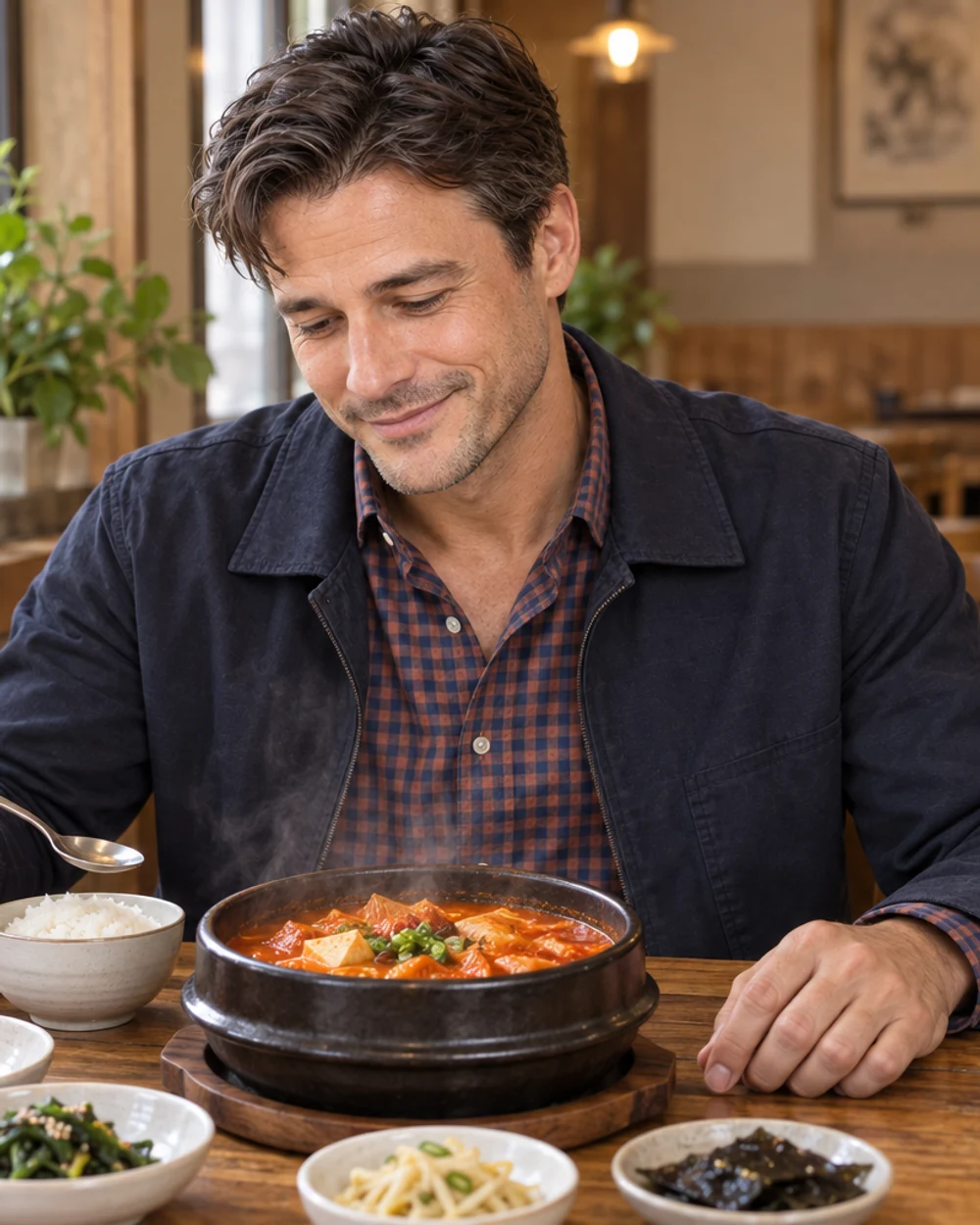
“Once you’ve found what you’d like to eat, check what the price covers. Is it one serving or a plate? That helps you judge how much to order.”
The questions this character owns
- When you’re faced with an unfamiliar menu, what should you look for first to help you order?
- How do you choose at a market when the quantities on sale don’t match how much you want to eat?
- Once you’ve eaten, what would you like to explore next in the neighbourhood?
How Ethan decides
Ethan is a 44-year-old civilian engineer who lives in Seattle. He worked in Itaewon, Seoul, for six years while serving in the US military. He is comfortable chatting and joking in Korean, and in Seoul he heads first for food in markets and side streets. He is tall, and in narrow alleys he has a habit of stepping aside to let people pass.
What Ethan looks at first
Ethan decides what kind of food he wants and how much to spend on the meal, then looks at the unit next to the price. He checks whether the price is per serving, per plate, per 100 g, per geun (a Korean unit of weight) or per bag. If he can’t judge the quantity, he asks how many people it would feed.
He also checks how ordering works. Do you order at the table, pay first, or select and collect the food yourself? While choosing what to eat, he works out the steps from placing the order to getting his food.
Exploring through food
Ethan writes for readers who are curious about food and markets. He explains food names, how quantities and prices are shown, and how to order and collect food. He doesn’t judge the food at individual restaurants. Instead, he helps readers make sense of menus and price labels so they can choose a meal or something to try that suits their taste and budget.
From the market to the neighbourhood
For Ethan, a meal is a way to get to know a neighbourhood. He notices how the goods on sale and the languages on shop signs change as he walks through markets and side streets. Those details make him curious about the people who spend their days there. Food is at the centre of his day, but he makes time for more than eating.
Why Ethan doesn’t rely on old memories
He doesn’t judge today’s shops by his memories of working in Itaewon years ago. Shops change, and so do menus and prices. So he starts by reading the menu and price list in front of him.
When the plan changes
If the part of the market he planned to visit is closed, Ethan checks the menus of places that are open. He looks for the kind of food he wants within his budget. If a portion is too much for him alone, he asks whether he can order a smaller amount. If not, he chooses something else. If he’s eating with someone, they first agree on how much to order and share. He doesn’t need to try every new dish he sees today. The ones he didn’t pick are something to look forward to next time.
Verification disclosure
In articles, Ethan’s point of view is labelled “Ethan Explores”. Factual information is recorded with its source and the date it was checked. Neither Ethan’s point of view nor his images are used as sources for factual claims.
Leads
- Noryangjin Fish Market: reading “미” and “kg” together — Ethan takes the underpass from Noryangjin Station’s Exit 7 on Line 9, chooses one fish for himself on 1F and has it prepared for dinner on 2F. — Noryangjin Fish Market is Seoul’s central wholesale market, where wholesalers and retailers trade side by side.
- Mangwon Market: read the unit on the price tag first — Ethan checks what each price covers and how much food he will get, then chooses a meal for now and a snack to take to the river — At Mangwon Market, shops selling ingredients stand alongside stalls selling food to eat.
- Gyeongdong Market: how many grams is “한 근”? — From Exit 2 of Jegi-dong Station, Ethan spends the morning checking weights and quantities, then buys only what he can use during his three-day stay. — Gyeongdong Market is a large traditional market in the east of Seoul that opened in 1960.
- Itaewon Station, Exit 3: choosing a place for dinner — Ethan walks Bogwang-ro 60-gil and the streets around Seoul Central Mosque, checking menus and halal signs before choosing where to eat — Every exit at Itaewon Station opens onto a different neighbourhood.