
SCENE · NORYANGJIN
Noryangjin Fish Market: reading “미” and “kg” together
Ethan takes the underpass from Noryangjin Station’s Exit 7 on Line 9, chooses one fish for himself on 1F and has it prepared for dinner on 2F.
Noryangjin Fish Market is Seoul’s central wholesale market, where wholesalers and retailers trade side by side. Ethan reads weight (kg) and the number of fish (미, mi) together to choose one fish he can eat on his own, then pays for the fish and for the restaurant separately and finishes his meal.
How to get there
Leave Noryangjin Station on Line 9 by Exit 7 and go straight ahead for 70 m. Through the underpass is the market entrance. On Line 1, leave by Exit 9 and go straight ahead for 150 m.
Ethan lives in Seattle, a city by the sea. Fish markets are nothing new to him. Yet at a Seoul fish market he always stalls at the same point. The price tags don’t all use the same unit. Some fish are priced by weight, others by the fish. To Ethan, an engineer, that is a table with two separate columns.
Today he has chosen Noryangjin Fisheries Wholesale Market. It began in 1927 beside Seoul Station, and today it is a central wholesale market opened by the Seoul Metropolitan Government and managed and run by Suhyup Noryangjin Fisheries. Auctions are held before dawn, and retail selling carries on after they finish. Inside, wholesalers who buy at auction work alongside retailers who sell to shoppers.
This guide is for anyone who wants a raw-fish meal at Noryangjin but is unsure how to buy the fish and have it prepared. First learn to read the price table, then choose a fish on the ground floor, finish with a meal upstairs on 2F and pay the fish seller and the restaurant separately. Ethan settles each step in turn.

The Cue
When you read a number at a fish market, read the unit next to it as well. Even if you choose a single fish, its price can be worked out by weight. Ethan asks separately what the price is based on and how much he can eat on his own, then adds the fish price and restaurant costs to work out the total for his meal.
- Leave Noryangjin Station on Line 9 by Exit 7 and go straight ahead for 70 m. Through the underpass is the market entrance. On Line 1, leave by Exit 9 and go straight ahead for 150 m.
- Retail selling runs every day of the year, and selling hours differ by type of seafood. The auctions close on Sundays, on 1 January, and for three days each over Seollal and Chuseok.
- Decide first whether you are on your own or with others, how much you will eat and what one meal should cost. Put into that budget not just the fish but also what you will pay at the restaurant.
- If you have liver disease or diabetes, or a weakened immune system, don’t eat fish or shellfish raw — have them well cooked. If you are eating with someone, agree on how the fish will be prepared before you choose it.
- Check the timetable for your travel date and find the latest train you can take from Noryangjin and still reach your destination, including any changes.
- Note the time of purchase, where the stall is, and the species, weight and number of fish, and keep the receipt. Under the market’s returns scheme (“소비자 리콜제”), the seafood must be brought back within 24 hours of sale, in its original condition.
01From Exit 7 into the underpass
Ethan gets off at Noryangjin Station on Line 9 and comes up at Exit 7. Straight ahead for 70 m, then through the underpass, and he is at the market entrance. Coming on Line 1, you would leave by Exit 9 and walk 150 m straight ahead. Ethan chooses the Line 9 side. He will head back towards Exit 7 too. He keeps the way between the market and the station the same, and inside the station he goes to the platform for his direction.

There are twelve entrances on the ground floor (1F). Ethan writes the name of the one he came in by in his notes. Today he will use the sales area on 1F, to choose a fish, and a restaurant upstairs on 2F, to eat. After the meal he plans to find the door he noted and go back through the underpass.
- Noryangjin Station, Line 9, Exit 7 → straight ahead 70 m → underpass → market entrance.
- On Line 1: Exit 9 → straight ahead 150 m.
- Write down the door you came in by.
Open in Kakao Map — Noryangjin Fish Market
02Read the table at home first
Before setting off, Ethan opens “오늘의 경락시세” (today’s auction prices) on the market’s website on his phone. Species, origin, size, pack, quantity, highest auction price, lowest auction price, average price. Like the engineer he is, he reads the column names before the numbers.
Ethan reads the “규격” (size specification) and “포장” (packaging/unit) columns separately. 미 (mi) is the word for counting whole fish, but he doesn’t take the fish count in the size column as the basis of the price. Some sizes in the size column are given as a fish count, such as “4/5미”, and the packaging/unit column shows marks such as “kg” or “S/P”. Before looking at a price, he checks the size and the unit on that row together. In his notes he writes, “Don’t mix up the fish count in the size column with the unit of the price.”

The table shows the prices agreed at auction. It is not a quote for what Ethan will pay on the sales floor. He doesn’t copy the average price over as the money he will hand a seller. At the market he will ask afresh about the fish he chooses today: the unit it is sold by, the unit price and the total for the whole fish. At home, the table helps him understand how auction prices are listed. Today’s purchase is decided on the terms he confirms on the sales floor.
Before closing the table, Ethan writes three questions on their own in his notes. “How many kg is one fish?” “How many people is that weight for?” “How much will I eat today?” The questions look similar, but the answers come from different sources. The scales answer the first, a seller who has prepared the fish answers the second, and Ethan himself answers the third. The auction price table answers none of them directly. What it tells you is which species traded at auction, in what size and by what unit.
So Ethan keeps reading the table at home and asking prices at the market apart. At home he learns the column names and how the units are written. He looks at which columns 미 and kg sit in, and whether the same species is split into several sizes. At the market he uses those words again, in front of real fish. If a seller gives a price per kg, he notes it down as a fish priced by weight. If the price is for the fish, he asks for the total for that fish. The table gives him the vocabulary for his questions, not the price of his purchase.
- On the market website’s “오늘의 경락시세” page, tell the size column from the pack unit.
- Don’t use the table’s prices as a retail quote. On the sales floor, ask the actual unit price and the total for the amount you will buy.
03Find the live-fish section on the ground floor
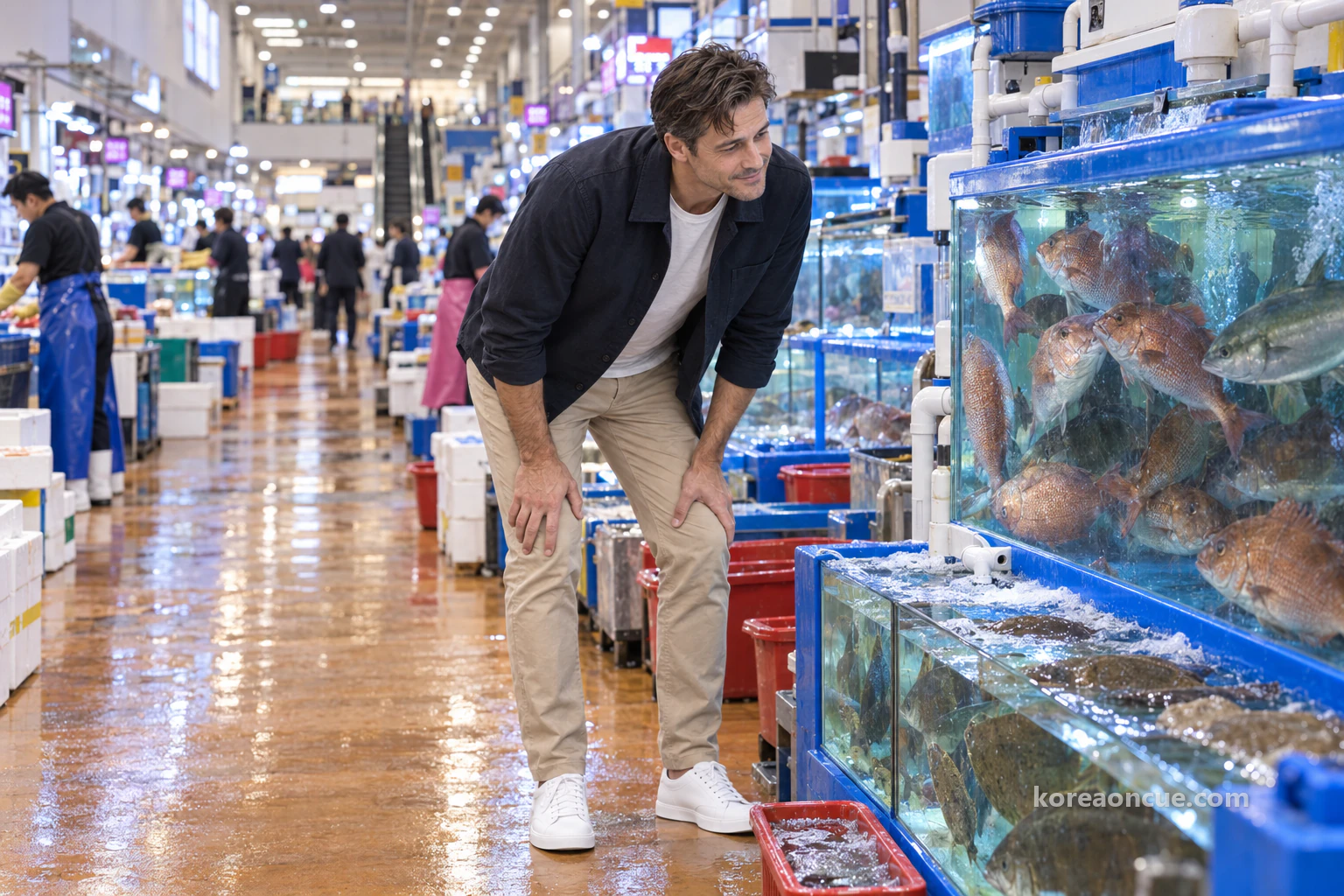
The ground floor is split between the auction hall on the west side and the sales floor on the east. Within the sales floor there are sections for shellfish (패류), live fish (활어), frozen seafood (냉동) and fresh fish (선어). Today Ethan wants a fish to eat raw, so he looks for the live-fish section.

Rather than walking a full loop of the whole market, Ethan looks at candidates within the live-fish section. He looks at the species and the size, and asks what unit the price of the fish he wants is given in. When he finds a candidate he likes, he notes where the stall is, so he can come back and compare amounts and totals.
- Find the live-fish section on the ground-floor guide map.
- Keep your search for candidates within that section, and note where each stall is so you can find it again.
04Look at the origin sign first
Seafood on sale must carry an origin label. Live seafood is kept in separate sections so that domestic and imported fish of the same kind don’t mix, and a sign or board shows the origin. Seafood of Korean origin is labelled “국산”, “국내산” or “연근해산”. Distant-water catches are labelled “원양산”, either on its own or with the name of the fishing area. Imported seafood is labelled with its country of origin.

Ethan looks at the fish he might choose and the origin label that goes with it together. If your Korean is shaky, you can read the sign with a translation app to get the meaning. If it is hard to tell which label belongs to which fish, point at the fish and ask: “Is this fish from the place written here?”
- Look at the fish you might choose and its origin label together.
- If it is unclear which label belongs to which fish, point at the fish and ask.
05Ask about weight and the number of fish together
On the way back, Ethan stops in front of a live-fish tank. He looks at what is written next to the number on the price tag. kg, or one fish? He asks the seller two things at once: “Do you sell this by the kg or by the fish?” and “What size would be right for one person?”

If the fish is to be priced by weight, Ethan asks the seller today’s selling price per kg and checks the weight used to calculate the price. Multiply that unit price by the weight and you have the price of the fish itself. If he is quoted a price for the whole fish, he checks the total for the one fish he has chosen. Either way, the last question is the same: “If I buy this fish, how much do I pay for the fish?”
Ethan is on his own today. Buying one fish doesn’t mean buying one person’s portion, so he first asks whether, once prepared for the meal, it is the right amount for one. After narrowing down the candidates, he plans to find out where it will be prepared and what that costs, whether a restaurant will seat him on his own and what he will pay there. He decides to pay only after he has checked the fish and the restaurant costs together.
Ethan doesn’t start with whichever fish is cheapest per kg. When a fish is sold by the kg, even if you choose just one, the total is its weight times the unit price. If another candidate costs a little more per kg but is the right size for one, its total is worth comparing. What Ethan wants to cut is not just the unit price but anything he can’t finish today and anything that goes over budget.
The seller shows him two candidates. The first is cheaper per kg but large. The second costs a little more per kg and is smaller. Ethan checks each fish’s weight on the scales and writes the two totals, unit price times weight, side by side in his notes. Looking only at the unit-price column, the first wins. Looking at the total column, the heavier first fish costs more. When he asks how much each would make as raw fish, the answer is that the first is too much for one person.

Ethan compares the two fish under three headings in his notes: “Price per kg / Total price / Right amount for one?” He chooses only once all three columns are filled. He narrows it down to the second fish. The unit price is a little higher, but the total is smaller, and it is a size he can finish on his own. With the first fish, both the cost and the leftover raw fish would go beyond today’s plan.
Before paying, Ethan tells the seller he will be back shortly and goes up to 2F. If he looked for a restaurant after buying the fish, the fish would already be in his hands even if the restaurant bill went over budget. So he switches the order.
At the restaurant entrance, Ethan asks: “Can I eat here on my own?” “Can you prepare a fish bought downstairs and serve it here as sliced raw fish?” “What comes on the table with it, and what is ordered separately? If I eat alone, how much do I pay here altogether?” He also asks how he should bring the fish up. With the answers in hand, he adds a line for the restaurant under the line for the fish in his notes.
If the fish and the restaurant together go over budget, he changes the order before paying. He looks at a different fish that suits one person, or drops a dish he meant to order separately at the restaurant. If he changes the order, he adds up the new fish price and restaurant cost again. If a restaurant says it can’t seat one person, he asks another about its terms and costs from scratch.
Today the second fish he kept as a candidate plus this restaurant’s cost still fits the budget. Ethan goes back to the ground floor and checks again the species, the origin, the weight used to calculate the price and the total for the fish he has chosen. He pays, and writes in his notes the species, the weight, one fish, and the price of the fish.
- Ask whether it is sold by the kg or by the fish, and check today’s retail unit price and the weight used to calculate the price.
- For each candidate, write the unit price, the total and whether it is the right amount for one, side by side.
- Before paying, find out about using a 2F restaurant and what it costs, and decide on the two amounts added together.
06Finish with a meal upstairs on 2F
The north side of 2F is lined with raw-fish restaurants. The one Ethan goes to is the restaurant where, before buying his fish, he checked that he could eat on his own and what it would cost. Having settled how the fish reaches the restaurant, he asks them to prepare it as raw fish. He pays the seller downstairs for the fish and the restaurant for its food and service.

Ethan checks which side dishes, vegetables and sauces are included, and which dishes must be ordered separately. “Eating alone, how much do I pay the restaurant altogether?” He doesn’t stop at asking whether a price is per person, but checks today’s full amount. After the meal he adds the fish price and the restaurant bill together to finish his note. He has two receipts today.
“Read the unit, choose one fish. Pay the seller and the restaurant separately, then add the two amounts.”
- Before buying the fish, find out about the restaurant and what it costs.
- At the restaurant, tell what is included from what is extra, and add up what you actually paid in both places.
07Read test results with their dates
The market website posts the results of radioactivity tests on seafood. Ethan checks the date in each post’s title and the posting date, and opens the latest results. Rather than just noting the date, he reads what the results say.
- Check each post’s date and posting date, and open the latest results.
08The way back
Before buying the fish, Ethan checks the latest train he can take from Noryangjin and still reach his destination. He notes separately when he needs to leave the restaurant. It is a time that leaves room to get out of the market, through the underpass and down to the station platform. After eating, he settles the bill in time, leaves by the door he noted and heads back towards Exit 7.
To count backwards, he started from the departure time of the train he will catch at Noryangjin Station. He first checked that the train and any onward connections would get him all the way to his destination. Then he subtracted, leg by leg, the time from the restaurant to the market door, from the door through the underpass to the station entrance, and from the station entrance to the platform. Leaving a margin for boarding, he set the time to leave the restaurant, and decided to have paid before then.
When he checked the 2F restaurant before buying the fish, he also asked how long the wait might be and how long preparing the raw fish takes. He looks at whether there is time to pay on the ground floor, come back, wait, eat and settle up. If the timing is too tight, he asks another restaurant about its terms and its wait before paying for the fish.
- Door you came in by → underpass → Line 9, Exit 7.
- Note the departure time of that train from Noryangjin and your restaurant leaving time separately.
If you need help
- Noryangjin Fish Market main line — 02-2254-8000~1.
- Returns enquiries — Market Hygiene Management Department (시장위생관리부): 02-2254-8144.
- Phone — Travel information and interpreting 1330 · Police 112 · Fire and ambulance 119.
Common Mistakes — where a fish market visit usually stalls
- Treating the average price on the auction price table as what you will pay on the sales floor.
- Seeing a fish count such as “4/5미” in the size column and reading the price on that line as the price of one fish.
- Comparing only the price per kg, without checking the total for the fish you chose at its actual weight.
- Planning to eat your fish at a market restaurant, but paying for it after budgeting the meal on the fish alone, without finding out whether you can eat at the restaurant and what it costs.
- Not matching each origin label to the fish it belongs to.
- Keeping no purchase record, or assuming seafood damaged through use or partial consumption still qualifies for the market’s returns scheme.
- Looking only at the time of the last train, without leaving time to get from the restaurant to the platform.
FAQ
When is Noryangjin Fish Market open?
Retail selling runs every day of the year, and selling hours differ by type of seafood. The auctions close on Sundays, on 1 January, and for three days each over Seollal and Chuseok.
How do I get there by subway?
Leave Noryangjin Station on Line 9 by Exit 7 and go straight ahead for 70 m. Through the underpass is the market entrance. On Line 1, leave by Exit 9 and go straight ahead for 150 m.
Where can I eat raw fish?
You can use the raw-fish restaurants on 2F. Before buying the fish, find out whether you can eat there, where the fish will be prepared and how much you will pay the restaurant altogether.
What if something is wrong with the seafood I bought?
You can request a return under the market’s scheme if seafood bought retail from its stalls has a freshness problem, or its species or origin differs from what was stated. Bring it back within 24 hours of sale, in its original condition. Seafood damaged through use or partial consumption is excluded. Contact the Market Hygiene Management Department on 02-2254-8144.
Recap — 30 seconds before you leave
- Noryangjin Station, Line 9, Exit 7 → underpass
- Tell the size column from the price unit on the auction price table
- Ask the amount, the retail unit price and the total for the fish you buy
- Before buying, check the restaurant and its cost, and add the two bills together
Reality Check
Transport, sales and auction closing days, conditions of the market’s returns scheme and the market layout checked: 13 October 2026. Selling hours for each type of seafood are on the opening-hours page of the market website. Check the retail price of the fish you are buying, and how the restaurant works and what it costs, with that stall and that restaurant before you pay for the fish. For radioactivity test results, look at the date in the post title and the posting date, and read the latest result.
After the Cut
On the subway, Ethan opens today’s purchase note again. The species and weight, one fish, the price of the fish and what he paid at the restaurant are all there. Next time he will ask the prices afresh, but he can use the same order again. Check the unit, choose a suitable portion and add up the full cost of the meal.

(※ This article includes staged images created with AI.)
Sources
- Noryangjin Fish Market — Directions (Korean) — Address, main line, Line 9 Exit 7 70 m via underpass, Line 1 Exit 9 150 m checked 2026-10-13
- Noryangjin Fish Market — Closing days and opening hours (Korean) — Retail open all year, selling hours by type, auction closing days checked 2026-10-13
- Noryangjin Fish Market — Facilities (Korean) — Ground-floor auction hall and sales sections, 12 entrances, raw-fish restaurants on the north side of 2F checked 2026-10-13
- Noryangjin Fish Market — About the market (Korean) — Central wholesale market opened by the Seoul Metropolitan Government checked 2026-10-13
- Noryangjin Fish Market — Fish market for children (Korean) — Began in 1927, wholesalers and retailers checked 2026-10-13
- Noryangjin Fish Market — Today’s auction prices (Korean) — Price table columns (size, pack and more) checked 2026-10-13
- Noryangjin Fish Market — Raw fish hygiene tips (Korean) — Advice against raw seafood for people with chronic illness checked 2026-10-13
- KDCA National Health Information Portal — Vibrio vulnificus sepsis (Korean) — High-risk groups (liver disease, chronic illness such as diabetes, weakened immunity), cook seafood thoroughly checked 2026-10-14
- Noryangjin Fish Market — Consumer recall (Korean) — Retail purchases only, 24 hours from sale, original state, exclusions, hygiene department contact, supporting documents for complaints after eating checked 2026-10-13
- Noryangjin Fish Market — Seafood radioactivity test results (Korean) — Posted test results checked 2026-10-13
- National Fishery Products Quality Management Service — How to label origin (Korean) — Origin label wording, separate sections and signs for live seafood checked 2026-10-13
- VISIT SEOUL — Noryangjin Fish Market — Pay the seller for the fish, the restaurant for side dishes, vegetables and sauces checked 2026-10-13
- VISITKOREA — Noryangjin Fisheries Wholesale Market — Began in 1927 beside Seoul Station, 1330 travel hotline checked 2026-10-13
Next Cue

Dongdaemun Shopping Complex: Start with the 2nd and 3rd Floors for Fabric
Rina walks straight into the market through the underground link at Exit 9 of Dongdaemun Station.

Goto Mall: how to choose just one thing without losing your way
Goto Mall is an underground shopping centre that runs for about 880 m.
Mangwon Market: read the unit on the price tag first
At Mangwon Market, shops selling ingredients stand alongside stalls selling food to eat.