
An Afternoon from Deoksugung to Jeongdong Observatory
An afternoon route from Exit 2 of City Hall Station to Deoksugung’s Junghwajeon, then along the stone wall road past the Seoul Museum of Art and the red-brick buildings of Jeongdong-gil to Jeongdong History Park and the Jeongdong Observatory. The walking between the seven stops is about 2.2 km, about 31 minutes. Check the alternatives for Mondays that are not public holidays (palace and museum closed) and weekday public holidays (observatory closed).
- Check opening days around Mondays. Deoksugung is usually closed on Mondays, but when a Monday is a public holiday it opens and closes on the next non-holiday day instead; the Seoul Museum of Art also opens on a Monday that is a public holiday. On an ordinary Monday, the first half of this afternoon is shut.
- This guide uses a 13:00 weekday start as its example. The observatory opens at 13:30 on weekdays, so it goes last. At weekends it opens at 9:00, but the times in this guide are for a weekday.
- On a weekday public holiday, drop the observatory. It closes on public holidays that do not fall at the weekend. On those days, finish at ⑥ Jeongdong History Park.
- Deoksugung’s general admission is 1,000 won. General admission to the Seoul Museum of Art and the stone wall road are free. On Wednesdays Deoksugung is free.
- Dinner is not in this guide. You come down from the observatory around half past four. Plan what comes next separately.
The Cue
Jeongdong is famous as a good neighbourhood to walk in, which is exactly why it is easy to lose track of where to start and where to stop. A palace, a road that runs along its wall, an art museum, a lane lined with red-brick buildings, a park with an old tower in it and an observatory that looks down on all of it are within thirty minutes of each other on foot. You leave City Hall Station at 13:00; the walking between stops comes to about 2.2 km, about 31 minutes of actual walking — the time you spend inside the palace and the museum is not included.
The order has its reasons. The observatory opens in the afternoon on weekdays, so it goes last; the palace has long opening hours, so it goes first. Out of Deoksugung, you follow its wall to the corner where the museum stands; turn north there onto Jeongdong-gil and you can see a church, a theatre and a red-brick school building along it, with the park at the northern end of the lane. Go up to the observatory from the park and the wall and the lane you have just walked appear in the window all at once. This afternoon is designed so that you check the road you walked from above, at the very end.
The stories behind this route are spread over five pieces: the stone wall road in part 1, the Seoul Museum of Art in part 2, Jeongdong-gil in part 3, the Jeongdong Observatory in part 4 and the inside of Deoksugung in part 5. Here we only set out the walking order, the timing and what to do when something gets in the way.
“The road along the wall shows up twice more — once from inside the wall and once from above it. Jeongdong is a neighbourhood where you see the same road from three heights.”
01Enter at Daehanmun and walk to the courtyard of Junghwajeon
13:00 · from City Hall Station Exit 2, About 122 m, 2 minutes on foot from Exit 2 of City Hall Station (Lines 1 and 2) to Daehanmun, the gate of Deoksugung
Deoksugung goes first not because of its opening hours but because every road this afternoon starts from this palace’s wall. See the throne hall inside first, and the stone wall road you walk afterwards becomes a road around something you know.

- Come out of Exit 2 of City Hall Station and walk to the front of Daehanmun. Two minutes on foot from Exit 2 of City Hall Station (Lines 1 and 2), per the Royal Palaces and Tombs Center. There is no car park. Find on the map
- Buy your ticket at Daehanmun and go in. Deoksugung Palace is open 09:00–21:00 (last entry 20:00) and closed on Mondays (if a Monday is a public holiday it opens, and closes on the next working day instead). Adult admission is KRW 1,000 (Koreans aged 25–64, foreign visitors aged 19–64). Admission is free every Wednesday (the art museum charges separately). There is no car park.
- Cross the small stone bridge inside Daehanmun and head for Junghwamun; beyond it is the courtyard of Junghwajeon. 185 m and about 3 minutes on the map route (TMAP pedestrian; the route inside the palace is a reference value) from Daehanmun to Junghwajeon, Deoksugung Daehanmun is the main gate of Deoksugung. The original main gate was Inhwamun on the south side, but the east gate, Daeanmun, took over that role as the area around it became the new city centre; the present name dates from a repair in 1906. The gate originally stood about 33 m further forward and was moved to its present position when Taepyeong-ro was widened in the 1970s. Geumcheongyo, the bridge just inside the gate, was excavated and restored in 1986 (Royal Palaces and Tombs Center).
- Allow about 45 minutes. See the courtyard of Junghwajeon, the dragons on the stairs and the roof of Seogeodang beyond it, and leave the palace’s other halls and its art museum for another day.

02Out through Daehanmun and along the stone wall road
13:55 · west, with the wall on your right
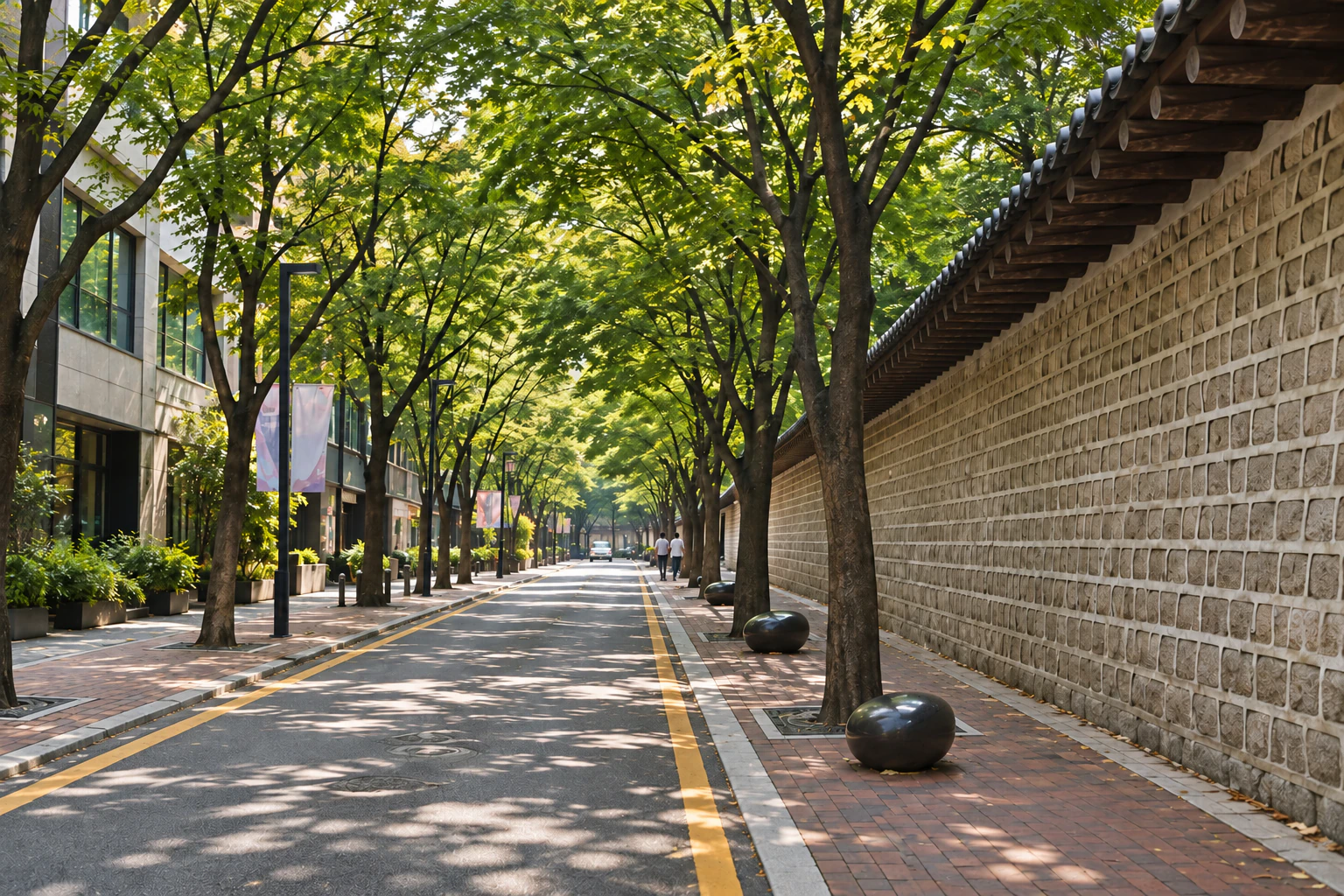
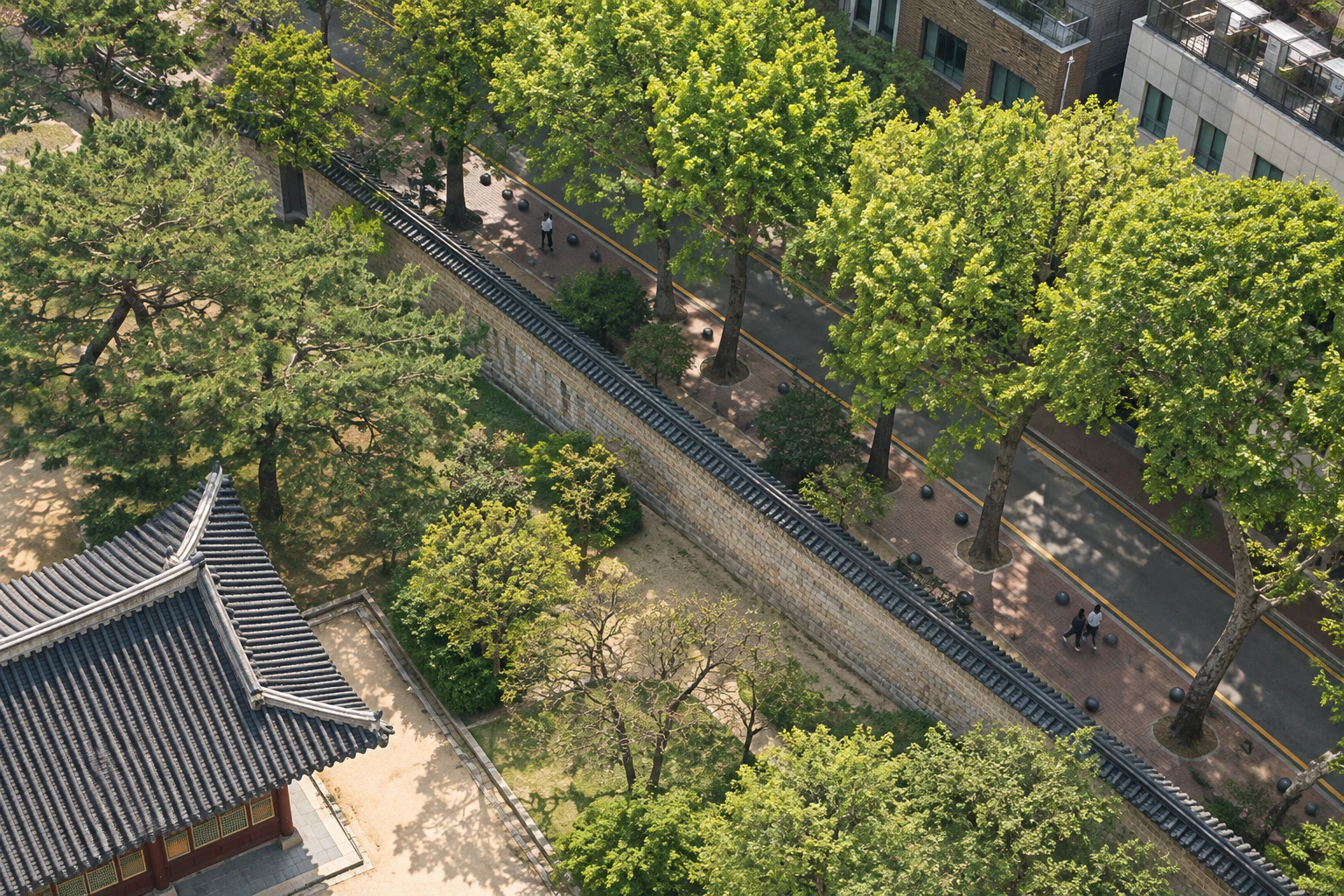
Once you leave the palace, you walk along its outer wall. The roofs you saw from inside show a little over the top, and the road bends the way the wall does. This stretch is not a destination — the way to the next stop is the stop.
- Come back out through Daehanmun and turn onto the stone wall road heading west, with the wall on your right. Deoksugung Stone Wall Road follows the outer wall of Deoksugung Palace; it is open all year, free, with benches along the way. In December 2018 a previously closed stretch was connected so that you can now walk all the way round the outside of the palace (that connecting stretch may keep its own opening hours). Find on the map
- Look at the stones. As Elena noted in part 1, the wall is layered: large granite blocks all the way up to the timber eaves, then black roof tiles. Walk on toward the museum and watch whether the shape of the stones changes.
- There are benches along the way. If you stood for a long time inside the palace, take a break here.
The stone wall road is open all year. The palace and the museum mix indoor and outdoor space, so if the rain is heavy, shift your time toward a longer stay at ③ the museum.
03The Seoul Museum of Art: up the hill with no wall
14:10 · from Daehanmun, About 420 m, 5 minutes on foot from Daehanmun along the stone wall to the front of the Seoul Museum of Art (Seosomun main building)
Where the stone wall road turns right at a corner, you go up to the left to reach the museum. It keeps the front of the old Supreme Court building, which makes it the second “old façade” you see after the palace. The permanent galleries are free, so the 40 minutes cost you nothing.
- At the corner of the stone wall road, walk up the approach that has no wall around it. The approach climbs a sloping path off Deoksugung-gil; the museum was built without a boundary wall so that the garden of old trees and flowers, and the outdoor sculptures, can be enjoyed from outside (there is an outdoor exhibition area). Find on the map
- Stop in front of the building and look at the façade once. The Seosomun building was put up in 1928 as the Gyeongseong Court, on the site of Pyeongriwon (the Hanseong Court), Korea's first modern court; after liberation it served as the Supreme Court, and when the Supreme Court moved to Seocho-dong in 1995 the building became the Seoul Museum of Art in 2002.
- Inside, watch the light as you climb the floors. Seoul Museum of Art (SeMA), Seosomun Main Branch, is open Tue–Thu 10:00–20:00, Fri 10:00–21:00, and Sat/Sun/public holidays 10:00–19:00 (Mar–Oct) or 10:00–18:00 (Nov–Feb); it is closed on Mondays and on 1 January (it opens if the Monday is a public holiday). Admission is free, special exhibitions are ticketed, and last entry is one hour before closing. Special exhibitions are paid, so check that day’s exhibition information.
- Allow about 40 minutes. Even if you choose just one floor and leave, the afternoon’s order holds.

04Turn onto Jeongdong-gil, to the red-brick church
14:55 · from the museum, From the front of the Seoul Museum of Art along Jeongdong-gil to Chungdong First Methodist Church is about 300 m, roughly 4 minutes on foot
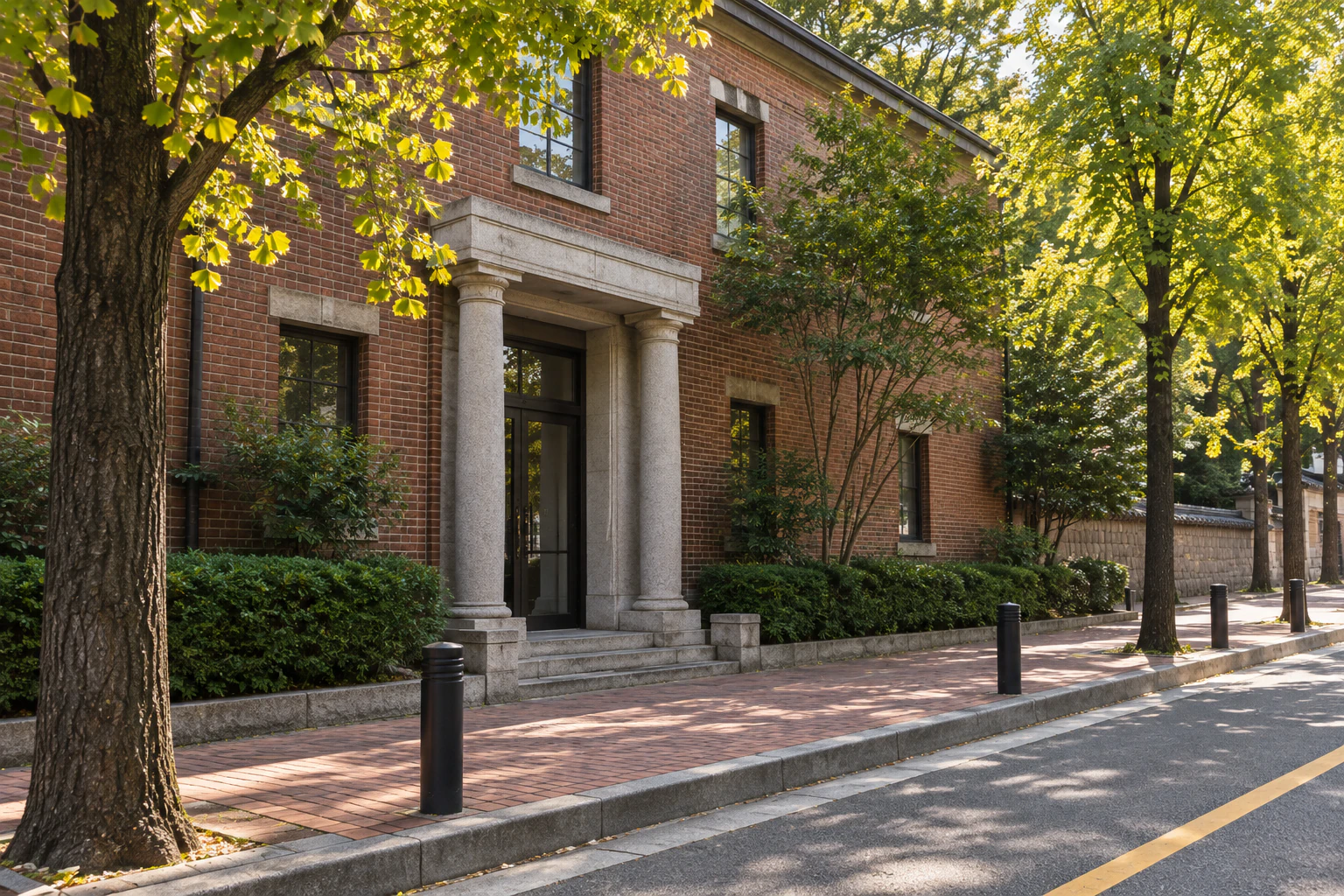
Come down from the museum and turn north, and you are on Jeongdong-gil. The lane winds so cars cannot pick up speed, and the road and pavement are at the same level, so the people on foot own the street. The first red-brick building you meet on it is a church.
- From the corner in front of the museum, turn onto Jeongdong-gil. Seoul's official tourism site (Visit Seoul) presents Jeongdong-gil and Deoksugung Stone Wall Road as representative walking streets in the city centre, explaining that they are designated as pedestrian-first one-way streets, laid out with curves so that cars cannot pick up speed, with carriageway and pavement set at the same level. It also notes that the name 'Jeongdong' comes from Jeongneung, the tomb of Queen Sindeok, the second consort of King Taejo. Find on the map
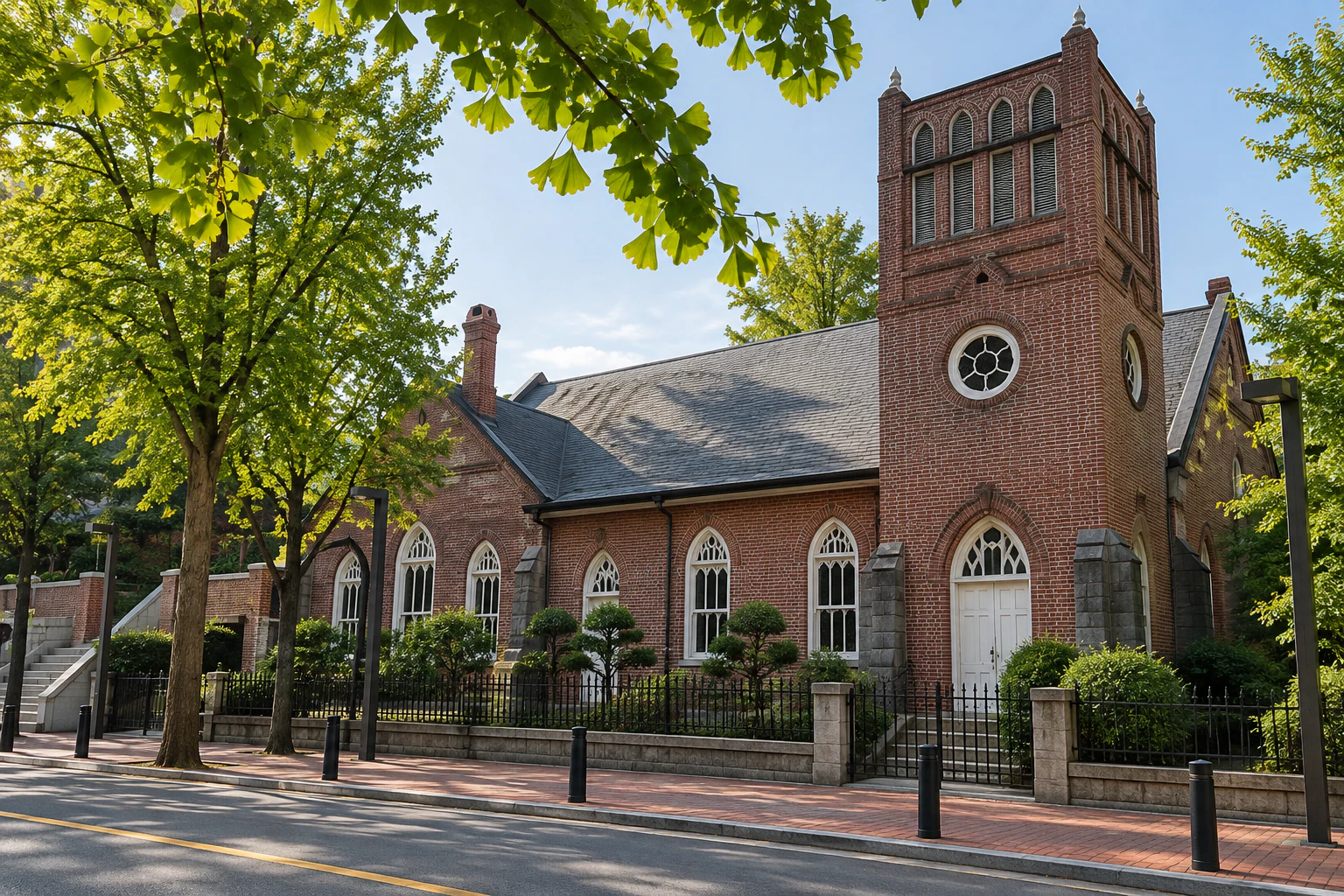
- At the church, stand across the lane and take in the whole building. Chungdong First Methodist Church is listed on the Korea Heritage portal as 'Chungdong Church, Seoul', a Historic Site designated on 22 November 1977. Completed in 1898, it is described as Korea's first full-scale Protestant church building: brick, with arched windows in a simplified Gothic style; the original cruciform plan was widened at both wings in 1926 into today's squarer shape, and its base of neatly dressed stone is said to carry the skill of Joseon timber architecture.
- Look from outside, without going in.
05Along Jeongdong-gil, past a theatre and a brick school building
15:10 · from the church to the northern end
Besides the church, red brick turns up twice more on Jeongdong-gil: the brick wall of a theatre and the brick building of a school. The same material standing in different eras for different purposes is what gives Jeongdong-gil its character.
- Not far from the church, where you see a red-brick wall and columns, is the Jeongdong Theater. The red-brick wall with four columns at 43 Jeongdong-gil belongs to Jeongdong Theater, which Seoul's official tourism site says opened in 1995 with the aim of reviving Wongaksa, Korea's first modern theatre. The auditorium is below ground, with an open courtyard above it. Find on the map
- Along the lane, a red-brick building also rises behind a stone wall. The red-brick building at 26 Jeongdong-gil is Simpson Memorial Hall of Ewha Girls' High School, a National Registered Cultural Heritage (registered 28 February 2002). Built in 1915 with funds entrusted by the American Sarah J. Simpson, it is the oldest building on the school's campus; it collapsed in the Korean War and was rebuilt in the early 1960s with the south elevation restored to its original appearance. Today it houses the Ewha Museum.
- For both buildings, seeing them from the lane is enough. A performance at the theatre or a visit to the museum inside is not part of this afternoon’s design.
06Jeongdong History Park: the white tower above the trees
15:30 · from the church, From Chungdong First Methodist Church along Jeongdong-gil to the entrance of Jeongdong History Park is about 360 m, roughly 5 minutes on foot
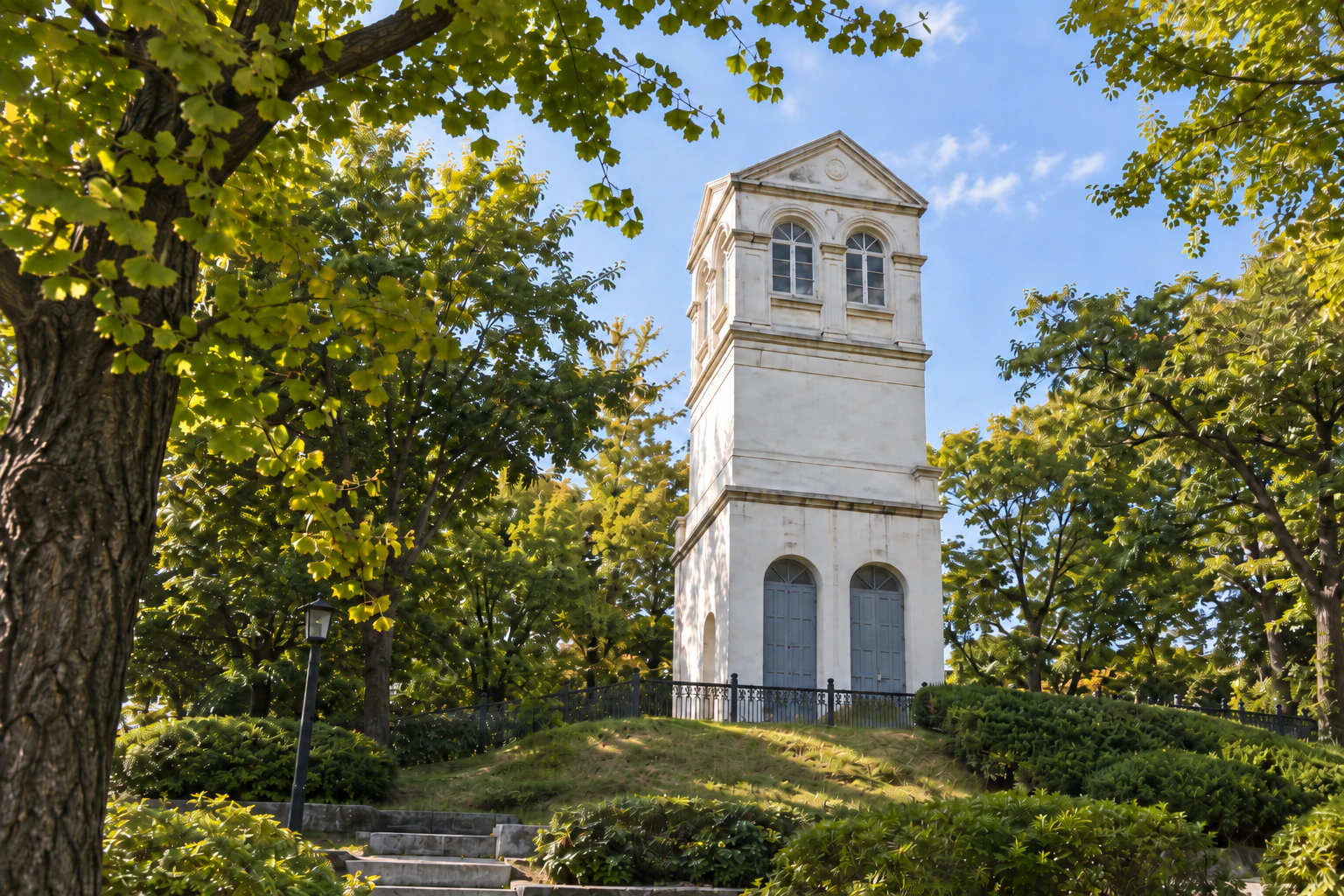
Climb the slope at the northern end of Jeongdong-gil and you reach a park, with a white tower above the trees. It is where the story of King Gojong’s refuge in 1896–1897 remains. Rest here for a moment; the last thing left is to go up.
- Follow the slope at the end of Jeongdong-gil up into the park. Find on the map
- Look at the tower. The white tower inside Jeongdong History Park is what remains of the Former Russian Legation, Seoul, a Historic Site designated on 22 November 1977. Built in 1890 as a two-storey Renaissance-style brick building, it was badly destroyed in the Korean War, leaving only the tower and two basement levels, restored in 1973. From February 1896 to February 1897 King Gojong took refuge here with the crown prince.
- Rest for about 20 minutes.
The observatory closes on public holidays that do not fall at the weekend. On those days, finish the afternoon here and retrace your steps to City Hall Station.
07The Jeongdong Observatory: the road you walked, from above
16:00 · from the park, 675 m and about 9 minutes on the map route (TMAP pedestrian) from Jeongdong History Park to the Jeongdong Observatory (Seosomun Building, Seoul City Hall)
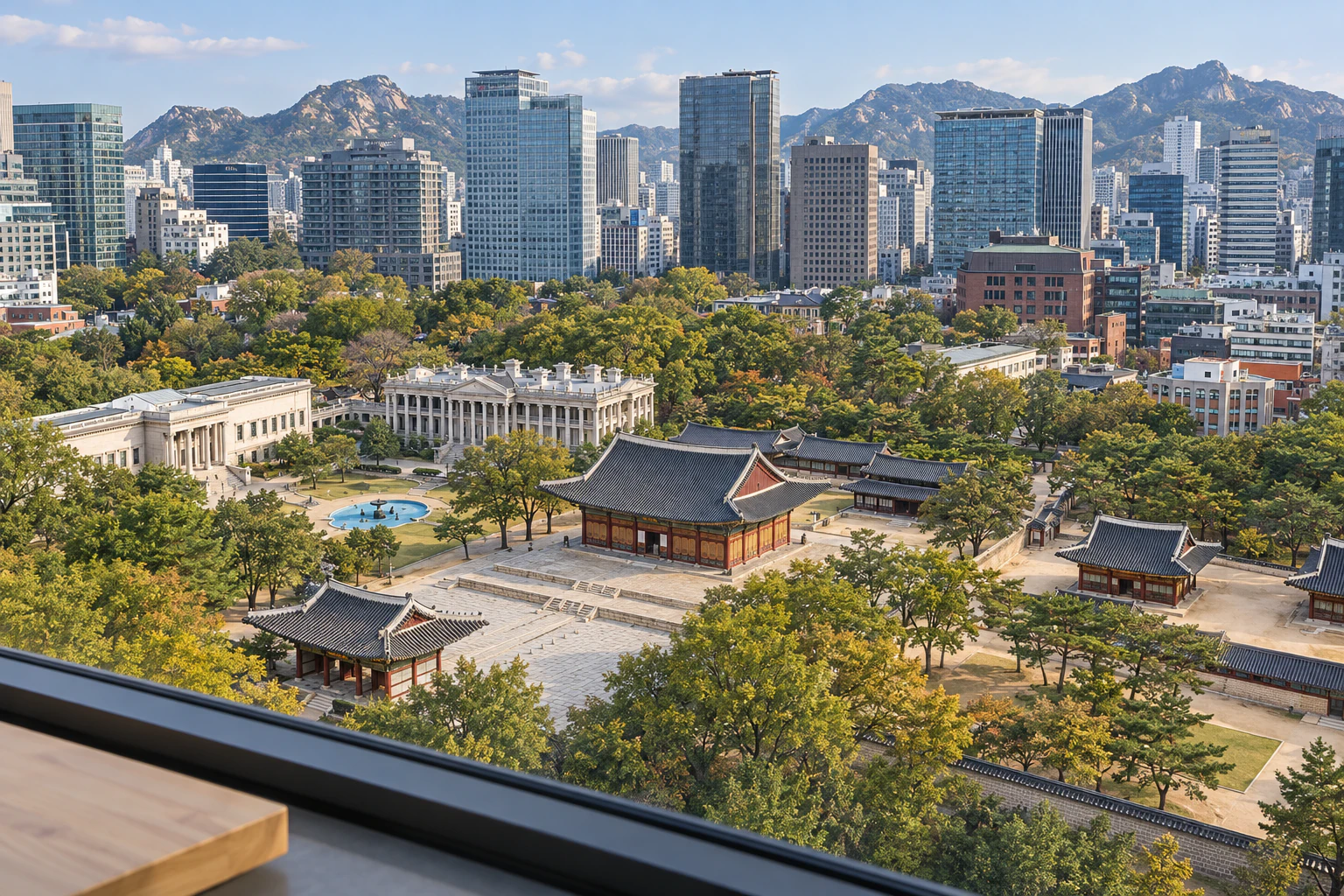
The last stop is the answer to this afternoon. Look down from the 13th-floor window and Deoksugung’s roofs and the wall around them appear as lines, and the tree-lined road outside the wall is the stone wall road you have just walked. It is exactly what Elena did in part 4 — seeing the road you walked all at once, from above.
- From the park, head to the Seosomun Building of Seoul City Hall. 675 m and about 9 minutes on the map route (TMAP pedestrian) from Jeongdong History Park to the Jeongdong Observatory (Seosomun Building, Seoul City Hall) About 185 m from Exit 12 of City Hall Station (Lines 1 and 2) (Seoul tourism listing). Find on the map
- On the ground floor, take the observatory’s dedicated lift. Weekdays 13:30–17:30, weekends 09:00–17:30 (last entry 17:20). Closed on public holidays that fall on weekdays. Visitors use the dedicated lift, No. 3 (Seoul tourism listing, April 2026).
- At the window, look for Deoksugung. Jeongdong Observatory is on the 13th floor of the Seosomun Building of Seoul City Hall. It has a café where you can look down over the Deoksugung area with a drink; photographs of old Jeongdong hang on the café walls. Bar tables line the windows, and on clear days the view reaches Gwanghwamun and the former presidential residence (Seoul tourism listing, April 2026).
- Stay about 30 minutes and come down. Last entry is 17:20, so arriving in the four o’clock hour leaves you room.
The Look
The rule for what to wear on this route is comfortable shoes and a light bag. The walking distance is short, but it mixes flagstones inside the palace, the museum’s hill approach and the slope up to the park. You move between indoors and outdoors at the museum and the observatory, so the lighter your bag, the easier it is.
Afternoon sun stretches the wall’s shadow along the stone wall road. On an autumn afternoon one light outer layer is enough, and since the sun at the observatory window can be warm, choose something you can take off and carry.
Route Variations — six situations
When the plan changes
| Situation | What changes | What stays |
|---|---|---|
| An ordinary Monday, not a public holiday (Deoksugung and the museum closed) | ② Stone wall road → ④ church → ⑤ Jeongdong-gil → ⑥ park → ⑦ observatory. The inside of the palace and the museum for another day | The observatory opens at 13:30 on weekdays — keep the start time |
| A weekday public holiday | Drop ⑦ the observatory and finish at ⑥ the park. The observatory closes on public holidays that do not fall at the weekend | Check the palace’s and museum’s own holiday information |
| A weekend | The observatory opens at 9:00. You can reverse the order, starting at ⑦ the observatory and ending at ① Deoksugung | Reversed, it becomes “see the road from above first” instead of “check the road you walked” |
| A Wednesday | Deoksugung is free. You can give the palace more time | The order stays |
| Only one hour | Just ② the stone wall road → ⑤ Jeongdong-gil → ⑦ the observatory. The palace and the museum for another day | The observatory’s hours (after 13:30 on weekdays) |
| Rain | Spend longer at ③ the museum and keep the park short | Watch your footing |
(※ This article includes staged images created with AI.)
Common Mistakes — where this route usually breaks
- Going on a Monday — On an ordinary Monday, Deoksugung and the Seoul Museum of Art are both closed. On those days, use the variation that walks the roads only.
- Heading to the observatory first on a weekday morning — The observatory opens at 13:30 on weekdays. That is why this guide puts it last and uses an afternoon start as its example.
- Going all the way to the observatory on a weekday public holiday — It closes on public holidays that do not fall at the weekend. On those days, end at the park.
- Splitting the palace visit into two parts — See the inside in one go.
- Trying to go inside the church or the school — This guide is designed to see both from the lane. The school is still attended by students.
- Missing the observatory’s last entry — Last entry is 17:20. If you spend too long earlier on, cut the park short.
FAQ
Can I follow this alone on my first visit?
Yes — that is how it is designed. On the day, start at Exit 2 of City Hall Station and follow from Step 01. The walking distances are short, so there is little room to get lost; just check your map app once for the stretch from the park to the observatory.
Why is the observatory last?
Partly because it opens at 13:30 on weekdays, but the bigger reason is the order. Walk the palace, the wall and the lane first and look down at the end, and every line outside the window is a road you have just walked.
Do we go to the art museum inside Deoksugung?
Not on this route. Deoksugung’s admission and that museum’s ticket are separate, and this afternoon only goes as far as the throne hall and its courtyard.
Where does the 2.2 km total come from?
The total distance is the sum of the map walking distances for the seven legs. It includes the round trip from Daehanmun to Junghwajeon, which is a road-network reference value. The extra steps to see Seogeodang, climbing the floors of the museum and walking inside the park are not included. The full breakdown is under Reality Check below.
Do we walk the whole loop of the stone wall road?
No. This route walks only the southern stretch of the wall, from Daehanmun to the museum corner. Official information says a formerly blocked section has been connected so you can walk all the way round the palace, but that connecting section may have separate opening hours, so it is not part of this afternoon’s order. If you want the full loop, set aside another morning for it.
Can I do it with a pushchair or a wheelchair?
Inside the museum there are wheelchairs and pushchairs to borrow and a lift. This guide does not present the whole route as a wheelchair or pushchair route. Check each place’s accessibility information before you go.
Does this order work at the weekend too?
Yes. At weekends, though, the observatory opens at 9:00, so you can also start there in the morning and walk it in reverse. The times in this guide are for a weekday afternoon.
Recap — 30 seconds before you go
- Day of the week: not an ordinary Monday (Deoksugung and the museum closed; a Monday public holiday is different) · on a weekday public holiday, drop the observatory
- Start 13:00 · City Hall Station Exit 2 · observatory last entry 17:20
- Deoksugung 1,000 won (free on Wednesdays) · museum general admission and stone wall road free
- See the inside of the palace in one go
- Comfortable shoes · a light bag · one light outer layer
- See the church and school from the lane · don’t photograph students outside the school
Reality Check
The walking total needs a note of its own. about 2.2 km and about 31 minutes are the sum of the map walking routes for the seven legs between stops. The round trip from Daehanmun to Junghwajeon runs inside the palace and follows the map’s road network. Steps taken inside the palace to see Seogeodang, climbing the floors of the museum and inside the park are not included in the sum.
After the Cut
What we thought about longest while putting this guide together was when to put the observatory. Go up first and you are previewing the road you are about to walk; go up last and you are checking the road you have walked. This afternoon takes the second option. On your first day, walk it in this order; the second time, try it in reverse — the same road looks different.
Before you go
Deoksugung’s hours, closing day, fees, directions, Daehanmun, Junghwajeon and Seogeodang come from the Royal Palaces and Tombs Center’s official information; the Seoul Museum of Art’s hours, fees, building history and approach from the museum’s official information and the Korea Heritage Portal; Jeongdong-gil, the Jeongdong Theater, Jeongdong History Park and the stone wall road from the Seoul Metropolitan Government’s official tourism information; Chungdong First Methodist Church, the former Russian Legation and the Simpson Memorial Hall from the Korea Heritage Portal; the Jeongdong Observatory’s location and operation from Seoul tourism information (April 2026). Walking between stops is from map walking routes (18–23 September 2026); how the total is built is set out under Reality Check above.
- The walking value for the round trip inside Deoksugung is a reference value based on the map’s road network. Inside the palace, follow the signs and visitor paths on the ground.
- The Jeongdong Observatory is open 13:30–17:30 on weekdays and 9:00–17:30 at weekends (last entry 17:20), and closes on public holidays that do not fall at the weekend. This is April 2026 information, so check again before you go.
- Chungdong First Methodist Church, the Simpson Memorial Hall at Ewha Girls’ High School and the Jeongdong Theater are designed to be seen from the lane.
- Ewha Girls’ High School is a school with students. Don’t block the gate or the way through, and don’t photograph students.
- The times in this guide (13:00 start) are an example for an autumn weekday afternoon.

