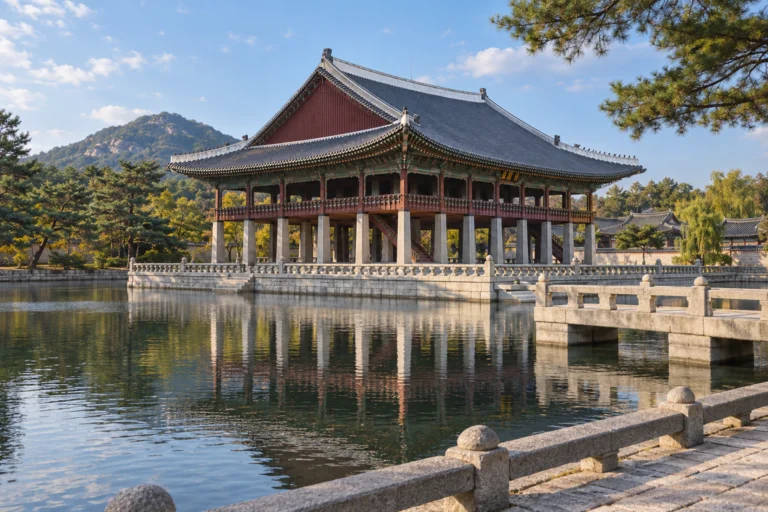
SEOUL · GWANGHWAMUN
Walking Gwanghwamun Square, from Statue to Gate
From King Sejong’s statue to Gwanghwamun is a 340-metre walk. Noah follows the line of statue, gate and mountain.
How to get there
The arrival point is the map app’s marker for the statue of King Sejong in Gwanghwamun Square, used as the routing reference; distances and times are map-route calculations, including the 340 m, 5 minutes from the statue to Gwanghwamun.
In the first piece Maya stood inside Gyeongbokgung, in the courtyard of Geunjeongjeon. Today Noah stands outside the palace’s main gate: Gwanghwamun Square. The city describes it as an open city square, open 24 hours a day all year. The hour Noah picks is late afternoon.
Noah reads a street with his eyes. At Tapgol Park he read the reflections in a glass case. Today he reads an axis. From south to north, the statue of King Sejong, Gwanghwamun and Bugaksan follow one another within a single field of view. On screen the three appear separately — the statue alone, the gate alone, the mountain alone. Noah walks along the framing in which the three read as one axis.
The square is new. According to the city’s introduction, the street in front of Gwanghwamun first took the form of a square in 2009 and reopened as today’s Gwanghwamun Square in August 2022. The Korea Tourism Organization describes it as the conversion of Sejong-daero, a street with 600 years of history, from a road for cars into a space for people. The square in its present form reopened in August 2022, but the road Noah walks carries six hundred years of time reaching back to the old avenue of the six ministries.
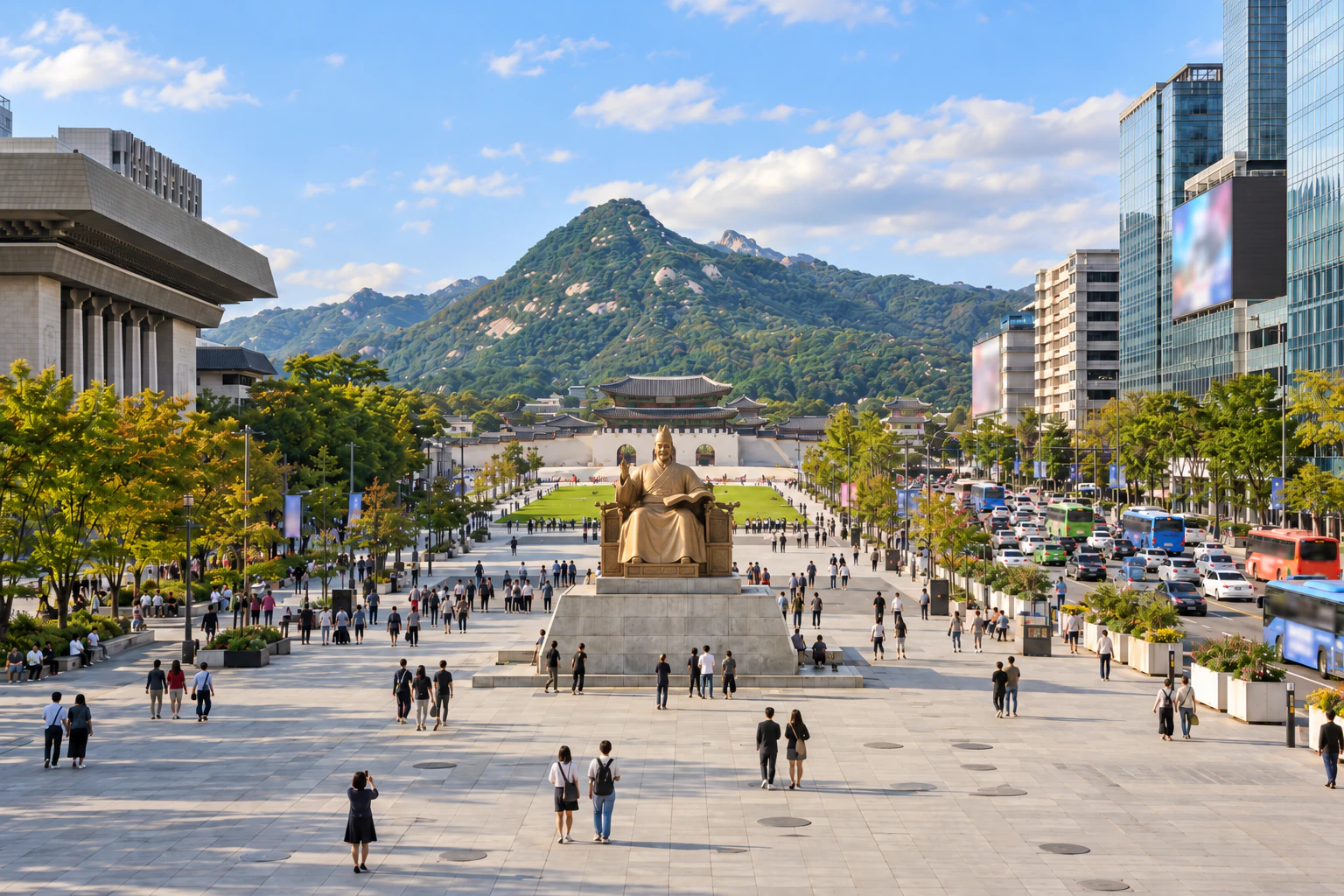
In front of the statue of King Sejong — a seated figure facing south
From Exit 7 of Gwanghwamun Station (Line 5) to the statue of King Sejong in the square, 314 m, about 4 minutes (TMAP pedestrian routing). The city’s directions give the underground link through Haechi Lounge or Exit 7 (toward the square’s grove) on Line 5, and Exit 6 of Gyeongbokgung Station on Line 3.
Out of Exit 7 of Gwanghwamun Station on Line 5, the city’s directions label this exit “toward the square’s grove,” and it brings you out at the square. By the map route it is 314 metres, four minutes, to the statue. Noah does not keep to the wooded edge but walks out into the middle of the square. The paving is wide, the statue is far ahead, and behind it the gate and the mountain overlap. Find on the map

He stands before the statue. The tourism organization’s entry says it is a seated figure 6.2 metres high and 4.3 metres wide, facing south. From the south, where Noah stands, you see the face; from the north, where Noah will walk, you see the back. In front of the statue, the entry says, stand reproductions of an armillary sphere, a rain gauge and a sundial. Noah writes the three names in his notebook.

The entry also says this statue stands 250 metres behind the statue of Admiral Yi Sun-sin. So there are two statues in this square, and both face south. Noah does not go toward Admiral Yi today. To read an axis you have to walk in one direction only. “South to north. Past the statue, toward the gate.”

On the axis — where the gate and the mountain overlap
The Korea Tourism Organization introduces Gwanghwamun Square as the conversion of Sejong-daero, a street with 600 years of history, from a road for cars into a space for people, laid out to give a view of Gyeongbokgung and Bugaksan, and describes it in two parts: “the square that restores the history of Gwanghwamun” at the head and “the square that recreates the scenery of Yukjo-geori” around Sejongno Park (traces of the avenue and a scale model). The restoration of the terrace (woldae) and haechi statues in front of Gwanghwamun was completed in October 2023 (Korea Heritage Service; Seoul Metropolitan Government). The city’s facility list includes the Time Waterway, the archaeological features, Haechi Lounge and the square’s grove; the city’s English site names the lounge Haechi Lounge.
Past the statue he walks north. By the map route it is 340 metres, five minutes, to Gwanghwamun. The square is wide and flat; the lanes of Sejong-daero run along its east side, and to the west it opens into the grove. The statue is behind him now. Walking out into the middle, Noah looks for the framing in which Gwanghwamun and Bugaksan overlap head-on. Where it is clearest, he stops. Find on the map

The Korea Tourism Organization writes that the square was laid out to give a view of Gyeongbokgung and Bugaksan. To Noah the widened walking space reads as a single line of sight. He likes that. In a street an axis usually happens by chance. The screen never showed this axis whole — it shot from in front of the gate, or from in front of the statue.

The tourism organization describes the square in two sections: near the gate, “the square that restores the history of Gwanghwamun,” and around Sejongno Park, “the square that recreates the scenery of the six-ministry avenue.” That avenue, according to the city, is the old name of the street in front of Gwanghwamun, lined with the government offices outside the palace. Traces of it have been recreated, the entry says, and a scale model placed. Noah does not go looking for the model. Reading with the eye of the axis, he knows only that he is walking down the middle of a road that once had offices standing in rows on both sides.
On the left, along the western edge, trees have been planted; the city’s directions call this the square’s grove. Noah steps off the axis into the shade to try it. Off the axis, in the shade to the west, the gate and the mountain sit at an angle rather than head-on. Noah walks back out to the middle.
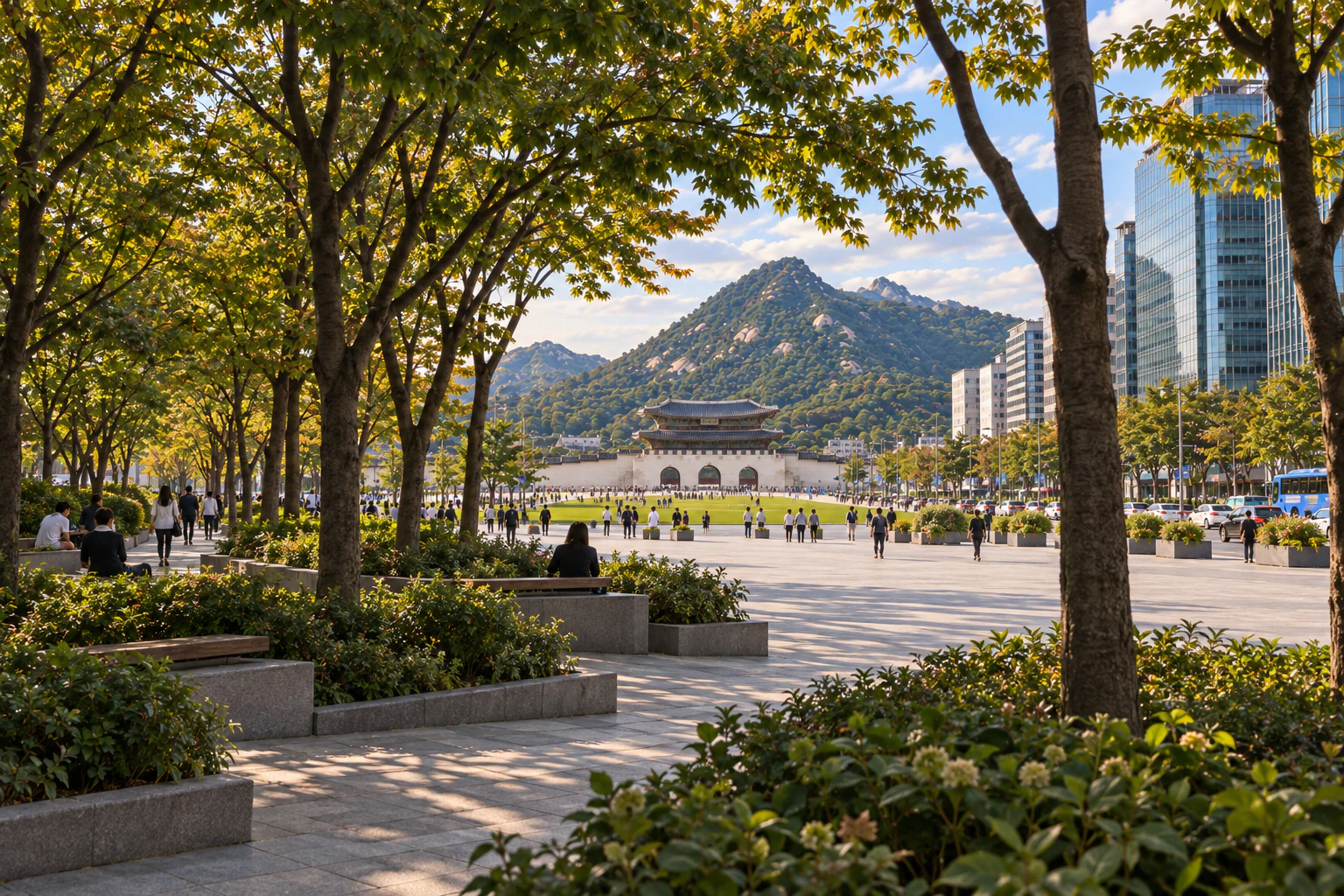
Underfoot there is a waterway. Along the edge of the square, the entry says, a timeline of the Joseon dynasty is carved into the channel. Noah does not read the timeline; he only follows the line of the channel.

In front of Gwanghwamun — the gate of 2010, the square of 2022, the terrace of 2023
In the Joseon period the street in front of Gwanghwamun was Yukjo-geori, the avenue of the government offices outside the palace (Seoul Metropolitan Government). Gwanghwamun was moved to the east side of the palace, north of Geonchunmun, when the Japanese Government-General building was put up; its tower was destroyed in the Korean War; in 1968 it was rebuilt in reinforced concrete and brought back to this site, but about 3.5 degrees off the original axis and about 14.5 m back from the original position. It was dismantled from 2006 and the restoration was completed on 15 August 2010 (Korea Tourism Organization). The street first took the form of a square in 2009, the statue of King Sejong was erected on 9 October 2009, and Gwanghwamun Square reopened in August 2022 (Seoul Metropolitan Government). The restoration of the gate’s stone terrace (woldae) and name board was completed with a ceremony on 15 October 2023, and the terrace opened to the public that day (Korea Heritage Service; Seoul Metropolitan Government).
At the end of the axis is the gate: Gwanghwamun, the main gate of Gyeongbokgung, the gate Maya did not pass through in the first piece. Noah does not go in today either; the square ends at the gate. The Korea Tourism Organization gives the gate’s history like this: moved to the east side of the palace when the Japanese Government-General building was put up; its tower destroyed in the Korean War; rebuilt in reinforced concrete in 1968 and brought back to this site, but off the original axis; then dismantled again from 2006 and fully restored on 15 August 2010. Find on the map

Noah reads that history again, standing on the axis. While the gate stood off to the east, and while it stood off its axis, this axis did not read as it does now. The statue, the gate and the mountain read as one axis only since 2010, when the gate came back to its place. The statue and the first square came in 2009, the square’s present shape in August 2022, the terrace in front of the gate in October 2023. Noah writes the years down. “2009 statue and square. 2010 gate. 2022 the square reopened. 2023 the terrace.”

In the wide space before the gate is the woldae, its stone terrace. The Korea Heritage Service announced that the restoration of the terrace and the name board, begun with the 2006 project to return Gwanghwamun to its original form, was complete, and held a ceremony on 15 October 2023; the city writes that the terrace opened to the public that day. Noah does not climb the terrace; he looks at the gate from in front of it. The reason is different from Maya’s in the first piece, when she could not climb the terrace of Geunjeongjeon. Here the spot for reading the axis is below the terrace.
In front of the terrace sit the haechi (also written haetae). The city lists the haechi statues among the square’s features; the tourism organization writes that the haetae statues were restored. Stone beasts sit before the terrace. Noah does not study their faces for long. To an eye reading an axis, what stands in front of the gate comes first.

He turns around. The square runs long to the south, the statue’s back small at the far end, and beyond it the buildings of the city centre. Looking north the mountain was the end; looking south the buildings are. Noah writes that contrast as his last line. “Two ends of one axis. A mountain and a city.”
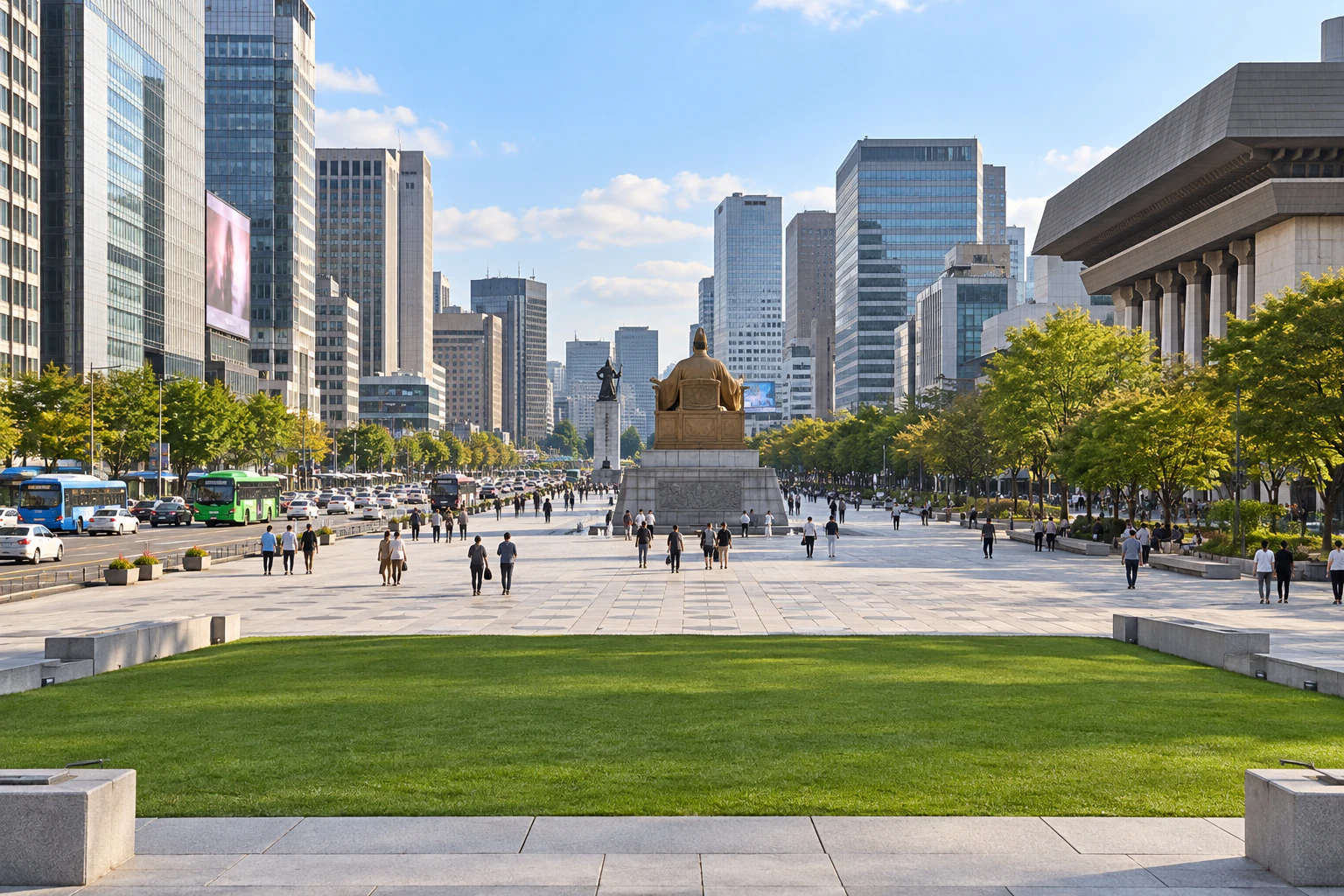
A statue facing south, a gate returned to its place, and the mountain behind it. What Noah read today was a single axis of 340 metres. The screen shows the three separately; stand in the middle of the square and they read as one axis.
Noah’s quiet recommendation is one thing. Come out of Exit 7 of Gwanghwamun Station, pass the statue and walk north, and stop once in the middle of the square. The square is open 24 hours, so the time is yours to choose.

(※ This article includes staged images created with AI.)
Plan your visit
Allow about 40 minutes to come up into the square from Gwanghwamun Station, pass the statue of King Sejong, walk to the front of Gwanghwamun and return across the same square. The inside of the palace (first piece), the Story of King Sejong hall and Haechi Lounge are not included, and walking times are map-route calculations.
A concept diagram of the order · not to scale, not oriented, not the real shape of the road.
- Gwanghwamun Station → statue of King Sejong — About 314 m, 4 minutes from Exit 7 of Gwanghwamun Station (Line 5), the exit marked for the square’s grove. The city also lists the underground link through Haechi Lounge and Exit 6 of Gyeongbokgung Station (Line 3). Find on the map
- Statue → middle of the square — South of the statue, the statue, Gwanghwamun and Bugaksan overlap in one view. Past the statue, heading north, the framing in which the gate and the mountain overlap head-on is toward the middle of the square; from the shade of the grove at the edge, the gate and the mountain sit at an angle. Find on the map
- Middle of the square → front of Gwanghwamun — About 340 m, 5 minutes from the statue to the gate. The axis reads without climbing the stone platform in front of the gate. For the inside of the palace, see the first piece (the courtyard of Geunjeongjeon). Find on the map
- Front of Gwanghwamun → looking back — Turn south and the statue’s back and the city centre are the other end of the axis. Go back down the same square to Gwanghwamun Station. Find on the map
Getting there
TMAPChecked 2026.09.22
From Exit 7 of Gwanghwamun Station (Line 5) to the statue of King Sejong in the square, 314 m, about 4 minutes (TMAP pedestrian routing). The city’s directions give the underground link through Haechi Lounge or Exit 7 (toward the square’s grove) on Line 5, and Exit 6 of Gyeongbokgung Station on Line 3.
Hours & fees
Checked 2026.09.22
Gwanghwamun Square is open 24 hours a day, every day of the year (an open city square). There is no parking. Address: 172 Sejong-daero, Jongno-gu. Gwanghwamun tourist information centre +82-2-735-8688 (Seoul Metropolitan Government’s Gwanghwamun Square site; Korea Tourism Organization).
Background4
TMAPChecked 2026.09.22
From the statue of King Sejong to the front of Gwanghwamun, 340 m, about 5 minutes by map route (TMAP pedestrian routing; routes within the square are indicative).
Checked 2026.09.22
The statue of King Sejong in Gwanghwamun Square is a seated bronze 6.2 m high and 4.3 m wide, facing south on its pedestal, 250 m behind the statue of Admiral Yi Sun-sin. He holds a book in one hand; in front of the statue stand reproductions of an armillary sphere, a rain gauge and a sundial, and a timeline of the Joseon dynasty is carved into the waterway along the edge of the square. Six columns behind the statue carry reliefs of his achievements, and the rear of the pedestal holds the underground entrance to the Story of King Sejong exhibition hall (Korea Tourism Organization).
Checked 2026.09.22
The Korea Tourism Organization introduces Gwanghwamun Square as the conversion of Sejong-daero, a street with 600 years of history, from a road for cars into a space for people, laid out to give a view of Gyeongbokgung and Bugaksan, and describes it in two parts: “the square that restores the history of Gwanghwamun” at the head and “the square that recreates the scenery of Yukjo-geori” around Sejongno Park (traces of the avenue and a scale model). The restoration of the terrace (woldae) and haechi statues in front of Gwanghwamun was completed in October 2023 (Korea Heritage Service; Seoul Metropolitan Government). The city’s facility list includes the Time Waterway, the archaeological features, Haechi Lounge and the square’s grove; the city’s English site names the lounge Haechi Lounge.
Checked 2026.09.22
In the Joseon period the street in front of Gwanghwamun was Yukjo-geori, the avenue of the government offices outside the palace (Seoul Metropolitan Government). Gwanghwamun was moved to the east side of the palace, north of Geonchunmun, when the Japanese Government-General building was put up; its tower was destroyed in the Korean War; in 1968 it was rebuilt in reinforced concrete and brought back to this site, but about 3.5 degrees off the original axis and about 14.5 m back from the original position. It was dismantled from 2006 and the restoration was completed on 15 August 2010 (Korea Tourism Organization). The street first took the form of a square in 2009, the statue of King Sejong was erected on 9 October 2009, and Gwanghwamun Square reopened in August 2022 (Seoul Metropolitan Government). The restoration of the gate’s stone terrace (woldae) and name board was completed with a ceremony on 15 October 2023, and the terrace opened to the public that day (Korea Heritage Service; Seoul Metropolitan Government).
- Gwanghwamun Square is open 24 hours a day, all year, with no parking (Seoul Metropolitan Government’s Gwanghwamun Square site, checked 22 September 2026). Gwanghwamun tourist information centre +82-2-735-8688.
- The statue of King Sejong is a seated figure 6.2 m high and 4.3 m wide facing south, 250 m behind the statue of Admiral Yi Sun-sin (Korea Tourism Organization).