
SEOUL · GWANGHWAMUN
Gyeonghoeru from the Pond Edge: Reading a Pavilion You Climb Only on Certain Days
Maya walks 226 metres from Geunjeongjeon, past Sujeongjeon, to the edge of the water — in the second half of 2026, the upper floor is part of booked special viewings on Wednesdays and Fridays
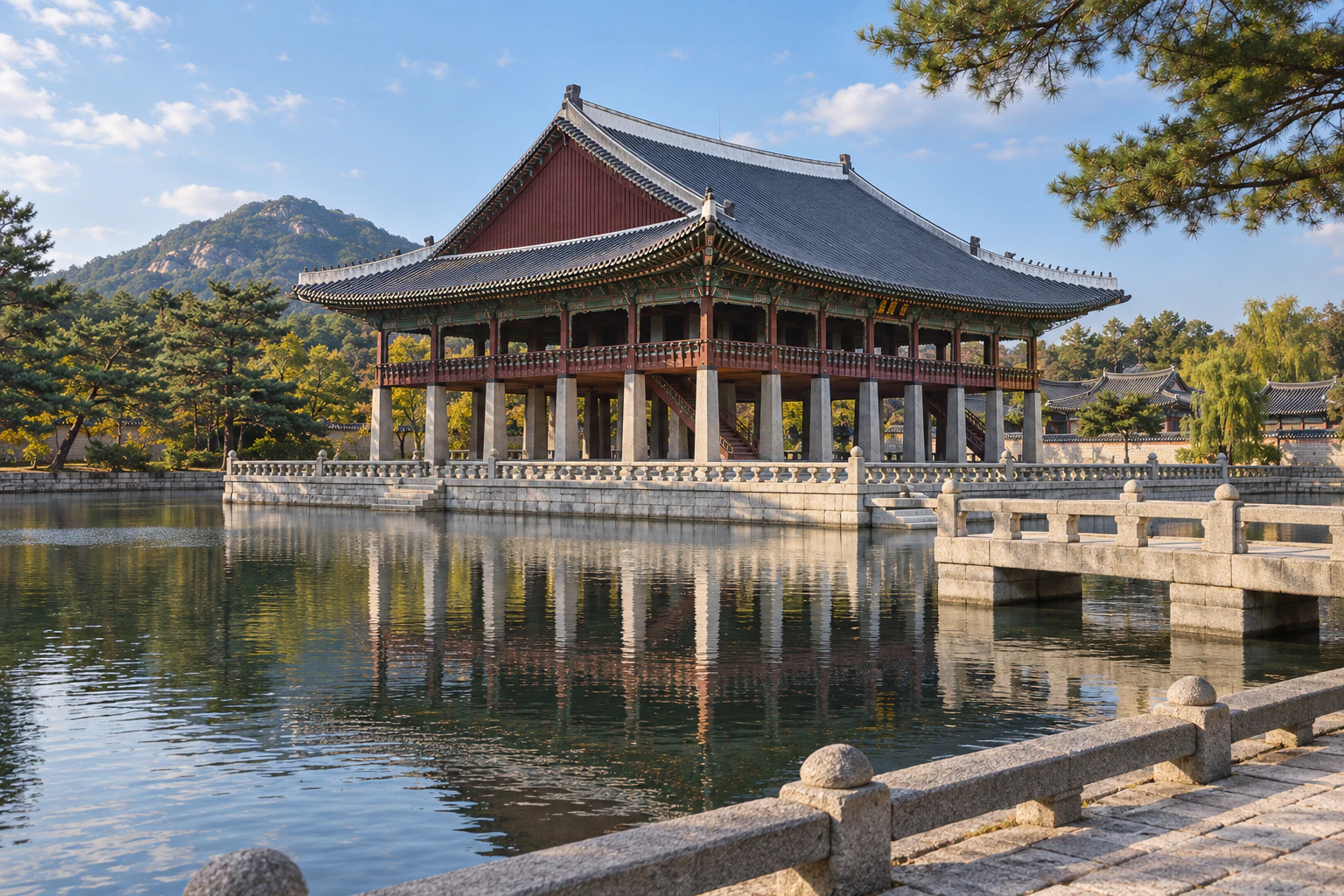
Third in the Gwanghwamun series, second place inside Gyeongbokgung. It is 226 metres north-west of Geunjeongjeon, at the end of the viewing order the Royal Palaces and Tombs Center calls its “40-minute course.” What Maya reads today is what shows from across the water — a square island, stone bridges, the outer row of square columns, seven bays in a long line. The upper floor is for booked special viewings on Wednesdays and Fridays in the second half of 2026, so this is a piece seen from the edge of the pond. Closed Tuesdays; regular admission 3,000 won for adults.
How to get there
The 192 m and 3 minutes in the route box are map-route values from Exit 5 of Gyeongbokgung Station to Heungnyemun. This piece’s route inside the palace, Geunjeongjeon → Gyeonghoeru, is 226 m and 4 minutes (a map-route reference value), and the “40-minute course” is the name the Royal Palaces and Tombs Center gives its official course, not a measured time for this piece. Follow on-site directions on the day.
The second place inside Gyeongbokgung. In the first piece Maya stood in the courtyard of Geunjeongjeon; today she walks north-west from it. By the map route, 226 metres, four minutes. The Royal Palaces and Tombs Center’s 40-minute course runs from Heungnyemun through Yeongjegyo, Geunjeongjeon, Sajeongjeon and Sujeongjeon and ends at Gyeonghoeru. Maya walks it in that order. What waits at the end is a pond.
Gyeonghoeru, too, came to Maya first as a screen. Among the images she had seen were views from inside the pavilion — water between the columns, people seated on the floorboards. Today the measure is not what she cannot climb but what can be read from outside. From across the water she reads the island, the bridges and the columns.
The rule, briefly. The upper floor of Gyeonghoeru is for those with a special-viewing booking. The Center announces the 2026 special viewing for the second half of the year from 2 September to 30 October, on Wednesdays and Fridays. The day Maya goes is neither. So today she stands at the edge of the pond.
Past Sujeongjeon — the end of the 40-minute route
The Royal Palaces and Tombs Center’s course guide gives the 40-minute route through Gyeongbokgung as Heungnyemun → Yeongjegyo → Geunjeongjeon → Sajeongjeon → Sujeongjeon → Gyeonghoeru. Gyeonghoeru also appears on the 60-minute and 90-minute routes.
West of Geunjeongjeon the path widens. She passes Sajeongjeon, then the front of Sujeongjeon. Maya writes down the names one by one but does not go inside. Today’s place is not in front of these halls but beyond them. The 40-minute course ends here, and where it ends there is water. Find it on a map

As she passes Sujeongjeon and draws nearer to Gyeonghoeru, Maya notes a scene in which the water arrives before the pavilion. “The screen starts with the pavilion; this view starts with the water.”
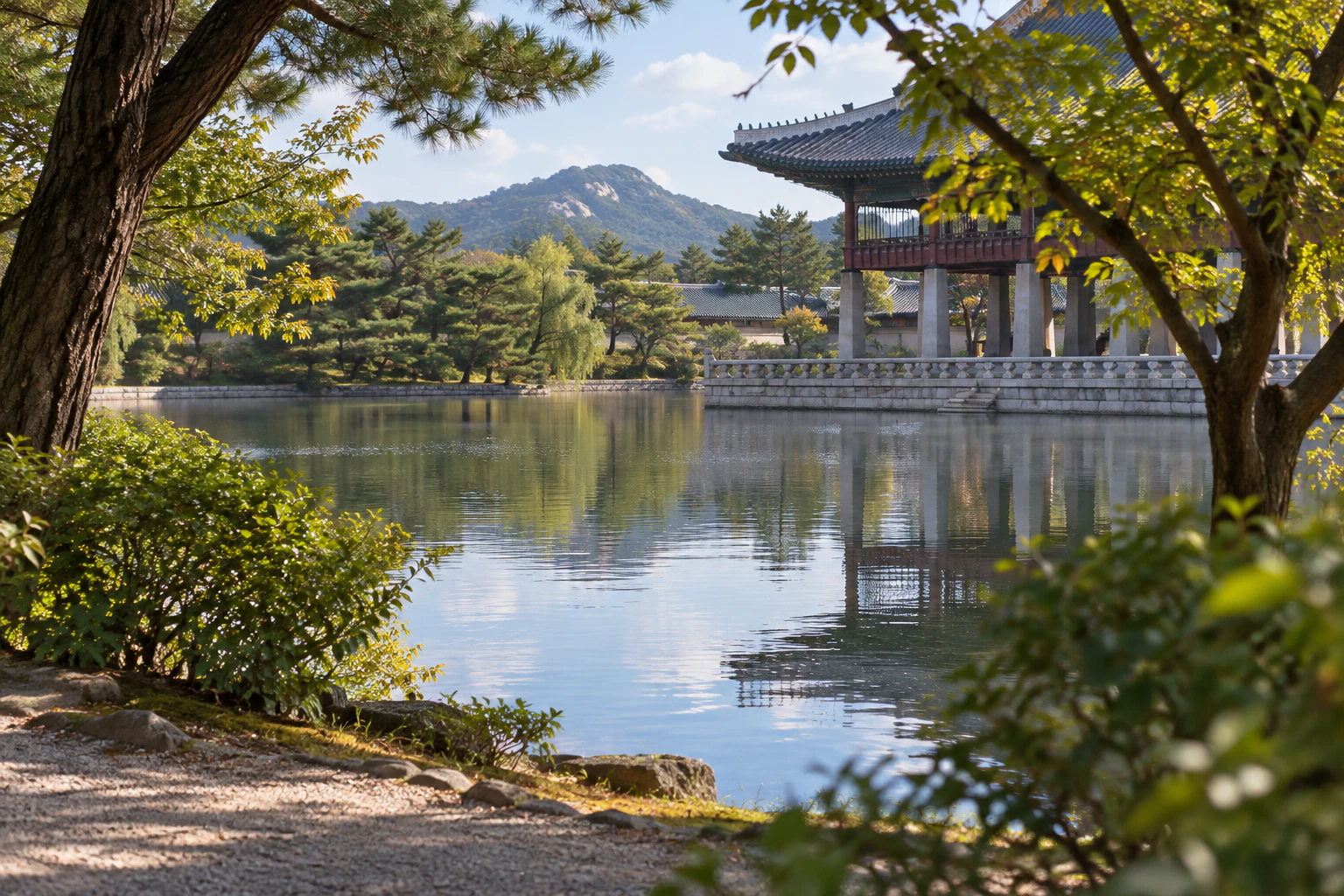
She stops at the edge of the pond. From Geunjeongjeon to here the map route gives 226 metres, four minutes; routes inside the palace are indicative. Maya does not time it. She only notes that the map marked 226 metres.

At the water’s edge — an island and three stone bridges
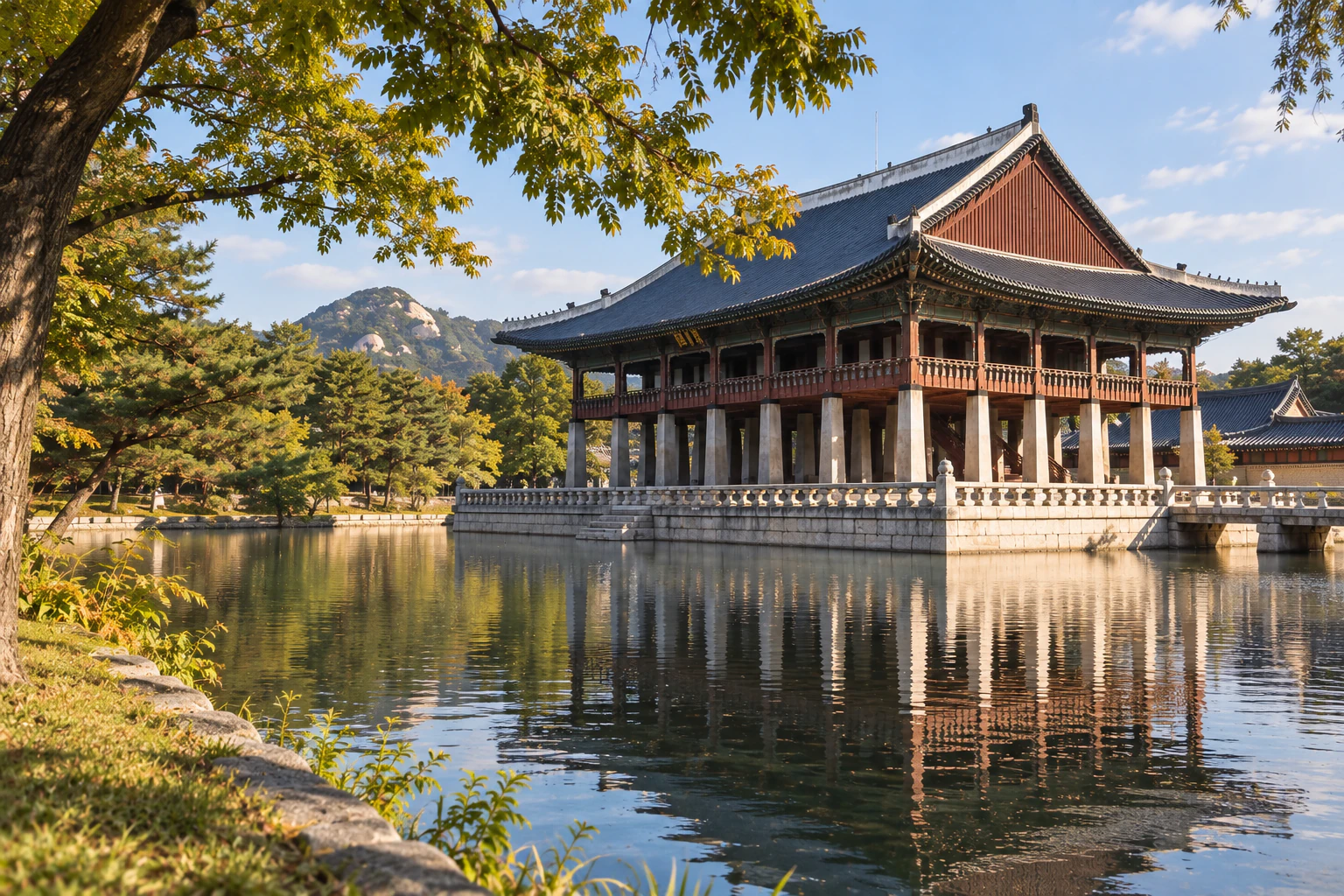
The Korea Heritage Service portal describes Gyeonghoeru of Gyeongbokgung (National Treasure, designated 8 January 1985) as a pavilion built on the pond to the north-west of Geunjeongjeon. Within the pond, dressed lengths of stone were banked up to make a square island for the pavilion, and three stone bridges connect it to the land. The two-storey building is seven bays wide and five bays deep with a hip-and-gable roof, and its bracket sets take the plain form common in pavilion architecture. Square columns stand on the outside and round columns within; the ground floor is paved with square bricks and the upper floor laid with boards at three different heights so that people sat according to rank. It is the largest pavilion in Korea on a single floor plan.
The Korea Heritage Service portal describes Gyeonghoeru like this: built on the pond to the north-west of Geunjeongjeon, it was where banquets were held for state celebrations and for envoys. Within the pond, dressed lengths of stone were banked up to make a square island, the pavilion was built on it, and three stone bridges connect it to the land. What Maya sees is that sentence made solid. A square island on the water, a building on the island, bridges between this bank and that island. Find it on a map

She counts the building. Seven bays across the front, five deep, two storeys. Seven bays means seven spans between columns, and from outside those seven stretch in a long horizontal line. Seen from the side the roof takes the hip-and-gable shape. Under the eaves, the portal says, the bracket sets are not dense as at Geunjeongjeon but take the plain form common in pavilions. Maya thinks of the eaves of Geunjeongjeon and writes the two down side by side.

She looks at the columns. The portal distinguishes square columns on the outside from round columns within. From across the water, the outer row of square columns reads first. “From out here, the square ones first,” she writes.
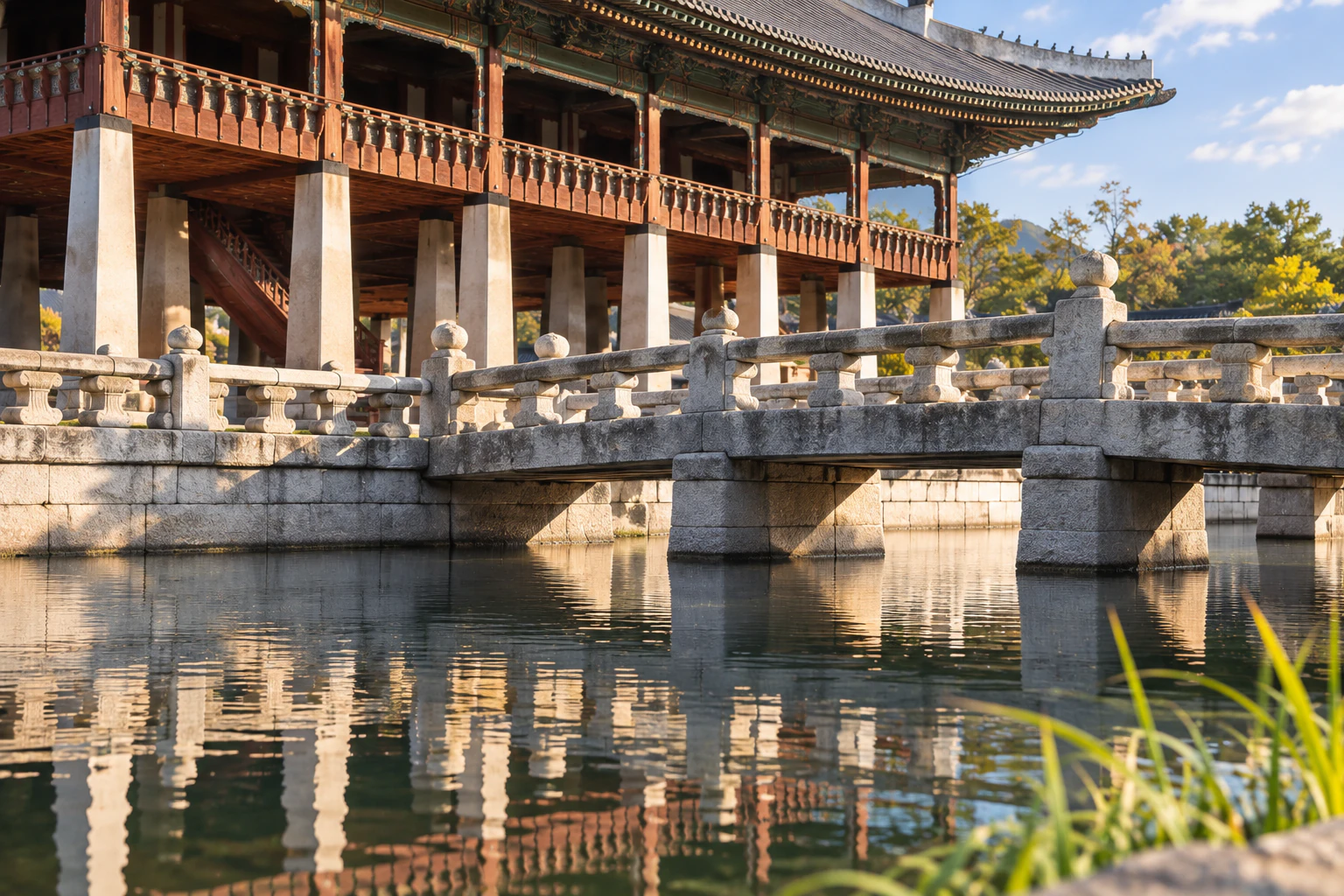
She looks at the bridges. The portal says three stone bridges connect the island to the land. Maya starts with the bridge nearest to her.
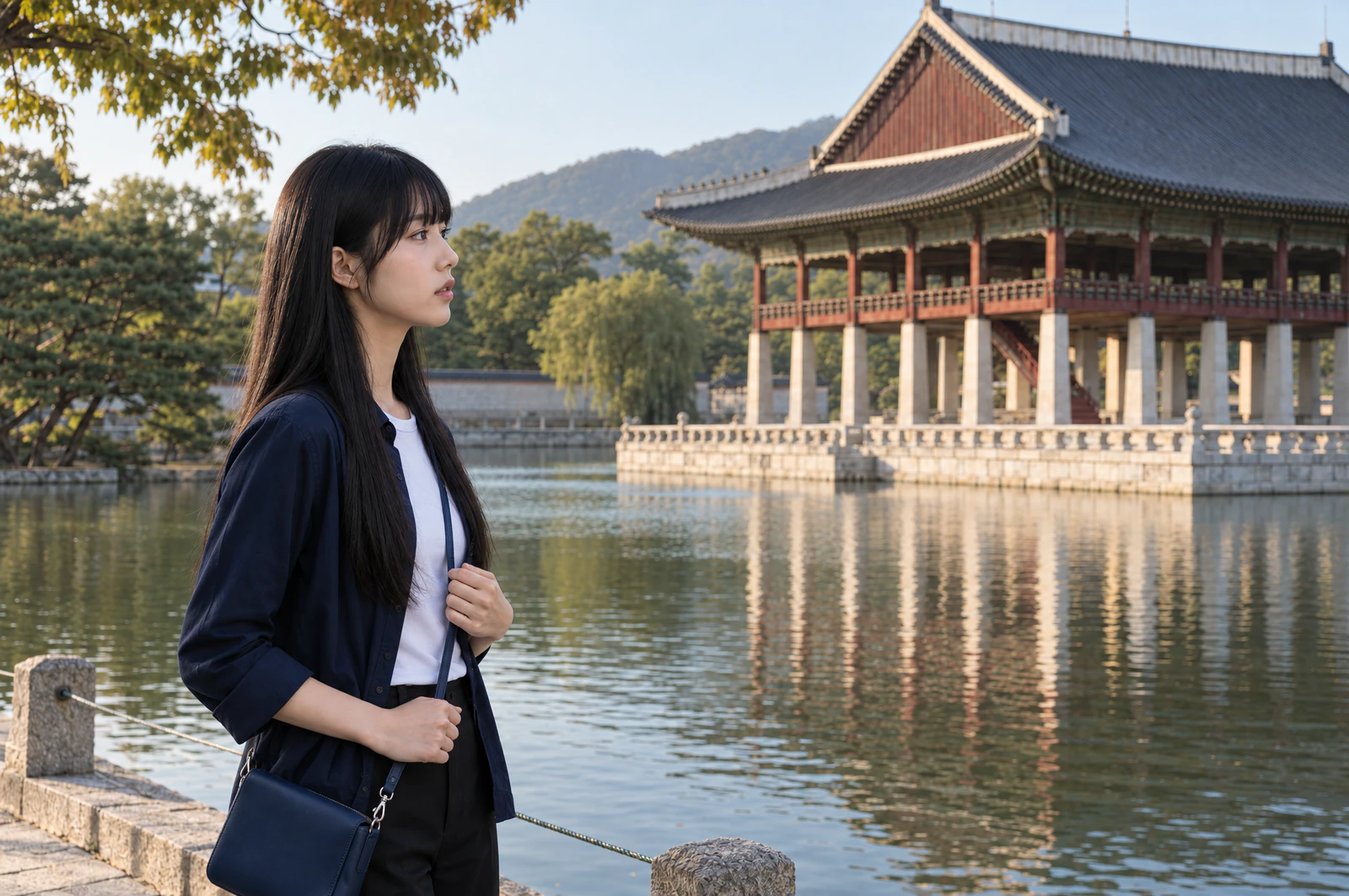
The days you go up — seventy minutes on Wednesdays and Fridays
The Royal Palaces and Tombs Center announces the 2026 special viewing of Gyeonghoeru and Hyangwonjeong at Gyeongbokgung for the second half of the year from Wednesday 2 September to Friday 30 October, on Wednesdays and Fridays (not running over the Chuseok holiday, 24–27 September, on Hangeul Day, 9 October, or during the palace culture festival, 7–11 October). There are two sessions a day, at 10:00 and 14:00, each about 70 minutes, for 25 people, guided by a docent with a special commentary in Korean. Admission to the programme is free; palace admission is separate. Places are booked online in advance on a first-come basis through the Center’s integrated reservation site (two tickets per person, with identity verification); booking runs from 10:00 nine days before the visit to 23:59 three days before. It is open to visitors aged seven and over. Participants wait in front of Hamhongmun by Gyeonghoeru, check-in begins ten minutes before the start, and no one is admitted once a session has begun. There is no commentary in foreign languages, and slippers provided on site must be worn to go up to the pavilion’s upper floor. Enquiries +82-2-3700-3900 (Gyeongbokgung Office).
The rules for the days you go up run long. Wednesdays and Fridays, 10:00 and 14:00, about seventy minutes a session, twenty-five people. Booking runs from 10:00 nine days before the visit to 23:59 three days before. Visitors aged seven and over may join. Check-in begins ten minutes before the start, and once a session has begun no one is admitted. Find it on a map

Two more lines are written there. That there is no commentary in foreign languages, and that, to protect the heritage and for safety, slippers provided on site are to be worn on the upper floor. The portal says the upper floor is laid with boards at three different heights so that people sat according to rank. Maya writes down “three heights.”
The guidance gives the waiting point as in front of Hamhongmun by Gyeonghoeru. Today’s Maya is not a booked visitor. Instead she walks a little further along the water. As the angle changes, the spaces between the columns overlap. The number seven and the rhythm the eye takes in are not the same thing.
1412 and 1867 — the 270 years of bare stone columns
According to the Korea Heritage Service portal, Gyeonghoeru was where banquets were held for state celebrations and for visiting envoys. Small when Gyeongbokgung was first built, it was rebuilt on a large scale in 1412, the twelfth year of King Taejong, when the pond was widened; it burned in the Imjin War so that only its stone columns remained, and was rebuilt some 270 years later in 1867, the fourth year of King Gojong, together with the rest of Gyeongbokgung.
The years. The Gyeonghoeru of the palace’s founding was small; in 1412, the twelfth year of King Taejong, it was rebuilt on a large scale as the pond was widened. It burned in the Imjin War, leaving only its stone columns, and stood that way until it was rebuilt some 270 years later in 1867, the fourth year of King Gojong, when Gyeongbokgung itself was rebuilt. The building on the water now is that building of 1867, designated a National Treasure on 8 January 1985. Find it on a map

Maya reads the phrase about the stone columns twice. It means that for some 270 years this pond held a roofless stand of stone columns. The building Maya saw on screen was always the finished one — reflected in the water, lit up, with people seated inside.
Last, she steps back to find the place where the whole building fits in one view. There is a point where the water is in front of you and you cannot step back any further. That is as far as today goes. “Today this is my spot,” she writes in her notebook.
A square island on the water, stone bridges, seven bays in a long line, the outer row of square columns. What Maya read today were the things that read from outside. The three-tiered wooden floor is part of the second-floor special viewing.
Maya’s quiet recommendation is simple: at Gyeonghoeru, do not look from one spot only — walk a little along the water. The rhythm of the columns changes with the angle. If you want the upper floor, check the special-viewing dates and booking window in the Center’s guidance for the day you visit. Gyeongbokgung is closed on Tuesdays.

(※ This article includes staged images created with AI.)
Making it your afternoon
An editorial suggestion: after the courtyard of Geunjeongjeon, walk on to the edge of the Gyeonghoeru pond and shift your angle a few steps along the water. The upper floor is a booked special viewing; 226 m and 4 minutes are map-route values from the Geunjeongjeon POI to the Gyeonghoeru POI.
A diagram of the order only — not to scale, not oriented, and not the actual shape of the route.
- Geunjeongjeon → Sajeongjeon and Sujeongjeon — Leave Geunjeongjeon on its west side and pass in front of Sajeongjeon and Sujeongjeon. The order the Center calls its “40-minute course” runs Heungnyemun → Yeongjegyo → Geunjeongjeon → Sajeongjeon → Sujeongjeon → Gyeonghoeru (a course name, not a measured time for this piece). Find it on a map
- Sujeongjeon → the pond edge — About 226 m, 4 minutes from Geunjeongjeon to Gyeonghoeru by map route (routes inside the palace are indicative). Find it on a map
- At the edge → along the water — Do not look from a single spot; walk along the water. As the angle changes, the spaces between the columns overlap. Find it on a map
- To go up to the second floor — Only special-viewing bookings go up, on Wednesdays and Fridays (second half of 2026; 10:00 and 14:00, about 70 minutes, 25 people, free with separate palace admission). The guidance gives the waiting point as in front of Hamhongmun; no entry once a session starts; commentary is in Korean; slippers provided on site are worn upstairs. Find it on a map
Getting there
TMAPChecked 2026.09.22
From Exit 5 of Gyeongbokgung Station (Line 3) to the map POI for Heungnyemun (the routing endpoint), 192 m, about 3 minutes (TMAP pedestrian routing). The Royal Palaces and Tombs Center gives 2 minutes on foot from Exit 5 of Gyeongbokgung Station and 6 minutes from Exit 1 of Anguk Station. Address: 161 Sajik-ro, Jongno-gu.
Hours & fees
Checked 2026.09.22
Gyeongbokgung is closed on Tuesdays (open if the Tuesday is a public holiday or substitute holiday, closing on the next non-holiday instead). Hours are 09:00–18:00 (last entry 17:00) from March to May and September to October, 09:00–18:30 (last entry 17:30) from June to August, and 09:00–17:00 (last entry 16:00) from November to February. Enquiries +82-2-3700-3900 (Royal Palaces and Tombs Center).
Checked 2026.09.22
Regular admission to Gyeongbokgung is 3,000 won for adults (Koreans aged 25–64, foreign visitors aged 19–64). Temporary free-admission periods and other short-term exceptions should be checked against the Royal Palaces and Tombs Center notices for the day of the visit.
Checked 2026.09.22
The Royal Palaces and Tombs Center announces the 2026 special viewing of Gyeonghoeru and Hyangwonjeong at Gyeongbokgung for the second half of the year from Wednesday 2 September to Friday 30 October, on Wednesdays and Fridays (not running over the Chuseok holiday, 24–27 September, on Hangeul Day, 9 October, or during the palace culture festival, 7–11 October). There are two sessions a day, at 10:00 and 14:00, each about 70 minutes, for 25 people, guided by a docent with a special commentary in Korean. Admission to the programme is free; palace admission is separate. Places are booked online in advance on a first-come basis through the Center’s integrated reservation site (two tickets per person, with identity verification); booking runs from 10:00 nine days before the visit to 23:59 three days before. It is open to visitors aged seven and over. Participants wait in front of Hamhongmun by Gyeonghoeru, check-in begins ten minutes before the start, and no one is admitted once a session has begun. There is no commentary in foreign languages, and slippers provided on site must be worn to go up to the pavilion’s upper floor. Enquiries +82-2-3700-3900 (Gyeongbokgung Office).
Background4
TMAPChecked 2026.09.22
From Geunjeongjeon to Gyeonghoeru, 226 m, about 4 minutes by map route (TMAP pedestrian routing; routes inside the palace are indicative).
Checked 2026.09.22
The Royal Palaces and Tombs Center’s course guide gives the 40-minute route through Gyeongbokgung as Heungnyemun → Yeongjegyo → Geunjeongjeon → Sajeongjeon → Sujeongjeon → Gyeonghoeru. Gyeonghoeru also appears on the 60-minute and 90-minute routes.
Checked 2026.09.22
The Korea Heritage Service portal describes Gyeonghoeru of Gyeongbokgung (National Treasure, designated 8 January 1985) as a pavilion built on the pond to the north-west of Geunjeongjeon. Within the pond, dressed lengths of stone were banked up to make a square island for the pavilion, and three stone bridges connect it to the land. The two-storey building is seven bays wide and five bays deep with a hip-and-gable roof, and its bracket sets take the plain form common in pavilion architecture. Square columns stand on the outside and round columns within; the ground floor is paved with square bricks and the upper floor laid with boards at three different heights so that people sat according to rank. It is the largest pavilion in Korea on a single floor plan.
Checked 2026.09.22
According to the Korea Heritage Service portal, Gyeonghoeru was where banquets were held for state celebrations and for visiting envoys. Small when Gyeongbokgung was first built, it was rebuilt on a large scale in 1412, the twelfth year of King Taejong, when the pond was widened; it burned in the Imjin War so that only its stone columns remained, and was rebuilt some 270 years later in 1867, the fourth year of King Gojong, together with the rest of Gyeongbokgung.
- Gyeongbokgung is closed on Tuesdays (open if the Tuesday is a public holiday or substitute holiday, closing on the next non-holiday instead). Hours 09:00–18:00 (last entry 17:00) March–May and September–October, 09:00–18:30 (last entry 17:30) June–August, 09:00–17:00 (last entry 16:00) November–February. Regular admission 3,000 won for adults; check the notices for the day you visit for temporary free-admission periods. Enquiries +82-2-3700-3900 (Royal Palaces and Tombs Center; Gyeongbokgung Office, checked 22 September 2026).
- The 2026 special viewing of Gyeonghoeru and Hyangwonjeong runs 2 September to 30 October in the second half of the year, on Wednesdays and Fridays (not over the Chuseok holiday, 24–27 September, on Hangeul Day, 9 October, or during the palace culture festival, 7–11 October). Booking is first-come on the Center’s integrated reservation site, two tickets per person, from 10:00 nine days before to 23:59 three days before. The cancellation deadline is given differently in the Center’s notice and on its event page; check the deadline on the booking screen when you book. Ages seven and over. Arrangements after that should be checked again.
More from this area

Hyangwonjeong from the Water’s Edge: A Six-Sided Pavilion with Its Bridge Behind It
Fourth in the Gwanghwamun series, third place inside Gyeongbokgung.

The National Folk Museum’s Forecourt: An Afternoon Between a House That Was Moved and a Street That Was Rebuilt
Fifth in the Gwanghwamun series, and the last of four places at Gyeongbokgung.