SEOUL · GWANGHWAMUN
The Wide Courtyard Before Geunjeongjeon
Three minutes from Exit 5 of Gyeongbokgung Station brings you to Heungnyemun, and two gates later you are in the courtyard of Geunjeongjeon.
How to get there
The route uses the map app’s Heungnyemun marker as its calculation endpoint; 192 m and 3 minutes are map-route values to that POI. From the Exit 5 side, visitors can enter the Heungnyemun forecourt through the side entrance without detouring to Gwanghwamun. Tickets are available around the Heungnyemun forecourt; follow on-site directions on the day.
If the Bukchon pieces stayed within walking distance of Anguk Station, this series goes west: to Gyeongbokgung, Gwanghwamun Square and Cheonggyecheon. The first place is the middle of Gyeongbokgung, the courtyard in front of Geunjeongjeon. Maya goes. In Insadong she spent two pieces writing down the gap between screen and reality. Today may be the place where that gap is widest.
For Maya, Geunjeongjeon arrived first as a screen. A king stands there, and close behind his back are red columns and a roof in two tiers. The camera was always near. The Korea Heritage Service portal describes it as the main hall of Gyeongbokgung, the principal palace of the Joseon dynasty, where New Year respects were paid, state ceremonies held and foreign envoys received. As she walks in, Maya reads that the building she first knew on screen was in fact a setting for these state ceremonies.
One thing first. The Royal Palaces and Tombs Center has announced that, because peak-season crowds risk damaging the stone railings and other stonework, access to the hall’s stone terrace, the woldae, is restricted from 2 September to 31 October 2026. Maya’s day falls inside that window. So today she does not climb the terrace; she looks from the courtyard. Not the spot the screen showed, but the spot where the officials stood.
From Exit 5 of Gyeongbokgung Station — two gates before the courtyard
From Exit 5 of Gyeongbokgung Station (Line 3) to the map POI for Heungnyemun (the routing endpoint), 192 m, about 3 minutes (TMAP pedestrian routing). The Royal Palaces and Tombs Center gives 2 minutes on foot from Exit 5 of Gyeongbokgung Station and 6 minutes from Exit 1 of Anguk Station. Address: 161 Sajik-ro, Jongno-gu.
Out of Exit 5 of Gyeongbokgung Station on Line 3, the palace is right beside you. By the map route it is 192 metres, three minutes, to Heungnyemun; the Royal Palaces and Tombs Center says two minutes on foot. Maya does not go round to Gwanghwamun; she enters the Heungnyemun forecourt through the side entrance on the Exit 5 side. She buys a ticket at the booths by the forecourt. Regular admission is 3,000 won for adults. Find on the map
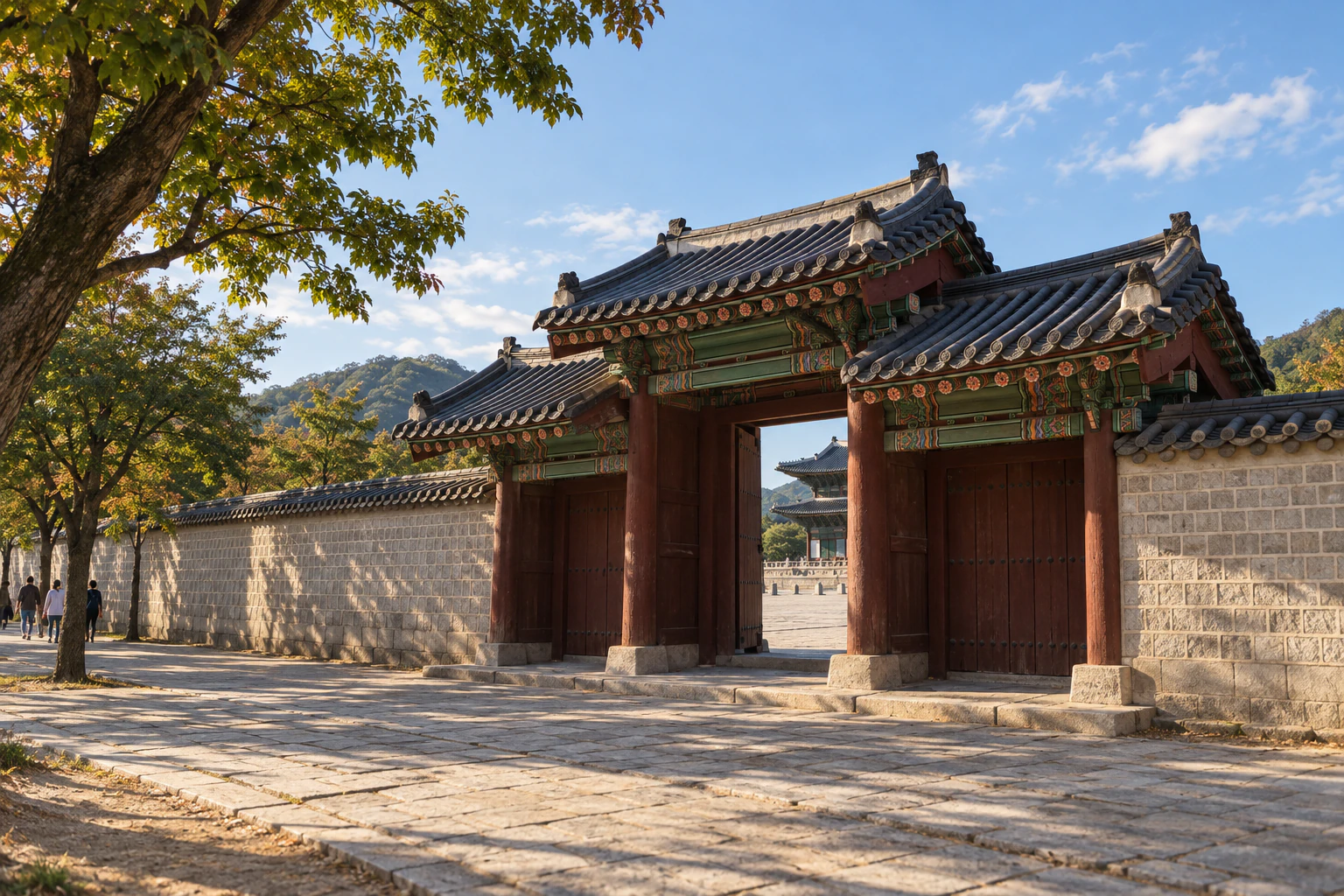
The first gate is Heungnyemun. Through it is a wide forecourt, and at its far end another gate: Geunjeongmun. Maya counts. “One gate, one courtyard, one gate, then Geunjeongjeon.” On screen there was no such order; the screen started at Geunjeongjeon. Here the hall is at the end of the second courtyard.
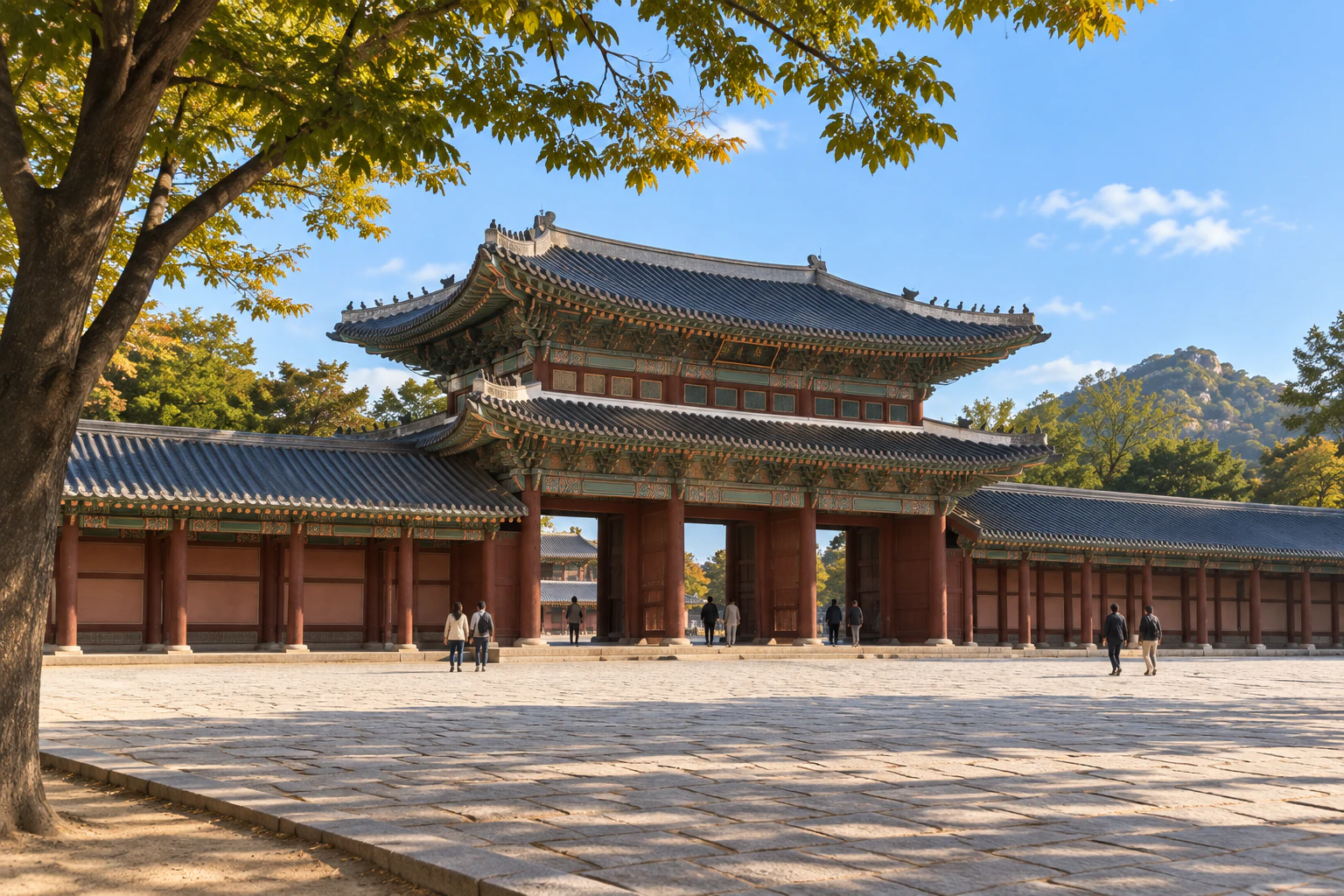
Standing in front of Geunjeongmun you can see the building through the gateway. Still far. Maya pauses under the gate. Past it the courtyard opens out, and that width is the first thing the screen never had.

Between the rank stones — where the officials stood
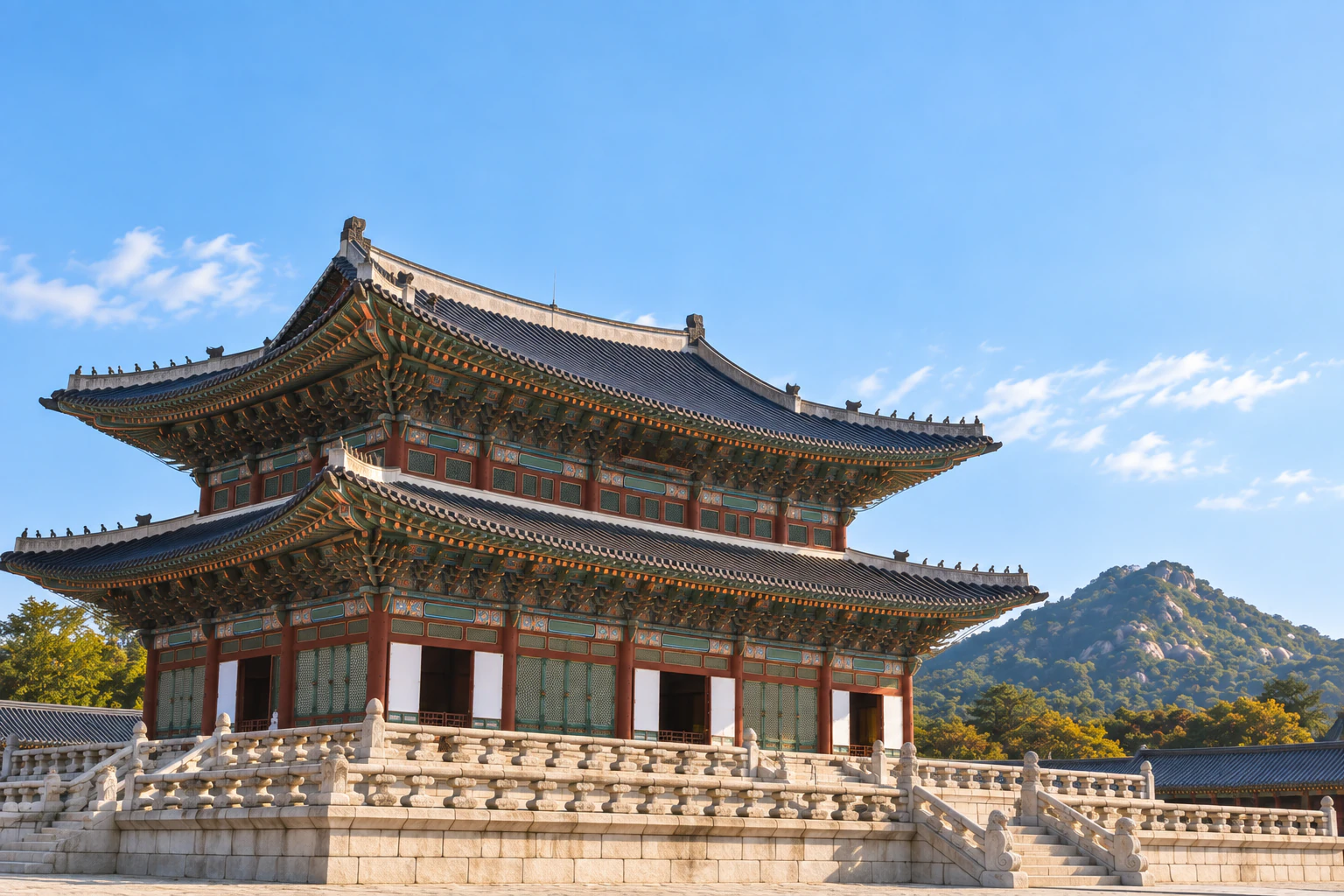
Geunjeongjeon, a National Treasure, is the main hall of Gyeongbokgung, the principal palace of the Joseon dynasty, where officials paid New Year respects to the king, state ceremonies were held and foreign envoys were received. First built in 1395, it saw the enthronement of several early Joseon kings including Jeongjong and Sejong. The name, chosen by Jeong Do-jeon, means that the affairs of the realm are governed well through diligence. The present hall, rebuilt in 1867 after the original burned in the Japanese invasion of 1592, is a two-storey building five bays wide and five deep with a hip-and-gable roof and multi-bracket eaves. Animal figures including the twelve zodiac animals are carved at the corners of the stone terrace and on the stair railings; rank stones line the path from the hall to Geunjeongmun Gate; rings for awnings remain in the courtyard; and corridors enclose the hall (Korea Heritage Service portal).
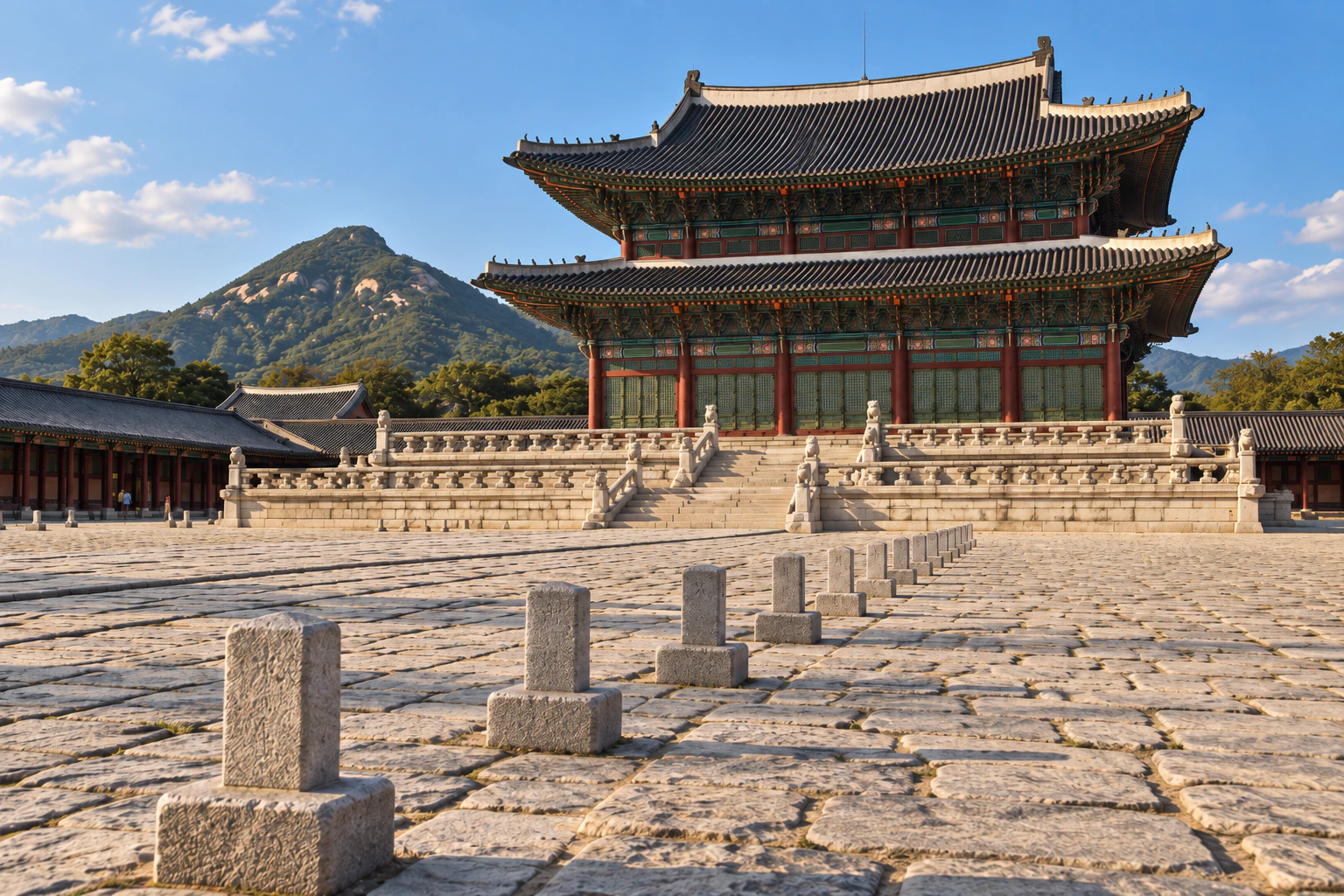
Through Geunjeongmun is the courtyard. The heritage portal describes it like this: along the path from Geunjeongjeon to Geunjeongmun, rank stones marking the positions of civil and military officials stand in order on either side; rings once used to hold awnings against the sun remain in the courtyard; and corridors run from around Geunjeongmun to enclose the hall. What Maya sees is that sentence made solid. Stone posts stand in two lines, and between them a stone path runs to the hall. Find on the map
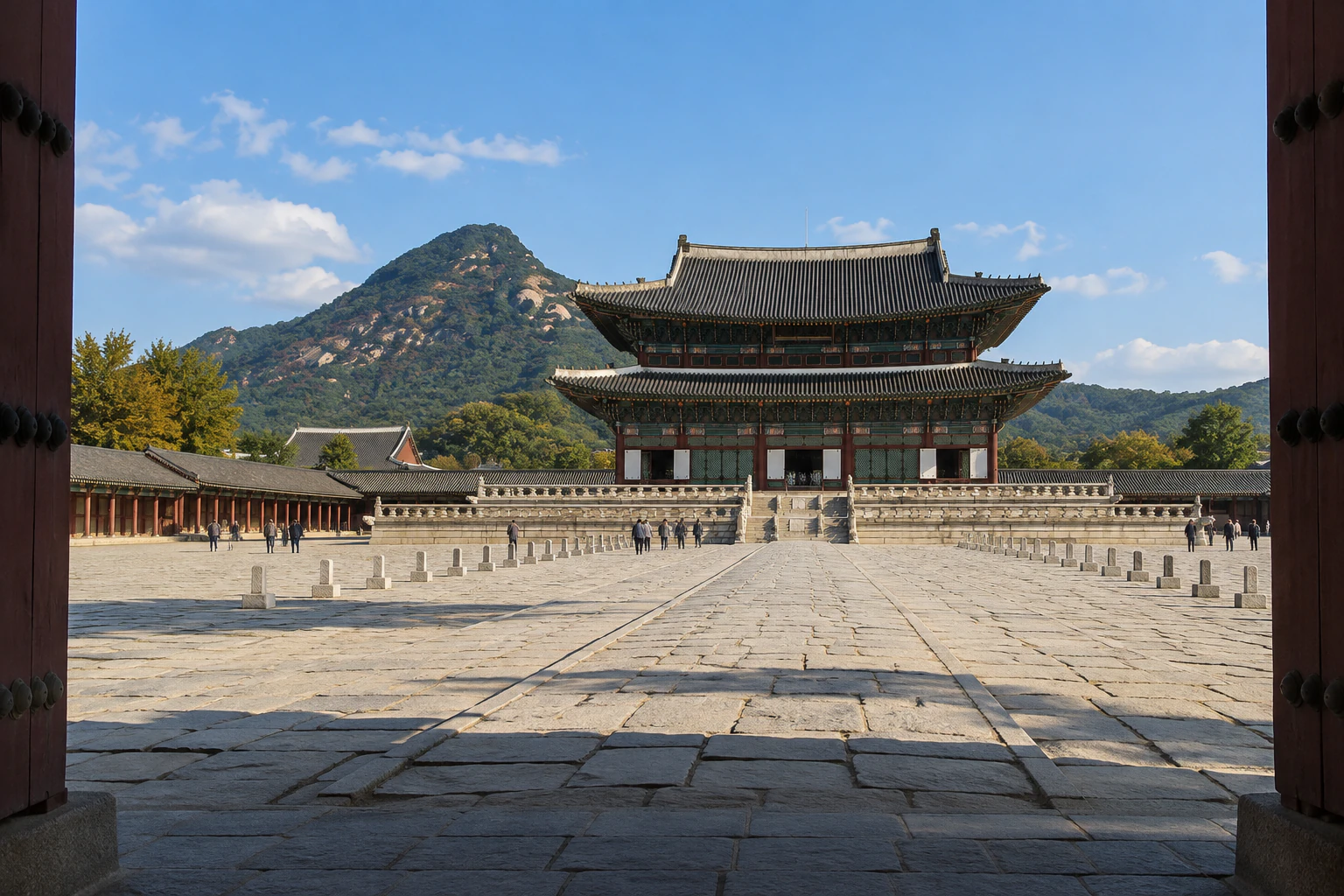
Maya stands beside one line of rank stones. There are characters cut into the stone, but she does not read them; she looks at the positions. That they were set out in order to mark the officials’ positions is as far as the portal’s sentence goes. Maya stands toward the back of one line. From here the hall looks small. The roof that sat close behind the king’s back on screen is, from here, two tiers stacked at the far end of the courtyard.
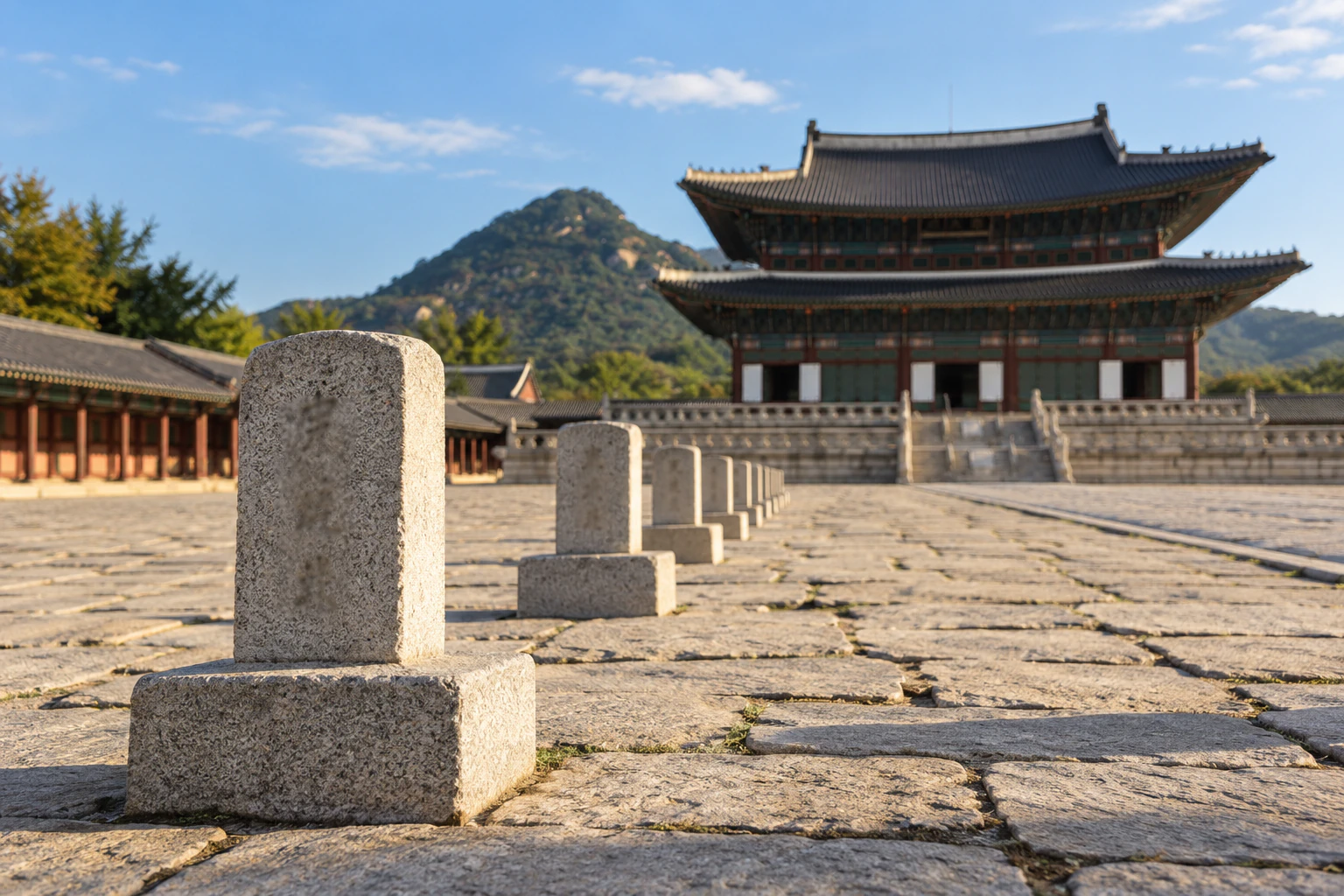
“The screen shot from the front; I’m standing at the back.” Maya’s note. From the back of the line, a long stretch of courtyard remains between her and the hall. The distance the screen showed was the camera’s. Maya likes that difference. Of all the gaps a first-time visitor meets between screen and reality, this one is distance.
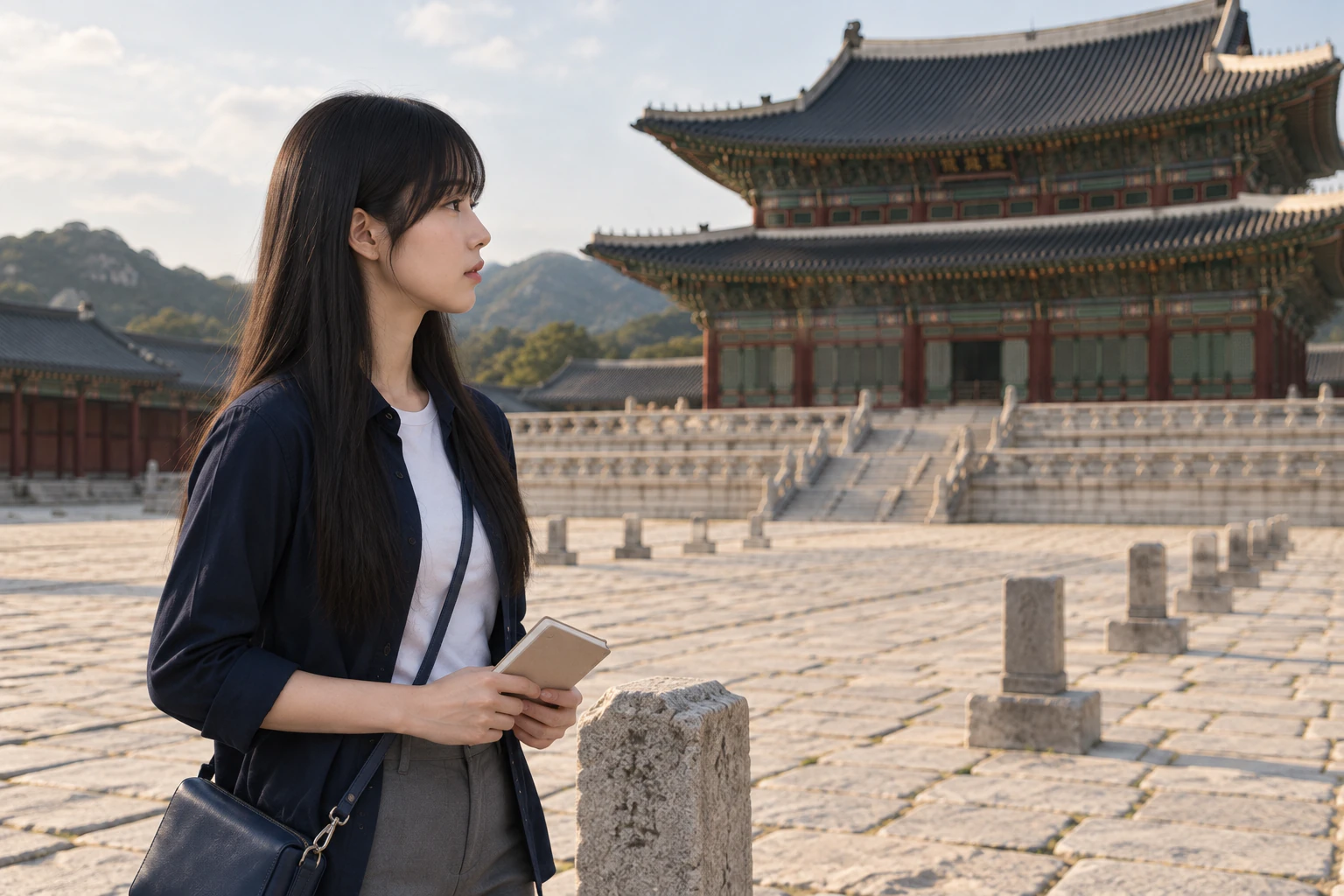
She looks down. The stones of the courtyard are uneven. Maya slows so as not to trip. Where the awning rings are, she could not find today. She writes “awning ring” in her notebook.
Below the terrace — Geunjeongjeon from the foot of the steps
Royal Palaces and Tombs Center notice (30 August 2026): because heavy peak-season visitor numbers risk damaging the stone railings and other stonework of Geunjeongjeon, access to the hall’s stone terrace (woldae) is restricted from Wednesday 2 September to Saturday 31 October 2026.
She crosses the courtyard to the foot of the hall. The building stands on a two-level stone platform, the woldae. The heritage portal notes that animal figures, including the twelve zodiac animals, are carved at the corners of the terrace and on the railing posts of its stairs. Maya looks at the animals on the railings from the bottom of the steps. Today this is as far as she goes: as the Center’s notice says, from 2 September to 31 October the terrace cannot be entered. Find on the map
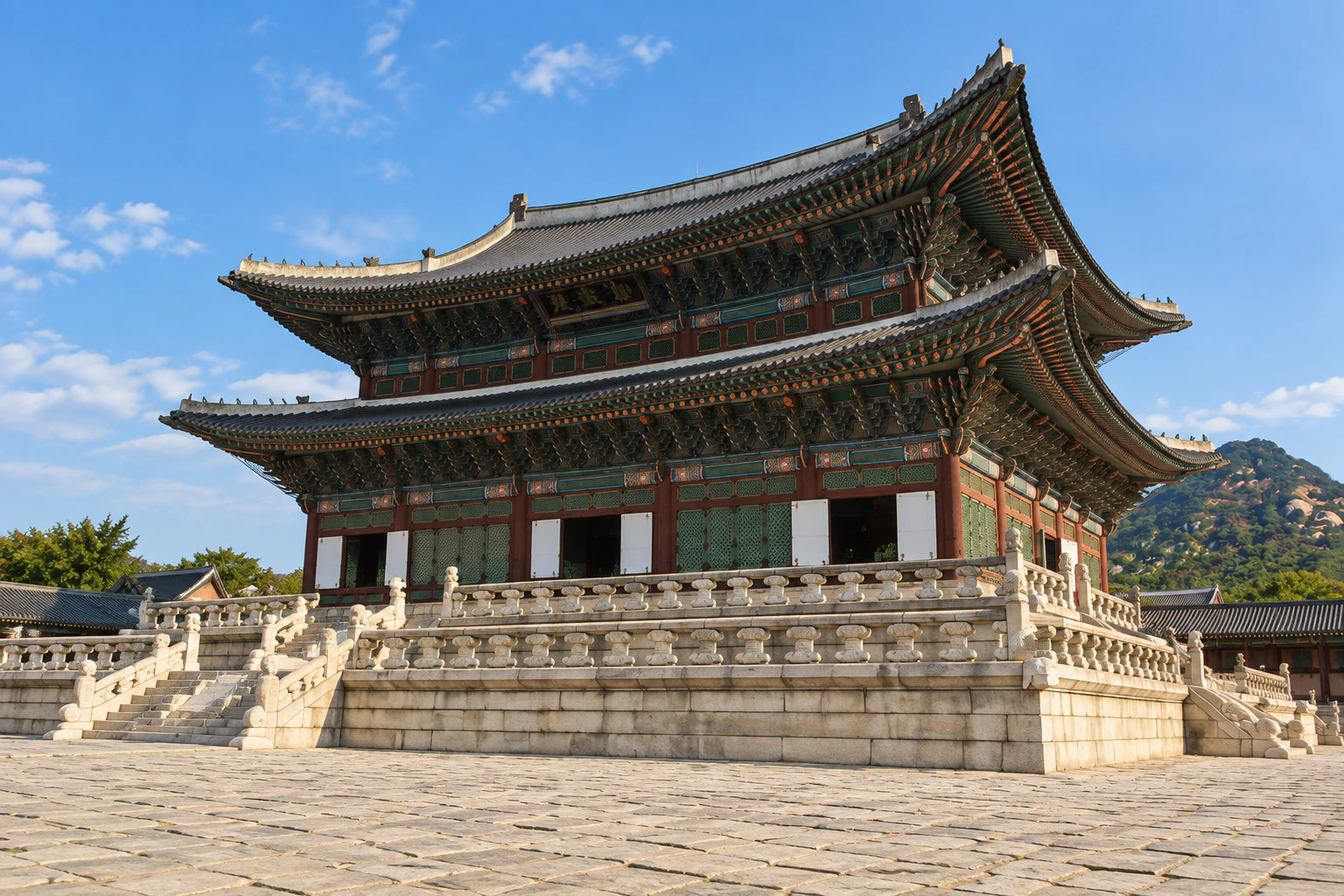
Maya reads the notice again. The reason was that heavy peak-season crowds might damage the stone railings and other stonework. She looks once more at the animal figures on the railing posts. They are visible from below the steps. “Today I look from here,” she writes.
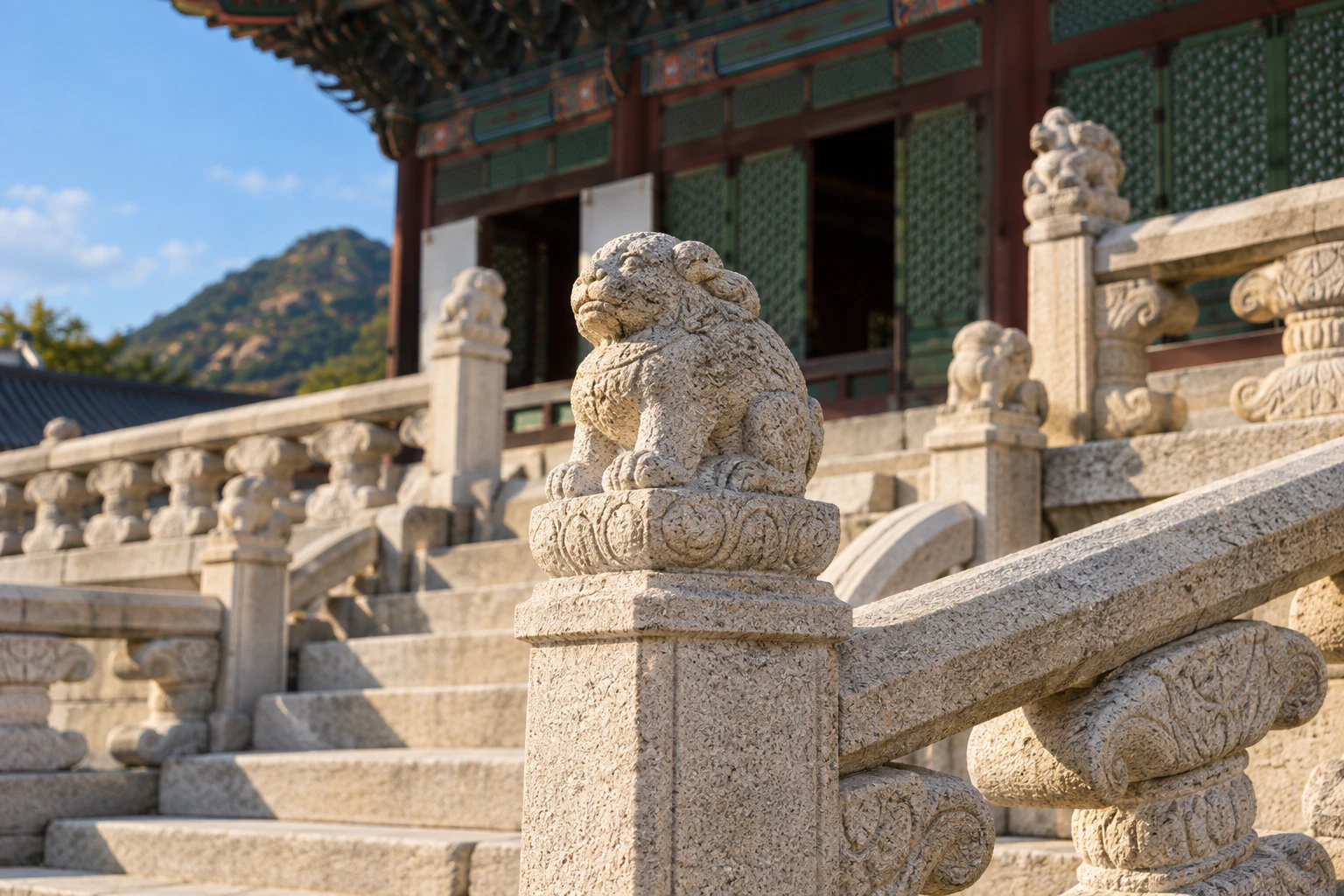
From below the terrace it becomes clear that the roof is in two tiers. Five bays across, five deep, two storeys. Seen from the side the roof is a hip-and-gable roof, and under the eaves the bracket structure is packed tight, over the columns and between them too — a multi-bracket building, the signs say. Maya writes down the name and looks at the shape. On screen the roof was always cropped. Here both tiers are in view.
She does not go inside; the limit is what can be seen from outside the doors. Maya steps back from the foot of the stairs to find the spot where the whole building fits in one view. It is about the middle of the courtyard. A spot the screen never stood on.
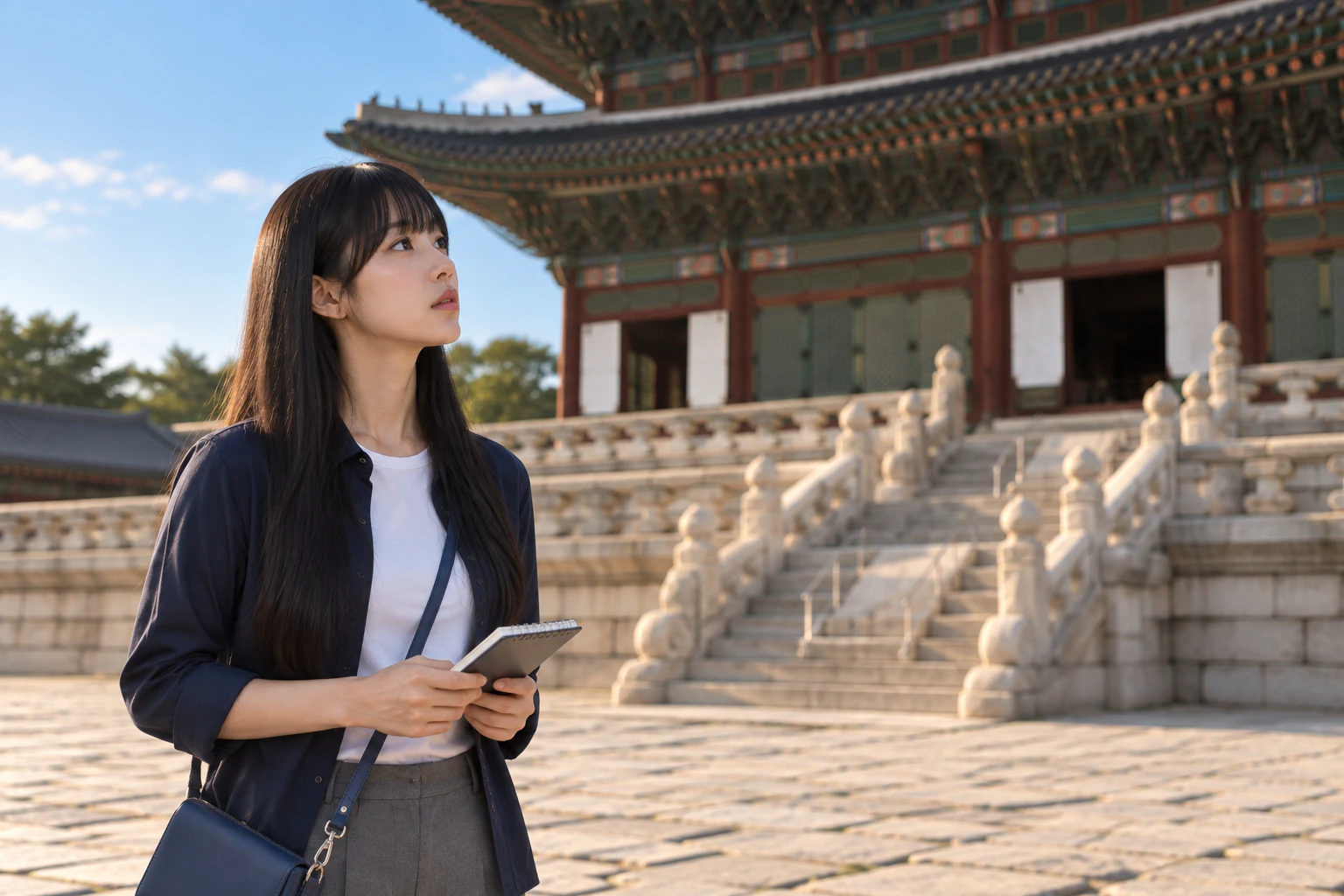
In the shade of the corridors — 1395, 1867 and what lay between
Gyeongbokgung, founded in 1395, was the principal palace of the Joseon dynasty and the centre of the capital, set against Baegaksan (Bugaksan) with the avenue of the six ministries running south from its main gate, Gwanghwamun. The name means that the new dynasty will enjoy great fortune and prosper. Burned in the Japanese invasion of 1592, it stood in ruins for some 270 years until it was rebuilt in 1867. Most of its buildings were demolished in 1915 on the pretext of an industrial exposition, and the Japanese Government-General building was erected on the grounds in 1926. Restoration began in earnest in the 1990s; the Government-General building was demolished in 1995–97, and Heungnyemun, Gwanghwamun and other areas have since been rebuilt (Royal Palaces and Tombs Center).
The edges of the courtyard are corridors: long roofed galleries. Maya steps into their shade and stands rather than sits. From here there is a mountain behind the hall. The Royal Palaces and Tombs Center writes that Gyeongbokgung was set against Baegaksan, today’s Bugaksan, as its guardian mountain. That there is a mountain behind the building is another thing the screen never had. Find on the map
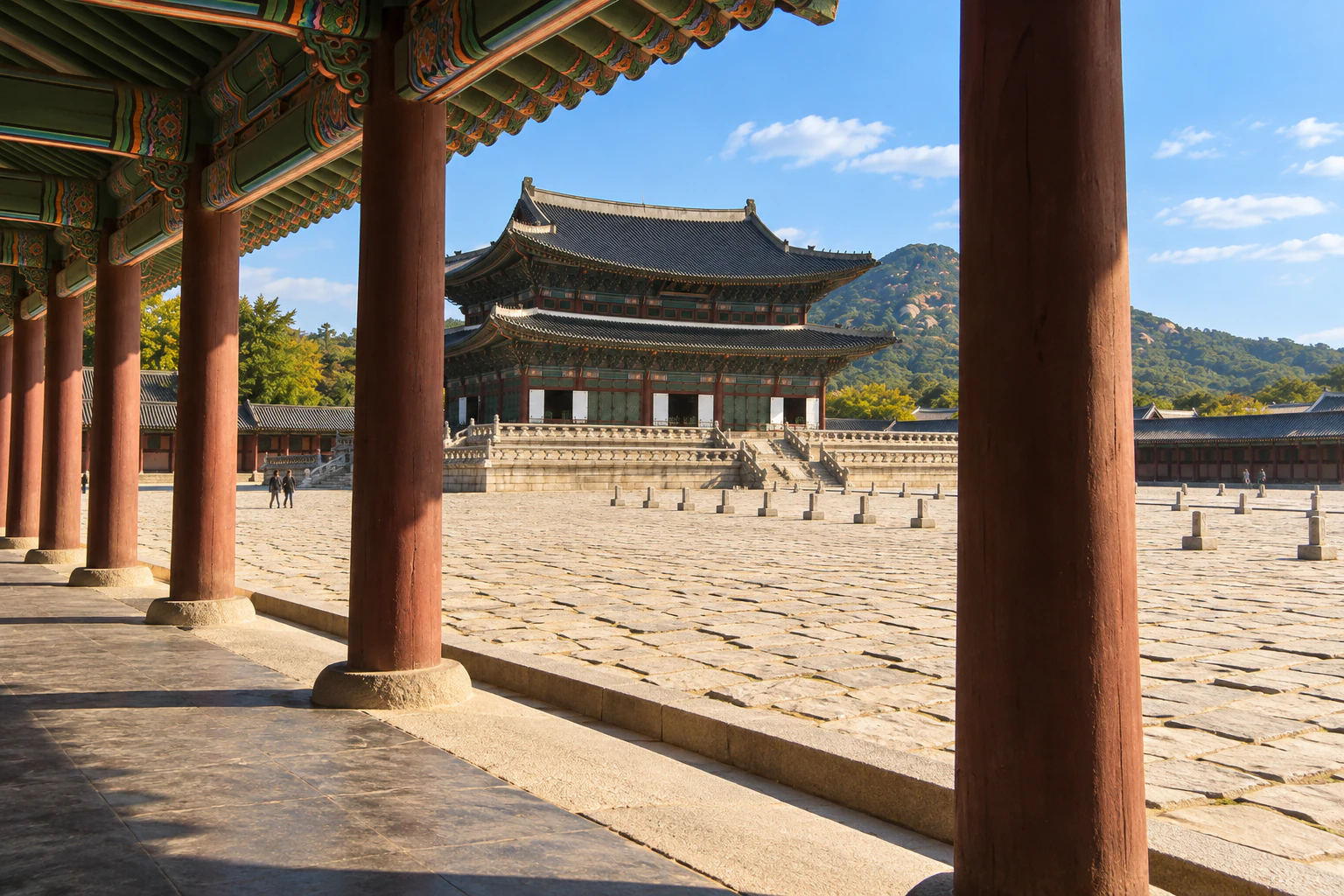
She writes down the years. Founded 1395. Burned in the Japanese invasion of 1592. Rebuilt some 270 years later, in 1867. The Geunjeongjeon standing now is that building of 1867. Then 1915, when most of the palace buildings were demolished on the pretext of an industrial exposition, and 1926, when the Japanese Government-General building was put up inside the palace. Restoration began in the 1990s, and that building was demolished between 1995 and 1997. Maya writes the years in one line and looks at the hall again.
The Geunjeongjeon of the screen was a building without time. A king, his officials, and the when decided by the screen. Standing in the courtyard, this is a building of 1867, and this is a courtyard that has been through everything in between. Maya calls it “the third thing the screen didn’t have.” Distance, order, and time.
On the way out she passes the same gates in reverse: Geunjeongmun, the forecourt, Heungnyemun. With each gate the hall gets farther, and once she is out through Heungnyemun it cannot be seen. The screen never films this scene either.
A courtyard that appears only after two gates, the distance from the back of the rank stones, a terrace you cannot climb, a mountain behind a double roof. What Maya saw today were the things the screen did not choose. The screen pressed close behind the king; the courtyard is seen from the officials’ distance.
Maya’s quiet recommendation is simple: before heading straight to the steps, stand once at the back of a line of rank stones. Check the Royal Palaces and Tombs Center notice for terrace access on the day you visit. Gyeongbokgung is closed on Tuesdays.
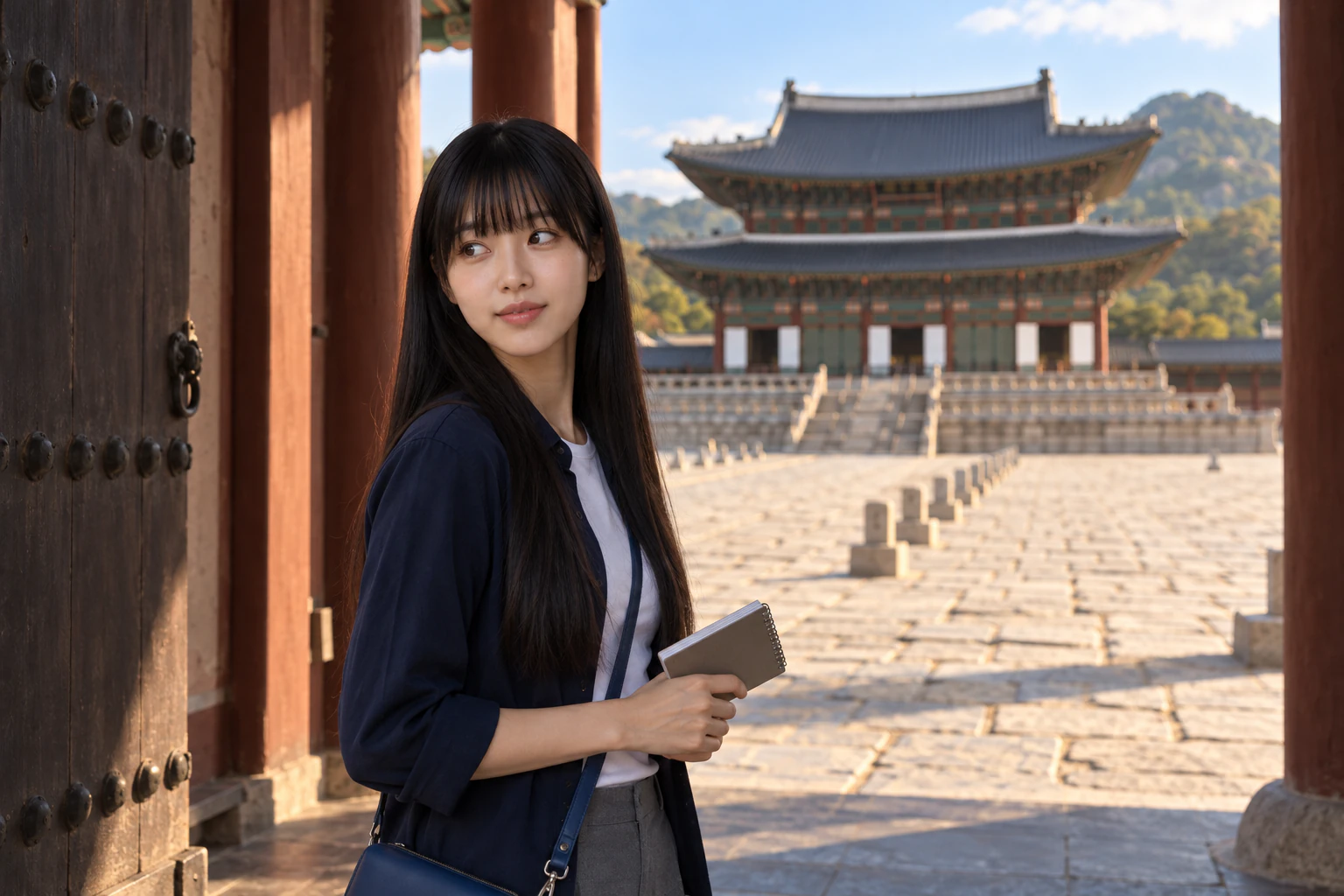
(※ This article includes staged images created with AI.)
Plan your visit
Allow about an hour to enter from Gyeongbokgung Station, see the courtyard of Geunjeongjeon and leave by the same gates. Gyeonghoeru, Hyangwonjeong and the rest are left for later pieces, and walking times are map-route calculations.
A concept diagram of the order · not to scale, not oriented, not the real shape of the road.
- Gyeongbokgung Station → Heungnyemun — About 192 m, 3 minutes from Exit 5 of Gyeongbokgung Station (Line 3) by map route; the Royal Palaces and Tombs Center gives 2 minutes on foot. Enter the Heungnyemun forecourt through the side entrance on the Exit 5 side and buy a ticket at the booths by the forecourt (regular admission 3,000 won for adults). Find on the map
- Heungnyemun → Geunjeongmun — Through Heungnyemun is the first courtyard, with Geunjeongmun at its end. From Heungnyemun to Geunjeongjeon is about 248 m, 4 minutes by map route (routes inside the palace are indicative). Find on the map
- Geunjeongmun → between the rank stones — Through Geunjeongmun is the courtyard of Geunjeongjeon. Stand at the back of a line of rank stones and the hall appears small at the far end. The paving is uneven, so watch your feet. Find on the map
- Below the terrace → the way out — From 2 September to 31 October 2026 access to the Geunjeongjeon terrace is restricted (Royal Palaces and Tombs Center notice). See the animal figures on the stair railings and the two-tier roof from the foot of the steps, then leave by the same gates. Find on the map
Getting there
TMAPChecked 2026.09.22
From Exit 5 of Gyeongbokgung Station (Line 3) to the map POI for Heungnyemun (the routing endpoint), 192 m, about 3 minutes (TMAP pedestrian routing). The Royal Palaces and Tombs Center gives 2 minutes on foot from Exit 5 of Gyeongbokgung Station and 6 minutes from Exit 1 of Anguk Station. Address: 161 Sajik-ro, Jongno-gu.
Hours & fees
Checked 2026.09.22
Gyeongbokgung is closed on Tuesdays (open if the Tuesday is a public holiday or substitute holiday, closing on the next non-holiday instead). Hours are 09:00–18:00 (last entry 17:00) from March to May and September to October, 09:00–18:30 (last entry 17:30) from June to August, and 09:00–17:00 (last entry 16:00) from November to February. Enquiries +82-2-3700-3900 (Royal Palaces and Tombs Center).
Checked 2026.09.22
Regular admission to Gyeongbokgung is 3,000 won for adults (Koreans aged 25–64, foreign visitors aged 19–64). Temporary free-admission periods and other short-term exceptions should be checked against the Royal Palaces and Tombs Center notices for the day of the visit.
Checked 2026.09.22
Royal Palaces and Tombs Center notice (30 August 2026): because heavy peak-season visitor numbers risk damaging the stone railings and other stonework of Geunjeongjeon, access to the hall’s stone terrace (woldae) is restricted from Wednesday 2 September to Saturday 31 October 2026.
Background3
TMAPChecked 2026.09.22
From Heungnyemun to Geunjeongjeon, 248 m, about 4 minutes by map route (TMAP pedestrian routing; routes inside the palace are indicative).
Checked 2026.09.22
Geunjeongjeon, a National Treasure, is the main hall of Gyeongbokgung, the principal palace of the Joseon dynasty, where officials paid New Year respects to the king, state ceremonies were held and foreign envoys were received. First built in 1395, it saw the enthronement of several early Joseon kings including Jeongjong and Sejong. The name, chosen by Jeong Do-jeon, means that the affairs of the realm are governed well through diligence. The present hall, rebuilt in 1867 after the original burned in the Japanese invasion of 1592, is a two-storey building five bays wide and five deep with a hip-and-gable roof and multi-bracket eaves. Animal figures including the twelve zodiac animals are carved at the corners of the stone terrace and on the stair railings; rank stones line the path from the hall to Geunjeongmun Gate; rings for awnings remain in the courtyard; and corridors enclose the hall (Korea Heritage Service portal).
Checked 2026.09.22
Gyeongbokgung, founded in 1395, was the principal palace of the Joseon dynasty and the centre of the capital, set against Baegaksan (Bugaksan) with the avenue of the six ministries running south from its main gate, Gwanghwamun. The name means that the new dynasty will enjoy great fortune and prosper. Burned in the Japanese invasion of 1592, it stood in ruins for some 270 years until it was rebuilt in 1867. Most of its buildings were demolished in 1915 on the pretext of an industrial exposition, and the Japanese Government-General building was erected on the grounds in 1926. Restoration began in earnest in the 1990s; the Government-General building was demolished in 1995–97, and Heungnyemun, Gwanghwamun and other areas have since been rebuilt (Royal Palaces and Tombs Center).
- Gyeongbokgung is closed on Tuesdays (open if the Tuesday is a public holiday or substitute holiday, closing on the next non-holiday instead). Hours 09:00–18:00 (last entry 17:00) March–May and September–October, 09:00–18:30 (last entry 17:30) June–August, 09:00–17:00 (last entry 16:00) November–February. Regular admission 3,000 won for adults (Koreans aged 25–64, foreign visitors aged 19–64); check the notices for the day you visit for temporary free-admission periods and the like. Enquiries +82-2-3700-3900 (Royal Palaces and Tombs Center, checked 22 September 2026).
- The restriction on the Geunjeongjeon terrace is announced for 2 September to 31 October 2026. Arrangements after that should be checked against the Center’s notices.
- The route across the Geunjeongjeon courtyard is not presented here as a barrier-free or step-free route.