
SEOUL · GETTING AROUND
From Incheon Airport to Seoul Station: Choosing the First Train on Arrival Day
Elena weighs the AREX Express against the all-stop train, rides twelve stops to Seoul Station and walks on to Sungnyemun
From Incheon Airport Terminal 1 to Seoul Station, the Express takes 43 minutes and costs ₩13,000 for adults. The all-stop train takes 59 minutes, with an adult transit-card fare of ₩4,750. Compare tickets and seating before choosing, then prepare a transit card if taking the all-stop train. At Seoul Station, tap out and find Exit 4 on Line 1. From there, the mapped walking route to Sungnyemun Plaza is 336 m, about 4 minutes.

How to get there
These figures are calculated using a map app’s walking route. Sungnyemun is open from 09:00 to 18:00 and closed on Mondays.
Choosing a first train from Incheon Airport to Seoul Station is easier with the journey time and fare side by side. From Terminal 1, the Express takes 43 minutes and costs ₩13,000 for adults. The all-stop train takes 59 minutes, with an adult transit-card fare of ₩4,750. Both reach Seoul Station, but tickets and seating work differently, so start with what matters today: a shorter ride or a lower fare. This piece follows the all-stop train from the Terminal 1 Transportation Center, then continues through Seoul Station’s Line 1 Exit 4 to Sungnyemun Plaza.
Whenever a drama cuts from someone arriving at the airport to walking along a Seoul street, Elena wonders about the journey in between. Which ticket do they buy, and which stations do they pass before reaching that next scene? Today she follows the part usually left out, writing Incheon Airport Terminal 1, Seoul Station and Sungnyemun on the first page of her notebook. She plans to read the signs and find her own way, even if she cannot stride out as confidently as someone on screen.
The journey has a simple order: choose a train at the airport, tap out at Seoul Station, then walk through the exit. Elena decides to read the signs she needs next rather than memorise everything as far as Sungnyemun. On the train, she can watch the station names, then look for Exit 4 after arriving. For a first visit, begin with the departure terminal and the station where you will get off. Breaking up the journey makes the relevant section of a long route map easier to find.
The Cue
From **Incheon Airport Terminal 1 → Seoul Station**, the Express takes **43 minutes and costs ₩13,000 for adults**. The all-stop train takes **59 minutes, with an adult prepaid or post-paid transit-card fare of ₩4,750**. Remember the ticket and seat pairing: **Express = separate ticket and reserved seat**, **all-stop train = transit card and no reserved seat**. On the all-stop train, continue past Gimpo Int’l Airport, Hongik Univ. and Gongdeok to Seoul Station. **Tap out**, then follow **Seoul Station, Line 1, Exit 4 → Sungnyemun Plaza, 336 m · about 4 min**.
- **Departure terminal**: Read the times and fares for Terminal 1 and Terminal 2 separately. This piece follows a departure from Terminal 1.
- **Train choice**: Buy a separate ticket for the Express and use your reserved seat. The all-stop train uses transit cards and has no reserved seating.
- **Card for the all-stop train**: Buy a single-journey card at a station ticket machine. Buy a prepaid transit card from a sales outlet or card vending machine, then top it up.
- **Card and direction**: The Climate Card airport exit service applies to journeys from eligible Seoul stations to the airport. It does not cover boarding at the airport.
- **After arriving**: Get off at Seoul Station → tap out → reclaim the single-journey card deposit if needed → find Line 1 Exit 4 → walk to Sungnyemun Plaza.
Two trains to Seoul Station: start with the comparison
In the Transportation Center, Elena looks between the Express and all-stop train signs. Both belong to AREX, but the Express runs non-stop between Incheon Airport and Seoul Station, while the all-stop train calls at the stations in between. Before buying the first ticket in sight, compare the journey time, fare and seating. Elena finds Seoul Station on the route map, then reads the intermediate stops. These are the names that fill the gap between the airport and Seoul on screen.
Open in Kakao Map — Sungnyemun

From Terminal 1, the Express takes 43 minutes and the all-stop train takes 59 minutes. Adult fares are ₩13,000 for the Express and ₩4,750 for the all-stop train with a prepaid or post-paid transit card. That is a difference of 16 minutes and ₩8,250, though a single-journey card adds ₩100 to the all-stop fare and requires a ₩500 deposit. Elena shifts her attention from the shorter journey to the type of card she will use. Compare both trains from the same terminal, using the fare for your chosen card.
If arriving at Terminal 2, use that terminal’s figures. The Express takes 51 minutes to Seoul Station and costs ₩13,000 for adults. The all-stop train takes 66 minutes, with an adult prepaid or post-paid transit-card fare of ₩5,350. Some all-stop trains take 2–6 minutes longer than the stated journey time, so check the service information for the train you plan to take before preparing a ticket or card. Elena returns to the Terminal 1 information, keeping the other terminal’s figures out of today’s comparison.
The 43-minute and 59-minute figures cover the train journey. Allow separate time to reach the Transportation Center from arrivals, prepare a ticket and wait on the platform. Elena briefly imagines the Sungnyemun walk starting as soon as she steps off the train, then remembers that she still has to find her way out of Seoul Station. With things to do at both ends of the ride, she leaves some room in the afternoon rather than fixing an exact arrival time at the plaza.
Today Elena chooses the all-stop train. She has considered the fare difference, but she also wants to follow the journey into Seoul through its intermediate stations. The extra 16 minutes will take her through Cheongna Int’l City, Gimpo Int’l Airport, Hongik Univ. and Gongdeok in turn. Choose the Express when a reserved seat or a shorter train journey matters more. Once you have chosen, prepare the ticket or card required for that train.
Different trains, different tickets
Before heading towards the all-stop train, Elena checks how the tickets differ. The Express requires a separate ticket bought before boarding and comes with a reserved seat. The all-stop train uses a transit card and has no assigned seats, so a transit card does not give access to both Seoul-bound services. In the comparison below, read the time and fare for your terminal alongside the ticket purchase point and seating arrangements. The train you choose determines where to go next.
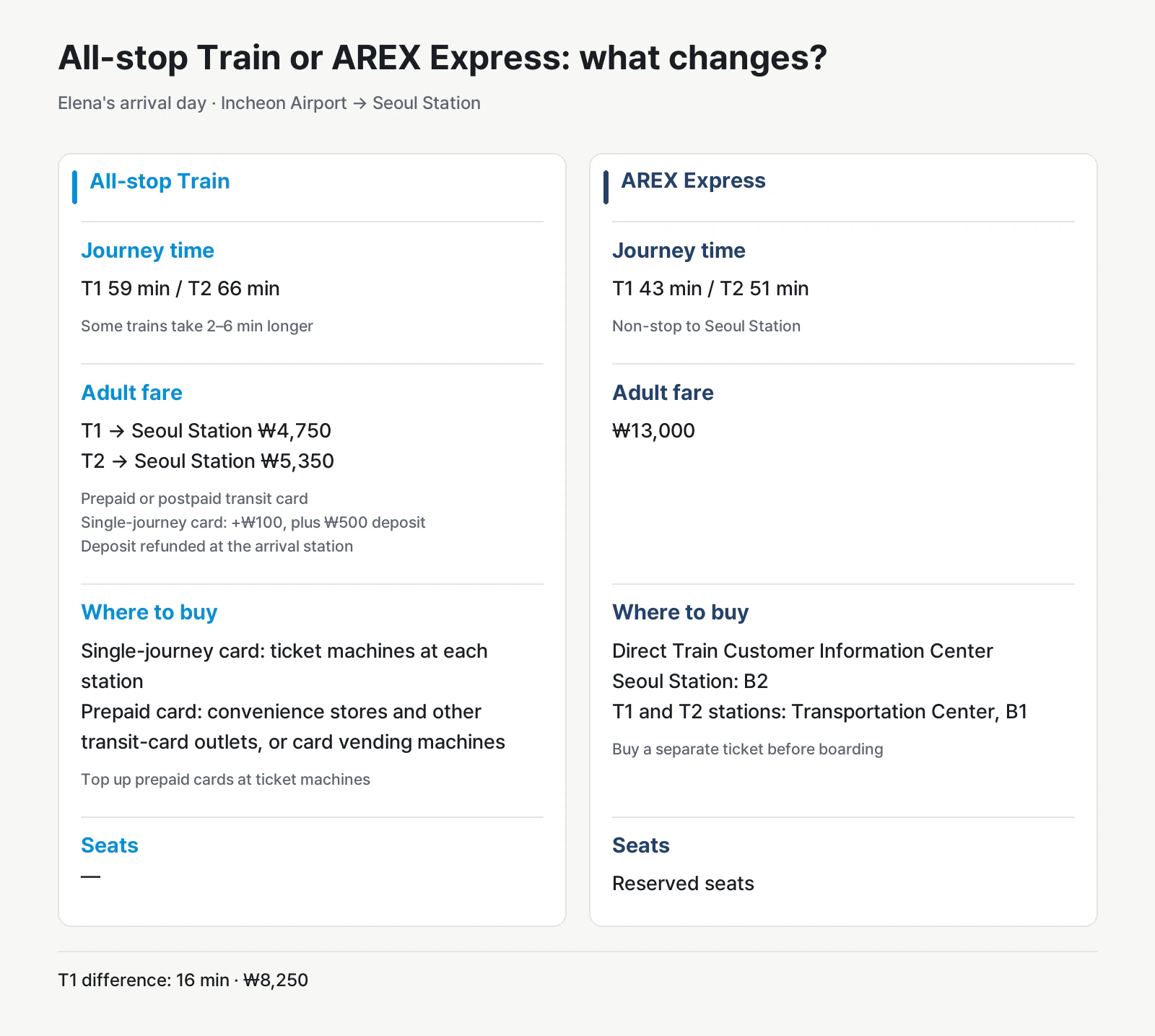
Elena looks towards the Direct Train Customer Information Center, distinguishing it from the places selling cards for the all-stop train. Express tickets are sold there on B1 of the Transportation Center at Incheon Airport Terminals 1 and 2, and on B2 at Seoul Station. If choosing the Express, buy the ticket and use the reserved seat. Elena’s all-stop journey needs neither that ticket nor a seat number. With the two purchase points clear, she turns to finding a transit card.
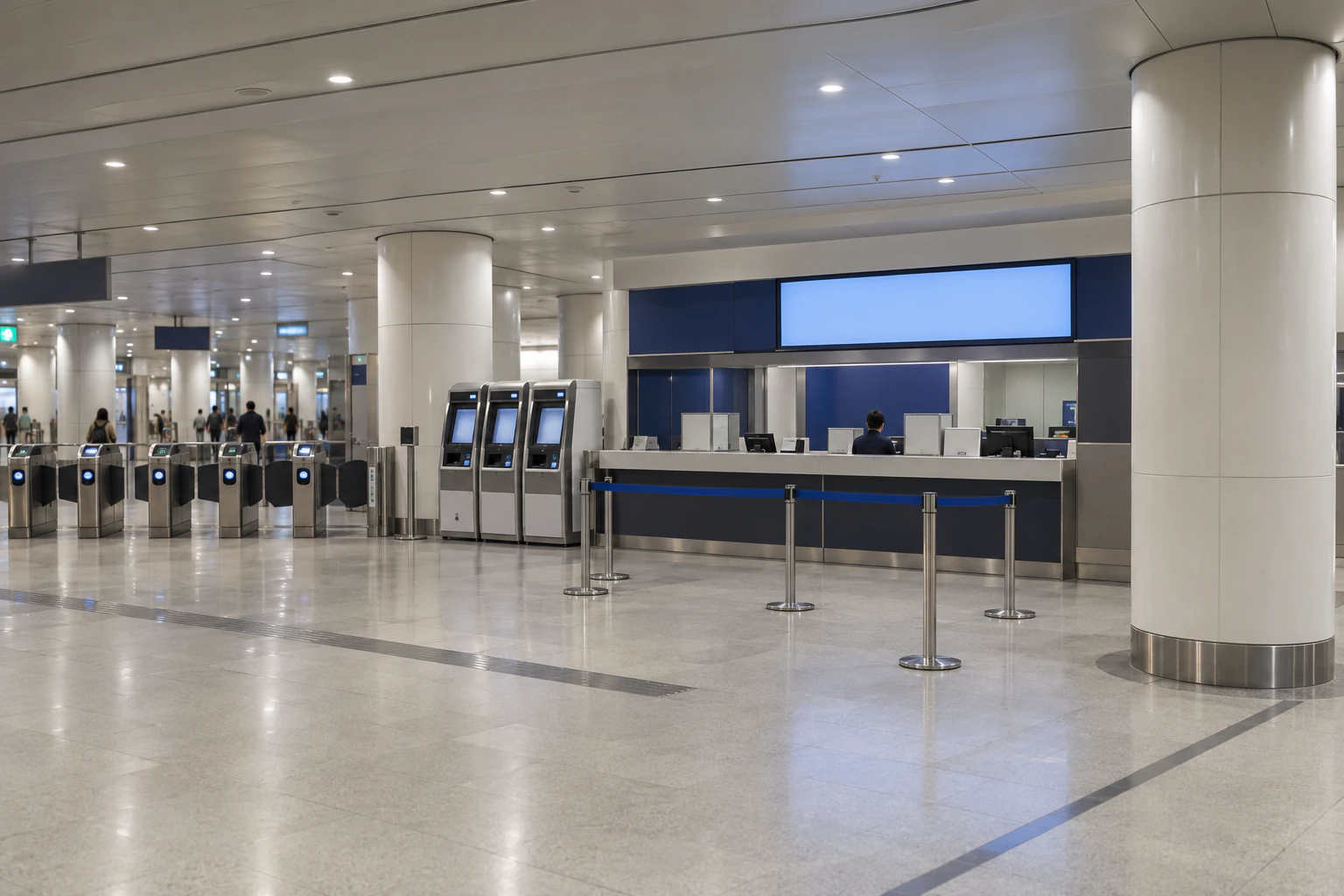
Single-journey cards for the all-stop train are sold at station ticket machines. Prepaid transit cards are sold at outlets such as convenience stores or from card vending machines, then topped up at ticket machines. Elena has no card yet, so she first needs to decide which kind to buy. If you already have a prepaid transit card, start by checking its balance rather than buying another. That tells you whether the next step is a purchase or a top-up.
At the ticket machine, Elena checks Incheon Airport Terminal 1 as the departure station and Seoul Station as the destination. The ₩4,750 transit-card fare is different from the total paid when issuing a single-journey card. Read the departure station, destination and card type in order, so a Terminal 2 fare or a total including the deposit is not mistaken for a fare change. Elena stops comparing isolated numbers and looks at what each one covers. Even for the same destination, the amount depends on the card being prepared.

A card for the all-stop train has no reserved seat number. Elena continues preparing for that service without returning to the Express signs. If the two become confusing, remember the pairings: a separate ticket with a reserved seat, or a transit card with no assigned seat. Once the right ticket or card is ready, head for the platform.
Taking the all-stop train? Choose a card first
Without a transit card, the choice is between a single-journey card for this ride and a prepaid card to buy and top up. Elena plans to keep travelling around Seoul after visiting Sungnyemun, so she chooses a prepaid card. If preparing only for this first journey from the airport, check the single-journey card’s issue amount and deposit refund steps. Both options get you ready for the all-stop train, but the purchase points and the steps after use differ.
A single-journey card adds ₩100 to the prepaid or post-paid transit-card fare and requires a ₩500 deposit. From Terminal 1 to Seoul Station, that means a ₩4,850 fare plus the ₩500 deposit, making ₩5,350 payable when the card is issued. Keep the fare separate from the total, because ₩500 comes back after use. The prepaid or post-paid transit-card fare from Terminal 2 is also ₩5,350, but that figure covers a different departure station and card type. Matching the number to its description prevents the two from getting mixed up.
After the journey, reclaim the ₩500 deposit at a station deposit refund machine. Keep the single-journey card safe, as a lost or damaged card cannot be refunded, and do not throw it away after leaving the ticket gates. It is needed both to tap out at Seoul Station and to reclaim the deposit. Elena notes this extra arrival step, which her prepaid card does not require. Knowing how the journey ends is part of choosing the card at the airport.
Elena buys a prepaid transit card from a card vending machine, then tops it up at a ticket machine. Getting the card and adding travel credit are separate steps. Complete the top-up before heading for the gates, checking that the card has enough for the adult fare of ₩4,750 from Terminal 1 to Seoul Station. Elena finishes loading the card before stepping away from the machine.

Keep the card’s purchase price, the credit loaded onto it and the journey fare separate. For a first card, check the price and payment methods shown by the outlet or machine you use. Elena reads the instructions at her machine and completes both the purchase and top-up. Treating these as separate amounts also makes later travel costs easier to follow.
> **Climate Card — travelling to the airport and getting off there** > With a Climate Card, you can board an all-stop train at Seoul Station, Gongdeok, Hongik Univ., Digital Media City, Magongnaru or Gimpo Int’l Airport and get off at Incheon Airport Terminal 1 or 2 without paying extra. You cannot board at the Incheon Airport stations with this card. For a journey starting at the airport, prepare a single-journey card or prepaid transit card for the all-stop train. Elena distinguishes the airport-bound service from her own direction of travel and uses the prepaid card she has prepared. The Express requires a separate ticket.
With her card ready, Elena turns towards the Seoul-bound all-stop train signs. Before following the signs, check which card you are using and, for a prepaid card, that the top-up is complete. With the card and destination settled, the next step is the ticket gates. Elena puts the card somewhere she can easily reach again when getting off.
Through the gates to the AREX platform
At the gate, Elena touches her prepaid card on the reader. Buying and topping it up are complete, and now she can use it for the first train of the day. She resists the urge to hurry after the person ahead and finishes her own tap before moving through. Keep the card safe after boarding, as the same one is needed to tap out at Seoul Station. Finish the journey with the card used at the airport.
Beyond the gates, Elena looks for signs for the all-stop train towards Seoul Station. Alongside the AREX name, she checks the service type and direction. If the signs feel like a lot to take in, focus first on “all-stop” and “Seoul Station”. Elena puts the Sungnyemun map aside and concentrates on the platform signs. The train’s destination is the useful name here, with the walk beyond the station to follow later.

Platform screen doors run along the track. Elena checks the Seoul Station direction, keeps her bag close and waits for the train. Even on a platform familiar from dramas, she starts by reading the direction when it is her own train to catch. Let passengers get off before boarding. If checking a route on your phone, stop walking to finish checking, then look ahead while passing through the doors.
From Terminal 1, the all-stop train heads towards Incheon Int’l Airport Cargo Terminal and continues to Seoul Station. Find the departure station and Seoul Station on the map to see the intervening stops in order. Elena starts trying to memorise the long list, then remembers she can read the route map on board. On the platform, she finishes by checking that the train is heading to Seoul Station. With the doors ahead, she waits to board rather than reviewing the whole day’s route again.
Inside the train, Elena puts her card in its chosen place in her bag and looks for somewhere to sit or stand. There is no seat number to find on the all-stop train. Keep that distinction in mind if you were expecting a seat assignment. Only after boarding does Elena look up at the route map. The airport decisions are behind her, and the 59-minute train journey will now take her through the names between Incheon Airport Terminal 1 and Seoul Station.
Twelve stops to go, with three names to remember
Elena traces the route between Incheon Airport Terminal 1 and Seoul Station on the map inside the train. Seoul Station is the twelfth stop after leaving Terminal 1, with the departure station excluded from the count. Rather than counting every stop, try using Gimpo Int’l Airport, Hongik Univ. and Gongdeok as landmarks along the way. Elena finds Seoul Station first, then locates those three names before it. This time, the journey between the airport and the Seoul street scene passes without a cut.

The full sequence from Incheon Airport Terminal 1 is Incheon Int’l Airport Cargo Terminal, Unseo, Yeongjong, Cheongna Int’l City, Geomam, Gyeyang, Gimpo Int’l Airport, Magongnaru, Digital Media City, Hongik Univ., Gongdeok and Seoul Station. At Cheongna Int’l City, Elena reads slowly along the map and finds Geomam next. As one name becomes a station already passed, she looks ahead to the following stop. The route extract below shows the stopping order, without representing the actual track bends or distances to scale.
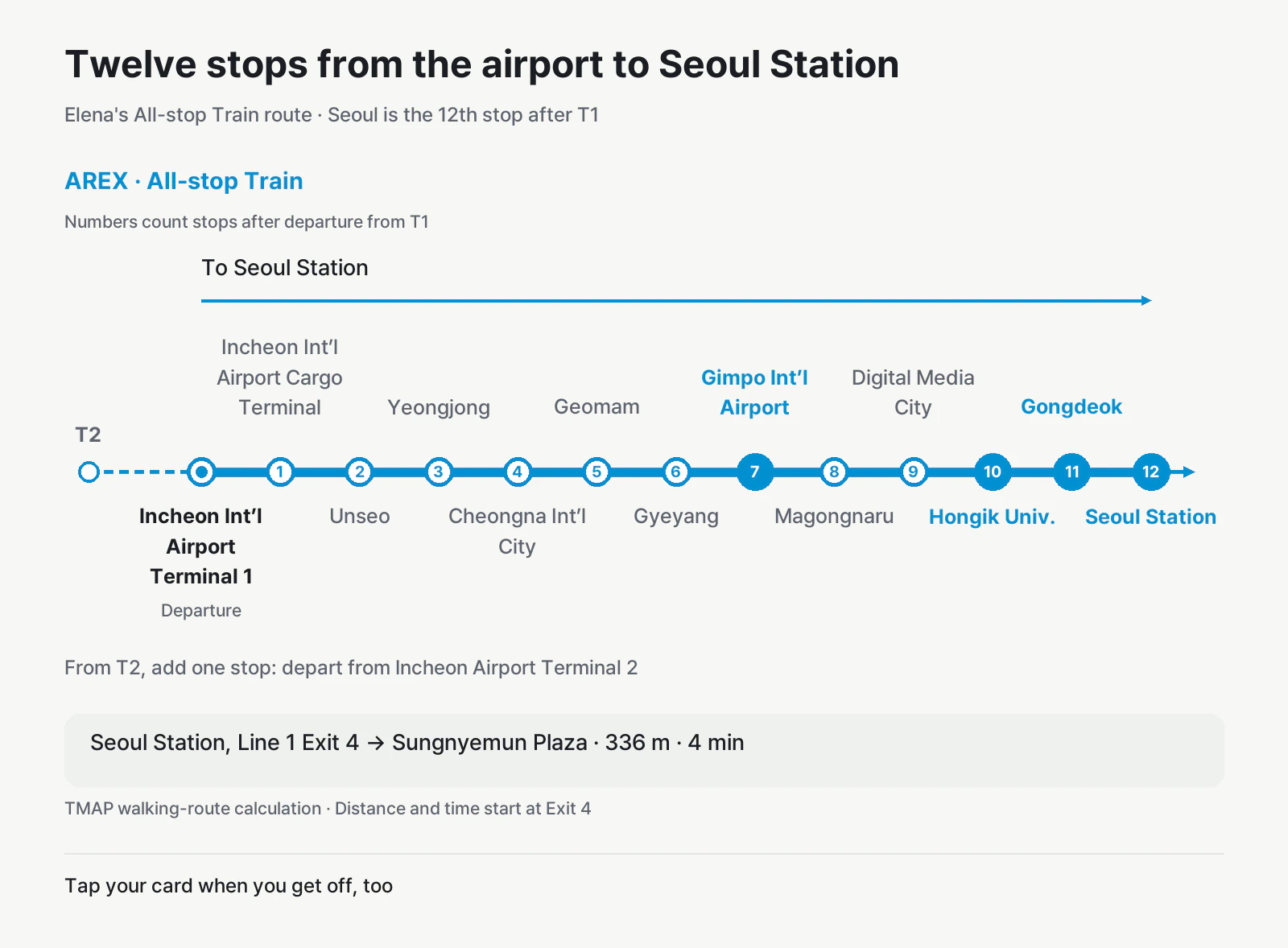
At Gimpo Int’l Airport, Elena meets the word “airport” again. This is a different station from Incheon Airport, where she started, and Seoul Station remains her destination. After Gimpo Int’l Airport come Magongnaru, Digital Media City and Hongik Univ. Keep your destination separate from the airport name rather than preparing to get off here. Elena checks the names ahead instead of restarting the count from the beginning.
When Hongik Univ. appears, Elena checks the map and sees Gongdeok and Seoul Station still to come. The long list she read before boarding is down to two stops. Following the station order tells her how far she has travelled without searching for every unfamiliar place. For Seoul Station, stay on the train at Hongik Univ. Elena leaves choosing another place to explore until after arrival and follows the next name, Gongdeok.
Seoul Station comes after Gongdeok. At Gongdeok, Elena gathers her bag and checks where she has put the card for tapping out. Twelve stops sounded like a long journey at the airport, but now she only needs to get off at the next station. If you lose count, look for the current station and the next one. From Gongdeok, there is no need to start again from the airport.
The train reaches Seoul Station, and Elena steps onto the underground platform. Following signs up to the concourse does not bring the Seoul streets into view straight away. Where a drama would change scenes, there are still ticket gates and an exit to find. The 59-minute train journey is over, but the route to Sungnyemun continues inside the station. Elena looks for the way out of the underground concourse, changing her next target from Seoul Station to Line 1 Exit 4.
At Seoul Station, finish the journey by tapping out
In the concourse, Elena pauses at signs for KTX, Line 1, Line 4 and the Gyeongui Line. She has reached Seoul Station, where yet another set of names points in different directions. She stops following the people ahead and remembers that today she is walking out towards Sungnyemun. Follow the transfer signs if taking another service, or the exit signs if leaving on foot. Elena uses Seoul Station’s Line 1 Exit 4 as her guide through the station.
At the gates leading out, Elena takes out the card she used at the airport and touches it on the reader. Getting off the train and completing the card journey are separate steps. Since 7 March 2026, passengers using prepaid or post-paid transit cards on urban rail who fail to tap out have the basic fare for their fare type added at the next boarding. For adults, that is ₩1,550, while season tickets, single-journey tickets and concession passes are excluded. Tap out with the card used to board, even if there is no immediate plan to take another train.

If using a single-journey card, reclaim the ₩500 deposit at a deposit refund machine after tapping out. This is the deposit paid alongside the fare when the card was issued, so keep the used card for the refund. Elena will keep using her prepaid card, while a single-journey card needs this final refund step before leaving. The card choice does not change the train to Seoul Station or the exit for Sungnyemun. Complete the steps for your card, then follow the same signs for Line 1 Exit 4.
Elena brings up Seoul Station’s Line 1 Exit 4 and Sungnyemun Plaza together on the map. Arriving by AREX and reaching the walking start point at Exit 4 are different stages. First make your way through the station to that exit, then begin the four-minute walk to the plaza. With the exit number found, Elena no longer needs to read all the transfer directions at once. She follows one route out of the underground concourse and gets ready for the first walk she chose at the airport.
The first destination: Sungnyemun, four minutes outside the station
Outside Seoul Station’s Line 1 Exit 4, Elena sets Sungnyemun Plaza as her walking destination. The mapped pedestrian route is 336 m, about 4 minutes, excluding the walk inside the station from the AREX gates to this exit. It is best to set Line 1 Exit 4 as the walking start point rather than Seoul Station in general. Elena follows the route, watching the crossings and signals. Treat the four minutes purely as the walk outside, rather than adding that time directly to the train’s arrival time.

Sungnyemun is open year-round from 09:00 to 18:00, with last entry at 17:55. Admission is free, and the regular closing day is Monday. If Monday falls on a public or substitute public holiday, it opens that day and closes on the first non-holiday afterwards. If you want to look closely at the gate on arrival day, plan around these hours and closing days. After comparing the train times, Elena checks Sungnyemun’s opening hours and looks towards the gate from the plaza.
Elena first notices the rounded arch opening through the centre of the high stone base. Above the arch stands a two-storey gate tower. Her gaze moves from the tower to the walls extending on either side, which were rebuilt during Sungnyemun’s restoration. From the plaza, the view naturally draws the eye from the stone base and arch up to the two storeys, then out along the walls.
Construction of Sungnyemun began in 1396 and was completed in 1398, with rebuilding in 1448. It is the oldest surviving wooden building in Seoul. A fire damaged it on 10 February 2008, and restoration was completed on 4 May 2013. Elena distinguishes its initial construction from the restoration that gave it its present form. Looking at the two-storey tower and rebuilt walls together gives her more to notice than a single construction date.
The name plaque hangs vertically on the gate tower. Elena follows the characters from top to bottom, then lowers her gaze towards the arch. A dragon painting decorates the ceiling of the passage. Look at the plaque from in front of the gate, and at the ceiling inside the passage. Beyond the stone entrance, Elena notices the painting within.

Leaving Sungnyemun behind, Elena retraces her route towards Seoul Station. The same 336 m route from the plaza leads back to Line 1 Exit 4. From there, enter the station to continue on Line 1 or Line 4, or decide where to go next. It is easiest to retrace the route just walked rather than searching for a new exit on the return. Elena chooses to reach the familiar entrance before deciding on her next line.
At the airport, Seoul Station was a single destination name. Now it brings to mind the underground concourse, Exit 4 and the walk to Sungnyemun. Instead of filling her notebook with new destinations, Elena makes a short note about the arch and the vertical name plaque. On a first arrival in Seoul, starting with the terminal, train and card makes it easier to plan what comes after Seoul Station. Back at Exit 4, Elena is ready to pick the next part of her afternoon.
(※ This article includes staged images created with AI.)
Common Mistakes
- Treating the Express and all-stop tickets as interchangeable — The Express requires a separate ticket and provides a reserved seat. The all-stop train uses transit cards and has no assigned seating.
- Expecting the total cost of a single-journey card to match the transit-card fare — The adult transit-card fare from Terminal 1 to Seoul Station is ₩4,750. A single-journey card adds ₩100 to the fare and requires a ₩500 deposit, refunded after use.
- Applying the Climate Card airport exit service to a departure from the airport — The service allows travel from Seoul Station, Gongdeok, Hongik Univ., Digital Media City, Magongnaru or Gimpo Int’l Airport to Incheon Airport Terminal 1 or 2, with no extra payment when getting off. For the all-stop train from the airport towards Seoul, prepare a single-journey card or prepaid transit card.
- Assuming the card journey ends when stepping off at Seoul Station — Tap out when leaving through the gates, using the same card tapped to board. Failing to tap out with a prepaid or post-paid transit card results in an additional basic fare at the next boarding.
FAQ
Which train is fastest from Incheon Airport to Seoul Station?
Of the two compared here, the Express has the shorter train journey. It takes 43 minutes from Terminal 1 and 51 minutes from Terminal 2, with an adult fare of ₩13,000. Buy a separate ticket before boarding and use the reserved seat.
What is the cheapest way to reach Seoul Station?
Of the two trains compared here, the all-stop train has the lower adult fare. With a prepaid or post-paid transit card, it costs ₩4,750 from Terminal 1 to Seoul Station and ₩5,350 from Terminal 2. A single-journey card adds ₩100 to the fare and requires a ₩500 deposit, refunded after use.
Do I buy Express and all-stop tickets from the same machine?
The purchase methods and tickets differ. Express tickets are available at the Direct Train Customer Information Center on B1 of the Transportation Center at Incheon Airport Terminals 1 and 2. For the all-stop train, buy a single-journey card at a station ticket machine, or buy a prepaid transit card from an outlet or card vending machine and top it up at a ticket machine.
Can foreign visitors buy a transit card for the all-stop train?
For the all-stop train, buy a single-journey card at a station ticket machine, or get a prepaid transit card from a transit-card outlet or card vending machine and top it up. Treat buying and topping up as separate steps. Check the card price and payment methods shown by the outlet or machine you use.
Can I use a Climate Card from Incheon Airport to Seoul Station?
For this journey starting at the airport, prepare a single-journey card or prepaid transit card for the all-stop train. The Climate Card airport service works in the other direction: board an all-stop train at Seoul Station, Gongdeok, Hongik Univ., Digital Media City, Magongnaru or Gimpo Int’l Airport and get off at Incheon Airport Terminal 1 or 2 without paying extra. The Express requires a separate ticket.
Is Sungnyemun far from Seoul Station?
From Seoul Station’s Line 1 Exit 4, the mapped pedestrian route to Sungnyemun Plaza is 336 m, about 4 minutes. That excludes the distance and time inside the station from the AREX platform through the ticket gates to Exit 4. Set the walking start point to Seoul Station’s Line 1 Exit 4.
Recap — 30 seconds before setting off
- **Check the departure terminal first**: The Express takes 43 minutes from T1 and 51 minutes from T2, with an adult fare of ₩13,000. The all-stop train takes 59 minutes from T1 with a transit-card fare of ₩4,750, or 66 minutes from T2 for ₩5,350. Some all-stop trains take 2–6 minutes longer.
- **Match the ticket to the train**: The Express requires a separate ticket and has reserved seats. The all-stop train uses transit cards and has no assigned seating.
- **Prepare the all-stop train card**: A single-journey card adds ₩100 to the fare and requires a ₩500 deposit. Buy and top up a prepaid card before boarding. The Climate Card airport exit service does not cover departures from the airport.
- **Stay on to Seoul Station and tap out**: Use Gimpo Int’l Airport, Hongik Univ. and Gongdeok to follow your progress, then tap out at Seoul Station with the card used to board. Reclaim the deposit if using a single-journey card.
- **Start the first walk towards Sungnyemun Plaza**: From Seoul Station’s Line 1 Exit 4, the mapped walking route is **336 m · about 4 min**. Allow separate time to reach the exit inside the station.
Sources
- AREX — All-stop train guide — T1 and T2 journey times · stop sequence · buying and loading transit cards · Seoul Station connections checked 2026-10-19
- AREX — All-stop fares — Adult pre- and post-paid transit-card fares · ₩100 single-journey supplement · distance-based fares checked 2026-10-19
- AREX — Express guide — T1 and T2 journey times · ₩13,000 adult fare · separate ticket · reserved seats · customer information centres checked 2026-10-19
- Seoul Metropolitan Government — Climate Card airport exits — Travel from eligible Seoul stations to exit at Incheon Airport T1 or T2 · no boarding at the airport checked 2026-10-19
- Seoul Metropolitan Government — Climate Card guide — Short-term pass validity · validity starts on loading day · coverage checked 2026-10-19
- Seoul Metropolitan Government — Single-journey transit cards — ₩500 deposit · station refund machines · no refund for lost or damaged cards checked 2026-10-19
- Seoul Metropolitan Government — Missing tap-out surcharge — Basic fare added on the next boarding from 7 March 2026 · excluded ticket types checked 2026-10-19
- Seoul Metropolitan Government — Foreign-card payments at ticket machines — New Seoul Metro machines on Lines 1–8 · overseas Visa and Mastercard payments checked 2026-10-19
- Dailian — AREX missing tap-out information — Joint information campaign by AREX and Incheon Transit Corporation · reported capital-area urban-rail coverage checked 2026-10-19
- Royal Palaces and Tombs Center — Visiting Sungnyemun — 09:00–18:00 · last admission 17:55 · Monday closure and public-holiday exceptions · free admission checked 2026-10-19
- Kakao Map — Sungnyemun — Sungnyemun and its plaza · Seoul Station Exit 4 location checked 2026-10-19
- TMAP — Pedestrian routes — Seoul Station Line 1 Exit 4 to Sungnyemun Plaza: 336 m, 4 minutes · excludes the indoor route from the AREX gates to the exit checked 2026-10-19
More from this area

From Gyeongbokgung to Seoul Forest: Your First Subway Transfer
At Gyeongbokgung Station, take Line 3 with Anguk as the next stop.

From Myeongdong Cathedral to the Journey Back After the Last Train
The last piece of “Getting Around Seoul.” Seoul’s Owl Buses — city buses that run only at night — operate 140 vehicles on 14 routes from 11 pm to 6 am, for ₩2,500 by card. Standard taxis add a late-night surcharge from 10 pm to 4 am. Rina, who always comes back to a place a second time, climbs the hill of Myeongdong Cathedral again — this time at dusk — and works out how to get back to her room once the subway has stopped.