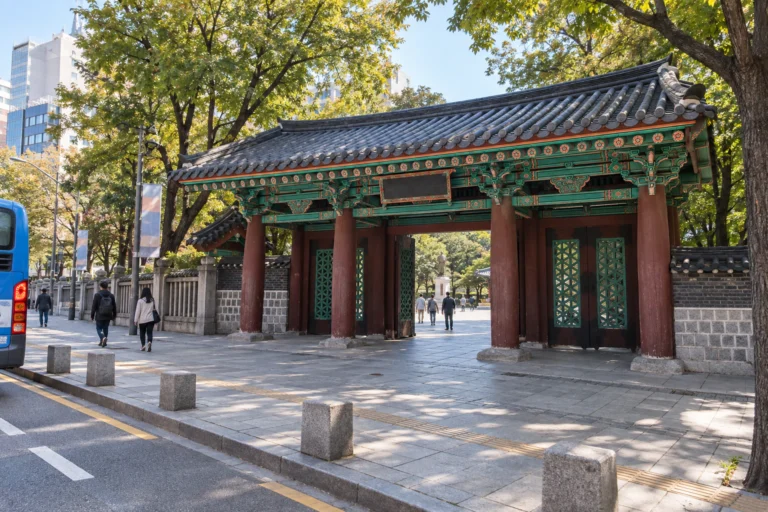
SEOUL · INSADONG
A Courtyard and Tea House at the Kyung-In Museum
It is the place she said “let's go there first” last time. One alley off Insadong-gil there is a museum, and there is no admission charge.
How to get there
The exit numbers follow the museum's directions; distance and time are map-route estimates.
In the first, standing in front of Ssamziegil, Maya told Lulu “let’s go to Kyung-In Museum first”; that day they got as far as the courtyard and were out again within four paragraphs. The second piece climbed Ssamziegil to the top. Today she goes back to that “first”. This time Maya is on her own. Lulu has other plans, and Maya wanted to see this place by herself.
Kyung-In Museum of Fine Art sits one alley off Insadong-gil. It opens from ten in the morning to six in the evening, and there is no admission charge. Tuesday is the day shows come down and the next one is set up, so Maya picked a weekday afternoon that was not a Tuesday. The traditional tea house inside the museum stays open until ten fifty at night — so the courtyard can be seen by day and the tea house after the sun has gone.
Today’s question is this. The hanok tea houses she saw on screen always had the door already open. Every scene shot from inside a room ended in a garden, and there was never a scene of someone opening the door. In real life, who opens it? And what does it feel like to step a few paces off a main street and find a courtyard with no admission charge?
On Insadong 10-gil — A Courtyard You Enter Without a Ticket
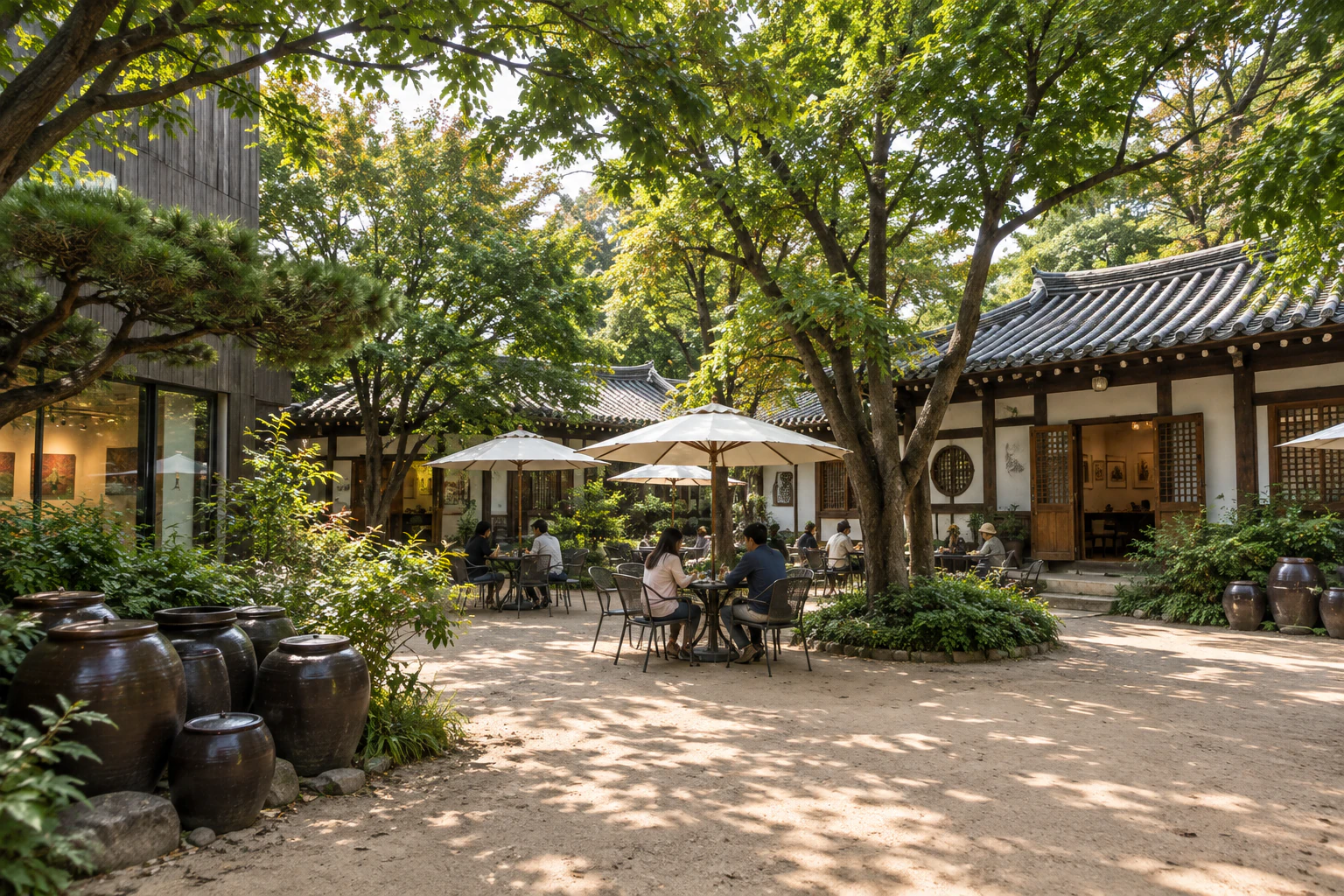
Kyung-In Museum of Fine Art opened on 6 December 1983. On a site of about 550 pyeong (roughly 1,800 m²) it has five exhibition halls (Nos. 1, 2, 3, 5 and 6) and an atelier, an outdoor exhibition space and gardens, and a traditional tea house; sculptures and installations stand among the gardens (museum listing).
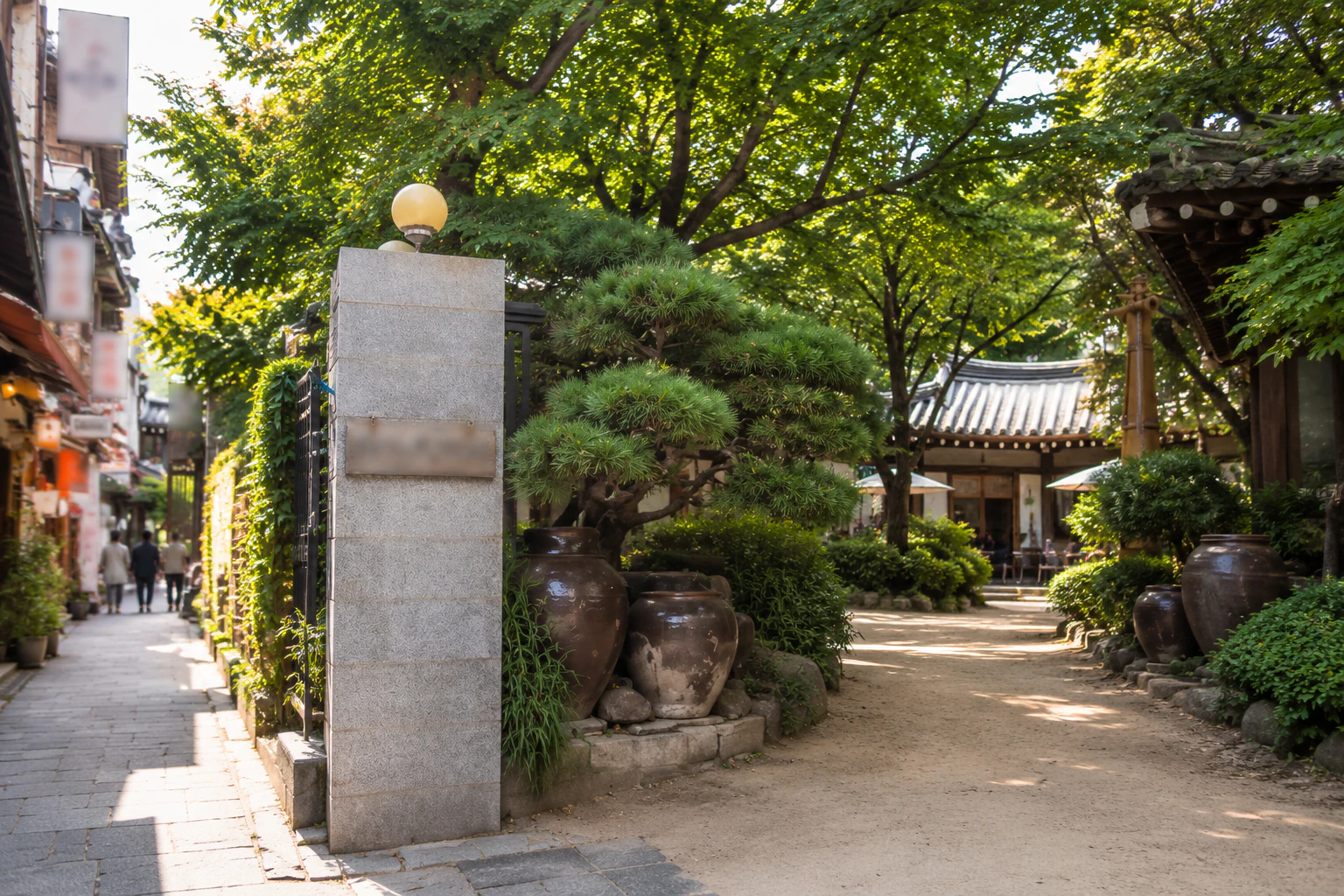
Out of Exit 6 of Anguk Station, down Insadong-gil, then a right turn into an alley: Insadong 10-gil. One alley in, the noise of the main street seems, to Maya, to drop by half. In the first piece Maya wrote that “the main street and the courtyard are the same Insadong, but your eyes rest at a different height”. Today she watches, walking, for exactly where that height changes. It is the moment you step into the alley. Find on map

The listing says admission is free, and past the gate the courtyard begins almost at once. Maya slows down. The museums Maya knows from the screen were places you bought a ticket to enter. Here, walking from the alley into the courtyard is the entering.
The museum opened in December 1983. According to its listing, on about 550 pyeong of land there are five exhibition halls, one atelier, an outdoor exhibition space and gardens, and a traditional tea house. Maya looks at the layout rather than the numbers. To Maya’s eye the halls wrap round the courtyard, and gardens run on between them. A museum with things to see without going indoors.
She stands in the courtyard and looks round once. Sculptures and installations stand among the gardens, the listing says. A work is something you see on the day it is up, and the museum asks visitors not to photograph works without the artist’s consent. Maya keeps her camera on the garden.

In Front of the Hanok Hall — The House That Moved Away and the House Built Again
Exhibition Hall No. 3 is a hanok. The hanok that originally stood there had been the residence of Park Yeong-hyo; the museum donated it to the City of Seoul and it was moved to Namsangol Hanok Village in 1996, and the present building was rebuilt afterwards (museum listing).
On one side of the courtyard stands a hanok: Exhibition Hall No. 3. The museum’s listing gives the history of this spot in a single paragraph. The hanok that originally stood here had been the residence of a man named Park Yeong-hyo; the museum donated that building to the City of Seoul, and in 1996 it was moved to Namsangol Hanok Village. The hanok standing here now was rebuilt afterwards. The Korea Tourism Organization’s listing, however, describes the house that went to Namsangol as the Min Family House of Gwanhun-dong, home to Min Yeong-hwi’s family, and says its inner quarters and gate quarters were moved and restored there in 1995–1998, while the museum owned the site. Park’s name survives only in brackets, as the house’s former name. Find on map
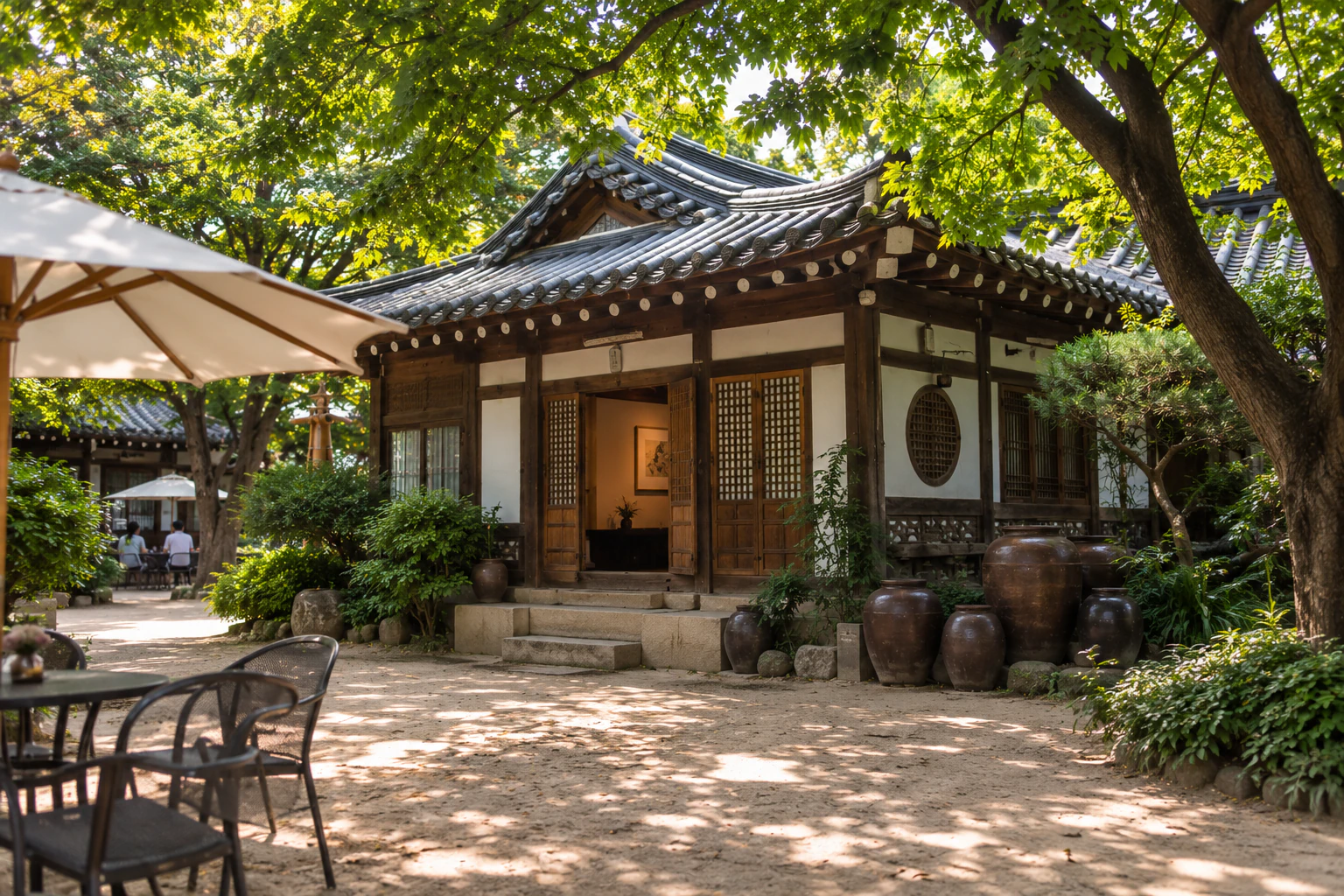
Maya reads the paragraph twice. “So this house isn’t the original house.” The original went to the foot of Namsan, and what stands here is a house built again on the same spot. On screen a hanok always appears as “an old house”. This hanok has an old site and a younger house. Maya likes this difference. It is the kind of difference a first-time visitor meets most often between the screen and the real thing.
A wind chime hangs at the end of the eaves. Describing the tea house, the listing mentions “the faint sound of the wind chime at the eaves”. Whether there is wind is for the day to decide. Maya does not wait for the sound; she looks up at the eaves. On screen a wind chime always arrived as a sound first. In real life, it is the shape you see first.
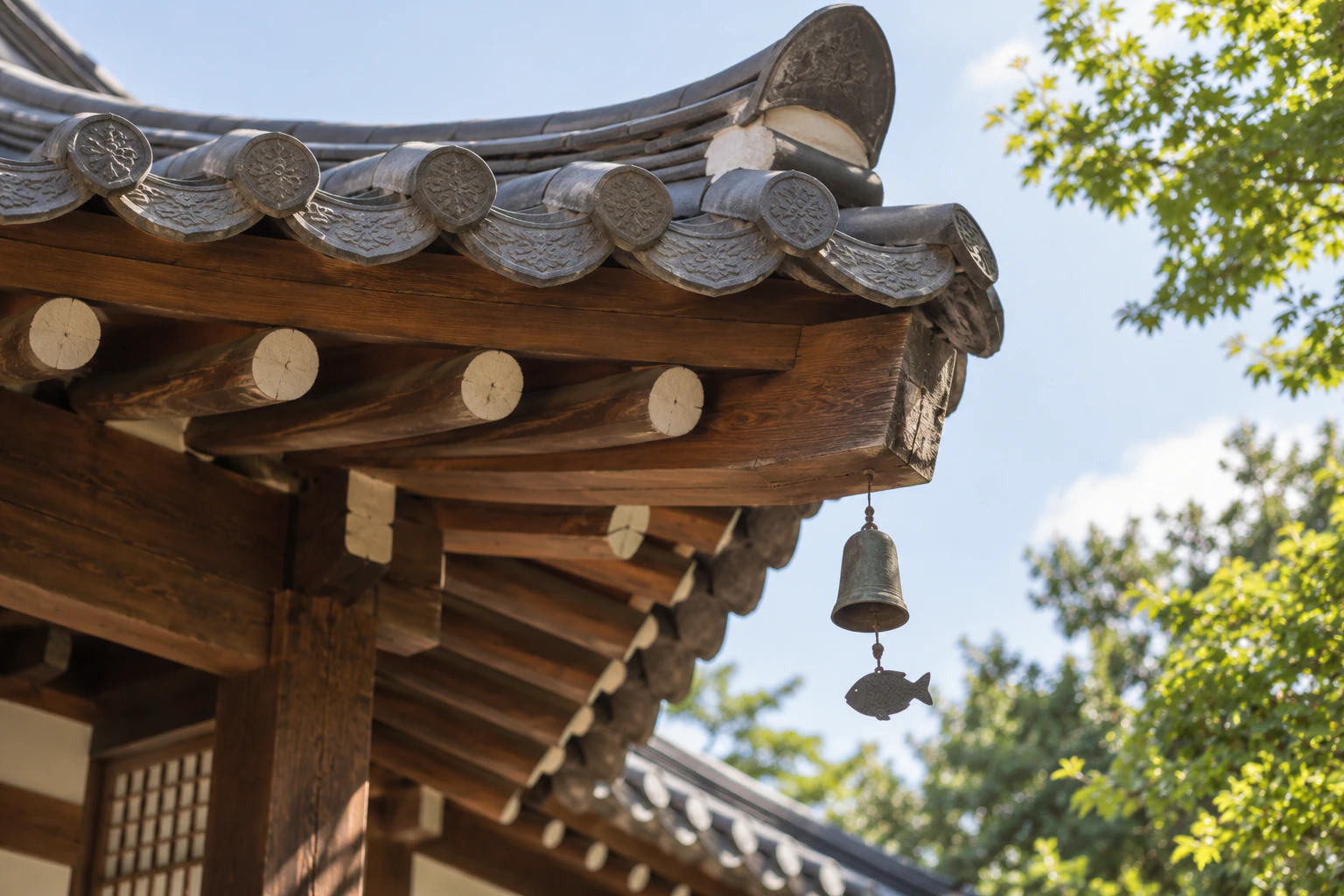
From in front of the hanok she looks back across the courtyard. One alley off the main street, one gate off the alley. Pass those two and you are in this courtyard. Now she understands what she meant in the first piece by “your eyes rest at a different height”. On the main street you look at signs; here you look at eaves, stone and trees.

In the Tea House — A Garden You See Only When You Open the Door
The traditional tea house is in a hanok and serves fifteen kinds of Korean tea. Slide the door open and the toenmaru (narrow wooden veranda) and the garden are right there in view. Open 10:00–22:50 (museum listing, checked September 2026).
The traditional tea house is in a hanok. According to the listing it serves fifteen kinds of Korean tea, and when you slide the door open, the toenmaru — the narrow wooden veranda — and the garden are right there in view. What Maya has come to check today is the second half of that sentence. “When you open the door.” Find on map

Maya sits down inside the paper-screened, floor-seated room, facing the closed sliding door. On screen this scene always began with the door already open: the camera faced the garden from inside the room, and there was no door in between. Closed, it shows only brightness through the paper.
She opens it. Push the sliding door sideways with one hand and the toenmaru comes first, and beyond it the garden — exactly as the listing put it. Maya stays still for a moment with the door open. The scene on screen started from here. That there was “someone who opened the door” before it is what the screen cut out. Today Maya is that someone.

She reads the menu, all fifteen names to the end. What Maya came to check today was not the tea but the door. The listing also says traditional music plays in the tea house. The day’s sound belongs to the day.
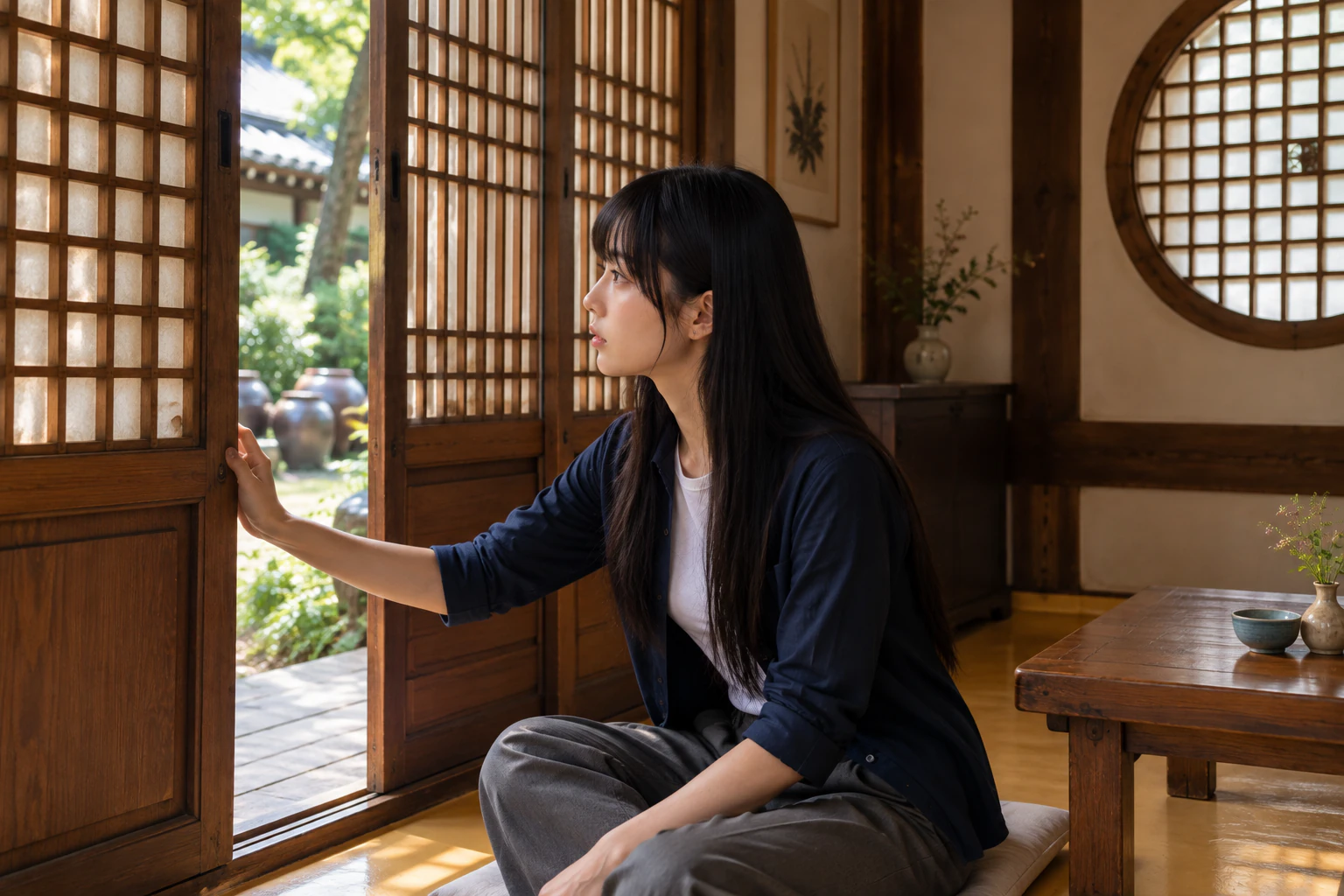
She looks at the garden first from inside the threshold, then from the toenmaru side. Looking at the garden from inside the room and looking at it from the veranda are a single step apart, and different. From inside, the door frame becomes a picture frame; on the veranda the frame is gone. The screen was always on the frame side. Having tried both, Maya sees why the frame suits the screen.
Instead of a notebook she opens the notes on her phone. She writes one line. “I open the door.”
Back to the Alley — Six O’Clock and Ten Fifty
Kyung-In Museum of Fine Art · 11-4 Insadong 10-gil, Jongno-gu. Museum 10:00–18:00 (open at weekends; Tuesdays are change-over days, with new shows opening on Wednesdays), free entry, closed on New Year’s Day, Seollal and Chuseok. The traditional tea house is open 10:00–22:50. Photographing the exhibited works needs the artist’s consent (museum listing, checked September 2026).
The exhibition halls close at six in the evening; the tea house is open until ten fifty at night. Maya checks the time. Since the tea house stays open after the halls close, seeing the courtyard by day and coming back to the tea house in the evening would work too. Today she did it the other way round — courtyard first, tea house after, and it is still daylight. Find on map
She slides the door shut and comes out. Closing, Maya feels, takes more care than opening. On screen nobody ever closed the door; when the scene ended, the garden ended with it. In real life you have to close the door for the room to become a room again.

Back across the courtyard to the entrance. She bought no ticket on the way in, so on the way out there is only the gate to pass. Standing in the alley, half the main street’s noise comes back. At the end of the alley Maya looks back once. From the alley the courtyard inside the gate cannot be seen. She thinks she understands why the screen starts with the courtyard: film the alley and the courtyard does not show.
Out on Insadong-gil, Ssamziegil is across the way — the building she climbed to the top in the second piece. In the first piece, standing in front of Ssamziegil, Maya said “let’s go there first”, and today she kept to that order on her own. Next time, with Lulu, she plans to reverse it: the tea house first, Ssamziegil after. Open the door, then climb.
The Insadong series leaves one more place for later: the pagoda an alley away, and the temple with a courtyard. That is someone else’s afternoon.
The museum one alley in had no admission charge, the hanok was younger than its site, and the garden showed only when the door was opened. None of the three was on screen. The screen starts from the courtyard, shows the house as old, and shows the door already open. The one line Maya wrote in her notes takes in all three.
The screen begins inside an open door. A first-time visitor begins in front of a closed one. That the hand which opens it is your own — that is what Maya, on her third visit to Insadong, learned on the third.

(※ This article includes staged images created with AI.)
Plan your visit
Allow 40 minutes to an hour to go into the alley from Anguk Station, see the courtyard and the hanok, sit in the tea house and come out. How long you stay in the tea house is up to you, and walking times are map-route calculations.
A diagram of the order only — not to scale, and not the shape or direction of the actual route.
- Anguk Station → Insadong 10-gil → Kyung-In Museum — From Exit 6 of Anguk Station (Line 3), down Insadong-gil and into Insadong 10-gil, about 412 m, five minutes. From Exit 5 of Jongno 3-ga Station (Line 5), about 501 m, seven minutes. The museum’s directions also list Exit 3 of Jonggak Station (Line 1). Find on map
- Entrance → courtyard and gardens — There is no admission charge. Stand in the courtyard and take in how the halls and gardens are laid out first. The works in the gardens are for the eyes only. Find on map
- In front of the hanok hall — Look up at the eaves and the wind chime of Exhibition Hall No. 3. The history — the original hanok moved to Namsangol Hanok Village, the present building rebuilt — is in the museum’s listing. Find on map
- The traditional tea house — Go in and slide the door open: the toenmaru and the garden are right there. Fifteen teas — names and prices from the menu on the day. Find on map
Getting there
Checked 2026.09.21
Exit 6 of Anguk Station (Line 3), Exit 3 of Jonggak Station (Line 1) or Exit 5 of Jongno 3-ga Station (Line 5), per the museum’s directions. Parking: the paid car park at Suun Hall, about five minutes on foot.
Hours & fees
Checked 2026.09.21
Kyung-In Museum of Fine Art · 11-4 Insadong 10-gil, Jongno-gu. Museum 10:00–18:00 (open at weekends; Tuesdays are change-over days, with new shows opening on Wednesdays), free entry, closed on New Year’s Day, Seollal and Chuseok. The traditional tea house is open 10:00–22:50. Photographing the exhibited works needs the artist’s consent (museum listing, checked September 2026).
Background1
Checked 2026.09.21
The traditional tea house is in a hanok and serves fifteen kinds of Korean tea. Slide the door open and the toenmaru (narrow wooden veranda) and the garden are right there in view. Open 10:00–22:50 (museum listing, checked September 2026).
- Museum 10:00–18:00 (open at weekends), free, closed on New Year’s Day, Seollal and Chuseok. Tuesdays are change-over days, so new shows open on Wednesdays — museum listing, checked September 2026. The traditional tea house is open 10:00–22:50.
- Photographing the exhibited works needs the artist’s consent (museum visitor etiquette). This piece names no works, and the images depict none.
- This hanok has thresholds and a raised toenmaru. If you use a wheelchair or pushchair, ask the museum office (02-733-4448) in advance.