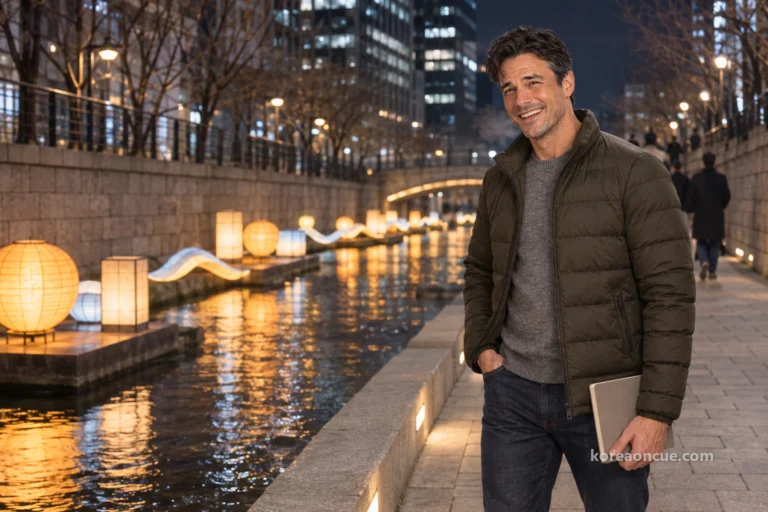
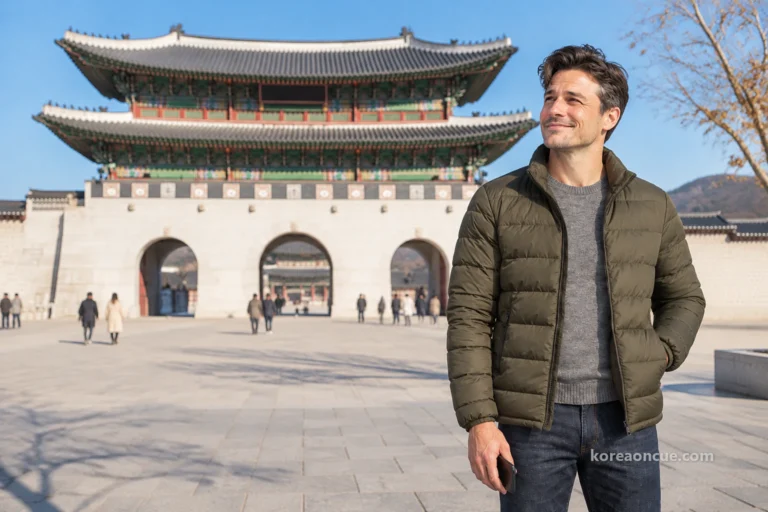
SEOUL · GWANGHWAMUN
The day Rina turned her notebook upside down: Gyeongbokgung first, then down three floors of the National Palace Museum of Korea
How late the National Palace Museum of Korea opens, whether it is free and what is on each floor · 21:00 on Saturdays and the last Wednesday · the palace closes on Tuesdays, the museum on the last Monday · 2 minutes on foot from Exit 5 of Gyeongbokgung Station
The Monday she chose to avoid the palace turned out to be the day the museum closes. Rina moves the date, sets the palace’s last entry against the museum’s late hours and turns her notebook upside down. On a Saturday, she carries three question marks from the palace down through three floors.
How to get there
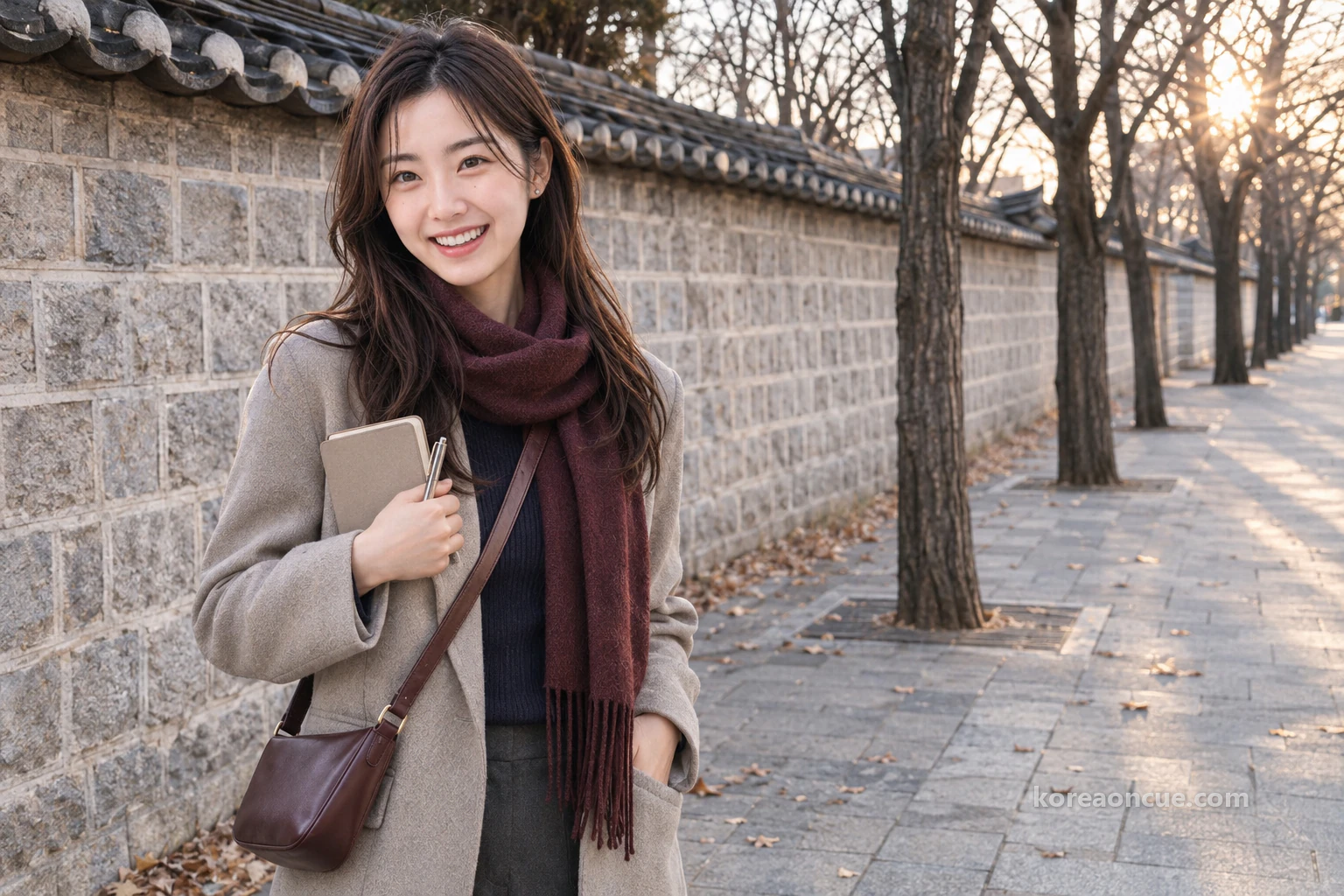
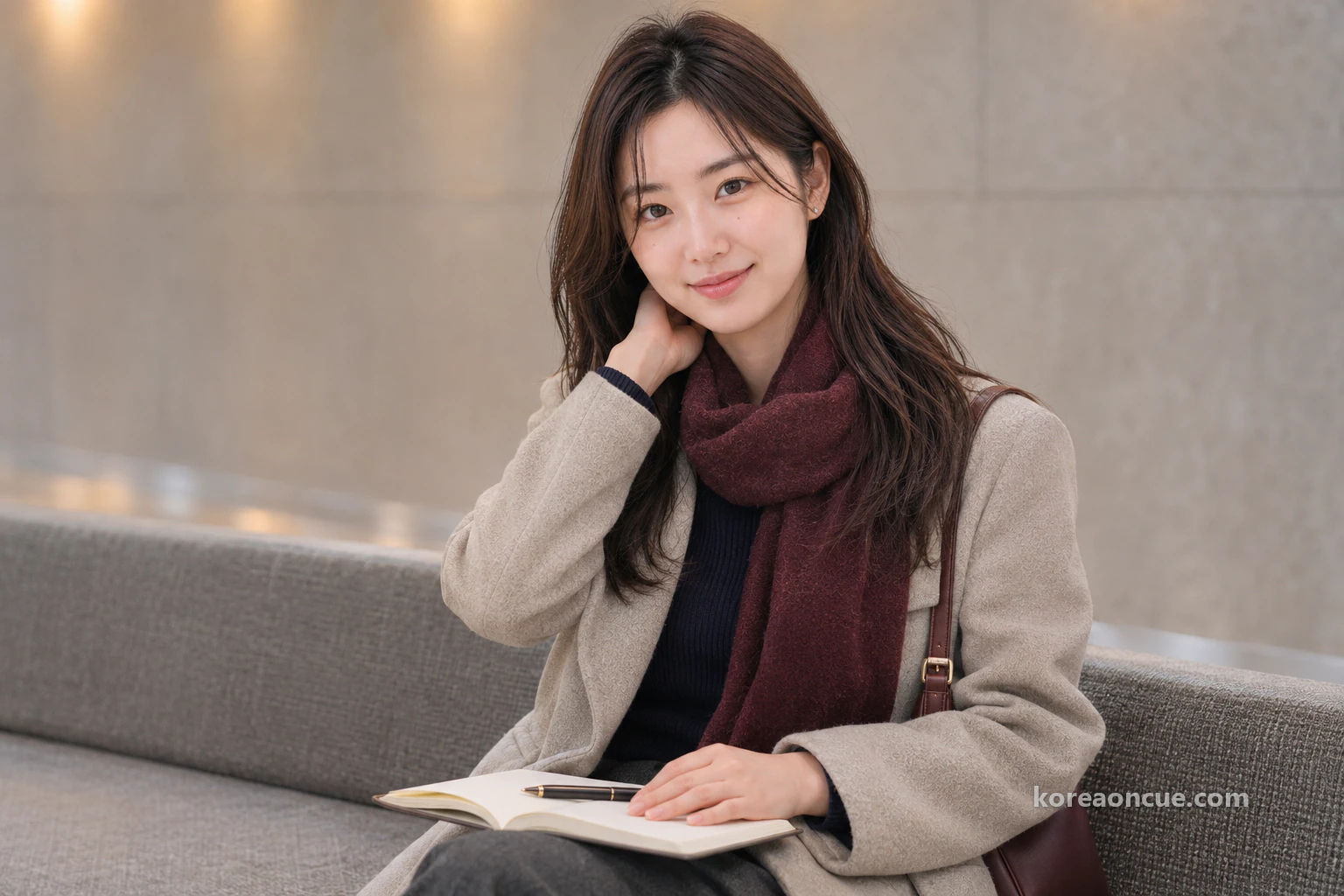
Rina is a traveller who divides places into boxes in her notebook. She is 23 and from Japan, and each palace box has a “Name” line at the top and a “Use” line below it. Going round Changdeokgung, Gyeonghuigung and Deoksugung, she filled the name lines in no time, but the use lines kept leaving gaps. She simply couldn’t picture things like the chair a king sat on, the clothes a queen wore or the instruments that measured time in a palace. Three palaces in, this was still the one line that never had enough pencil on it.
In late November, when the cold had her digging out a thick coat, Rina decided to fill those gaps at the National Palace Museum of Korea, where the royal artefacts are gathered. It stands next to Gyeongbokgung, so she thought she could do both in a day, and she ruled two boxes side by side on a fresh page. The museum went on the left and the palace on the right, the idea being to learn the names from the objects first and walk the palace afterwards. To avoid Tuesday, when Gyeongbokgung closes, she picked Monday 30 November. That, she felt, was the safe choice.
This plan is about to flip, both its date and its order. This piece follows the day as Rina rewrote it. On the first Saturday in December, she comes out of Exit 5 of Gyeongbokgung Station, walks the palace first, then works down the museum from the 2nd floor to the basement in the evening. How late it opens, whether it is really free and what is on each floor are all set out in turn.
The Cue — At a glance
With three floors to see and no admission to pay, the National Palace Museum of Korea suits the evening after a palace walk. On a Saturday, see the palace first and leave the evening for the museum. When choosing a date, start by crossing out Tuesdays, when the palace closes, and the last Monday, when the museum closes. If you want a tour in another language, pick a date that has your language before you think about the day of the week.
- Station and exit: 2 minutes on foot from Exit 5 of Gyeongbokgung Station on Line 3. The other exits and the buses are together in the exit section below.
- Address: 12 Hyoja-ro, Jongno-gu.
- Hours and admission: Hours by day, last entry and admission are together in the “How late is it open?” section below.
- What to bring: If you plan to borrow an audio guide, bring ID.
- By car: The museum has no car park of its own. Use the Gyeongbokgung car park (enquiries 02-736-9536).
When is the National Palace Museum of Korea closed? The palace on Tuesdays, the museum on the last Monday
The National Palace Museum of Korea’s regular closing day is the last Monday of each month, which is a different day from Gyeongbokgung’s, every Tuesday. This is exactly where Rina’s first plan came unstuck. She looked at the calendar again and saw that 30 November was the last Monday of the month. The day she had chosen to avoid the palace was, of all days, the day the museum closes. Rina drew a small cross in the left-hand box and stared for a while at the box of someone who had believed that avoiding Tuesday would do.
Open in Kakao Map — Gyeongbokgung Station
The two sit side by side, yet their rules for closing are quite different. So Rina ruled new lines for the days of the week, wrote the palace and the museum separately in each, and added the days with tours in other languages too. It became a table that showed at a glance what worked on which day, with no need to shift dates along one box at a time.
| Day | Gyeongbokgung | National Palace Museum of Korea | Tours in other languages |
|---|---|---|---|
| Monday | Open | Until 17:30 (closed on the last Monday) | On set dates |
| Tuesday | Closed | Until 17:30 (closed if it falls on a museum closing day) | On set dates |
| Wednesday to Friday | Open | Until 17:30 (until 21:00 on the last Wednesday) | On set dates |
| Saturday | Open | Until 21:00 | None |
| Sunday | Open | Until 17:30 | None |
The row to look at first in this table is Tuesday. The museum opens even on Tuesdays when the palace is shut, so if you have come all the way to Gwanghwamun on a Tuesday, this one box is still alive for you. On the last Monday it is the other way round, with the museum closed and the palace open. When picking a day for both, rule through Tuesdays and the last Monday first. The bottom two rows are the ones to note if you are looking for a tour in another language.
The museum also closes on 1 January and on the day of Seollal and of Chuseok. If the last Monday is a public holiday, the closing day moves to the day after the holiday ends, and if that day is a Tuesday, the palace and the museum are closed together. In winter 2026 the last Mondays are 30 November and 28 December, so if you decide by looking only at the Mondays on your calendar, as Rina did, these are the two dates you are likely to hit. Seollal and Chuseok move every year, so look them up separately for your travel dates.

Looking for a new date, Rina’s eye stopped on the last Wednesday of the month. On that day the museum opens until 21:00, entry to Gyeongbokgung is free and, as it is a weekday, there are tours in other languages as long as the date suits. All three overlap on one day, but that month’s Wednesday had slipped past just the day before Rina drew her table. Annoyed with herself, she wrote “Last Wednesday — look at this first next time” at the very bottom of the page, and turned her attention to Saturday, which also runs until 21:00. And so the date became Saturday 5 December.
How late is it open, and is it free? 17:30 on weekdays and Sundays, 21:00 on Saturdays and the last Wednesday
The National Palace Museum of Korea charges no admission, and it stays free until further notice. The only lines in Rina’s notebook that cost money were 3,000 won for the palace and 1,000 won for an audio guide. The palace’s 3,000 won is the admission for foreign adults aged 19 to 64. At Gyeongbokgung, people wearing hanbok, those aged 65 and over and those aged 6 and under go free, and entry is also free on the last Wednesday of each month. So Rina’s day came to 4,000 won, the two added together.
The opening time is 09:30 every day, and it’s the closing end that changes. In the table below, look at the last entry column before the closing time, because if you arrive to match the closing time, you can no longer get in. Last entry at the museum is 30 minutes before closing, and at the palace it is an hour before. Rina wrote only the last entries large in her boxes too, and for the palace she noted the times for November and December, the months she was walking in.
| Where | Opens | Last entry | Closes |
|---|---|---|---|
| Museum, Mon–Fri and Sun | 09:30 | 17:00 | 17:30 |
| Museum, Saturday and last Wednesday | 09:30 | 20:30 | 21:00 |
| Gyeongbokgung, Nov–Dec | 09:00 | 16:00 | 17:00 |
The galleries are not the only things open late. The cafe, the museum shop on the 1st floor and the Digital National Heritage room, where you can try VR, AR and media art, also run until 21:00 on Saturdays and the last Wednesday. Only the National Heritage Visit Campaign promotion hall closes at 17:30 every day. If you want to collect a visitor passport and start the stamp tour, put this one in a daytime box. If you are looking for places to drop into in the evening, leave the galleries and the museum shop for your last box.
In what order should you see it with Gyeongbokgung? In November and December, the palace first and the museum after
If you are seeing both in winter, see the palace first and the museum after. In November and December, Gyeongbokgung’s last entry is 16:00, while on Saturdays you can get into the museum until 20:30. That puts four and a half hours between the two last entries. Even after the palace closes at 17:00, the museum still has four hours left on a Saturday. Go first to the one that shuts first: that is the one rule of this day.
Rina wrote the two times one above the other and looked again at her first plan. It showed her seeing the museum on the left first, then moving across to the palace on the right. There are six galleries, and Rina is someone who lingers in one room filling boxes, so at that pace there would be days when she missed the palace’s last entry. The left-hand box was going to eat the right-hand one. See the palace first, on the other hand, and the museum side keeps a whole evening.
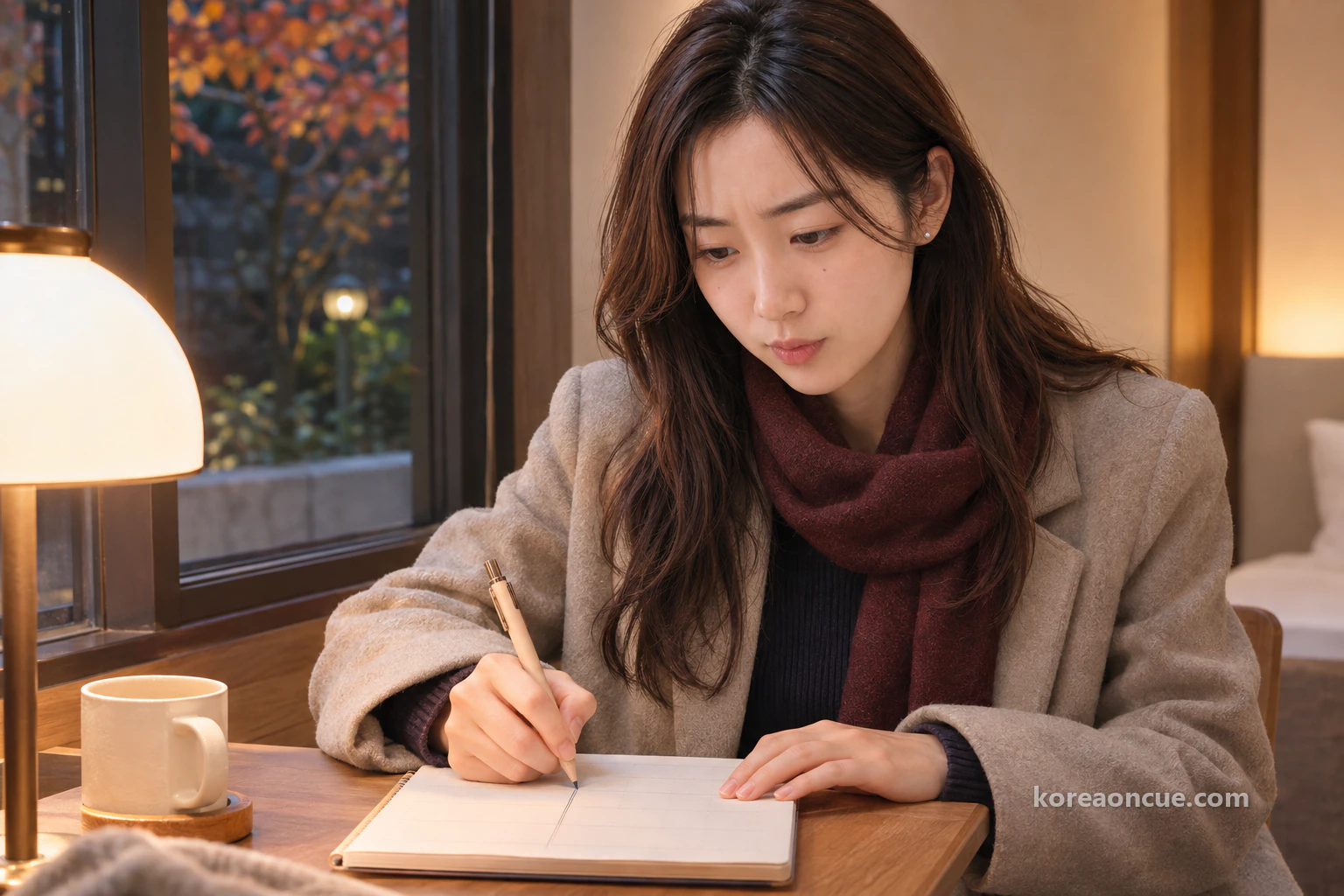
Instead of rubbing out the boxes, Rina turned her notebook upside down. A 180-degree turn brought the palace box on the right round to the left. The order changed in one go, but every letter in the boxes was now doing a handstand too. Upside down, “궁” (gung, palace) could only be read as “온” (on). Rina laughed out loud, alone in her room, and when the laughter died down she wrote the times again underneath in letters that stood the right way up.
There is one more reason to see the palace first. Walking a palace is what makes you curious in the first place. Take boxes with the names written in and the uses left blank into the museum, and hunting for answers in front of the objects becomes fun. It was the exact opposite of Rina’s first idea of studying the objects and then going to the palace, but for this notebook, bringing question marks from the palace worked better. The more question marks the palace produces, the longer the museum evening gets.
This order does cost you something, and the sums change with the day. For Rina, arriving in the afternoon, the weekend 10:00 Korean-language tour would already be over and at 15:00 she would be walking the palace, so she left that box empty. If you are moving from the morning, you can join the museum’s 10:00 tour and cross to the palace before 16:00. On weekdays and Sundays the museum’s last entry is 17:00, only an hour from the palace’s, so if you want to take the three floors slowly, Saturday or the last Wednesday suits best. On a Tuesday, when the palace is closed, just plan the day around the museum alone.
When are the tours in other languages? Weekdays only, and the language changes by date
Exhibition tours in other languages run only on weekdays (Monday to Friday), so Rina, having picked Saturday, couldn’t hear a tour in Japanese. The tours are in English, Japanese and Chinese, but not all three run every day. On the November 2026 schedule the times were 13:00 for Chinese, 14:00 for English and 15:00 for Japanese, and five weekdays that month had no English tour. Rina weighed the weekday tour against the Saturday evening and came down on the side of the evening.
If you want a tour in another language, you need to settle the date before the day of the week. The schedule goes up date by date on the calendar in the visitor information section of the museum’s website, so pick a day with your language first and fit your trip around it. The meeting point is in front of the information desk in the 2nd-floor lobby, so give yourself a box that gets you there before it starts. Koreans can’t join the tours for foreign visitors on their own, but Koreans who come with a foreign visitor can.
| How to listen | When | Languages | Where |
|---|---|---|---|
| Exhibition tour for foreign visitors | Weekdays between 13:00 and 15:00, on set dates | English, Japanese, Chinese | In front of the information desk, 2nd-floor lobby |
| Regular tour in Korean | Weekdays 10:00, weekends 10:00 and 15:00 | Korean | Ask at the information desk |
| Audio guide | Borrow one and listen on your own | Korean, English, Japanese, Chinese | Information room, 2nd floor |
Wanting to hear it in Japanese even on a Saturday, Rina chose the bottom row. You borrow an audio guide from the information room on the 2nd floor, the standard fee is 1,000 won and you need ID to borrow one. The night before, Rina moved her ID to the inside pocket of her coat. This was the only box that cost money in a free museum, so she drew a square round “1,000”. Video devices with sign-language commentary for deaf visitors are lent free from the same room, and these need ID too.
Which exit do you use? 2 minutes on foot from Exit 5 of Gyeongbokgung Station
The nearest exit is Exit 5 of Gyeongbokgung Station on Line 3, 2 minutes on foot. Exit 4 is 4 minutes on foot, and at Gwanghwamun Station on Line 5, Exits 1 and 2 are both 10 minutes. By bus, get off at a stop around Sejong-ro in Gwanghwamun and walk 5 to 10 minutes. The museum has no car park, so drivers have to use the Gyeongbokgung car park. It is on the left at the start of the road from Gwanghwamun to Samcheong-dong, and it takes about 240 cars underground.
On the afternoon of the first Saturday in December, Rina came up through Exit 5. At the top of her box was written “Line 3 — 5 — 2 min”. The cold wind reached her face first, so she pulled her coat collar up to her chin, and she had tucked her pencil into the notebook so that it would fall open at the upside-down page. There was plenty of time before the palace’s last entry, so nothing in her step that day needed hurrying. The day’s first box was no longer the museum but the palace.
What should you note down when you see Gyeongbokgung first? In before 16:00, and three things you wonder about
When you see the palace first, it’s a good idea to note down what you wonder about, because the museum holds the answers. Rina paid her 3,000 won, went in and, for this one day, walked along leaving the use lines blank on purpose. She wrote a name, put a question mark by what she was curious about and moved on to the next box. Blanks that would usually have bothered her were, today, luggage to carry to the museum.
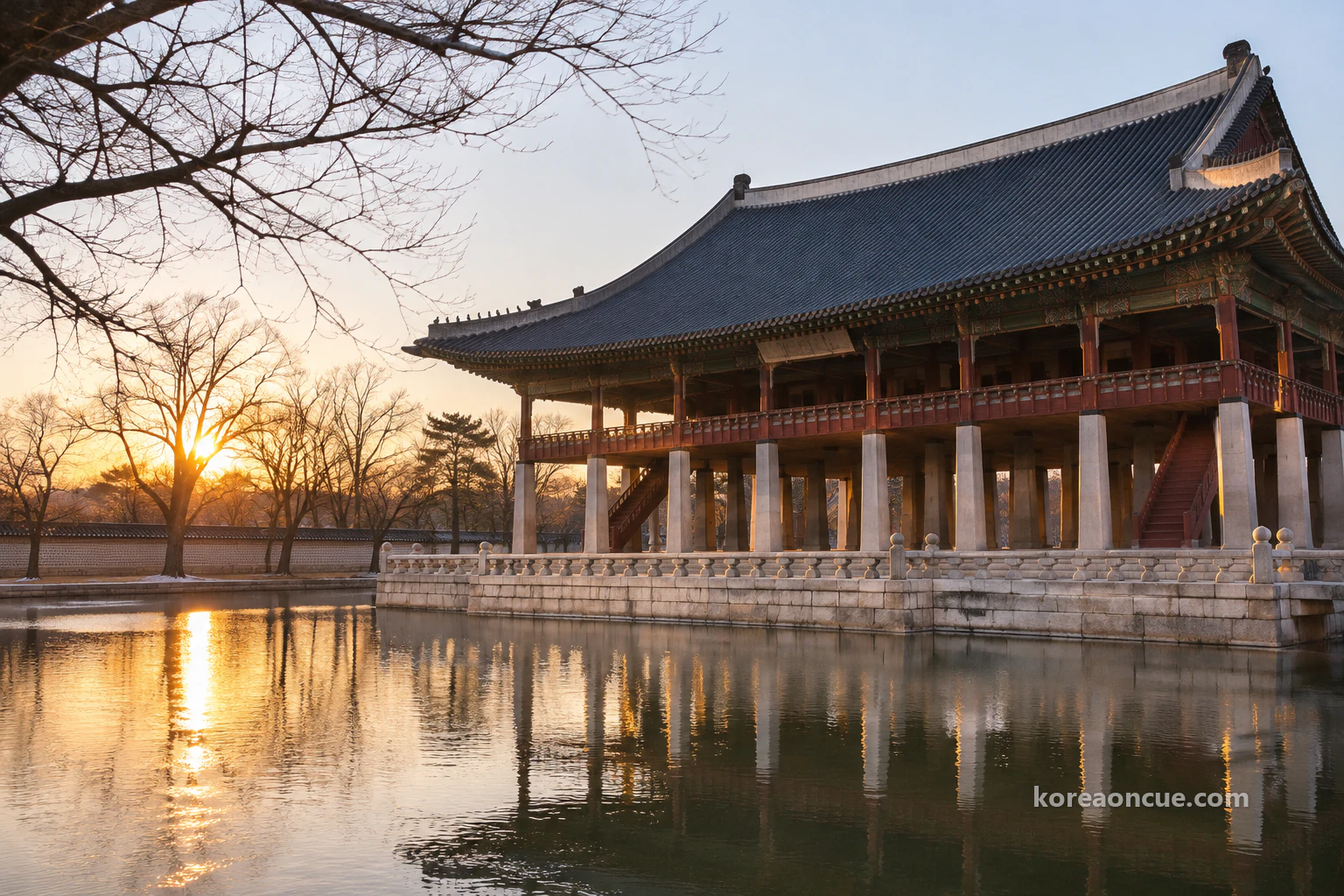
The first question mark was “The king’s chair”. For all the palace boxes she had filled, she had never once written down what the seat a king sat on looked like. The second came up in front of the Gyeonghoeru pond. Rina looked down at the winter water for a long time, began to wonder what had been underneath it and wrote “In the pond?”.
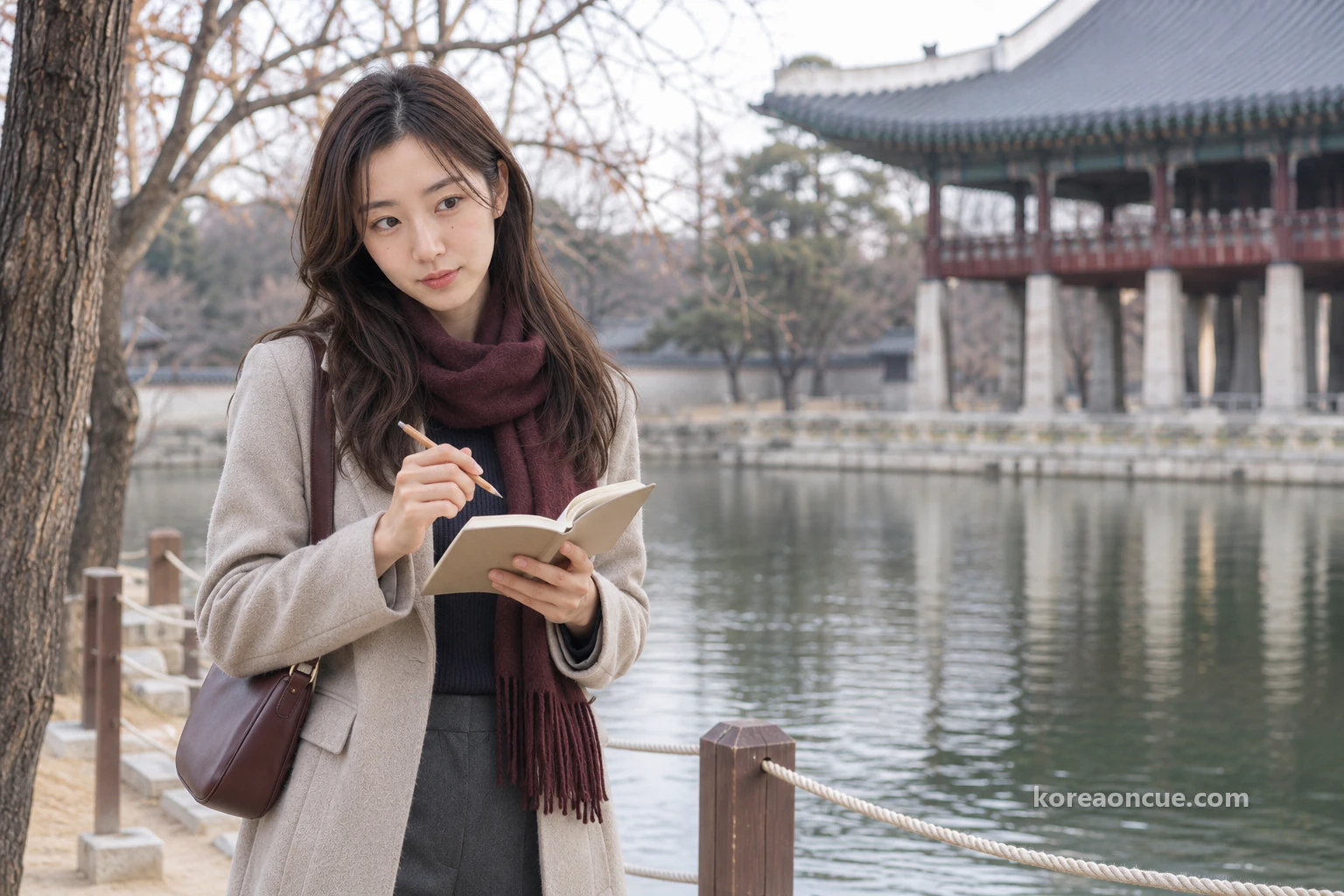
The third question mark was “Time — what instrument?”. A king’s day must have run by the clock too, and she wondered what instrument the palace used to measure the hours. With the palace closing at 17:00, Rina herself checked her watch several times that day. With her three question marks filled in, she put her frozen hands in her pockets and set off for the museum. Finishing outdoors first and then going into a place with seats is also much kinder on the body in December.
What is on each floor? Start on the 2nd floor and come down to the basement
The permanent galleries are six rooms on three floors, and it is easiest to start on the 2nd floor and work downwards. The information room and the cloakroom behind it are both on the 2nd floor, so leaving your bag and borrowing an audio guide is all done on one floor. Pushchairs and wheelchairs are also at the 2nd-floor information room, free for infants, older people and disabled visitors. Rina left her bag and walked to the first room with only her notebook and pencil in her hands.
| Floor | Galleries | Worth a close look | Places to rest and facilities |
|---|---|---|---|
| 2nd floor | Kings of the Joseon Dynasty, Life in the Royal Family, Special Exhibition Galleries I and II | Irworobongdo, the king’s chair, the bronze dragon from the Gyeonghoeru pond, the jeogui of Prince Yeongchin’s consort | Information room, cloakroom, pushchairs and wheelchairs, drinking fountain, rest area |
| 1st floor | Korean Empire, Special Exhibition Galleries III and IV, royal cars in the lobby | Emperor Gojong’s imperial seal and case, the Gyeongungung name board, Emperor Sunjong’s car, Empress Sunjeonghyo’s car | Museum shop, nursing room, drinking fountain |
| Basement 1 | Paintings and Calligraphy of Joseon Royal Court, Royal Rituals, Scientific Achievement | Yeon, pyeongyeong, Angbuilgu, the Changgyeonggung Jagyeongnu | Drinking fountain, rest area in the central hall |
In this table, take a look at the far-right column first. It’s the column you will want when your legs get heavy on the way down. The rest areas are between the Kings of the Joseon Dynasty and Life in the Royal Family galleries on the 2nd floor and in the central hall in the basement, and there is a drinking fountain on all three floors. You can’t bring food in, so keep eating for before or after your visit. Rina put a small star by each of the two rest areas.
The objects named in the table are each room’s representative pieces. Objects in the permanent galleries are rotated regularly to preserve them, and the Paintings and Calligraphy gallery is constantly reorganised, so the table names nothing there. It is more relaxing to think of coming to see the rooms than to come for one particular object. Rina’s three question marks, too, were written as things she wondered about, not as names of objects. She had written just the room names for each floor in advance and left the boxes blank.

What do you see in the 2nd-floor Joseon kings and royal family galleries? The king’s seat and the Gyeonghoeru bronze dragon
On the 2nd floor you see the symbols of the king and the life of the royal family. Kings of the Joseon Dynasty gathers the symbols and records of the dynasty, and Rina’s first question mark, “The king’s chair”, was answered here in front of the king’s chair itself. In the same room, Irworobongdo is a folding screen painted with mountain peaks, sun, moon, water and pine trees, and it symbolises the king’s virtue. Rina wrote “A painting of virtue” on the use line and rested her pencil for a moment.
The answer to the second question mark was in the same room. It was the bronze dragon unearthed in 1997 during dredging work on the Gyeonghoeru pond: two dragons made of bronze had been put in the pond to ward off fire. Remembering the winter water of a few hours before, Rina rubbed out the question mark and wrote “Two dragons, against fire” in its place. This was where seeing the palace first paid off. If you are coming with Gyeongbokgung, slow down in this room and bring up the photos you took at the palace side by side.
Right after that, Rina caused a small incident. Some display cases are kept dimly lit, and when she raised her phone to photograph a dark one, the flash burst out. She hid the phone inside the hem of her coat and went red to the tips of her ears. She stepped back alone, switched the setting off first, then wrote “Flash off” at the top of her notebook and copied it onto the next page as well. It was something to laugh off on her own, but her ears stayed hot for quite some time.
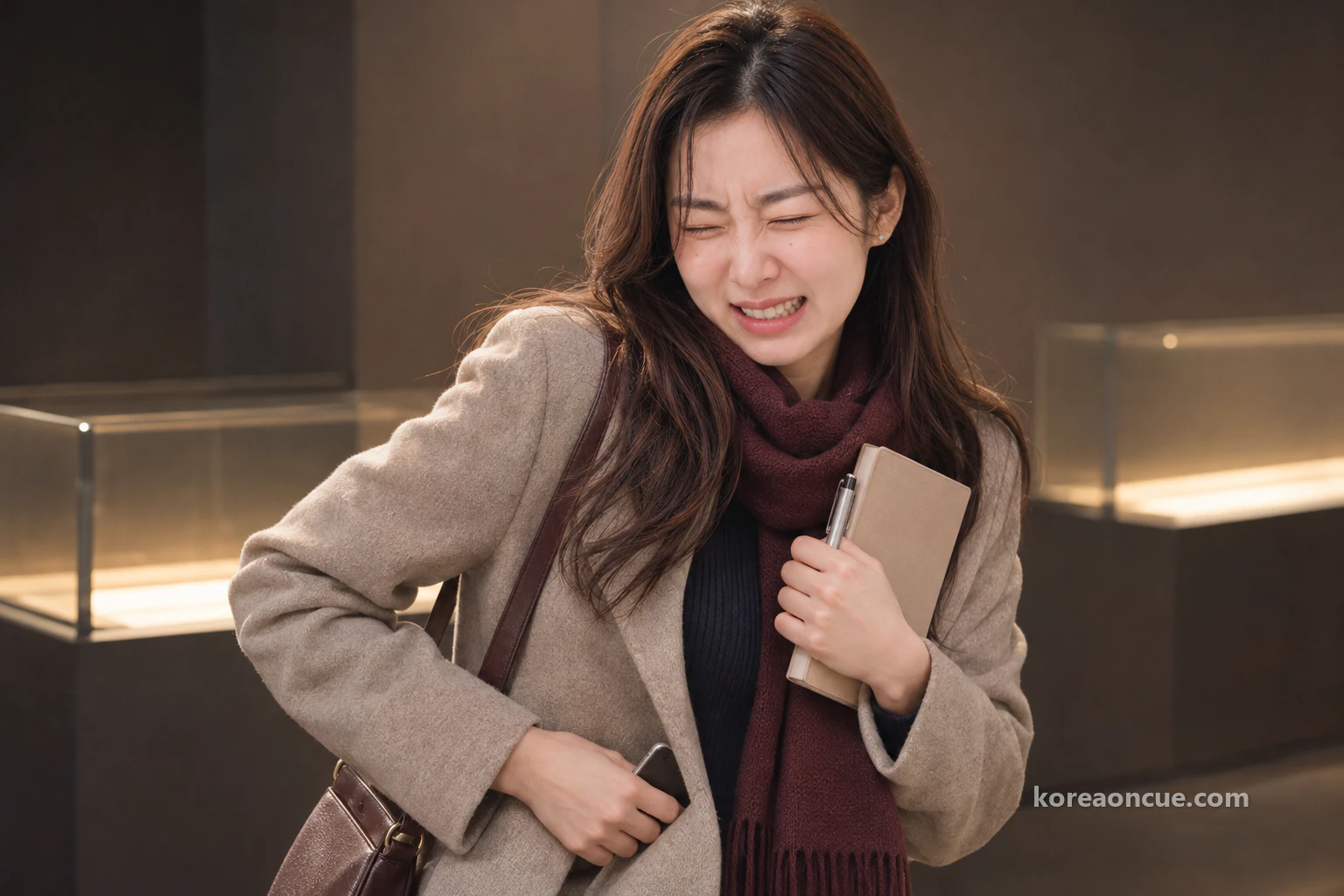
Photography with a flash, tripod or selfie stick and photography for commercial purposes are prohibited. Taking photos as such isn’t banned, so switch off your phone’s flash before you go into the galleries. Don’t touch the exhibits, and while pets can’t come in, guide dogs can.
In Life in the Royal Family, Rina’s eyes went back to the finish of things. In this room showing the life of the royal family, the first thing to stop her was the jeogui, a pheasant-patterned robe that Prince Yeongchin’s consort wore in 1922 for an audience with Emperor Sunjong. Next to it came a daesamjak norigae and a hwagak box decorated with ox horn, and her pencil slowed even further. For each object she wrote the use line first, then spent a long time at the glass looking at how its ends had been finished.
What is worth seeing in the 1st-floor Korean Empire gallery and the lobby’s royal cars? The plate for a banknote never issued, and a wooden car body
On the 1st floor you see the proclamation of an empire and the move towards a modern state. The Korean Empire gallery’s representative pieces are Emperor Gojong’s imperial seal and case, a Treasure, and the gold seal and gold book presented when Empress Myeongseong was invested in 1897. In front of the Gyeongungung name board, Rina flipped back through her notebook. Gyeongungung is the old name of Deoksugung and the writing on the board is Gojong’s, so “Gyeongungung” in brackets spread alongside the Deoksugung box she had made while walking Dondeokjeon.
With the Deoksugung box open anyway, Rina wrote the museum’s beginnings in next to it. It opened as the Royal Museum in 1992 in the Stone Hall of Deoksugung. On 15 August 2005, the 60th anniversary of Liberation, part of it opened on its present site in the former National Museum of Korea building, and on 28 November 2007 all the galleries in the three-storey building opened. By the time she had written down 40,000 items, an exhibition space five times that of the Deoksugung days and a storage area thirty times larger, the box was crammed with numbers. There was no way she could see all this, she thought, so she decided to stand for a long time only in front of objects whose use made her curious.
What held Rina longest in this room was the plate used to print the Hojo Taehwan-gwon. The Hojo Taehwan-gwon was Korea’s first banknote, but it was never actually issued. Rina wrote “A plate for printing banknotes” on the use line, then stopped her pencil. The fact that the notes never came out wasn’t something that belonged on a use line. So she ruled one more line at the bottom of the box and wrote “Result — the notes were never issued” separately, and this was the first time a box of only name and use had grown a third line.
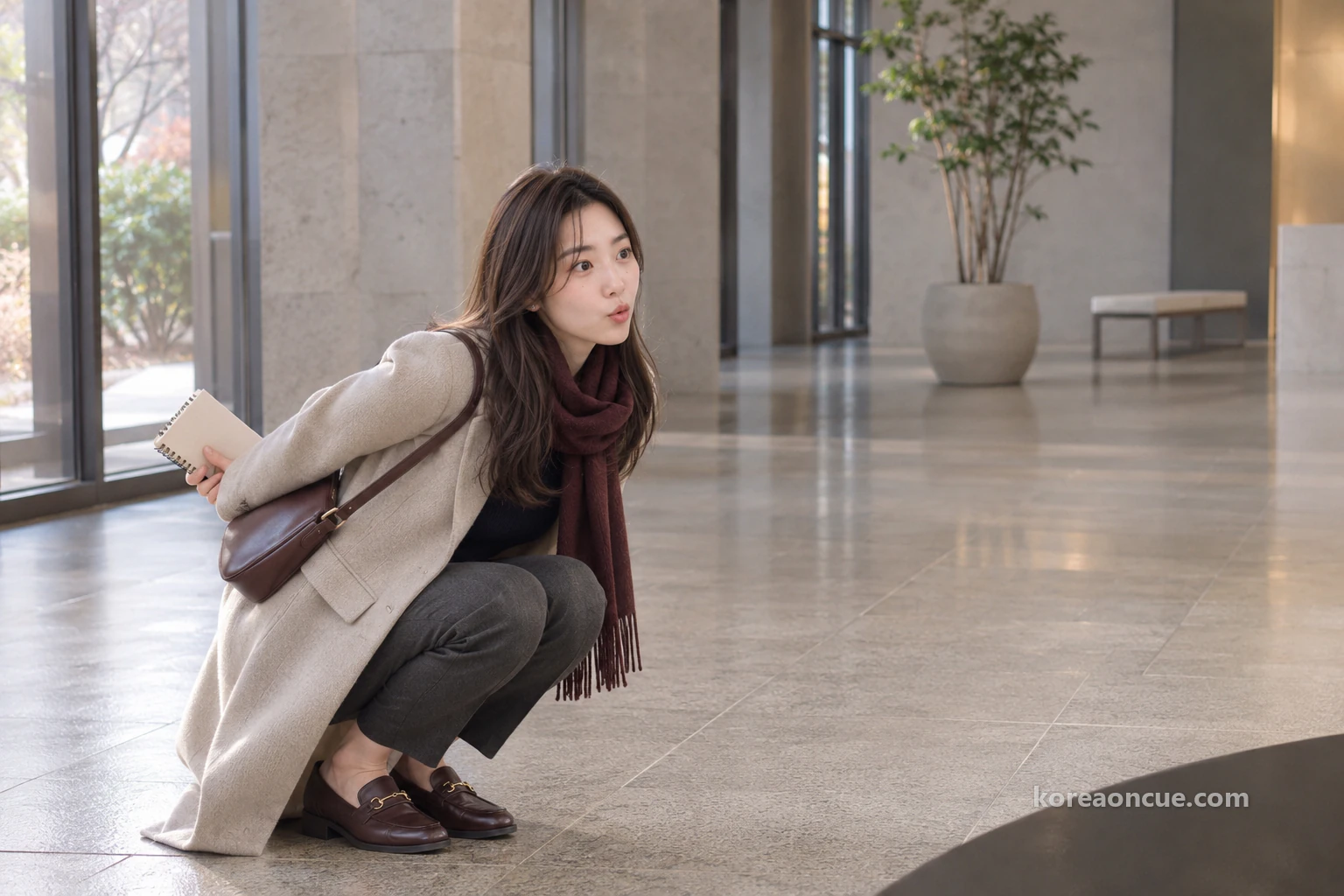
Step out into the lobby and you find the royal cars, the automobiles that Emperor Sunjong and the Empress rode in. Emperor Sunjong’s car is a Cadillac limousine made by General Motors (GM) in the United States, and its body is made of wood, not iron. Only 20 are left in the world. Empress Sunjeonghyo’s car is by Daimler of Britain, with only 3 left in the world, and it is the oldest surviving car in Korea. So an American car and a British car share one lobby.
For Rina, who always looks at the finish first, “wooden body” was not a phrase she could walk past. She clasped her hands behind her back, bent her knees and lowered her eyes to the level of the edge of the bodywork. If a car was made of wood, she wanted to know where the joins would be. In her notebook she wrote only two numbers side by side: “20 / 3”. Both are National Registered Cultural Heritage, so don’t treat this lobby as a corridor between galleries.
What is in the basement? Three rooms: Paintings and Calligraphy, Royal Rituals and Scientific Achievement
The basement has three rooms, so leave yourself plenty of time. If you come down on a weekday afternoon, the 17:30 closing time arrives first, but Rina, on a Saturday, had no such worry. The answer to her third question mark, “Time — what instrument?”, was in this floor’s Scientific Achievement gallery. Its representative pieces are the Angbuilgu, the Ilseongjeongsiui, the Changgyeonggung Jagyeongnu, a cheugudae and the stone carving of the Cheonsang Yeolcha Bunyajido.
The Changgyeonggung Jagyeongnu dates from 1536, with three pasuho and two susuho. The Ilseongjeongsiui is an instrument from 1437 in King Sejong’s reign, and part of one was unearthed in Insa-dong in 2021. Rina wrote the three names beside “Time”, rubbed out the question mark and went back to find the Changgyeonggung box near the front of her notebook. The building was at the palace and the object was here, so for the first time that day she ruled a line between two boxes and joined them up. It was an evening that taught her that joining boxes is as much fun as dividing them.
Royal Rituals covers the five rites that established the king’s authority: gilrye, hyungnye, gullye, binrye and garye. The yeon, the formal palanquin that kings, queens and crown princes rode in on royal processions, is in this room. A pyeongyeong, the Hwangnyonggi flag, a Baekjado folding screen, and King Sukjong’s white porcelain placenta jar and placenta plaque are also among its representative pieces. Remembering the royal cars upstairs, Rina wrote “Yeon, and the royal cars” and joined the boxes for things you ride in with one line. This was the room where her use lines filled fastest that day.
Paintings and Calligraphy of Joseon Royal Court shows court paintings made jointly by painters of the Dohwaseo under the supervision of the Ministry of Rites. They were painted realistically, with weight given to record, symbolism and decoration. Rina wanted to keep at least one reason to come back, so this was the one room whose box she deliberately left unfinished. Rather than the names of paintings, she wrote in the box only the time she had stood in that room.
This floor also has the Gogung Education Space and the Open Storage. If your legs are heavy after the three rooms, sit down for a bit in the rest area in the central hall. It was here that Rina took her first long breath as well. She put down her pencil and turned through the pages from the start, and all three question marks from the palace had been rubbed out. Only then did she notice how many letters on the upside-down page were now standing the right way up.
Rina’s Saturday in order: Exit 5 of Gyeongbokgung Station, the palace first, three museum floors in the evening
Rina’s day ran in this order: Exit 5 of Gyeongbokgung Station, the palace, then the museum’s 2nd floor, 1st floor and basement. On another day it would change a little. If you want a tour in another language, start by finding a weekday on the calendar with your language. On a last Wednesday with a tour in your language, you can fit the palace, the tour and the late hours into one day, and on a Tuesday, when the palace is closed, plan the museum alone, and on the last Monday, the palace alone. Draw the calendar first, as Rina did, and you’ll save yourself at least one wasted trip.
Before leaving the museum, Rina took a photo of that upside-down page and posted it in the group chat of four. “I turned 궁 round and it became 온. This order was the right one.” Those two sentences were the whole message, and without waiting for a reply she put her phone in her pocket. Outside, the cold evening air came in through her coat collar again. In the photo, the “궁” was still standing on its head.

If you go to the National Palace Museum of Korea, start by ruling boxes on a calendar. Cross out the closing days and you are left with a date, and set the last entries against each other and you are left with an order. Note what you wonder about at the palace, and the three floors become a way of tracking down the answers. There is still one upside-down page in Rina’s notebook. At the bottom of it, the Paintings and Calligraphy box is still waiting to be filled in.
Common Mistakes
Avoiding only the palace’s closing day
Rina’s first cross came from this. The day she chose to avoid the palace was the museum’s last Monday.
Spending a long time in the museum first in winter
Walk slowly, filling boxes, and you’ll miss the palace’s last entry. That’s why Rina turned her notebook upside down.
Arriving to match the closing time
Entry ends before the doors shut. In your notebook, write last entry larger than closing time.
Matching only the day of the week and expecting a tour
Even on a weekday, some dates don’t have your language. Pick the date first.
Walking into a gallery with your flash on
Rina set hers off in front of a dark display case and went red to the tips of her ears. Switch it off before you go in.
FAQ
Is the museum always open on Tuesdays, when Gyeongbokgung closes?
It is closed if the Tuesday is 1 January, the day of Seollal or the day of Chuseok, or if a public holiday has pushed the last-Monday closing onto it. It opens on all other Tuesdays.
What is different if I bring a child?
The children’s audio guide is 3,000 won, and you need a guardian’s ID to borrow one. The nursing room is next to Special Exhibition Gallery IV on the 1st floor.
Can a travel agency group join the regular tour in Korean?
Groups run for commercial purposes can’t use this tour.
Where do I go if I feel unwell during my visit?
The first-aid room is behind the information room on the 2nd floor.
Recap — 30 seconds before you go
- For the date, cross out Tuesdays, when the palace closes, and the last Monday, when the museum closes
- On a winter Saturday, the palace first, then the museum in the evening from the 2nd floor down
- For a tour in another language, a weekday with your language — at weekends, bring ID and borrow an audio guide
Sources
- National Palace Museum of Korea — Visitor information (Korean)Mon–Fri and Sun 09:30–17:30, until 21:00 on Saturdays and the last Wednesday · closed on the last Monday, 1 January, Seollal and Chuseok · free admission · regular and foreign-language tours · visitor ruleschecked 2026-11-06
- National Palace Museum of Korea — Notice of changed opening hours (Korean)Opening hours and closing days in use from 1 March 2026checked 2026-11-06
- National Palace Museum of Korea — General InformationAdmission Free · foreign-language tours meeting at the information desk in the 2nd-floor lobby · guide dogs welcomechecked 2026-11-06
- National Palace Museum of Korea — Directions (Korean)Gyeongbokgung Station on Line 3, Exit 5, 2 minutes, Exit 4, 4 minutes · Gwanghwamun Station on Line 5, Exits 1 and 2, 10 minutes · bus stops · no museum car park, use the Gyeongbokgung car parkchecked 2026-11-06
- National Palace Museum of Korea — Permanent exhibitions (Korean)Six galleries on three floors and the cars in the lobby · key objects by gallery · objects rotated regularlychecked 2026-11-06
- National Palace Museum of Korea — Facilities (Korean)Where to find bag storage, the first-aid room, pushchairs and wheelchairs, the nursing room, drinking fountains and rest areas · audio guide fee, languages and ID · sign-language video guidechecked 2026-11-06
- National Palace Museum of Korea — Purpose and vision (Korean)A cultural space linked with Gyeongbokgung · partial opening in August 2005, full opening in November 2007checked 2026-11-06
- Royal Palaces and Tombs Center — Opening hours (Korean)Gyeongbokgung in November and December 09:00–17:00, last entry 16:00checked 2026-11-06
- Royal Palaces and Tombs Center — Admission (Korean)Foreign adults aged 19–64, 3,000 won · free on the last Wednesday · free for those aged 6 and under, those aged 65 and over, and people wearing hanbokchecked 2026-11-06
A Seoul story told with our AI characters. Place details are checked against public sources; the photos are AI-made illustrative images. How we use AI