SEOUL · GETTING AROUND
Suitcase storage and airport delivery at Seoul Station: Ethan misses noon by 14 minutes and re-measures four options on the day he flies home
T-Locker, T-Luggage, same-day airport delivery and the City Airport Terminal, compared by time and cost
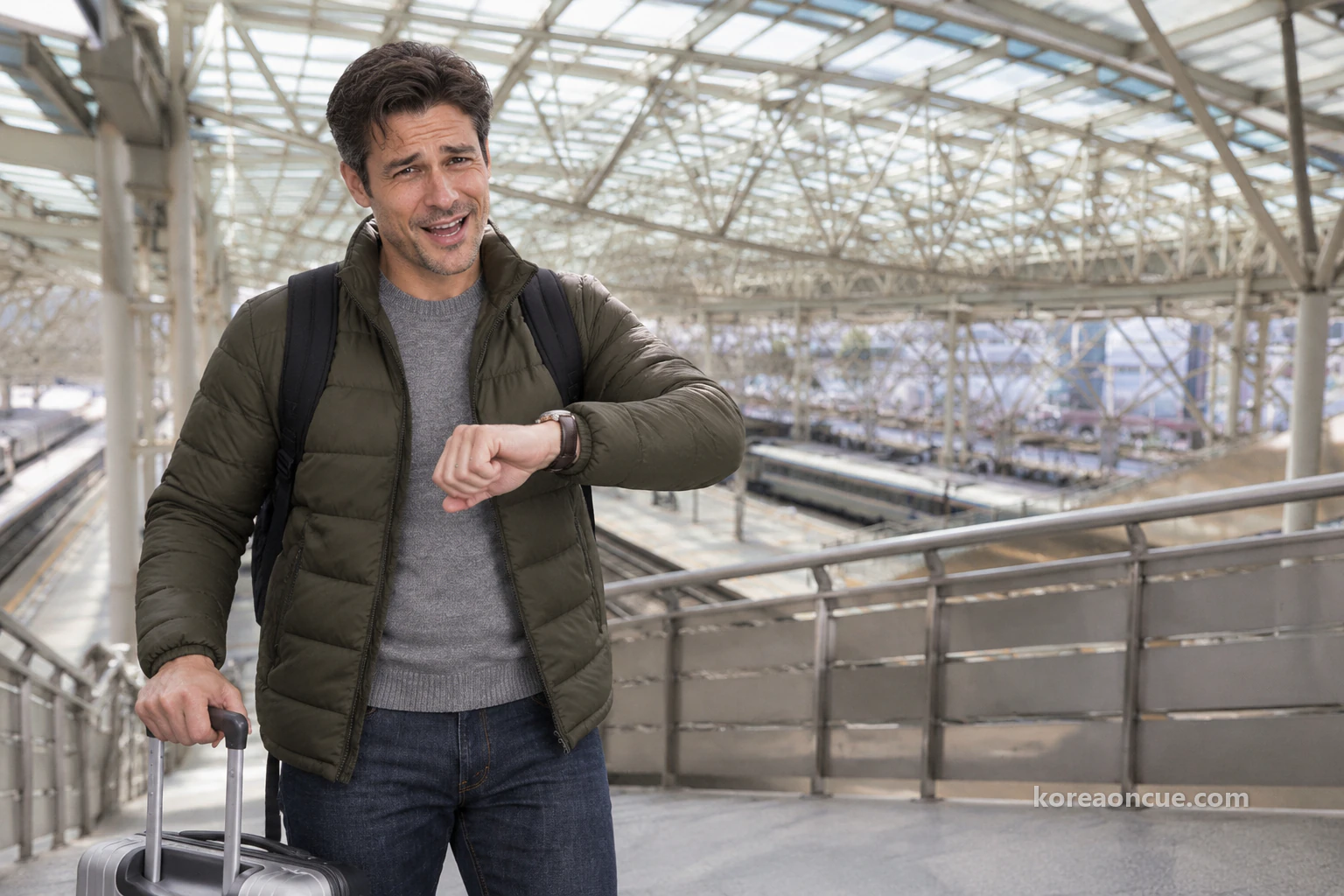
500 minutes until the evening flight home. Ethan steps off at Seoul Station planning to send his suitcase ahead to the airport, and at 12:14 he learns that drop-off ended at noon. This is the afternoon he redraws four options as a table on the spot.
How to get there
On the morning he flies home, Ethan measures a jacket sleeve in Dongdaemun and heads back to his hotel. By the time he has packed everything and checked out, it is 11:30. His flight back to Seattle leaves Incheon Airport Terminal 2 at 7:50 p.m. True to a 44-year-old engineer who counts everything by switching units, he opens his notebook in the lobby and starts with the time he has left: “500 minutes”. On the line below he adds “1 suitcase, 2 hands”.

Checkout gives a traveller a strange stretch of time. The room is gone, the flight is still a long way off, and the suitcase follows everywhere. Ethan lived in Seoul for six years, but he has never worked this time out. Back then he had a home, and on business trips he could stand his case in the corner of a meeting room. So this time he decides to measure every way of leaving luggage at one place, Seoul Station.
This piece is a record of that afternoon, and a guide to choosing where at Seoul Station to leave a suitcase after checkout, what it costs and whether it can go ahead to the airport. Ethan’s first plan was simple. He would send his suitcase to the airport from T-Luggage (또타러기지) on B1 at Seoul Station, spend the afternoon empty-handed and collect it at the airport. The opening hours he copied into his notebook read “09–22”. Trusting those numbers, he doesn’t hurry at the hotel, and that is where the story starts.
The Cue — At a glance
If you can drop your bags before 12:00 and have no reason to come back to Seoul Station in the afternoon, same-day airport delivery is the easiest choice. If you have missed 12:00, or you will be coming back to Seoul Station, leave them at T-Luggage or in T-Locker (또타라커), the Line 1 lockers. If you have an evening flight with a Korean airline in the table, leaving your case, collecting it and going down to the City Airport Terminal on B2 costs less and leaves you lighter at the airport too. Either way, start by checking your flight time against the tables below.
- Where to go: T-Luggage is on B1 of Line 1 Seoul Station, from Exit 1 towards Exit 2. The City Airport Terminal is on B2 of AREX Seoul Station.
- What to note down: Write down your flight’s departure time and terminal, the operating airline on your ticket and the three dimensions of your suitcase, and you can go straight to the tables below.
- What to keep on you: Don’t leave your passport, laptop and other electronics, or valuables. Keep them on you.
Where is luggage storage at Seoul Station? On B1, on B2 and outside the station
There is more than one place to leave luggage at Seoul Station. T-Luggage is on B1, and AREX’s Seoul Station City Airport Terminal is on B2. The private unstaffed storage places open 24 hours are outside the station, and because they have different operators, their hours and prices run separately. So if you set off looking for “Seoul Station luggage storage” and nothing more, it is easy to end up on the wrong floor. Ethan, too, writes the floors in his notebook first, as soon as he steps off Line 1.
Open in Kakao Map — Seoul Station
T-Luggage is a station service for storing a suitcase or sending it to its destination the same day. The Seoul Station branch is on B1, on the way from Exit 1 to Exit 2. T-Locker is the name of the subway’s station lockers. Line 1 Seoul Station has three sets: around Exit 1, in the corridor between Exits 2 and 3, and by the toilets in that same corridor.
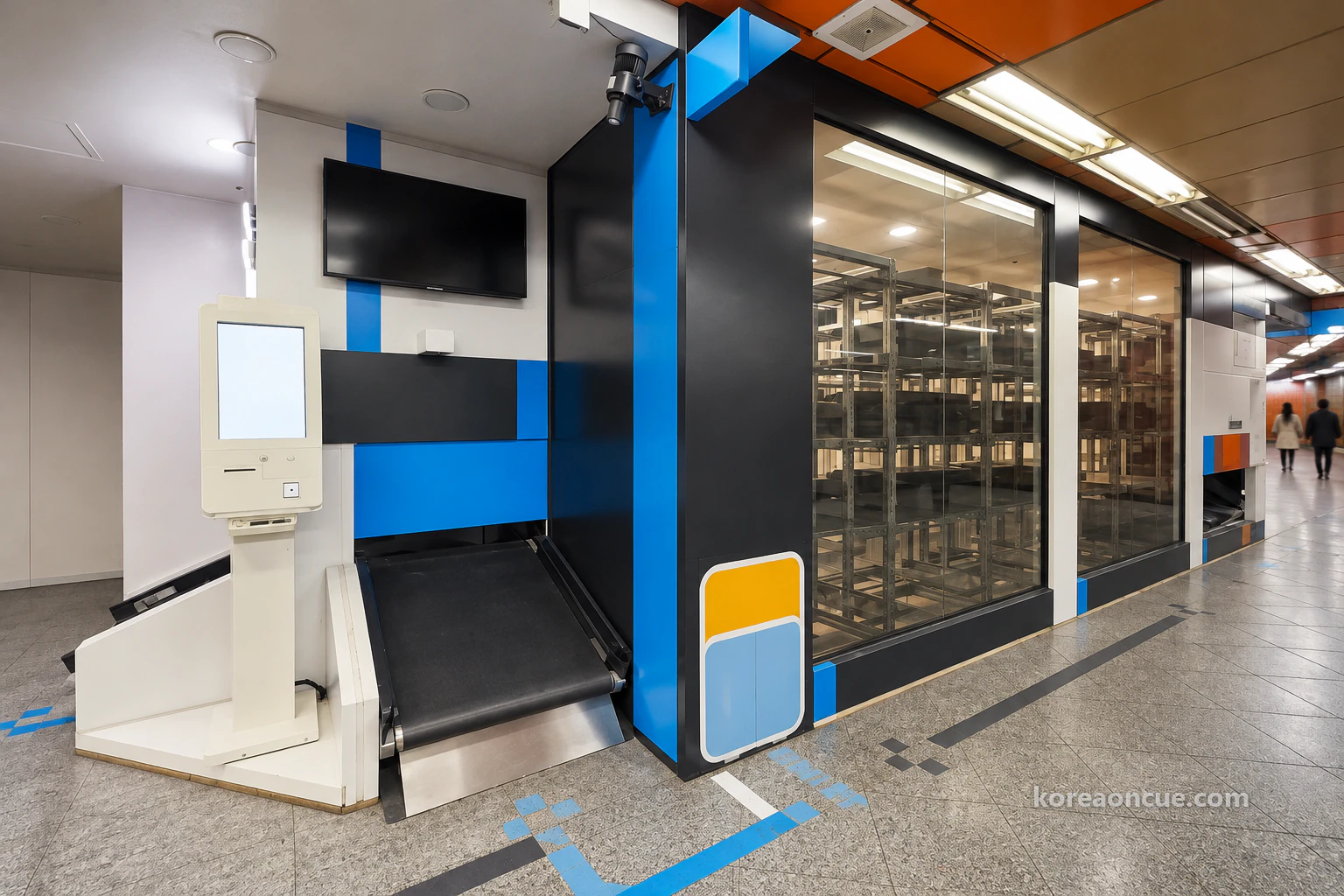
There are four main options. Ethan puts all four in one table. The column to look at first is “Until when”. However good the price, a row whose hours don’t fit might as well not be there. All the prices in the table are for size L on a weekday.
| Option | Where | Until when | Cost (size L, weekday) |
|---|---|---|---|
| T-Locker lockers | Three sets at Line 1 Seoul Station | 05:00–24:00 | 4 hours 4,400 won, plus 1,000 won per extra hour |
| T-Luggage storage | B1, from Exit 1 towards Exit 2 | 09:00–22:00, no closing days | 4 hours 6,000 won, plus 1,000 won per extra hour |
| T-Luggage airport delivery | Same place | Drop-off until 12:00, collect at the airport by 21:00 | 26,000 won |
| City Airport Terminal | AREX B2 | Check-in until 18:50, closing 3 hours or 3 hours 20 minutes before departure | No luggage charge, AREX Express adult 13,000 won |
One question separates the four rows: will you come back to Seoul Station in the afternoon? The two storage rows and the City Airport Terminal mean coming back, and only airport delivery doesn’t. So if you are spending the afternoon in a neighbourhood far from Seoul Station, delivery fits well. That round trip is exactly what Ethan wanted to wipe from his table when he first chose delivery.
How late can you send a suitcase to the airport? Same-day delivery drop-off ends at 12:00
To use same-day airport delivery, you have to drop your bags before 12:00. Along with Seoul Station, Hongik Univ., Myeongdong, Gimpo Int’l Airport, Jongno 3-ga and Jamsil stations share the same drop-off hours: 09:00–12:00. Open until 22:00 means the doors are open, not that delivery is taken until then. Check out at 11:00, stroll round the neighbourhood, make up your mind in the afternoon, and it is already too late.
Ethan stands in front of T-Luggage at 12:14. Before going to the kiosk he brings up the delivery guide on his phone, and there in the drop-off deadline column is “09:00–12:00”. Ethan looks down at the “09–22” in his notebook for a long moment. The gap between the 22:00 he trusted and the real 12:00 deadline is exactly 10 hours. “With a 10-hour error, you redraw the plans,” he says to himself, and writes “−14 min” beside that line.
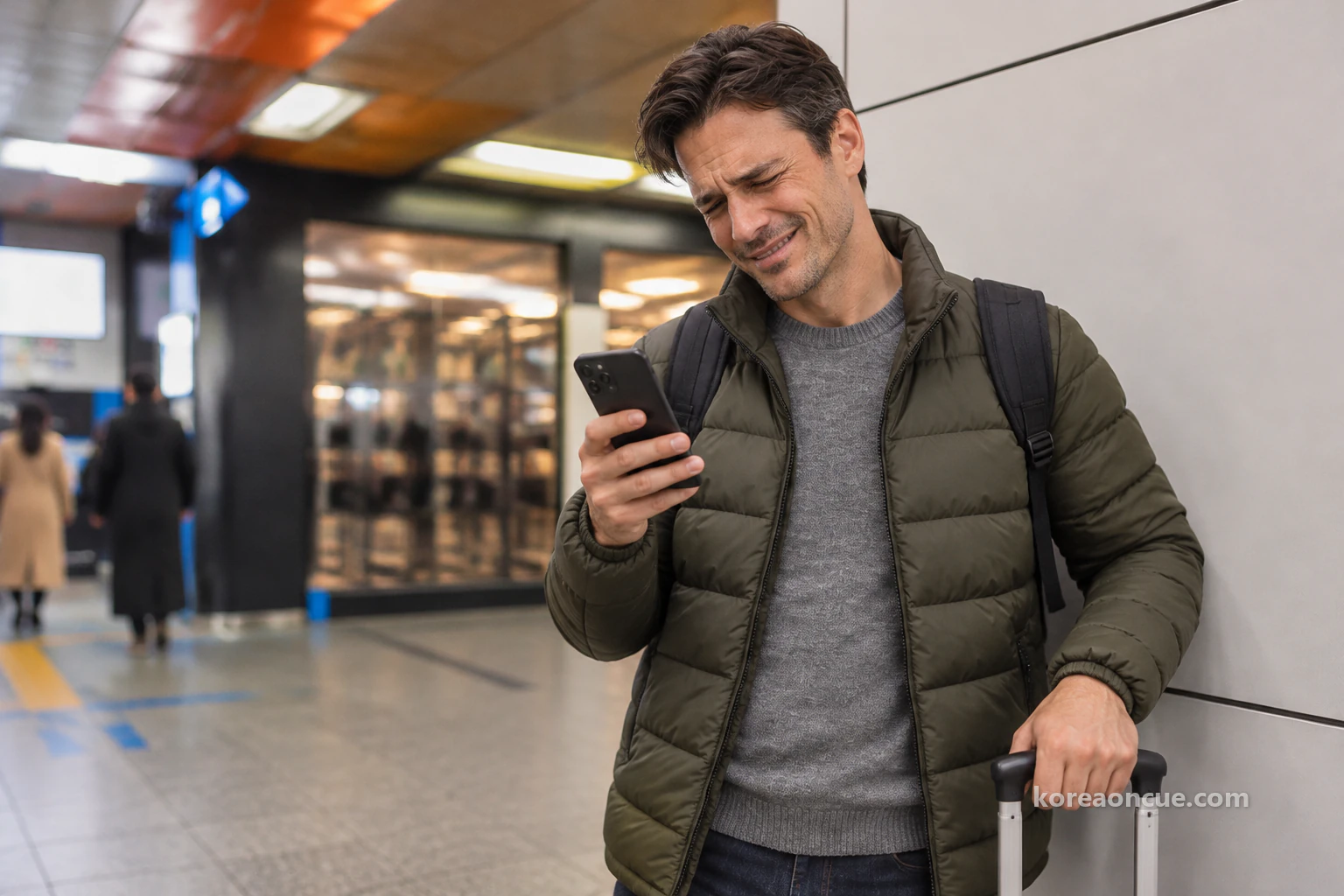
That is what makes it sting. If he had only arrived before 12:00, his suitcase would have left for Incheon Airport ahead of him. Collection at the airport runs from 16:00 at Terminal 1 and from 16:30 at Terminal 2, until 21:00. You collect at the airport courier counter in the public area on the 3rd floor, opposite check-in counter B at Terminal 1 and opposite check-in counter H at Terminal 2. Prices vary by size, so they are gathered in the fee table a little further on.
Scrolling down the guide, Ethan only now sees that there is also a way to book the day before. You can book on the T-Luggage website, which comes in Korean, English, Chinese and Japanese. On a busy morning, checking the site beforehand gives you peace of mind. In the margin of his notebook Ethan writes “Next time: read it the night before”, then draws a pencil line through today’s delivery row.

Which option suits which flight? Choosing by departure time
Look at your flight time first and the four options quickly shrink. Airport delivery suits evening flights, not morning or early-afternoon ones. That is because collection at the airport doesn’t begin until the afternoon. The City Airport Terminal works the opposite way, requiring you to arrive well in advance. Check-in at Seoul Station closes long before the flight takes off.
Ethan steps aside to the wall of the passage and draws a new table. Having crossed out one row, he wants to see which rows survive at each flight time. For the City Airport Terminal cut-off, take 3 hours (Terminal 1) or 3 hours 20 minutes (Terminal 2) off the departure time. If the result is later than 18:50, it stops at 18:50, and if it is earlier than 05:20, that flight can’t use it. In the table below, the 17:00 row is the example AREX gives, and the rest are worked out the same way.
| Flight departs | City Airport Terminal cut-off (Terminal 1) | City Airport Terminal cut-off (Terminal 2) | Airport delivery |
|---|---|---|---|
| 08:00 | Not possible | Not possible | Flight leaves before you can collect |
| 14:00 | 11:00 | 10:40 | Flight leaves before you can collect |
| 17:00 | 14:00 | 13:40 | Tight, collection starts just before departure |
| 19:50 | 16:50 | 16:30 | Works |
| 22:30 | 18:50 | 18:50 | Works, collect before 21:00 |
Find the row nearest your departure time and read across, but pay attention to the night-flight row at the bottom. For flights leaving after 21:50 from Terminal 1 or 22:10 from Terminal 2, the cut-off is 18:50 every time. An 11 p.m. flight doesn’t mean you can turn up late in the evening. The top row needs care too. For flights earlier than 08:20 from Terminal 1 or 08:40 from Terminal 2, the cut-off has already passed before check-in even opens.
Ethan’s row is 19:50, Terminal 2. The City Airport Terminal cut-off is 16:30, and from 12:14 that leaves 256 minutes. With delivery there would have been no such wall, because he could have left Seoul later and simply collected his case at the airport. The City Airport Terminal means being at Seoul Station 3 hours 20 minutes ahead of a Terminal 2 flight, so on an evening flight, delivery gives you longer in Seoul.
Even so, 256 minutes is more than enough for lunch and some cold air. Ethan draws an arrow on the table in his notebook. In the afternoon the suitcase will sit in a locker, and at about 3 p.m. he will collect it and go down to the City Airport Terminal on B2. That joins two rows together, storage and terminal. If you have missed 12:00 and have an evening flight with an airline in the table, look at this combination first.
What does each suitcase size cost? T-Locker in centimetres, T-Luggage in inches
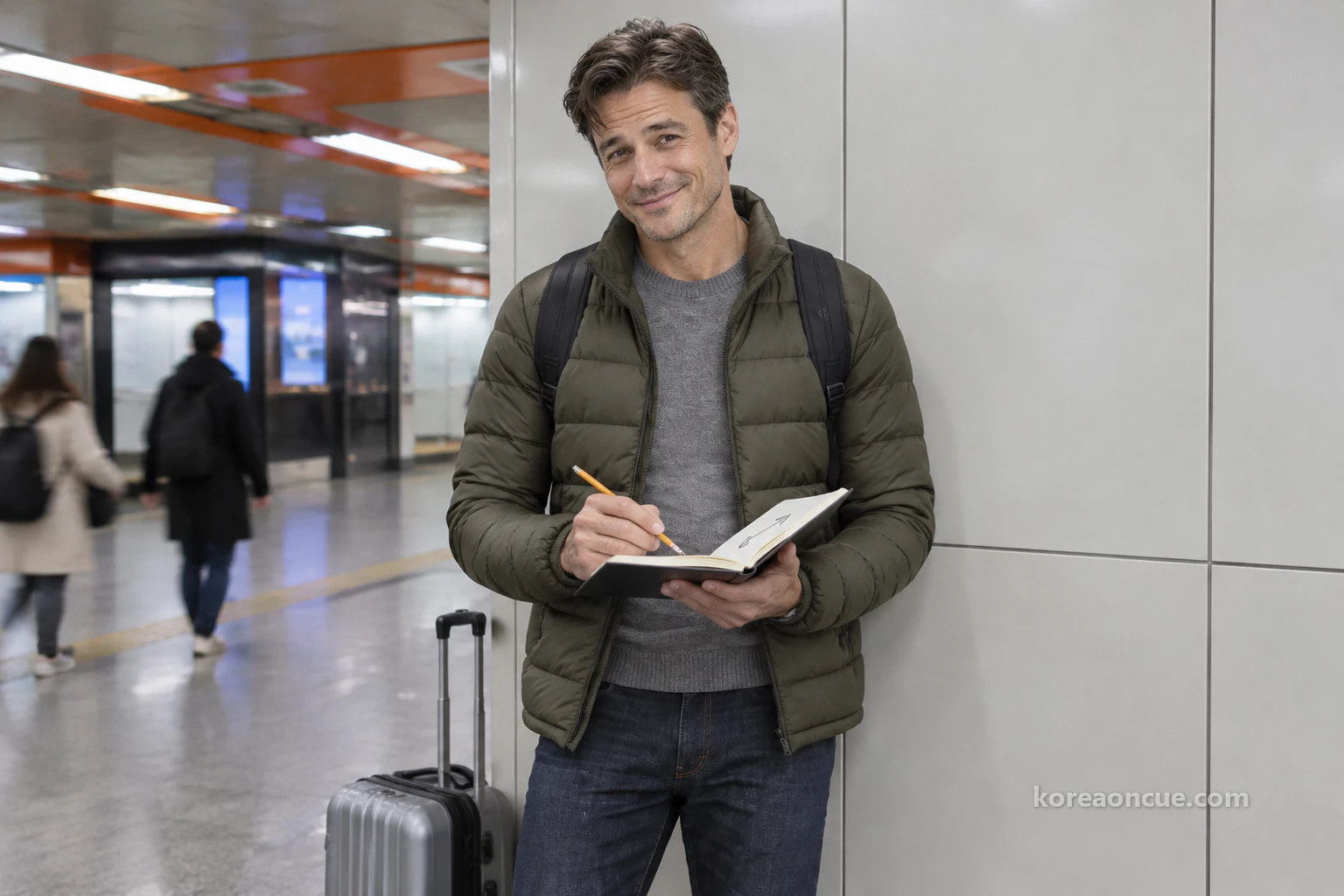
The two facilities give sizes in different units. T-Locker lists compartment sizes in centimetres, and T-Luggage divides suitcases by inches. So L at one is not the same size as L at the other. At this point Ethan’s face brightens. To someone who grew up in America, inches are a mother tongue, and to someone who lived in Seoul for six years, centimetres are something like a second foreign language.
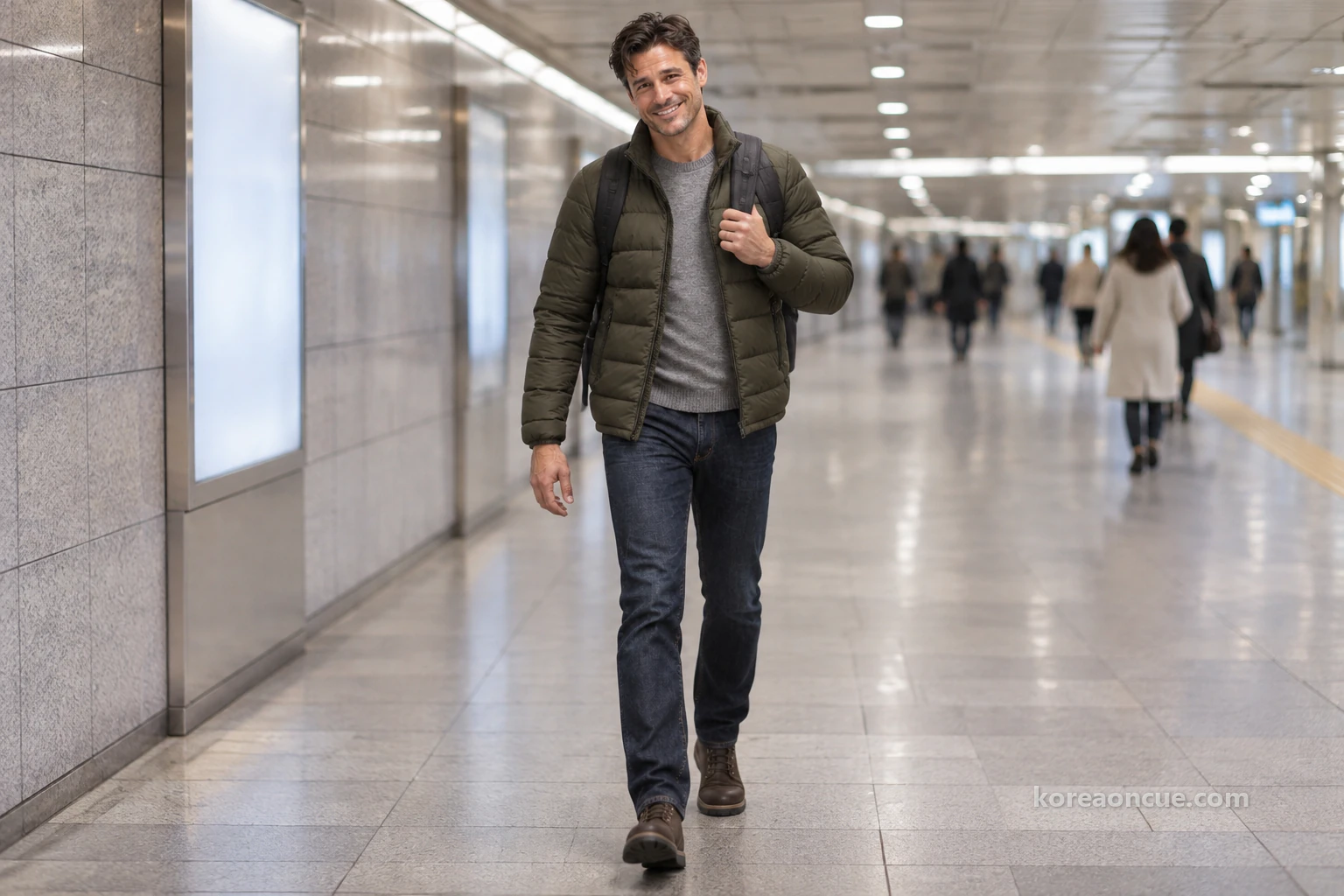
In the pocket of his padded jacket is the old tape measure he picked up in Dongmyo the day before yesterday, with inches on one side and centimetres on the other. Ethan crouches at the edge of the passage and measures the three sides of his suitcase. A man of 193 cm measuring his own luggage under Seoul Station evidently stands out. An elderly passer-by slows down and asks, “What are you measuring all that for? Moving house?” “I’m off to catch a plane,” Ethan says, with a big laugh.
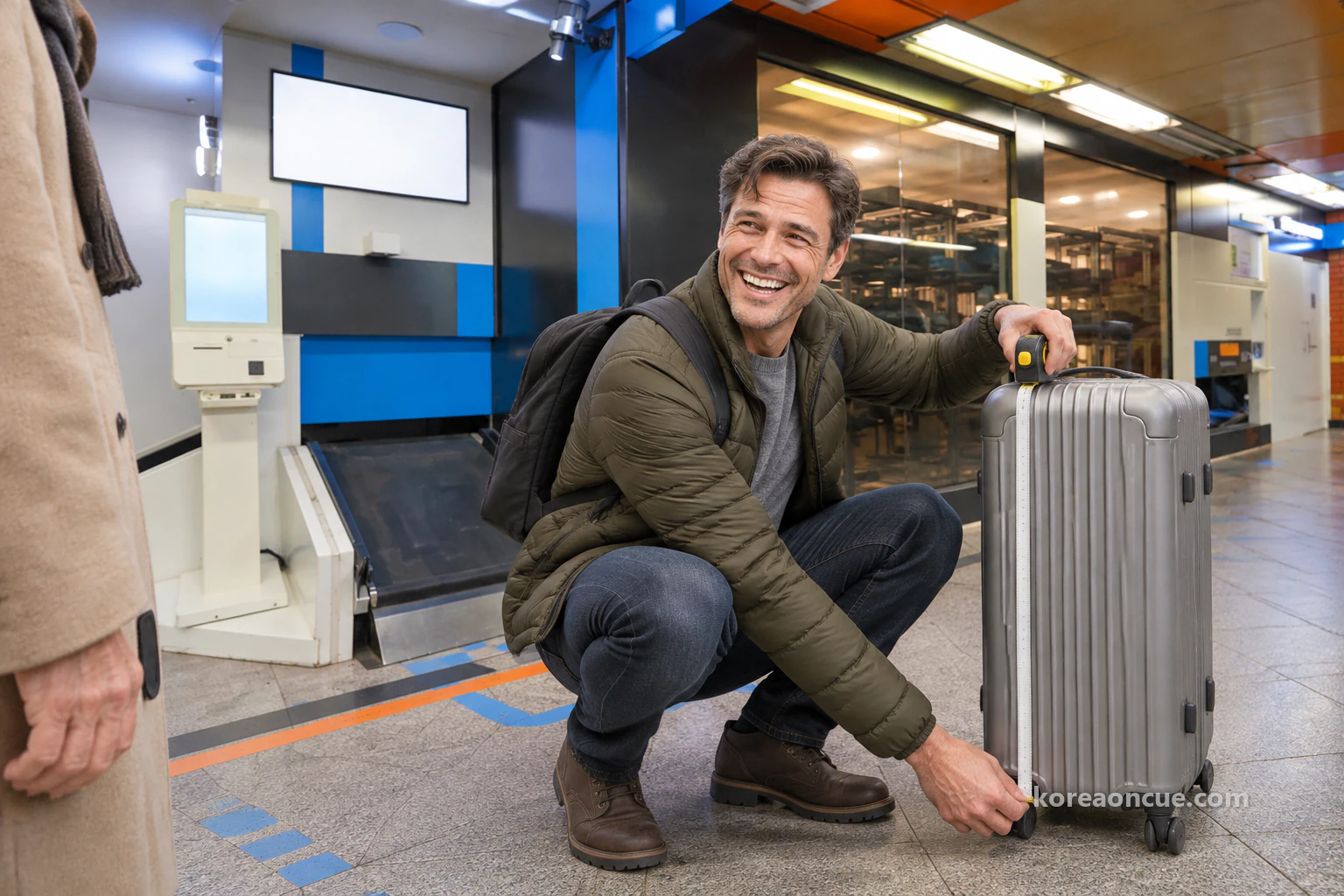
Put sizes and prices in one table and you get the one below. Left of the slash is weekdays, right of it is weekends. T-Locker compartments are given as width × length × height. First compare your suitcase’s dimensions with the compartment sizes, then check whether your travel day is a weekend.
| Size | T-Locker, 4 hours | T-Luggage storage, 4 hours | Delivery to Incheon Airport |
|---|---|---|---|
| S | Compartment 50×30×60 cm · 2,200 / 3,100 won | Up to 20 in · 3,000 / 4,000 won | 20,000 / 29,000 won |
| M | Compartment 50×45×60 cm · 3,300 / 4,600 won | 20–23 in · 4,000 / 6,000 won | 20,000 / 29,000 won |
| L | Compartment 50×90×60 cm · 4,400 / 6,100 won | 23–27 in · 6,000 / 9,000 won | 26,000 / 38,000 won |
| XL | No compartment | 27 in and over · 9,000 / 13,000 won | 31,000 / 45,000 won (27–36 in) |
Beyond 4 hours, a charge is added for every hour. T-Locker adds 500 won for S, 800 won for M and 1,000 won for L, and T-Luggage adds 1,000 won on weekdays and weekends alike. Work out 10 hours from 11:00 to 21:00, adding 6 hours to the 4-hour price, and a weekday L comes to 10,400 won at T-Locker and 12,000 won at T-Luggage. At weekends that becomes 12,100 won and 15,000 won, and the gap between them widens from 1,600 won to 2,900 won.
Ethan’s suitcase is 69 cm high, 44 cm wide and 27 cm deep. He writes the three sides next to the table, sees that L is the only compartment with a side longer than 69 cm, and underlines that row. He will be leaving it from about 12:40 until a little after 3 p.m., which is within the 4 hours. The difference between T-Locker’s 4,400 won and T-Luggage’s 6,000 won is 1,600 won, and Ethan circles the lockers. Because compartment sizes are clearly listed, measuring your suitcase’s three dimensions before setting out will save time on the day.
What shouldn’t you leave? Keep laptops and valuables on you
Laptops and valuables are best left at neither. T-Locker’s terms ban cash, securities, precious metals and valuables worth 100,000 won or more, and items of 30 kg or more aren’t accepted either. T-Luggage’s terms list electronics such as laptops, digital cameras, iPads and mobile phones as items it can refuse, along with anything fragile or perishable. Compensation differs too. T-Locker pays up to 100,000 won when the company is at fault, while T-Luggage treats the value of a stored bag as 500,000 won or less and pays up to 500,000 won.
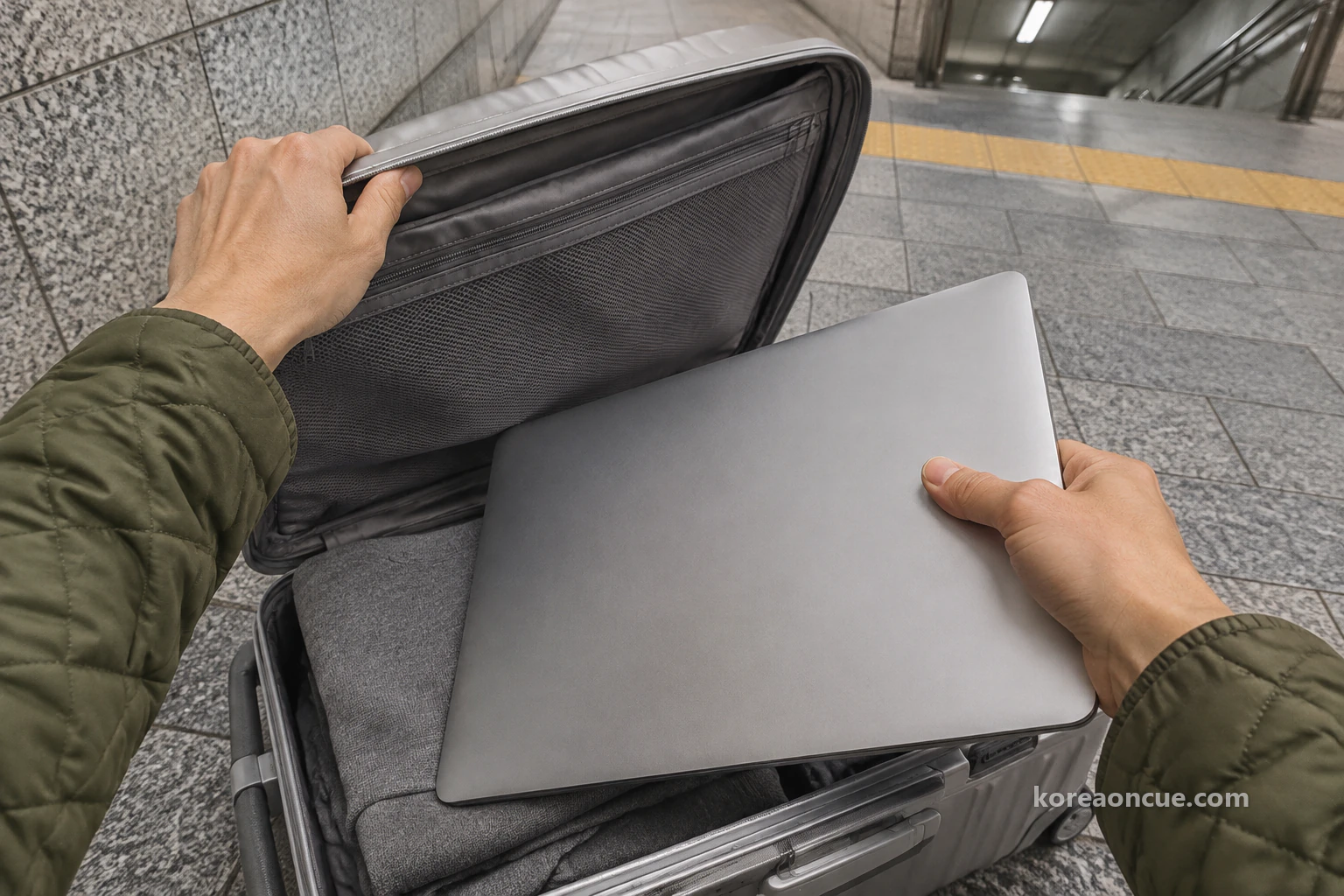
Ethan is that rare person who reads terms to the very end, and thanks to that, he ends up opening his suitcase again. The lines in the two sets of terms are different, but there is only one place for his hand to go. There is no need to do the sum on whether a work laptop is worth more than 100,000 won. Ethan takes out his laptop and transfers it to his small cabin bag, slipping his passport into the inside pocket of his padded jacket. Once the suitcase is shut, he writes “To leave ≠ to carry” in his notebook, and his mind feels a good deal lighter.
How do you use T-Locker at Seoul Station? Choosing a compartment, paying and the 24:00 close
T-Locker can only be used from 05:00 to 24:00. Outside those hours you can neither put anything in nor take anything out. This is the number that matters most if you are coming back late at night. Go past 24:00 and your luggage waits in the compartment until 05:00 the next day. On a day when you take the last train to the airport it beats T-Luggage, which closes at 22:00, but this is one number you mustn’t delete from your table.
Ethan heads first to the lockers around Exit 1, but every L compartment is full, so he wheels his suitcase to the corridor between Exits 2 and 3. With the newer lockers you can check a station’s availability and pay in the T-Locker app, so on a day when you need a big compartment, opening the app first can save a wasted trip. The older lockers have instructions posted on them, and whether you pay by app or by kiosk varies from place to place, so just follow the guide in front of you.
The L compartments in the corridor are free. Ethan lays his suitcase down and slides it in, and when the door shuts he writes “12:41 in” in his notebook. Some compartments are paid in advance, and at others you enter your mobile number and pay later with a password sent by text.
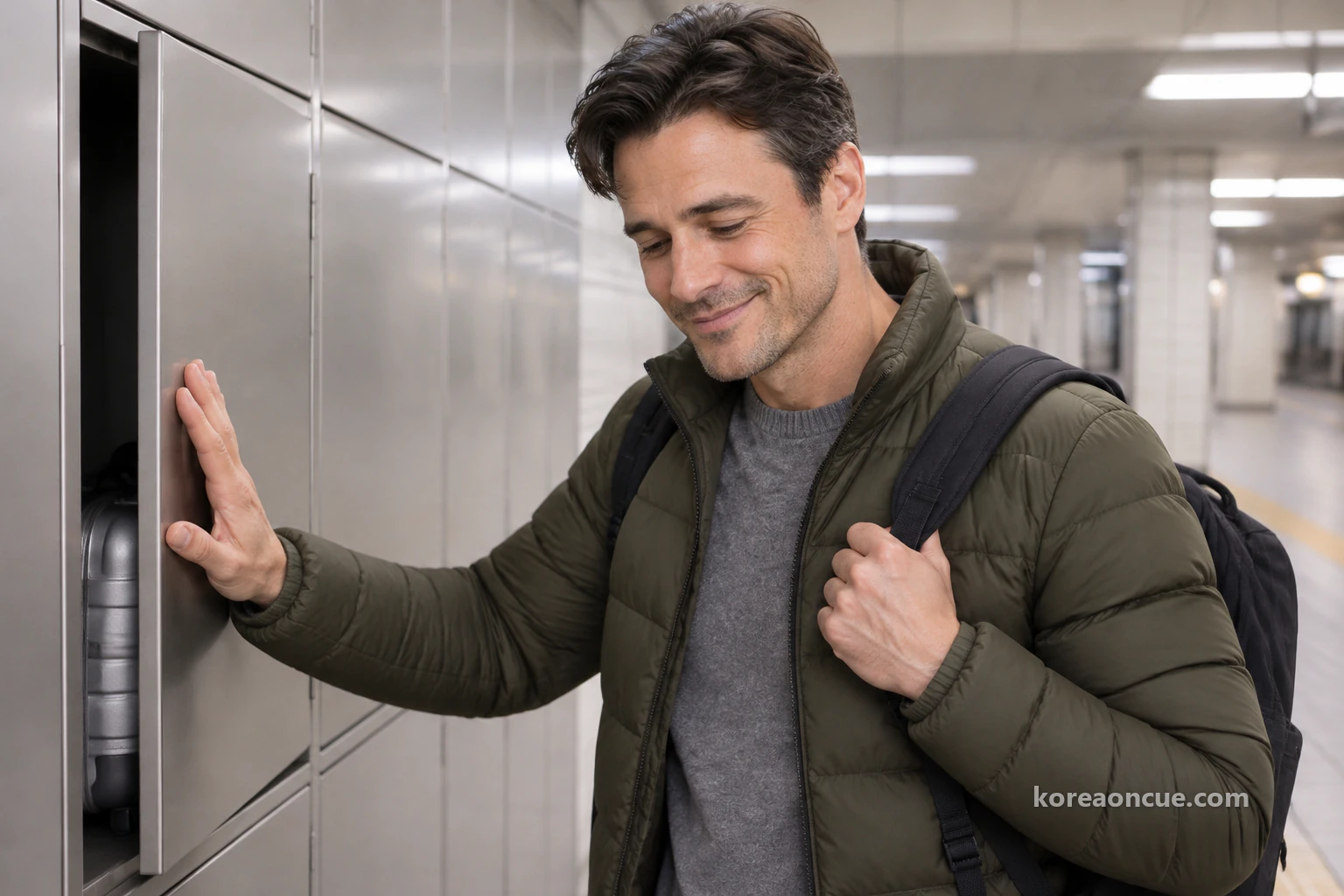
With the suitcase gone, his left hand feels empty. Ethan puts that hand in his jacket pocket, fiddles with the tape measure and walks out of the station. The wind at the very end of November is cold, but with nothing to pull, his pace is quick. Over lunch, too, there is no luggage to stand beside his chair. Ethan writes “2 of 2 hands available” in his notebook, and only then does the afternoon feel like his own.
Collecting your bags late at night: 24-hour private storage, plus Myeongdong, Hongdae and Gangnam
At lunch, Ethan rules one more row at the bottom of his table. It is for days when you need your bags after 24:00 or before 05:00, and on those days the answer is the private unstaffed storage open 24 hours outside the station. There is one 304 m from Seoul Station Exit 15 and one 287 m from Exit 12, and both charge 1,000 won an hour. The one on the Exit 15 side takes card, cash and pay apps at an unstaffed kiosk, which works in Korean, English, Chinese and Japanese. The one on the Exit 12 side takes card and cash as well as Alipay, WeChat Pay, Naver Pay and Kakao Pay.
At 1,000 won an hour, 10 hours simply comes to 10,000 won. That is almost the same as the 10,400 won for 10 hours in a weekday L T-Locker. So these two are places where you pay for hours more than for a low price. They suit a dawn flight, or a night when you go to a late show and come back after midnight. In Ethan’s table this row has no use today, but he leaves it in for his next business trip.
He has no idea where his hotel will be on his next trip, so Ethan also writes down rows for other stations. If you checked out somewhere other than Seoul Station, look at your nearest station first. T-Locker has 5,557 compartments in 336 places across 273 stations. Besides Seoul Station, T-Luggage is at Hongik Univ., Jamsil, Myeongdong, Gimpo Int’l Airport and Jongno 3-ga stations, and the Hongdae and Myeongdong branches are on B1, so you can follow the signs in the station. Prices and the 12:00 airport delivery deadline are the same as at Seoul Station.
If you need 24 hours, there is also private unstaffed storage 145 m from Hongik Univ. Station Exit 7. It costs 1,000 won an hour, and you pay by card, cash or pay app. In Gangnam, there is a mini-storage open 24 hours 462 m from Gangnam Station Exit 4. Wherever you leave your bags, count back from the time you leave for the airport to set your collection time, and you won’t forget the round trip to fetch your suitcase.
Which airlines can use the City Airport Terminal? 8 Korean airlines, and no foreign airlines in the table
Only 8 Korean airlines can use the City Airport Terminal. If you are leaving with a Japanese, Chinese or Southeast Asian airline, this option doesn’t exist. Before going down to B2, find your airline in the table below. If it is there, look next at the route conditions in the right-hand column. For codeshares, what decides it is which airline actually operates the flight.
| Terminal | Airline | Conditions |
|---|---|---|
| Terminal 1 | Jeju Air | Excluding Americas routes (Guam, Saipan, etc.) |
| Terminal 1 | T’way Air | Excluding Americas routes (Guam, Saipan, etc.), codeshares on TW-operated flights |
| Terminal 1 | Eastar Jet | Routes flown on Eastar aircraft |
| Terminal 2 | Korean Air | Codeshares on KE-operated flights |
| Terminal 2 | Asiana Airlines | OZ-operated flights |
| Terminal 2 | Jin Air | Excluding Americas routes (Guam, Saipan, etc.), LJ-operated flights |
| Terminal 2 | Air Busan | BX-operated flights |
| Terminal 2 | Air Seoul | Excluding Americas routes, RS-operated flights |
For Ethan, on his way back to America, the first thing to catch his eye is “Excluding Americas”. With his notebook open on the lunch table, he strikes out the rows among the five for Terminal 2 that carry those words, then holds the operating airline on his ticket up against the table. His flight home is in one of the rows that remain. To avoid going down on the strength of the airline’s name and turning back because of a codeshare, read as far as the operating airline next to the flight number on your ticket.
Even for airlines in the table, there are a few more conditions. Only international flights leaving Incheon Airport that same day qualify, not departures from Gimpo Airport or flights the next day. You can’t buy air tickets here either. Sports equipment and musical instruments needing careful handling can’t be checked in, nor can oversized baggage over 150 cm long, and the standard for oversized baggage is 45×90×60 cm or more, or 50 kg or more. Ethan’s suitcase clears this row comfortably too.
Using the City Airport Terminal at Seoul Station, in order: start by buying an AREX Express ticket on B2
To enter the City Airport Terminal you need an AREX Express ticket first, because the gate opens with the QR code on the ticket. Buy it at a ticket machine on B2, and it is 13,000 won for adults (the standard fare is 18,500 won to Terminal 1 and 19,100 won to Terminal 2). Using the City Airport Terminal itself is free, so there is no separate charge for luggage. Allowing for check-in, it is best to buy a ticket for a train leaving at least 30 minutes later.
Ethan takes his suitcase out of the locker at 3:10 p.m. At 149 minutes, it is comfortably within the 4-hour price. He goes down to B2, buys a ticket at the machine and holds the QR code to the gate, and the check-in hall opens up in front of him. At the queue-ticket kiosk added in the renovation, you select your airline to receive a numbered ticket. You can follow the calling order on the monitors in the waiting area.

What pleases Ethan most while he waits is the smart baggage scale. He sets the suitcase he hefted by hand at the hotel and noted as “18 kg” on the scale, and it reads 18.6 kg. “Today’s second error,” Ethan mutters, writing 0.6 in his notebook. Considering that the first error was 10 hours, that is quite an improvement in precision. The weight you can check in follows your airline’s rules, so weighing your case on this scale before check-in means less chance of unpacking in front of the counter.
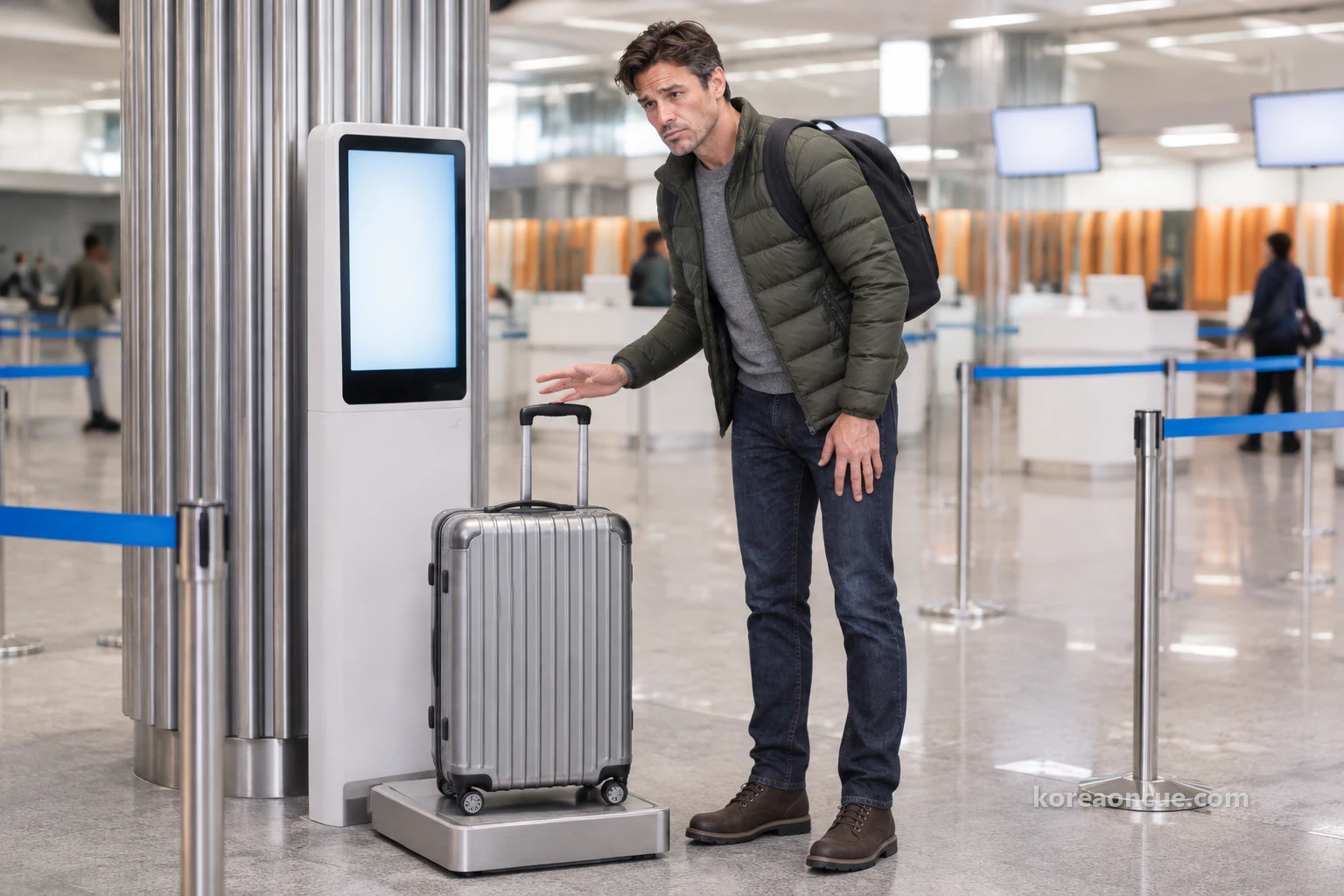
A suitcase checked in at the counter is not collected at Incheon Airport. Baggage that has gone through check-in and security here comes out at your destination airport. That one sentence is the City Airport Terminal’s biggest advantage. Next comes the City Airport Terminal’s departure immigration, open from 05:30 to 19:00, for which you need your boarding pass and passport. His luggage has vanished and the formalities are done, and for a moment Ethan can’t quite believe he is standing there empty-handed.
The AREX Express leaves from the platform on B7. Counting as he goes down from the check-in hall, Ethan finds that today, inside Seoul Station alone, he has set foot on B1, B2 and B7. The AREX Express takes 43 minutes to Incheon Airport Terminal 1 and 51 minutes to Terminal 2. From Seoul Station the first train leaves at 06:00 and the last at 23:00, on the same timetable on weekdays and holidays. From 23 October, 2 more trains in each direction were added between 11:00 and 18:00, making 56 a day in both directions combined, with an average interval of 35 minutes.
One more thing to keep in mind. At busy times such as the Seollal (Lunar New Year) holiday or Japanese holidays, daily users of the City Airport Terminal pass 2,000, more than 70% above normal. On days like that the queues grow, so it is better not to arrive right on the cut-off. Ethan planned his table to arrive about an hour ahead of the 16:30 cut-off, and that day his number is called before it. The wall of 16:30 never reaches him.
Airport delivery or storage then the City Airport Terminal: how much is the difference? Ethan’s homecoming accounts
In his seat on the AREX Express to the airport, Ethan posts the Dongdaemun bar chart to the group chat, then turns to another page of his notebook. It is time to settle up today’s spending. If both plans use the AREX Express, the first plan is 26,000 won for delivery plus 13,000 won for the train, which makes 39,000 won. What he actually spent is 4,400 won for the locker plus 13,000 won for the train, which makes 17,400 won, though he had to come back to Seoul Station in the afternoon. Seeing that the redrawn table came out 21,600 won cheaper than the first one, Ethan laughs silently, his shoulders shaking.
That price came with a condition. All afternoon, Ethan moved only inside the wall of 16:30. If he had wanted to stay out until evening in a neighbourhood far from Seoul Station, delivery would have been worth its price. Choose delivery if you can drop off in the morning and are going far in the afternoon, and storage then the City Airport Terminal if you are flying with an airline in the table and coming back to Seoul Station. If your airline isn’t in the table, leave your bags in a locker or at T-Luggage, then pull your suitcase to the airport.

Ethan writes one last line at the bottom of his notebook: “09–22 is door time. 12:00 is luggage time.” Now that he knows one facility has two clocks, the 500 minutes weren’t wasted. From here the suitcase travels on its own until Ethan sees it again. Their next meeting will not be at Incheon Airport, but at his destination airport, and Ethan finds that rather funny. Slipping the tape measure into his pocket, he begins counting backwards, this time from the moment the plane lands.
Common Mistakes
Believing delivery is open because the doors are
this is how Ethan lost 14 minutes. Opening hours and delivery drop-off hours run separately.
Booking airport delivery for a morning flight
your plane leaves before you can collect your suitcase.
Assuming a night flight means you can reach the City Airport Terminal late
however late the flight, check-in there ends in the evening.
Standing at the City Airport Terminal gate without a ticket
the gate opens with the QR code on your ticket, so you will be sent back to the ticket machine.
Going down to B2 on the airline’s name alone
on a codeshare, you will have to turn back if the operating airline isn’t in the table.
Waiting at Incheon Airport for bags checked in at the City Airport Terminal
those bags come out at your destination airport.
Shutting the compartment door with your laptop still in the suitcase
Ethan nearly did this too, before he read the terms.
Going to the lockers after midnight
you can’t take your bags out until early the next morning.
FAQ
Do I get my money back if I cancel a booking?
For a T-Luggage booking you get the full amount back 3 days before, half back 1–3 days before, and nothing on the day.
Can I send luggage from a locker to a locker at another station?
No. Either the start or the end has to be an on-site counter, and only Lines 1–9 run by Seoul Metro are covered.
What if I lose my T-Luggage receipt?
You may be asked for ID such as your passport. Keep the receipt, and keep your passport on you.
How many days can I leave things in a locker?
T-Locker is normally for collecting within 5 days at most.
Who do I call if something goes wrong with a locker?
Call the call centre on 1877-1265 or 1670-4302. It answers from 06:00 to 24:00, on-site help comes within 2 hours, and there is a charge if the fault is the user’s.
Can I check in at the City Airport Terminal for non-scheduled or charter flights?
Ask your airline first.
Recap — 30 seconds before you go
- Dropping off in the morning and going far in the afternoon: airport delivery, with 12:00 as the cut-off
- Coming back to Seoul Station with an airline in the table: storage, then the City Airport Terminal
- Airline not in the table: leave your bags, collect them and pull your suitcase to the airport
Sources
- Seoul Metro — T-LuggageSeoul Station on B1, towards Exit 1 · walk-in hours 09:00–22:00, open all year · storage prices by size and per extra hour · delivery prices between stations and Incheon Airportchecked 2026-11-05
- T-Luggage website — Guide and noticesSame-day delivery drop-off 09:00–12:00 (Seoul Station, Hongik Univ., Myeongdong, Gimpo Airport, Jongno 3-ga, Jamsil) · airport collection times · site languageschecked 2026-11-05
- Incheon International Airport — AREX guide (luggage delivery)Seoul Station counter from Exit 1 towards Exit 2 · airport collection opposite check-in counters B (Terminal 1) and H (Terminal 2) on the 3rd floor · no locker-to-locker delivery · Lines 1–9 onlychecked 2026-11-05
- Seoul Metro — T-Locker273 stations, 336 sites, 5,557 compartments · S, M and L sizes · weekday and weekend prices with hourly extras · 05:00–24:00 · call centre 06:00–24:00checked 2026-11-05
- Seoul Metropolitan Rapid Transit Engineering — T-Locker termsNo cash, securities, precious metals, valuables worth 100,000 won or more, or items of 30 kg or more · up to 100,000 won for company fault · normally 5 days at most · pay first or pay laterchecked 2026-11-05
- AREX — Seoul Station City Airport Terminal guideB2 · check-in drop-off ends at 18:50 · closes 3 hours before departure from Terminal 1 and 3 hours 20 minutes from Terminal 2 · 8 airlines and their route conditions · oversized baggage not acceptedchecked 2026-11-05
- AREX — City Airport Terminal procedureTicket machines on B2 · a train at least 30 minutes later recommended · checked bags collected at the destination airport · boarding pass and passport for immigrationchecked 2026-11-05
- AREX — Express train introductionAdult 13,000 won · standard fare 18,500 won to Terminal 1 and 19,100 won to Terminal 2 · 43 and 51 minutes · free use of the City Airport Terminalchecked 2026-11-05
- Seoul Tourism Organization — 24-hour unstaffed storage near Seoul Station Exit 1524 hours · 1,000 won per hour · unstaffed kiosk taking card, cash and pay apps · 4 languages · 304 m from Exit 15checked 2026-11-05
A Seoul story told with our AI characters. Place details are checked against public sources; the photos are AI-made illustrative images. How we use AI