
SEOUL · GETTING AROUND
Which Incheon Airport bus do you take? The week Ethan rewrote his colleagues’ arrival guide three times
Why Myeongdong means the bus, Hongik Univ. the train and Gangnam the bus, plus tickets at Terminal 2 and the card trap on the way back to the airport
After six years of living in Seoul, Ethan gets handed the arrival guide for three colleagues. He measures the numbers and the fares, and then has to correct the guide twice: once under Terminal 2, and once on the steps of a bus on Friday.

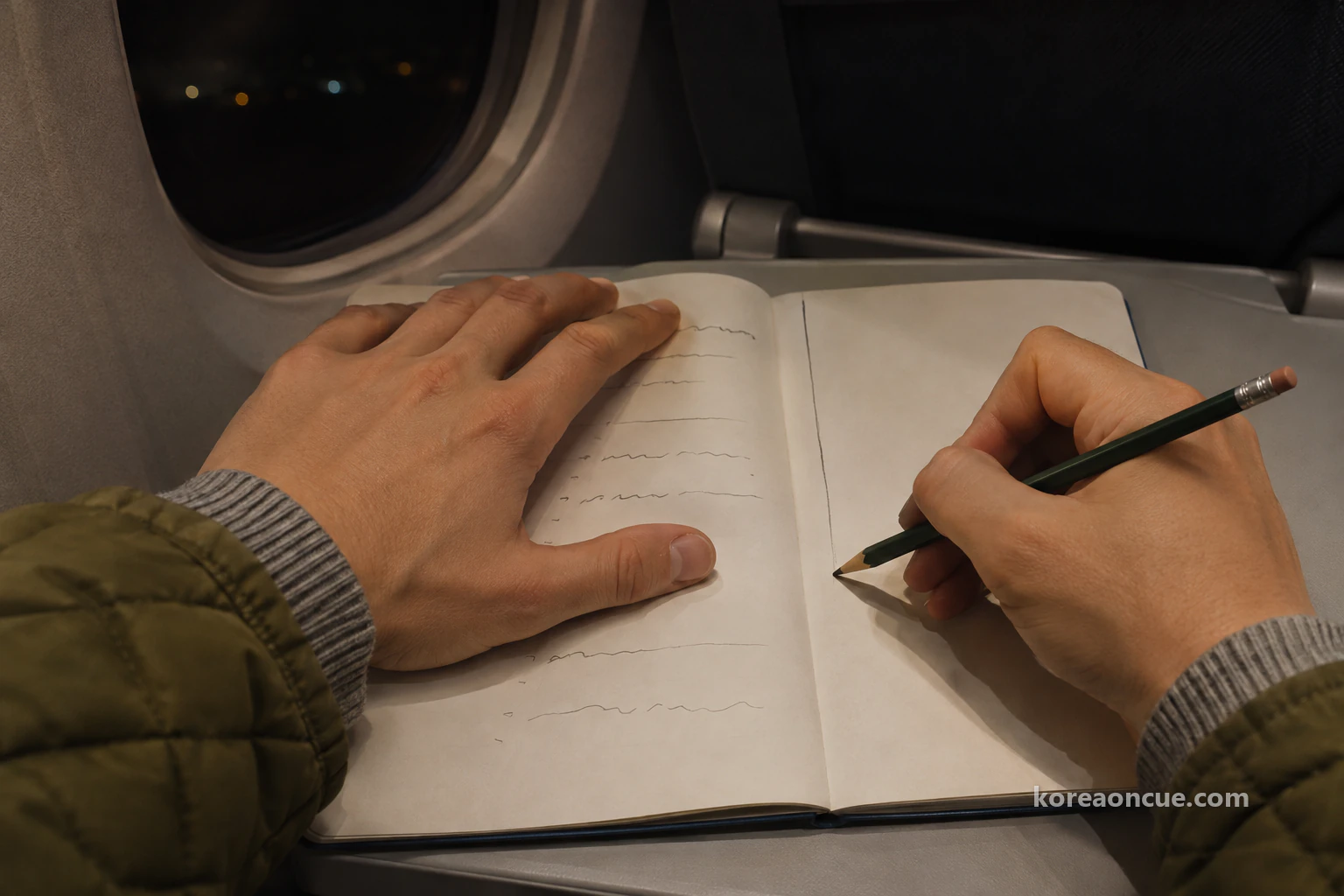
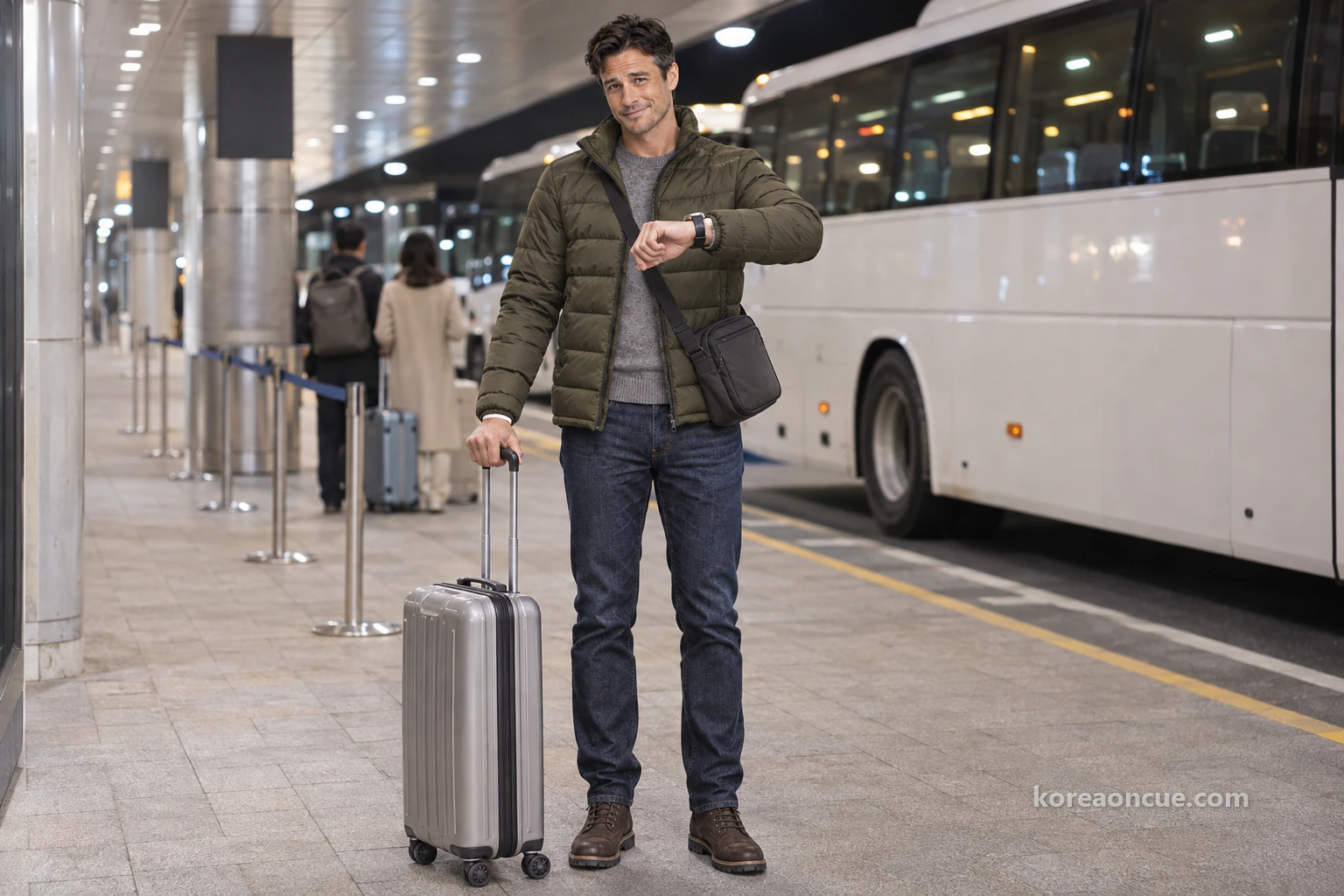
Six days after flying back to Seattle, Ethan landed at Incheon Airport Terminal 2 again. It was 6:20 on a Sunday evening, and this was his fourth business trip to Seoul. This time he had homework. Three colleagues were arriving in Seoul separately that week, and because he had lived there for six years, the arrival guide had been handed to him. On the plane he wrote a one-page guide and, as he would on a drawing, put “Rev A” at the top.
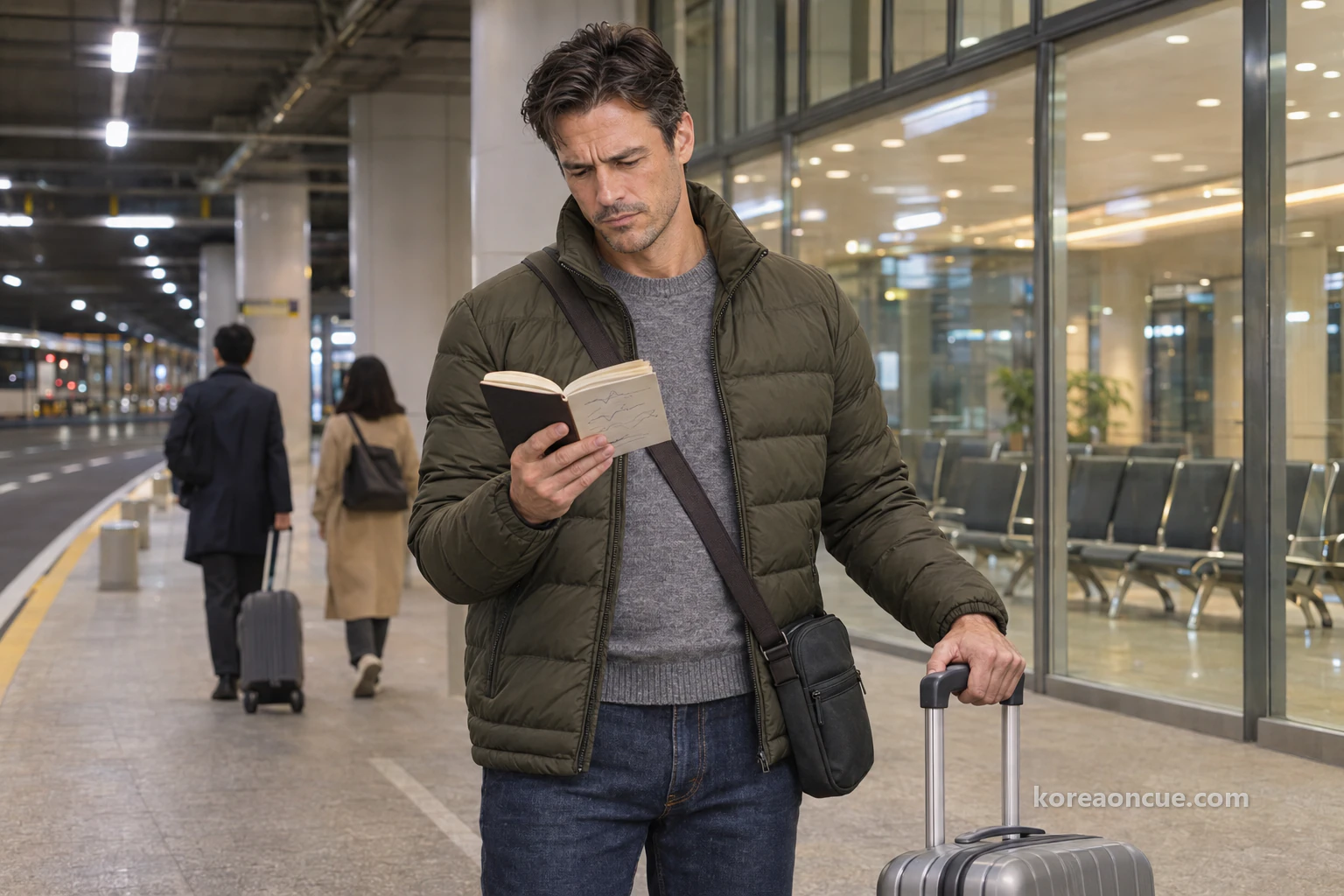
The guide had four questions to answer. Which number do you take, where do you buy the ticket, how much is it, and where does it part ways with AREX? When he lived here, Ethan had never looked into any of this. The airport was somewhere he went now and then, and someone had always told him the way. So he gave Colleague A Hongik Univ., Colleague B Gangnam, Colleague C Gwanghwamun and himself Myeongdong, and set about measuring the time, the fare and the number of changes for each.
This piece is the record of that week, and a guide to choosing an airport bus from Incheon into central Seoul. We may as well say now that Rev A did not last. It was corrected once under Terminal 2 and once on the steps of a bus on Friday, and the second time Ethan was going through his own wallet. Those mistakes ended up making the guide more useful. It has turned cold and Ethan has got his thick coat out, so let’s follow him from arrival to departure.
The Cue — At a glance
For Myeongdong take airport bus 6001 or 6015, for Gangnam 6020 or 6703, and for Hongik Univ. the AREX all-stop train. If price comes first, Myeongdong works by train too. Buy your ticket first when boarding at the airport and you won’t be turned away at either terminal, and on the way back from the city it is safest to have T-money or cash ready.
- Write down: Your arrival terminal, the stop nearest your hotel and your landing time, so you can hold them straight up against the tables below.
- Luggage: Measure the sum of the three sides and the weight.
Bus or AREX from Incheon Airport to Myeongdong, Hongik Univ. or Gangnam? It depends where you’re going
There isn’t one answer to which is better. There is one for each destination. Myeongdong and Gangnam lean towards the bus, and Hongik Univ. leans towards the train. Ethan drew three columns in the guide and wrote down the number of changes before the time, because he reckoned that for his colleagues, dragging a suitcase off and on at an unfamiliar station weighed more than a few minutes either way. When choosing between the three, look first at which station or stop is close to where you’re staying.
| Where to | Airport bus | AREX | Changes (bus / train) |
|---|---|---|---|
| Myeongdong | 6001 · 6015, 17,000 won, 6001 about 1 hr 20 min | Line 4 from Seoul Station, about 1 hr 10 min, from 4,750 won | 0 / 1 |
| Hongik Univ. | 6002, 17,000 won, about 1 hr 10 min | All-stop train direct, about 1 hr, from 4,750 won | 0 / 0 |
| Gangnam | 6020 17,000 won, about 1 hr 20 min · 6703 18,000 won | Line 2 from Hongik Univ. Station, about 1 hr 50 min, from 4,750 won | 0 / 1 |
The column to look at first is the one on the far right. All the times are for leaving from Terminal 1. From Terminal 2, where Ethan landed, you need to add a little. Even the AREX Express takes 43 minutes to Seoul Station from Terminal 1 and 51 from Terminal 2. Airport buses generally take about 60 to 80 minutes to the city, and the arrival time shifts with the traffic.
The column Ethan stared at longest was his own, Myeongdong. Leaving from Terminal 1, the train is about 10 minutes quicker and costs at most 12,250 won less. Put the other way round, the bus charges you that time and money to delete one change. Ethan wrote “1 change = about 10 min + at most 12,250 won” and smiled for a moment. He had never put a price on a change before.
Whether that price is steep depends on your luggage. With one shoulder bag, the train is perfectly fine: change to Line 4 at Seoul Station and get off at Myeongdong Station. With a big suitcase, sitting on the bus is the better deal. Ethan’s hotel was near Myeongdong Station and he had a suitcase, so he wrote “bus” in his own column without a second thought. If price comes first on your trip, pick the train row from the same table, and that isn’t a wrong answer either.
The two numbers to Myeongdong pass through different neighbourhoods. The 6001 goes by Seoul Station, Namdaemun Market and Hoehyeon, stops at Myeongdong Station, and then carries on to Chungmuro and Dongdaemun. The 6015 goes through Mapo and Gongdeok, then past Namdaemun Market and the Euljiro 1-ga side before reaching Myeongdong Station. So for a hotel around Hoehyeon or Chungmuro look at the 6001 first, and for one on the Euljiro 1-ga side look at the 6015. If a number stops right outside your hotel, that bus is worth more than one saved change.
The Hongik Univ. column was done in no time. The AREX all-stop train goes to Hongik Univ. Station without a change, from 4,750 won. Bus 6002 also passes Hapjeong, Seogyo-dong and Hongik Univ. Station, but at 17,000 won there is little reason not to take the train unless your hotel is right by the stop. The all-stop train has unreserved seating, though, so some days you won’t get a seat. Ethan wrote “train” in Colleague A’s column and added “Might have to stand” next to it.
The Gangnam column leaned the other way, firmly towards the bus. From Terminal 1 to Gangnam Station, the train means changing to Line 2 at Hongik Univ. Station and takes about 1 hour 50 minutes, while bus 6020 takes about 1 hour 20 minutes with no change. It saves 30 minutes and removes the change too, so Ethan’s pencil didn’t hover over this column for long. The 6020 serves Gangnam Station and Yeoksam, and the 6703 serves Sinnonhyeon, Seonjeongneung and COEX, so pick whichever is nearer your hotel. Colleague B’s meeting venue was on the COEX side, so Ethan wrote 6703 in that column.
Areas that aren’t in the table have numbers too. City Hall and Gwanghwamun have the 6005 or 6701, and Namsan and Dongdaemun have the 6702. The 6002 runs past Hongik Univ. to Gwanghwamun, Jongno 1-ga and Dongdaemun Station and on to Cheongnyangni, so it crosses the city centre. The 6001 also continues to Dongdaemun, so for a hotel in that area put both numbers side by side, and since the fare is the same, take whichever stop is closer. Ethan wrote 6005 in Colleague C’s column for the time being.
If you are only going as far as Seoul Station, there is also the AREX Express, listed at 13,000 won for adults, with reserved seats. It runs 56 times a day, on average every 35 minutes between 11:00 and 18:00. The all-stop train takes 59 minutes from Terminal 1 to Seoul Station and costs 4,750 won with a transport card. For the Express you need to buy your ticket first, which you can do at the AREX Express customer service centre in the B1 Transportation Center at either terminal. None of the three colleagues was headed for Seoul Station itself, so Ethan moved this line down under the table in small print.
How much is the airport bus? Even the numbers starting with 6 come in three prices
Airport bus fares for adults split into 16,000, 17,000 and 18,000 won. Every number starts with 6, so they look like one company’s buses, but there are four operators. At this point Ethan shifted his grip on the notebook. Anyone who designs machines knows from parts that the same leading digits from a different maker can mean a different spec. So he decided to write the operator next to the number in each colleague’s column.
| Adult fare | Number | Operator |
|---|---|---|
| 16,000 won | 6003 · 6014 (via Gimpo Airport) | Airport Limousine (공항리무진) |
| 17,000 won | 6001 · 6002 · 6005 · 6015 | Airport Limousine (공항리무진) |
| 17,000 won | Night buses N6000 · N6002 | Airport Limousine (공항리무진) |
| 17,000 won | 6020 | Seoul Airport Limousine (서울공항리무진) |
| 18,000 won | 6701 · 6702 · 6703 · 6705A | Korea Airport Limousine (한국공항리무진) |
| 18,000 won | 6100 series · 6103 | Korea City Air Terminal (한국도심공항) |
Read the table from the cheapest upwards. Even for the same Gangnam, the 6020 is 17,000 won and the 6703 is 18,000 won. City Hall and Gwanghwamun split by a thousand won too, with the 6005 at 17,000 won and the 6701 at 18,000 won. Two people going both ways would make four rides and a 4,000 won gap, but that is no reason to drag a suitcase to a stop far from your hotel. Choose the number with the nearer stop first and look at the fare afterwards.
More than the fares, the column that stayed with Ethan was the operator. Who you ring later, where you board and how tickets are handled all follow the operator. He didn’t yet know how much that column would weigh. He would find out why it mattered on Friday, and we’ll come to that shortly. A number alone would have found the bus, but Ethan is a man who can’t stand a blank in a table, so he filled in all four.
Where do you buy an airport bus ticket? At Terminal 2, Airport Limousine buses need a ticket
At Terminal 2 you have to buy your ticket first, and Rev A said “Bus: board with T-money”. Coming through arrivals and down to the B1 Transportation Center, Ethan reread the operator’s notes and stopped walking. With Airport Limousine, the way of simply boarding with a transport card or cash was open only at Terminal 1, and at Terminal 2 every route required a ticket. Korea Airport Limousine, which runs the 6703 that Colleague B would take, also had you buy a ticket in advance at the airport. Had he sent it as it was, his colleagues would have been turned back at the bus stop.
| Airport Limousine: where you board | Ticket | Transport card · cash |
|---|---|---|
| Terminal 1: 6001 · 6002 · 6015 | Yes, first come, first served | Yes, first come, first served |
| Terminal 1: other numbers | Buy a ticket to board | If seats are left about 1 minute before departure |
| Terminal 2: all numbers | You must buy a ticket | No |
| City to airport | First come, first served, no ticket or booking | Pay this way |
Start with the row for the terminal you land at. At Terminal 1, the 6001, 6002 and 6015 board in order of arrival whether you have a ticket, a transport card or cash, so this is the most relaxed row for anyone heading to Myeongdong or Hongik Univ. On other numbers, cards and cash only work when the crew judge there are seats left about 1 minute before departure, so buying a ticket beats standing there relying on it. Looking over the table, Ethan wrote “Ticket first” in large letters at the top of each colleague’s column. With a ticket in your hand you won’t be turned away at the stop on any of these rows, so that one line was all the guide needed.
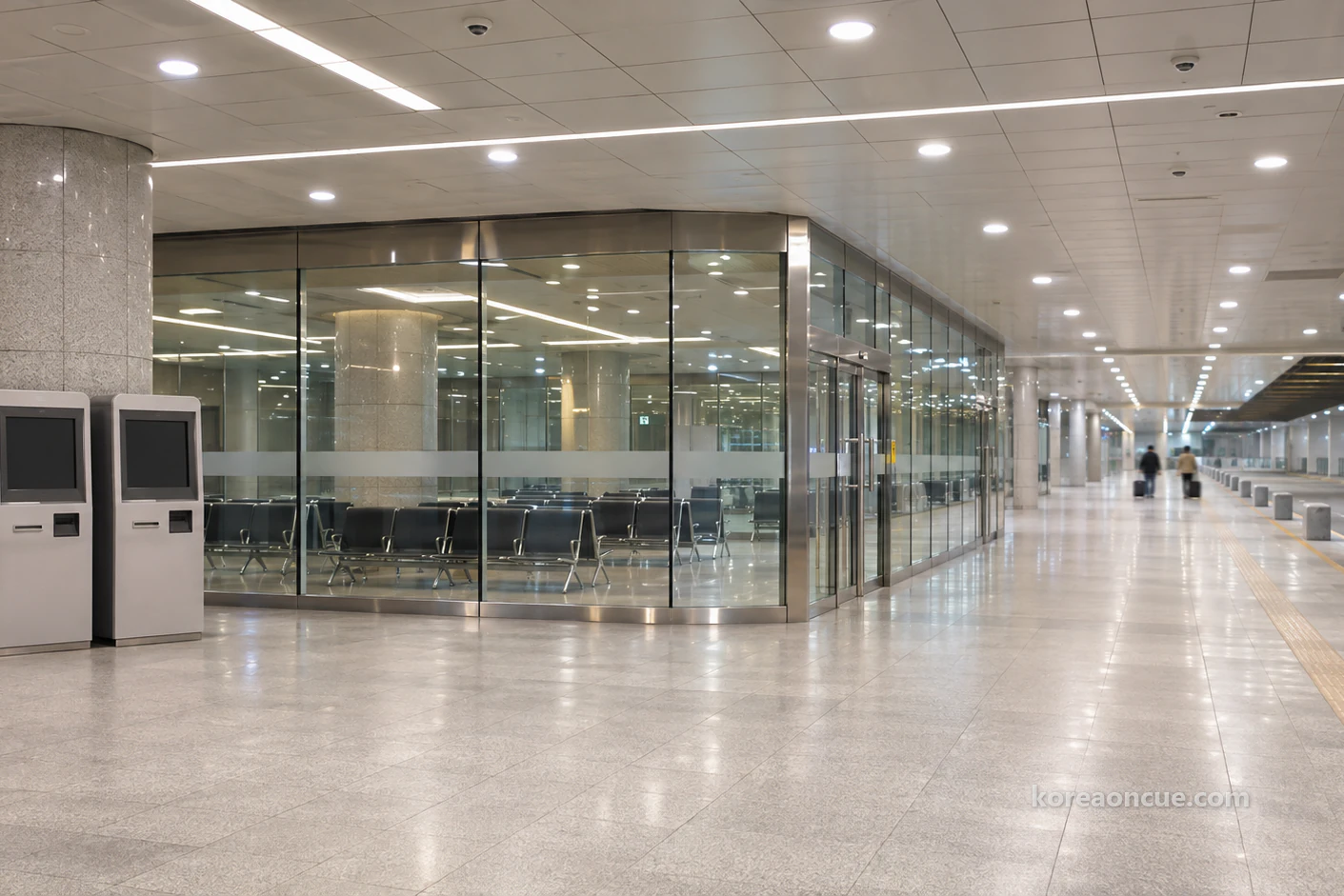
Where you buy a ticket depends on the floor at each terminal. At Terminal 1, the arrivals hall, the ticket counters and the bus stops are all on 1F, so you never change floors. The staffed ticket counters are near Gates 4, 6, 9 and 11, and the ticket machines near Gates 4, 7, 8 and 11. At Terminal 2 you go down to the B1 Transportation Center after arrivals to reach the buses, with the ticket counter on the west side towards the short-term car park, and the ticket machines around the waiting lounge, the bus stops and the AREX entrance. He could already picture his colleagues looking around upstairs, so at the very front of the Terminal 2 column Ethan wrote “B1 first”.
The ticket machines run 24 hours a day. Staffed counters are open 05:40–22:20 at Terminal 1 and 04:00–24:00 at Terminal 2, and only Counter 4 at Terminal 1 stays open continuously apart from 01:30–03:30. Taking a lap of B1, Ethan found something he liked. There were bus ticket machines by the AREX entrance too, and the AREX Express service centre was on the same floor. This is the very floor where bus and train part ways, so it isn’t too late to make up your mind once you are down here.
Where do you board at Terminal 1 and Terminal 2? Stops and last buses by number in one table
The stop numbers are completely different at each terminal. Terminal 1 uses the Seoul bus stops 2A–7A on 1F, and Terminal 2 uses Seoul bus stops 11–35 on B1. The same 6001 stops at 5 at Terminal 1 and at 29 at Terminal 2. Ethan got his ticket from a machine and, walking to stop 29, wrote the two numbers side by side in the guide. Send just one number, and a colleague who lands at Terminal 1 would go looking for a stop 29 that isn’t there.
| Number (destination) | Stop (T1 / T2) | Last bus (T1 / T2) | T2 last bus − 2 hrs for arrival |
|---|---|---|---|
| 6001 (Myeongdong · Dongdaemun) | 5 / 29 | 23:09 / 22:49 | 20:49 |
| 6015 (Myeongdong) | 5 / 28 | 23:19 / 22:59 | 20:59 |
| 6002 (Hongik Univ. · Cheongnyangni) | 6 / 30 | 23:29 / 23:09 | 21:09 |
| 6005 (City Hall · Gwanghwamun) | 5 / 28 | 22:54 / 22:34 | 20:34 |
| 6020 (Gangnam · Yeoksam) | 4 / 16 | 23:02 / 22:42 | 20:42 |
| 6703 (Gangnam · COEX) | 3 / 19 | 22:55 / 22:35 | 20:35 |
The column to watch here is the last bus. On all six numbers the Terminal 2 last bus is exactly 20 minutes earlier than Terminal 1, and Ethan liked that match so much that he underlined it in pencil. The far-right column is the last bus minus the longer end of the 1 to 2 hours the airport tells you to allow for immigration. It doesn’t yet include the time to buy a ticket and walk to the stop. So don’t read it as a time to land by. If your flight lands around that time, read it as your cue to look at the night buses further on as well.
Some numbers finish early. At Terminal 1 the last 6104 is at 18:50, the last 6500 at 20:50, the 6600 at 21:30 and the 6100-1 at 21:50. Not every daytime route runs until 11 p.m. Timetables can change with road conditions, so the operator urges you to compare a map app’s real-time figures against its own timetable. Opening the operator’s timetable the day before you leave will put your mind at rest.
Ethan’s flight had landed at 6:20 in the evening, so he had plenty of time before the last bus. Even so, he wrote “landing + 2 hrs arrival + ticket and walk < last bus” in his notebook and copied this inequality into each colleague’s column. The units didn’t quite match, but it read more easily that way for his colleagues. Colleague B’s flight was in the daytime, and Colleague A’s landed before evening. The problem was Colleague C.
How many big suitcases can you put on? 2 per person, under 28 inches, under 20 kg
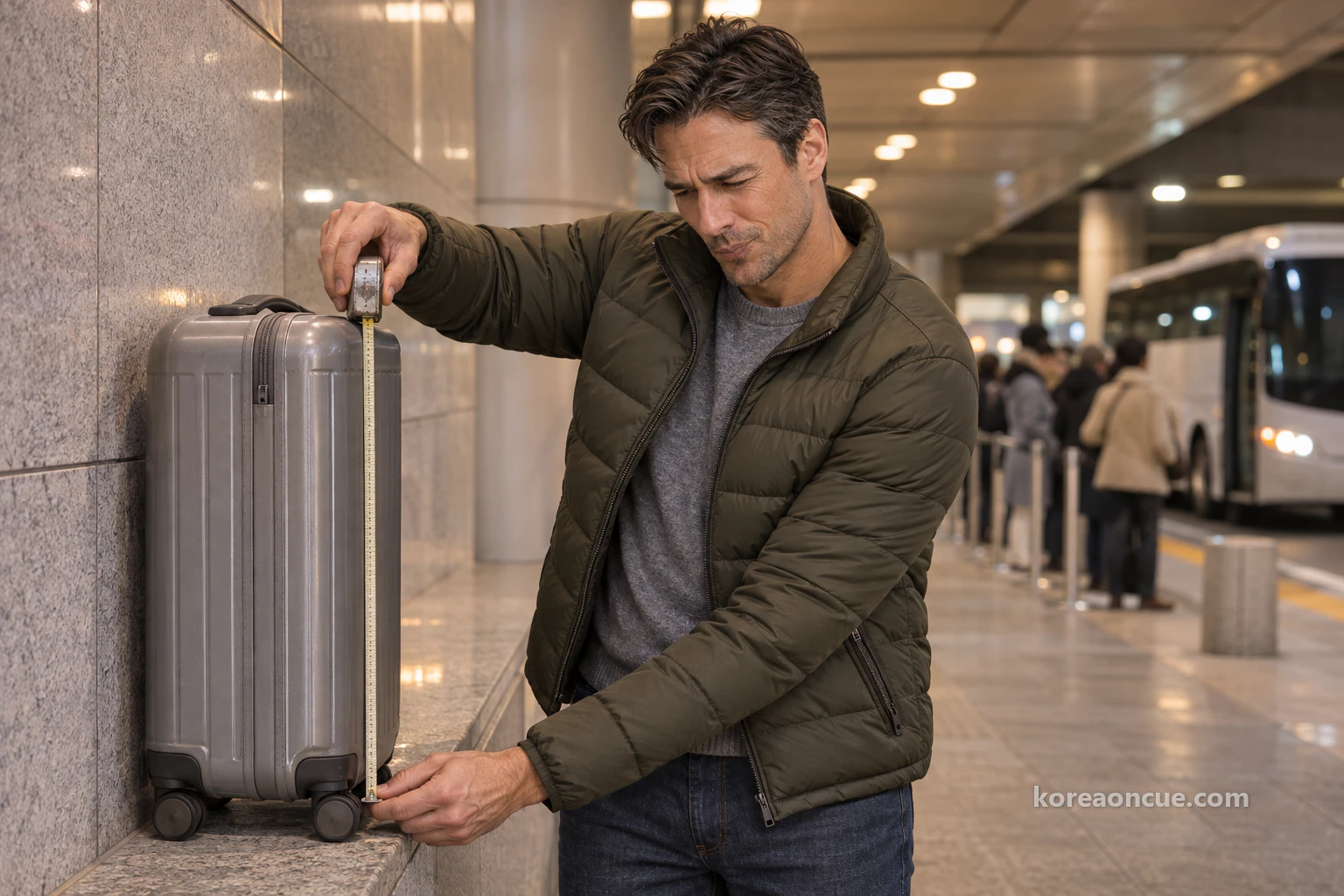
Airport Limousine buses take 2 pieces of luggage per person. Each piece must be under 28 inches and under 20 kg, and width, depth and height together must come to 158 cm or less. Pieces of 20 kg or more or over 28 inches are limited to 1 per person, and going over the number means an extra charge. Bicycles can’t be loaded.
While waiting in the queue, Ethan pulled his old tape measure out of his pocket. The suitcase he had measured at Seoul Station last time is 69 cm high, 44 cm wide and 27 cm deep. The three sides add up to 140 cm, which leaves 18 cm. 69 cm converts to 27.2 inches, leaving 0.8 of an inch to the 28-inch line. Remembering the 18.6 kg the scales had shown, Ethan murmured with satisfaction: “1.4 kg of margin, 0.8 of an inch.”
Watch out for the bag on your shoulder. Luggage you carry onto the bus counts towards the number too, and that goes for large backpacks, suitcases, Boston bags and duffel bags. Ethan had one suitcase plus a small cabin bag, which made exactly 2. Glass items, bottles, precision equipment, cameras and instruments should stay out of the hold and travel with you. Ethan decided to keep the small bag with his measuring kit on his knees.
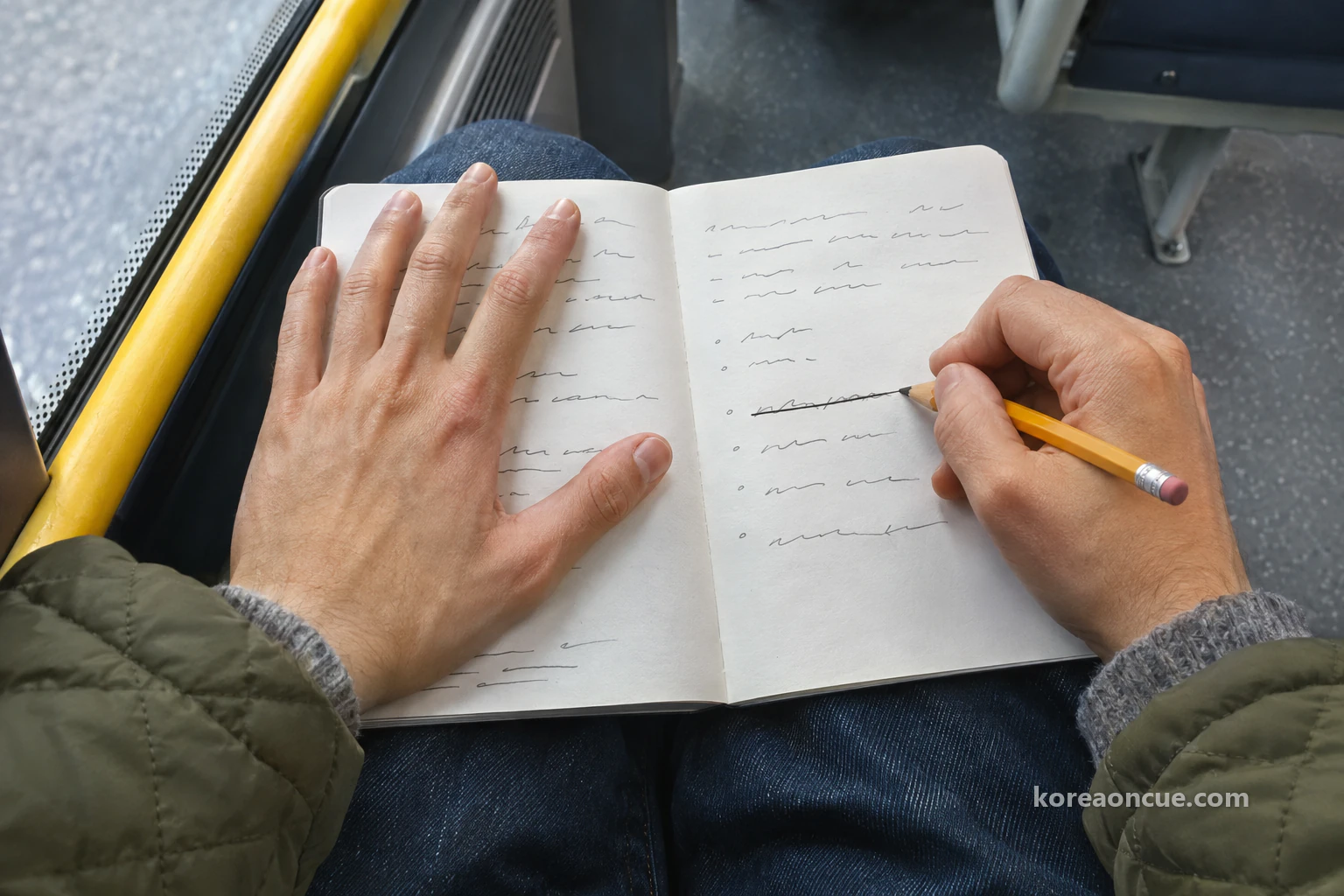
When the bus pulled in, the driver took the suitcase and loaded it into the hold, and Ethan was given a claim tag. The number on it is checked when you collect your luggage, so keep it safe until you get off. Ethan watched his suitcase all the way into the hold before climbing the steps. At 193 cm, it took him a while to fold his long legs in at an angle between the seats. Once settled by the window, he copied the number into his notebook and sent his colleagues Rev B.

As your stop approaches, you have to press the bell yourself. The driver doesn’t know each passenger’s destination, so if you don’t press it you can easily sail past. Ethan had noted where each colleague would get off, and he added a line to the guide as well: “Press the bell to get off.” As the Myeongdong Station stop drew near, he stretched out a long arm to press it, handed over his claim tag at the hold, took his suitcase and walked off towards the hotel.
Is there an airport bus if you land late at night? Night buses N6000 and N6002, with tickets from the machine
There are night buses from Incheon Airport into the city even after the last buses have gone. The N6000 heads for the Gangnam Express Bus Terminal, the N6002 for Cheongnyangni, Hongik Univ. and Gwanghwamun, and the N6701 and N6703 run as well. The Airport Limousine night bus costs 17,000 won for adults, the same as the 6001 or 6002. Ethan had assumed nights would carry a surcharge and was about to note a bit extra, then rubbed that cell out, feeling slightly sheepish.
On Tuesday evening, at the desk in his hotel, Ethan reopened Colleague C’s column. C’s flight would land at Terminal 2 at around 11 p.m., and the hotel was on the Gwanghwamun side. Running it through the inequality, no daytime route worked, let alone the last 6005. Ethan struck through the 6005 he had pencilled in and wrote N6002 beside it. At Terminal 2 the N6002 stops at 30 and the N6000 at 28.
What night-bus passengers need to sort out is the ticket. At night there are fewer staffed counters, so the ticket machine is the one to rely on. It issues night-bus tickets as well. Ethan messaged C: “Once you’re through arrivals, go to the ticket machine first. The queue comes after that.” C got a ticket that night with no trouble, and the next day waved the one-page guide around in the meeting room.

From then on, Ethan came to believe the guide had turned out rather well. Colleague A reported reaching Hongik Univ. without changing, and Colleague B reported getting off right by COEX, so all three had made it to their hotels without getting lost. It had been a week that restored the dignity of a man who claimed to know Seoul. Rev B had a line about the way back as well. “City → airport: bus, tap card”, it said.
Can you use a credit card on the airport bus from the city? Not on Airport Limousine, and it varies by operator
You can’t board an Airport Limousine bus from the city to the airport with a credit card. You pay with cash, T-money or a postpaid transport card, and the Climate Card and Discover Seoul Pass can’t be used either. Korea Airport Limousine does take credit cards and transport cards, so it’s the operator you need to look at, not the number. Ethan learned this not from the guide but on the steps of a bus.
On Friday around midday, heading home, Ethan waited for the 6001 at the Myeongdong Station stop. From the city to the airport there are no bookings and you board in order of arrival, and when a bus fills up you take the next one, so he came out early and stood near the front of the queue. Unlike at the airport he didn’t need a ticket either, so he felt light-hearted. The bus pulled up, his luggage went in, and Ethan climbed the steps, took his American credit card from his wallet and held it to the reader.
The reader made no sound at all, and a second try did no better. The driver looked round and said, “No credit cards. Transport card or cash.” Behind him stood people with suitcases, and the 193 cm man began going through his wallet, bent over with his head nearly touching the ceiling. His T-money card from his Seoul days turned up, but the balance was 1,250 won.

Luckily there was a little exchanged cash left in the inside pocket of his coat. Ethan counted out one 10,000 won note, one 5,000 won note and two 1,000 won notes and held them out one by one. It came to exactly 17,000 won. He thought about the front seat, gave up on it, walked to the back with his head still bowed, and opened his notebook the moment he sat down. There he wrote “Error: 0 won. Dignity: −1.”
The problem was a single word. The “card” in Rev B had no type attached. He hadn’t said transport card or credit card, which was the same as putting a number with no unit on a drawing. A man who had spent his life catching that on other people’s drawings had done the same thing in his own guide. Ethan struck through the line, bumped it to “Rev C”, and sent it first to Colleague A, who was still in Seoul and whose journey home depended on that line.
But no sooner was Rev C out than a reply arrived from Colleague B, who had left the day before. “I got on at COEX with a credit card, though?” Ethan read the sentence three times. The 6703 that B took was run by Korea Airport Limousine, and the 6001 Ethan took was run by Airport Limousine. The operator column he had filled in on Sunday night had shown its worth five days later. They had been bolts with the same leading digits and a different thread.
So there is one answer for the day you go home. Whichever number you take, make sure first that you have about 17,000 won on your T-money or in cash. If you are taking an 18,000 won number like the 6703, add that much more. Don’t forget to tell the driver clearly, as you board, whether you want Terminal 1 or Terminal 2. For an early flight, the departure times from the first stop are 04:00 for the 6020 and 6703, 04:12 for the 6002, 04:24 for the 6015 and 04:30 for the 6001.
There is one thing to watch when reading times in the city. The operators’ timetables list separate times for each stop. Those times above are first-stop values, so reading them as your own stop’s time will send you out too early, and you should find the row for your own stop in the timetable. Ethan too had copied just the Myeongdong Station row into his notebook on Friday morning. Even with that written down he had been caught out by one card, so getting the time right wasn’t the end of it.
Ethan’s final version: choosing between the airport bus and AREX on one page
On the bus to the airport, Ethan read the guide again from the top, and the four original questions all had answers. What needed fixing was the order. Put your destination together with your arrival time to narrow the options, then look at the terminal, and finally look at the operator. Had he gone by destination alone, Colleague C would still be standing in the 6005 column. Rev A hadn’t had this order, so Ethan moved those three columns to the top and pushed the numbers and fares below them.

Colleague A’s reply came in too. It promised to top up a T-money card, and on the end of that was “But didn’t you say you lived in Seoul?” Ethan laughed out loud. Even after six years of living there, some things stay unknown until you stand on the steps of an airport bus, and until you measure them you don’t even know you don’t know. On the last line he wrote “Six years’ Seoul residence: outside tolerance.”
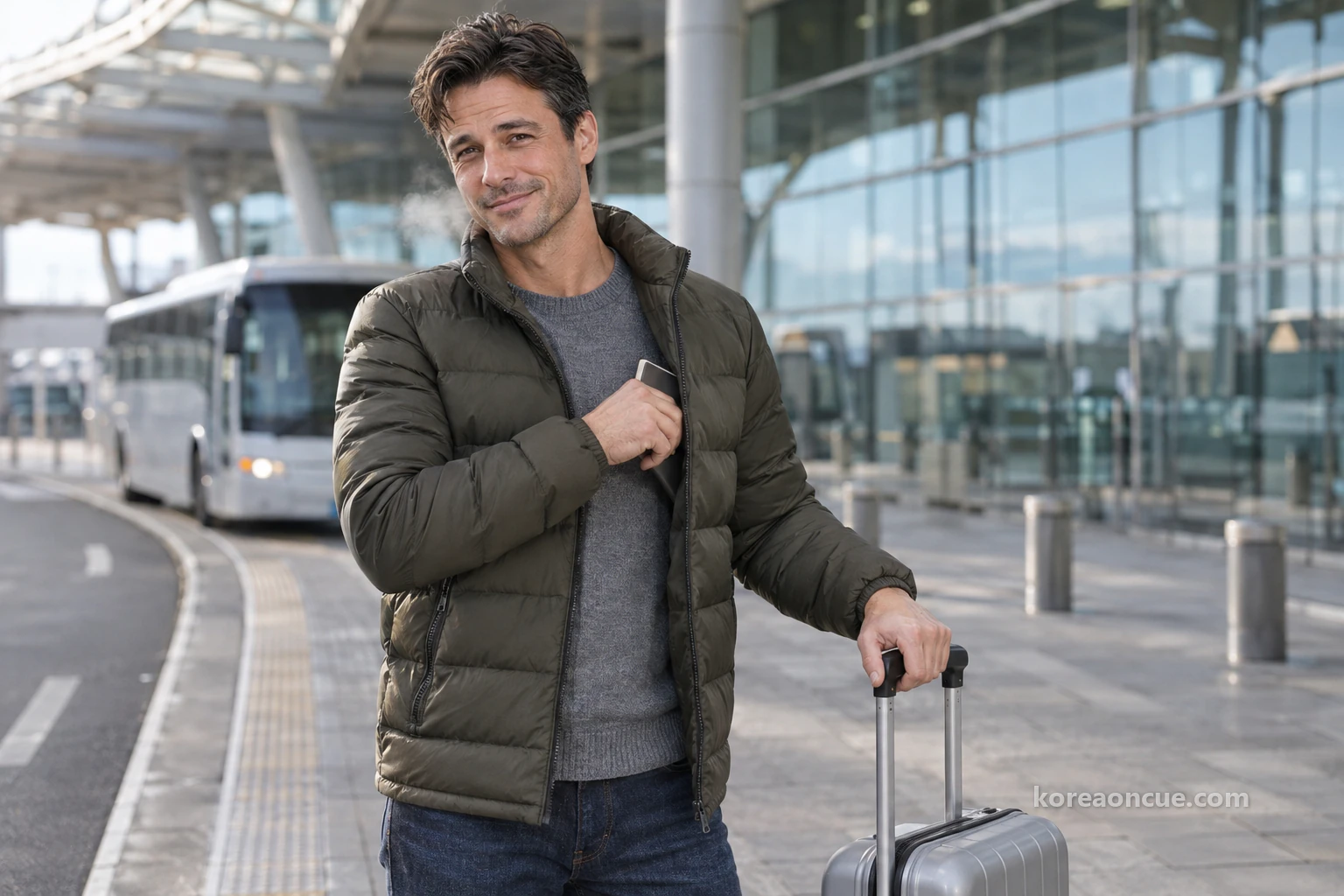
When the bus reached the airport, Ethan matched his claim tag and got his suitcase back. The tape measure went into a pocket and the notebook into his inside pocket, and on his next trip he plans to land with T-money loaded in his wallet. The guide has now reached Rev C, so the next person coming to Seoul may well correct one more line. The only error on this trip home was the short moment spent counting notes. Ethan left that cell blank and walked towards departures.
Common Mistakes
Heading for the bus stop at Terminal 2 trusting T-money alone
Ethan wrote exactly that in the guide, then corrected it on B1.
Assuming the same leading digits mean the same company’s bus
Only Colleague B’s reply showed Ethan why the operator column was there.
Matching the last bus to your landing time alone
Colleague C’s 6005 was written down that way before it became a night bus.
Reaching for a credit card first at a city stop
That mistake had Ethan counting notes on the steps of a bus.
FAQ
Do children pay the adult fare?
On Airport Limousine daytime routes the child fare is 12,000 won, for children up to primary school age. One preschool child travelling with an adult is free as long as they don’t take a seat of their own. If you want a seat for them, or you bring two, you pay the child fare.
How do I phone an operator?
Seoul Airport Limousine 02-577-1343–5, Korea Airport Limousine 02-2667-0386, Korea City Air Terminal 02-551-0077–8.
Recap — 30 seconds before you go
- Myeongdong and Gangnam by bus, Hongik Univ. by train, and Myeongdong by train too if price comes first
- If your flight is late, look at the night buses as well as the daytime last bus
- On the way back, T-money or cash first, and check the operator before relying on a credit card
Sources
- Airport Limousine — Fares (Korean)Seoul to Incheon Airport adult 17,000 won, via Gimpo Airport 16,000 won · child 12,000 won, up to primary school age · one preschool child free, and the conditions when they take a seatchecked 2026-11-06
- Airport Limousine — Boarding points and ticket counters (Korean)Terminal 1 counters near Gates 4, 6, 9 and 11, ticket machines near Gates 4, 7, 8 and 11 · Terminal 2 B1, towards the west short-term car park · staffed counter hours · ticket machines 24 hours, night bus tickets includedchecked 2026-11-06
- Airport Limousine — Notes on using the airport bus (Korean)City to airport: no bookings, first come, first served, no credit cards · Terminal 1 6001, 6002 and 6015 first come, first served · Terminal 2 all routes need a ticket · luggage 2 items, 28 inches, 20 kg, 158 cm · the stop bell and telling the driver your terminalchecked 2026-11-06
- Incheon International Airport — Bus route search (Korean)Boarding point by number · last daytime buses from Terminal 1 and Terminal 2 · fare and operator contact by number · night bus adult fare 17,000 won · bus boarding maps for each terminalchecked 2026-11-06
- Incheon International Airport — Terminal 1 bus stop guide (Korean)Bus ticket counters on 1F · 1–2 hours for arrival procedures after landingchecked 2026-11-06
- Korea Airport Limousine — FaresAdult 18,000 won · credit and transport cards accepted from the city to the airport · from the airport, buy tickets in advance at counters or machineschecked 2026-11-06
- AREX — Express train introduction (Korean)To Seoul Station, 43 minutes from Terminal 1 and 51 from Terminal 2 · adult 13,000 won · tickets at the AREX Express customer service centre, B1 Transportation Center, at both terminalschecked 2026-11-06
- AREX — Press release on extra Express trains (Korean)56 Express trains a day · an average of 35 minutes apart between 11:00 and 18:00checked 2026-11-06
- Seoul Tourism Organization — From the airport to the city (Korean)Train and bus times and fares to Myeongdong, Hongik Univ. and Gangnam from Terminal 1, as of June 2026 · all-stop train 59 minutes, 4,750 won, unreserved · airport bus about 60–80 minutes · luggage claim tag numberchecked 2026-11-06
A Seoul story told with our AI characters. Place details are checked against public sources; the photos are AI-made illustrative images. How we use AI
More from this area

Seoul Guided Walking Tour: what to know when booking alone
Looking for one scene — listening to a guide on a city wall path — Elena signs up for the Seoul Guided Walking Tour on her own.

T-money refunds: shop limits and the short-term pass
On the morning she flies home, Hina lays three transit cards out on the desk the way she sorts concert tickets.