CULTURE NOTE
When a Seoul Café Feels Cooler Than the Street
You can feel comfortable outside and chilly once you sit down in a café. Look at how the season, your seat and the time you spend there may affect comfort, and how to prepare with a thin extra layer.
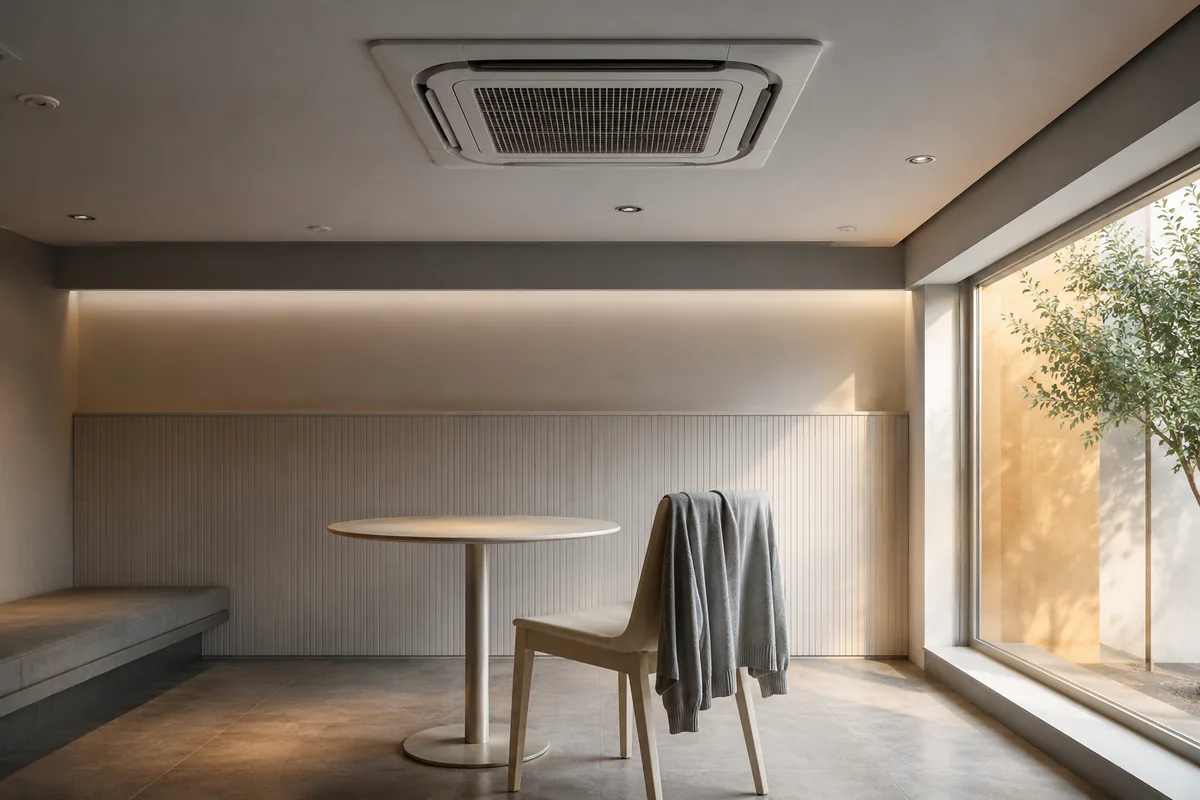
How to get there
Walking distance and time are map-route estimates; exit numbers are as of the check date.
- Read the outdoor baseline for your dates in two layers. Before you leave, the KMA climate normals (Seoul in October: daily mean 15.0°C, average daily low 10.6°C, average daily high 20.2°C); on the morning itself, the forecast. Normals are background, not the weather on the day.
- Check that you have one thin layer that comes off easily and packs into the bag. It is the only piece of kit this guide asks of you.
- Decide roughly how long you will stay in the cafe. A place you pass through and a place you sit in expose you for different lengths of time.
- Leave thirty seconds before choosing a seat. Use that time to scan the ceiling vents and ceiling height, the entrance, and the largest glass surface.
- Learn why a room can feel different, and decide the order of what to look at before you sit.
The scene is imagined, not a record of a visit. Seating, ordering and indoor conditions vary by café and by day.
What to consider
The story repeats across public reviews: an outfit that felt right on a Seoul autumn street suddenly felt thin the moment the cafe door closed. Visitor reviews of Seongsu’s converted-factory cafes carry the same lines from different accounts — “the room was cooler than I expected,” “I put my outer layer back on.” Wearing the same clothes, on the same day, in the same neighbourhood — why can the street and the room read so differently on your skin?
The answer draws on two materials: the general mechanics of thermal comfort (a technical standard) and the official climate background of a Seoul autumn (KMA climate normals). What you do comes in four steps. Know the variables your body reads → check the day’s outdoor baseline → look around before choosing your seat before you sit → answer with one layer.
Why it can feel different
How a room feels is not decided by one thermometer reading. ASHRAE 55, the technical standard for thermal comfort, treats it as a combination of air temperature, radiant temperature, humidity and air speed — plus two human variables, activity level and clothing. The same 26°C can read differently depending on whether you sit beside a large window, in the path of moving air, or arrived walking rather than sitting.
Two of the six variables walk in with you. Clothing is an insulation variable — the standard treats it as the insulating layer between the body and its surroundings, so the comfortable range shifts with what you wear even in the same room. Activity is a variable that affects the body’s heat production. So the person who just walked in and the person who has been sitting a while can feel differently in the same chair. A traveller’s day is precisely a day of moving these two variables around: walk, sit, shed a layer, walk again.
Stepping from the street into a room changes the remaining variables at once. From open air where wind disperses to a closed room where air moves in specific paths; from outdoors with its sun and wind conditions to an indoor seat with different surface temperatures and airflow. The same standard also treats local discomfort separately — draft (local cooling by moving air), radiant asymmetry from hot or cold surfaces, and the vertical temperature difference between your ankles and your neck. That is the general mechanism by which the clothes stay the same while the feel changes.
Four variables to read in the indoor gap
- Season & outdoor air
- Each shop’s HVAC practice
- Direct airflow at the seat
- Dwell time
- Felt difference
KMA climate normals describe the outdoor autumn context.
01Consider six things that affect how warm you feel
Know the six variables — one thermometer number does not decide the feel
The first step is understanding, not equipment. Ask “why is it cold” in terms of one temperature and there is no answer; split it into six variables and the ones you can move separate from the ones you can observe.
- Remember the variables that decide the feel as six. Four on the room’s side — air temperature, radiant temperature, humidity, air speed. Two on your side — activity and clothing.
- Mark the two you bring in with you: clothing (insulation) and activity (heat production). These are the variables you can change, not the shop.
- Treat it as a variable that sitting down after walking lowers activity and can reduce the body’s heat production. That change can contribute to the feel shifting over time.
- The three local variables — moving air that reaches you directly, radiant asymmetry beside a cold or hot surface, the temperature difference between ankle and neck height — become observation items in Step 03.
Take one sentence: “the clothes stay the same, but the feel can change.” Whichever of the six variables is behind it, what you do stays the same — the observation in Step 03 and the one layer in Step 04.
02Check the day’s weather
Check the outdoor baseline — normals are background, the forecast is the day
The second step is outdoors. The outdoor baseline is one of the background variables for reading the indoor-outdoor gap. Autumn is a handover season that straddles the cooling season and the heating season.
- Before you leave, look at the climate normals. By the Korea Meteorological Administration’s normals (1991–2020), Seoul’s October daily mean is 15.0°C, with an average daily low of 10.6°C and an average daily high of 20.2°C. It is a season in which the average daily low and average daily high normals sit that far apart.
- On the morning itself, look at the forecast. Normals are a long-term baseline averaged over thirty years — they are not the weather on the day you visit. The actual temperature on a given date belongs to forecasts and same-day checks.
- Read the normals for your month as seasonal background only. What you actually wear is decided by that morning’s forecast.
Read that month’s normals in the same table. In early summer, the direction of the indoor–outdoor difference can reverse.

03Look around for thirty seconds before choosing a seat
Read the room in 30 seconds — vents · the door · the largest glass · ceiling height
The third step is observation. Some features of a space can influence how it feels. What follows is not a ranking of which room type runs colder — it is a checklist of things you can observe before choosing a seat.
- From the doorway, find the ceiling vent positions first. A seat in the direct path of conditioned air corresponds to the standard’s draft variable. Direction and strength differ by shop.
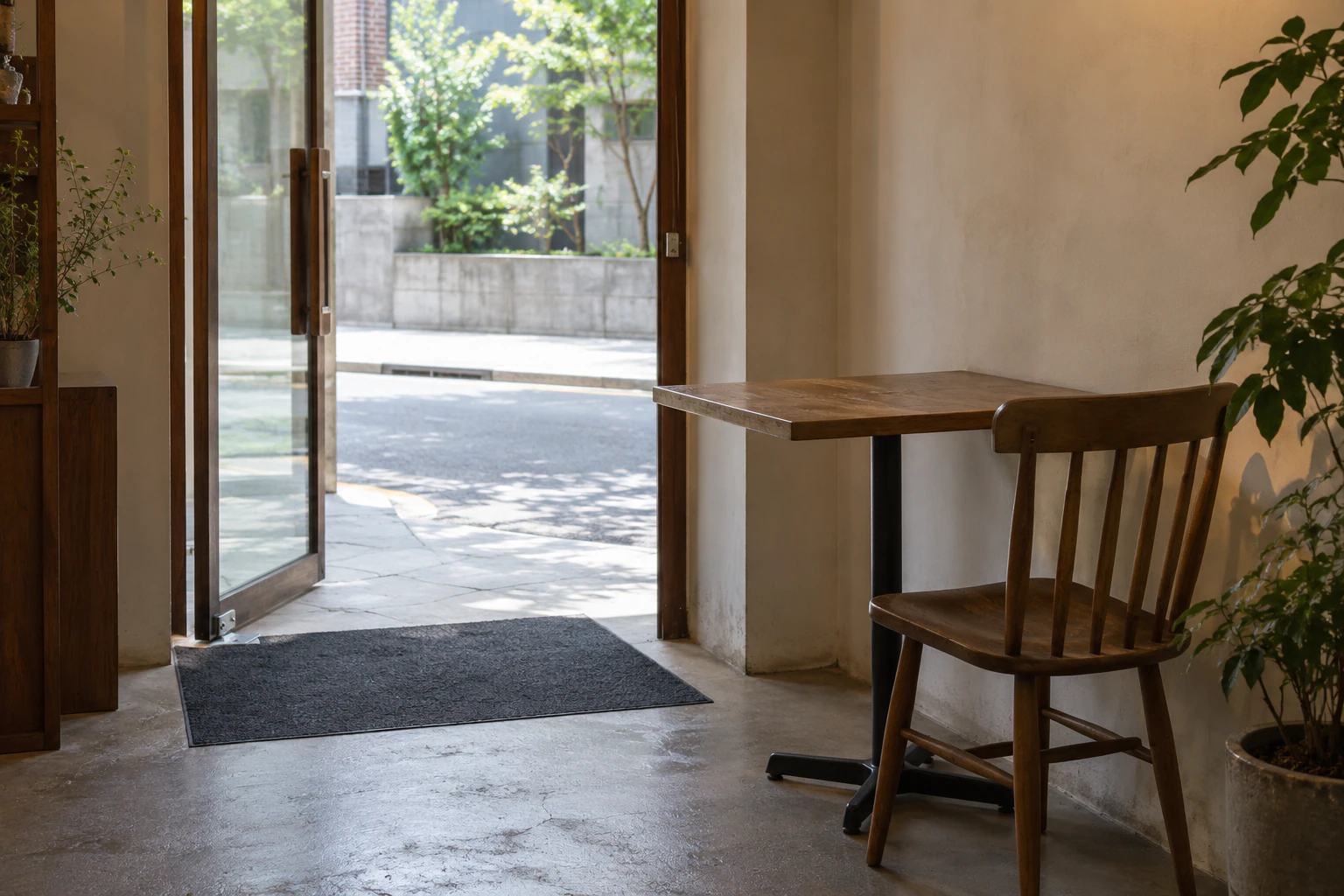
- Find the door’s traffic path. A seat along the entrance path can be exposed to outdoor air when the door opens.
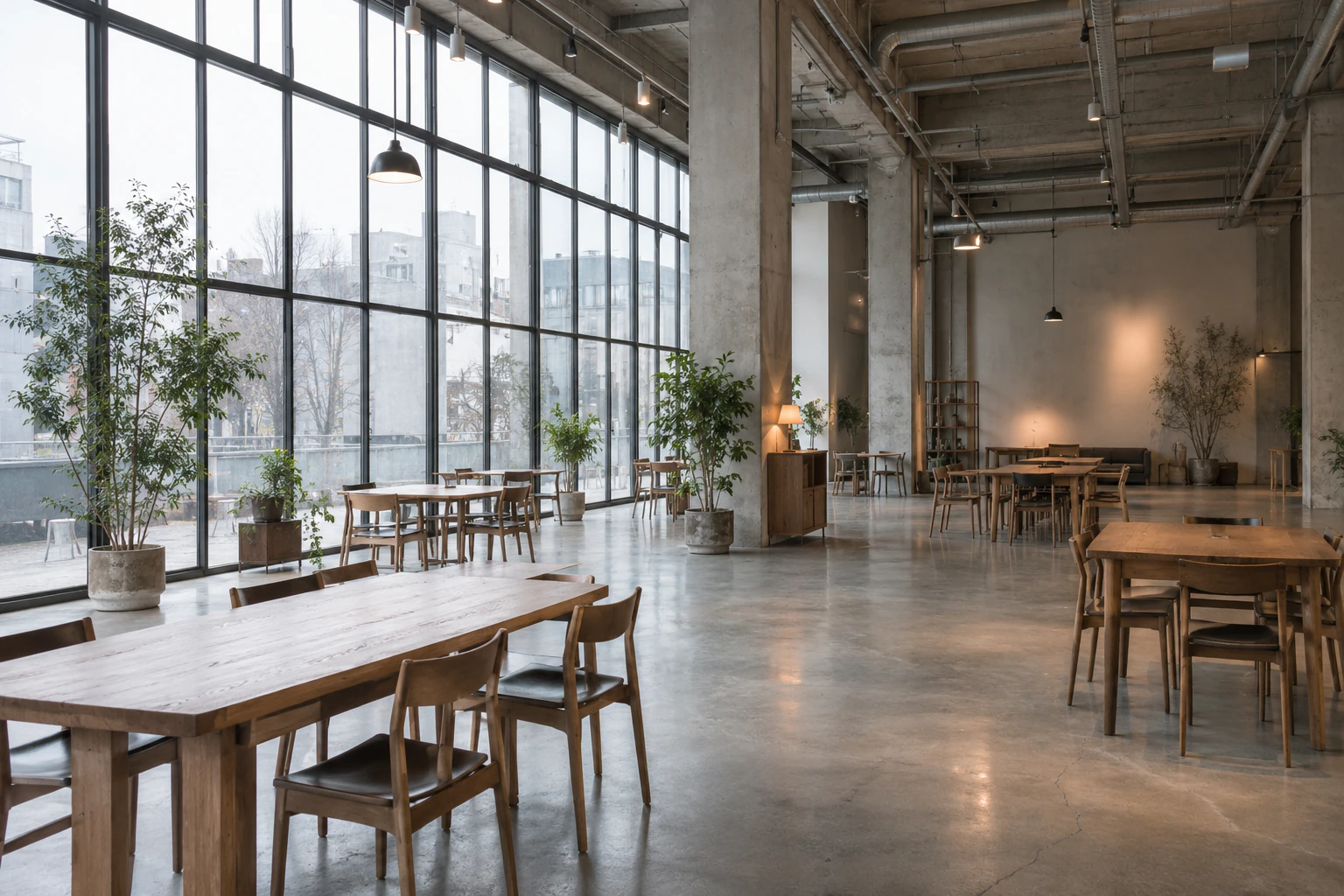
- Find the largest glass surface. Near a large glass surface, its surface temperature can affect the seat’s radiant environment (general principle).
- Glance up at the ceiling height, too. In a space where air circulates through a tall volume, ankle height and chest height can differ — the vertical temperature difference the standard describes. Tall does not automatically mean cold.
- Check the position relative to the vents, the door and the largest glass, and whether air reaches the seat directly, then choose.
The 30-second check
- Ceiling vent positions
- The door’s traffic path
- Direct airflow reaching the chair
- Can a thin layer come out right away?
What to check before choosing a seat
Check whether conditioned airflow reaches the seat directly.
Check whether the seat sits on the path outdoor air takes each time the door opens.
Check how far it sits from the largest glass surface, the door and the vents.
Not a warmth ranking — a list of what to observe at each seat.
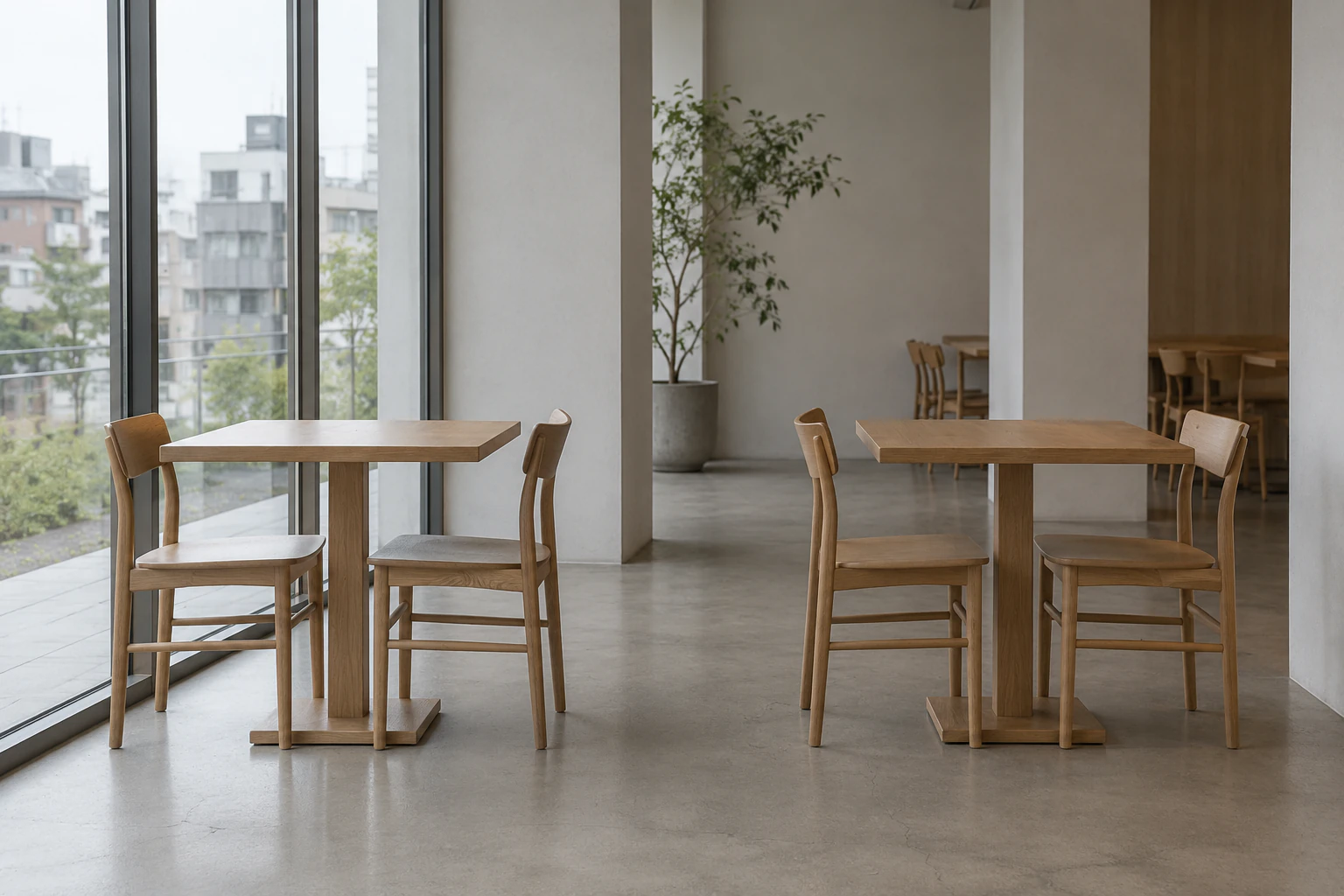
Converted factory halls, glass-fronted buildings, small single-room cafes — the types you meet around Seongsu are just different combinations of these variables. Within one room, conditions can differ seat by seat. Airflow and the radiant environment are positional variables — exposure can change with where you sit relative to vents, doors and large glass.
Keep the observation and hand the response to Step 04. Even when a busy hour leaves you whatever seat is free, sitting under a vent or beside the door knowingly is different from sitting there unknowingly. Keep the thin layer at the top of the bag.
04Bring one extra layer
Bring one extra layer — instead of predicting the temperature, keep one thin layer within reach
The fourth step is the response. The response can be prepared before arrival. This is the one rule a reader takes away.
- On a day when indoor-outdoor transitions are expected, carry one layer that comes off easily and packs into the bag. Not one thick layer but one thin one — it has to fit in the bag once it comes off.
- Keep that layer at the top of the bag. That is why the last item on Step 03’s checklist is “can a thin layer come out right away?”
- Keep dwell time as a separate variable. A cafe is a place you sit in, not pass through, so the exposure time itself differs from the street.
- The full outfit system lives in One Jacket, Three Temperature Zones, and the order of response when a day departs from the plan belongs to the reality check. This guide’s job ends at building the background for why that preparation is not wasted.
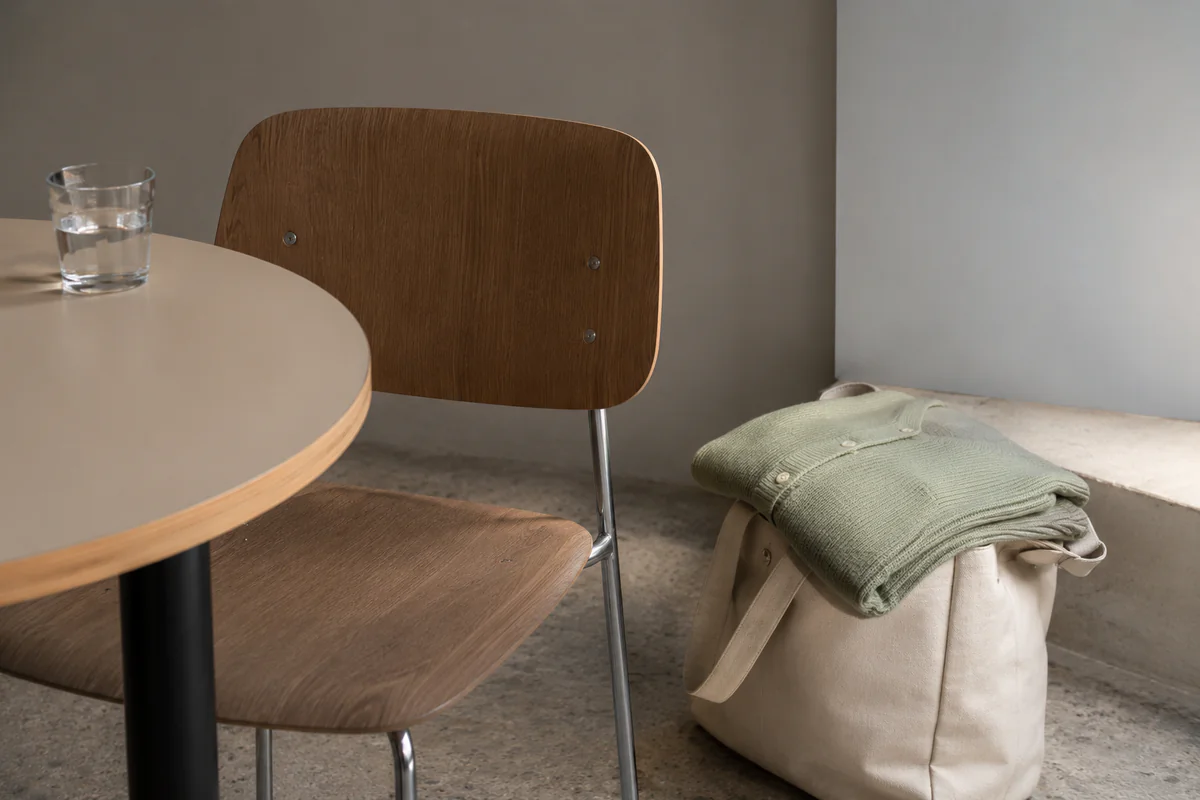
The same rule runs the other way. If you came in wearing two thin layers, take one off and put it in the bag. This guide prefers “one thin layer” over one thick layer precisely to leave room to adjust in both directions.
(※ This article includes staged images created with AI.)
Things to watch for
- Using the building’s history as the cause — “it’s cold because it used to be a factory” sounds plausible, but the renovation alone cannot explain the feel. How it actually feels has to be read together with variables like airflow, the radiant environment, temperature, humidity, activity and clothing.
- Judging by one thermometer number — the same 26°C can read differently depending on the seat, the airflow and what you were doing just before.
- Declaring “the window seat is cold” — before you sit, look at where the vents, the door and the glass are relative to your seat.
- Reading the normals as the day’s weather — normals are a thirty-year long-term baseline. The day belongs to the forecast and the check on the spot.
- Preparing only one thick layer — it can leave less room to stow it once it comes off, or to adjust to how it feels. This guide’s default response is one thin layer that comes off easily and packs into the bag.
FAQ
How do I prepare for a cafe that feels cool?
Keep one thin layer that goes on and off easily at the top of your bag.
What do I check before I sit?
Spend thirty seconds looking at where the vents, the door and any large glass are relative to the seat. Check whether air blows straight at the seat, too.
When do I put the layer on or take it off?
Put it on when the room feels cool, and take it off and pack it when you feel warm.
Does the same logic hold in summer?
The direction can flip. In early summer, the direction of the indoor–outdoor difference can reverse. This guide is written around autumn conditions.
Should I take the outer layer off or keep it on?
Decide on arrival. That is why the kit is “one thin layer that comes off easily and packs into the bag.” The rule of this guide is not to decide in advance whether you will take it off, but to keep both options open.
Before you go — 30 seconds before you leave
- Today’s forecast: morning ____ / afternoon ____ (normals: average daily low 10.6 / high 20.2 are background)
- One thin layer that comes off easily and packs into the bag — at the top of the bag
- Thirty seconds before sitting: vents · the door’s traffic path · the largest glass surface
- Check the position relative to vents, door and largest glass, and whether air reaches the seat directly
- Instead of “this cafe is cold / warm” — observe, then answer with the layer
Exceptions & Limits
This guide’s reach has limits. The date and its actual weather, a shop’s HVAC practice, the seat you take, what you wear, how hard you were just walking, and personal difference all change how the same room feels. Two people at the same table can reach different judgements and both be right. When the season turns, the handover works the other way — in early summer the same logic can run in reverse.
A building’s history is not used as a cause here. “It’s cold because it used to be a factory” sounds plausible, but the renovation alone cannot explain the feel — it has to be read together with variables like airflow, the radiant environment, temperature, humidity, activity and clothing.
Putting it into practice
The rule a reader takes away is a single one: on a day when indoor-outdoor transitions are expected, carry one layer that comes off easily and packs into the bag. The response can be prepared before arrival. This works as a set with the rest of the magazine — the full outfit system lives in One Jacket, Three Temperature Zones, the order of response when a day departs from the plan belongs to the reality check, and where two thin layers sit inside a look is the scene guide’s job. This guide’s job ends at building the background for why that preparation is not wasted.