AFTER CUT
Shoes and Bags for a Full Day in Seongsu
Uncomfortable shoes, extra shopping bags or a long queue can change your day. Prepare comfortable footwear and a light layer, and decide which stop you could skip if time runs short.
How to get there
Walking distance and time are map-route estimates; exit numbers are as of the check date.
- Are today’s shoes half-day shoes or full-day shoes? This answer changes the response to all four variables below.
- Are you wearing two thin adjustable layers? That is this simulation’s default preparation for the indoor-chill variable.
- A5 slack in the bag? That is the room to balance any luggage from shopping at the select shops against the essentials.
- Write down today’s sunset time and tomorrow’s first commitment. Whether the last two stops are kept is decided from these two times together with the energy left to get home.
- Decide in advance what gets deleted on a 30-minute delay. On this route the doubling-back stop (Point of View) is the first candidate.
The character scenes and outfits are not records of a wear test. Check the forecast and walking distance, then adapt the ideas to your own clothes.
What to consider
Even a carefully chosen outfit and itinerary can need a rethink when shoes become uncomfortable or queues are long. Using the Seongsu day route, this guide considers four possibilities: footwear problems, chilly interiors, extra bags and weekend crowds. It helps you decide what to prepare and which stops you could leave out. Related: Seongsu full-day route
So this is not a guide to planning more; it is a guide to deciding the order of stops to skip. Five steps. Set the shoe standard first → prepare for indoor chill with one thin layer → set a limit on what you carry at the shops → make a 30-minute wait the redesign trigger → check the reasons to keep or skip a stop for the last two stops. Each step owns one variable, and the last step decides whether the day’s conclusion is kept or dropped.
“In this simulation, the point where the route changed wasn’t the shoes — it was the standard for choosing them. That’s where I start checking again.”

01Set the shoe standard first
Moment 1 · Shoes — the variable that changes the structure of the day, not the timetable
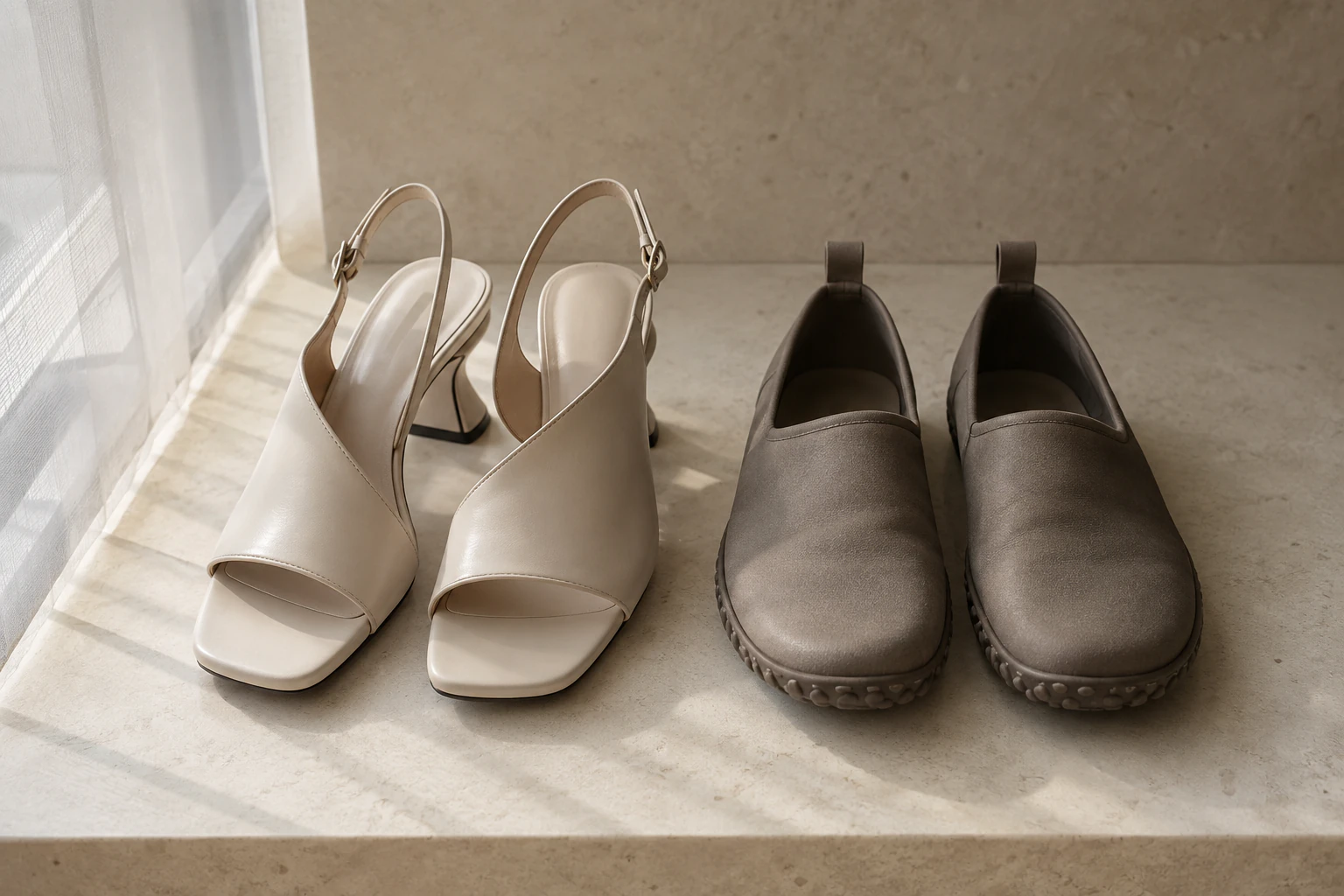
The first variable is shoes. In the simulation, changing one pair of shoes rewrote several route decisions. In this simulation, shoes are treated as a variable that can reshape the structure of the day, not just the timetable.
- Decide first whether today is a half day built around standing shots or a full day built around moving. That answer is the shoe answer.
- For a half day, Plan A (photo-first shoes) holds. Heeled, beautiful in close-up — in this simulation it bought close-up quality at the price of planting a recovery stop into the afternoon and trimming the select-shop stay.
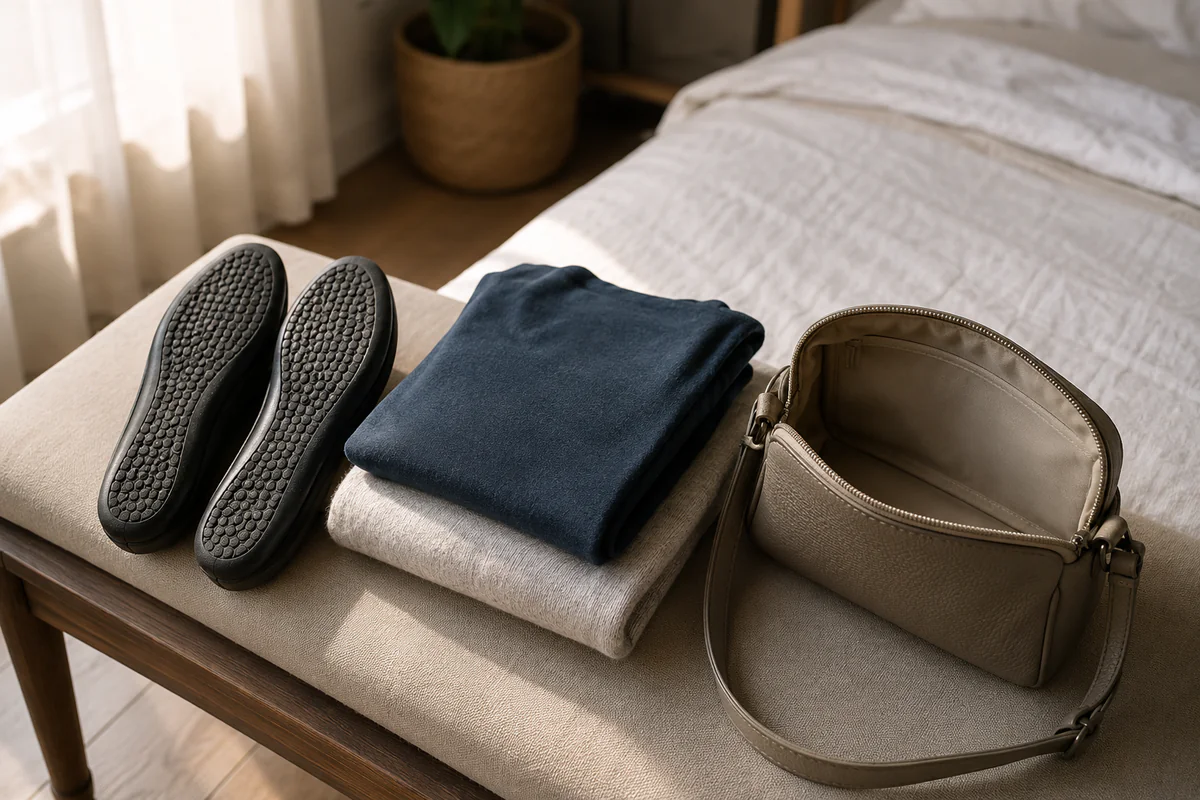
- For a full day, go with Plan B (grip-first flats). Half a step down on camera, but in this simulation’s Plan B the recovery stop was removed and that time was reallocated to the select-shop stay and to slack before blue hour.
- This simulation rejects one combination: walking Plan B’s day in Plan A’s shoes. If the heels are truly needed, they ride in the bag and you accept the weight — carrying them in hand is logged in this simulation as a friction risk for shooting and moving.
Bags already packed, or only one pair along — this simulation’s response order has three moves. ① Raise the cushioning with insoles and socks → ② delete one stop from the longer later sections → ③ rebuild the shooting around standing shots. You are not abandoning the route; you are lowering its density. The standard for choosing shoes itself is in Step 04 of the scene guide.
02Prepare for indoor chill with one thin layer
Moment 2 · Indoor Chill — the variable with the lowest preparation cost
The second variable is indoor chill. An outfit that fit the street can feel thin the moment it crosses a cafe door. The variables you can consider are each shop’s HVAC practice, the position relative to vents and the door, and dwell time.
- Go out in two thin layers. In this simulation, two thin layers go in as the option with adjustment slack. One thick layer can leave less room to stow it once it comes off, or to adjust to how it feels.
- If you can choose your seat, first check the position relative to vents and the door, and whether air reaches the seat directly.
- Don’t generalise any one shop’s temperature. The mechanism, the KMA climate-normals basis and the 30-second check before you sit are in Why Can Seoul Cafes Feel Cooler Than the Street?.
- What marks this variable out is its low preparation cost. In this simulation, indoor chill is treated as the variable with the lowest preparation cost: one thin layer leaves more room to adjust on site.
If you have no thin layer, check how it actually feels on arrival and adjust that day’s dwell plan. Buying something touches Step 03’s limit on what you carry.
03Set a limit on what you carry at the shops
Moment 3 · Bags and Shopping — “can I carry this to blue hour?”
The third variable is the bag. The bag you start with and the bag after shopping are different objects. On the Seongsu route, the point where luggage can grow if you shop is the select-shop stretch. On the base route, the longest leg — 1.8km from Point of View to Seoul Forest — still follows.
- Attach one question to everything you pick up in a shop: “can I carry this to blue hour?” As shopping bags multiply and start covering the jacket silhouette, in this editorial frame the risk that bag and luggage compete with the shoulder line grows.
- On a day that looks like heavy shopping, either reorder the route to end at the shops instead of Seoul Forest, or check the station storage options in advance.
- Priority inside the bag runs charger > rain layer > purchases. In this simulation, same-day essentials outrank purchases.
- The hardest case is the overlap. This simulation treats bag weight and foot fatigue coinciding in the afternoon as its reduction fork — see the If below.
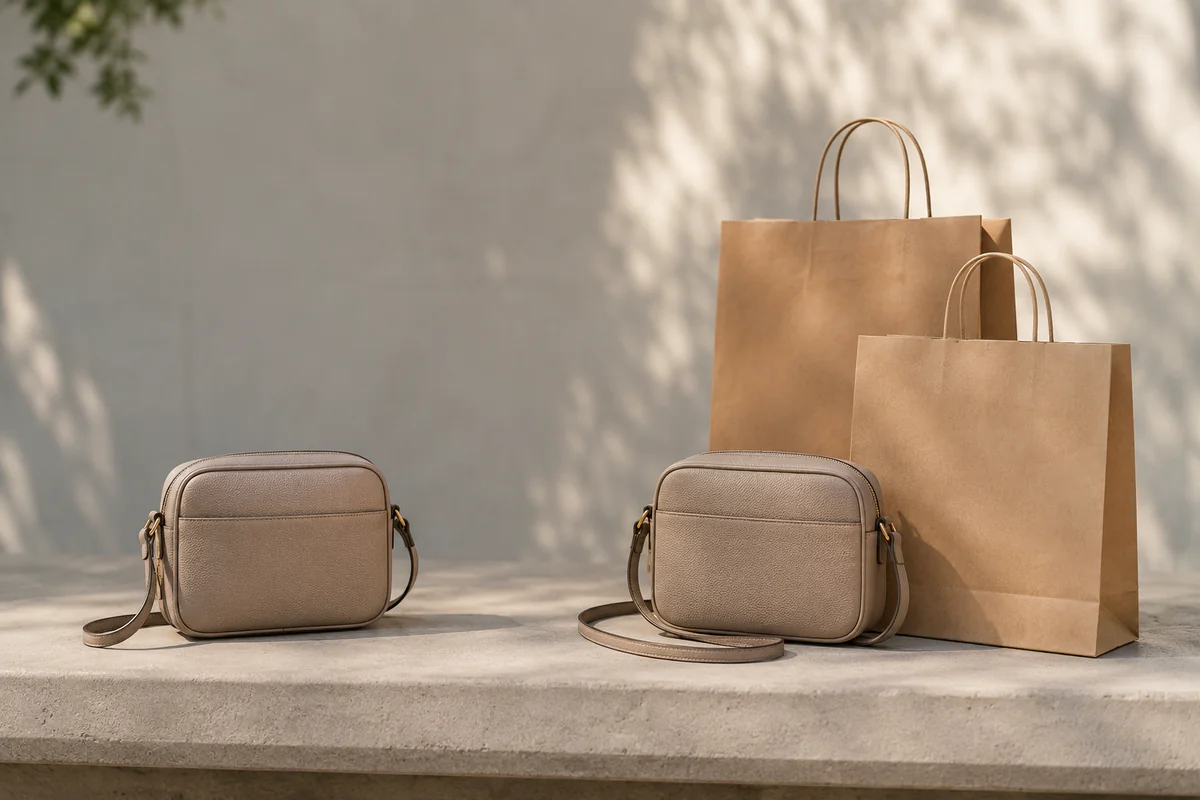
This simulation’s reduction order is explicit. First, stop buying. Preventing more weight from being added is the lowest-cost adjustment. Second, delete the doubling-back stop (on this route, Point of View). Third, if that’s still not enough, don’t change the destination — lower the density on the way to it: keep Seoul Forest, but shrink the scope of the stroll you meant to take there down to the reset and the closing shot. Protect the route’s conclusion; trim the path to it.
04Review your plans if the wait reaches 30 minutes
Moment 4 · Weekend Crowds — decide what gets deleted before you join a queue
The fourth variable is weekend crowds.
- This simulation sets a 30-minute wait as its redesign trigger. Past thirty minutes, change the question from “shall I wait longer?” to “what do I delete?”
- Decide what gets deleted before you join the queue. On this route, the doubling-back stop, Point of View, is the first candidate.
- A moment will come when the shot can’t be taken. Not blocking doorways, pavements and alleys comes first, and when a spot is blocked, changing the backdrop is faster than waiting it out.
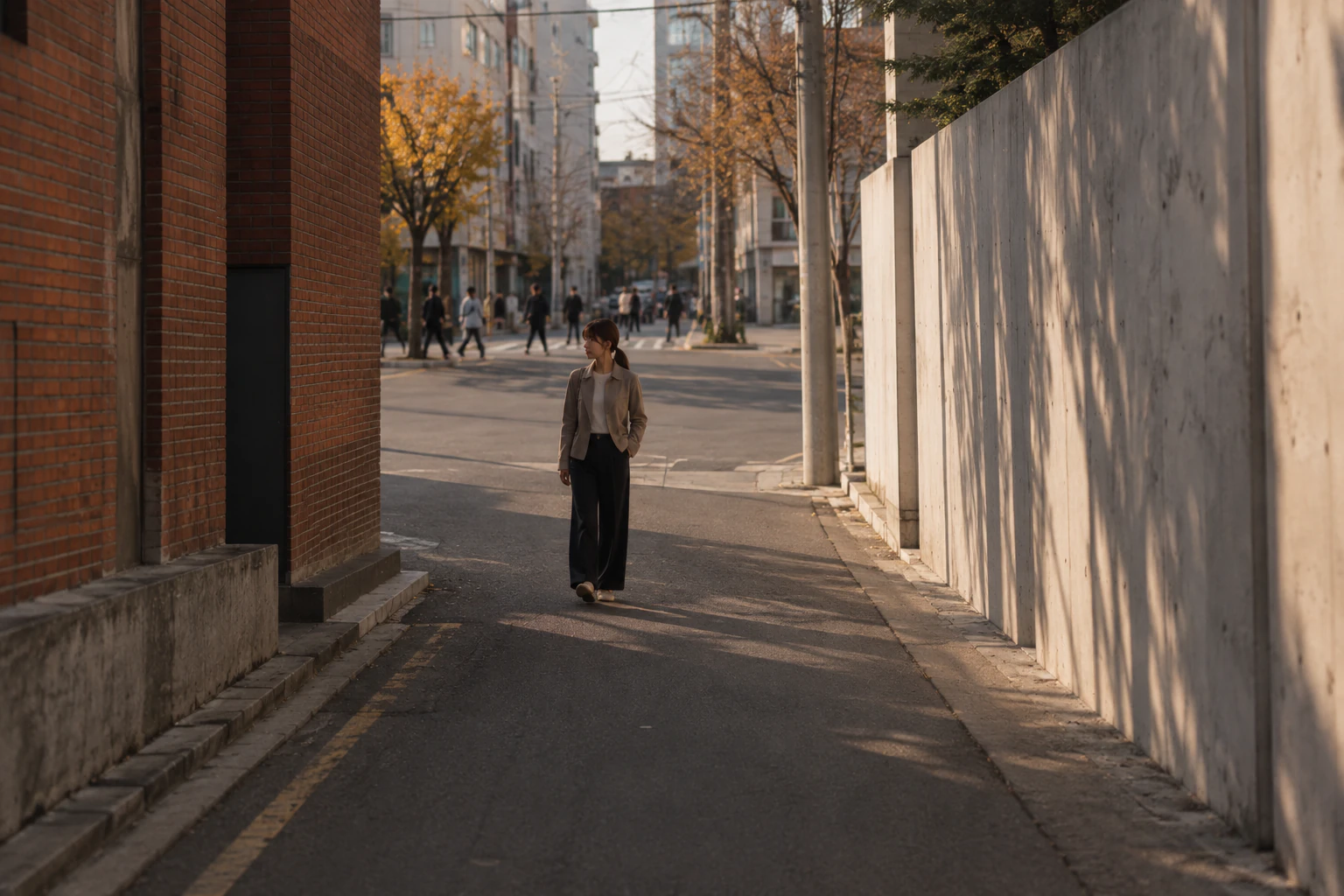
Recalculate in time, not distance. The map app’s estimate is a planning value; the actual time on a crowded day is that day’s value. How the map’s distance and the body’s distance differ is the subject of It Looked Close on the Map.
05Check the reasons to keep or skip a stop for the last two stops
Keep or drop the last two — sunset, the energy to get home, and tomorrow
The fifth step is the conclusion. However the four variables arrived, one thing gets decided last — whether Seoul Forest and the footbridge are kept or dropped. In this simulation they are the priority keep candidates, kept only when sunset, stamina and tomorrow’s commitment all allow.
- First check the two immediate conditions: can you reach Seoul Forest before sunset, and is there enough energy left to get home? Then check tomorrow’s first commitment before keeping both stops.
- If the sun is already down, end at ⑥ Seoul Forest and hand only ⑦ the footbridge to your next visit’s first slot. The dark riverside stretch is not recommended as a closing scene.
- If tomorrow starts early, or the energy to get home matters more and the day must stop before reaching ⑥, both ⑥ and ⑦ can go. Some days, tomorrow’s first commitment outranks today’s closing shot — a trip has to be planned across the whole itinerary, not just one day.
- This simulation’s reduction order runs the doubling-back stop → the close-ups → the density of the stroll. Priority protection goes to the energy to get home and tomorrow’s commitment; the closing shot is kept when sunset and stamina allow.
Once you have walked Seongsu by day, the order for re-editing the evening for time, light and closing conditions belongs to Rina’s evening revisit. Step 05 here uses the same rule as that edit’s “closing condition.”
(※ This article includes staged images created with AI.)
Things to watch for
- Planning more to block the variables — all four are met not by planning more but by pre-deciding the order of stops to skip.
- Walking Plan B’s day in Plan A’s shoes — half-day shoes on a full day is, in this simulation, the first candidate cause of an afternoon redesign. If the heels are truly needed, in the bag.
- Letting the shopping bags multiply — once they start covering the jacket silhouette, in this editorial frame the risk of competing with the shoulder line grows. Ask “can I carry this to blue hour?” first.
- Queueing without a trigger — this simulation sets a 30-minute wait as the redesign trigger and fixes the order of stops to skip before it. Otherwise the risk grows that the stops behind it need rescheduling too.
- Spending the energy to get home on the closing shot — priority protection goes to the energy to get home and tomorrow’s first commitment. The closing shot is kept only when the conditions allow.
FAQ
Do I always have to give up the pretty shoes?
No — it is a fork. For a half day built around standing shots, Plan A holds. The combination this simulation rejects is walking Plan B’s day in Plan A’s shoes. If the heels are truly needed, they ride in the bag and you accept the weight.
How do I prepare for chilly rooms?
Wear thin layers and put one on or take one off as you feel the room.
How do I order the day if shopping will add bags?
On a heavy shopping day, make the select shops your last stop.
When should I change the plan if a queue gets long?
At a 30-minute wait, look at the plan again. The first stop to skip on this route is the backtrack to Point of View.
If the sun sets, do I give up both Seoul Forest and the bridge?
It splits in two. If the sun is already down, end at Seoul Forest and hand only the footbridge to your next visit. If tomorrow starts early or the energy to get home matters more, both can go. A trip has to be planned across the whole itinerary, not just one day.
Before you go — 30 seconds before you leave
- Today’s shoes: half-day / full-day — full day means grip flats, fixed
- Two thin layers + (full day) an outer layer for the evening
- A5 slack in the bag — charger > rain layer > purchases
- Sunset today ____ / tomorrow’s first commitment ____
- On a 30-minute delay, delete: Point of View (the doubling-back stop) → close-ups → the density of the stroll
- Priority protection: the energy to get home · tomorrow’s first commitment — the closing shot only when conditions allow
What has been checked
All four are simulation-based trade-offs. One principle this simulation fixes: all four variables are answered by pre-deciding the order of stops to skip rather than by planning more. This simulation’s reduction order runs: the doubling-back stop → the close-ups → the density of the stroll. Priority protection goes to the energy to get home and tomorrow’s first commitment; the closing shot is kept when sunset and stamina allow.
The seasonal background of the indoor-chill part comes from KMA climate normals (checked 2026-08-31). The 14:00–17:00 select-shop stretch and the 1.8km to Seoul Forest are reused source-record values from the Seongsu full-day route.
Putting it into practice
The four variables are not on the timetable, but the responses can be. Half day: photo shoes allowed and two layers as the baseline, with A5 bag slack not set as a requirement. Full day: grip flats fixed, two layers plus an outer, A5 bag slack required. First to give up: the doubling-back stop (here, Point of View) and the close-ups; priority protection: the energy to get home and tomorrow’s first commitment. Read alongside: the Seongsu full-day route · the office-romance look, translated for travel · why Seoul cafes can feel cooler · the look out of your suitcase.