SECOND VISIT · EVENING REVISIT
A Seongsu Evening Starts with Closing Time and Sunset
Seongsu feels different when you return in the evening. Check closing times and sunset, choose one indoor break, and decide where you would like to end the day.

How to get there
Walking distance and time are map-route estimates; exit numbers are as of the check date.
- Check today’s sunset time in the morning. Blue hour is not a fixed time — it is a short window calculated from that day’s sunset.
- Re-check whether both candidates (Point of View, Daelim Changgo) are open today in your map app. Seongsu turns over fast.
- Make sure one outer layer for after dark fits in your bag. The bridge is an open section that can be exposed to wind.
- This guide assumes you have already walked Seongsu by day once. If this is your first visit, follow the ⑥→⑦ section of the route guide as written instead.
The return visit in this story is imagined. Check opening hours and access before you set out.
What to consider
Before returning to a place you visited by day, check when it closes. The same street will look different in the evening, and the café you planned to rest in may no longer be open. Start with familiar places, then change the order to leave room for an indoor break and the view you want to finish with.
Rina’s five details asked what to recheck when a place starts to feel familiar. This guide moves that question to the back of the day: what to check first as the sun starts to go. The edit has four steps. Check the clock → keep one → count back from the light → end on one frame. Each step owns one check, and each later step only handles what the previous one left. Evening is shorter than daytime, which is why the order matters — there is less room for choices that double back.
“The more familiar the place, the more I recheck today’s timetable and light before I trust my memory.”
01Start with the clock
The more familiar the place, the more you reread the timetable first
The first check is the clock, not the mood. Whether a place you know by day is still a candidate in the evening is decided by its operating conditions, not by memory.
- For each candidate, fill in four boxes first: opening time, closing time, break, last entry. Don’t fill them from memory — look them up as of today on a map listing or an official channel.
- Place anything with a last-entry time before that time, and anything with a break outside that window.
- A place where only the opening time is confirmed is not judged an evening candidate on that record alone. Leave it as a separate check.
Evening Window — the candidates’ timetable
| Candidate | Operating conditions — check dates shown with each record | Role in the evening edit |
|---|---|---|
| Point of View | Daily 12:00–20:00 · entry may close at 19:55 depending on the shop · closed one day a month (announced on Instagram) | Indoor-buffer candidate — entering before the cut-off is the condition |
| Daelim Changgo Dining & Bar | 11:00–23:00 · break 15:00–17:00 | Indoor candidate open in the evening after the break |
| Onion Seongsu | Opens daily 08:00 (Sat/Sun 09:00) | Opening time only — not judged an evening candidate on this record alone |
| Blue hour | Counted back from that day’s sunset | No fixed time — a short window calculated on the day |
The timetable is used only to assign each candidate a role.

Keep only the one that fits the Step 03 target time and your travel plan. Seats and atmosphere are not used as the reason. If neither fits on the clock, go to Step 03 without an indoor break — only the reference point for counting back remains.
02Keep one indoor break
An indoor stop is a buffer, not a destination
The second check is subtraction. Fill the evening with several indoor places and it risks becoming a repeat of the afternoon — spending more of the remaining light moving from door to door.
- From the Step 01 table, pick only one indoor place that is open in the evening: the one open after its break (Daelim Changgo) or the one you must enter before 19:55 (Point of View). Make one of them the day’s buffer and let the other go.
- Treat the one you keep as a standby candidate — somewhere to use, after checking it is available that day, if the weather turns, if there is a gap before blue hour, or if walking gets hard. It is not a fixed appointment.
- Remove the other indoor places from the evening list. Keep only their names in the note for your next visit.

The reason for keeping only one is the same as in the repeat visitor’s suitcase. If a second trip is about removing redundant just-in-case packing and keeping the decisions that matter, a second evening does the same with indoor stops: keep one buffer and let the rest go. What you keep is room to adjust when the plan slips, not an appointment you must keep.
Make the Step 02 indoor break your first candidate. If it is available that day, stay there; if there is still light, go on to Step 04, otherwise end that day’s evening edit there. The rain-layer formula follows the scene guide.
03Count back from the light
Start from the fading light, not from a start time
The third check is light. Blue hour is not a single fixed time but a short window that has to be recalculated from each date’s sunset. So the evening itinerary is not stacked front to back — it is counted backwards from that window.
- Use the sunset time you checked that morning as the reference. 18:50 is the finishing time used in the Seongsu full-day route, not a general blue-hour time for Seongsu.
- Set the target time on the bridge first, then use the route estimate from your map app that day as a planning value to fix when you leave the indoor break. The order of the last section reuses the source record from the Seongsu full-day route.
- Then, within the time that remains, set the upper limit for how long you stay at the indoor break. The target time on the bridge and the time you leave the indoor place — those two times are the reference points of the evening timetable.
- An evening timetable does not start from a start time the way a daytime one does. It starts from the light that ends.
Order of the last frame — reusing the route record
- Seoul Forest Hill of Wind — start of the evening walk
- Footbridge — the Han River and the Seongsu Bridge skyline open up from the deck. The place for the blue-hour frame
- North end of Seongsu Bridge — where the route ends
This order is taken as is from the Seongsu full-day route (2026-08-31).
04Choose one place to finish the evening
Save one last view for the end
The fourth check is the ending. Instead of scattering the evening across several scenes, close it on one last frame.
- Create no new scene — take the last section of the existing route as it is: from Seoul Forest’s Hill of Wind to the footbridge, across the bridge to the north end of Seongsu Bridge.
- Have the outer layer ready before you climb the bridge. It is an open riverside section that can be exposed to wind.
- The footbridge is open 05:30–21:30. Plan to finish the footbridge section within those hours.
- When the light goes, the evening is over. Add nothing after that frame.
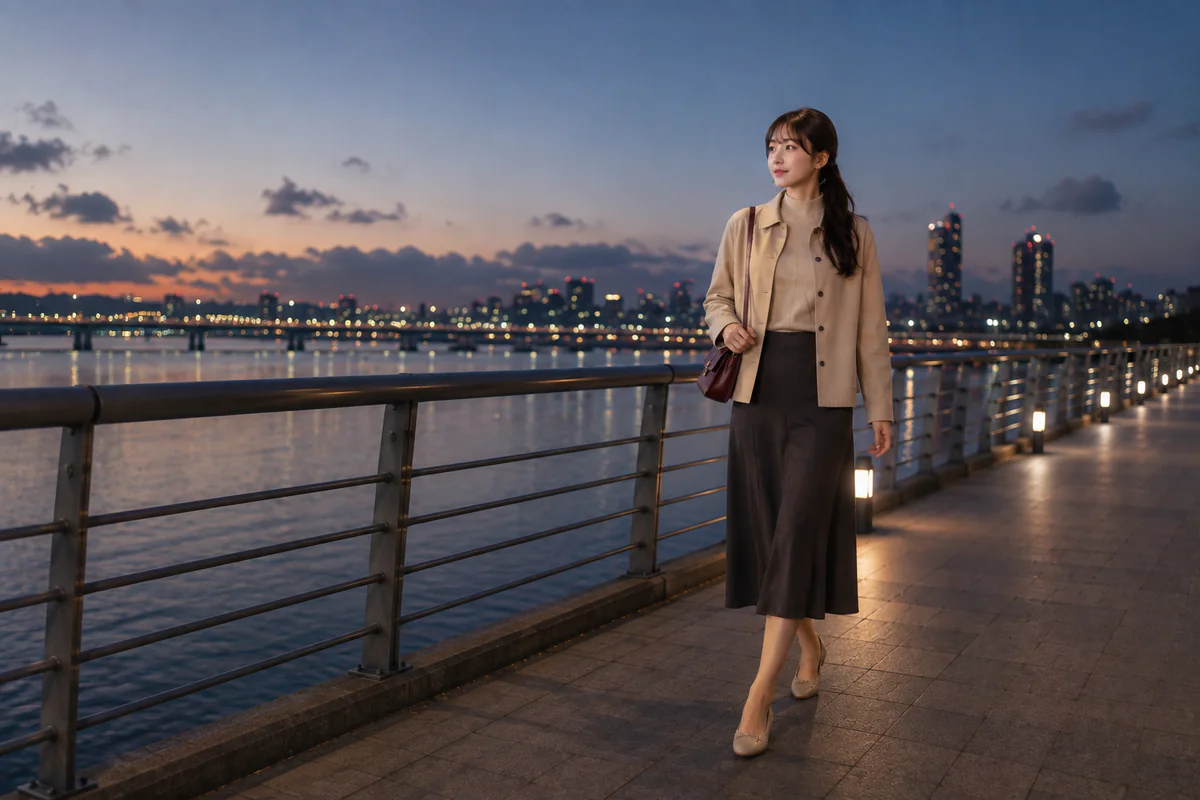
Don’t insist on the bridge. A dark riverside section is not a closing frame we recommend. Don’t force a last frame — close that day’s evening edit. If you are still at the indoor break, end there; if you have already reached Seoul Forest, end there as the route guide does. Hand the last frame to the first slot of your next visit, when counting back from sunset is easy. You are not giving up the frame — you are changing its date.
(※ This article includes staged images created with AI.)
Things to watch for
- Memorising 18:50 — mistaking the route record’s design time for today’s blue hour. Recalculate from sunset every day.
- Keeping two indoor places — the second one, kept “just in case”, becomes a risk that shortens the time left before blue hour. This edit keeps one buffer.
- Judging the evening by Onion’s opening time — a record that confirms only an opening time does not decide evening candidacy.
- Leaving the last section’s opening hours out of the plan — plan to finish the footbridge section within its hours (05:30–21:30).
- Filling the timetable from memory — the more familiar the place, the more you look it up as of today. Seongsu turns over fast.
FAQ
What if it rains?
Make the Step 02 indoor break your first candidate. If it is available that day, stay there; if there is still light, go on to Step 04, otherwise end that day’s evening edit there. The rain-layer formula follows the scene guide.
How do I choose between Point of View and Daelim Changgo?
Choose one by that day’s sunset and the time you have left. For Daelim Changgo, check its hours after the break; for Point of View, plan to enter before 19:55.
Can I use this guide on a first visit?
It assumes you have walked the daytime itinerary once. On a first visit, follow the ⑥→⑦ section of the route guide as written — this guide is an edit on top of it.
Do I have to go into the indoor break?
No. The buffer is a waiting place for when weather, timing or tiredness get in the way. If the light is good and walking is easy, skip it and go straight to the last section at the time from Step 03.
Where do I check sunset time?
A weather app or a search for that day’s sunset is enough. Blue hour is a short window, so leave some margin in your sunset-based plan.
Before you go — 30 seconds before you leave
- Today’s sunset: ____ → target time on the bridge: ____
- The one indoor break you kept, with its closing time and break (confirmed open today)
- The time you leave the indoor place (travel time counted back, with a margin)
- One outer layer, in the bag
- Names of the candidates you dropped go into the note for next time
- If the sun is down, close that day’s evening edit — the bridge waits for the next visit
What has been checked
Point of View’s hours and entry conditions, Daelim Changgo’s hours and break, and Onion’s opening time follow the check dates shown with each record. Check the map listing or official channel for same-day changes.
Putting it into practice
An evening revisit is not more places but a more precise order. Check the clock, keep one indoor place, count back from the light, end on one frame. Read alongside the first-visit questions (the five gaps, the distance on the map, the look out of the suitcase), this edit finds its place. Same Seongsu, same route — a different time of day.