SECOND VISIT · PACKING
What to Leave Out of Your Suitcase on a Return Trip
Packing for a return visit starts with what you did not use last time. Look for clothes and shoes that do the same job, bring only the toiletries you need, and keep room for a change in the weather.
How to get there
Walking distance and time are map-route estimates; exit numbers are as of the check date.
- Write down the list of what you did not use on the first trip first. This guide’s subtraction starts from that list, not from memory.
- Have the scene guide’s temperature and rain formulas open. Judge layer overlap against the two temperature bands and the separate rain branch.
- Check whether you own one pair of grip-first shoes you have already broken in. If not, Step 02 is skipped.
- Look ahead for one compartment in the suitcase to reserve for the return load. Step 04 sets its size.
- Keep the four-line note (checked on / what changed / unchecked / look at next time) this time too. It is a judgment tool, not a suitcase item.
The character scenes and outfits are not records of a wear test. Check the forecast and walking distance, then adapt the ideas to your own clothes.
What to consider
On a first trip, it is tempting to pack for every possibility: another layer in case it is cold, another pair of shoes in case the walking is tiring. For a return visit, you can look back at what you actually used. Start by removing items that do the same job, while keeping what you need if the weather or plans change.
If Maya’s suitcase test asked “what to let through,” this guide asks from the other side — “what no longer needs to come along.” Five steps: remove the duplicate spare layer → remove the backup shoes → replace full-size amounts with decanted amounts → replace the unplanned spare space with a defined space → keep the four things that stay. The first four are subtraction; the last is the floor of subtraction. It is where a first visit and a revisit part ways across the same suitcase.
“When I pack the second bag, I look for overlaps, not things.”

01Remove the duplicate spare layer
Remove the Second Just-in-Case Layer — two layers in the same role, and one only takes up space
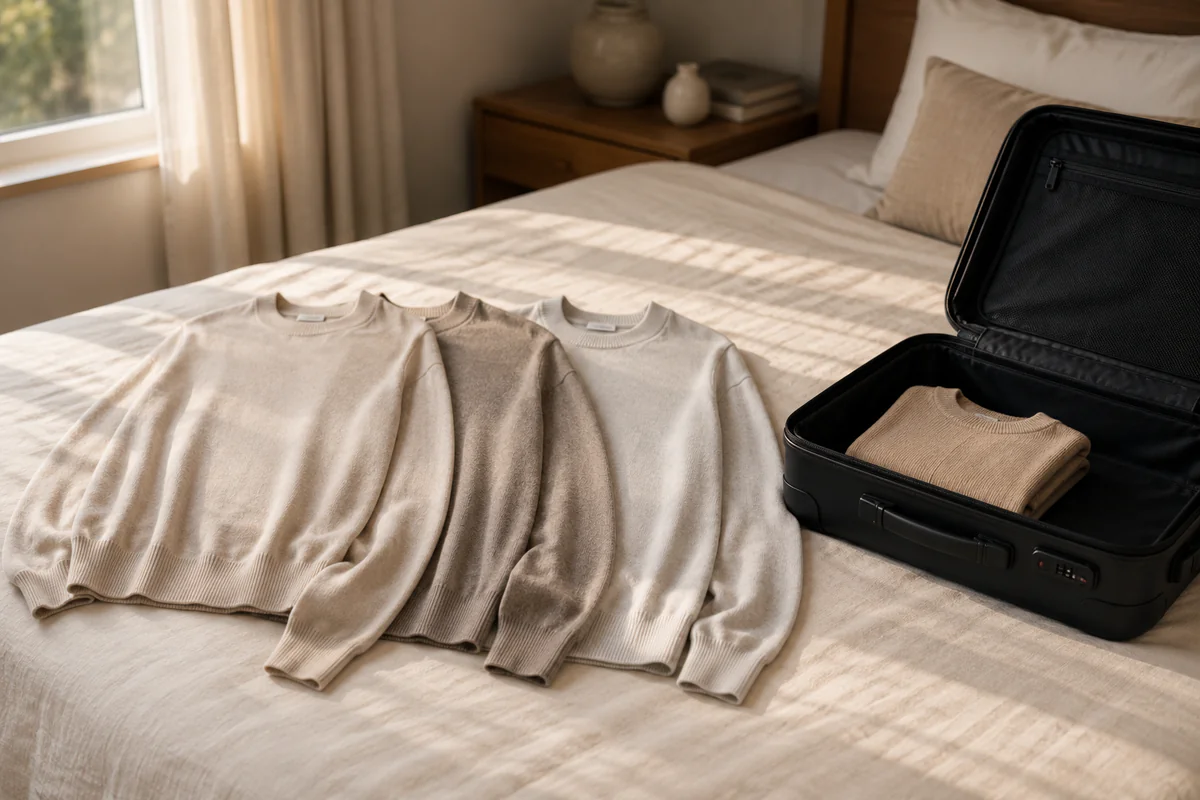
The first removal candidate is the duplicate spare layer. In this simulation, on the assumption that you already know the temperature and rain formulas, spare layers whose roles overlap are removed and one adjustable removable layer stays. The test for overlap is the role — the scene guide separates two temperature bands from a rain branch, and this simulation checks whether two spare layers serve the same role under the applicable conditions; if they do, one of them only takes up space. What made the first trip’s bag heavy was usually not heavy clothes but the repetition of these similar things.
- Take every layer out and assign each one a role under the scene guide’s two temperature bands and rain branch. Two or more in the same role means that role has an overlap.
- The order of removal is not the thicker piece but the one whose role overlaps. Do not keep a layer simply because it is the thickest. Keep the layer that still has a distinct role under this trip’s forecast and schedule, and remove the overlapping “similar but slightly different” middle layers.
- Choose the one removable layer you keep so that it folds to A5. The suitcase test’s A5 rule is reused as it is.
- That indoors can feel different from the street is handled by the culture note, split into general principle, climate background and review reports. How it actually feels is a field-visit item; in this guide it is only the reason for keeping one removable layer.
This subtraction stands on the premise of “knowing the day’s conditions.” If the season has changed, the roles of the temperature bands and the rain branch are different, so Step 01 is no longer a subtraction but a return to the scene guide’s temperature formula to assign everything from scratch. The list of what you know comes only from what you have rechecked.
02Remove the backup shoes
Remove the Backup Shoes — with one proven pair, the second pair’s space is the first to be reclaimed
When the reader’s main pair is a grip-first pair already broken in, this test puts backup shoes whose function overlaps first on the removal list. The reality check treats shoes as an early variable that can trigger a redesign of the day — and so, paradoxically, if a pair has already passed the test, the second pair’s space is the first to be reclaimed. This is not an unconditional application of the one-shoe rule, though; it is the default branch of repeat-visitor packing. One pair is the default, not the ceiling.
- The main pair must be one pair chosen by grip and forefoot fit that you have already broken in. Brand-new shoes are not main-pair candidates.
- Remove first the backup pair whose function overlaps with the main pair (similar heel, similar grip). If photo shoes are truly needed, count their weight against the longest leg’s 29 minutes.
- The three exceptions set by Maya’s suitcase test are inherited as they are — a formal commitment on the itinerary, prolonged rain in the forecast, or sensitive feet for which one pair is not a reliable default make the second pair an allowed exception.
- If an exception puts the second pair in, reclaim its volume from the space the removed layers left in Step 01. The exceptions are part of the rule.
Skip Step 02. This subtraction works only when one proven pair exists. If you are leaving on a second trip in new shoes, go back to the reality check’s shoe verdict rather than this guide.
03Pack travel-sized amounts
Remove the Full-Size Routine — the question is not “is it needed” but “is the whole volume needed”
The third is the size of your kit. Instead of full-size as the default, switch to amounts that fit the length of the stay — travel-size volumes. This step does not remove the needed item itself — it asks whether the whole volume is needed. The question is “is this whole volume needed.” The things you brought full-size on the first trip and used less than half of become this item’s candidate list. What gets subtracted is not the thing but the unused volume.
- From the “things I did not use” list in Before, pick the full-size items first. Anything used less than half is first in line.
- Set the amount as days of stay × daily use and decant into travel containers. It doesn’t have to be exact — as long as it is smaller than full-size, this step has done its job.
- Items that should not be decanted (things that spoil once opened, things that need their original container) keep their original container or a travel-size product.
- Anything used daily, anything whose absence stops the day, only shrinks in volume and always stays. Decanting reduces; it does not remove.

Don’t assume local resupply — which items are easy to find locally is not a fact this guide has checked. Instead, add one more travel-size of that item only, and keep the rest decanted. The floor is “anything whose absence stops the day.”
04Set aside space for the journey home
Replace the Guessed Souvenir Space — undefined space is not space
The fourth is not an item to remove but one to replace. A first-trip suitcase holds a vague allowance called “in case I shop” — space left empty with no size decided, a guess. This test replaces that space with the principle Maya’s A5 test established: define the empty spot in advance. A defined empty space does two jobs. It stops the outbound load from invading that compartment, and it makes packing on the return day part of the plan. A guessed allowance is usually already filled with other things before departure.
- Choose one compartment of the suitcase to reserve for the return load. One pouch, one section — any unit with a visible boundary.
- Set that compartment’s size before departure. Not “left empty in case I shop,” but one concrete spot the return load will occupy.
- The rule is that the outbound load does not invade that compartment. If things overflow, don’t shrink the compartment — go back to Steps 01 to 03 and find more to take out.
- When a purchase happens it goes into that compartment, and when the compartment is full, that day’s buying ends there. It is a way of planning ahead for the fact that shopping can add to the load — not a recommendation to shop.
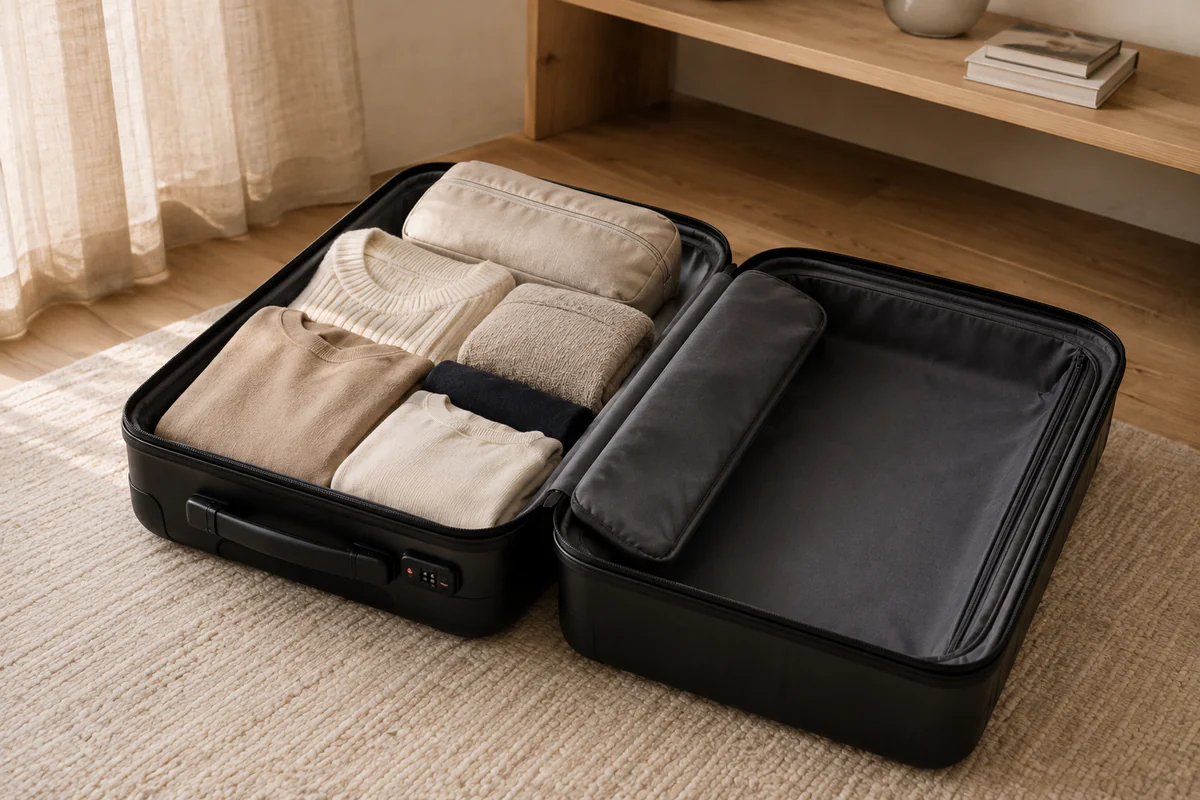
Define the compartment anyway. Make it as small as possible, but don’t remove it. Even with no shopping plan, this simulation keeps the smallest defined compartment as return-space reserve; it makes no claim about how the return load will differ in shape.
05Keep these four essentials
What Stays — knowing the day’s conditions and the day going to plan are different matters
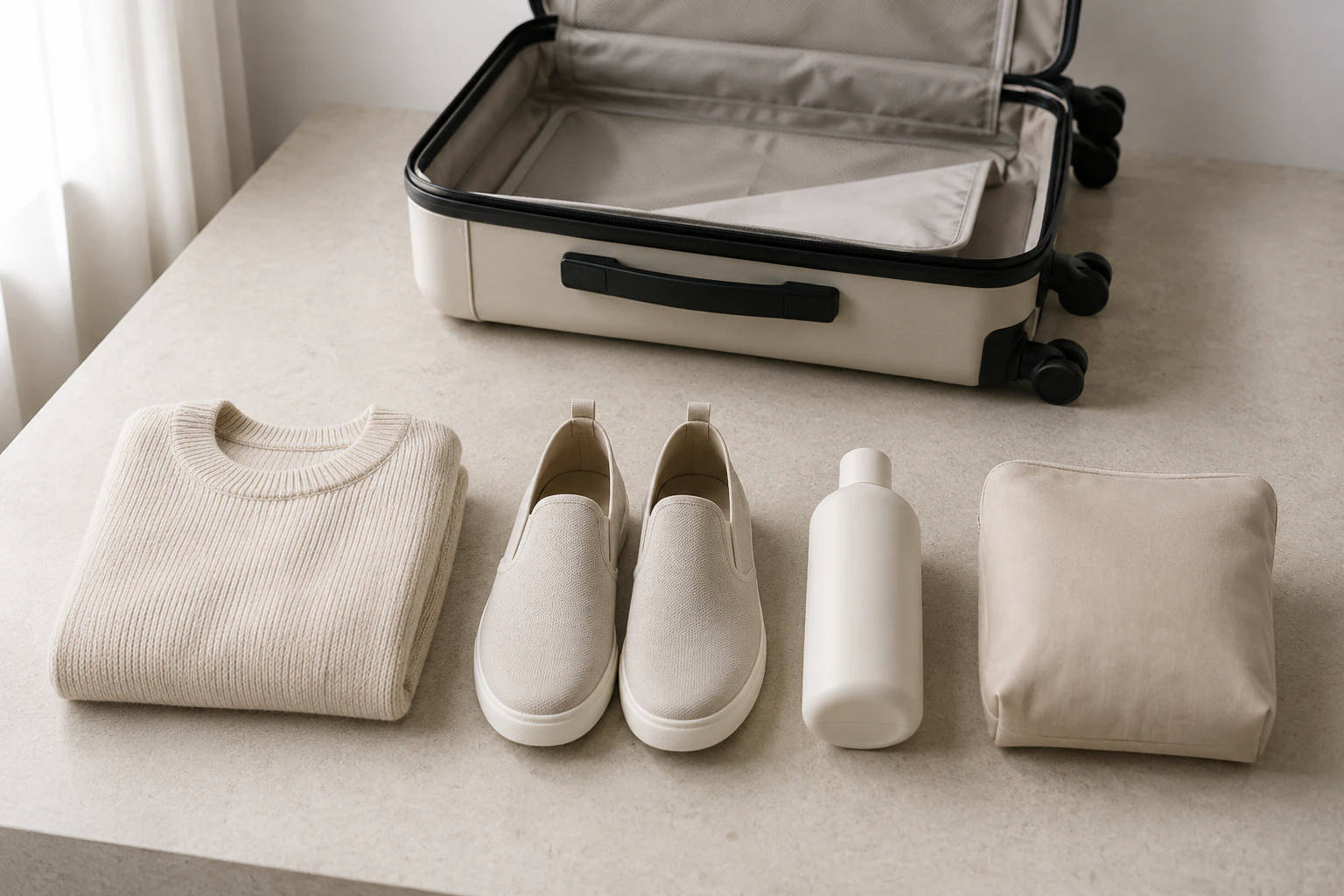
The floor of subtraction is stated explicitly. The four below do not come out in this test — because knowing the day’s conditions and the day actually going to plan are different matters. This step’s conclusion is also the whole guide’s: the floor of subtraction is not “bringing less,” but keeping the ability to readjust when the plan slips.
- One rain response — a packable waterproof layer or one umbrella. Even a known forecast is not that day’s weather.
- The proven grip pair — the main pair itself is the body of adaptability.
- One removable layer — the one kept in Step 01. The adjustable layer kept for changing temperatures you may experience.
- The four-line record — checked on / what changed / unchecked / look at next time. The note set up in Rina’s five details.
- After packing, check that all four still remain in your travel setup. If any got swept up in the subtraction of Steps 01 to 03, put it back.
- The four-line note need not be a physical notebook. It is Rina’s judgment tool, not a suitcase item, so a phone memo is enough.
- The 4.3 km / 67-minute stop-to-stop record is background for treating bag weight as a planning variable. How the load actually affects fatigue is a FIELD item, and how that distance actually walks is the route check’s subject.
Don’t. The four are not exceptions to “bringing less” but the minimum unit of the ability to adjust. The rain response in particular stays even when the forecast is clear — this simulation does not treat the forecast as that day’s weather.
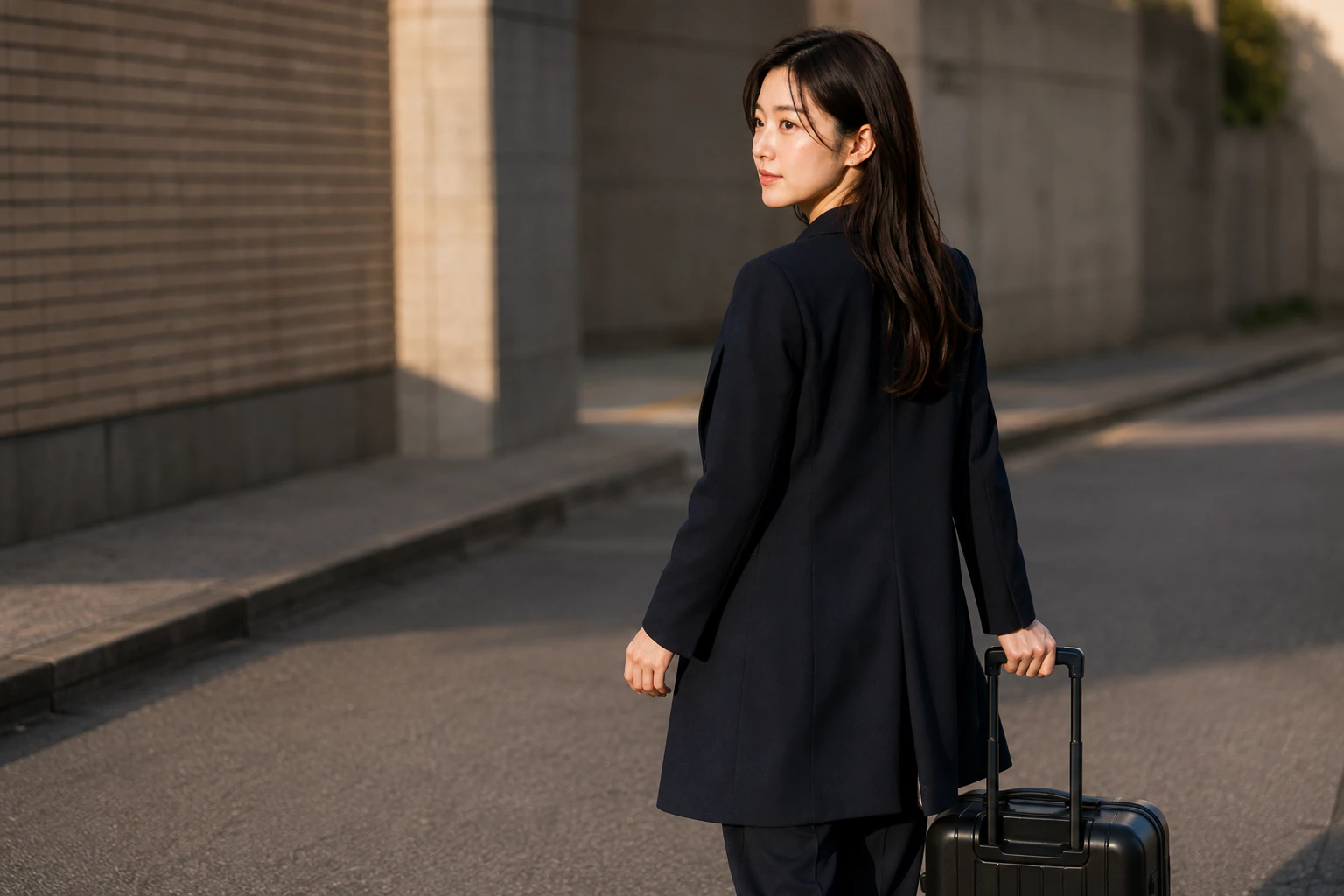
(※ This article includes staged images created with AI.)
Things to watch for
- Removing the thick pieces first — what comes out is not heavy clothing but clothing whose role overlaps. Nor does a layer stay just for being the thickest — keep the layer with a distinct role under this trip’s forecast and schedule.
- Reading one pair as the ceiling — one pair is the default. A formal commitment, prolonged rain, or sensitive feet for which one pair is not a reliable default make the second pair an allowed exception.
- Mistaking decanting for removing — it reduces; it does not remove. Anything whose absence stops the day only shrinks in volume and always stays.
- Leaving space “in case I shop” — undefined space gets filled with other things before departure. Set the size of one compartment before you leave.
- Removing the rain response too — the forecast is not that day’s weather. One packable waterproof layer or umbrella is the floor.
FAQ
Same season as the first trip — do I still have to reassign the layers?
Yes. Assignment is done not from memory but by the scene guide’s two temperature bands and rain branch, and this trip’s forecast. Even in the same season, overlap only shows once you assign.
Does this mean I should bring only one pair of shoes?
It means one pair is the default, not the ceiling. The three exceptions set by Maya’s suitcase test — a formal commitment, prolonged rain, and sensitive feet for which one pair is not a reliable default — are inherited as they are.
How much lighter does decanting make the bag?
This guide claims no figure. Actual weight lost and volume changed have never been measured and stay as FIELD items. What the guide sets is only the order: “unused volume comes out first.”
How big should the return compartment be?
No size is set. There are only two rules: “decide before departure” and “the outbound load does not invade it.” Even with no shopping plan, define it at its smallest.
Can this subtraction be used on a first trip?
Steps 03 and 04 work on a first trip as they are. Steps 01 and 02 need the premises “the day’s conditions are known” and “a proven pair exists,” so on a first trip the suitcase test’s pass standard comes first.
Before you go — thirty seconds on packing night
- Do you have the list of what you did not use on the first trip
- Layers assigned by role to the two temperature bands and rain branch, and same-role overlaps removed — one removable layer (A5) kept
- Is the main pair a broken-in pair — if one of the three exceptions (formal · prolonged rain · sensitive feet) applies, the second pair and where its volume comes from
- Full-size to decanted — anything whose absence stops the day kept, volume only reduced
- One return compartment, size set, outbound load not invading it
- The four that stay — one rain response · the proven grip pair · one removable layer · the four-line note
What has been checked
What this guide offers is the order of decisions about what to remove first, and that alone is the scope of the Planning exercise. It claims no size of actual gain — the following are all FIELD items never measured: actual suitcase weight lost, actual storage volume changed, actual walking fatigue reduced, and the on-site convenience that “packing less” creates.
For reference, the scale of the day’s movement has a source record — the Seongsu full-day route’s stop-to-stop walking total is about 4.3 km / 67 minutes (DESK CHECK · 2026-08-31). That record is background for treating bag weight as a planning variable; how the load actually affects fatigue is a FIELD item. The culture note separates the indoor-outdoor question into general principles, official climate background and repeated public-review reports; how any particular space actually feels is a FIELD item. Source tiers inherit each record’s original label and are not reclassified in this guide.
Putting it into practice
A revisit suitcase is not a smaller bag but a more accurate one. If the first trip packed for the unknown, the second keeps only what is known — and the list of what is known comes only from what has been rechecked. When you need the standard for letting things through, take Maya’s suitcase test; when you need the standard for subtraction, take this guide — two sides of the same suitcase. The evening re-edit is picked up by the evening revisit guide.