
SEOUL · GETTING AROUND
Hina sorts out three transit cards on the morning she flies home: convenience shop limits, partial refunds and the Climate Card short-term pass
T-money balances come back in cash minus a 500 won fee, and the card itself is not refunded — from 20,000 won you need to choose your shop, over 30,000 won head to Seoul Station, to keep the card take part of it out at a station in 10,000 won steps, and refund a short-term pass within its validity period
On the morning she flies home, Hina lays three transit cards out on the desk the way she sorts concert tickets. She has moved the job from the airport to the street outside her guesthouse, and at the very first shop her colleague’s note, “any convenience shop”, runs into trouble.

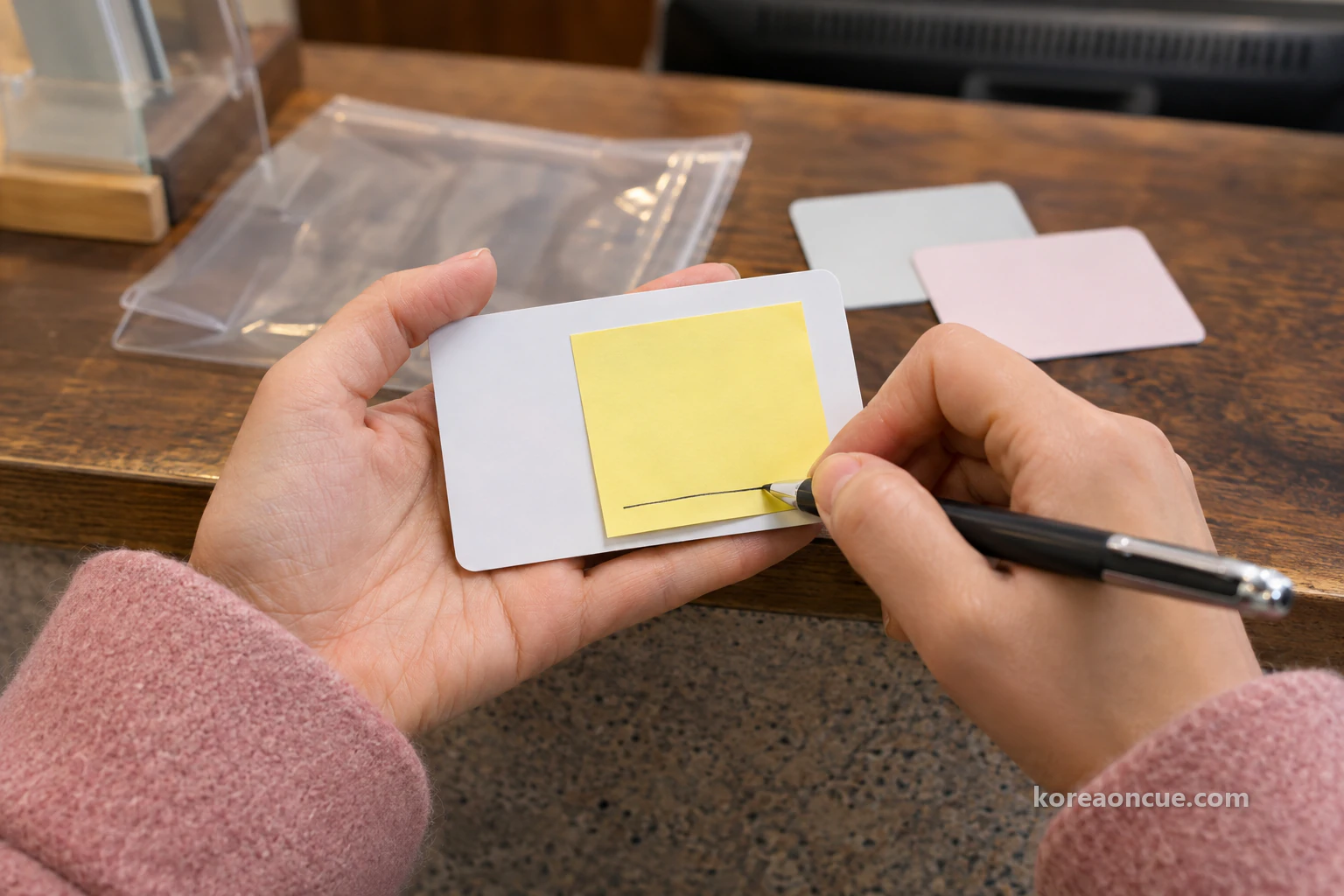
On the morning of Monday 7 December, her day to fly home, Hina lays things out in a row on the desk in her guesthouse room. There is last night’s concert ticket, the clear envelope holding last Saturday’s National Gugak Center ticket, and three transit cards. One is Hina’s own T-money card, and the other two are cards a colleague at work handed her the day before she left. A yellow sticky note is stuck to the colleague’s T-money card. “23,600 left. Swap it at any convenience shop at the airport for me.”

Hina is 21 and works in concert promotion at a marketing company in Tokyo, and she is the kind of person who sorts out her tickets the moment a show ends. Tickets go into an envelope by date, and if one went unused she writes a line in her notepad about why. The last thing to sort out on this trip is the money left on the cards. With the thick coat she brought out for the cold hanging on the back of her chair, Hina writes in her notepad: “Airport — sort out three cards.” Waiting for the plane would surely give her plenty of time for three cards.
Then, before setting off, she reads the refund guide again and finds the order is back to front. A balance can be refunded at a convenience shop, at a subway station customer service centre, at Tmoney Town near Seoul Station, or at a bank ATM. Convenience shops and stations are the places she passes first on the way from her guesthouse to the airport. Hina decides she is not going to spend her last hour before boarding hunting for somewhere to get a refund. She strikes through “Airport” in her notepad and writes “outside the guesthouse” next to it.
Hina’s morning starts with where you can get a balance back and how much, and what happens to the fee and the price of the card. After that come keeping your card and taking out only part of the balance, and the refund rules for the Climate Card short-term pass. As for what to do first on the day you fly so that you travel light to the airport, just follow the order in which Hina ticks her boxes.
The Cue — At a glance
Finish off your transit card balance outside your guesthouse, not at the airport, and then leave. Under 20,000 won works at any convenience shop, but from 20,000 won you need to pick a shop with a higher limit, and over 30,000 won it is quicker to head straight for Tmoney Town at Seoul Station. If you are coming back to Seoul, don’t empty the card: take out part of it at a station. Sort out a Climate Card short-term pass on an earlier day within its validity period, not on the day you leave.
- Where to go: A convenience shop near where you are staying, a subway station customer service centre, or Tmoney Town (Seoul Station Exit 10, Seoul City Tower, 110 Huam-ro, Jung-gu, Seoul).
- What to bring: The transit card you want refunded. Your passport too, if you are collecting a short-term pass refund in cash at Tmoney Town.
- Questions: T-money customer centre 1644-0088 (weekdays 09:00–18:00). For other languages, Dasan Call Center on 120, then press 9.
Where can you get a transit card balance refunded? Convenience shops, station customer service centres and Tmoney Town
The easiest place for a traveller to get a balance back is a convenience shop. Hand over the card, tell the staff how much you would like refunded, and they give you the balance in Korean won cash along with your card. You get the refund where you bought and topped up the card, so there is no office to track down. They do take off a 500 won fee, though, and the price you paid for the card itself is not included in the refund. Under the figure on the sticky note Hina writes “−500”, and corrects the amount her colleague will receive to 23,100 won.
| Where | When | Good to know |
|---|---|---|
| Convenience shop | Anywhere under 20,000 won, and up to 30,000 won if you choose the shop | Limits differ by shop, and you get cash |
| Subway station customer service centre | Also when you want to keep the card and take out only part | This is where partial refunds are done |
| Tmoney Town (Seoul Station Exit 10) | When the balance is over 30,000 won | Up to 500,000 won per person per day |
| Bank ATM | When the balance is 500,000 won or less | Sends it to your own account at that bank |
The first row Hina crosses out in this table is the ATM at the bottom. An ATM does not pay out cash: it sends the balance to an account in your own name at that bank, so for anyone without a Korean bank account the row is no use at all. Once it is crossed out, three rows are left: convenience shops, station customer service centres and Tmoney Town. The first two are places she will pass first on the way to the airport, so Hina draws a small circle beside each of them.
What you say at a convenience shop counter is short. Hand over the card, say you would like a refund and how much you want back, and that’s it. If you want it all, say all of it, and the staff hand you the balance minus the fee. In case her Korean fails her, Hina has already written a line in her notepad: “A T-money balance refund, all of it, please.” It is the same kind of preparation as writing a shopping list before joining the merchandise queue at a concert.
The 500 won fee feels bigger the smaller the balance. On a card with 3,000 won left you walk away with 2,500 won, and on one with 20,000 won left you get 19,500 won. The same 500 won is a sixth of the first balance and a fortieth of the second. Hina writes the two figures side by side and stops her pen for a moment. Just as she would when weighing up the fee on a concert ticket, she decides to look at how much is left first and then choose which cards to sort out.
Convenience shop refund limits differ by shop: from 20,000 won, choose your shop
If you assume every convenience shop is the same, on the day your balance reaches 20,000 won you will walk out empty-handed at least once. Convenience shop refund limits split into under 20,000 won, up to 20,000 won and up to 30,000 won, depending on the chain. Where the limit is under 20,000 won, even exactly 20,000 won won’t go through, and where it is up to 20,000 won, 20,000 won is fine. Which name sits in which row is in the first column of the table below, so match it against the shop signs you remember near where you are staying. The “any convenience shop” on her colleague’s note was the wrong advice for a card with 23,600 won on it.
| Shop limit | Balance 19,000 won | Balance 20,000 won | Balance 25,000 won |
|---|---|---|---|
| Under 20,000 won (GS25) | Yes | No | No |
| Up to 20,000 won (7-Eleven, independent convenience shops, some street top-up kiosks) | Yes | Yes | No |
| Up to 30,000 won (CU, emart24) | Yes | Yes | Yes |
With a balance in the 10,000s you can walk into any convenience shop, but the moment it reaches exactly 20,000 won you need a shop with a higher limit. From just over 20,000 won up to 30,000 won only the shops in the last row are left, and over 30,000 won you are past all three rows, so no convenience shop will refund it in one go. At that point, stop going from shop to shop and switch your plan to Tmoney Town. Look up which row your nearby convenience shop is in the night before, and your morning gets a good deal shorter.
Independent neighbourhood convenience shops and some street top-up kiosks also refund balances of up to 20,000 won. If you pass one of the little kiosks on the street that top up transit cards, it is fine to ask there with a balance in the 10,000s. Not every kiosk does it, though, so don’t go looking for one with a large balance. Hina tries to remember whether there was a kiosk like that on the street outside her guesthouse, decides a convenience shop will be quicker, and heads that way.
Hina puts on her coat and goes into the convenience shop right outside her guesthouse first. Reading from the line in her notepad, she asks for a refund, and the staff member looks at the card and shakes their head apologetically. That shop is one with a limit under 20,000 won. Hina ends up bursting out laughing at the counter. The woman who puts “limited to 4 per person” on concert posters had never thought there might be a limit on how much you can get back in one go.

Once the laughter dies down, Hina stands outside the shop and looks at the limits box in her notepad again. 23,600 won won’t go through in one go at a shop with a limit under 20,000 won, or at one with a limit of up to 20,000 won. What is left is a shop with a limit of up to 30,000 won, and if she can’t find one, there is always the trip to Tmoney Town at Seoul Station. Hina adds one more line, “If not, Seoul Station”, and walks on to the next side street. When one counter is blocked, finding another is nothing new for someone who handles tickets.

The second place she finds is a different convenience shop a block away. This time it is a shop with a limit of up to 30,000 won, and the same words work straight away. The staff member hands her 23,100 won in cash, the balance minus the 500 won fee, and gives back the now empty card with it. The price of the card is not refunded, so it is now just a piece of plastic holding 0 won. Hina puts the notes and coins into her colleague’s envelope and clips the empty card to the outside.
Balances over 30,000 or 50,000 won: Tmoney Town at Seoul Station Exit 10
With a large balance, you go to Tmoney Town instead of a convenience shop. Tmoney Town is in Seoul City Tower, by Exit 10 of Seoul Station, and the address is 110 Huam-ro, Jung-gu, Seoul. Over 50,000 won, a balance is refunded not at a convenience shop but here or at an ATM with a refund function. An ATM needs a Korean bank account, so for a traveller without one, Tmoney Town is the place left. One person can get up to 500,000 won refunded a day.
A balance between 30,000 and 50,000 won is an easy one to get confused about. It is over every convenience shop limit, yet not over 50,000 won either. For this amount it is quicker to go straight to Tmoney Town than to try several convenience shops, and since it refunds up to 500,000 won a day, it is done in one go. If you want to keep the card, you can also take out up to 50,000 won with a partial refund at a station customer service centre. Had her colleague’s card been even a little over 30,000 won, Hina’s morning would have taken a detour to Seoul Station.
The bigger the amount, the more you need to bring. For refunds of 50,000 won or more, your identity is checked with your name, date of birth and contact details. For 100,000 won or more, the balance is taken off the card that day and paid into a bank account after 18:00 the next day. Weekends and public holidays are not counted in that next day, and in this case you need to bring a copy of your bankbook and ID. So a balance over 100,000 won is money that a traveller without a Korean bank account will find hard to sort out on the day they fly.
It is better to top up only as much as you will use. T-money takes top-ups in units of 1,000 won, from 1,000 won to 90,000 won at a time, and a single card holds up to 500,000 won. Load all it can hold, and your last day’s job gets that much bigger. Thinking of her own card, Hina writes “Next time, 20,000 at a time” in the corner of her notepad. She had put 50,000 won on it in one go on Friday night only because she didn’t want to queue at a top-up machine over the concert weekend.
Keep the card and get only part of the balance back: partial refunds at station customer service centres, in 10,000 won steps
If you are coming back to Seoul, you don’t have to empty the card. A partial refund lets you get only part of the balance back and keep using the card. It is done only at Tmoney Town and at subway station customer service centres, and you ask for 10,000 to 50,000 won at a time, in 10,000 won steps. Convenience shops can’t do it, so if you want to keep the card, go to a station. Even a card that runs into a convenience shop limit can be sorted out at a station, if you only want part of it.
So a card with less than 10,000 won on it has nothing to take out, and you are left with two choices: carry it over to your next trip, or have the whole balance refunded. The other way round, if you want to take out more than 50,000 won, a full refund at Tmoney Town suits you better than a partial one. If you are coming back, first decide how much to keep for your next trip and for the fare to the airport, then round the rest down to the nearest 10,000 won. That way the card stays in your wallet and only the money that was tied up comes back to you.
| Full refund | Partial refund | |
|---|---|---|
| Where | Convenience shops, station customer service centres, Tmoney Town | Station customer service centres, Tmoney Town |
| What to ask for | The whole balance, with convenience shops and stations taking off a 500 won fee | 10,000–50,000 won, chosen in 10,000 won steps |
| The card | The balance is emptied, and the card price is not refunded | Keep using it with the balance left |
Hina’s card fits this box exactly. After riding around through the concert weekend, a little over 40,000 won is left on it. Hina decides to keep enough for her next trip and the fare to the airport, and to get just 20,000 won back. For someone who comes to Seoul about twice a month, emptying the card would feel as wasteful as handing back a fan club membership card. On the stairs down into the subway station, Hina writes “20,000 — station” in her notepad.
At the window of the station customer service centre, Hina shows the line she has written in her notepad: “A partial refund of 20,000 won, please.” Partial refunds come in 10,000 won steps, so 20,000 won is a neat fit. You can’t split it into something like 15,000 won, so when you decide how much to keep, work in units of 10,000 won. Hina takes the money and the card together and slides the card back into the front slot of her wallet. The thought of taking this card out again on her next trip to Seoul makes her steps towards the airport a little lighter.

As she leaves the customer service centre, Hina notices the unstaffed top-up machines in the concourse. These are the first machines you visit to refund a Climate Card short-term pass. Her colleague’s short-term pass is still in Hina’s bag. She takes the card out in front of a machine, but before touching it to the reader she opens the date box in her notepad. A short-term pass is a card where you check the deadline before you check how to get the money back.
Climate Card short-term pass refunds happen within the validity period: cash 3 business days after you apply
Her colleague’s second card is a Climate Card short-term pass. The colleague had used it as a 3-day pass on a business trip last month and left it unused since. A short-term pass lets you ride Seoul’s subway and Seoul city buses for a set number of days, so it is not a card that gives back whatever balance is left, like an ordinary T-money card. The refund is the amount loaded, minus the fares for the rides you actually took and a 500 won fee. And once the validity period is over, no refund is given, whether the card is normal, lost or faulty.
If you loaded a 3-day pass for 10,000 won and the rides you actually took came to 4,000 won, you get back 10,000 won minus 4,000 won and 500 won, which is 5,500 won. If the rides you actually took come to 9,500 won or more, the refund is 0 won. A short-term pass refund is useful for people who rode less than they expected. Under the sum Hina writes “Only if I rode less.”
Her colleague’s card is already past its validity period. The 3,000 won paid separately for the physical card does not come back either, so the card is now a souvenir of the colleague’s business trip to Seoul. As soon as she reads that line, Hina moves the card into the envelope next to the concert tickets. This is the same colleague who, before the Hangang Bus last month, told her “with a Climate Card you can even take the boat.” Hina writes the message she means to send her colleague in her notepad first: “This is a souvenir instead of a refund. I’ll bring it home in the concert ticket envelope.”
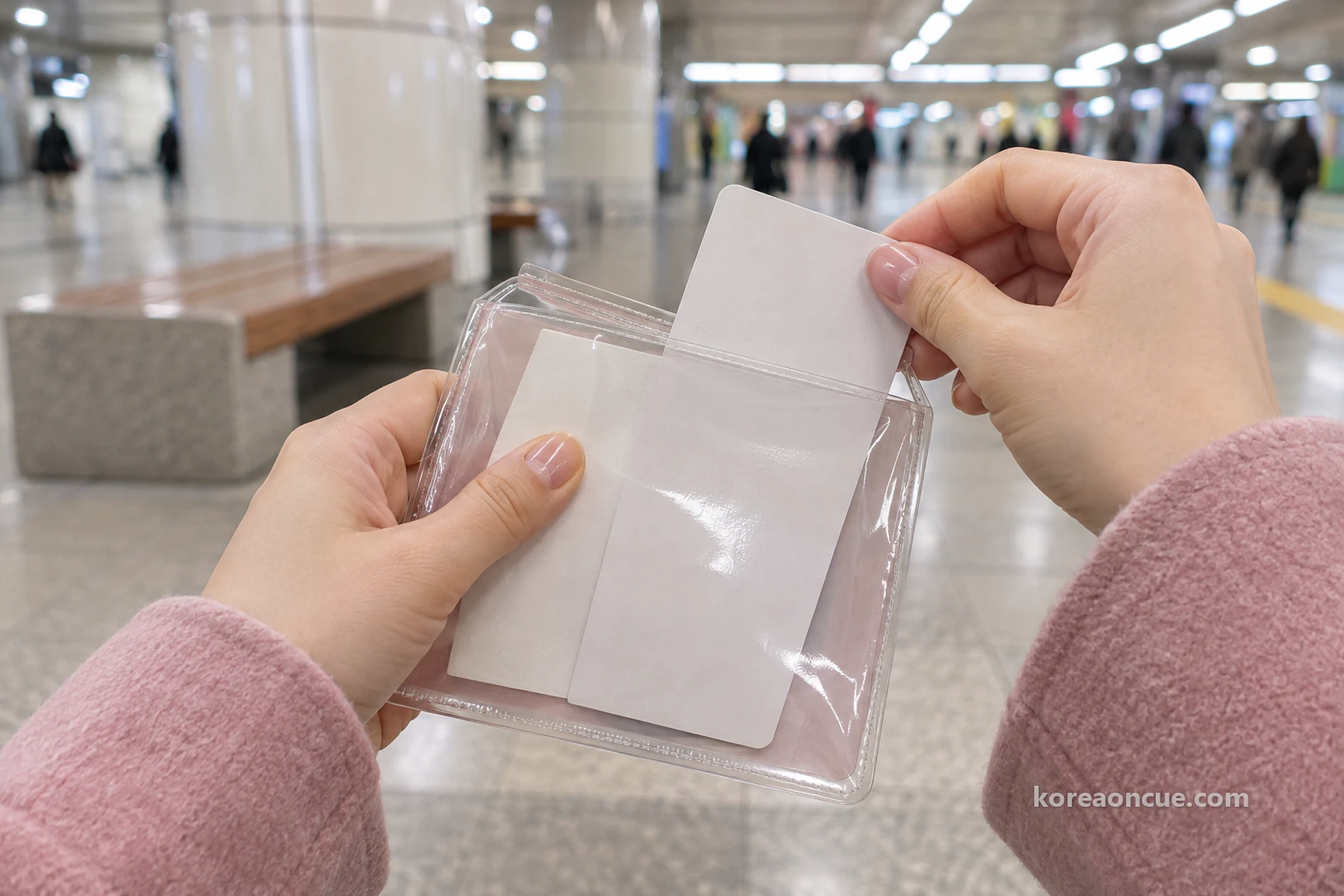
If a short-term pass is still within its validity period, there is a set order, and the first step comes on the day you buy the card. A physical short-term pass has to be registered on the T-money Card & Pay website using the QR code on the back of the card, and an unregistered card can’t be refunded. After that, you stop the card at a station, apply at Tmoney Town, then go back a few days later for the money. You can stop the card at an unstaffed top-up machine in the station during the station’s operating hours, and the second and third rows of the table below have to be done before the validity period ends.
| Step | Where | What to do |
|---|---|---|
| 1 | T-money Card & Pay website | On the day you buy the card, register it with the QR code on the back |
| 2 | Unstaffed top-up machine in a subway station | Touch the card and press “Refund (Stop Card Use)” |
| 3 | Tmoney Town | Visit within the validity period and apply for the refund — your passport may be required |
| 4 | Tmoney Town | Go back 3 business days after applying and collect the refund in cash |
The thing travellers most easily miss is the date in the last row. You collect the cash 3 business days after applying, so if you apply on Monday you have to go back on Thursday. If, like Hina, you are leaving on a Monday, you won’t be in Seoul by then. Only the latest short-term pass loaded with cash or a card issued outside Korea is refunded in cash, and if you loaded it with a Korean card, you sign up on the T-money website and get the money in a Korean bank account in your own name.
Business days skip weekends and public holidays. Apply on a Friday, and with the weekend skipped you have to go back the following Wednesday. The right time to decide that you probably won’t use a short-term pass much is the first or second day of your trip. On a weekend trip that arrives on Friday and leaves on Monday, there is no day left to go back for the cash. In the short-term pass box of her notepad, Hina writes “Decide on day one.”
When the rules get confusing, it is quicker to ask by phone than to work it out alone. The T-money customer centre is on 1644-0088 and answers on weekdays from 09:00 to 18:00. If you want to ask in another language, call Seoul’s Dasan Call Center on 120 and press 9. Hina copies both numbers onto the last page of her notepad. The next time her colleague hands her a card, she plans to ask about the validity period and registration before she takes it.
What the Climate Card short-term pass covers: the 30-day pass has ended
Having put her colleague’s card in the envelope, Hina decides to work out, right there by the machine, whether to buy a short-term pass on her next trip. The Climate Card a traveller can use now is the short-term pass. The 30-day pass ended on 1 October 2026, and the short-term pass, meant for foreign travellers and short-stay visitors, carries on with no discount. Prices are 5,000 won for 1 day, 8,000 won for 2 days, 10,000 won for 3 days, 15,000 won for 5 days and 20,000 won for 7 days, and the physical card has to be bought separately for 3,000 won.
The day you load it is the day it starts, so you can ride from 4 a.m., the first train on the start day, until the last train on the final day. Since 17 March 2026, you can buy a short-term pass with a credit or debit card issued outside Korea at the new transit card machines on Seoul Metro Lines 1–8. Depending on the card, though, payment may not go through or a separate surcharge may apply. Hina writes her Friday-night arrival into the short-term pass box of her notepad, then stops her pen when she sees that her first day would be less than half a day.
It helps to write down what you can’t ride in the same box. The Shinbundang Line, GTX, subways outside Seoul, metropolitan and airport buses and buses licensed in other regions are excluded, and Ttareungi and the Hangang Bus are not included in the short-term pass either. On the Airport Railroad you can only get off at Incheon Int’l Airport Terminal 1 and Terminal 2 stations, and you can’t board at those two stations. So if you fly in and out of Incheon, the neat plan is to reach the city by another card or ticket on the day you arrive, and to make the last day of the validity period the day you leave. Having already learnt this once at the Hangang Bus last month, Hina nods to herself as she reads the line.
This box is also why Hina didn’t choose a short-term pass for this trip. On a trip that arrives on Friday night and leaves on Monday, the first and last days are only half days, so it is awkward to work out how many days to buy, while the balance left on a T-money card simply carries over to the next trip. For someone who comes about twice a month, a T-money card that keeps its balance was the right fit, while for someone who will ride Seoul’s subway and buses solidly for several days, a short-term pass is the easy card to work out. Holding a card in each hand and weighing them up, Hina decides to show this exact box to her colleague the next time they come on a business trip.
The order for sorting out your transit cards on the day you fly home: finish outside the guesthouse, then head for the airport
On the day you fly, sorting out your cards is lightest if you finish before boarding the train to the airport. For a card you won’t use again, check the limits and get a full refund at a convenience shop outside your guesthouse, and for a card you will use again, take part of the balance out at a station customer service centre in 10,000 won steps. If you are riding to the airport on the card, don’t get a full refund: leave enough for the fare. A short-term pass is sorted out not on this day but on an earlier day within its validity period. In Hina’s notepad, these four lines are getting their ticks one by one from the top.
Sitting on a bench by the concourse wall, Hina runs the tip of her pen down the ticked lines one by one. Her colleague’s T-money card was done at the second convenience shop, her own card at the customer service centre window, and the short-term pass in front of the top-up machine. The time it took before she boarded the airport train was shorter than the wait for an encore at a concert. Had she tried to do the same at the airport, as first planned, that time would have come out of her last hour before boarding.

On the train to the airport, Hina takes a photo of this morning’s notes and sends it to Noah. It is the box with a line through “Airport” and “outside the guesthouse” newly written in. The only words she sends with it are “Today I sorted out my wallet, not a map.” Someone who draws maps with times written on them would surely see what kind of morning it had been just from the box that had moved. Once she puts her phone away, bare roadside trees rush past the window.
When Hina gets off at the airport, all that is left in her pockets is one card for her next trip and her colleague’s envelope. The time left before boarding is time she would have spent, on the original plan, looking for somewhere to get a refund. She spends it on a bench in the departures area writing out today’s figures again. Her colleague’s share is 23,100 won and one souvenir, and hers is a card that still has a balance even after taking out 20,000 won. In the envelope in her bag, last night’s concert ticket and the expired short-term pass sit side by side.

Sitting on the bench, Hina opens the first page of her notepad. Next to the “Booking closes” box she drew last Saturday, today she draws one more small box. Its name is “Balance left”. From now on, every time she comes to Seoul, she will write her card balance and how much to keep in that box. Just as she sorts out her tickets when a show ends, she decides to put a day for sorting out her cards in front of the end of each trip.

When the boarding call comes, Hina closes her notepad and puts the clear envelope on top of everything in her bag. The moment she touches this card to a reader on her next trip to Seoul, the first figure will go into the new box. She has already decided what to say when she hands the envelope to her colleague. That it turned out not to be any convenience shop after all, but at least there was a souvenir. Hina puts her bag on her shoulder, joins the end of the queue and laughs to herself again.
Common Mistakes
Walking into the first shop on the strength of one line on a note
Hina handed over a card with 23,600 won on it, and in front of a staff member shaking their head, she burst out laughing. Before going in, just check which row of the limits table the shop is in.
Leaving it for the airport
This is the box Hina struck through that morning. Once she moved it to outside the guesthouse, her whole hour before boarding was left free.
Emptying the card you are riding to the airport on
Hina didn’t empty her own card. She took out just 20,000 won and rode the airport train on that card.
Bringing out an expired short-term pass too late
This is why her colleague’s card became a souvenir in the envelope instead of a refund.
Applying for a short-term pass refund on the day you leave
There is no day left to go back for the cash. That is why Hina wrote “Decide on day one” in her notepad.
FAQ
Can I load a short-term pass in advance?
No. The day you load it is the day it starts, so load it on the first day of your trip.
What if I ride a short-term pass to a station in Gyeonggi?
If you board at a station in Seoul and get off at a station outside Seoul, you can’t use the short-term pass, and station staff at the exit station charge the fare separately.
Is there a youth fare?
Only for the 7-day pass: there is a youth 7-day pass for 13,000 won.
Recap — 30 seconds before you go
- On the morning you leave, finish off outside your guesthouse, not at the airport, then set off.
- From 20,000 won, choose your shop, over 30,000 won head to Seoul Station, and if you are keeping the card, take part out at a station.
- Register a short-term pass on the day you buy it, and if you think you will ride less, sort it out on an earlier day within its validity period.
Sources
- T-money — Refunds for normal cards (Korean)Convenience shop limits of under 20,000, up to 20,000 and up to 30,000 won · 500 won fee for full refunds, card cost not refunded · bank ATMs up to 500,000 won, to an account in your name · Tmoney Town up to 500,000 won per person a day, ID check from 50,000 won, from 100,000 won paid into an account after 18:00 the next day · balances over 50,000 won · partial refunds of 10,000–50,000 won in 10,000 won steps · station customer service centres as refund pointschecked 2026-11-10
- T-money — Foreigner GuideCash refunds in won where cards are sold and topped up · 500 won fee, card cost not included · top-ups in 1,000 won units from 1,000 to 90,000 won, up to 500,000 won on a card · partial refunds at Tmoney Town and stations · Tmoney Town at Seoul Station Exit 10, Seoul City Tower, 110 Huam-ro · Dasan Call Center 120, then 9 · customer centre 1644-0088checked 2026-11-10
- Seoul Metro — Station guide, transit card FAQ (Korean)T-money refunds at the station customer service centre (i-Center)checked 2026-11-10
- T-money — User Guide (Foreigner), Climate cardShort-term pass refund steps: “Refund (Stop Card Use)” at a station top-up machine → apply at Tmoney Town within the validity period (passport may be required) → cash 3 business days later · cash only for the latest pass loaded with cash or an overseas card; Korean card top-ups go to a Korean account in your name after signing up on the website · card cost not refunded · overseas card limits and surchargeschecked 2026-11-10
- Seoul Metropolitan Government — Climate Card short-term pass (Korean)Refund = amount loaded − fares actually used − 500 won fee · no refund after the validity period · register the physical card on the website with the QR code on the back, or it can’t be refunded · Airport Railroad: getting off at Incheon Int’l Airport Terminal 1 and 2 only · excluded lines · 1-, 2-, 3-, 5- and 7-day prices and the youth 7-day pass · physical card 3,000 won · from the first train at 04:00 · no loading in advance · getting off outside the areachecked 2026-11-10
- Seoul Metropolitan Government — Climate Card short-term pass FAQ (Korean)Short-term passes sold to overseas cards at new machines on Lines 1–8 from 17 March 2026 · stopping card use during station hours · Ttareungi and the Hangang Bus not included · no discount on short-term passeschecked 2026-11-10
- Seoul Metropolitan Government — 30-day Climate Card end-of-service FAQ (Korean)30-day pass ended on 1 October 2026 · short-term passes continuechecked 2026-11-10
A Seoul story told with our AI characters. Place details are checked against public sources; the photos are AI-made illustrative images. How we use AI
More from this area
Seoul Station: choosing a first transit card
At the new ticket machines on the Line 4 concourse of Seoul Station, you can pick up a Climate Card (3,000 won) and load a short-term pass.

Incheon Airport to Seoul Station: express or all-stop
From Incheon Airport Terminal 1 to Seoul Station, the Express takes 43 minutes and costs ₩13,000 for adults.