
SEOUL · ANGUK
Rina walked past the entrance once and redrew her notebook from the 4th floor: Museum Kimchikan, the Insadong Maru door and the English kimchi-making class
Tue–Sun 10 a.m.–6 p.m., last entry 5.30 p.m., closed on Mondays · no booking for individual visitors, adults 5,000 won · the way in is the ground-floor door of Insadong Maru with the convenience store → the lift on the left to the 4th floor · for the English class, pick a date on the museum’s calendar first
Rina had been writing down every kimchi she was served as “the red one” and nothing more, so she went to Museum Kimchikan to fill in the names. Looking for a museum door, she walked down Insadong-gil straight past the entrance, and on the 4th floor, where the lift let her out, she drew all her notebook boxes again from scratch.
How to get there
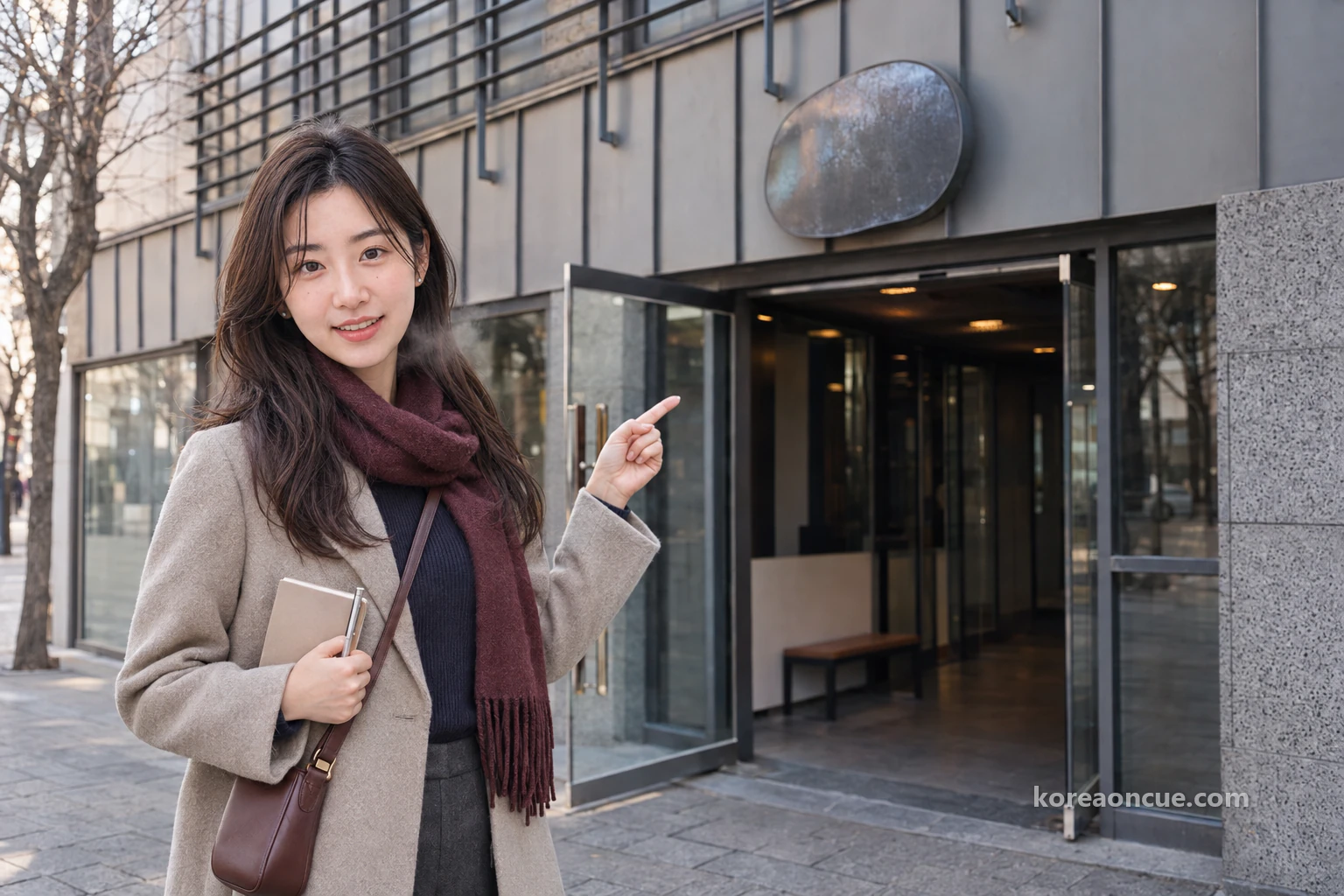
Just after 10 a.m. on Wednesday 2 December, Rina came up out of Exit 6 of Anguk Station on Line 3 and set off towards Insadong-gil. She took her notebook out of the pocket of the thick coat she had been wearing since late November and opened it, and there were the four boxes she had drawn on today’s page in advance. “Entrance”, “Exhibits”, “Hands-on” and “Price”. Rina is a twenty-three-year-old traveller from Japan who writes places down in boxes, and the newer a place is to her, the more she needs the boxes drawn before she feels settled. The place that would fill today’s boxes was Museum Kimchikan, the kimchi museum on Insadong-gil.
The reason she had picked it was on a page near the back of the notebook. Since arriving in Seoul she had been noting the kimchi that came in little dishes at every restaurant, and almost every box on that page had a label like “the red one”, “the white one” or “the watery one”. Rina, who had carefully written down every street name and every building name, was bothered that the name boxes for something she ate every day were empty. So she decided to go somewhere that kept real kimchi on display and fill those boxes in properly. Rina is the kind of person who puts a cross through Monday the moment she opens her plan, and since she had picked a Wednesday, she did not have to think about the day at all.
This piece follows that Wednesday morning, step by step through when Museum Kimchikan opens and what it costs, how to find the building’s entrance on Insadong-gil, and what is on each floor from the 4th to the 6th. At the end it also sets out how to book the kimchi-making class taught in English. To own up straight away, Rina walked right past the entrance once that day. She had set off believing that a museum would have a museum door of its own on the street.

The Cue — At a glance
Museum Kimchikan is a museum you can walk into without booking, as long as you avoid its closing days, and take your time over even on your own. On the street, look for the building name Insadong Maru and the convenience store on its ground floor rather than a museum sign. If the kimchi-making class is the point of your visit, do not fix the day first. Pick a date on the museum’s online calendar and plan around it.
- Station and exit: Anguk Station (Line 3) Exit 6 → walk down Insadong-gil, on your right / Jonggak Station (Line 1) Exit 3 → once on Insadong-gil, 200 m, on your left. About 10 minutes from either station.
- Way in: Insadong Maru main building, ground-floor door with the convenience store → lift on the left → 4th floor.
- Bring: Your own earphones for the audio guide, and ID if you qualify for free entry.
- Enquiries: 02-2088-8531, or search “뮤지엄김치간” on KakaoTalk and chat.
When is Museum Kimchikan open and how much is it? Tue–Sun 10 a.m.–6 p.m., adults 5,000 won
Museum Kimchikan opens at 10 a.m. and closes at 6 p.m. from Tuesday to Sunday, with last entry at 5.30 p.m. It is closed every Monday, on 1 January, for three days over Seollal and three days over Chuseok, and on 25 December. Individual visitors do not need to book and can simply walk in and look round freely during opening hours. These three lines were the first things Rina copied from the museum’s website the night before.
Open in Kakao Map — Anguk Station
| What | Details |
|---|---|
| Opening hours | Tue–Sun 10:00–18:00, last entry 17:30 |
| Closed | Every Monday, 1 January, 3 days each over Seollal and Chuseok, 25 December |
| Individual admission | Adults 5,000 won · students 3,000 won · preschool children 2,000 won |
| Groups of 20 or more | Adults 4,000 won · students 2,000 won · preschool children 1,000 won |
| Free | Under 36 months, 65 and over, disabled visitors and the person accompanying them, and others (bring ID) |
Christmas Day falls on a Friday this year, and the museum is closed that day. The closing days are split between one day of the week and a handful of dates, so if you plan only by the day of the week it is easy to get caught out by a date. If your end-of-year plans include that Friday, simply move this visit to another day. There is no separate price for foreign visitors, so travellers pay the same as everyone else. If you are entering free, be sure to bring ID that shows your age or eligibility.
If you are thinking of dropping in late in the afternoon while walking Insadong-gil, check the last entry time first. Entry stops at 5.30 p.m. and the doors close at 6, so going in at that point leaves you 30 minutes for three floors. Each floor has several rooms, so if you want to listen to the audio guide as well, it is more relaxed to go in well before then. That is why Rina chose the morning. See the museum in the morning, and the whole afternoon is left for walking Insadong-gil.
At first Rina’s “Price” box had just one line. She wrote “adults 5,000 won”, then, reading about the classes, drew a second line underneath. The price of the kimchi-making class already includes admission, so on a class day the cost fits on a single line, admission and all. Next to the two lines she wrote “Just looking” and “Making too”. With the lines named, all that was left was choosing which one today would be.
Even on a just-looking day there is plenty to listen to. The audio guide is free, has no time limit, and comes in Korean, English, Japanese and Chinese. You scan a QR code with your phone and listen at your own pace, so you must bring your own earphones. When Rina read that Japanese was one of the options, she fished a tangled pair of earphones out of the bottom of her bag before leaving her room that morning and unknotted them in advance. After days of reading every sign letter by letter as she walked, being able to walk round with the explanations in her own language felt like a real treat.
Finding the Museum Kimchikan entrance in Insadong: the Insadong Maru main building, the door with the convenience store
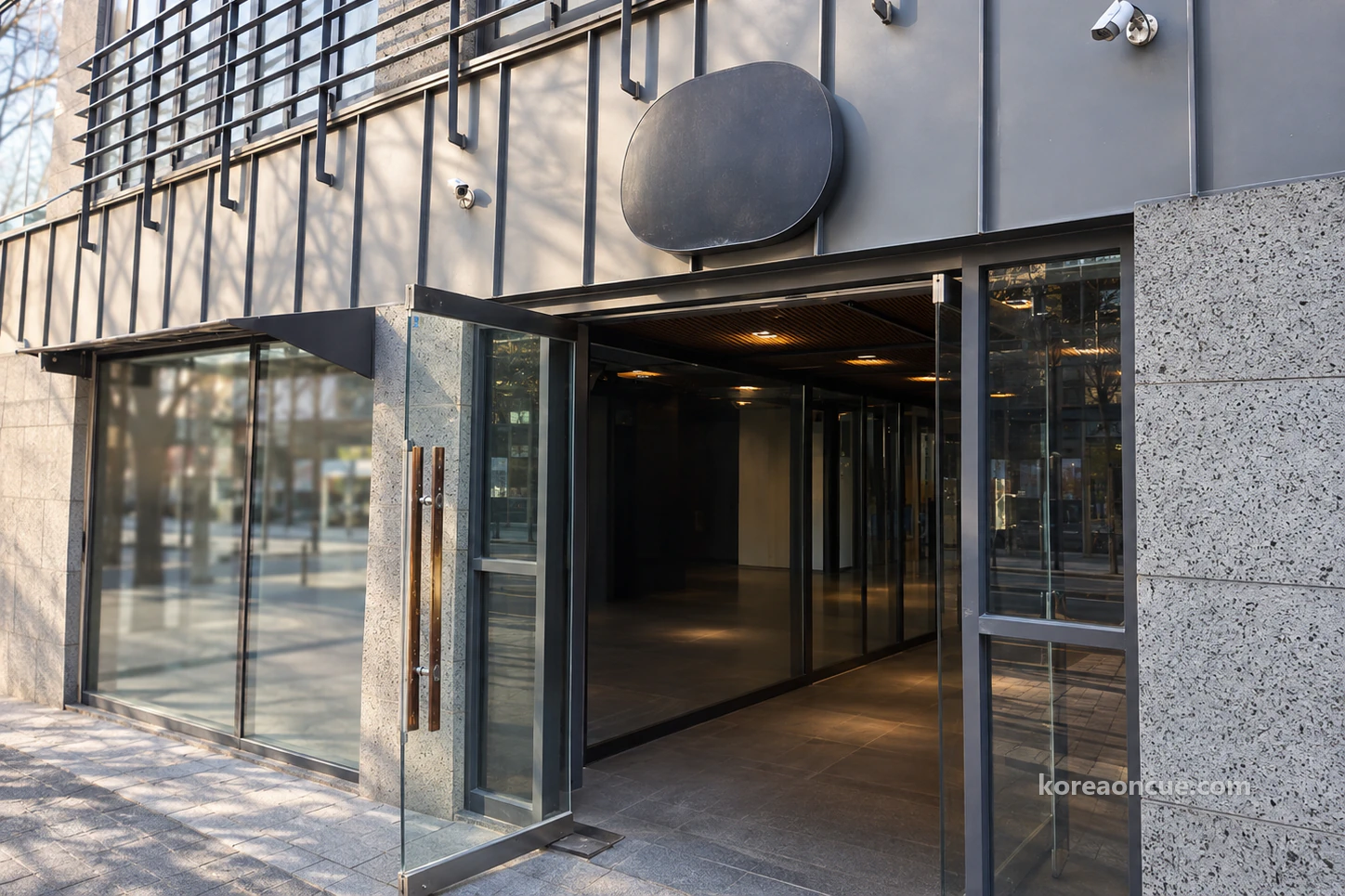
Museum Kimchikan takes up the 4th to 6th floors of the Insadong Maru main building at 35-4 Insadong-gil, Jongno-gu. There is no separate museum building on the street, so you go in through the building’s ground-floor door. Enter the Insadong Maru building, the one with the convenience store, and take the lift on the left up to the 4th floor. Had Rina read that line properly in the morning, her morning would have been a little shorter.
Turning into Insadong-gil from Exit 6 of Anguk Station, Rina walked with her eyes on the right-hand side. Her note said that coming from Anguk Station you walk down Insadong-gil and it is on the right. What she was looking for was a door with the museum’s name written large above it. She passed a string of old shopfronts and the mouths of several side alleys, but no such door appeared, and the walk she had been told was about 10 minutes from the station had somehow grown a good deal longer.

Rina stopped in the middle of the street and looked down at the “Entrance” box in her notebook. Inside it was a single small drawing she had made the night before. It showed a wooden door under a tiled roof, the museum entrance she had pictured all by herself. “So this door only ever existed in my head,” she said to herself, and before she knew it she was laughing out loud. She retraced her steps, walking slowly back up the street, and this time she looked for the building’s name instead of a museum sign.

On the way back up, the building name “인사동마루” (Insadong Maru) caught her eye. There was a convenience store on its ground floor, and when she went through the door of the building with the convenience store, there was a lift on the left. It was exactly the order the museum’s directions had given from the start. Rina drew a line across the door drawing in her “Entrance” box and wrote beside it, “Building with the convenience store → lift on the left → 4”. She left the drawing there with just a line through it, her own way of making sure she would not imagine the same door next time.
| From | Exit | Then |
|---|---|---|
| Anguk Station (Line 3) | 6 | Walk down Insadong-gil, on your right |
| Jonggak Station (Line 1) | 3 | Once on Insadong-gil, 200 m straight on, on your left |
| At the building | — | Ground-floor door with the convenience store → lift on the left → 4th floor |
Both stations are about a 10-minute walk away, so pick whichever is closer to where you are staying. Just remember that people coming from the two stations see the same building from opposite sides. Walking down Insadong-gil from the Anguk end, it is on your right, and walking up from the Jonggak end, it is on your left. If, like Rina, you have watched only one side and gone past it, the one thing to remember is that when you turn round, the same building is now on the other side. On the street it is quicker to look for the building name “인사동마루” and the convenience store on the ground floor than for a museum sign.
If you are coming from Jonggak Station, it also helps to know where the 200 m starts. Come out of Exit 3, get onto Insadong-gil, and from there walk 200 m straight on, and it is on your left. Start counting as soon as you reach the top of the exit stairs, and your count will be off by that much. Rina wrote “From Insadong-gil” next to the second row of the table. It was a note from someone who had walked past the entrance that very morning, looking only for a museum sign.
Museum Kimchikan floor by floor: from the 4th floor, where the lift lets you out, to the 6th
Museum Kimchikan starts on the 4th floor and ends on the 6th. The information desk and the museum shop are on the 4th floor, where the lift lets you out, so that is where you stop first. Each floor has a fairly clear subject of its own. The 4th floor covers how kimchi comes about and ripens, along with an old kitchen, the 5th floor many kinds of kimchi and pickled vegetables from around the world, and the 6th floor gimjang culture and a space for making kimchi yourself. The museum first opened in 1986 in Pil-dong, Jung-gu, Seoul, as the “Kimchi Museum”, and reopened under its present name in Insadong on 21 April 2015.
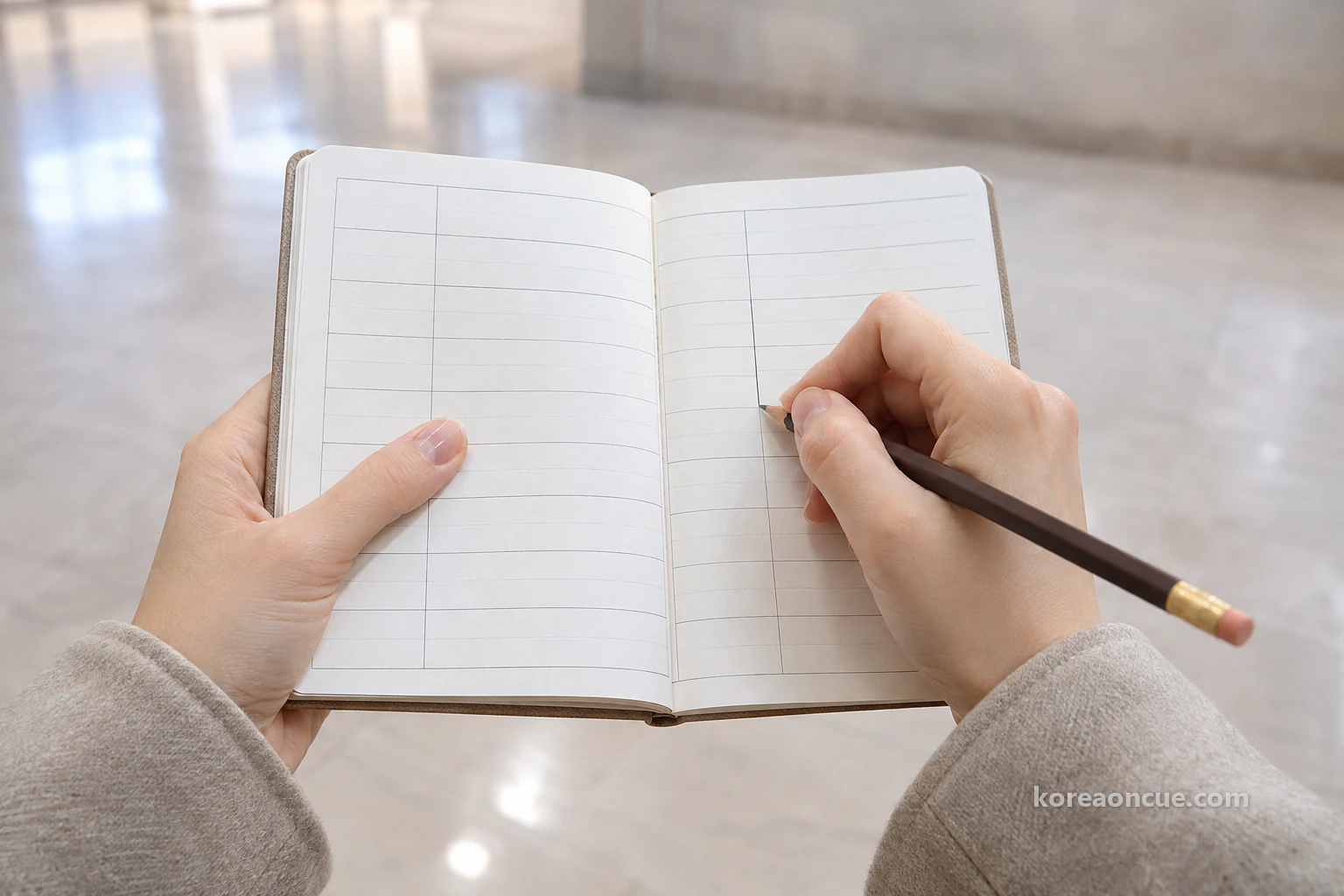
When the lift doors opened on the 4th floor, Rina stepped aside next to the information desk and opened her notebook again. Boxes split into “Exhibits” and “Hands-on” would not hold this museum, she thought. Each floor told a different story, so it made more sense to split the boxes by floor too. On a fresh page she drew three boxes from the top down, “4”, “5” and “6”, and moved the “Hands-on” she had written earlier into the box for the 6th floor, where the cooking classes are held. The “Entrance” box, which had led her astray all morning, shrank to a single line at the top.
| Floor | What is there |
|---|---|
| 4th floor | Information desk, museum shop, Kimchi Madang, the Scientist’s Room, Kimchi Sarangbang |
| 5th floor | Kimchi Road, Kimchi Contents Collection (seasonal special exhibitions), The Four Seasons of Kimchi, Kimchium |
| 6th floor | UNESCO Intangible Cultural Heritage Tribute Room, Gimjang Maru (cooking classes), Kimchi Gongbang, the Kimchi Tasting Room |
The three places Rina circled on this table were Kimchium on the 5th floor and the Scientist’s Room and Kimchi Sarangbang on the 4th. On a first visit, decide on those three first and see the rest around them, and you will spend less time going up and down between floors looking for things. Since the lift brings you to the 4th floor, the natural order is to finish the 4th and then go up to the 5th and 6th in turn. The museum passed 1.4 million visitors in total in 2025, and Rina wrote the figure small in the margin outside her boxes.
The 4th floor, Kimchi Madang, the Scientist’s Room and Kimchi Sarangbang: how kimchi comes about and ripens
The first room Rina went into on the 4th floor was Kimchi Madang, which shows the main film, “The Birth and Evolution of Kimchi”. The same room also has a gimjang play table, so watching and trying things with your hands happen side by side. Rina took off her coat, draped it over her left arm and switched on the audio guide here for the first time, and when she scanned the QR code and chose Japanese, the explanation began to flow in her own language through the earphones she had untangled that morning. After watching the film to the end, she wrote just “Birth” on the first line of the “4” box. She found it a little funny that, having come to collect names, she had written a stage in the story on the first line instead.
The Scientist’s Room, true to its name, has a fermentation science table for looking at fermentation as science. It is a room that treats kimchi as a process rather than a taste, so it is a good early stop for anyone just starting to learn about kimchi. At the table Rina turned once to the restaurant page at the back of her notebook. There was a box there labelled “the sour one”. Beside it she wrote “Not a name, maybe how ripe it is?”, question mark and all, and decided to look for the answer on the floors above.
Kimchi Sarangbang is a room set up as an old kitchen. With a buttumak (부뚜막), a chanjang (찬장) and a chanmaru (찬마루) in place, it gives a clear picture of the kind of kitchen where kimchi was made and kept before it ever reached a museum case. Rina wrote the three words, all new to her, into the “4” box one after another. “Buttumak”, “chanjang”, “chanmaru”. Once all three names were down, there was no room left for their meanings, so she drew one more small box beside them labelled “Meaning”.

Rina stayed on this floor longer than she had expected. With the film, the table and the old kitchen running on from one another, the floor showed how kimchi has been made and kept before it showed what kimchi is. To someone who had come only to collect names it might look like a detour, but Rina liked this order. She had seen the places where the names belong before learning the names themselves. She took out one earphone, slipped it into the pocket of the coat over her arm and went up to the 5th floor.
The 5th floor, Kimchium: real kimchi, not models, and pickled vegetables from around the world
On the 5th floor, the place Rina lingered longest was Kimchium. It displays Korean kimchi and pickled vegetables from around the world as the real thing, and being able to see many kinds of kimchi in real form rather than as models is the first thing to single out about this museum. You can stand at the displays and look at the kimchi you have only ever seen in side dishes at restaurants, one by one,, so if you are new to kimchi, circle this room first. The box Rina had come to fix today was here as well.
Rina opened the “the red one” box at the back of her notebook and stood in front of the displays. Kimchi she had only ever seen a dish at a time in restaurants could be looked at here one kind at a time. Before she had gone many steps, she tapped “the red one” with the tip of her pencil. It was not the name of any one kimchi but a label that had bundled several different boxes together under a single colour. Rina drew a line through “the red one”, split the space below it into several rows, and began copying names in one box at a time as she moved back and forth along the displays.

Kimchium also has pickled vegetables from around the world. For Rina, who comes from Japan, this display felt close to home. It brought back the small jar that always stood in a corner of her grandmother’s kitchen when she was a child, and she stood in front of it for a long while with her notebook lowered. Coming to learn about kimchi, visitors often find themselves looking back at their own country’s table, and travellers from abroad will each be reminded of something different here. Under the “5” box Rina drew one more small box, labelled “Kimchi and its neighbours”.
The 5th floor also has Kimchi Road, The Four Seasons of Kimchi and Kimchi Contents Collection. Kimchi Road lets you hear the flavours of kimchi as sound, and Kimchi Contents Collection holds special exhibitions that change with the seasons. The museum describes Kimchi Road as “kimchi flavours you hear as sound”, and Rina shortened it in her box to “Taste as sound”. Of all the names in her notebook that day, it was the strangest, and for that very reason the one she liked best. She left “the white one” and “the watery one” to be fixed another time.
The 6th floor, the gimjang tribute room and Gimjang Maru: the floor where kimchi is made
The 6th floor belongs to the people who make kimchi. The UNESCO Intangible Cultural Heritage Tribute Room shows gimjang culture, scenes of gimjang in the early modern period and a kimchi archive. On the same floor are Gimjang Maru, where the cooking classes are held, Kimchi Gongbang, an art workshop space, and the Kimchi Tasting Room. If the 4th floor was the story of how a single dish of kimchi comes about, the 6th floor is about the culture of making that kimchi together. At the top of the “6” box Rina wrote “The making floor”.
Walking slowly through the tribute room, Rina wrote the word “gimjang” large in the “6” box. Downstairs she had collected the names one by one, and here she had gained one more name, for the work that brings all those names together. It connected with the “Meaning” box she had drawn by the old kitchen on the 4th floor, so she drew a short line joining the two boxes. The order in which she had climbed the floors, following the story, was there on the page. Only on the 6th floor did Rina realise that working your way up from the bottom suits this museum well.

In front of Gimjang Maru, Rina remembered the “Hands-on” she had moved into this box that morning. At first she had meant to come today and, if she felt like it, join a class on the spot. But the kimchi-making class was a programme you book in advance by choosing a date on the website. Passing it by, she wrote “Not today. Calendar first.” next to “Hands-on”. Today was for looking, and making would come after she had picked a date, so she gave each its own box.
Booking the English kimchi-making class: Kimchi! Basic and All-in-one, and the calendar comes first
Museum Kimchikan has two kimchi-making classes in English, and both are booked individually under “교육·체험” on the museum’s website. On the English site, go to Programs and then Adult. Both are open to Korean and foreign applicants alike and are taught in English, and if you book Kimchi! Basic as an individual, it runs as an English class for foreign visitors. You book by choosing from the dates open on the website’s calendar, so if the class is the point of your trip, pick a date on the calendar first and fit the rest of your plans around it.
| Class | Length and group size | Adult price (admission included) | What you make in Nov–Dec |
|---|---|---|---|
| Kimchi! Basic | 60 min, 4–24 people | 40,000 won (class fee 35,000 won + admission) | Napa cabbage kimchi |
| All-in-one | 90 min, 4–12 people | 65,000 won (class fee 60,000 won + admission) | Cheese kimchi fried rice and napa cabbage kimchi |
In November and December, if you just want to make napa cabbage kimchi, choose Basic, and if you are happy to spend 25,000 won and 30 minutes more to make cheese kimchi fried rice as well, choose All-in-one. Basic is a beginners’ class that takes you through the basic steps of making kimchi in order, so it suits first-timers, and at 60 minutes it fits easily into a day. All-in-one has a smaller limit of 12 people. Both classes need at least four people booked, or that session does not run. Next to the second column of the table, Rina noted that anyone booking on their own has to leave the numbers, as well as the date, partly to luck.

It also helps to know the rules after booking. You can cancel or change the number of people only until 10.59 a.m. three days before your visit, and if you cancel after that you cannot book again for six months. If your travel plans are still shifting, it is safer to settle the date before you book. Rina opened the calendar on her phone there and then, ran her eye over the open dates, checked them against the rest of her trip and decided to choose that evening back at her room. In today’s “Hands-on” box, a time went down before any date: “3 days before, 10:59”.
If you have a question before booking, call 02-2088-8531, or search for “뮤지엄김치간” on KakaoTalk and ask by chat. If phoning a Korean number feels daunting, chat is the easier option. At the bottom of the “Hands-on” box Rina wrote only “Chat”, with a small circle beside it. She did not bother making a box to copy the phone number into.
After the class you have to take the kimchi you made home with you. You are given a container for the kimchi, a bag to carry it in and a certificate or recipe postcard, but there is no packaging for the kimchi dish you cook in All-in-one. On a class day, keep your plans for afterwards short and choose a day when you can go straight back to where you are staying. Reading this, Rina added “Straight back to the room that day” next to the “Making too” line. Picturing herself carrying a tub of kimchi around the lanes of Insadong for hours, she shook her head to herself.
Back out on Insadong-gil: the boxes Rina redrew from the 4th floor
Rina took the lift down from the 6th floor and stepped back out onto Insadong-gil through the same door she had come in by. Coming out from the inside, the door she had walked past that morning was less a museum entrance than simply the building’s ground-floor door. She turned round once in front of it, looked up at the building’s name and decided what she would tell the next person to walk this street. Do not look for a museum sign, look for the building’s name and the convenience store. That one line held the whole reason she had gone astray that morning.
Rina stepped to the side of the street and ran through today’s page again from the top. Under the door drawing with its line through it came the “4”, “5” and “6” boxes in order, and at the back “the red one” had been split into several rows. The “Meaning” and “Hands-on” boxes were still half empty, but Rina did not mind those gaps. They were reasons to come back, left behind as boxes.

Rina took a photo of today’s page and posted it to the group chat the four of them share. The message she sent with it was a single line: “I’ve filled about half my kimchi name boxes, and the entrance turned out to be the building with the convenience store.” Putting her phone back in her pocket, she turned towards Anguk Station, and this time she walked watching the left-hand side rather than the right. She wanted one more look at the side she had walked past that morning. The door stood open beside the convenience store just as it had in the morning, as if nothing had happened.
Back at her room that evening, Rina plans to do two things. One is to fill in the buttumak, chanjang and chanmaru in her “Meaning” box, and the other is to pick a class date on the calendar on her phone. When she chooses the date she will first check it is not a Monday, and next to it she will also write down the last time she can cancel. This museum was not a place to find on the street but one that starts on the 4th floor, and Rina’s boxes had been redrawn floor by floor to match.
Common Mistakes
Looking only for a museum sign
Rina walked straight past the entrance looking for the tiled-roof door in her head. What to look for on the street is the building name “인사동마루” (Insadong Maru) and the convenience store on the ground floor.
Watching only one side
Rina walked down looking only at the right-hand side and found the building only after she had turned round. For anyone walking up from the Jonggak end, the same building is on the left.
Trying to decide on the class on the day
Rina had meant to join a class on the spot if she felt like it, but the kimchi-making class is booked in advance by choosing a date on the website’s calendar.
Leaving your earphones behind
The audio guide is played on your phone through your own earphones. That is why Rina untangled the earphones at the bottom of her bag that morning.
Treating Christmas as just another Friday at the end of the year
25 December is a closing day, whatever day of the week it falls on.
FAQ
Can I go by car?
The museum has no car park of its own. The nearby Seoinsa Madang public car park (500 won per 5 minutes) is about a 3-minute walk away, and large coaches cannot get in.
What about the bus?
Towards Anguk Station: buses 102, 109, 151, 162, 171, 272, 601, 602-1 and 7025. At Jonggak Station Exit 3: buses 0015, 401, 406, 704, 5500, 7022, 7023, 9400 and 9402.
Is there a lift?
On the ground floor of the Insadong Maru building, take the lift on the left up to the 4th floor. Disabled visitors and the person accompanying them get in free, so bring ID that shows eligibility.
Recap — 30 seconds before you go
- Avoid the closing days and you can walk in without booking, and going in the morning rather than late afternoon gives you time for all three floors.
- On the street, look for the building name Insadong Maru and the convenience store on its ground floor, not a museum sign.
- If the kimchi-making class is the point of your visit, pick a date on the museum’s calendar first.
Sources
- Museum Kimchikan — Visitor guide (Korean)Tuesday to Sunday 10:00–18:00, last entry 17:30 · closed every Monday, 1 January, 3 days each over Seollal and Chuseok, and 25 December · individual visitors walk in with no booking during opening hours · adults 5,000 won, students 3,000 won, preschool children 2,000 won · group rates for 20 or more · free entry groups, ID required · free audio guide, no time limit, in Korean, English, Japanese and Chinese, bring your own earphones · main number 02-2088-8531, chat on KakaoTalkchecked 2026-11-11
- Museum Kimchikan — Directions (Korean)4th–6th floors, Insadong Maru main building, 35-4 Insadong-gil, Jongno-gu · Jonggak Station (Line 1) Exit 3, 200 m straight on along Insadong-gil, on the left · Anguk Station (Line 3) Exit 6, walk down Insadong-gil, on the right · about 10 minutes from the station · enter the Insadong Maru building with the convenience store and take the lift on the left to the 4th floor · buses towards Anguk Station and at Jonggak Station Exit 3 · no car park of its own, Seoinsa Madang public car park (500 won per 5 minutes) about 3 minutes’ walk, no large coacheschecked 2026-11-11
- Museum Kimchikan — Visitor Information4th–6th floors of Insadong Maru, 35-4 · about a 10-minute walk from Jonggak and Anguk stations · Jonggak Station Exit 3, 200 m along Insadong Street, on the left · lift on the left to the 4th floor · Seoinsa Madang public car parkchecked 2026-11-11
- Museum Kimchikan — Visit InfoOpening hours, last admission and closing days · free to view without booking during opening hours · adult, student and preschool prices · free audio guide by QR code, personal earphones requiredchecked 2026-11-11
- Museum Kimchikan — Exhibition spaces (Korean)4th floor: information desk, museum shop, Kimchi Madang, the Scientist’s Room, Kimchi Sarangbang (buttumak, chanjang, chanmaru) · 5th floor: Kimchi Road, Kimchi Contents Collection, The Four Seasons of Kimchi, Kimchium (real Korean kimchi and pickled vegetables from around the world) · 6th floor: UNESCO Intangible Cultural Heritage Tribute Room, Gimjang Maru (cooking classes), Kimchi Gongbang, the Kimchi Tasting Roomchecked 2026-11-11
- Museum Kimchikan — About the museum (Korean)Opened in 1986 in Pil-dong, Jung-gu, Seoul, as the “Kimchi Museum” · reopened as Museum Kimchikan in Insadong on 21 April 2015 · more than 1.4 million visitors in total by 2025checked 2026-11-11
- Museum Kimchikan — Programmes and booking (Korean)Individuals book under “교육·체험” (English site: Programs → Adult) · Kimchi! Basic 60 minutes, 4–24 people, adults 40,000 won (35,000-won class fee + admission) · All-in-one 90 minutes, 4–12 people, adults 65,000 won (60,000-won class fee + admission) · open to Korean and foreign visitors, taught in English · cancelled if fewer than the minimum · napa cabbage kimchi in November and December, plus cheese kimchi fried rice in All-in-one · cancel or change numbers until 10.59 a.m. three days before, no booking for six months after a late cancellation · take your kimchi home; container, carrier bag and certificate or recipe postcard providedchecked 2026-11-11
- Seoul official tourism site (Korean) — Museum KimchikanMany kinds of kimchi shown as the real thing, not modelschecked 2026-11-11
A Seoul story told with our AI characters. Place details are checked against public sources; the photos are AI-made illustrative images. How we use AI

