
SEOUL · SANGAM
Mali’s sixth work trip to Seoul: the background colour for a year-end shoot, found at Haneul Park at sunset
Haneul Park in World Cup Park — from World Cup Stadium Station Exit 1 on Line 6, up by the Maengkkongi electric shuttle (November 09:00–19:00, last ride up 18:30) or the Haneul Stairs, to the silver grass and views across Seoul on all sides, and back down before the park closes at 21:00
The homework: find a background colour that holds sunset light and dry-grass colour together, for a year-end shoot. Mali decides to climb Haneul Park, a hill where grassland grew on top of a mountain of rubbish. First, she writes its closing time in her notebook.

How to get there
Mali’s sixth work trip to Seoul falls in the third week of November. She is twenty-three and works for a beauty magazine in Bangkok, and these days she comes to Seoul about twice a month. This time her homework is the background colour that will sit behind the model in a year-end shoot. Her editor wants a colour with sunset sky and dry grass together in one scene. At the top of the “For work” column in her trip notebook, Mali writes “Background — sunset, wide grassland”.

Wednesday’s meeting ends on time, at about half past three, and she has no plans for the evening. Mali thinks back to last week, when she walked Namsan with Rina. Most of the colour cards she collected that day were the colours of a forest in autumn leaf. For today’s homework she needs one more place, somewhere with a wide-open sky. As she spreads the map on her phone, her finger stops on a hill rising near the Han River. Its name even has the sky in it: “Haneul Park”, the sky park.
Today’s destination is Haneul Park, inside World Cup Park in Mapo-gu, Seoul. It is a wide grassland park on the spot in World Cup Park closest to the sky. From Exit 1 of World Cup Stadium Station on Line 6, she goes to the Nanjicheon Park car park and takes the Maengkkongi electric shuttle to the top of the hill. At the top she sees the silver grass and Seoul in all four directions, then comes down before the park closes. This piece follows Mali step by step through a visit timed for sunset.
What draws Mali in is one sentence in the park guide. Haneul Park is a grassland park built on top of Nanjido Landfill No. 2. A landfill is a place where rubbish was buried in the ground. Grassland here means land where grass grows over a wide area. As soon as she reads about grass growing on a mountain of rubbish, Mali thinks of colour. A place where colour first appeared on empty ground seems the perfect place to look for a background colour.
The Cue
Haneul Park is a grassland park inside World Cup Park in Mapo-gu, Seoul, built on top of Nanjido Landfill No. 2. In November it opens at 06:00 and closes at 21:00, and you cannot enter at night, to protect wildlife. The easiest way up is the Maengkkongi electric shuttle (paid), from the Nanjicheon Park car park near Exit 1 of World Cup Stadium Station on Line 6. In October and November the shuttle runs 09:00–19:00. The last ride up leaves 30 minutes before service ends, at 18:30. If you are going for the sunset, decide on your last ride up and your time to come down first.
- Station and exit: Line 6 World Cup Stadium Station Exit 1.
- Shuttle stop: Nanjicheon Park car park (1538-24 Sangam-dong, Mapo-gu). Route 1 runs between Nanjicheon Park and the top of Haneul Park.
- Park hours (November): 06:00–21:00. No entry at night.
- Shuttle hours (October–November): 09:00–19:00. Last ride up 30 minutes before the end, at 18:30.
- Shuttle fares (Route 1): General 2,000 won one way · 3,000 won return. Children (4–12), people aged 65 and over, and disabled visitors 1,500 won one way · 2,200 won return. Free for children aged 48 months and under.
- Walking up: There are two Haneul Stairs, on the east side and the west side.
- Don’t skip: the silver grass and grassland split into an X · views on all sides, with Bukhansan, Namsan, the Han River and Haengjusanseong · Haneul Observatory and the Metasequoia Path.
- Rules: Don’t bring food (to protect wildlife). Take your rubbish home, and leave pets at home if you can.
- Shuttle enquiries: Maengkkongi electric shuttle office, 010-6702-5460.
How late can you stay for the sunset: in November the park closes at 21:00
In November, Haneul Park opens at 6 a.m. and closes at 9 p.m. Once it closes, you cannot go into the park at night. So before looking at any photos of the park, Mali opens the timetable. Rina taught her “checking the finish”, which was originally about looking at a garment’s seams and button placements first. Today Mali tweaks the idea and uses it to check when the park closes.
Open in Kakao Map — World Cup Stadium Station
There is a clear reason the park closes at night. World Cup Park turned a rubbish island back into an ecological park, so at night it keeps people out to protect wildlife. It is a firm rule, stated separately: no entry outside opening hours. The only time it opens at night is during the autumn silver grass festival, and this year’s festival already ended in October. So if you visit in November, treat 21:00 as your final time.
Opening hours change a little with the seasons. From January to March, the park opens 06:00–21:00. From April to September, it opens 06:00–22:00, closing an hour later. From October to December, it is 06:00–21:00 again, so just remember that it stays open an hour longer only in summer. Near the bottom of her notebook page, Mali writes her first line: “21:00 — gate”.
But for anyone going at sunset, another time matters more. It is the timetable of the Maengkkongi electric shuttle, which carries people from the bottom of the hill to the top. In autumn, in October and November, the shuttle runs from 09:00 in the morning to 19:00 in the evening. The last ride up is set at 30 minutes before service ends. So in November, the last shuttle to the top leaves at 18:30.
Mali writes two more lines in her notebook. “18:30 — last ride up” and “19:00 — shuttle ends”. Sunset time changes a little every day, so she looks it up in the weather app on her phone and writes it beside them. She also counts on her fingers how long she can stay at the top between sunset and 19:00. With a few numbers side by side, her afternoon plan falls neatly into place.
Which exit: Line 6 World Cup Stadium Station Exit 1
For Haneul Park, take Exit 1 of World Cup Stadium Station on Line 6. The World Cup Park leaflet also lists only this exit under subway directions. Mali takes the subway from her meeting and reaches the station at about four o’clock. As the station name suggests, the World Cup Stadium is nearby. Before leaving through the ticket gates, Mali marks her next stop on the map on her phone.
That stop is not Haneul Park but the “Nanjicheon Park car park”. The car park is where you catch the Maengkkongi electric shuttle. Its address is 1538-24 Sangam-dong, Mapo-gu. If you put just Haneul Park into the map, it points to the top of the hill, so if you plan to take the shuttle, mark the car park by name to avoid confusion. Only after placing two pins side by side on the map does Mali head for the exit.
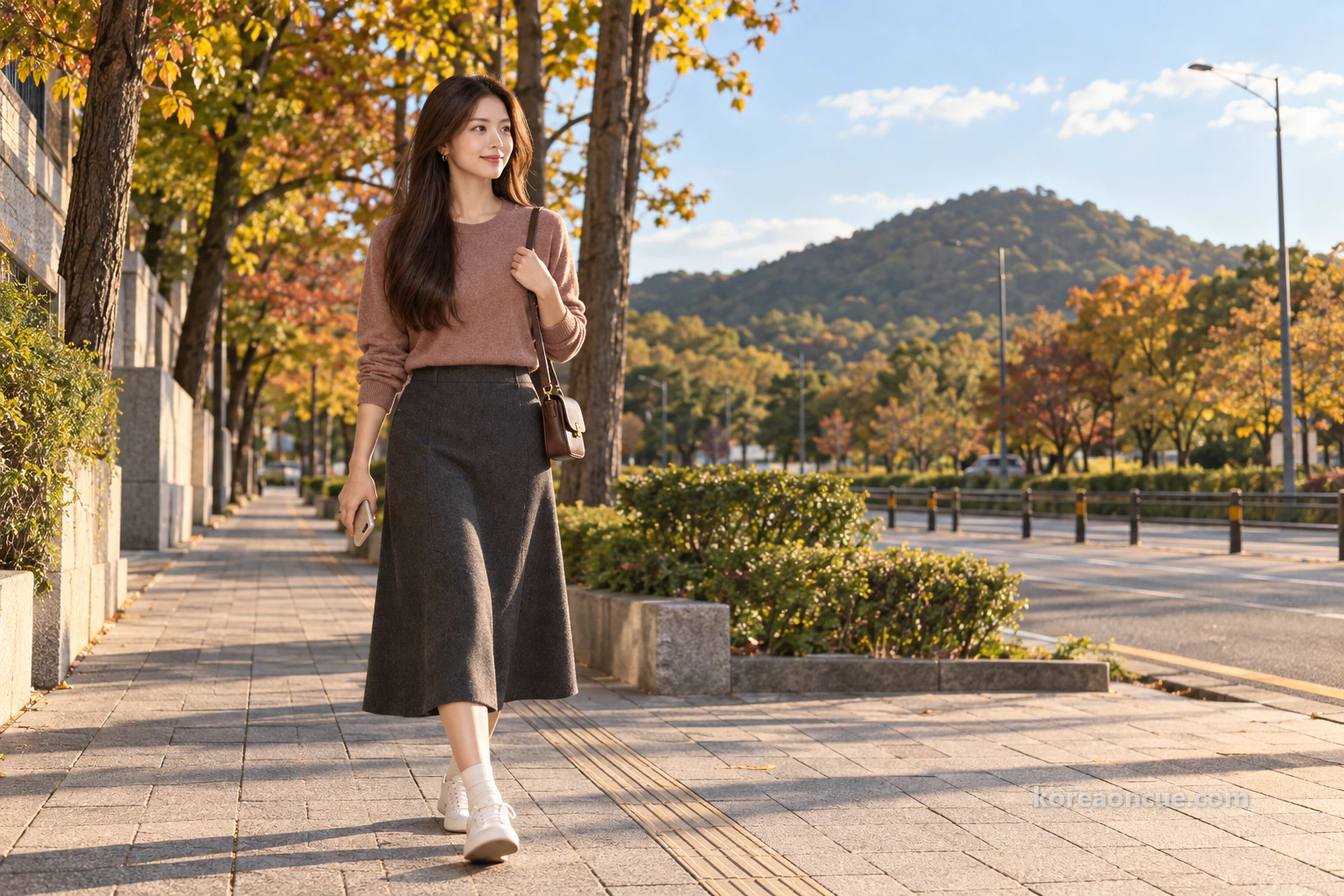
World Cup Park asks visitors to come by public transport. Its general information even has a separate line: “Please use public transport”. Coming by subway and walking to the car park, as Mali does, is the simplest way. As she gets closer to the car park, there are more trees along the road and the sky slowly opens up. Mali holds a card up to the sky as she walks, but with the sun still high, the light has a lot of white in it.
Shuttle or Haneul Stairs: times, fares and how to choose
If you are timing your visit for sunset, the shuttle saves time. If you have time to spare and trust your legs, you can walk up the Haneul Stairs. “Maengkkongi” is the name of a small, round frog that lives in Korea. The Maengkkongi electric shuttle is a paid electric vehicle named after it, and Route 1 runs between Nanjicheon Park and the top of Haneul Park. Mali is already smiling at the idea of a vehicle named after a little frog climbing a hill.
Fares depend on whether you go one way or return. The general fare is 2,000 won one way and 3,000 won return. Children aged 4 to 12 pay 1,500 won one way and 2,200 won return. People aged 65 and over and disabled visitors pay the same as children, and children aged 48 months and under ride free. Groups of more than 30 pay 800 won one way and 1,500 won return.
The shuttles run frequently, or every 10–20 minutes. A round trip on Route 1 covers 3.8 km. Mali hesitates for a moment between one way and return, then chooses return. Taking the shuttle down feels easier than walking down dark stairs alone after sunset. Changing your mind is fine, too. If you buy a return ticket and do not take the shuttle down, you can get the difference back on the same day.
There is also a way up on foot, without the shuttle. The Haneul Stairs are on two sides of the hill, east and west. On the leaflet map, the “East Haneul Stairs” and “West Haneul Stairs” each have their own number. If you plan to walk down the stairs, leave plenty of time to be completely out of the park before 21:00. Mali decides to try the stairs next time she comes in daylight, and writes both names in the corner of her notebook.

The shuttle that pulls into the stop is a red vehicle with open sides. As soon as she sits down, Mali holds a card against the red bodywork and names it “Maengkkongi red”. It is not a colour for the shoot, but she rather likes it as the day’s first card. Willows pass by along the slope, and with each bend the view below opens a little wider. Instead of taking out her phone, Mali follows the changing height with her eyes.
What to see first at the top: silver grass and grassland split into an X
When you get off at the top, the first thing you see is the wide grassland. Haneul Park’s grassland covers 109,567 m². Mali gets off the shuttle, walks a few steps towards the grass and stops where she is. In front and on both sides there is grass bent by the wind, and above it there is nothing but sky. Here, she thinks, nothing but sky and grass will get in the way when she chooses a background colour.
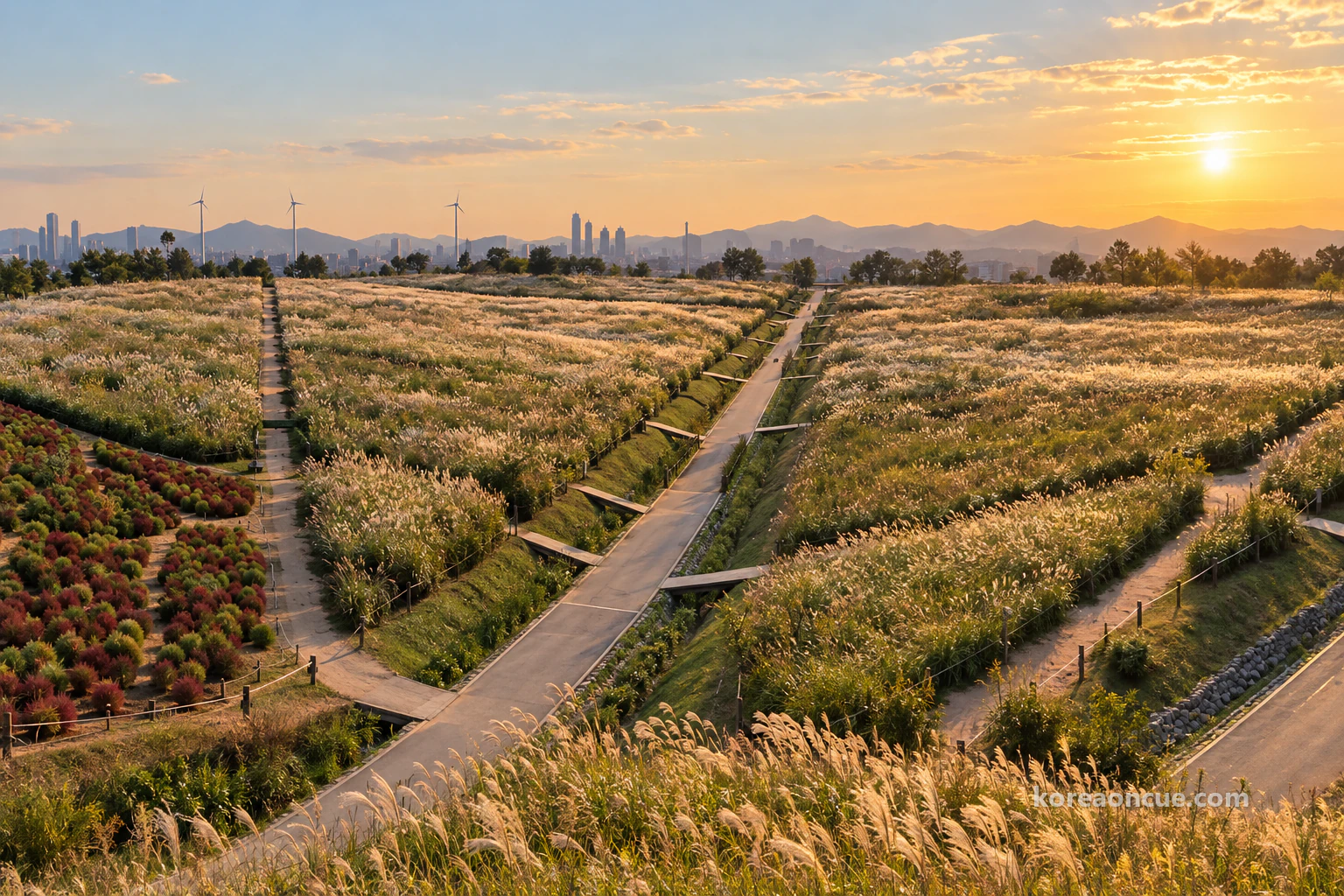
This grassland has a pattern you can see from above. Ridges built to drain rainwater divide it into an X. Of the four sections this creates, the north and south are planted with tall grasses, and the east and west with short grasses. So as you walk along the path, at some point the height of the grass suddenly changes. Mali stands on the boundary, looking from one side to the other, and thinks there are two backgrounds on the same hill.
In the north of the tall grassland, silver grass and cogon grass are planted. The idea is to feel nature among silver grass swaying in the wind. The short grassland mixes native species such as thistles, violets and sseumbagwi with naturalised species such as white clover. Native species are plants that grew in Korea all along, and naturalised species came from other countries and settled here. Reading the names one by one, Mali feels the grassland is like a palette, chosen and mixed on purpose.
In spring, white cogon flowers sway in the wind here, and in autumn the silver plumes of the silver grass are a spectacular sight. Beyond them, Seoul views such as Bukhansan, Namsan and the Han River come into sight at a glance. In front of the tall grassland, Mali holds up three cards in turn. She names the card between silver and grey “silver-grass grey”. The slightly yellower card becomes “wheat-gold cogon”.
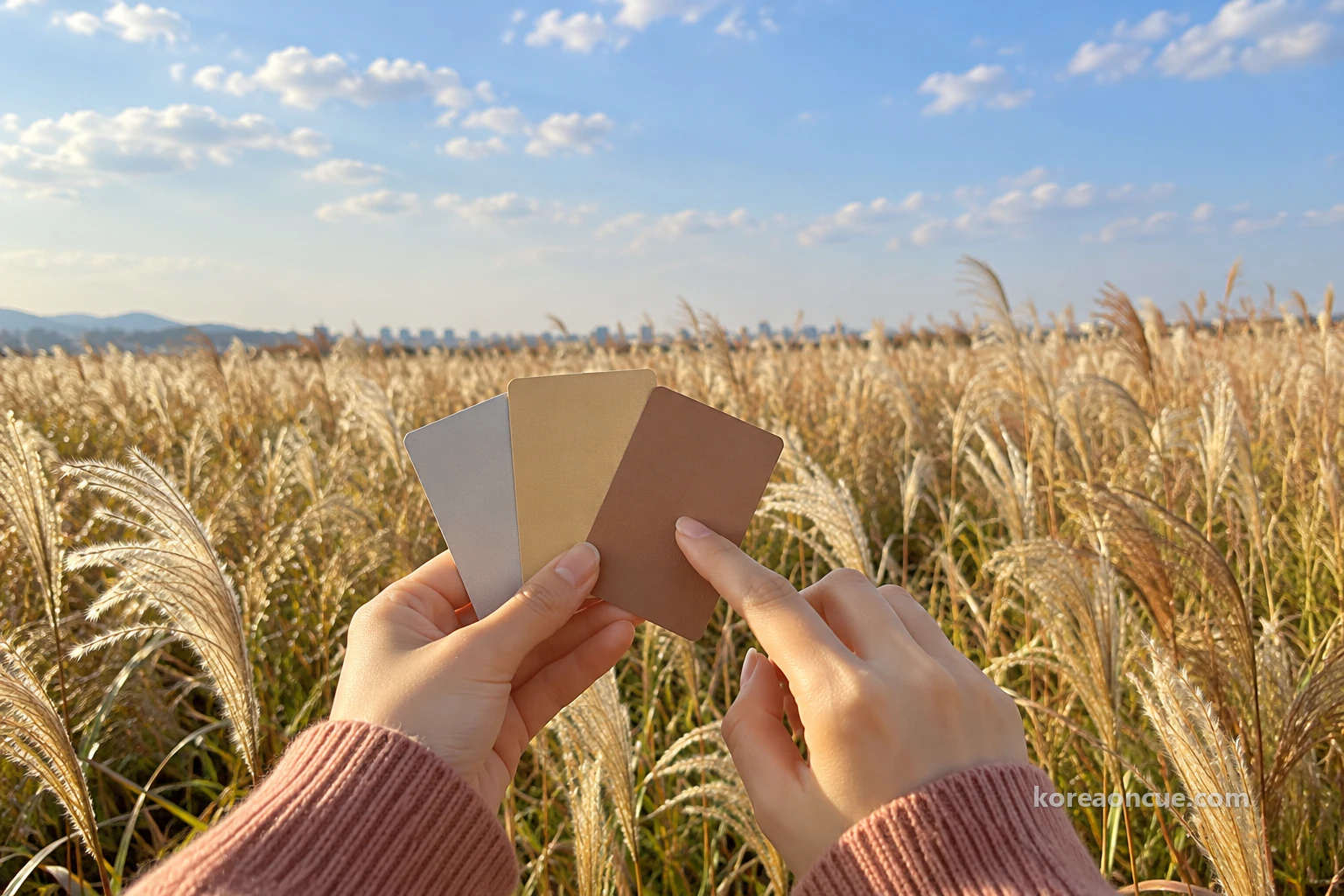
At the outer edge of the grassland, the mood changes a little. Around the outside of the park, the planting layer is raised 1–1.5 m higher than the grassland. Many tall trees such as oaks grow there, so you can rest in the shade. Mali compares the light in the middle of the grassland with the light in the shade at the edge, using the same card. In the shade the card looks a tone darker, so she decides to choose her background colour in the middle of the grassland.
What you can see from the top: Bukhansan to the north, Namsan to the east, the Han River to the south and Haengjusanseong to the west
From the top of Haneul Park, Seoul spreads out widely in all four directions. To the north you see Bukhansan, and to the east Namsan and the 63 Building. To the south you see the Han River, and to the west Haengjusanseong. Each direction looks completely different, so time flies even if you just walk slowly round the grassland path. On a first visit, don’t look in only one direction — turn and take in all four first.
To make the most of these open views, the park built lookouts on the slopes of the hill. Haneul Park has 20 lookouts in all. There are also facilities where people can rest and stay a while. Walking along the grassland path, Mali stops briefly at each lookout and turns to face a new direction. Even at the same moment, the sky is a slightly different colour in each direction, so the cards in her hand keep changing.
The place where Mali stands longest faces east. Far away in that direction, Namsan looks small. The mountain she walked with Rina for half a day last week looks the size of her palm from here. Mali holds a card against the sky above Namsan and names it “Namsan-side blue-grey”. The colour she chose on Namsan that day and the colour of Namsan seen from afar today are quite different, and she smiles quietly to herself.
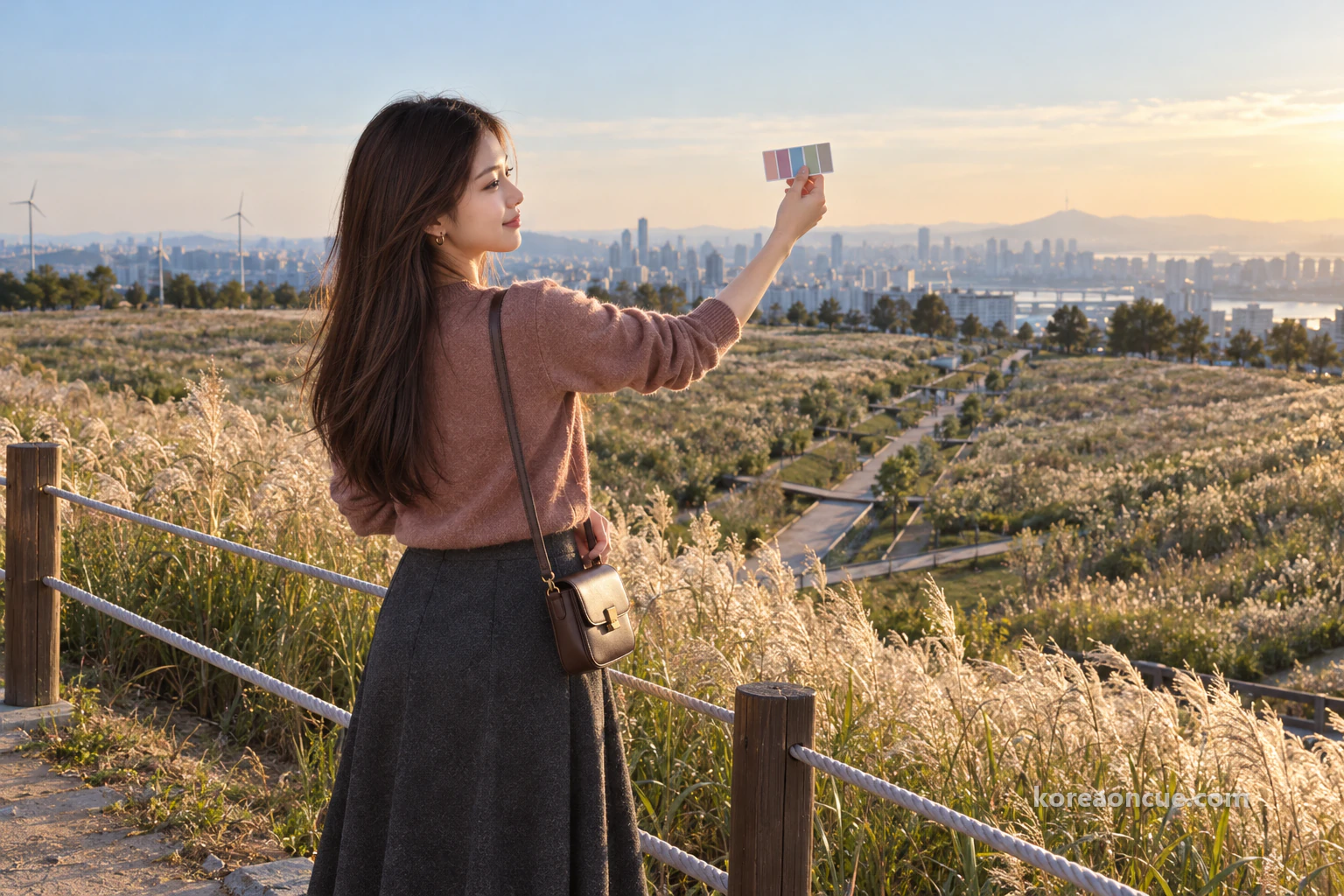
Turn south, and the Han River spreads wide below the hill. The west is the direction of Haengjusanseong. Mali has already chosen the west, where the sun goes down, as her last spot of the day. There is still a little time before the sunset time she saw in the weather app. Meanwhile, standing beside the grassland path, Mali decides to read about the ground under her feet first.
What lies underfoot: how the Nanjido landfill became Haneul Park
Haneul Park, where you are walking now, was built on land where rubbish was buried. The site of today’s World Cup Park was once an island by the Han River called Nanjido. The name means an island full of orchids and jicho, a flowering plant. It was a place rich in life, where all kinds of flowers bloomed and countless migratory birds came. Mali finds it fun that one island name holds two flowers, and copies the name into her notebook.
From 1978, for 15 years, the island was used as Seoul’s landfill. Rubbish thrown away by ten million Seoul residents was buried here. The amount would have filled 13 million 8.5-tonne trucks. The flower island turned into a huge mountain of rubbish, also called “Samdado” because of all the flies, dust and smell. “Samda” means “three things in abundance”, and those three things were flies, dust and smell.
Landfilling ended in March 1993. From 1996 to 2002, works were carried out to stabilise the ground. The works fell into four main parts. They treated the dirty water and the gas underground, covered the top with soil and firmed up the slopes. Then, on 1 May 2002, World Cup Park opened on this former mountain of rubbish.
The soil on top of the rubbish was laid in several layers, not just one. First, 50 cm of soil went over the rubbish. On top of that came a waterproof membrane to stop water seeping through, and then more than 1 m of soil so that plants could grow. Reading this order, Mali thinks of laying a base in several layers when she does make-up. The grass under her feet is colour placed on top of a base built up in layers.
The gas from the buried rubbish is not wasted either. On the tops and slopes of Haneul Park and Noeul Park, there are 106 pipes, 120 m apart, that draw out the gas. The gas fuels boilers to produce heating. That heat goes to nearby apartments and buildings such as the World Cup Stadium. Mali remembers the stadium she passed at the station. It amazes her that the ground under her feet is linked to that building.

Landfill No. 2, where Haneul Park now stands, covers 190,000 m². On the upstream side of the Han River, this land had the roughest soil on all of Nanjido. Rather than land shaped by nature over time, it is man-made land created by the works to stabilise the landfill. That is why it can show how nature begins on rough ground. Mali writes a short line in her notebook: “Empty ground → first colour”.
The park also brought wildlife back to this soil-covered land. Since 2000, more than 30,000 butterflies, such as yellow butterflies and swallowtails, have been released, mainly around Haneul Park. The park closes at night to protect this returning wildlife. The 21:00 Mali wrote in her notebook earlier now looks a little different to her. Closing time is also the time this hill rests.
More to see at the top: Haneul Observatory, Bowl Holding the Sky and the Metasequoia Path
Besides the grassland, the Haneul Park map names four main sights. They are the silver grass fields, Haneul Observatory, the Mountain-Sky Gate and the Metasequoia Path. The leaflet adds “Bowl Holding the Sky” to these. If you have time before sunset, don’t just look at the grassland — follow these names. Mali copies the five names into her notebook and decides the order she will see them in before sunset.
The leaflet map also shows smaller spots, each with its own number. There are wind turbines, the silver-grass swing and heart stairs, a wish rock and a naturalised plant garden, and at the top there is a visitor centre. Haneul Park has five wind turbines in all. Mali holds a card up to the white blades in the distance and names it “turbine-blade white”. It is too bright for the shoot’s background, but she keeps it aside as a colour that will contrast with the sunset.
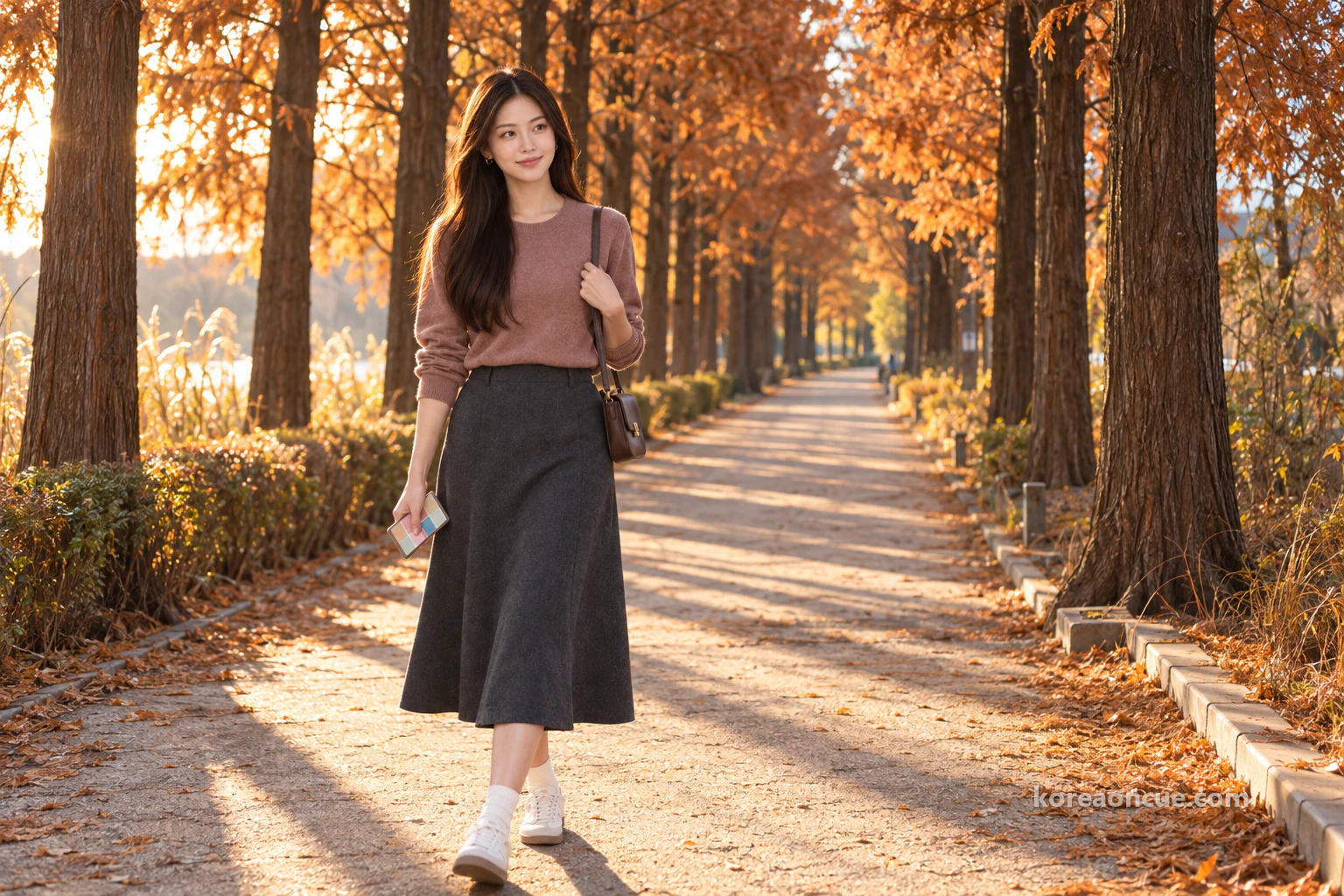
The visitor centre at the top has a nursing room for babies, open 09:00–18:00. You can also pick up postcards at the visitor centre, and they have a rather special use. They are for Haneul Park’s “slow postbox”. The slow postbox is emptied twice a year, and the cards are delivered around Seollal and Chuseok. The idea is to remember the day you visited the park about a year later.
There are slow postboxes in Haneul Park, Noeul Park and Gyeongui Line Forest Park. Mali’s eyes pause on the name Gyeongui Line Forest Park. It was the first path she walked with Rina, on her second trip. She cannot decide who to send a postcard to, or where, so this time she only writes the postbox’s name in her notebook. She will write a postcard next time, when she comes in daylight and climbs the stairs.
The wide grassland is relaxing, but there are a few rules at the top. To protect wildlife, you cannot bring food, and you must take your rubbish home. To protect the ecosystem and avoid bothering other visitors, the park asks people to leave pets at home if they can. So Mali has deliberately left the snacks she packed that morning in her hotel room. At the top there are five toilets and four drinking fountains.
Where to stand as the sun goes down: the western sky and the photo Mali sends Rina
At sunset, stand at the edge of the grassland and face west, where the sun goes down. West is the direction of Haengjusanseong. Just as the sun starts to sink, Mali comes back round from the Metasequoia Path to the western edge of the grassland. By the timetable in her notebook, this is where she will stay longest today. Mali fans out her bundle of cards on her palm and waits for the sky to change.
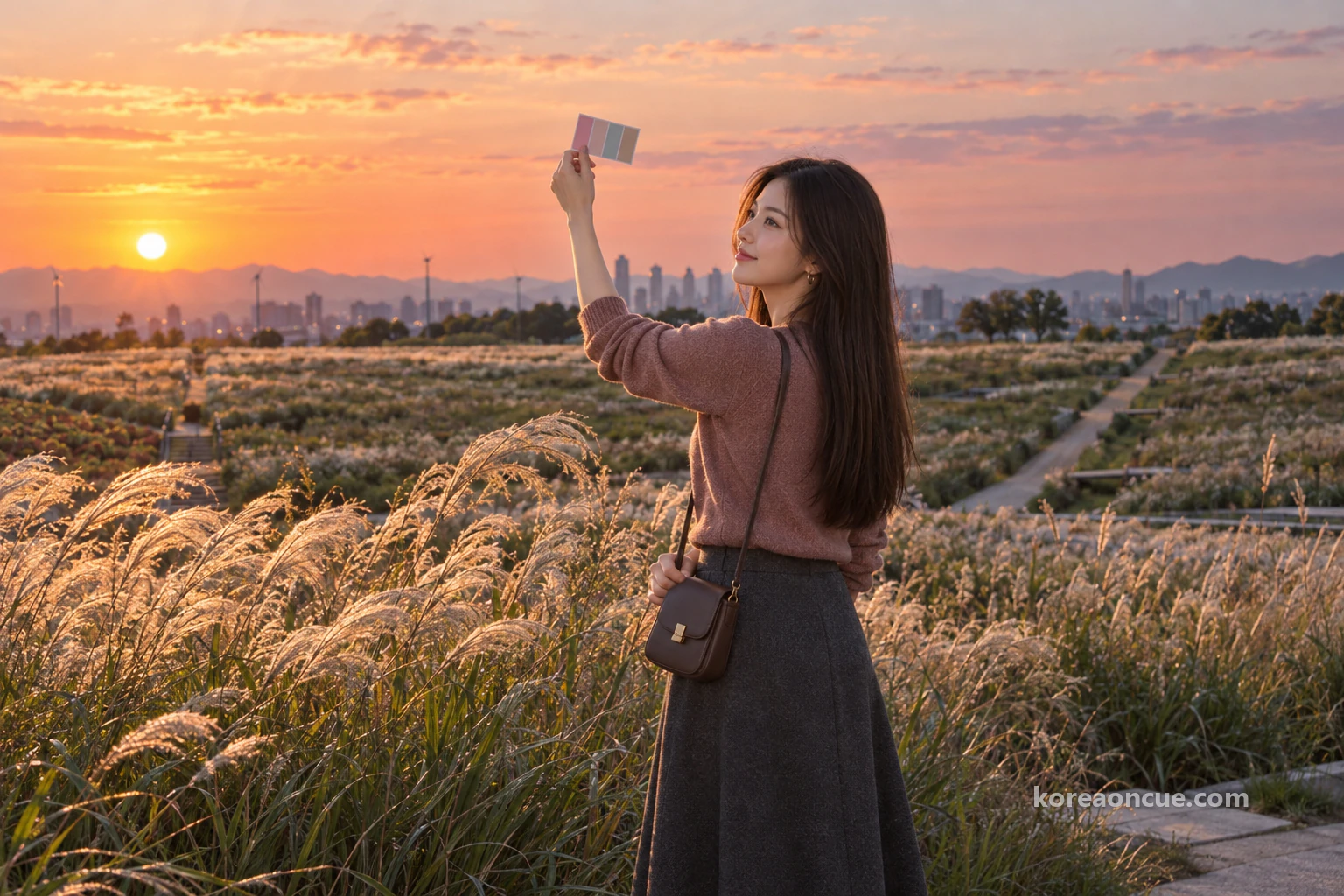
As the sun goes down, the sky turns a different colour every few minutes. At first there is a lot of yellow, then apricot and pink begin to mix in. Mali takes out the “sunset apricot” card she made on the Ichon Sunset Trail and holds it next to the sky. The sunset over the grassland today is a little drier and warmer than the one she saw over the river last time. Mali names a new card “Haneul Park apricot”.
Next, Mali holds two cards together, one over the other. Haneul Park apricot on top, silver-grass grey below. Sunset light and dry-grass colour sit together in one scene, and this is exactly the combination her editor described. Mali slips the two cards side by side between the pages of her notebook and folds the corner slightly to mark today’s answer. Last week on Namsan, she and Rina chose colours half each. Today she has chosen the background alone.

With her colours chosen, Mali turns east and takes one photo of the sky above Namsan. Then she sends it to Rina with a short message. “Namsan, the one we walked last week, looks this small from here.” Without waiting for a reply, she puts her phone straight back in her bag. For the few minutes before the sun sets completely, she does not want to take her eyes off the sky for a screen.
Coming down before closing: the shuttle runs until 19:00, the park until 21:00
On the way down, catch the shuttle before service ends at 19:00. The park closes at 21:00, but the shuttle stops two hours earlier. Mali watches the sky turn deep blue after sunset before she walks to the stop. Thanks to “19:00 — shuttle ends” in her notebook, there is no need to hurry. Rina’s checking the finish has more than earned its keep today.
Some people will want to watch the sunset to the end and walk down the stairs. If so, leave plenty of time to be completely out of the park before 21:00. If you paid for a return and do not take the shuttle down, you can get back the difference, minus the one-way fare. If you do not use a one-way ticket, you get the full fare back. Either way, refunds are only given on the day you bought the ticket, so don’t leave it until the next day.

Back at the hotel, Mali opens the “For work” column in her notebook again. Next to “Background — sunset, wide grassland” at the top, she draws a circle. Below it, she writes the two cards she chose today side by side: Haneul Park apricot and silver-grass grey. At the very bottom, the three times she wrote that afternoon are still there: 18:30, 19:00 and 21:00. Next time she comes to this hill, she has a feeling the names of the two stairs will go above those three lines first.
Common Mistakes
Trying to go up after sunset
in November, Haneul Park closes at 21:00, and there is no entry at night, to protect wildlife. The park opens at night only during the autumn silver grass festival.
Thinking the last shuttle up is at 19:00
in October and November the shuttle stops at 19:00, and the last ride up is 30 minutes earlier, at 18:30.
Putting only Haneul Park into the map
the shuttle leaves from the Nanjicheon Park car park. Mark the car park by name.
Bringing snacks
to protect wildlife, food is not allowed. Take your rubbish home.
Buying a return, walking down the stairs and just leaving
if you did not take the shuttle down, you can get back the difference, minus the one-way fare, on the same day.
FAQ
Which station and exit should I use?
Line 6 World Cup Stadium Station Exit 1. For the shuttle, go to the Nanjicheon Park car park (1538-24 Sangam-dong, Mapo-gu).
What are the opening hours in November?
It opens at 06:00 and closes at 21:00. From April to September it stays open until 22:00, and from January to March and October to December until 21:00.
How much is the Maengkkongi electric shuttle?
Route 1 general fare: 2,000 won one way, 3,000 won return. Children (4–12), people aged 65 and over and disabled visitors: 1,500 won one way, 2,200 won return. Free for children aged 48 months and under.
How late does the shuttle run?
In October and November it runs 09:00–19:00, with the last ride up at 18:30. From December to February it runs 10:00–18:00, and from March to September 08:00–20:00.
Can I walk up?
Yes. There are Haneul Stairs on the east and west sides.
Can I bring my dog?
The park asks visitors to avoid bringing pets. On the shuttle, small and medium-sized dogs under 40 cm at the shoulder can ride if you hold them, but large dogs and dangerous breeds cannot.
What can I see from the top?
Bukhansan to the north, Namsan and the 63 Building to the east, the Han River to the south and Haengjusanseong to the west.
Recap — 30 seconds before you go
- Line 6 World Cup Stadium Station Exit 1 → Nanjicheon Park car park → Maengkkongi electric shuttle Route 1 → top of Haneul Park (or the east and west Haneul Stairs).
- November park hours 06:00–21:00, no entry at night.
- Shuttle in October–November 09:00–19:00, last ride up 18:30 · general fare 2,000 won one way, 3,000 won return.
- At the top: silver grass and grassland split into an X, views of Seoul on all sides (Bukhansan, Namsan, the Han River, Haengjusanseong), Haneul Observatory and the Metasequoia Path.
- Leave food behind, and take your rubbish home.
Sources
- Seoul Metropolitan Government, Garden City Seoul — World Cup ParkHaneul Park as a grassland park on Nanjido Landfill No. 2 (190,000 m²) · the name Nanjido, 15 years of landfill from 1978, landfill ended March 1993, stabilisation works 1996–2002, park opened 1 May 2002 · 50 cm of soil, a waterproof membrane and more than 1 m of soil · 106 landfill gas wells and district heating · tall and short grasses in four X-shaped sections and the species planted · views on all sides (Bukhansan, Namsan and the 63 Building, the Han River, Haengjusanseong) · 20 lookouts, 109,567 m² of grassland, wind turbines, toilets and drinking fountains · butterfly releases · November hours 06:00–21:00, monthly hours, why it closes at night, night opening only during the festival · Maengkkongi electric shuttle Route 1 hours, last ride up, fares, refunds, frequency, distance and office phone · Nanjicheon Park car park address · visitor centre nursing room, postcards and the slow postbox · rules on food, rubbish and pets · main sightschecked 2026-10-28
- World Cup Park leaflet — Park mapLine 6 World Cup Stadium Station Exit 1 · Haneul Park key (east and west Haneul Stairs, Metasequoia Path, wind turbines, silver-grass swing and heart stairs, Haneul Observatory, wish rock, naturalised plant garden, visitor centre) · Bowl Holding the Skychecked 2026-10-28
- Seoul Metropolitan Government, Environment — 25th Seoul Silver Grass FestivalThe 2026 festival was held in October and has endedchecked 2026-10-28
- Seoul Metropolitan Government, Seoul Garden Show 2023 — DirectionsLine 6 World Cup Stadium Station Exit 1checked 2026-10-28
A Seoul story told with our AI characters. Place details are checked against public sources; the photos are AI-made illustrative images. How we use AI
More from this area

Mali’s second work trip to Seoul: her first walk with Rina through Gyeongui Line Forest Park in Yeonnam-dong
Back in Seoul after a month, Mali messages Rina: “I’d like to see some autumn colours.” Rina chooses an old railway route that starts at a single pine tree outside Hongik University Station Exit 3.

A Thursday evening before Halloween: walking Hongdae’s Red Road from R1 to R7 with Maya and Rina
In her second week in Seoul, Maya visits Hongdae for the first time.