
SEOUL · HONGDAE
A Thursday evening before Halloween: walking Hongdae's Red Road from R1 to R7 with Maya and Rina
A 2 km walk from R1's street art towards Sangsu Station, with the tourist information centre, scooter-free hours and advice for crowded days
In her second week in Seoul, Maya visits Hongdae for the first time. Rina brings a photo of a ginkgo leaf sent from Gyeongui Line Forest Park and suggests following Red Road in order, starting at R1.

How to get there
Maya is in her second week in Seoul. On her first trip here from Singapore, she has settled into an evening routine: back at her accommodation, she pins the next day’s destinations on her phone map. Hongdae has collected more pins than anywhere else. Street photos from Instagram, streets of clothes shops recommended by friends, stories about how busy it stays after dark — she has plenty of places marked, but no idea which order to visit them in.

So she asks Rina, who has been swapping photos of Seoul with her since they first met in Jongno 3-ga and spent the day together. Rina’s reply is brief: “Hongdae is confusing if you’re looking at separate pins. Think of it as one route called Red Road, with sections numbered R1 to R7.” Maya laughs at the idea of a street having numbers like station exits. It is a very Rina way of explaining things.
Rina is on her way back from meeting Mali in Gyeongui Line Forest Park in Yeonnam-dong that afternoon. “A friend called Mali has sent something for you. I’ll show you when we meet.” Maya is curious about this name she hasn’t heard before, but decides to wait until then and clears every pin from her phone map. In her notes, she writes just “R1 → R7”.
This is the story of their Thursday evening, and a guide to walking Hongdae’s Red Road for the first time. We’ll follow them from the start to the finish, finding somewhere to ask for directions along the way. We’ll also cover when electric scooters are banned and why, and what to bear in mind on crowded occasions such as Halloween and the end of the year.
The Cue
Red Road runs for about 2 km from Gyeongui Line Forest Park through Hongdae towards Dangin-ri Power Plant, divided into seven sections numbered R1 to R7. The walk from Hongik Univ. Station on Line 2 to the area around Sangsu Station on Line 6 takes about 25 minutes, with performances, fashion and food giving different stretches their character. R1, the starting section, has street art, and although Exits 4, 5 and 7 of Hongik Univ. Station all reach it, Exit 7 is closest to the artwork. For directions, head to Mapo Tourist Information Centre at 22 Hongik-ro, open 10:00–19:00 with help in English, Chinese and Japanese. Electric scooters are banned from R1–R6 during the busy hours from noon to 11 p.m.
- Route: About 2 km from R1 by Gyeongui Line Forest Park to R7 towards Dangin-ri Power Plant, taking roughly 25 minutes on foot. It runs from Hongik Univ. Station to the Sangsu Station area.
- Starting point: Hongik Univ. Station Exits 4, 5 and 7 all lead to R1. Exit 7 is closest to the street art.
- Information: Mapo Tourist Information Centre, 22 Hongik-ro, Mapo-gu (Seogyo-dong), 10:00–19:00. Help in English, Chinese and Japanese. Phone 02-334-7878.
- Scooter-free hours: Electric scooters are banned from R1–R6, 12:00–23:00. R7, a residential section, is excluded.
- Facilities: Red Road Baljeonso has a promotional exhibition space, a display and sales area for merchandise, and public toilets.
- Crowded days: Halloween and the end of the year can bring shoulder-to-shoulder crowds. At Halloween in 2025, large electronic screens around Red Road displayed live crowd levels.
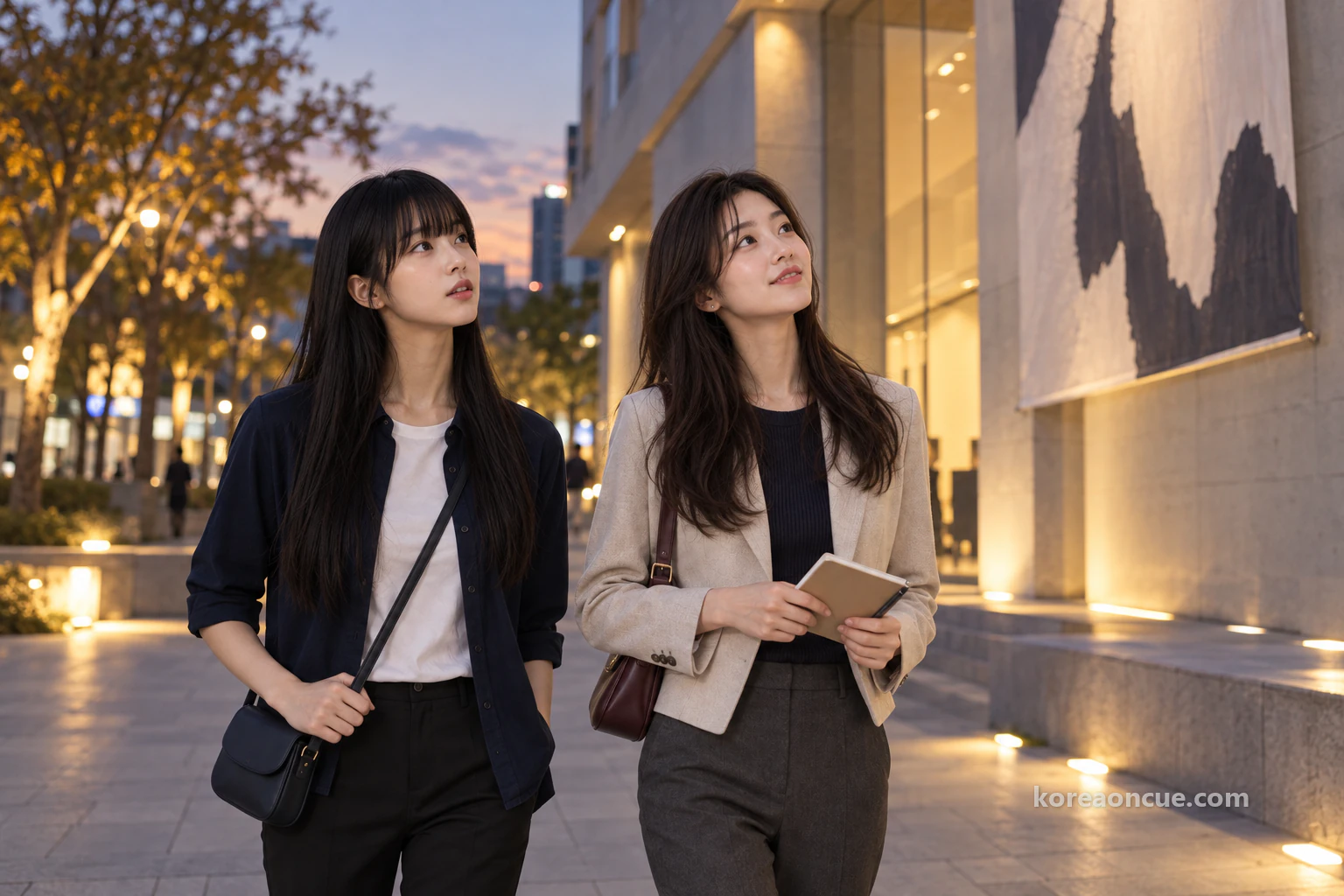
R1: street art near Exit 7
At six in the evening, Maya comes out of Exit 7 at Hongik Univ. Station. Rina has told her, “Exits 4, 5 and 7 all bring you to R1, but 7 is closest to the artwork.” Hongik Univ. Station is a large station served by Line 2, the Gyeongui Line and the Airport Railroad, with enough exits for the choice to change a first-time visitor’s evening route. At the top of the steps, Rina is waiting right in front of her, with artwork covering the walls behind.
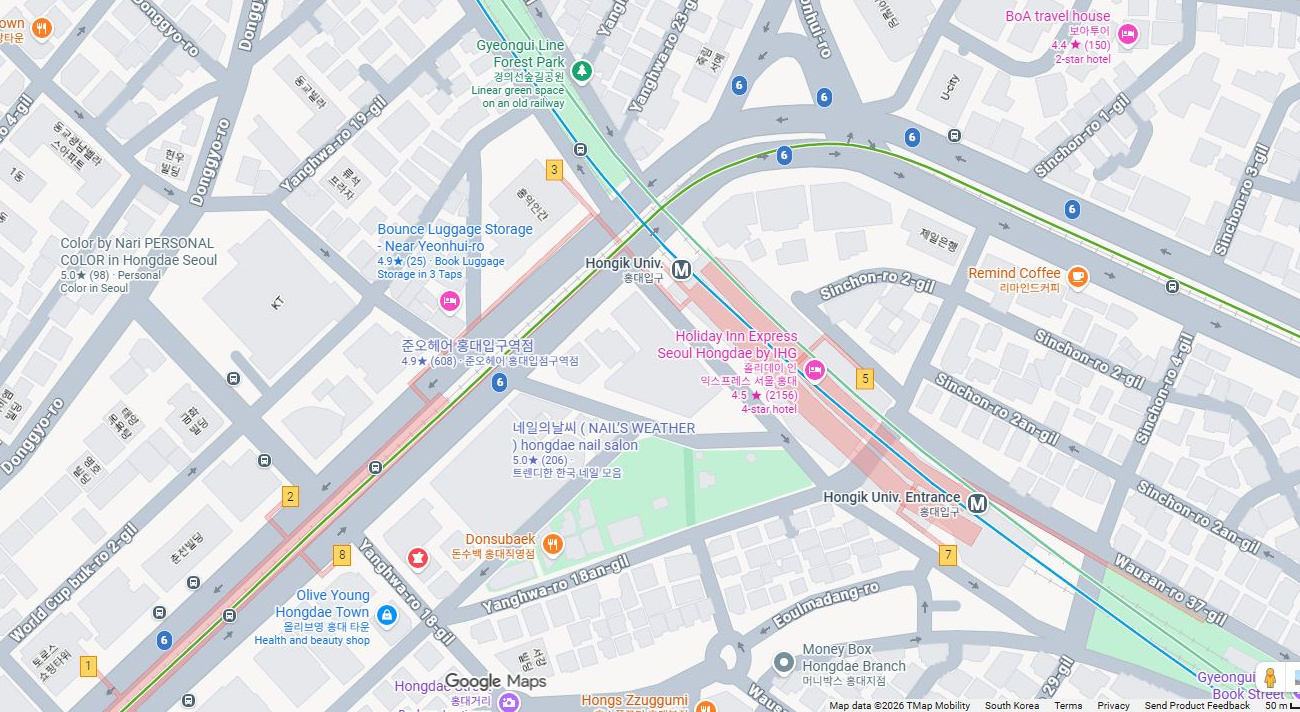

R1 marks the start of Red Road and is a good stretch for looking at street art. Maya stops in front of a painting and raises her phone, then opens her notes instead when she sees Rina take out her notebook. At the top of the page, Rina writes “R1 — art — start”, making Maya laugh at the three words. Rina’s notes were just as brief when they first met in Jongno 3-ga, though Maya’s own first entry is rather longer: “R1, Exit 7, lots of art, Rina has the notebook out again.”
Before they set off, Rina shows her a close-up photo of a ginkgo leaf resting on a palm. “Mali sent this — we walked in Gyeongui Line Forest Park this afternoon. She says the yellow starts at the edges, and wanted you to look at it alongside Red Road’s red.” Maya studies the photo for a while as Rina explains that Mali works for a beauty magazine in Bangkok and that they first met in Dongdaemun. There is something unexpectedly lovely about being sent a colour by someone she has never met.
Maya takes another look at R1’s artwork. She has walked streets with murals in Singapore, but here the paintings also mark the start of a route. “So instead of a sign, the pictures are saying, ‘Start here.’” Rina doesn’t copy that into her notebook, but nods and leans in to look at Maya’s phone screen. Rather than taking a selfie against the artwork, Maya photographs Rina with the paintings — her first street photo in Seoul with a friend in it.
Red Road R1–R7: seven sections over about 2 km
There is a reason Rina calls Red Road “a numbered route”. The name brings together about 2 km linking Gyeongui Line Forest Park, Hongdae and Dangin-ri Power Plant, divided into seven sections that each have their own character. Decorated in red to represent youth and passion, the route leads from the forest park through Hongdae and on towards the Hangang River. It bends rather than running straight, so the section numbers help first-time walkers keep their bearings.

Rina draws seven boxes in her notebook and numbers each one. “We’ll fill them in as we walk — the last one’s towards Sangsu Station.” From R1 at the start to R7 at the end takes about 25 minutes on foot, passing sections with different things to see, from performances to fashion and food. Maya says seven boxes are much less confusing than twenty pins on a map. On a first visit to Hongdae, walking the whole route before hunting down individual shops makes it easier to understand how the neighbourhood fits together.
Maya checks R1 and R7 on her phone map and tilts her head. “Two kilometres is shorter than I thought — I walk that far between shopping malls in Singapore.” Rina laughs: “It’s a short distance, but there are so many places to stop that it takes ages.” The 25 minutes is for walking without stopping, so looking around, taking photos and asking for directions can easily fill an hour or two. For an evening walk, keep the subway journey back to your accommodation in mind too.
Passing R2 and saving the busking area for another day
A little way beyond R1, they spot people gathered in a circle. This is the busking area on Geotgo Sipeun Geori, the walking street. Maya wants to stop, but Rina suggests marking it with a star on the map: “There are specific performance rules here — let’s set aside another day to see it properly.” Tonight is for walking the whole route once.
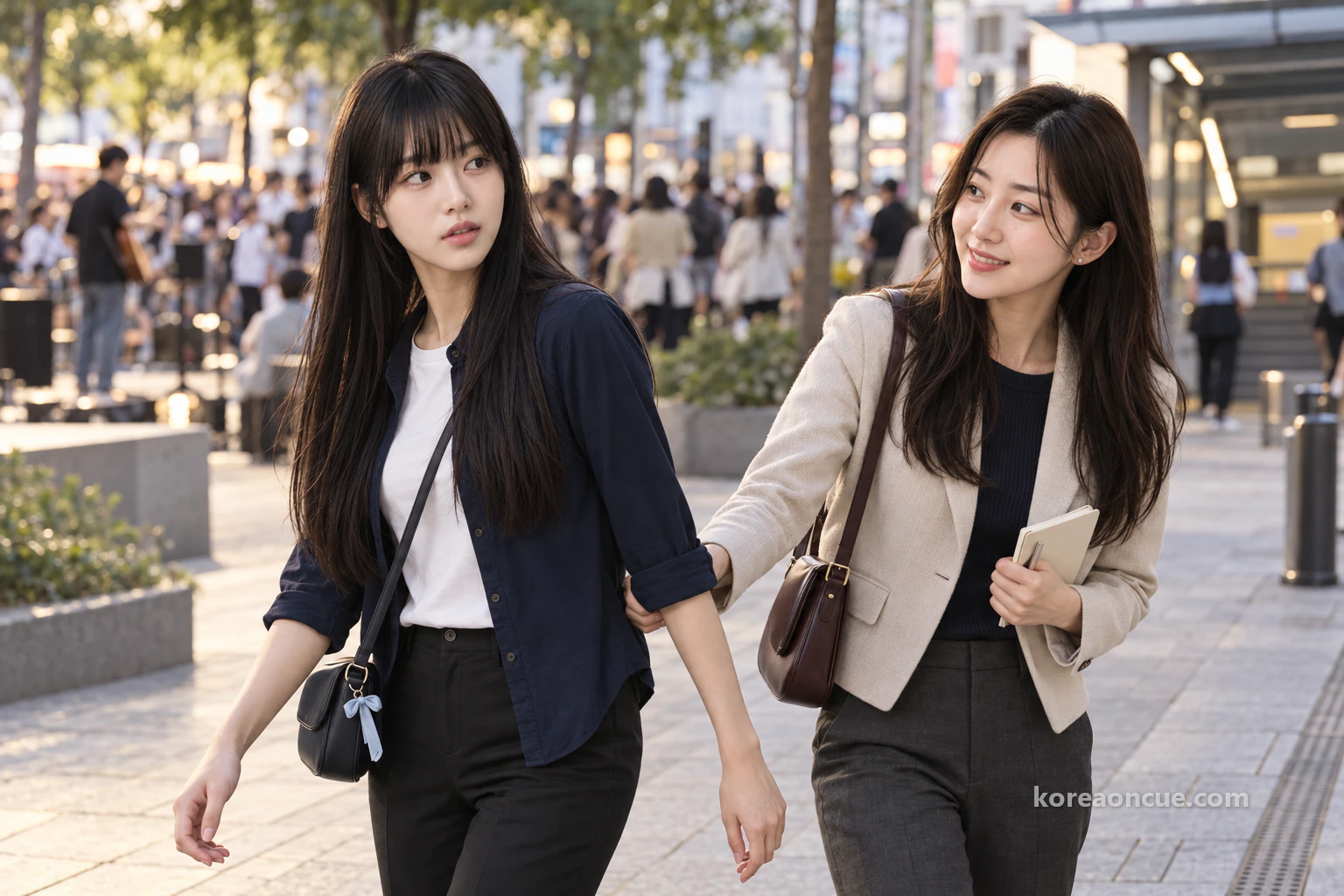
As they pass the gathering, Rina slows down and they fall into single file. An audience around a performance narrows the space for walking, so passing slowly in single file gives everyone more room. Maya laughs: “You organise the street the same way you organise your notebook.” Rina shrugs as though it is nothing, but her second box already reads “R2 — performances — next time”.
Maya keeps glancing back, apparently not quite satisfied with leaving only a star on the map. Rina smiles: “There are things both performers and audiences need to follow here, and it’s much more fun when you know how it works.” They agree to come back another day just for the busking area. Maya laughs that, only two weeks into her stay in Seoul, she rather likes how many places are already going on her “next time” list. More places left for later mean more reasons to return.
R3: clothes and cosmetics shops
Maya slows down noticeably as they enter R3. This is Red Road’s fashion and shopping section, packed with clothes and cosmetics shops. In fact, most of her original map pins were around here. She stops at every display to compare colours, while Rina counts the stops in her notebook with strokes of the Korean tally character 正.

In the end, Maya buys nothing, opening Mali’s ginkgo-leaf photo again instead and holding it beside the clothes to compare the colours. “I want to find a red that goes with this yellow.” Rina smiles at that, remembering how Mali also used photos to compare colours when they met in Dongdaemun. She finds it funny that two people who have never met are choosing colours in exactly the same way.
There is one small trick to shopping along Red Road. Sections packed with shops, such as R3, draw some of the biggest crowds in the evening, so step towards the shop when studying a display rather than standing out in the walking space. Maya stops in the middle of the street a few times and nearly collides with people coming up behind her. Each time, Rina gives her sleeve a gentle tug towards the shops, and by about the third occasion Maya remembers to step aside herself.
Maya often holds her phone out in front of her as she walks, filming short clips for Instagram. Watching her, Rina suggests a change: stop walking to film, and stand close to a shopfront or wall. Looking only at the screen makes it easy to bump into someone ahead, while on a crowded evening street such as Red Road, it also interrupts the people behind. Maya finds it a nuisance at first, but agrees to keep doing it when she sees how much steadier the footage looks.
Finding each other at Mapo Tourist Information Centre
As they pass through R3, Maya briefly loses sight of Rina. She looks up from a shop she has been peering into, and her friend has disappeared. Opening her map doesn’t help at first, because on the curving street she can’t work out which way she is facing. A few minutes later, a message arrives from Rina: “If you’re lost, come to the tourist information centre. It’s at 22 Hongik-ro — I’ll wait there.”
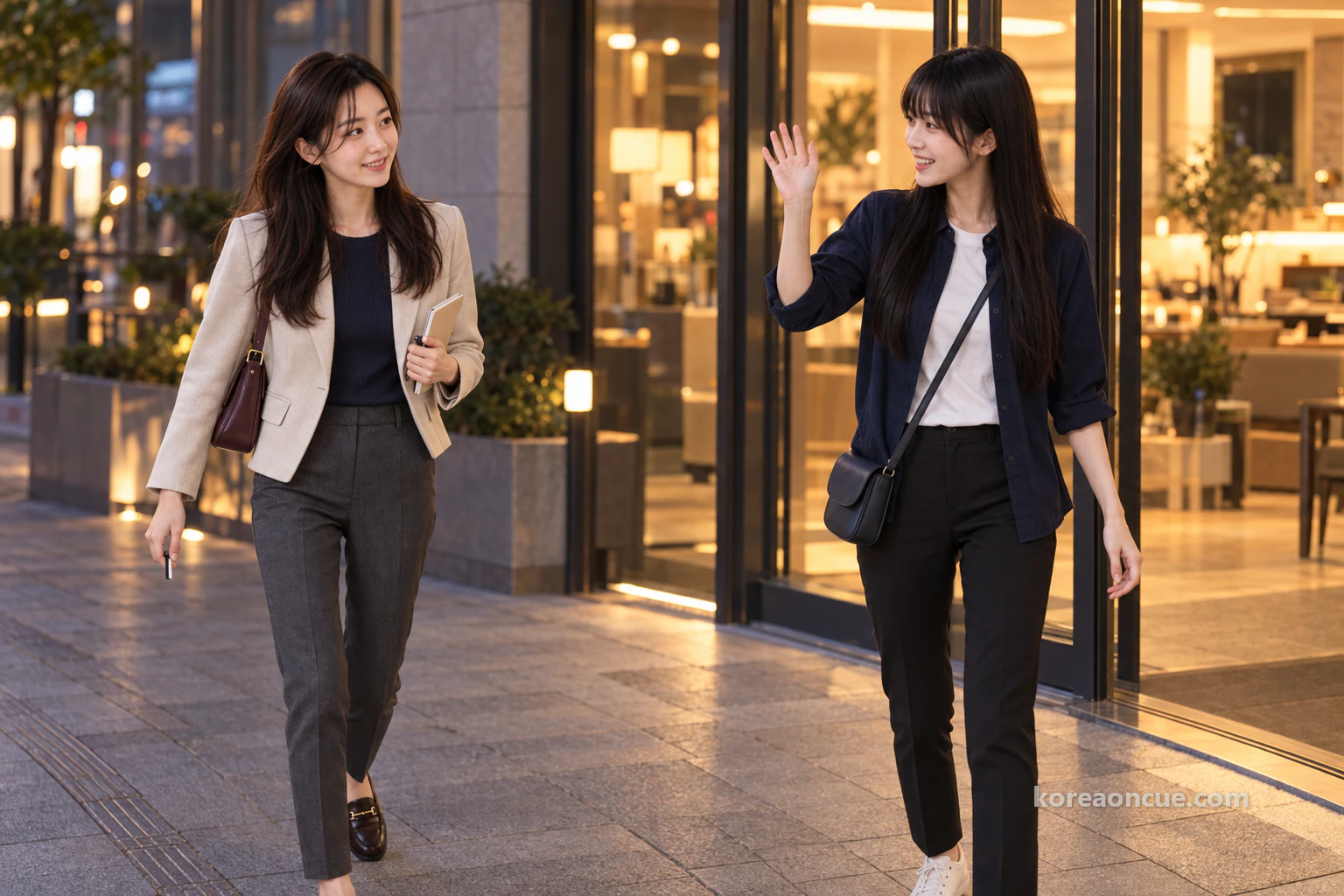
Mapo Tourist Information Centre is at 22 Hongik-ro, Mapo-gu, and is open from 10 a.m. to 7 p.m. With help in English, Chinese and Japanese, it is a reassuring place to know about in Hongdae if Korean isn’t your strong point. Rina says she picked up a map here on her own first visit. It is nearly closing time when Maya arrives, but simply having a clear meeting point outside the centre puts her at ease. The centre closes at 7 p.m., so come a little earlier if you need help.
Rina suggests agreeing on one thing for the next time they get separated. “Use the number — tell me which R you’re in.” Every section of Red Road has a number, so “the end of R3” or “near R5” makes finding each other much easier. Maya immediately writes “If lost: R number + tourist information centre” at the top of her notes. She is rather pleased that, this time, her note is shorter than Rina’s.
Rina tells her about her own first visit to Hongdae, when she relied on map pins just as Maya has and went round the same alley three times looking for individual shops. Only after unfolding the map from the tourist information centre did she realise the route connected. “That’s why I wanted to show you the route first.” Maya appreciates it. Her friend has already done the confused wandering that comes with a first visit, and is making hers a little easier.
Electric scooters: banned from noon to 11 p.m.
As they start walking again, Rina points down at an electric-scooter prohibition symbol on the ground. There are signs at the approaches to the Red Road walking route, as well as markings underfoot. Seoul Metropolitan Government and Seoul Metropolitan Police Agency designated Red Road as the country’s first “scooter-free street”. Electric scooters are banned from R1 to R6 from noon to 11 p.m., with the residential R7 section excluded.
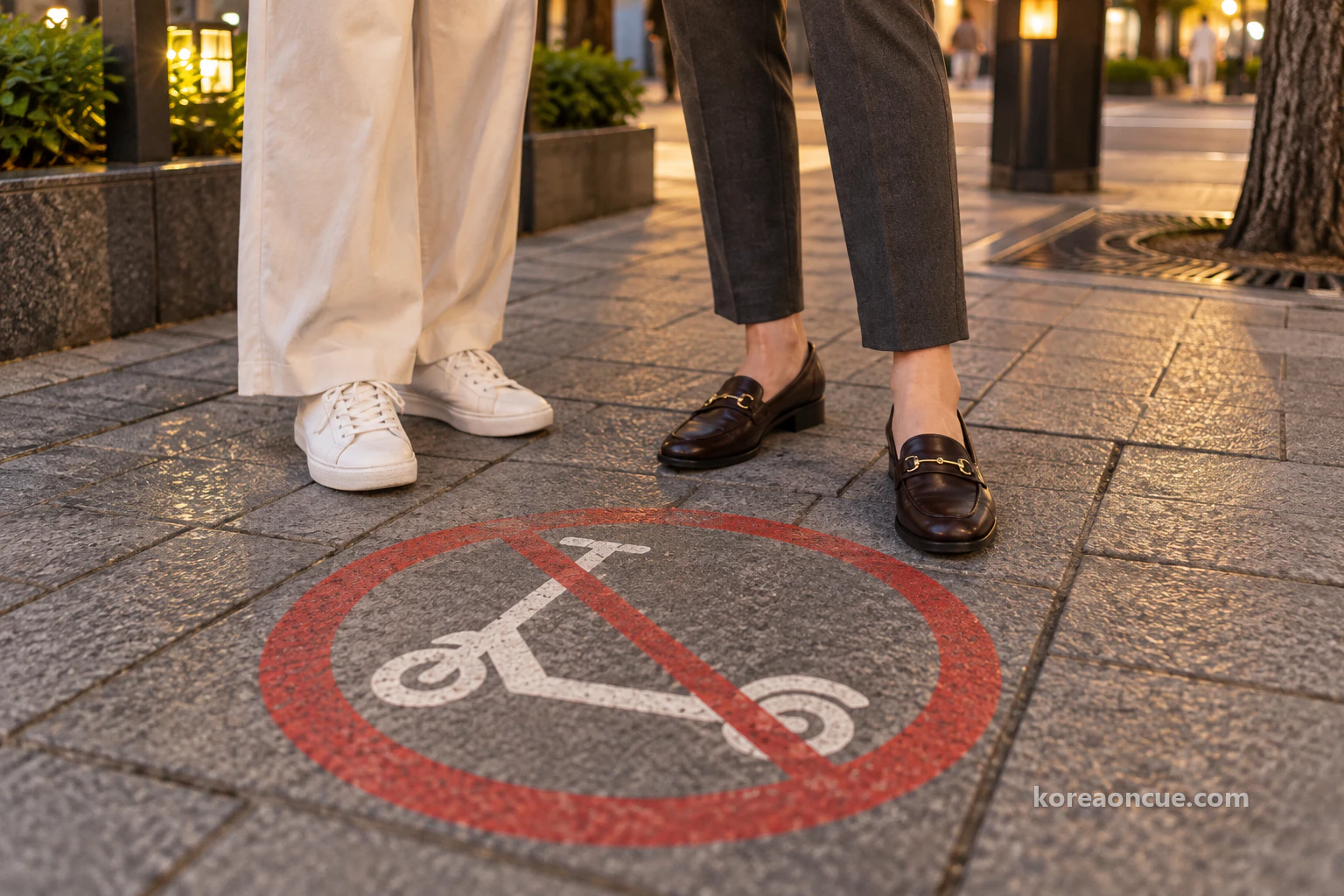
The choice of hours has an interesting explanation: large-scale data analysis identified when the street is at its busiest. Hearing this, Maya looks around and sees that the crowd really is growing as the evening goes on. “I always had to be careful riding a scooter in Singapore — here, there’s a time when people walking don’t have to watch out for them.” For travellers exploring on foot, these are the most comfortable hours to walk.
The scooter-free scheme began on 16 May 2025. Red Road and the private-academy district in Banpo, Seocho, were the first two locations. Rina adds that anyone thinking of hiring an electric scooter in Hongdae should check the affected sections and hours first. Most people exploring Red Road in the evening are on foot, so during these hours the street belongs to the walkers. Maya writes “R1–R6, 12:00–23:00, walking only” in her notes and draws a little footprint beside it.
R5: Geurimdongne Creative Centre and Red Road Baljeonso
As they head towards R5, Rina points out a building. Geurimdongne Creative Centre (그림동네 창작센터) now stands on the former open space known as Hongdae Playground. After a long period of construction, the site has become a space for several kinds of art. Rina remembers seeing only construction hoardings when she passed a few years ago, and wants to note how much the same spot has changed.
A little further on, they reach Red Road Baljeonso (레드로드발전소). It brings together a promotional exhibition space about Red Road, a display and sales area for tourism-character merchandise, and facilities including public toilets. Toilets can become the most pressing concern on a long walk, so this is a useful stop to remember. Maya spots a dokkaebi character among the merchandise and laughs. Red Road has two of these Korean goblin characters, called Kkaebi and Kkaesuni.
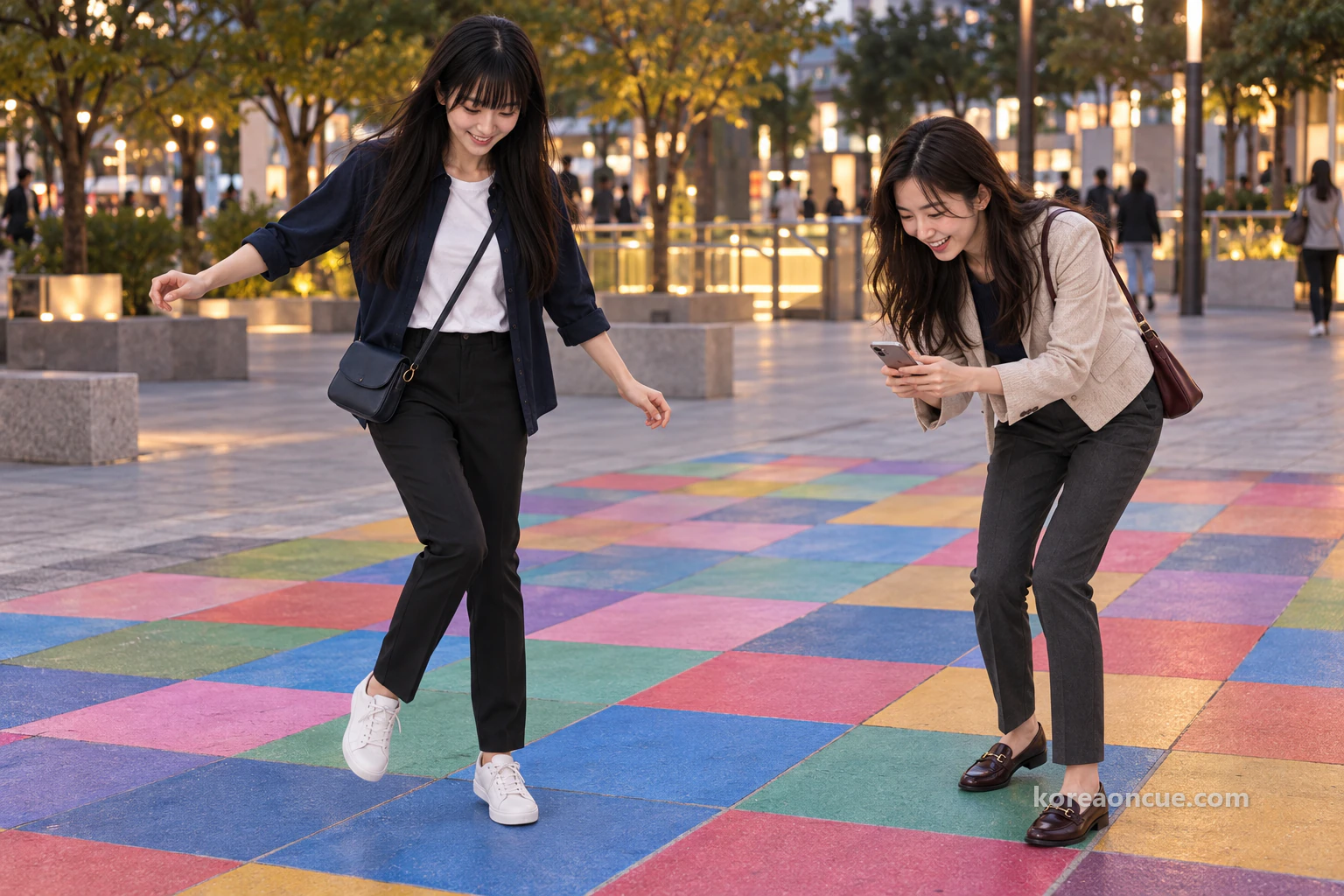
There is artwork on the ground in the square at Red Road Baljeonso too: a street-art floor mural called “Pixel Travel” covers 300 m². Maya skips from square to square across it, reminding Rina of Mali counting railway sleepers as they walked through Gyeongui Line Forest Park that afternoon. “Mali was walking like that today — I think you’d get on.” Maya answers straight away: “Then next time, all three of us.”
At the merchandise display, Maya spends a while considering a small item with one of the dokkaebi characters on it, but eventually photographs it and puts it back. “I want to keep today the way you do in your notebook, rather than buy something.” Rina smiles and suggests writing the two characters’ names in her phone notes instead. Maya types “Kkaebi, Kkaesun”, followed by the practical addition “Red Road Baljeonso — has toilets”. Rina declares that the most useful note of the evening.
Halloween and other crowded days
There is something Rina has been meaning to mention during the walk. Halloween is a week away, and Red Road can get so crowded at Halloween and the end of the year that there is barely room to move. Preventing accidents caused by dense crowds was one reason for improving the streets under the Red Road name. Rina wants Maya to know before she starts thinking about coming back that day.
For Halloween in 2025, Seoul Metropolitan Government put safety measures in place at 14 locations across the city where crowds were expected. In the Hongdae Special Tourist Zone, large electronic emergency-message screens around Red Road displayed live crowd levels. “If you come that day, check the numbers on the screens first,” Rina says, “and if it’s too crowded, leave it for another day.” On busy days in Hongdae, agree on a meeting point using an R number beforehand, and keep moving with the crowd rather than stopping in narrow spaces.
Maya thinks for a moment, then decides to spend Halloween itself quietly near her accommodation. She would rather come back on another weekday evening like this one. Rina likes that choice, wanting her friend’s first experience of Seoul to include a Hongdae she can explore slowly, rather than only its most crowded day. Another line appears in Maya’s notes: “Halloween — screens — or another day.”
Rina also gives her a few brief pointers for finding herself in a crowd, since avoiding busy days isn’t the whole answer. Agree on a section number for meeting up, keep plenty of charge in the phone, and if people suddenly pack in, move towards a wider space instead of trying to push forwards. Maya nods along to each point. Rina sounds more like a friend helping with packing than someone listing things to worry about. Maya takes it in the same spirit: “Then I’ll just come more often on weekdays.”
R7: the quieter end near Sangsu Station
The final section, R7, leads towards Dangin-ri Power Plant. Red Road runs from Hongik Univ. Station to the Sangsu Station area on Line 6, continuing from that end towards the Hangang River. R7 is close to residential streets, which is why it is excluded from the scooter-free designation. As the surroundings grow quieter than the earlier sections, both of them naturally lower their voices.
Maya rather likes the quiet, having never expected the same route to end so calmly after R1’s art and R3’s lights. Rina says walking from R1 towards R7 lets the noise fade gradually. Starting near Sangsu Station reverses that order, taking a walker from quiet streets into the crowds of Hongdae. On a first walk, choose whichever direction suits the evening’s mood. Start at Hongik Univ. Station for the livelier opening, or near Sangsu Station to ease into it.

Rina fills the seventh box with “R7 — quiet — end” and shows Maya the seven boxes, now all complete. Maya opens her own notes, where five of the seven entries are longer than Rina’s. The last one, though, is brief: “R7, with Rina, three of us next time.” Rina sees it and sends Mali a photo of Maya’s screen.
Mali replies from the airport: “If you’ve got the yellow, send me the red.” Laughing, Maya sends Rina a photo of the red clothes she took in R3, and Rina forwards it to Mali. Through the photos, Rina is connecting two people who have never met. Sky blue from Dongdaemun, yellow from Gyeongui Line Forest Park, red from Red Road — her notebook has gained another colour this month.
Before they head down into Sangsu Station, Maya asks Rina to make their next plans. There is the day they will come back to see the busking area properly, and a morning walk through Gyeongui Line Forest Park with Mali when she next comes to Seoul for work. Rina writes two lines on the back page of her notebook: “R2 — performances — return” and “forest park — morning — all three”. From her first evening in Hongdae, Maya is taking away two reasons to return rather than a handful of shop names.
Going down the station steps, Maya opens her phone map again. Where she deleted the pins earlier, seven points now form a line from R1 to R7, following the route in Rina’s notebook. On the Line 6 train back to her accommodation, Maya adds one pin to that line. R2, the busking area — next time, she will start with that star.
Common Mistakes
Starting with a map full of shop pins
Hongdae is harder to understand as scattered pins than as one route from R1 to R7. Walk the whole route once before seeking out individual shops.
Taking any station exit when looking for R1
Exits 4, 5 and 7 all reach R1, but Exit 7 is closest to the street art.
Assuming 2 km will be over quickly
it takes about 25 minutes without stops, but allow an hour or two if you’re looking around.
Staring at the map after losing your group
use a section number, such as “the end of R3”, to agree where to meet. Mapo Tourist Information Centre at 22 Hongik-ro, open until 7 p.m., is a useful meeting point to arrange beforehand.
Planning to explore Red Road by electric scooter
electric scooters are banned from R1–R6, 12:00–23:00.
Arriving at Halloween or the end of the year without a plan
crowds can leave barely any room to move. Check the crowd levels on the electronic screens and choose another day if it is too busy.
FAQ
Where does Red Road start and finish?
It runs for about 2 km from R1 by Gyeongui Line Forest Park to R7 towards Dangin-ri Power Plant. Walking from Hongik Univ. Station to the Sangsu Station area takes about 25 minutes.
Which exit is closest to R1?
Hongik Univ. Station Exits 4, 5 and 7 all lead there. Exit 7 is closest to the street art.
Can I ask for directions in another language?
Mapo Tourist Information Centre at 22 Hongik-ro, Mapo-gu, offers help in English, Chinese and Japanese from 10:00–19:00. Phone 02-334-7878.
Can I ride an electric scooter?
Electric scooters are banned from R1–R6 between 12:00 and 23:00. The residential R7 section is excluded from the designation.
Where are the toilets?
Red Road Baljeonso has public toilets, along with a promotional exhibition space and an area displaying and selling merchandise.
Is Halloween a good time to visit?
Halloween and the end of the year can bring shoulder-to-shoulder crowds. At Halloween in 2025, large electronic screens around Red Road displayed live crowd levels. Check the levels and choose another day if it is crowded.
Recap — 30 seconds before you go
- Red Road = R1–R7, about 2 km, roughly 25 minutes on foot or an hour or two with stops.
- Start at R1 near Hongik Univ. Station Exit 7, with Exits 4 and 5 also possible, and finish around Sangsu Station.
- If separated, use section numbers to find each other. Mapo Tourist Information Centre: 22 Hongik-ro, 10:00–19:00, help in English, Chinese and Japanese.
- Scooter-free sections: R1–R6, 12:00–23:00.
- Public toilets are at Red Road Baljeonso. At Halloween and the end of the year, check crowd levels first.
Sources
- Seoul Media Hub — exploring Hongdae’s Red RoadCurving route of about 2 km, R1–R7 · about 25 minutes on foot from Hongik Univ. Station to the Sangsu Station area · R1 street art via Exits 4, 5 and 7, with Exit 7 closest to the artwork · 300 m² “Pixel Journey” ground mural in the Red Road Power Station plazachecked 2026-10-22
- Seoul Media Hub — Seoul Lifestyle TourRed-themed street linking Gyeongui Line Forest Park, Hongdae and the Han River · aim of preventing crowd-related accidents · goblin characters Kkaebi and Kkaesuni · Red Road Power Station information hall, character-goods exhibition and shop, and public toiletschecked 2026-10-22
- Seoul Metropolitan Government — first kick-scooter-free streets operating from May 16Electric kick scooters prohibited on Red Road R1–R6 from 12:00 to 23:00 · residential R7 excluded · crowd-density analysis used to set the hours · launch on Red Road and in the Banpo academy districtchecked 2026-10-22
- Mapo District Culture and Tourism — tourist information centresMapo Tourist Information Center at 22 Hongik-ro · hours 10:00–19:00 · assistance in English, Chinese and Japanese · telephone 02-334-7878checked 2026-10-22
- Seoul Media Hub — special Halloween safety measures2025 Halloween safety measures for 14 areas expecting crowds · real-time crowd information on large emergency-message displays along Red Road in the Hongdae tourism districtchecked 2026-10-22
- Seoul Media Hub — Geurimdongne Creative Center and Hongdae PlaygroundGeurimdongne Creative Center built on the former open space known as Hongdae Playground · site transformed into a multidisciplinary arts space after constructionchecked 2026-10-22
A Seoul story told with our AI characters. Place details are checked against public sources; the photos are AI-made illustrative images. How we use AI
More from this area

The night before the concert: Hina explores Hongdae’s busking zones on her own
Back in Seoul a month later, Hina has kept the night before her concert free.
An afternoon before the concert: Hina and Noah meet again at Mangwon Hangang Park a month later
Outside the embassy last month, they promised to meet again.