SEOUL · HONGDAE
The night before the concert: Hina explores Hongdae’s busking zones on her own
A 500 m walk from Hongik University Station Exits 8 and 9, four busking zones, a 60 dB limit and where to check the performance schedule
Back in Seoul a month later, Hina has kept the night before her concert free. She heads out alone to explore Hongdae’s busking zones, curious to see how street performances work through the eyes of someone who promotes concerts for a living.
How to get there
Hina is back in Seoul, just as she promised last month. That was the weekend she lost her passport and visited the Embassy of Japan’s consular section, when she told Noah she would return for a concert the following month. This time, the plan is a Friday afternoon flight in, a Saturday evening concert and a Sunday night flight home. On the journey from the airport to her accommodation, she opens her bag’s zip pocket twice to check her passport is there. Her hands still remember last month.

She has left Friday night, the evening before the concert, free. An early night is tempting, but there is something in Hongdae she particularly wants to see. It is the busking zones on Hongdae Walking Street (걷고싶은거리). Working in concert promotion at a Tokyo marketing company, Hina has often wondered how performances draw a crowd out on the street. She knows the rules inside a concert venue, but the ones outside are new to her.
Hina’s job is to make sure people hear about a concert before it happens and find their way to the venue. Much of her time goes on choosing poster wording, deciding when to reveal merchandise and working out how far the queue might stretch. A street performer has none of that preparation with the audience, just a few seconds to make a passer-by stop. Hina wants to see how those few seconds work. That is the real reason she has kept tonight free.
Before setting off, she messages Noah: “I’ve arrived — I’m going to walk around Hongdae’s busking zones on my own tonight, so I’ll see you tomorrow during the day.” His reply is a photo of a map with a circle drawn near Mangwon Hangang Park. That is where they are meeting tomorrow. Hina pastes the photo into her notes and gives the page a new heading: “The night before the concert”.
This piece follows that Friday night and doubles as a guide to watching street performances on Hongdae Walking Street. We’ll follow Hina from the station exits to the busking zones, looking at where they are and how they work. Along the way, we’ll cover where to check the day’s performances and how to watch without getting in anyone’s way.
The Cue
Hongdae Walking Street runs for about 500 m towards Hongik University from Hongik University Station (Line 2) Exits 8 and 9, filling with buskers from around the country every night. Its four busking zones sit outside 107, 111, 127 and 143 Eoulmadang-ro, with amplified singing and dance in Zones 1, 2 and 4, and unamplified performances in Zone 3. Performers apply through Mapo-gu’s booking system and are selected by lottery, with up to two amplifiers allowed and a volume limit of 60 dB. Check the “홍대 야외공연 일정표”, the Hongdae outdoor performance schedule, on Mapo-gu’s website before heading out. Homes, accommodation and shops line the street, so leave shop entrances and walking routes clear while watching.
- Where: Eoulmadang-ro, Mapo-gu. Leave Hongik University Station through Exit 8 or 9 and walk straight towards Hongik University. The street runs for about 500 m, from 107 to 155-1 Eoulmadang-ro.
- Busking zones: Zone 1 outside 107 Eoulmadang-ro · Zone 2 outside 111 · Zone 3 outside 127 · Zone 4 outside 143. Zones 1, 2 and 4 host amplified singing and dance. Zone 3 is for unamplified performances, including gentle vocal music, magic, mime and instrumental music.
- Other stages: Gwangjang Stage (광장무대), 132 Eoulmadang-ro · Yeohaeng Stage (여행무대), 144 Eoulmadang-ro, above the tourist information centre · AK& Busking Zone, outside Hongik University Station Exit 4.
- Performance rules: Monthly applications and lottery · maximum six appearances per person per month · up to two amplifiers, 60 dB limit · no lighting installed separately by performers · 1 hour 50 minutes performing plus 10 minutes clearing away.
- Today’s performances: “홍대 야외공연 일정표” on Mapo-gu’s culture and tourism website.
- Rest stop and toilets: Hongik Culture Park (홍익문화공원), across the road from Hongik University, has benches, toilets and a small stage.
- Phone: Mapo-gu Tourism Policy Division, 02-3153-8673.
From Exits 8 and 9 towards Hongik University
At eight in the evening, Hina comes out of Hongik University Station Exit 9. The stairs are packed, and she has to climb slowly, one step at a time. Exit 9 gets so crowded that a new Exit 8-1 is planned opposite it, with completion targeted for 2028. For now, Exits 8 and 9 are the way to Walking Street, followed by a straight walk towards Hongik University. Hina makes a note to try Exit 8 next time.
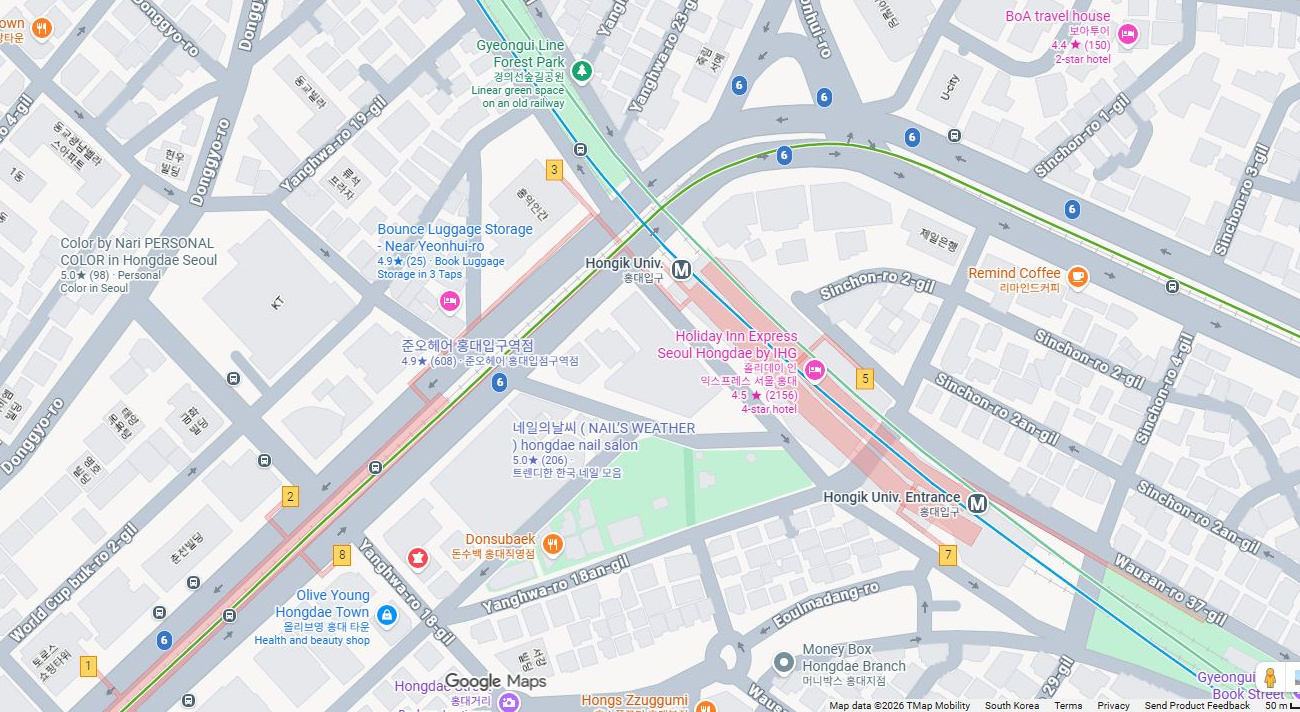
Before coming, she has also learnt that Walking Street forms part of a longer route called Red Road. The name brings together streets previously known by several names, including Eoulmadang-ro, Walking Street and Dangin-ri Junction. Red Road curves for about 2 km from Hongik University Station to Sangsu Station, with red paint marking the route. Tonight, Hina is taking her time over just the 500 m with the busking zones. Walking the whole route can be next month’s homework.

Seoul developed Walking Street between October 2016 and July 2017, along the roughly 500 m stretch from 107 to 155-1 Eoulmadang-ro. Its width makes “little street” feel more fitting than “main road”. Shops line both sides, with busking zones and stages along the way. It reminds Hina of a concert venue’s foyer. People waiting for a performance, people passing through and people heading into shops all share the same space.
Almost as soon as she starts walking, she hears singing in the distance. Buskers gather here from around the country, bringing noise and activity to the street every night. Bars and Korean barbecue restaurants popular with office workers cluster around the wooden stage and outdoor square, making this Friday evening particularly crowded. With performances, shop music and laughter all competing around her, Hina wonders how hard it must be to stop someone with a single song.
Four busking zones, with and without amplifiers
Hina has read through Mapo-gu’s notice before setting out. Walking Street has four busking zones. Zone 1 is outside 107 Eoulmadang-ro, Zone 2 outside 111, Zone 3 outside 127 and Zone 4 outside 143. Each has its own permitted types of performance. Zones 1, 2 and 4 allow amplified singing and dance, while Zone 3 is reserved for performances without amplification, including gentle vocal music, magic, mime and instrumental music.

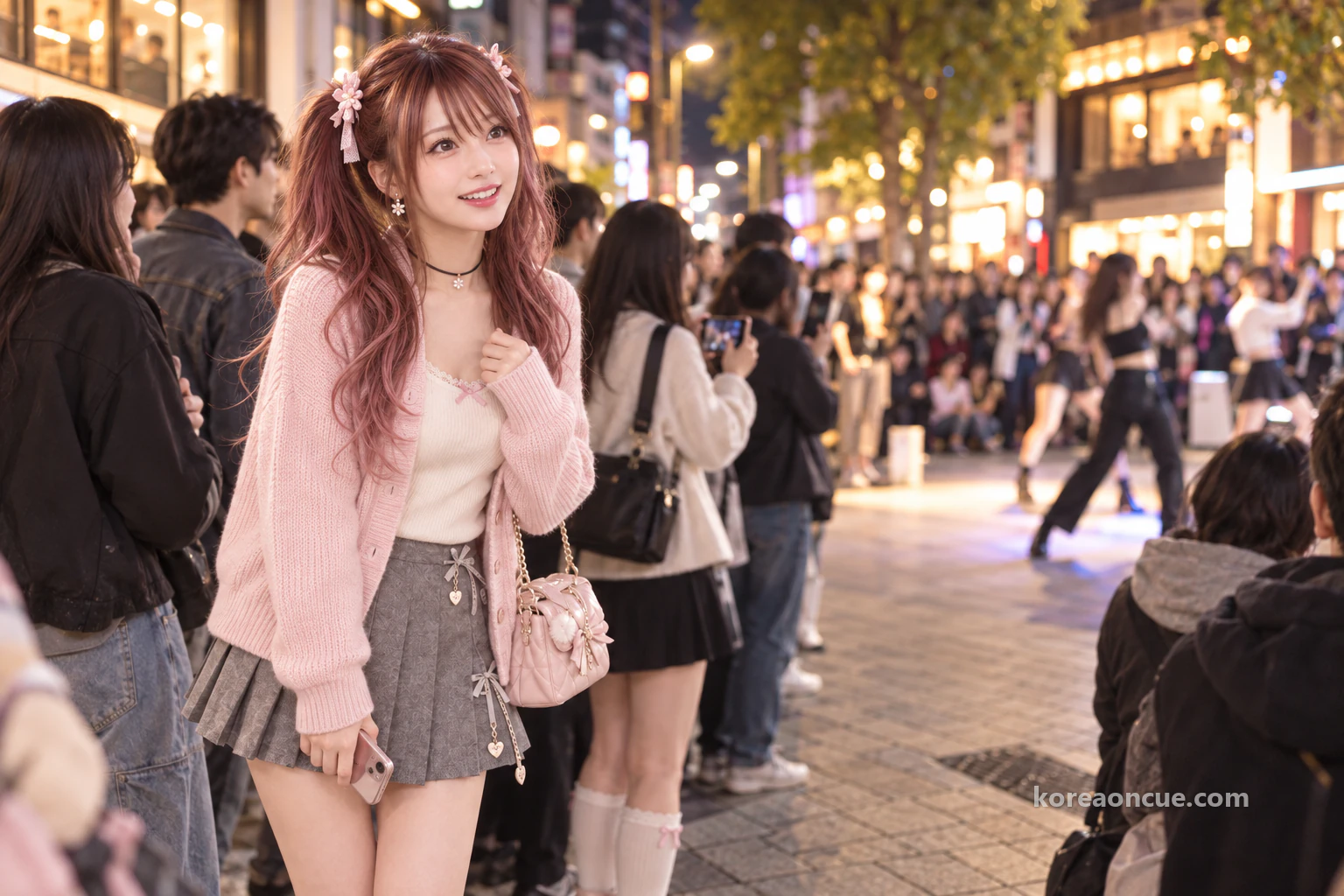
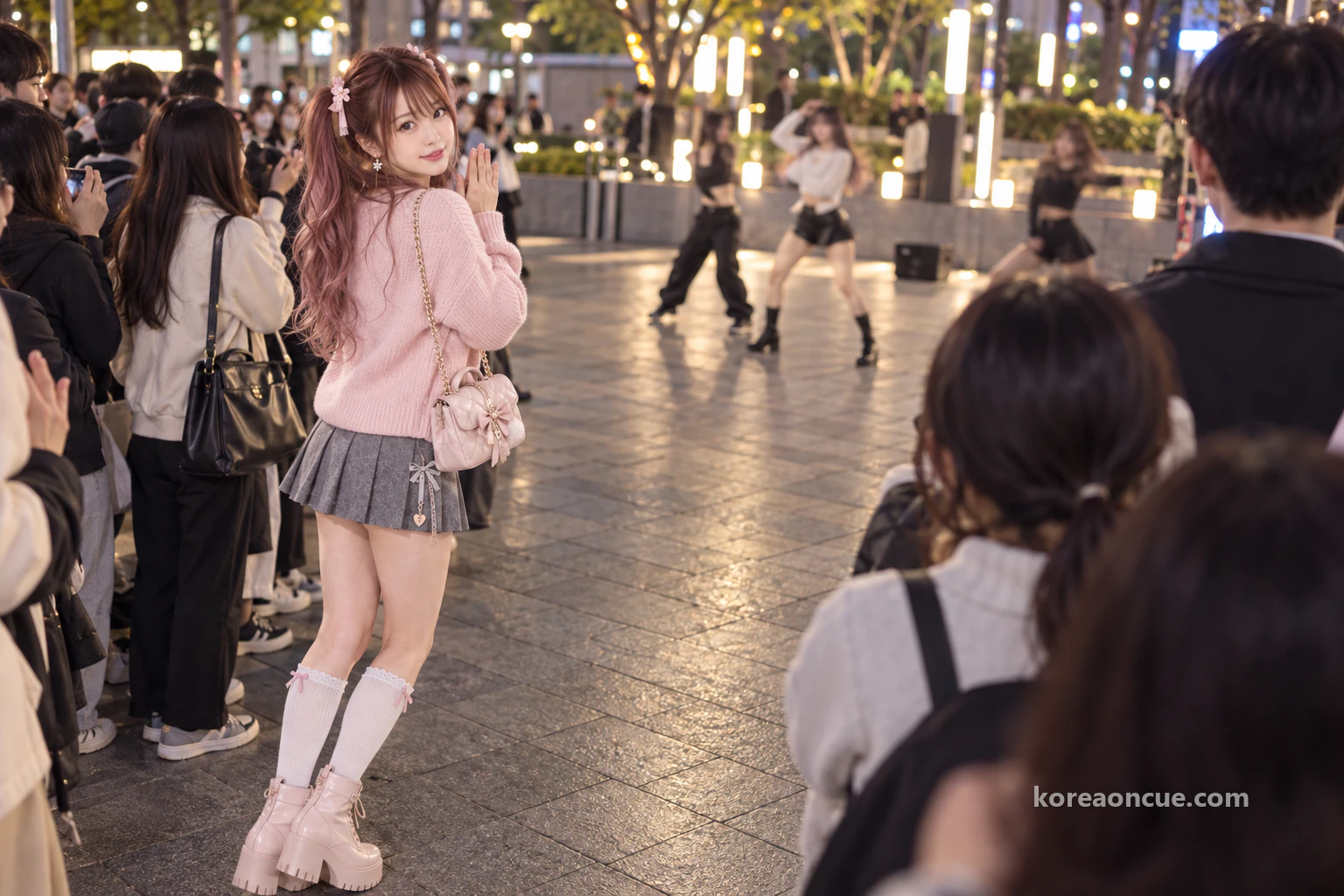
The first performance she finds is a dance act in Zone 1, where three people move to amplified music before a semicircle of spectators. Hina listens before she watches, surprised that such energetic music is quieter than she expected. Performers may use up to two amplifiers, but the 60 dB limit applies however many they use. Exceeding it can get a performance cancelled. She realises that sound out here involves quite different calculations from sound inside a concert venue.
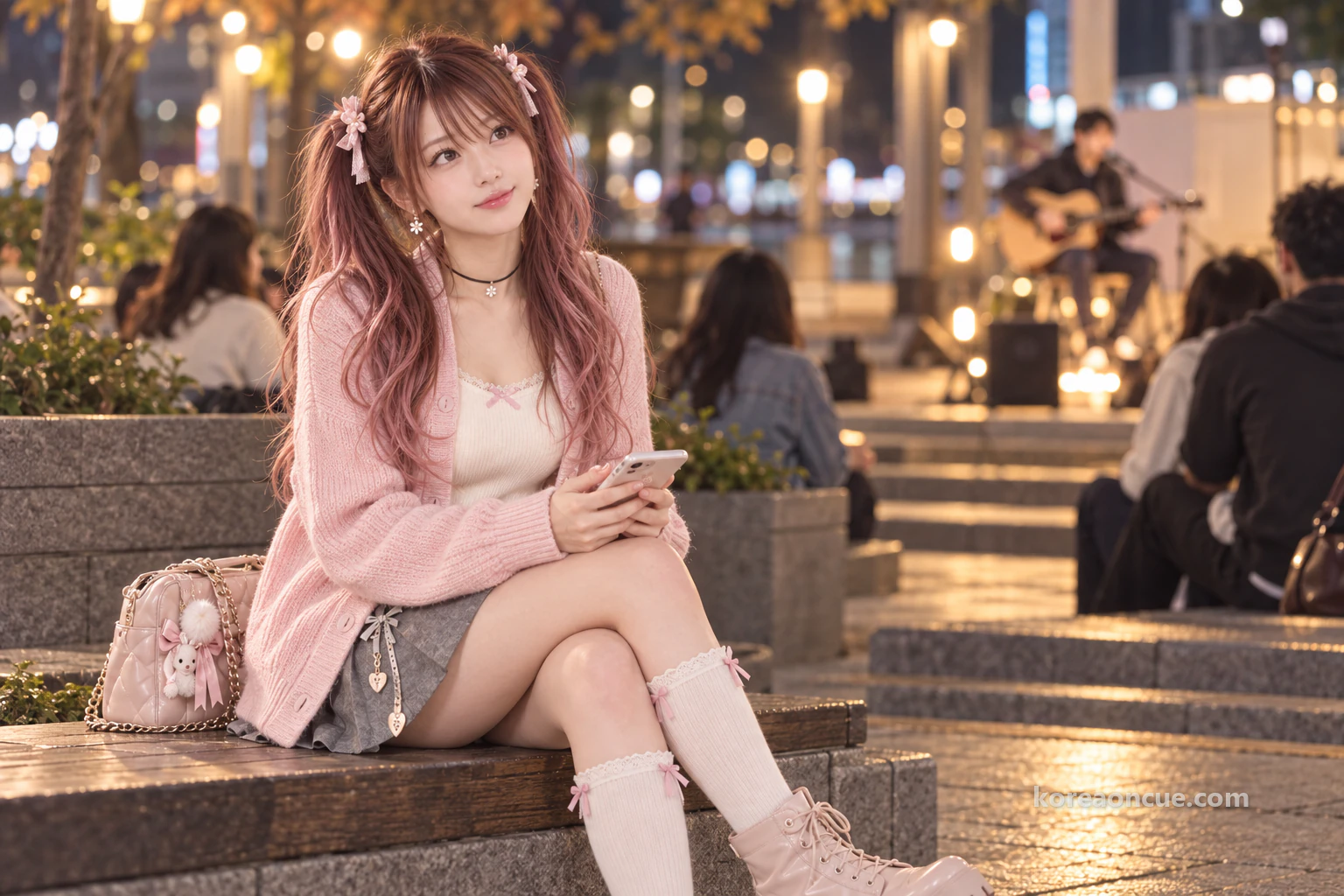
A little further along, Zone 3 feels completely different. Someone is singing with just a guitar and no amplifier, and the spectators have each edged a step closer. The softer sound naturally quietens the audience, creating a small pocket of calm even with shop music playing along the street. Hina begins to understand why the zones are separated. Louder and quieter performances have their own places, so one does not drown out the other.
When the guitar performance ends, a magic act follows in the same zone. The performer silently works a single coin through their hands while the audience watches every movement, barely breathing. Without amplification, the smallest gesture and each brief gasp from the crowd become part of the act. Hina is fascinated by how sounds she would never hear in a concert venue belong to the performance here. Mime and instrumental performances are also allowed in Zone 3, so it is somewhere to linger if quieter acts appeal.
How the lottery works and what performers must follow
What Hina most wants to understand is who gets to perform here and how. In a notice issued in late August 2026, Mapo-gu replaced its advance registration arrangement with monthly applications and a lottery. The first application round runs from the 10th to the 16th of each month through the booking system on Mapo-gu’s culture and tourism website, for two-hour slots. All applications go into the draw once the application period closes. Anyone who has not breached the rules can apply, but must include their performance genre and a performance plan.

Hina likes the arrangement, particularly the limit of six appearances per person per month: four on weekdays and two at weekends. It prevents the same person taking the same spot every day, while each two-hour slot allows 1 hour 50 minutes of performance and the final 10 minutes for clearing away before the next act. All lighting installed separately by performers is prohibited. She writes “six a month”, “1 hour 50 minutes + 10 minutes” and “no lighting” in her notes, then adds a small “fairness” beside them. For someone who works in promotion, a stage that gives everyone a chance makes a good story.
If slots remain after the first round, a second application round runs from the 25th to the 27th of each month. Reading that, Hina thinks of an extra release of concert tickets. It gives people who missed the first opportunity another chance. Eligibility and application dates may be information for performers, but they matter to spectators too. With different people able to take the same spot each day, another visit to Hongdae could bring a different performance.
The lighting rule is easy to spot as she walks, with performers using street lamps and the light from shops rather than setting up their own. Without a concert venue’s lights picking out the stage, performers and spectators stand under the same light. Hina thinks it suits a street performance. There is a practical reason for the rule too. Walking Street is surrounded by homes and shops, and excessive noise or lighting must not disturb the neighbours.
The consequences of breaking the rules are clear too: a performance that cannot be authorised will be stopped immediately if someone goes ahead with it. Hina reads this as a way to keep the street available for years to come. If complaints from residents and shops put an end to busking, performers and spectators would both lose their place. Tonight, the acts she watches keep within the sound rules and their allotted spaces. Perhaps that is why the whole street feels more orderly than she expected.
Check the schedule before choosing a performance
After the singing in Zone 3 finishes, Hina checks another detail. Lottery results are not sent out individually, so applicants must look on the website’s outdoor performance venue application page or the “홍대 야외공연 일정표”. That is useful for spectators as well as performers. Checking which genres are scheduled in each zone saves wandering along the street trying to follow the sound.
As someone who travels for concerts, Hina moves this information to the top of her notes. Even when coming over from Japan, she always starts by checking the line-up and timetable. “Street performances have a timetable too,” she writes. It makes Walking Street somewhere she can plan a visit around, as well as somewhere to stumble across an act. The schedule is filled in after the performers are selected by lottery, so check it the day before or on the day of the visit.
She notes the other stages too. Alongside the four busking zones, Walking Street has Gwangjang Stage at 132 Eoulmadang-ro and Yeohaeng Stage at 144, above the tourist information centre, while the AK& Busking Zone sits outside Hongik University Station Exit 4. Following the sound alone can make it hard to tell which stage it comes from, but knowing their positions makes the street easier to navigate. Hina marks each stage with a star on her map, ready to show Noah tomorrow.
The stage above the tourist information centre particularly interests her. Travellers asking for directions and spectators watching a performance gather at the same building. If this is a first visit to Hongdae and it is hard to know where to begin, the stage and information centre make a useful starting point. Looking at her map, Hina notices that all four zones and both stages sit along the same road, Eoulmadang-ro, in house-number order. Following those numbers would let her pass every performance spot.
Where to stand while watching
Throughout the walk, Hina pays particular attention to where she stands. Performers are required to manage their audiences so they do not block shop entrances or obstruct people walking past. Spectators who leave those spaces clear from the start give performers more time to concentrate on the act. While watching the dancing, Hina finds herself outside a shop door and quickly steps aside when someone wants to go in.

After that, she chooses her spot before settling down to watch. She leaves doorways clear, stays towards the edge rather than in the middle and allows room for people to pass behind her. Walking Street is also, as its name suggests, a street for walking, shared by spectators and people simply passing through. On a crowded Friday evening, even half a step to the side makes moving around easier. To Hina, it feels like the same understanding that keeps someone from blocking another person’s view at a concert.
The homes and accommodation around the street become more noticeable as she walks. Upstairs windows are lit, and travellers pulling suitcases thread between performances towards their lodgings. The repeated reminders to performers make sense when this is also the street someone comes home to every day. When Hina applauds, she claps enthusiastically without adding a shout.
The street is still far from silent, with audiences clapping along to the dancers and applause breaking out after each song. The sound simply does not overwhelm the whole road. Remembering herself waving a light stick at concerts, Hina thinks that being a fan also means adjusting the volume of her support to the setting. In a concert venue she can let go, while out on the street there are neighbours to consider. She writes “How loudly to cheer” in her notes.
A break at Hongik Culture Park
After about an hour of walking, Hina’s legs begin to ache. She heads to Hongik Culture Park, across the road from Hongik University. It is a small place to rest in the city, with benches, toilets and a little stage. Keep it in mind for a break or a toilet stop while exploring Walking Street. Hina sits on a bench, reties her shoelaces and reads her notes from the beginning.
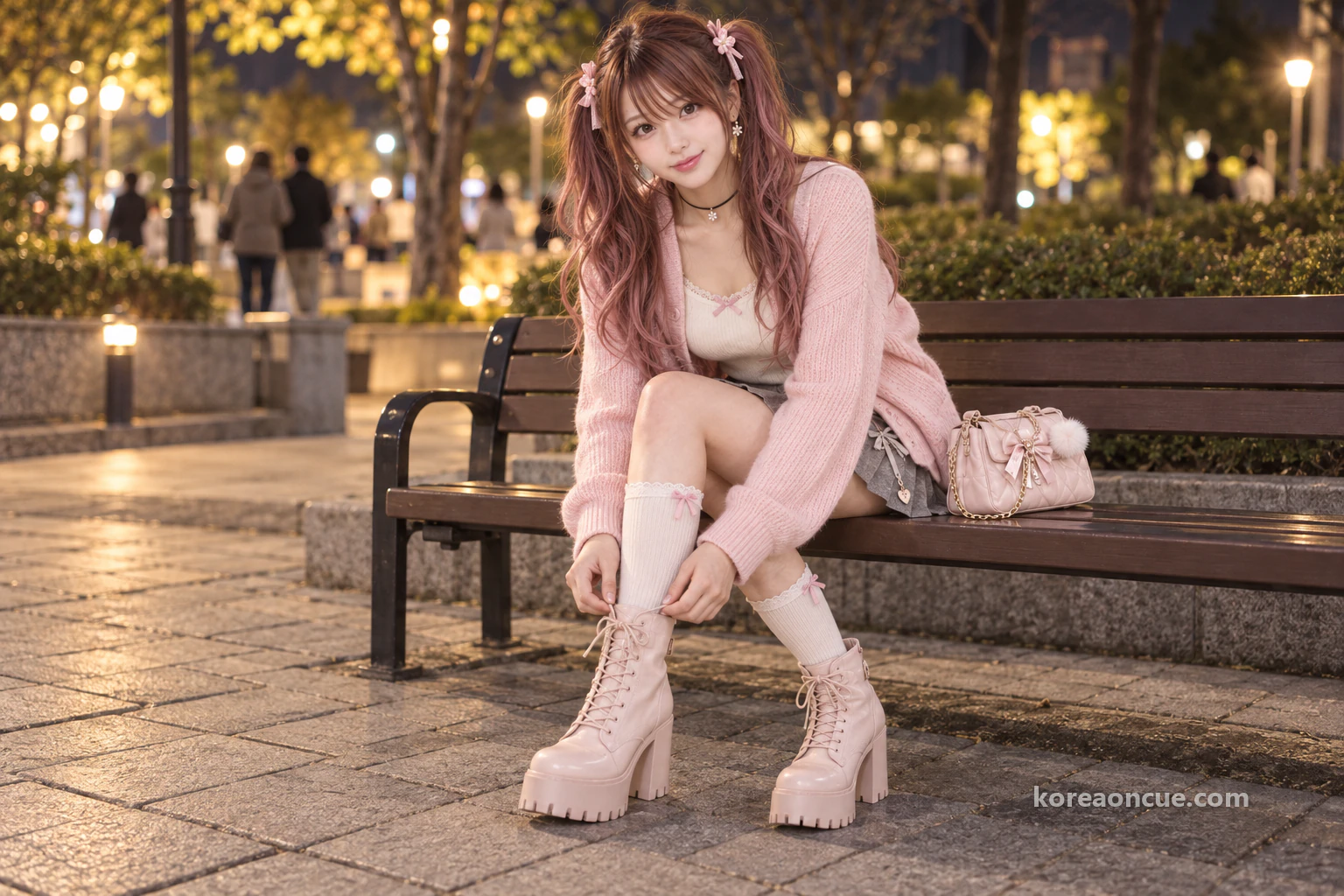
The page holds exit numbers, zone numbers and performance types, rules for performers, the schedule and “keep entrances clear”. Hina laughs, imagining herself applying the same habits at tomorrow’s concert venue. Her colleagues would surely call her a workaholic if they knew she was studying performances out on the street the night before a concert. But this is how she unwinds. She likes spending time with something she loves and looking at it from another angle.
The small stage at one side of the park is empty. Tonight, people are simply sitting on benches, resting or checking their phones. Sound from Walking Street reaches her faintly in the distance. Hina is surprised by how much quieter it gets after such a short walk away. After more than an hour surrounded by performances, the park gives her ears a rest too.
From the bench, Hina sends Noah another message: “The guitar performance in Zone 3 was my favourite — it was so quiet that everyone moved closer.” He replies, “The riverside tomorrow is like that too — people sit there for ages without much noise.” She decides she will understand what he means when she sees it tomorrow. For now, she checks the circle on his map photo again.
Watching the acts change over, then back towards Exit 8
Before returning to her accommodation, Hina takes another slow walk along Walking Street. The first time, she kept turning her head to follow the sound, but now she can check off the zone numbers as she goes. In Zone 1, the dancers have already been replaced by the next act. The figures in her notes, 1 hour 50 minutes performing and 10 minutes clearing away, are playing out in front of her.
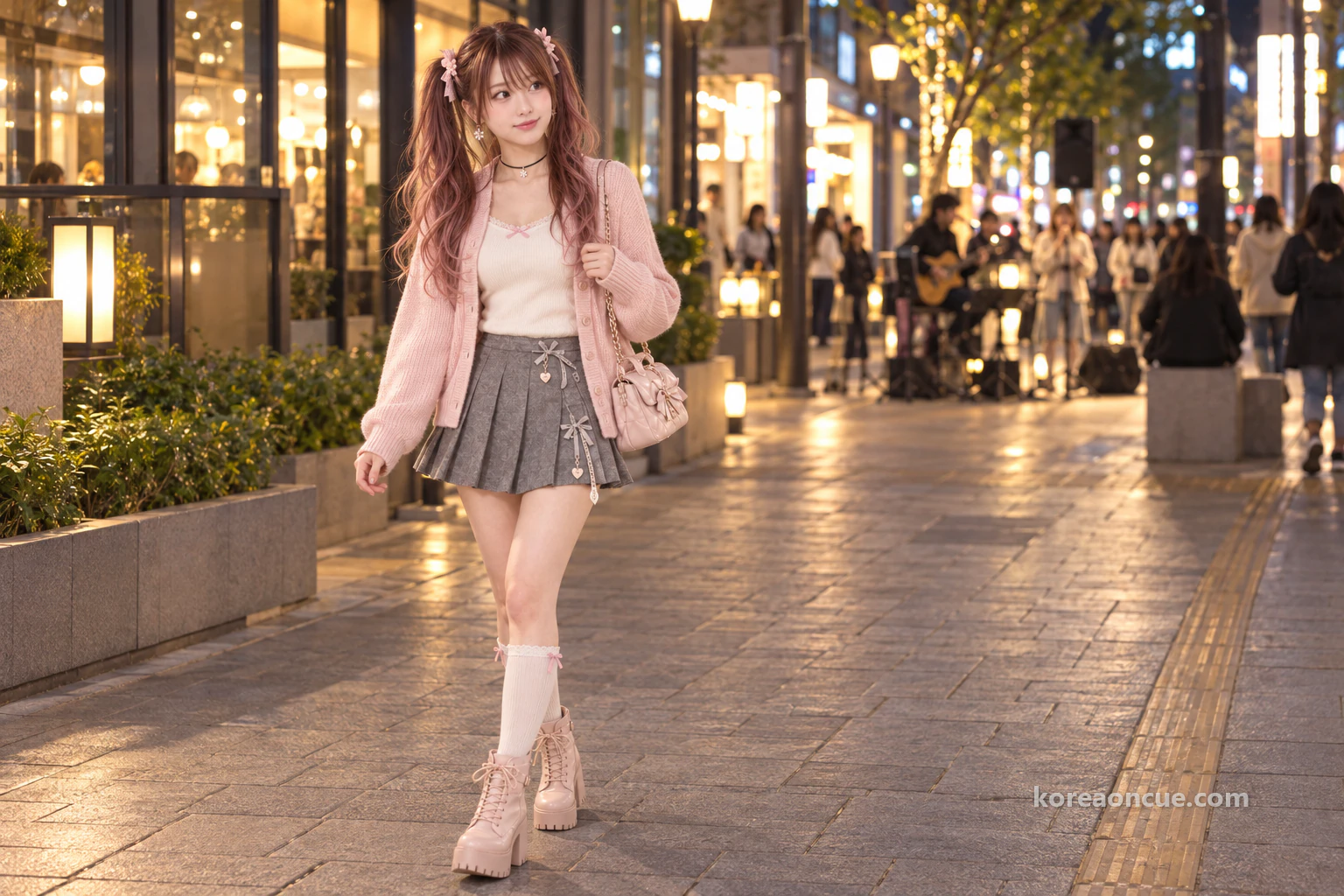
The changeover itself interests her. As one performer packs away their equipment, the next waits nearby, while some spectators leave and others stay for the following act. There is no curtain rising and falling as in a concert venue, but the street has its own transitions. Hina wants to tell Noah about this tomorrow. Someone who draws routes might also enjoy watching how people gather and disperse.
Hina has not spoken to any of the performers during her walk. She has not asked for an autograph or a photo together, simply stood among the audience, watched, clapped and moved on. Usually a fan at concerts, she finds this little distance unfamiliar. Instead of following a favourite performer, she can stop for one song by someone she has never seen before and then leave. It feels right for a Friday night in Seoul.
Walking towards Exit 8, Hina adds another line beneath “The night before the concert”: “The street has a timetable too, and a place to stand.” Tomorrow evening she will follow the concert venue’s schedule, but first she has a daytime appointment at the circle on Noah’s map. Last month he showed her the way, and she has promised that this time she will show him the route to the concert venue.
On the walk back to her accommodation, she puts tomorrow’s stories for Noah in order. Four busking zones, separate spaces with and without amplifiers, performers chosen by lottery, then the sound of the guitar in Zone 3. Since he likes drawing routes, she thinks he would enjoy seeing the zone numbers and street addresses marked on a map. She writes “For Noah — a map of the zones” in her notes and adds a small star beside it.
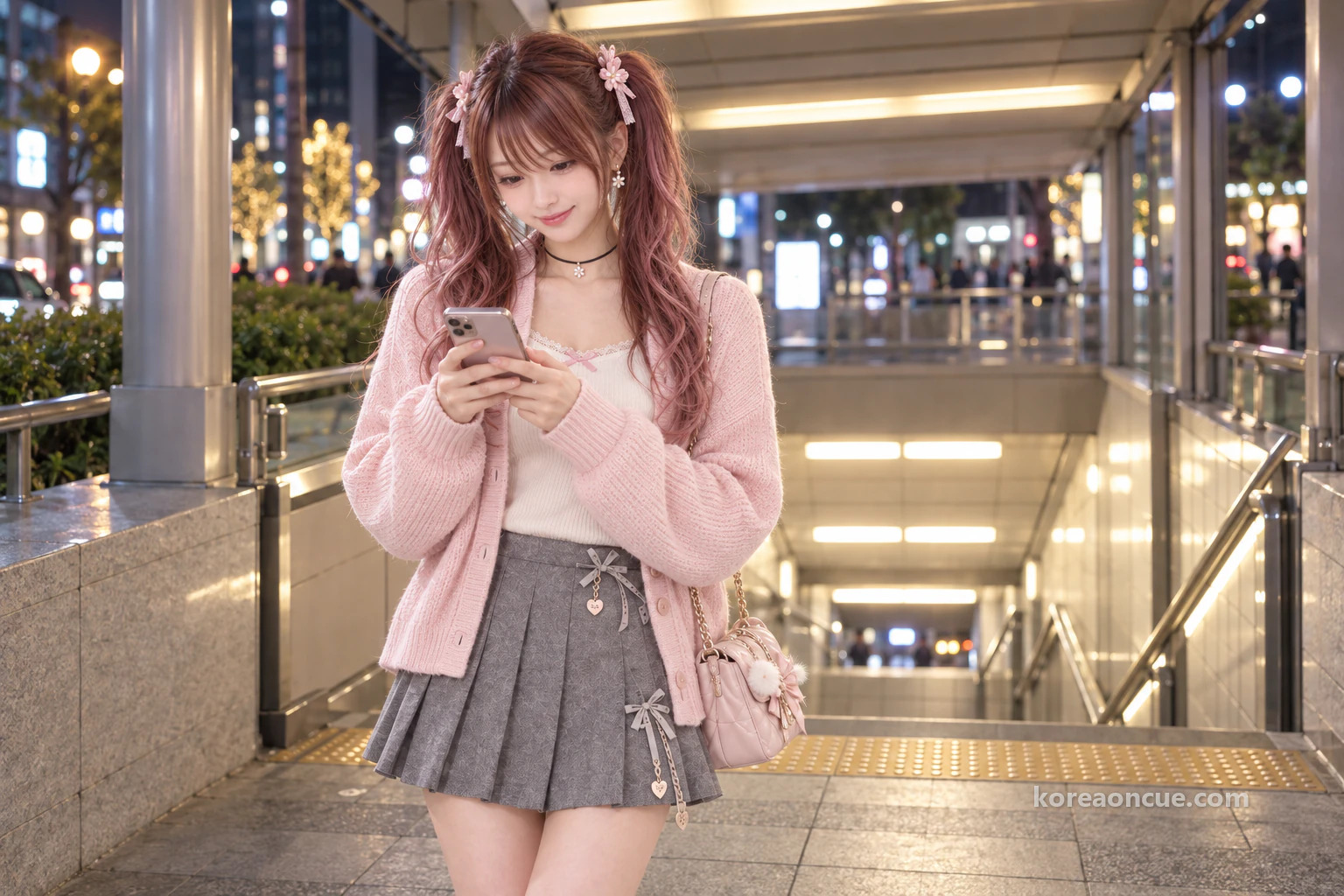
Back at her accommodation, Hina opens her bag’s zip pocket once more. Her passport is still there, beside the phone holding tomorrow’s concert ticket. Last month she made a note called “The way home”, and this month she has “The night before the concert”. She feels a little amused and a little proud that the headings have changed so much in a month, in the same city.
Before bed, Hina opens Noah’s map photo again and notices the small word “나들목” beside the circle near Mangwon Hangang Park. She will find out what it means tomorrow, but copies it into her notes now. It becomes the final line of “The night before the concert”. Tomorrow means the riverside during the day and a concert in the evening. She is already excited to have her day in Seoul divided into those two parts.
Common Mistakes
Rushing up the stairs at Exit 9
this exit gets very crowded. Exit 8 also leads towards Walking Street, with the same onward direction towards Hongik University.
Following only the sound
the four busking zones are outside 107, 111, 127 and 143 Eoulmadang-ro, with Gwangjang Stage at 132 and Yeohaeng Stage at 144. Knowing their locations makes the walk easier.
Leaving every performance to chance
check the day’s acts in advance on Mapo-gu’s “홍대 야외공연 일정표”.
Watching from a shop doorway
leave entrances and walking routes clear. Homes, accommodation and shops all share this street.
Talking loudly beside a quiet act
Zone 3 is for unamplified performances, including gentle vocal music, magic, mime and instrumental music.
Wandering around looking for toilets
Hongik Culture Park, across the road from Hongik University, has benches and toilets.
FAQ
How do I get to Hongdae Walking Street?
Leave Hongik University Station (Line 2) through Exit 8 or 9 and walk straight towards Hongik University. The street runs for about 500 m, from 107 to 155-1 Eoulmadang-ro.
How many busking zones are there?
Four: Zone 1 outside 107 Eoulmadang-ro, Zone 2 outside 111, Zone 3 outside 127 and Zone 4 outside 143. Zones 1, 2 and 4 allow amplification, while Zone 3 is unamplified.
How can I find out who is performing today?
Check “홍대 야외공연 일정표” on Mapo-gu’s culture and tourism website.
How loud are the performances?
Performers can use up to two amplifiers, with a volume limit of 60 dB. Exceeding it can get a performance cancelled.
Can anyone perform?
Anyone who has not breached the rules can apply through Mapo-gu’s booking system from the 10th to the 16th of each month, with places allocated by lottery. Each person can perform up to six times a month: four weekday appearances and two at weekends.
Is there somewhere to rest or use the toilet?
Hongik Culture Park, across the road from Hongik University, has benches, toilets and a small stage.
Who can I contact with questions?
Mapo-gu Tourism Policy Division, 02-3153-8673.
Recap — 30 seconds before you go
- Hongik University Station Exits 8 and 9 → straight towards Hongik University. Exit 9 gets crowded, and Exit 8 leads in the same direction.
- Busking zones outside 107, 111, 127 and 143 Eoulmadang-ro. Amplification in Zones 1, 2 and 4, none in Zone 3. Gwangjang Stage at 132 and Yeohaeng Stage at 144.
- Check Mapo-gu’s “홍대 야외공연 일정표” for the day’s performances before heading out.
- Leave shop entrances and walking routes clear, and keep conversation quiet beside unamplified acts.
- For a rest or toilets, head to Hongik Culture Park.
Sources
- Mapo-gu — changes to Hongdae Walking Street busking zone use (31 August 2026)Advance registration abolished · monthly applications on the 10th–16th followed by a lottery, remaining slots on the 25th–27th · two-hour booking units, genre and performance plan required · maximum six bookings per person per month (four weekday, two weekend) · up to two amplifiers and a 60 dB limit, with possible cancellation if exceeded · no separately installed lighting · amplified performances in Zones 1, 2 and 4, unamplified performances in Zone 3 · directions to the Hongdae outdoor performance schedule · Tourism Policy Division: 02-3153-8673checked 2026-10-22
- Mapo-gu — outdoor performance venue applications, step 1Performances last 1 hour 50 minutes with 10 minutes for clearing up · manage audiences to keep shop entrances and pedestrian routes clear · avoid excessive sound or lighting that disturbs residents and businesses · unauthorised performances that do not meet approval criteria may be stoppedchecked 2026-10-22
- Mapo-gu — outdoor performance venue applications, step 2Busking Zones 1–4 outside 107, 111, 127 and 143 Eoulmadang-ro · plaza stage at 132 · travel stage at 144, above the tourist information centre · AK& busking zone outside Hongik Univ. Station Exit 4checked 2026-10-22
- Mapo-gu — Hongdae attractions: Hongdae Walking StreetEoulmadang-ro area in Mapo-gu · walk straight towards Hongik University from Hongik Univ. Station Exits 8 or 9 · buskers from across the country · pubs and barbecue restaurants near the wooden stage and outdoor plazachecked 2026-10-22
- Korea Tourism Organization, VisitKorea — Hongdae Walking StreetAbout 500 m from 107 to 155-1 Eoulmadang-ro · developed between October 2016 and July 2017checked 2026-10-22
- Korea Tourism Organization, VisitKorea — Hongik Culture ParkSmall urban rest spot across the road from Hongik University · benches, toilets and a small stagechecked 2026-10-22
A Seoul story told with our AI characters. Place details are checked against public sources; the photos are AI-made illustrative images. How we use AI