
SEOUL · HAPJEONG
Sunday at Jeoldusan, Monday at Yanghwajin: Noah’s two walks from Hapjeong Station Exit 7
The church and museum at the historic site of Yanghwanaru and Jamdubong, a weekend guided pilgrimage, and a cemetery closed to general visitors on Sundays
The day after saying goodbye to Hina at Mangwon Hangang Park, Noah comes out of Hapjeong Station Exit 7. Of the two places he plans to draw in his notebook, one does not open to general visitors on Sundays.
How to get there
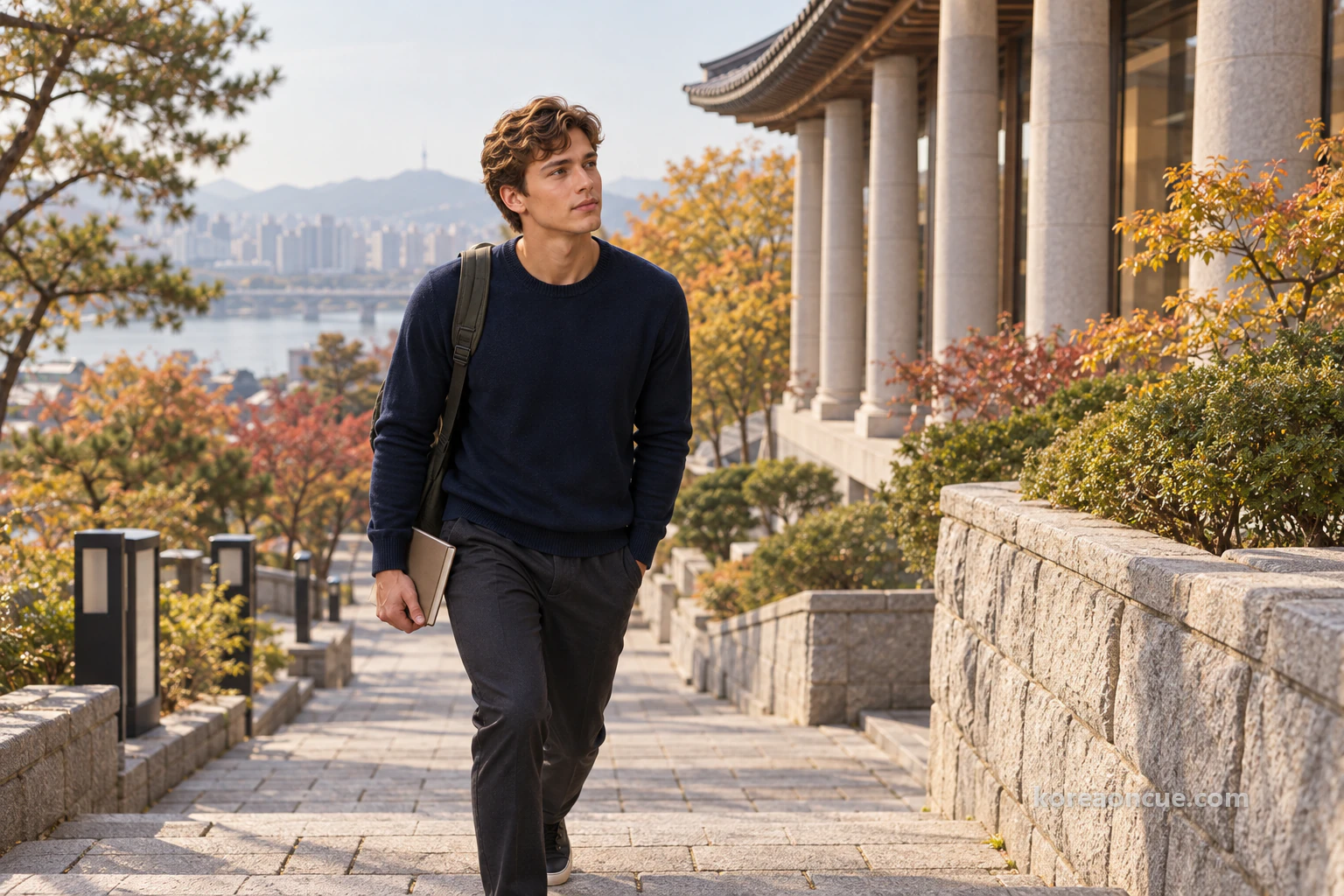
On Sunday morning, Noah looks again at his sketch of the spot where he and Hina spread their picnic mat at Mangwon Hangang Park yesterday. A small rectangle, with “Hina’s route” written beside it. Hina said she was flying back to Tokyo tonight, and when they parted, Noah promised to send her a drawing from his walk around Hapjeong today. He is from Canada and is spending his time in Seoul walking its streets and drawing the routes he takes. Today’s page begins at Hapjeong Station Exit 7.

Noah has chosen two places within walking distance of Hapjeong Station Exit 7: Jeoldusan Martyrs’ Shrine and Yanghwajin Foreign Missionary Cemetery. Both are near the same exit, towards the Hangang River. When he first arrived in Seoul, he passed through this area and noticed a building on a hill by the river, without knowing what it was. Before drawing it today, he wants to read its history.
He read both websites carefully last night and spotted something that changed his plans. Yanghwajin Foreign Missionary Cemetery opens Monday to Saturday, but not to general visitors on Sundays. On Sundays, only bereaved families may visit the graves. Noah adjusted the plan in his notebook: Jeoldusan on Sunday, the cemetery on Monday morning, turning one walk into two.
He does not mind the change. At Mangwon Hangang Park yesterday, Hina said that Seoul’s public spaces set out exactly where things are allowed and until what time. The cemetery’s Sunday closure feels like another such agreement. It leaves a day for the families of those buried there to visit quietly. Thinking about that, Noah feels that spreading the walk over two days suits these places rather well.
This piece follows those two days and serves as a first-visit guide to Jeoldusan Martyrs’ Shrine and Yanghwajin Foreign Missionary Cemetery. It covers the station exit and walking routes, the history of both sites, opening hours and the rules to keep in mind. Along the way, Noah joins a weekend guided pilgrimage and finds out why the cemetery needs a separate plan on Sundays.
The Cue
Jeoldusan Martyrs’ Shrine and Yanghwajin Foreign Missionary Cemetery are historical sites towards the Hangang River, within walking distance of Hapjeong Station Exit 7 on Lines 2 and 6, with Jeoldusan about 450 m or ten minutes away. Jeoldusan forms part of the nationally designated historic site “Yanghwanaru Ferry Dock and Jamdubong Peak, Seoul”, where Catholics were executed during the Byeongin Persecution of 1866. The shrine grounds can be visited at any time, but individual buildings have their own hours: the Byeongin Martyrdom Centenary Memorial Church and relic chamber open from 7 a.m. to 5 p.m., and the Korean Catholic Martyrs’ Museum opens Tuesday to Sunday from 9:30 a.m. to 5 p.m. The cemetery entrance is about 200 m along the passage beside Yanghwajeong Pavilion directly ahead of Exit 7, with opening hours of Monday to Saturday, 10 a.m.–5 p.m., subject to these restrictions: Saturdays are for visitors with a guided-visit booking only, from 10 a.m. to 3 p.m., and Sundays are for bereaved families only. Both places call for quiet, so check their photography rules before visiting.
- Jeoldusan Martyrs’ Shrine: 6 Tojeong-ro, Mapo-gu, Seoul, in the Hapjeong-dong neighbourhood. About 450 m / 10 minutes on foot from Hapjeong Station Exit 7.
- Jeoldusan hours: Church and relic chamber 07:00–17:00, with no entry to the relic chamber during Mass. Museum Tue–Sun 09:30–17:00, closed Mondays, 1 January and the Seollal and Chuseok holiday periods. Admission is by voluntary offering.
- Guided pilgrimage: Saturdays and Sundays only, departing from outside the education building at 11:00, 11:30, 13:00 and 14:00. No booking needed, duration 50 minutes. No video filming or audio recording.
- Yanghwajin Foreign Missionary Cemetery: 46 Yanghwajin-gil, Mapo-gu, Seoul. About 200 m along the passage beside Yanghwajeong Pavilion, directly ahead of Hapjeong Station Exit 7.
- Cemetery hours: Mon–Sat 10:00–17:00. Saturdays 10:00–15:00, guided-visit bookings only. Sundays are for bereaved families only. Book guided visits by 18:00 the day before, with no same-day bookings.
- Rules: Keep quiet. At Jeoldusan, no alcohol, smoking, bicycles or kick scooters, and no pets except guide dogs. Photography inside the church or museum requires prior agreement. At the cemetery, walk in single file along the visiting paths and take photographs only from the paths between the burial areas. No eating, drinking or loudspeakers.
Hapjeong Station Exit 7, then 450 m towards the river
At 10:30 on Sunday morning, Noah comes out of Hapjeong Station Exit 7, about 450 m or ten minutes on foot from Jeoldusan. Visitors arriving by bus can also get off at Hapjeong Station and follow the same walking route. Outside the exit, he opens his notebook and draws the first line. This is today’s starting point. Directly ahead stands Yanghwajeong Pavilion, which he will pass on his way to the cemetery tomorrow.
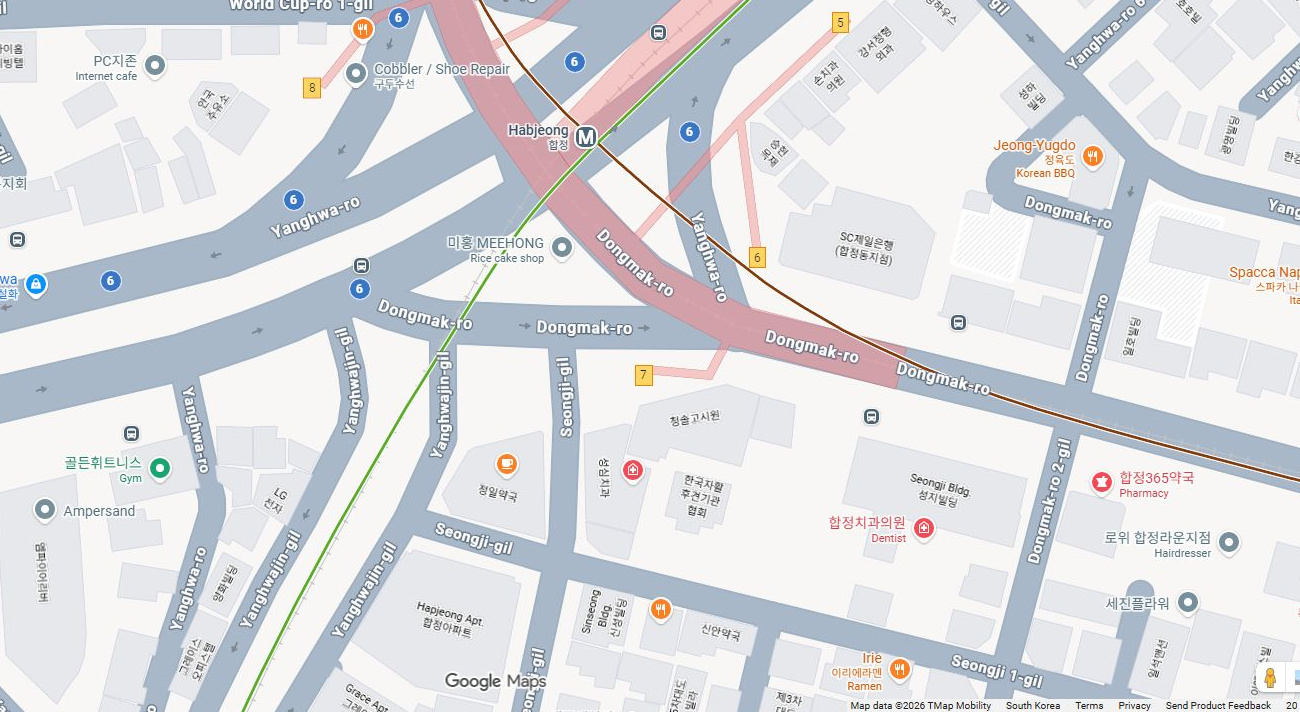
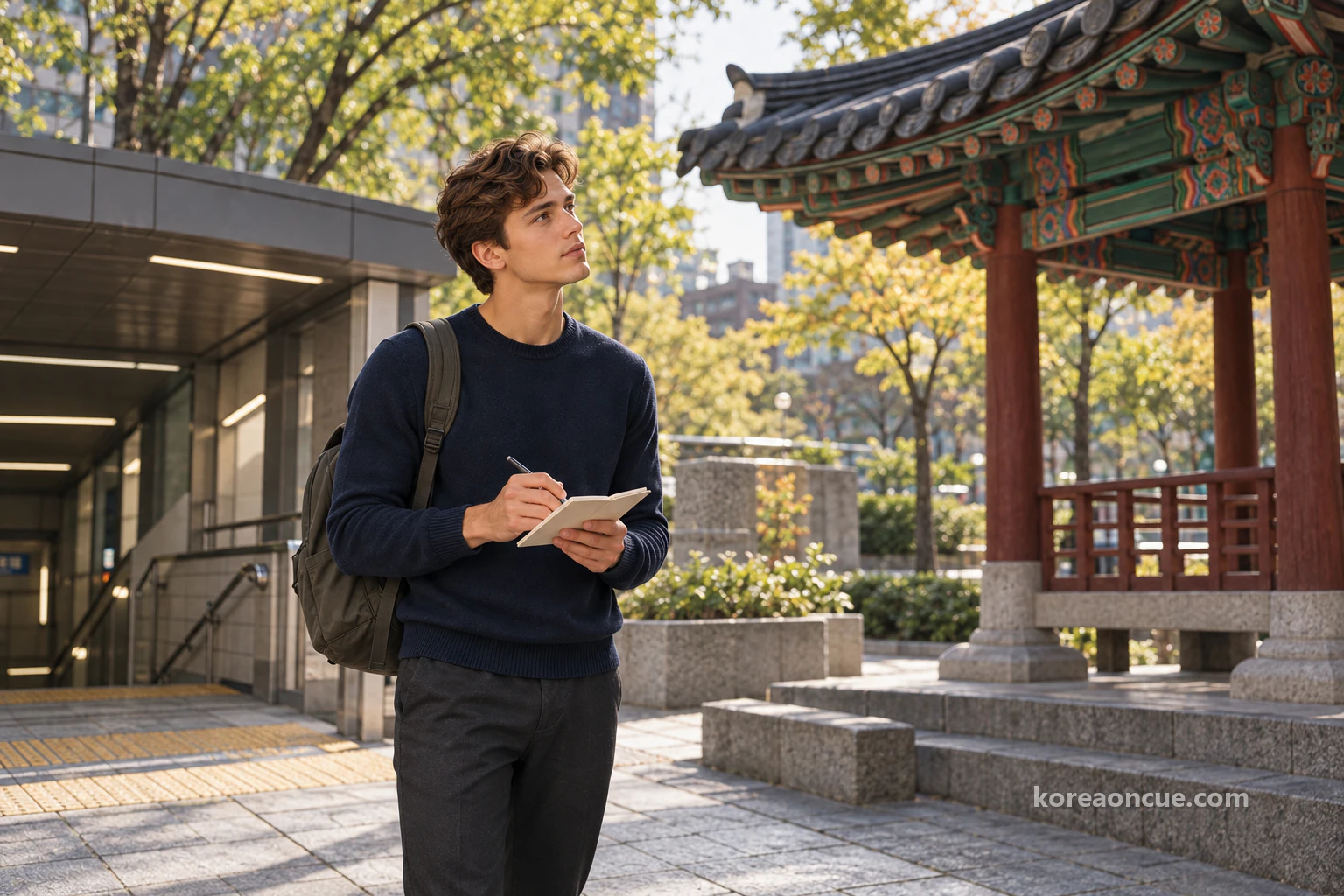
Walking towards the river, Noah thinks back to what he read last night. Yanghwajin means a ferry landing where willow flowers bloom, while the prominent riverside peak was called Jamdubong because its shape resembled a silkworm’s head. The names suggest a peaceful stretch of river, but Noah knows the peak would later acquire a very different name.
The neighbourhood begins to change as he walks. Beyond the busy streets around the station, it grows quieter, with more trees as the road climbs towards the hill. It is Sunday morning, and some of the people heading towards the shrine look as though they are going to Mass. Noah slows down and keeps to the edge of the path so he does not get in their way. Drivers can use the shrine’s outdoor car park, but buses and vehicles whose occupants are not visiting the shrine cannot park there, and public transport is recommended on Saturdays, Sundays and public holidays.
From Yanghwajin and Jamdubong to Jeoldusan
At the entrance to Jeoldusan, Noah stops for a long time in front of an information panel. From the reign of King Taejong in the 15th century to that of King Injo in the 17th, during the Joseon dynasty, Yanghwanaru and Jamdubong were used chiefly to receive envoys from Ming China, while senior officials and scholar-officials built villas here and enjoyed the setting. “Yanghwa dapseol”, walking through snow at Yanghwanaru, was one of the ten celebrated views of Hanyang known as the Hando sipyeong. An official military garrison was established here in 1754, the 30th year of King Yeongjo’s reign.

Then, in October 1866, executions of Catholics previously carried out at Saenamteo or outside Seosomun suddenly began taking place at Yanghwajin. During this Byeongin Persecution, the peak became known as Jeoldusan, meaning the peak where Catholics were beheaded. Church martyr records suggest that around 200 people were martyred at Jeoldusan, of whom 29 can be identified by name. Noah leaves those numbers out of his notebook. They feel too heavy to put on a page intended for drawing.
A willow-flower ferry landing, a silkworm-head peak, a scenic place for receiving envoys, and Jeoldusan. What stays with Noah is how differently the same ground has been named. When drawing a route, he usually begins by asking what the road looks like now, but here he finds himself wondering what this land has been called over time. Across the top of today’s page, he writes the four names in small letters.
On 11 November 1997, the site received national historic-site designation under the name “Yanghwanaru Ferry Dock and Jamdubong Peak, Seoul”. Other Catholic shrines had already been designated as local cultural heritage, but Jeoldusan was the first to become a national historic site. It covers 35,548 m², at 6 Tojeong-ro, Mapo-gu. Knowing its designation makes Noah feel he should walk a little more carefully here.
Looking at the church and museum from outside
At the top of the hill, the church and museum appear side by side. The Byeongin Martyrdom Centenary Memorial Church is on the right, and the Korean Catholic Martyrs’ Museum on the left. The martyrdom site was purchased in 1956, construction began in 1966, and the church and museum were built in October 1967. The museum was originally called the Jeoldusan Martyrs’ Memorial Hall. A bell tower stands where the two buildings join.
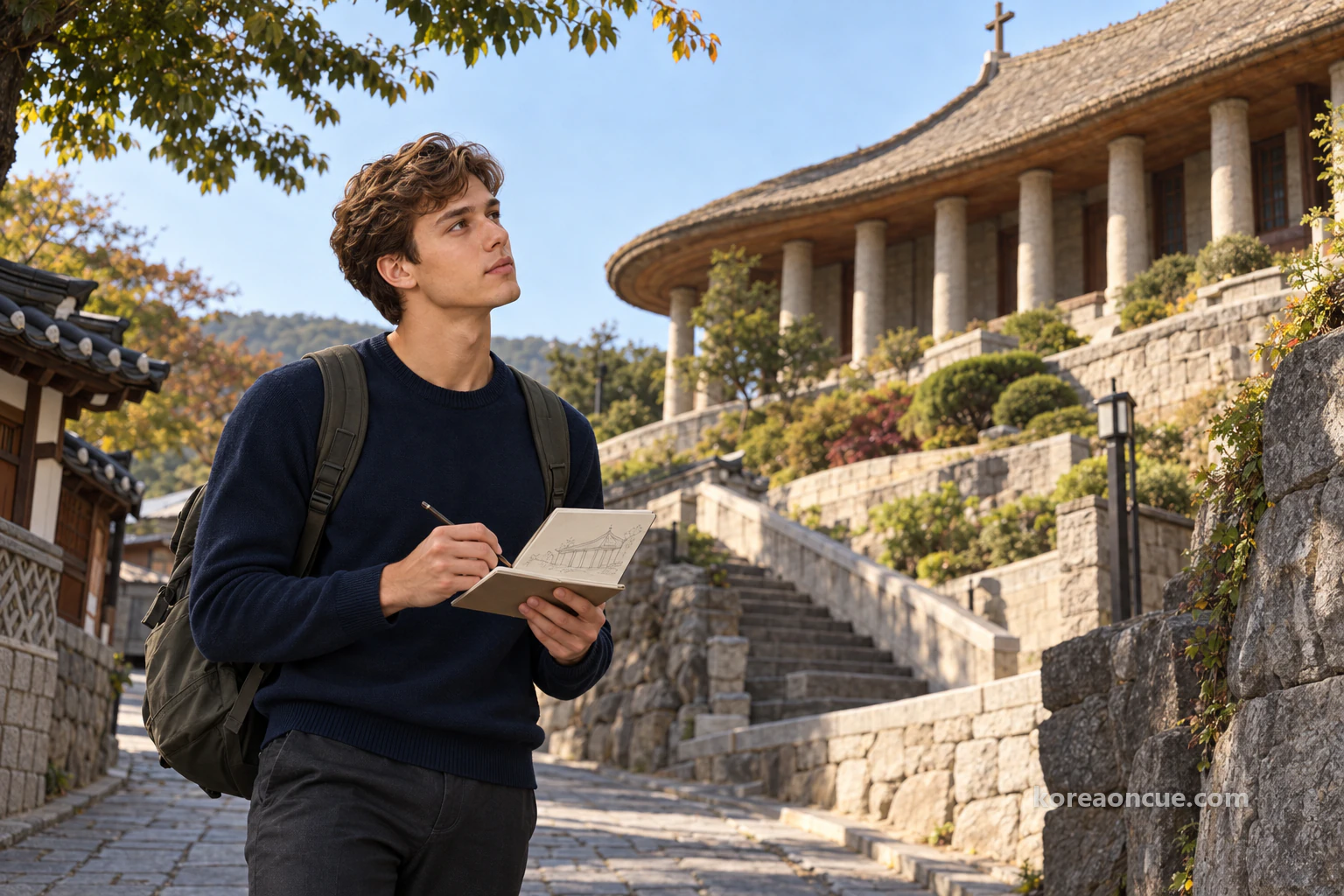
Noah spends a while looking at the buildings. Designed by Lee Hee-tae, they draw on traditional Korean architecture. The colonnade has round pillars like those of a palace, the eaves sweep down like the roof of a thatched house, and inside the church, the canopy above the altar takes the shape of a gat, a traditional Korean hat. As he copies the pillars and eaves into his notebook, Noah studies how the architect has brought a Western church and a Korean roof into the same building.
There are sculptures on the outside of the bell tower and the church’s western wall. The tower carries Kim Se-jung’s relief *Martyrs* and Kang Hee-deok’s *Cross*, while a bronze relief by Kim Se-jung on the church’s western wall depicts 26 martyrs of the Byeongin Persecution. Two works by Lee Sun-seok face each other on either side of the museum entrance. Noah does not draw each sculpture individually, but marks their positions with small dots on his sketch of the buildings. That way, whoever looks at the drawing later will know where to look.
Before going inside, Noah puts his notebook in his bag. Photography inside Jeoldusan’s church or museum is permitted only by prior agreement. He decides to approach drawing in the same spirit and simply look while he is indoors. Food and drink cannot be brought into the church or museum either. He puts away the water bottle he has been holding and pushes the door open quietly.
The relic chamber and Mass times
Beneath the church is a chamber housing the martyrs’ relics. It took its present form in 1984 and holds the relics of 27 Korean martyr saints and one unnamed martyr. On 3 May 1984, Pope John Paul II visited this chamber as the first engagement of his visit to Korea. The church and chamber open from 7 a.m. to 5 p.m., but the chamber is closed to visitors during Mass.
The morning Mass is still under way when Noah arrives. At Jeoldusan, Mass is held once on Mondays, at 10 a.m., and twice daily from Tuesday to Sunday, at 10 a.m. and 3 p.m. Saturday’s 3 p.m. Mass is celebrated as a Sunday Mass. Noah waits outside until Mass has finished before heading to the relic chamber. For a first visit, checking the Mass times beforehand can save a wait or a return trip at the chamber entrance.
Noah does not stay long in the relic chamber. He bows his head quietly and tries to remember the room as it is. For someone who draws, looking without drawing can be the hardest part, but today it feels appropriate. Outside, he takes out his notebook again without attempting a picture of the chamber. Instead, he adds a single line for the steps leading up to the church.
The shrine asks visitors to observe a few rules. Keep conversations and laughter quiet, avoid very short skirts or shorts and tight-fitting clothes, and do not ride bicycles or kick scooters into the grounds. Pets are not allowed except guide dogs, and alcohol and smoking are prohibited throughout the shrine. Visitors are also asked to leave the trees and flowers untouched. Reading the list, Noah remembers that more than a visitor attraction, this is somewhere people come to pray.
Inside the church, Noah spends longest looking at the crucifix above the altar. It hangs from the ceiling, with Christ’s head bowed. Along the walls, the Stations of the Cross are depicted using hands alone, and the gat-shaped canopy above the altar contains a circular stained-glass work. Rather than drawing any of it, Noah takes his time looking. Later, he tells Hina that the Stations of the Cross taught him something about saying more with fewer lines.
The museum and weekend guided pilgrimage
The museum opens Tuesday to Sunday, from 9:30 a.m. to 5 p.m. It closes on Mondays, 1 January and during the Seollal and Chuseok holiday periods. There is no fixed admission charge, only a voluntary offering. The permanent exhibition “A Pilgrimage Through the Eyes: The History of Korean Catholicism” has been running since November 2020. Flash, tripods and commercial photography are prohibited inside, and phones must be switched off or set to vibrate.
Leaving the museum, Noah checks the time. It is a little after 11:30. Jeoldusan runs guided pilgrimages on Saturdays and Sundays only. There is no need to book: meet outside the education building for a 50-minute visit starting at 11 a.m., 11:30 a.m., 1 p.m. or 2 p.m. Noah decides to join the 1 p.m. departure and spends the time until then walking slowly along the paths outside the shrine.
The guided pilgrimage brings Noah back to things he passed without noticing on his own. Outside are a statue of Father Kim Dae-geon, blessed in 1972, a Lourdes grotto made in 1978, and a statue of Nam Jong-sam, whose baptismal name was John the Baptist. The cross from the old bell tower is displayed embedded in the ground in front of the Nam Jong-sam statue. Listening to the guide, Noah begins to understand how many different periods have left their mark here, beyond any single memorial. Video filming and audio recording are not allowed on the guided pilgrimage, so follow his example and take it in by listening.
Afterwards, Noah sits on a bench outside the education building to organise his notebook. The shrine has facilities for visitors with limited mobility. Two wheelchairs are available at the education building entrance, and visitors using a wheelchair can ask staff to operate the lift into the church. Automated external defibrillators are located at the museum and education building entrances, while toilets are in the education building, outdoors and halfway up the steps to the church. The outdoor toilets close in winter.
The education building also houses a chapel, the shrine office, a religious-goods centre and a pilgrims’ dining room, offering somewhere to pause during a longer visit. Noah gets up from the bench, looks around the front of the building and watches the pilgrims quietly disperse. There are quite a few people at the shrine this Sunday afternoon, but little noise. He records the scene in a few lines. Instead of drawing faces, he uses arrow-like strokes to show which way people are walking.
Why Noah leaves the cemetery for Monday
Around 3 p.m., Noah passes Yanghwajeong Pavilion on his way back towards Hapjeong Station Exit 7. The cemetery entrance is about 200 m along the passage beside it. He pauses at the start of the passage, then turns away, leaving it for tomorrow. Yanghwajin Foreign Missionary Cemetery opens Monday to Saturday from 10 a.m. to 5 p.m., while Sundays are reserved for bereaved families visiting the graves.
This is an easy detail to miss on a first visit. Jeoldusan’s church and museum open on Sundays, but the nearby cemetery does not admit general visitors that day. Saturdays are restricted too, with entry from 10 a.m. to 3 p.m. only for visitors who have booked a guided visit. To see both sites in one day, Tuesday to Friday is the most straightforward choice. Monday works for the cemetery, but Jeoldusan’s museum is closed.
For a longer riverside walk, there is also the Mapo Hangang Trail. Running about 5 km from Maponaru to Yanghwajin, it takes roughly two hours and 30 minutes to walk from Mapo Bridge past Seogang Bridge to Yanghwa Bridge. Near Yanghwa Bridge, walkers can turn towards Hapjeong Station and continue to Jeoldusan Martyrs’ Shrine and Yanghwajin Foreign Missionary Cemetery. Noah writes the route on a back page of his notebook. Next time, he would like to approach from the river and join it to the first line he drew today.
That evening, Noah sends Hina a photograph of his sketch: the church and museum outlines, the colonnade, the sweep of the eaves and the little dots marking the sculptures. Underneath, he writes, “Today I spent more time looking than drawing.” Her reply comes from the airport: “Some days are like that. Safely on board — see you next month.” Reading it, Noah draws in tomorrow’s line towards the cemetery.
Monday morning at Yanghwajin Foreign Missionary Cemetery
At 10 a.m. on Monday, Noah comes out of Hapjeong Station Exit 7 again. He passes Yanghwajeong Pavilion directly ahead and follows the passage beside it for about 200 m to the cemetery entrance. During opening hours, visitors can pay their respects independently. A guided visit or access to Yanghwajin Hall requires a booking by 6 p.m. the day before, with no same-day bookings. Today, Noah decides to walk quietly on his own.
The cemetery is cared for by the 100th Anniversary Memorial Church. It took responsibility for the cemetery and memorial hall in July 2005 and gave the site the name Yanghwajin Foreign Missionary Cemetery in May 2006. Visitors can walk around independently, with separately booked guided visits for those who want to hear more of its history. Noah thinks that next time he will book by the previous evening and return to hear the stories behind what he is seeing alone today.
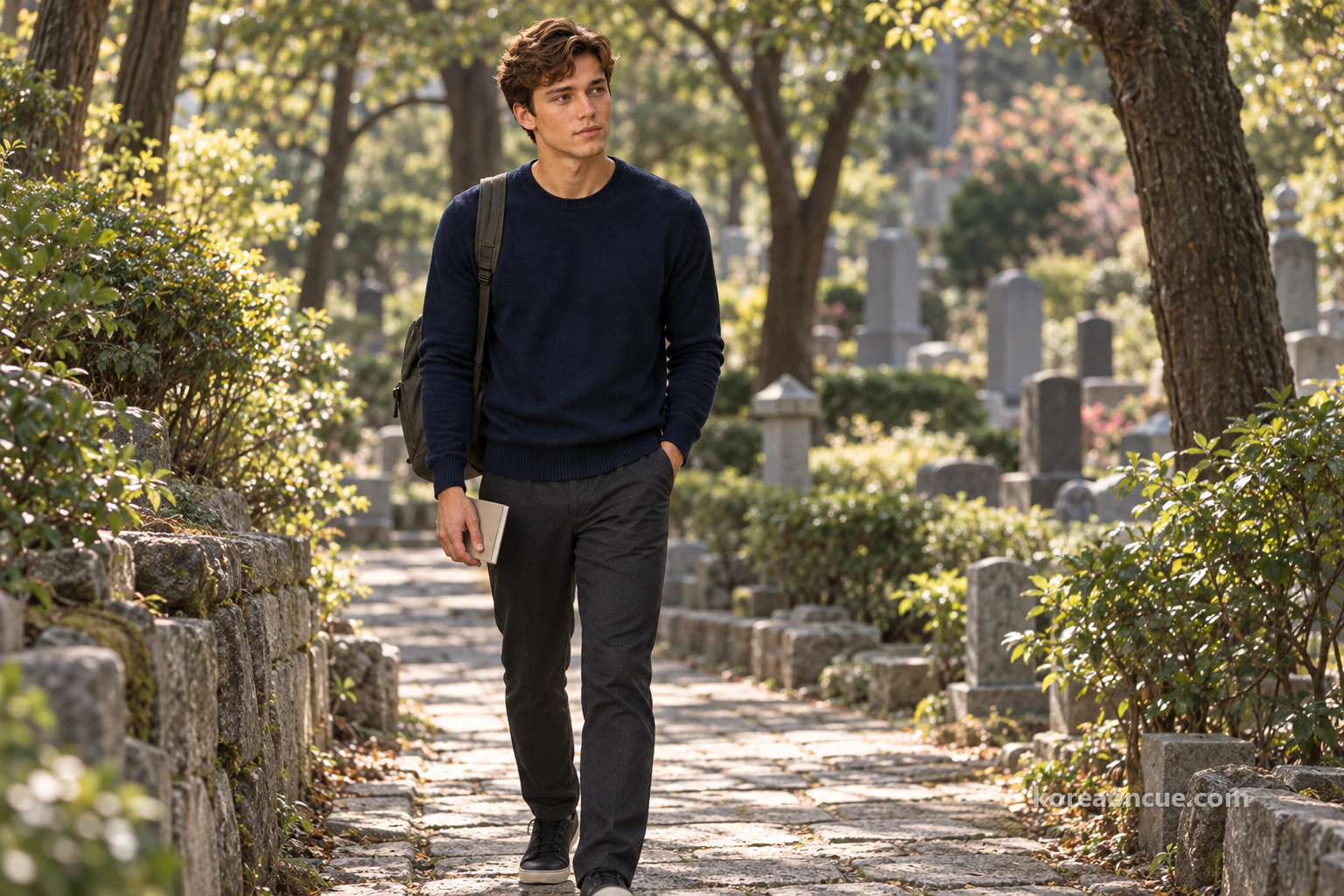
The first foreign burial here was that of the missionary J. W. Heron on 28 July 1890, marking the beginning of the cemetery. In August that year, the site was laid out as a burial ground for foreigners. Today it covers 13,224 m² and holds the graves of 417 people from 15 countries. Of these, 145 are missionaries and their family members from six countries: South Africa, the United States, Sweden, Britain, Canada and Australia. No new burials have been accepted since 1 July 2005.
Noah stops at the name Canada. For the first time, it feels real that people from his own country came here more than a century ago and were buried on this ground. He does not go searching for particular people’s graves. Instead, he walks slowly in single file along the visiting path and spends a while watching the morning light between the gravestones. In the months he has spent drawing his way around Seoul, he has never thought quite so much about where he comes from.
The cemetery is quiet even in the morning. A few visitors walk the paths alone, like Noah, or in pairs. Nobody speaks loudly, and even the sound of footsteps seems to fade among the trees. He remembers laughing with Hina at Mangwon Hangang Park yesterday as they read the instruction against shouting or talking loudly. The reasons for keeping quiet there and here are different, but both ask people to consider others.
The cemetery has its own rules. Walk quietly in single file along the visiting paths, and take care of the gravestones, burial mounds and monuments. Photographs must be taken only from the paths between the burial areas, and eating, drinking, littering and loudspeakers are strictly prohibited within the burial grounds. If visiting with children, explain respectful behaviour before entering. From one of the paths, Noah draws just a few lines for the trees and the route, leaving the gravestones undrawn.
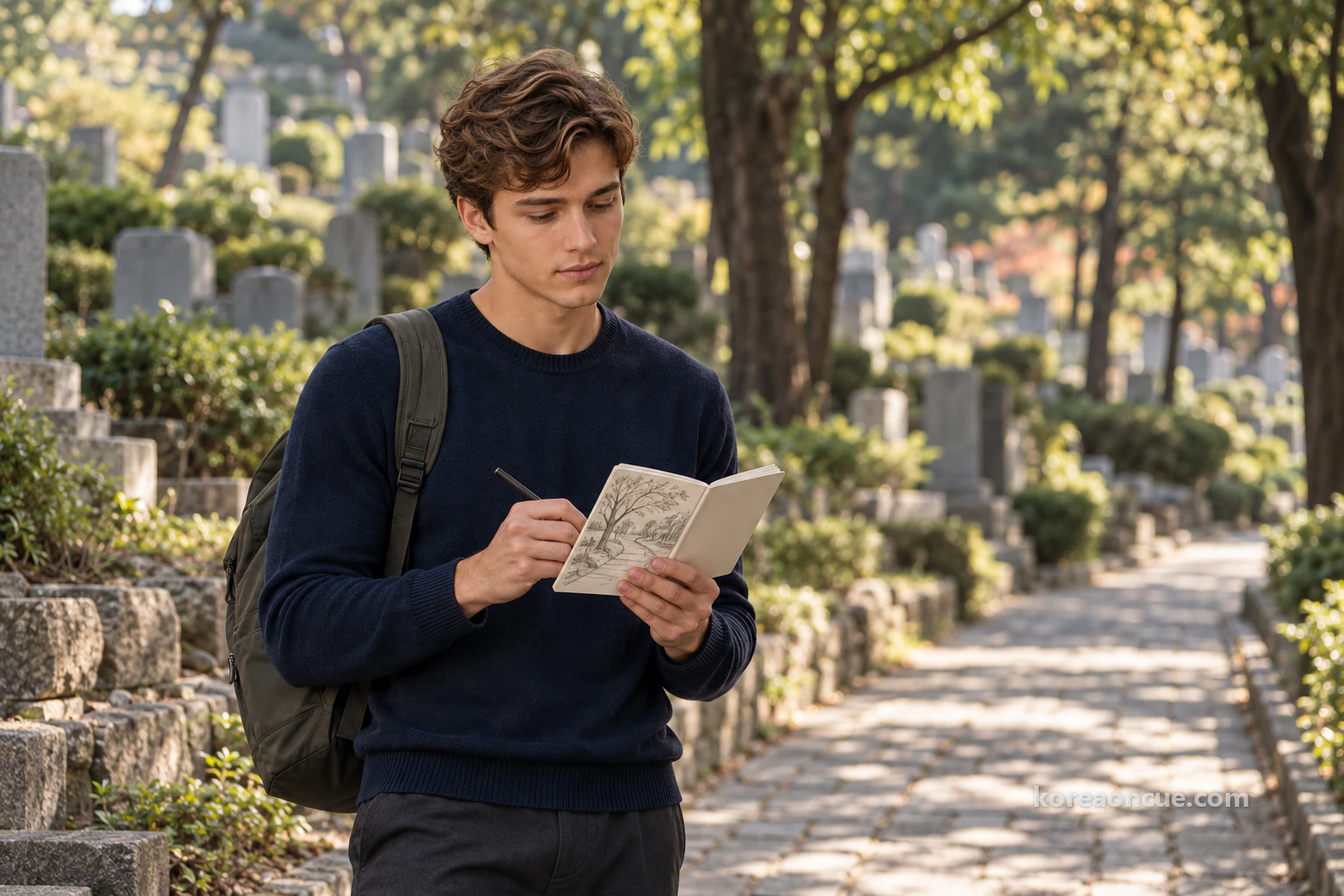
As he leaves, Noah turns back through the pages from his two days of walking. There is the first line outside Hapjeong Station Exit 7, the four names, the church and museum outlines, a line for the steps, the passage where he turned back, and this morning’s trees. The pages have far fewer lines than usual. Even so, he thinks he will remember them longer than almost anything else he has drawn in Seoul. What he chose not to draw seems to fill the empty spaces.
On the way back to Hapjeong Station, Noah passes Yanghwajeong Pavilion again, at the spot where he turned away yesterday. The same pavilion looks different a day later. Yesterday, it marked the entrance to somewhere he had yet to visit, and today it marks the way out of somewhere he has been. Passing it, he draws another small arrow beside the first line in his notebook. It marks a two-day route that began and ended at the same station exit.
Noah sends Hina one last photograph, this time of the trees he drew from the cemetery path. “There were Canadians here too,” he writes. “Somewhere so quiet, I found myself thinking about where I come from.” Hina replies on her morning commute in Tokyo: “Next month it’s my turn to draw the way to the concert venue — then let’s walk somewhere quiet together too.” On the back page of his notebook, beside the date of Hina’s concert, Noah adds a small tree.
Common Mistakes
Trying to visit the cemetery as part of a Sunday trip
Yanghwajin Foreign Missionary Cemetery admits only bereaved families on Sundays. Saturdays are for guided-visit bookings only, from 10:00 to 15:00.
Planning both sites for Monday
the cemetery opens, but Jeoldusan’s museum is closed. Tuesday to Friday is the most straightforward choice for seeing both in one day.
Going straight to the relic chamber during Mass
entry is not permitted during Mass. Mass times are Tue–Sun 10:00 and 15:00, with only the 10:00 Mass on Mondays.
Taking photographs inside the church or museum
photography inside Jeoldusan’s church and museum requires prior agreement. At the cemetery, take photographs only from the paths between the burial areas.
Recording the guided pilgrimage
neither video filming nor audio recording is permitted on the weekend guided pilgrimage.
Assuming any casual outfit will do
avoid very short skirts or shorts and tight-fitting clothes. Keep conversations and laughter quiet too.
FAQ
How do I get to Jeoldusan Martyrs’ Shrine?
From Hapjeong Station (Lines 2 and 6) Exit 7, it is about 450 m or ten minutes on foot. The address is 6 Tojeong-ro, Mapo-gu.
What time does Jeoldusan open?
The shrine grounds can be visited at any time, but the church and relic chamber open 07:00–17:00, and the museum opens Tue–Sun 09:30–17:00. The museum closes on Mondays, 1 January and during the Seollal and Chuseok holiday periods.
Is there a museum admission charge?
There is a voluntary offering rather than a fixed fee.
Can I join a guided visit?
A 50-minute guided pilgrimage starts outside the education building on Saturdays and Sundays at 11:00, 11:30, 13:00 and 14:00. No booking is needed.
When does Yanghwajin Foreign Missionary Cemetery open?
Mon–Sat 10:00–17:00, with Saturdays restricted to guided-visit bookings from 10:00 to 15:00. Sundays are for bereaved families only. Book guided visits by 18:00 the day before.
How do I get to the cemetery?
Follow the passage beside Yanghwajeong Pavilion, directly ahead of Hapjeong Station Exit 7, for about 200 m to the entrance. The address is 46 Yanghwajin-gil, Mapo-gu.
Can I visit Jeoldusan in a wheelchair?
Two wheelchairs are available at the education building entrance, and staff can operate the lift into the church.
Recap — 30 seconds before you go
- Both sites start from Hapjeong Station Exit 7. Jeoldusan is about 450 m / ten minutes away, and the cemetery is about 200 m along the passage beside Yanghwajeong Pavilion.
- Jeoldusan: church and relic chamber 07:00–17:00, with no chamber entry during Mass. Museum Tue–Sun 09:30–17:00, admission by voluntary offering.
- Weekend guided pilgrimage: 11:00, 11:30, 13:00 and 14:00, outside the education building. No audio recording or video filming.
- Cemetery: Mon–Sat 10:00–17:00, with Saturdays restricted to booked visitors from 10:00 to 15:00. Sundays are for bereaved families only.
- Keep quiet and dress respectfully. Photography inside the church and museum requires prior agreement, and cemetery photographs must be taken from the paths between the burial areas.
Sources
- Jeoldusan Martyrs’ Shrine — Yanghwanaru and JamdubongMeanings of Yanghwajin and Jamdubong · reception of Ming envoys and Yanghwa Dapseol · military post established in 1754 · executions in 1866 and the name Jeoldusan · around 200 estimated martyrs, with 29 identified by name · construction of the church and museum · historic-site designation in 1997checked 2026-10-22
- Jeoldusan Martyrs’ Shrine — ChurchChurch on the right, museum on the left and bell tower between them · design by Lee Hee-tae · round colonnade pillars, eaves and gat-shaped canopy · artworks on the church and bell tower walls and at the museum entrance · suspended crucifix, Stations of the Cross depicted through hands and circular stained glass · outdoor sculptures and the old bell tower crosschecked 2026-10-22
- Jeoldusan Martyrs’ Shrine — Mass and visiting hoursDistinction between access to the shrine grounds and individual buildings · church and relic chamber 07:00–17:00, with no chamber access during Mass · Mass at 10:00 on Mondays and 10:00 and 15:00 Tuesday–Sunday · museum Tuesday–Sunday 09:30–17:00 and closure dayschecked 2026-10-22
- Jeoldusan Martyrs’ Shrine — Guided pilgrimageSaturday and Sunday departures from the education building without reservations · starts at 11:00, 11:30, 13:00 and 14:00 · duration 50 minutes · no video filming or audio recordingchecked 2026-10-22
- Yanghwajin Foreign Missionary Cemetery — Visitor informationMonday–Saturday 10:00–17:00 · Saturday admission only for visitors with guided-visit reservations, 10:00–15:00 · independent visits during opening hours · guided visits and Yanghwajin Hall visits require reservations by 18:00 the previous day, with no same-day reservationschecked 2026-10-22
- Yanghwajin Foreign Missionary Cemetery — Visiting rulesQuiet conduct and single-file walking along the visiting paths · protection of gravestones, burial mounds and monuments · photography only from paths between graves · no eating, drinking, littering or loudspeakers · teaching cemetery etiquette to accompanying childrenchecked 2026-10-22
A Seoul story told with our AI characters. Place details are checked against public sources; the photos are AI-made illustrative images. How we use AI
More from this area
Mali’s sixth work trip to Seoul: the background colour for a year-end shoot, found at Haneul Park at sunset
The homework: find a background colour that holds sunset light and dry-grass colour together, for a year-end shoot.

Mali’s second work trip to Seoul: her first walk with Rina through Gyeongui Line Forest Park in Yeonnam-dong
Back in Seoul after a month, Mali messages Rina: “I’d like to see some autumn colours.” Rina chooses an old railway route that starts at a single pine tree outside Hongik University Station Exit 3.