
SEOUL · NAMSAN
Elena’s Thursday night at 가배옥 (Gabaeok): a coffee table spread and a hanok evening at the Ogin-dong House, Namsangol Hanok Village
Thursdays 12, 19 and 26 November at 7 pm, 25,000 won per person, 10 adults per session, ages 18 and over · book on K-GUIDE, no refund after 23:59 the day before · 3 minutes on foot from Chungmuro Station Exit 4
Elena, who writes her scene directions in square brackets, has picked a single hanok and a coffee table spread as her stage this time. At the Ogin-dong House, a coffee table is laid for ten people per session every Thursday night, and she sees the house by day first, then comes back to it at night.

How to get there
At 3:40 pm on Thursday 5 November, Elena was standing in front of the Ogin-dong House at Namsangol Hanok Village. At 2 pm she had got a ticket for next week’s palace night event at a café, and had come straight on to Chungmuro. Elena, 27 and from Spain, likes to hold the scenes of Korean dramas up against the real Seoul. She reads places as if they were stages, dividing them up, and writes her camera directions inside square brackets. The first line on today’s new page was “[Thursday night — one house, one hour]”.

Tonight Elena is here for 가배옥 (Gabaeok), which is held in this house. It is a special night programme that Namsangol Hanok Village runs every Thursday evening in October and November. The line under its name calls it “a specialty coffee table spread that brings together hanok and coffee culture”. Each session takes 10 adults, starts at 7 pm, and serves four drinks and two traditional sweets. Elena had seen hanok night scenes on screen many times, but she had never spent an evening in a house like that herself.
There was a reason she had come before sunset. On a Thursday when 가배옥 runs, the Ogin-dong House is closed to general visitors from 16:00 to 21:00. At night she would be coming to this house as a guest of the programme, so if she wanted to see it by day, she had to do it before four. She had 20 minutes left. Elena wrote “[Day — once before 16:00, see the set first]” in her notebook and moved towards the gatehouse.
Today Elena is walking through Namsangol Hanok Village, at 28 Toegye-ro 34-gil, Jung-gu, Seoul. It is close to Chungmuro Station on Lines 3 and 4, and entry to the village is free. This piece starts with 가배옥’s dates and times and its booking and cancellation rules. Then it looks at the Ogin-dong House before sunset and at what else the village offers until the evening. Last, it follows Elena’s Thursday in order, through the 7 pm coffee table and the 30 minutes of free time.
The Cue — At a glance
가배옥 is a special night programme that Namsangol Hanok Village holds at the Ogin-dong House every Thursday from 1 October to 26 November 2026. In November it continues on Thursdays the 12th, 19th and 26th. It runs from 7 pm to 8:30 pm, made up of one hour of tasting and 30 minutes of free time, and the time field on the booking screen shows 19:00–20:00 (60 minutes). It costs 25,000 won per person, each session takes 10 adults, and it is for ages 18 and over. Four drinks (including non-coffee ones) and two traditional sweets are served, and the November cups carry the names of the solar terms Sanggang, Ipdong, Soseol and Daeseol. Booking is on K-GUIDE, through the “예매하기” (Book) button in the event post on the village website, and after 23:59 on the day before, you can neither cancel nor get a refund. On 가배옥 days, general visits to the Ogin-dong House are restricted from 16:00, so see the house by day before then.
- Station and exit: Chungmuro Station (Lines 3 and 4) Exit 4, then 3 minutes on foot following the signs. 가배옥 is held at the Ogin-dong House inside the village (28 Toegye-ro 34-gil, Jung-gu, Seoul).
- Dates and times: Every Thursday from 1 October to 26 November 2026. In November, the 12th, 19th and 26th. 19:00–20:30 (one hour of tasting + 30 minutes of free time). The booking screen shows 19:00–20:00 (60 minutes).
- Price and group size: 25,000 won per person, 10 adults per session, ages 18 and over.
- Booking and cancelling: The “예매하기” (Book) button in the 가배옥 event post on the village website → K-GUIDE (as a non-member, verified by mobile phone number or email). Cancel two days before for a 30% refund, one day before for a 50% refund. No cancellation or refund after 23:59 on the day before. Show the mobile ticket QR code before entry.
- Daytime visits: On 가배옥 days (Thursdays), visits to the Ogin-dong House are restricted from 16:00 to 21:00. Entry to the village is free, it is closed every Monday, and the traditional garden is open 24 hours.
- Worth seeing: ① the Ogin-dong House, built new as a copy of a 1910s house, with the lie of the ground brought back too ② the four November drinks named after solar terms, and the traditional sweets ③ “Accumulated Hands, 木手” in the same village (3–22 November, Yi Seung-eop House).
When does it run? — Thursdays 12, 19 and 26 November, starting at 7 pm
가배옥 runs every Thursday from 1 October to 26 November 2026. Counting on the November calendar, it continues on the 12th, 19th and 26th. Thursday 26 November is the last night. Every session starts at 7 pm. Elena picked the Thursday before those, 5 November, and since she already had a ticket for a palace night event the following Thursday, this date fitted perfectly.
Open in Kakao Map — Chungmuro Station
The time is set out like this. The programme starts at 7 pm and runs until 8:30 pm, made up of one hour of tasting and 30 minutes of free time. On the booking screen, the time field shows “Time of use 19:00–20:00” and “Duration 60 minutes”. Elena copied down both lines and decided not to put anything else in her plans before 8:30. If you are thinking of going on to an evening arrangement afterwards, keeping the time until 8:30 clear, as Elena did, takes the pressure off.

It costs 25,000 won per person. Each session takes 10 adults. It is for ages 18 and over, and as it is a programme for adults, you cannot sign up together with family members under 18. Ten people make a small gathering. Seeing that number, Elena wrote “[Capacity 10 — no extras]” in her notebook and drew a line under it once.
It helps to know what you will be served. The set is four curated drinks, including non-coffee ones, with two traditional sweets on the side. In other words, not all four cups are coffee. The drinks and desserts are different in October and November. If you have read a review from someone who went in October, bear in mind that the November table is set differently.
There is one note about the venue, too. The venue is the Ogin-dong House, but the programme is held outdoors, and the venue may change depending on the weather on the day. It is a late-autumn evening, so bringing an extra layer is a good idea. Elena, too, had a coat on over her knitwear and a scarf in her bag. For enquiries, contact the traditional houses operations office (02-6358-5533).
How do I book and cancel? — from “예매하기” on the village website to K-GUIDE, and no refund after 23:59 the day before
Booking starts from the 가배옥 event post on the Namsangol Hanok Village website. Press the “예매하기” (Book) button in the post and you move to the Namsangol Hanok Village booking page on K-GUIDE. You book as a non-member, without signing up, and verify with a mobile phone number or email address. Choose the date, press “신청하기” (Apply) and type in the anti-bot characters, and the application is done. Elena had followed these steps in this order and got her ticket for 5 November in advance.

Read the cancellation rules before you book. Cancel two days before the date and you get 30% back, cancel one day before and you get 50%. After 23:59 on the day before, you can neither cancel nor get a refund. For a Thursday session, two days before is Tuesday and one day before is Wednesday. So 11:59 pm on Wednesday is the last moment you can change your mind.
Cancelling is done by the person who booked. For online bookings, the booker cancels directly under “My bookings and cancellation (requests)” (나의 예약 및 취소(요청) 내역). After reading the rules, Elena wrote “[Wednesday 23:59 — cut here]” in her notebook. Then she set a reminder on her phone for the same time. Since the refund rate changes with the day, it is worth looking over the rest of that week’s plans once more when you choose your date.
Taking the last night as an example makes the sums easy. For the session on Thursday 26 November, cancelling two days before, on Tuesday the 24th, gets you 30% back. Cancel one day before, on Wednesday the 25th, and it is 50%. Once 23:59 on Wednesday the 25th has passed, you can neither cancel nor get a refund. For Elena, who had chosen the 5 November session, that line fell on the night of Wednesday 4 November, and she let that night go by quietly with nothing more than a cut mark in her notebook.
You need a QR code to go in. If you booked online, check the QR code on your booking ticket before entry. The mobile ticket comes up when you log in to the booking page and open “Mobile ticket” under “My bookings” (나의 예약내역). The notice also asks you to come into the house on time for the session you booked, without being late. So that she could bring up the screen straight away in the evening, Elena logged in once during the day.
Which exit? — Chungmuro Station Exit 4, then 3 minutes on foot following the signs
Namsangol Hanok Village is a 3-minute walk from Chungmuro Station (Lines 3 and 4) Exit 4, following the signs. The exits on the village side are 3 and 4, and the signposted route starts from Exit 4. Elena came out of Exit 4 and walked with her eyes only on the signs. The way was so short that the main gate came into view before she had time to take out her notebook. Walk it once by day and you can easily retrace the same way after dark.

You can also come by bus. Get off at the Toegye-ro 3-ga, Hanok Village stop. Buses 7011, 104, 105, 140 (towards Gangnam), 421, 463, 507 and 604 stop here, along with Namsan loop buses 02 and 05 and the 90s tour. By airport bus, you can take 6001, 6015 or 6021. If you bring a car, there is a Seoul public car park in front of the main gate, but it only has room for 14 small cars and 3 medium-sized buses.
The toilets are at the main entrance. An accessible toilet and a nursing room are in the same place. 가배옥 runs until 8:30 pm, so it is handy to stop at the toilets by the main gate before seven. During the day, Elena had already walked once from the main gate to the Ogin-dong House. Thanks to that, at night she could follow the same way without opening the map again.
On 가배옥 days the Ogin-dong House is restricted from 16:00 — before then, see the reconstructed 1910s house
To see the Ogin-dong House by day on a 가배옥 Thursday, you need to get there before 4 pm. From 1 October to 26 November, visits to the house are restricted every Thursday from 16:00 to 21:00. Outside those hours, you can visit as usual. So if you want to see both the house by day and the table at night, drop in once before four, as Elena did. Travellers coming on a day other than Thursday do not need to think about this restriction.
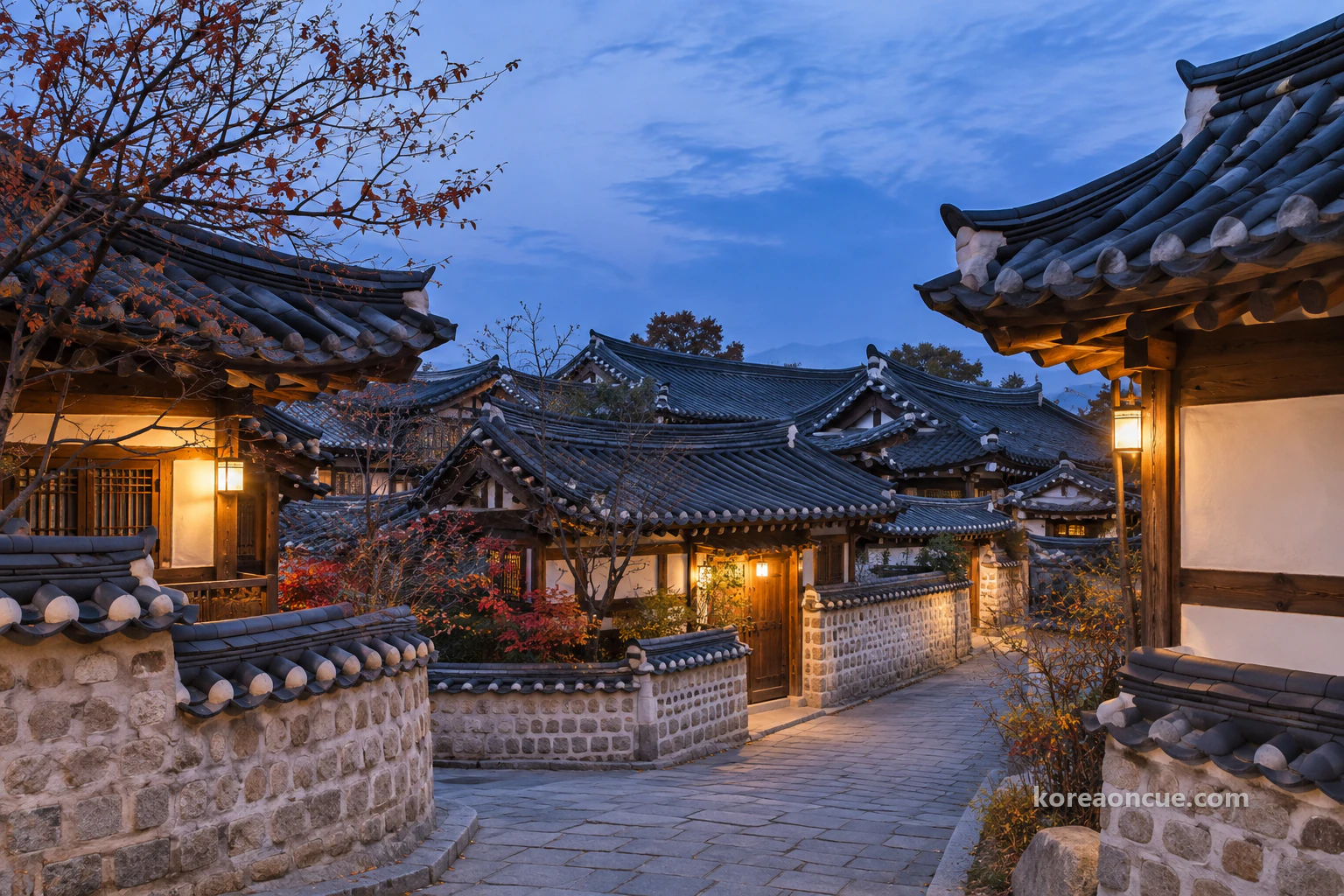
The Ogin-dong House is a new house built as a faithful copy of the house that stood at 47-133 Ogin-dong, Jongno-gu. The original house is known to have been built around the 1910s. When Namsangol Hanok Village was created in 1998, there was an attempt to move this house here, but its timbers were too old and damaged, so it was built new. Timbers here refer to the posts, beams and other wooden members that make up a house. Instead, it was built after detailed research, and even part of the original site’s differences in ground level were brought back to recreate the original atmosphere.
This was where Elena stopped walking. The film sets she knew copied the outside of a house. This house, though, had been built to follow both its outward look and the rise and fall of the original ground. Elena crossed out the line she had written earlier that afternoon and wrote it again. “[Not a set — a new house built on the lie of the old ground]”.

The house also holds a human story. At the time, the wide land around 47 Ogin-dong belonged to Yun Deok-yeong (1873–1940), uncle of Empress Sunjeonghyo (1894–1966), the empress of Emperor Sunjong. Yun built some 20 houses in the area and lived there together with his relatives. Of them, only the house at 47-133, where Yun Deok-yeong’s concubine lived, survives. A concubine here means a wife kept at his side who was not his formal wife.
Knowing how the house is shaped helps you see more of it. A very large ㅁ-shaped inner wing, or anchae, is joined by a maru room that serves as the outer wing, or sarangchae, and by a gatehouse, so that the whole layout forms a ㅁ shape. The house was built in the plain mindori-jip style, but at the front of the anchae, the column heads are decorated with ikgong, which is rare in ordinary homes. Ikgong are wooden members set into the top of a column and projecting outwards. That is the spot where the look of a top-class house of the time shows.
If you only have 20 minutes, narrow it down to three things. The first is the ㅁ layout of the whole house, and the second is the ikgong on the column heads at the front of the anchae. The third is the ground, where part of the original site’s level differences has been brought back. Elena rewrote these three as three lines of camera directions: “[Wide — ㅁ shape]”, “[Close-up — ikgong]” and “[Ground — levels]”. Then, for each line, she stood on the spot, lifting and lowering her head, and took in one shot at a time.
When Elena checked the time again in front of the gatehouse, it was 3:57. She wrote “[Day shots done — same gate at night]” in her notebook and took a step back. From four the house would be restricted for the night programme, so she decided not to linger over the remaining three minutes. Instead, she looked up once more at the ikgong on the column heads and walked slowly further into the village.
Around the village until 7 pm — “Accumulated Hands, 木手” at the Yi Seung-eop House, an outdoor escape game, Seoul Namsan Gugakdang
The three hours left until seven can be spent inside the same village. From Tuesday 3 to Sunday 22 November, the art project exhibition “Accumulated Hands, 木手” (《축적된 손, 木手》) is on at the Yi Seung-eop House in Namsangol Hanok Village. The Yi Seung-eop House is the village’s House of Master Carpenter Yi Seung-eop from Samgak-dong. It is open 09:00–21:00 and closed every Monday. The participating artists are Studio East×East (Jo Dong-ho and Choi Dong-eun).
The exhibition’s introduction opens with a question: “How does the touch of the carpenters who built hanok carry on today?” Elena copied the question straight into her notebook. The Ogin-dong House she had just seen was a new house built as a copy of an old one, so the idea of a carpenter’s hands did not feel distant to her. To Elena, the order itself — stepping out of a new house modelled on an old one and walking straight into an exhibition about carpenters’ hands — was well-planned blocking. On the way to the exhibition she turned a page in her notebook and wrote “[Next scene — hands]” at the top of the new page.
The same village is also holding an outdoor escape game, “The Dokkaebi’s Si時gnal” (〈도깨비의 시時그널〉). It runs from Tuesday 29 September to Sunday 29 November, Tuesday to Sunday 9:00–21:00, around Namsangol Hanok Village. It is free to play, and all ages can take part. Children of middle-school age and under are advised to come with a guardian. The story starts from a single line: “Seoul’s memories are disappearing one by one.”
Elena was drawn to that line, but she decided not to play the escape game today. She felt that rushing round the village before seven would break up tonight’s scene. In the margin of her notebook she wrote “[Escape game — another day, in daylight, with time to spare]”. If you want to fit the escape game in around 가배옥, remember that it runs until 21:00. From 7 pm to 8:30 pm on Thursday you will be at 가배옥, so the escape game fits better in the time before.
If you have booked 가배옥 in the third week of November, you can see the Art Nomad Art Fair as well. It runs from Tuesday 17 to Sunday 22 November at the Min Family House, Yun Taek-yeong’s Jaesil, the Traditional Crafts Hall and the village yard. It is an event that exhibits and sells the work of 48 disabled artists from Korea and abroad. It is open 10:00–18:00, so as a 가배옥 guest on Thursday 19 November, you can look round before 6 pm. Elena wrote this date small in the bottom box of her notebook too.
There is also a performance venue in the village. Seoul Namsan Gugakdang is a venue dedicated to gugak, Korean traditional music, built in 2007 to bring traditional performing arts to a wider audience. It is based on a single-storey hanok building above ground, with the auditorium placed underground. The stepped sunken garden Chimsangwon, linked to the auditorium lobby on B1, brings out the feel of Gyotaejeon Hall at Gyeongbokgung. Hearing of a hanok with its stage lowered underground, Elena wrote “[Stage below ground, hanok roof above]”.
7 pm, back to the Ogin-dong House — show the mobile ticket QR code and go through the gate you passed by day
At 6:50 pm, Elena came back to the Ogin-dong House along the way she had walked by day. The mobile ticket screen was already open on her phone. You check the QR code on your booking ticket before going in, so having the screen up in advance keeps your hands free. Elena remembered the line she had written by day, “[Same gate at night]”, and gave a small nod. She really was standing in front of the same gate again.

The hanok nights Elena had seen in dramas were mostly two-person scenes. The kind of shot where two people sit facing each other and talk in low voices. Tonight’s scene was one of spending the same time at a single table with other guests she had never met. Elena wrote “[Not a two-hander — an ensemble scene, few lines]” in her notebook. Then she put the notebook in her bag and slowly breathed in the night air of a real hanok, not one on a screen.
The booking notice asks you to come into the house on time for the session you booked, without being late. That was why Elena was already at the gatehouse 10 minutes before seven. It is 3 minutes from Chungmuro Station to the main gate of the village, but there is also the walk inside the village from the main gate to the Ogin-dong House. If it is your first time, arrive with a few minutes to spare. The venue may change with the weather, so arriving early means you will not miss any instructions.
How is the coffee table served? — four drinks (including non-coffee) and two traditional sweets, with solar-term names on the November cups
At the heart of 가배옥 is the table spread. It is described as a specialty coffee table spread that brings together hanok and coffee culture, with an invitation to try curating that only 가배옥 offers. On the table go four curated drinks and two traditional sweets on the side. Among the four are drinks that are not coffee. While the table was being laid, Elena put her hands together and kept her notebook closed for a while.
The four November cups have names. They are Sanggang (frost’s descent), Ipdong (start of winter), Soseol (minor snow) and Daeseol (major snow). All four are names of solar terms. Each cup has a different shape, so even on one table, each one catches the eye on its own. Elena slowly ran her eyes over the four cups on the table, from the far left to the far right.
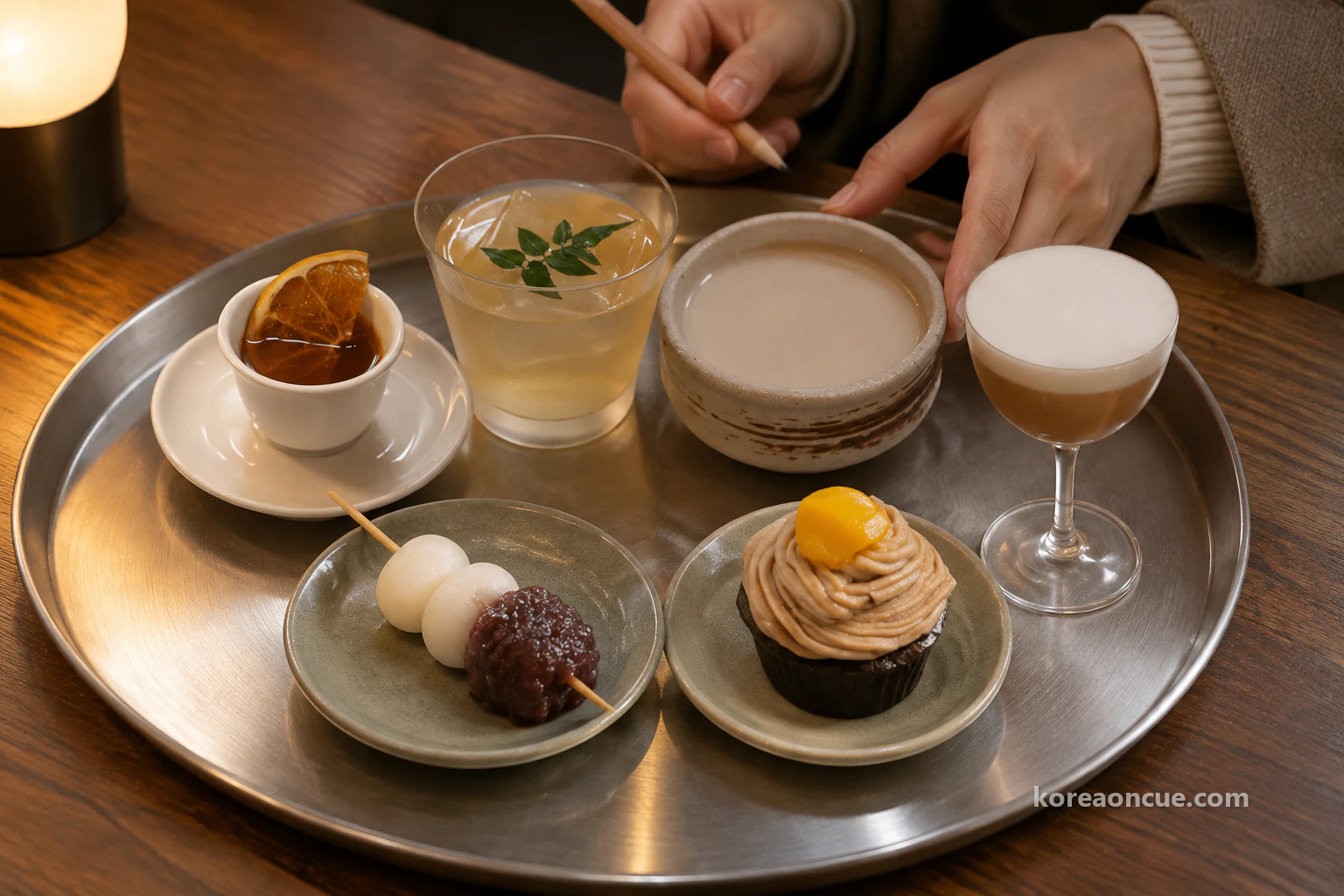
To Elena, these names sounded like the episode titles of a drama. One cup an episode, so four cups made a season split into four episodes. Elena opened her closed notebook again and wrote four lines. “[Ep. 1 Sanggang]”, “[Ep. 2 Ipdong]”, “[Ep. 3 Soseol]”, “[Ep. 4 Daeseol]”. The numbers were not the order of drinking but Elena’s own, given in the order the solar terms come round in the calendar.
Each time she picked up a cup, Elena touched its number in her notebook once with a finger. Every time she moved on to the next cup, it felt as if the screen were cutting to the next episode. Instead of writing down tasting notes, she took in the hands moving over the table and her own fingertips around the cup. In a drama, background music would have come in at this point, but tonight low voices and the small sound of cups meeting the table filled that space. Elena decided not to put this scene in brackets.
On the side come two traditional sweets. The November desserts are put together differently from October’s. On the hanok tea tables Elena remembered from dramas, there was always a teacup. Tonight’s table was a scene with four cups, coffee among them, in that place. Elena wrote this difference down as “[Coffee where the teacup was — reality one step ahead of the script]” and closed her notebook again.
The tasting lasts one hour. With only ten people per session, it is a small table, and there is no need to rush. Elena wrote almost nothing in her notebook during that hour. Brackets are for cutting a scene into pieces, and just this once she did not want to cut it. This is a good hour to spend with your notebook and phone put down for a while.

How to use the 30 minutes of free time — the time Elena spent writing next Thursday’s daytime into her notebook
After the hour of tasting come 30 minutes of free time. Once it was past eight, Elena decided to spend those 30 minutes on her notebook. She had not yet decided how to spend the daytime of next Thursday, 12 November, the day she had bought a ticket for at 2 pm. She had made up her mind to plan it slowly tonight. And now there were 30 minutes in front of her, just right for picking up a pen.
Elena opened a new page and wrote today and next week side by side. On the left was “[Thursday one — one house, one table, a small gathering]”, and on the right, “[Thursday two — two palaces, night]”. If today was a small scene inside one house, next week would be a long scene walking through two palaces. Elena wrote only the first line at the top of the right-hand column and left the rest blank, waiting for next week. As she put down her pencil, her face kept the cheerful look of someone who has not worked everything out yet.

It helps to think beforehand about how you will use the 30 minutes of free time. You can sort out your next plans, as Elena did, or think back slowly over the table you were served. A walk in the garden can wait until after the programme. The traditional garden is open 24 hours, so you can still walk there after 8:30. Elena, too, saved the garden for the last scene.
8:30 pm, through the garden to Chungmuro Station — the traditional garden you can walk even at night
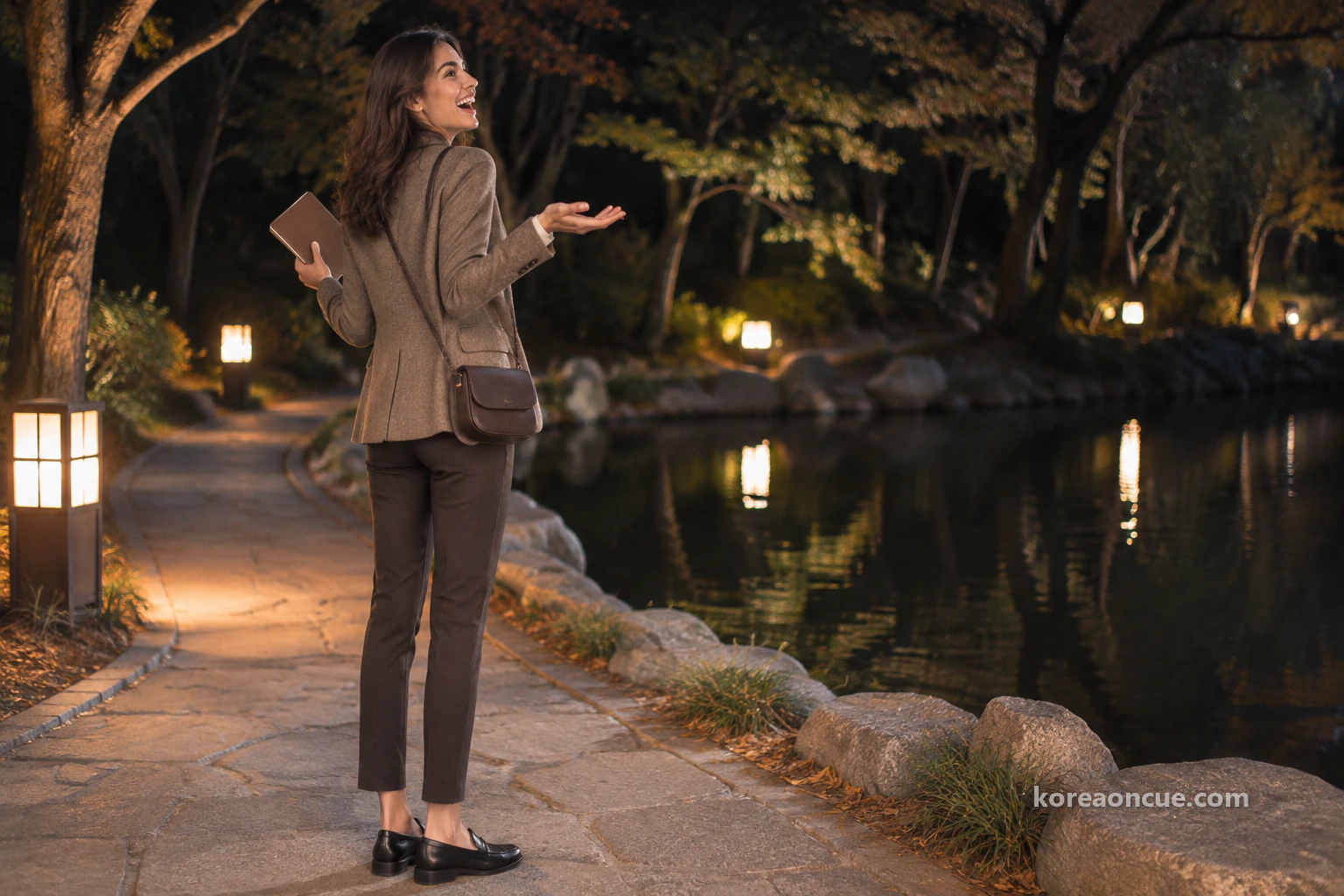
가배옥 ended at 8:30 pm. Instead of heading straight for the station, Elena went round towards the traditional garden. The traditional garden is open 24 hours, so you can walk there late. There is no separate charge to enter the village either. Elena wrapped her scarf round once more and stepped slowly onto the garden path she had passed by during the day.
Among the garden’s pavilions, Pigeumjeong is a square thatched pavilion whose name means opening your heart and talking with a friend. The “heart” in that name means the thoughts you keep deep in your chest. Remembering that meaning, Elena shrugged and smiled. Tonight, the one she had opened her heart to was a single notebook. Elena stopped and wrote “[Friend — tonight, the notebook]”.
The way back is the same as the way in. Leave by the main gate and follow the signs for 3 minutes to Chungmuro Station Exit 4. If you want to come back another day in daylight, just remember that the traditional houses are closed on Mondays. Walking to the station, Elena drew a small circle beside the first line in her notebook, “[Thursday night — one house, one hour]”. And under it she added one more line: “[Next Thursday — same day, different stage]”.
Common Mistakes
Thinking 가배옥 is a free experience
entry to the village is free, but 가배옥 costs 25,000 won per person.
Arriving late on a Thursday afternoon to see the Ogin-dong House
on 가배옥 days (Thursdays), general visits to the house are restricted from 16:00 to 21:00. See the house by day before 4 pm.
Thinking you still get half back after midnight on Wednesday
for a Thursday session, cancelling on Wednesday (one day before) gets you a 50% refund, but after 23:59 on Wednesday you can neither cancel nor get a refund.
Signing up with family members under 18
it is a programme for adults, open to ages 18 and over.
Making your next plan for 8 pm sharp
the booking screen shows 19:00–20:00 (60 minutes), but the programme adds 30 minutes of free time to the hour of tasting and runs until 20:30.
Looking for the QR screen at the entrance
before you go in, have the mobile ticket under “My bookings” ready on your screen.
FAQ
Which station and exit should I use?
Chungmuro Station (Lines 3 and 4) Exit 4, then 3 minutes on foot following the signs. 가배옥 is held at the Ogin-dong House inside the village.
When does it run in November?
Thursdays 12, 19 and 26 November, at 7 pm. 26 November is the last night.
What time does it finish?
It is a 19:00–20:30 programme made up of one hour of tasting and 30 minutes of free time. The booking screen shows time of use 19:00–20:00 and duration 60 minutes.
How much is it, and how many people?
25,000 won per person, and each session takes 10 adults. It is open to ages 18 and over only.
What is served?
Four curated drinks, including non-coffee ones, with two traditional sweets on the side. The set differs between October and November, and the November cups are named Sanggang, Ipdong, Soseol and Daeseol.
Where do I book?
Use the “예매하기” (Book) button in the 가배옥 event post on the Namsangol Hanok Village website to reach the K-GUIDE booking page. You book as a non-member and verify by mobile phone number or email.
How much do I get back if I cancel?
30% two days before the date and 50% one day before. After 23:59 on the day before, there is no cancellation or refund. The booker cancels directly under “My bookings and cancellation (requests)”.
What if it rains?
The programme is held outdoors, and the venue may change depending on the weather on the day. Enquiries: 02-6358-5533.
Recap — 30 seconds before you go
- Chungmuro Station (Lines 3 and 4) Exit 4 → follow the signs for 3 minutes → Namsangol Hanok Village, 가배옥 at the Ogin-dong House
- November Thursdays 12, 19 and 26, starting 19:00, one hour of tasting + 30 minutes of free time (until 20:30), booking screen shows 19:00–20:00 (60 minutes)
- 25,000 won per person · 10 adults per session · ages 18 and over · four drinks (including non-coffee) + two traditional sweets
- Book via “예매하기” on the village website → K-GUIDE, 30% refund two days before · 50% one day before, no cancellation after 23:59 on the day before
- Mobile ticket QR before entry, and an extra layer, as the venue may change with the weather
- On 가배옥 days the Ogin-dong House is restricted from 16:00 — see the house by day before 4 pm, the traditional garden is open 24 hours
Sources
- Namsangol Hanok Village website — [Event] 2026 Namsangol Night Special Programme “가배옥 (Gabaeok)”Every Thursday, 1 Oct – 26 Nov 2026, 19:00–20:30 · 25,000 won per person · 10 adults per session · 4 curated drinks including a non-coffee option and 2 traditional sweets · 1 hour of tasting and 30 minutes of free timechecked 2026-11-03
- Namsangol Hanok Village website — Visitor information / DirectionsChungmuro Station (Lines 3 and 4) Exit 4, 3 minutes on foot following the signs · free admission · closed every Monday · traditional garden open 24 hours · 28 Toegye-ro 34-gil, Jung-guchecked 2026-11-03
- K-GUIDE Namsangol Hanok Village booking — [Night Special] 가배옥 <Coffee Table Spread>Hours 19:00–20:00 (60 minutes) · ages 18 and over · 10 people per session · cancel 2 days before for a 30% refund, 1 day before for 50%, no cancellation or refund after 23:59 the day before · enquiries 02-6358-5533checked 2026-11-03
- Namsangol Hanok Village website notice — dates when some houses are closed to visitors because of a programmeOgin-dong House, every Thursday 1 Oct – 26 Nov, 16:00–21:00 · 〈가배옥〉 runs there · normal viewing outside those timeschecked 2026-11-03
- Namsangol Hanok Village website — introduction to the traditional housesOgin-dong House: newly built as a copy of a house said to date from the 1910s · a ᄆ-shaped main building · ikgong bracket decoration on the column tops in front of the main buildingchecked 2026-11-03
- Namsangol Hanok Village website — art project exhibition 《축적된 손, 木手》 (Accumulated Hands, Carpenters)Tue 3 Nov – Sun 22 Nov 2026 · Yi Seung-eop House · 09:00–21:00 · closed every Mondaychecked 2026-11-03
- Namsangol Hanok Village website — 2026 Namsangol outdoor escape game 〈도깨비의 시時그널〉29 Sep – 29 Nov 2026 · Tue–Sun 9:00–21:00 · free to play · all ageschecked 2026-11-03
A Seoul story told with our AI characters. Place details are checked against public sources; the photos are AI-made illustrative images. How we use AI
More from this area

Namsan Cable Car: Myeongdong Station Exit 3 or Exit 4
There are two ways from Myeongdong Station to the Namsan Cable Car: the Exit 3 lanes you walk up, and the Namsan Oreumi from Exit 4, an incline elevator that climbs the slope for you.

Namsangol’s Gugakdang: reading three court dances before the show
Lulu, off to her first court dance performance, has learned the stories of all three dances.